Context Transport based on 802.21 MIH protocol
Marcelo Lebre1, Daniel Corujo 2, Diogo Gomes3, Rui Aguiar4Instituto de Telecomunicações University of Aveiro
Aveiro, Portugal
{marcelolebre1, dcorujo 2, dgomes3, ruilaa4}@av.it.pt Abstract— Sensor networks, along with the
sensorial output from their nodes, provide an information source to enhance and enrich upper layers mechanisms. The 802.21 MIH protocol provides a cross layer framework that can be extended for sensor information transport. At the same time, it creates an abstraction layer that removes hardware and software specificity from sensor nodes. On a higher level of the network stack, the XMPP protocol also provides an upper layer solution for content syndication on a platform with global access availability. We present a framework which integrates a cross-layer abstraction approach towards sensor devices of different families, while enabling the integration of media-independent sensor information into context consumers with the aim of optimizing network management, as well as application operation and usability. The work presented was also part of the first author’s MsC dissertation.
Keywords - IEEE802.21, Media Independent Handovers, Mobility, Mobile Terminal, Sensor Networks, Adaptation, Context-Awareness, Context Management
I. INTRODUCTION
Sensor technology, of both hardware and software kind, is vastly disperse and diverse. This directly impacts the way how information is conveyed. At the same time, network technologies are also varied and thus heterogeneous environments with different access technologies, protocols and mechanisms co-exist. A well-known heterogeneous empowering framework is the 802.21 MIH standard [1] which optimizes Media Independent Handovers (MIH), through the abstraction of link-layer technologies to handover-decision entities. Both these areas of technology introduce Context information into the network and to the users, about network conditions, available services, received signal strength at the terminal, among many
others, which is able to characterize a certain location or network by its patterns, features and abilities. Merging context information, such as sensor readings, with a media independent cross layer protocol allows the user to discover and interpret information, on multiple interface technologies, about its surrounding context. Enabling context information to reach users by any means possible creates a myriad of scenarios able to be deployed in already existent procedures [2], but there is no actual framework which manages the underlying heterogeneity of the collected information in an abstract way.
A framework of such kind is the result of a synergy between three technological areas, heterogeneous networks, sensor networks and context management. The heterogeneous networks are the linking element in this framework enabling the transport of information by a media independent protocol on various communication layers. Sensor networks provide the information and data related to the surrounding environment that, through context management can be stored, merged and used to extrapolate the most varied information. This paper presents a framework where the 802.21 MIH protocol is used to transport context information such as sensor data, enabling an abstract mean of transporting and communication with different types of sensor nodes, as well as empowering entities on upper layers to perform more accurate decisions based on context information. The aim of this framework is twofold: i) to provide a context-enriched environment which enables terminal and usability adaptation to physical and network context and ii) empower 802.21-enabled entities with access to sensorial data. The development of this paper’s framework was implemented with the integration of two projects, in Instituto de Telecomunicações, Aveiro, Portugal, ODTONE [19] and XCoA[20].
This paper is organized as follows. We start by providing a state of the art combining the existent research on the same areas enhancing the innovation of our framework, in Section II. Section III presents
the concept architecture for the presented framework and, in Section IV, we present our implementation based on the proposed architecture. Section V evaluates the proposed solution and in Section VI we conclude on the the benefits brought by our framework.
II. STATE OF THE ART
The context transport based on 802.21 MIH protocol is an innovative concept and considers the integration of the three technological areas. There are some solutions, concerns and issues related to this approach that were previously addressed and should be highlighted:
A. Heterogeneous Networks
Users are becoming continuously mobile, which means that they expect to be able to use their Internet access ubiquously. While on the move, users are most likely to cross different types of networks with different technologies, of which the user doesn´t have to understand or bother with the technology requirements and details. These technologies are impacted by hardware, software and functionality of different nature. For usability matters, a user shouldn’t even realize that it crossed two or three different technologies on the same network let alone manually connect to each one [6]. For this purpose heterogeneous networks have to consider mobility issues and the associated handover procedures. The main purpose for a handover on a heterogeneous network is to seamlessly provide the user with a continuous experience while maintaining a connection through a network link swap [7].
There are already some known solutions for the integration of context-awareness in heterogeneous networks such as [8]. Nonetheless, these architectures involve the construction and development of complex structures, and their maintenance in heterogeneous networks is not sustainable when we need to integrate nodes with low processing power, such as sensor nodes. To support this context monitoring, we introduce sensor networks as a source of context information and a promoter of network and application adaptations such as handovers.
B. Sensor Networks
Sensor networks have the distinctive features of a particular distributed system model. There are intrinsic issues that have to be addressed when designing a sensor network such as: power management, dynamic
network topology, scalability, data access and continuous communication ability [4].
It is important to consider the growth of a sensor network not only in number but by the capabilities provided to users, which can also provide context information at this level [3]. Power management can be a critical aspect due to most sensor nodes use of a battery with limited lifetime. Hence, measures have to be taken to ensure optimal usage of power. Access to data is an important issue because it provides the means to collect the collected sensorial data. A user must be empowered with the ability to access information by any means possible, not depending on the network attachment or the technology involved [3]. Obtaining location information usually involves the mobile user’s ability to perceive different phenomena [4]. A sensor network can reduce this dependency, providing the user with the most varied sensor readings, thus reducing the need for expensive devices with different sensing hardware, which not only impair its battery lifetime, but can never truly adapt to an entire area of phenomena. On the other hand, sensor networks can be populated with different sensor hardware, covering a vast area and provide accurate information for the monitored phenomena, based on coordinated readings from multiple devices [5].
Sensor networks can be composed by different types of sensors (i.e.: seismic, magnetic, radar, etc.), adding to the heterogeneous nature there’s also the heterogeneous hardware and communication technology by which sensor nodes are composed. According to this fact, it is important that a sensor network is able to incorporate different types of sensor nodes as well as different hardware and software capabilities [5].
Independently of the sensor hardware nature, or type of sensor node, it is important that information is correctly retrieved. A solution is presented in [3] where a management platform is suggested to store information and apply functioning rules to ensure privacy, security and robustness. Nevertheless, as we summarized earlier, sensor nodes are small devices with limited capabilities, and for this reason management platforms at sensor networks level imply another complex structure in a low capability network. There are upper layer technologies for context storage that not only provide information for application related usage but also provide merging capabilities for both lower layers and upper layers context information. Being an upper layer solution, this approach to context-aware data exists in more capable network nodes thus removing the need for processing
concerns. These solutions are called context management frameworks.
C. Context Management
Context-aware systems depend greatly on their users and resources. The main goal of context management is to optimize the usage of applications and network with information provided by context sources (i.e. sensor networks, social information, user’s data, etc.). The success of context management is greatly influenced by three essential components: context gathering, data correlation and information distribution [10]. Integrating context information with terminal usage enables a framework that provides users with a seamless adaptation reacting to physical, computational and network environment [13]. There are two ways to achieve context integration: actively, where applications automatically adapt their behavior to the perceived context and passively, where applications store context information for posterior analysis.
[10] proposes a solution for adaptive context-aware infrastructure for wireless services. It depicts the need for adaptation of wireless services at application and presentation layers, but leave behind the merge of context information for the entire protocol stack such as managing network link status and handover issues. D. IEEE Standard 802.21 MIH
The IEEE 802.21 Media Independent Handover is a standard which aims to optimize handovers between heterogeneous IEEE networks and facilitate the handover between IEEE 802 networks and cellular networks through media access independent mechanisms [1]. This standard’s objective is to provide mobile user experience enhancement through seamless handover between heterogeneous networks, empowering mobility decision entities with simplified means to both access information and issue link commands in an abstract way. The handover process is optimized based on two sources, network retrieved information and link level events which are sent to the upper layers where it is processed and can originate a handover decision.
1) General Structure
This standard is represented by three functional entities: the MIHF (MIH Function), MIH Link SAP (MIH Link Service Access Point), and MIH User. The MIHF defines three types of services: the command service (MICS), the event service (MIES) and and the information services (MIIS). Through these three services the MIH protocol manages the various links and provides abstract controls for the handover
procedures to mobility management entities. A MIHF is an entity responsible for managing message translation between high-level MIH Users and technology-specific Link SAP. The MIH Link SAP abstracts technology links (i.e. IEEE 802.11, IEEE 802.16, IEEE 802.3, 3GPP and 3GPP2c.) by translating MIH messages into technology-specific operations and vice versa. Finally the MIH User is the entity responsible for requesting and controlling handover procedures. These entities association and services are depicted by Figure 1.
Figure 1 - MIH Entities and Services
Figure 1 represents the MIH communication model as described by the IEEE 802.21 MIH standard [1]. The standard allows the services to be used by local entities belonging to the same node, but by remote entities existing in other 802.21-enabled nodes, through the usage of the MIH Protocol.
2) Transport
One of the great advantages of 802.21 MIH is that it is designed to be a cross layer protocol. Hence, meaning that MIH Protocol frames can be transported through layer 2 or layer 3. For layer 2 MIH messages are exchanged using MAC management frames. In layer 3 MIH messages can be transported through TCP/UDP/SCTP over IP [1].
3) Related Work
Expanding the 802.21 MIH protocol for context-aware environments as been addressed in solutions such as [11] where a universal approach to use the information service as a universal framework to support context information is proposed. Although it fundaments the integration of 802.21 protocol in context management area, it is suggested that the information service can have a dynamic usage. Based on the 802.21 MIH protocol, the information service has a static nature and since it is SPARQL [1] based,
the delay introduced in the network due to this querying language can hinder performance.
E. XMPP – Extensible Messaging and Presence Protocol
XMPP is an open source protocol for real time communication. It is presently being used in the most diverse applications, such as presence information, instantaneous messaging, multi-party chat, video and voice calls, content publication, XML data routing, etc. Typically XMPP is used for request/response interactions. Being a XML based protocol, messages are built accordingly to its intrinsic rules. Moreover, the IETF standardized XMPP as being a instantaneous messaging and presence protocol.
1) Architecture
The XMPP presents a totally distributed architecture allowing the existence of several servers, but there isn’t a master server or a server with special importance in the network. This architecture supports a client-server behavior where the clients never talk to each other directly.
2) Entities
This protocol is composed by three types of entities, server, component and client. The server is the entity that provides the basic functionalities of message, iq, and presence exchange, and XML routing. There are several servers in the network that communicate with each other and route their client’s message through one another. It also manages connections/sessions through XML streams. Components are intermediary entities that can act depending on received XML stanzas [18]. Typically, a component is a XMPP entity that performs certain actions in the XMPP server that usually a client can’t do, like special configurations, security settings etc.
3) Extensions
The XMPP Standards Foundation developed extensions to the XMPP protocol increasing its versatility. There are many types of extensions but we’ll address only the required for this paper [17].
The PubSub extension is an extension for publish-subscribe mechanisms. This extension supports the creation of publication nodes where any node can subscribe, and every time this node’s info is updated all subscribed nodes are notified. The organization of PubSub is of a tree structured kind and there are two types of nodes: collection nodes, who group lead nodes into a category which cannot be subscribed or
published, and leaf nodes that are ―child‖ nodes, which can be subscribed and published to [17].
III. ARCHITECTURE
In this section we present our framework which is centered on heterogeneous networks, based on sensor networks information with context management support. The application of this architecture directly impacts on the ability of users and equipment to adapt to its environment using any means possible.
A. Service Architecture
As mentioned this architecture is based in three elements, heterogeneous networks, sensor networks and context management. The user is supposed to be able to access data by two different mechanisms: directly, through 802.21 MIH sensor extended protocol (MIH S), without requiring network attachment, thus, no IP is required, or indirectly, through XMPP enabling global access.
Figure 2 depicts the concept’s implementation. Users can access information directly through an underlying protocol as 802.21, not having to be associated with the network, or through a upper layer protocol as XMPP if it is already connected to a network.
Figure 2 - Implementation's Architecture B. Context Information
The intelligence layer is empowered by context information and its construction depends greatly on the amount and source of the data retrieved. The decision-making and condition assessment are the main goal for context management.
Today’s mobile devices already have different forms to retrieve context information either by hardware or software. Even though the enrichment of decisions and adaptation has come a long way, it still lacks the capacity to make important decisions as alterations to applications behavior, handovers and other significant mechanisms. Sensor networks can provide all the environment information that mobile devices lack and through that enable better and complex cross layer decisions. In short, context information will feed the proposed architecture with the sufficient data to adapt usability to the surrounding environment.
C. Information Services
Information Services provide to the network and users, storage, management and information of varied nature, context and entities. It is important that, as shown in this architecture, our system supports an Information Service at any level or layer due to the importance of data storage for posterior processing. Context management platforms, as context brokers, allow applications to organize information for fast and effective access. This type of information services provides the essential mechanisms for data and context correlation for a future characterization and prediction of key events based on rules and history.
D. 802.21 based Transport
The 802.21 MIH protocol allows the encapsulation of specific information into a generic and abstract form. This feature is important in a heterogeneous environment, enabling different devices to communicate. To sustain the proposed architecture it is important to define the following MIH entities, MIH Users, MIHF and a new type of MIH Link SAP, the MIH Sensor SAP, which performs for sensors the same way that MIH Link SAP performs for link layer.
Figure 3 - MIH Architectural Entities
The proposed MIH Sensor SAP (MIH S), as depicted by Figure 3, is a generic SAP which means that it translates any sensor specific information into MIH messages and vice versa, creating an abstraction for a better integration with heterogeneous environments. Expanding the MIH protocol involves maintaining certain rules and message structures provided by the 802.21 standard that can be integrated in the standard MIH protocol.
1) Messages
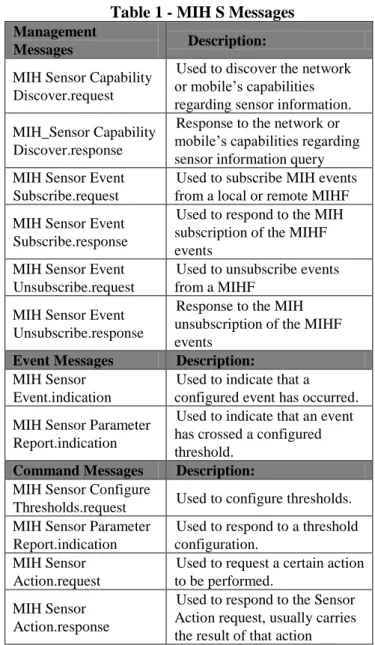
MIH messages are coded in TLV format. The following tables depict the necessary messages created to complement the 802.21 MIH S protocol with support for sensors. The gray area represents the header and the following white areas represent the payload parameters. Table 1 depicts these messages.
Table 1 - MIH S Messages
Management
Messages Description:
MIH Sensor Capability Discover.request
Used to discover the network or mobile’s capabilities regarding sensor information. MIH_Sensor Capability
Discover.response
Response to the network or mobile’s capabilities regarding sensor information query MIH Sensor Event
Subscribe.request
Used to subscribe MIH events from a local or remote MIHF MIH Sensor Event
Subscribe.response
Used to respond to the MIH subscription of the MIHF events
MIH Sensor Event Unsubscribe.request
Used to unsubscribe events from a MIHF
MIH Sensor Event Unsubscribe.response
Response to the MIH unsubscription of the MIHF events
Event Messages Description:
MIH Sensor Event.indication
Used to indicate that a configured event has occurred. MIH Sensor Parameter
Report.indication
Used to indicate that an event has crossed a configured threshold.
Command Messages Description:
MIH Sensor Configure
Thresholds.request Used to configure thresholds. MIH Sensor Parameter
Report.indication
Used to respond to a threshold configuration.
MIH Sensor Action.request
Used to request a certain action to be performed.
MIH Sensor Action.response
Used to respond to the Sensor Action request, usually carries the result of that action 2) Datatypes
Also, to support the newly created messages, it is necessary to define new sensor oriented parameters. These parameters are showed in Table 2.
Table 2 - Datatypes TLV Name
Type Size Value Definition Sensor
Identifier Variable 64 Sensor identification Requested MIH Sensor Event List Bitmap (32) 65 List of supported sensor events Sensor Event Configuration List
Variable 66 List of configurations
Parameter Report List
parameters to report
Sensor
Identifier List Variable 68
List of sensor identifiers Sensor Device States Response Variable 69 Datatype used to report the device status
Sensor Configure Request List
Variable 70 List of configuration parameters
Sensor Configure Response List
Variable 71 List of configuration status
Sensor Action Variable 72 Required action to be performed
Execution Delay
Unsigned
Int 73
Time delay for action execution
Sensor
Support Variable 74
Support for Sensors Type of Action 3) IP Address Management
Using the 802.21 MIH protocol cross layer framework allows the use of information by layer 2 when otherwise was only available by layer 3. This benefits not only the access to information on a non-attached network, but also the need for more complex processing equipment as we move upper the protocol stack.
E. Alternative Transport
Providing information to users is the most important factor on this architecture. As such, if by any reason the mobile device cannot access context information through 802.21 MIHS it should be able to consume the same information by any alternative mean, Therefore, in our proposed architecture the alternative mean of transport is through XMPP. Enabling this alternative, a user can detach from a network and still be able to access its context information. To support this mechanism, there are, at least, three mandatory entities. A context broker, a context provider and a context consumer. The context broker is an entity that stores, manages and provides context information acting as a server. The context provider, is a publisher entity, its only responsibility is to retrieve sensor readings and publish the data to the context broker, enabling and updating information for outside users. At any time there should be at least one publisher entity per sensor network. Finally, the context consumer is a user who will request context
information from the context broker subscribing information nodes for updates.
F. Example Use Case
As an example, on emergency situations that occur in big scale locations, it is essential that rescue teams have continuous connection with the outside and with each other. For this purpose, their connection requirements have to be considered primarily when compared to other people on the spot, and should only concern themselves with the safety procedures. In an unforeseen emergency situation it is quite common that every one tries to leave the premises through the fastest way possible, disorderly and by non-safe exits. In conjunction with this human stampede, there is also the problem of connection congestion due to people trying to contact someone close. These panic-driven actions difficult the rescue team’s role. A framework considering the input of several kinds of sensors while being mobile-aware would present two principal types of advantages. First, through hardware, alarm notices could be obtained through motion sensors, vibration sensors and embedded microphones. Secondly, through software, by controlling the connection flow created from over-using the area’s connection load capabilities. Using hardware and software aids the joint effort of these technologies allows the targeting of people in danger situations and send them information about safe exit maneuvers safely, safety advices and procedures, or just by locating people who are trapped and unresponsive. The same framework would also have a key-role regarding connection problems, enabling the establishment of priorities for rescue teams to have top priority on communications, thus reducing the miscommunication problems.
IV. IMPLEMENTATION
A. Prototype
Through the integration of 802.21 based context transportation, using the proposed MIHS, with a complementary data access via XMPP, we’ve developed and implemented a prototype composed by a framework for network and application-enriched environments, based on context information provided via 802.21 or as XMPP.
When a mobile user approaches a network his/hers knowledge of it is nearly zero, and its capabilities can be quite distinctive from one another in terms of technologies and requirements. Nevertheless, it is important that the mobile device is given sufficient information while approaching a candidate network to handover, in order to make the correct adaptation
decisions. Taking all these facts into account our prototype reveals new proposed ways for network capabilities discover and access.
There are three base mechanisms implemented by the prototype: the discovery mechanisms, through which an approaching mobile device becomes aware of the context information and network capabilities available, the access mechanism, by which the mobile device can access context information from sensor networks or from the network itself, and the providing mechanism, through which information is made available.
B. Implementation’s Architecture
Figure 4 represents the implementation’s architecture with each block representing the technology or entity that was developed. For the sensor networks there are SunSPOTs sensor nodes, for heterogeneous protocol the ODTONE’s Java API for 802.21 MIH and MIHS protocol were used, and for the context broker was used the XCoA’s context broker.
The authors are aware that typically scenarios consider low-powered sensors, but in this work we consider a broader range of sensor deployment possibilities such as current smartphones, where normally a large number of sensors exists and power consumption is less stringent. SunSPOTs [8] wireless sensor nodes were chosen by their versatility and implementation flexibility. For communication, these nodes are equipped with IEEE 802.15.4 allowing short distance communication, and present acceptable power consumption [8] considering the development faculties that it presents when compared to other sensor technologies.
Figure 4 - Implementation's Architecture C. Development
The prototype was developed in two phases. The first involved the creation of the Java API for the 802.21 MIH and MIH S protocol, related entities and mechanisms, as well as their integration with the SunSPOTs technology. The second phase involved the development of the context-aware mechanisms, entities and using already existent XMPP libraries [21][22][23].
D. Proof of Concept
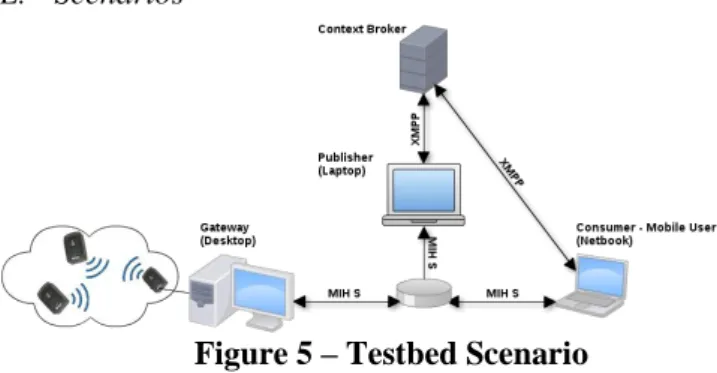
As proof of concept this prototype was tested with selected scenarios to demonstrate the potential of the proposed architecture in a testbed. This testbed was composed by a desktop, a laptop, a netbook, each representing active network entities, a SunSPOTs network and a server with the context broker. The SunSPOTs network provides an information source based on sensor readings, composed by a wireless network (IEEE 802.15.4) between two pairs of sensor nodes and a gateway. Each node’s sensor readings are retrieved by a base station which manages and validates the obtained information. All data retrieved is organized in a gateway responsible for making that information available for 802.21 based transport. E. Scenarios
Figure 5 – Testbed Scenario
Figure 5 represents the testbed scenario, with sensor networks represented by SunSPOTS nodes attached to a gateway (Desktop). A publisher entity that consumes information and provides it for consumption in a context broker, and a mobile user, our context consumer that will originate the two different scenarios explained below.
1) Scenario 1 – Direct Access through 802.21 MIHS In the first scenario, the user approaches a network and through 802.21 MIHS discovers the networks capabilities and also discovers that it provides sensor network information available by MIH S events and commands. Then, the mobile device will subscribe to that information and configure its needs for operation with the given data. Once the subscription of events and operating configurations are finalized the mobile device will begin to receive all data requested.
2) Scenario 2 – Alternative Access through XMPP In this second scenario the user will also approach a network and through 802.21 MIHS it will discover the network capabilities and will be informed that the sensor information is only accessible by XMPP using the Publish-Subscribe mechanism through a node and address that are also provided.
F. Mechanisms and Processes 1) Discovery
The discovery mechanism is equal in both scenarios. Both publisher and the mobile device consumer discover the networks capabilities through a broadcast that is answered only by the gateway. The publisher is an entity that should, at all times be given the access through 802.21 MIHS to context information due to the fact that it is the one who ensures data accessibility through XMPP. Figure 6 represents this mechanism’s sequence of messages.
Figure 6 - Discovery Mechanism 2) Subscription
For the first scenario, both the consumer and the publisher go through the same mechanisms, where they subscribe the events that the discover mechanism showed to exist. This subscription implies that the MIH User states a periodicity for event report. Then the same entities perform a configuration of thresholds, this configuration allows MIH Users to set a threshold for each sensor and every time a threshold is crossed a report is triggered to the respective registered MIH User. Figure 7 depicts the message sequence of this mechanism.
Figure 7 - Subscription Mechanisms
For the second scenario, the Publisher is already receiving data through 802.21 MIHS subscription mechanisms, but the network denies MIHS access to sensor information. In this scenario the mobile device
will obtain through the discovery mechanism the address and node on which to subscribe and, by XMPP will subscribe the same information as shown in Figure 8.
Figure 8 - XMPP Subscription 3) Providing information
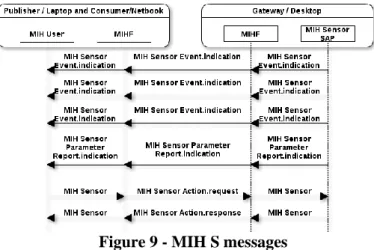
Information is provided in two ways, first, through event messaging of MIHS protocol, and second, through XMPP publication to the Context Broker. In the first scenario both users receive information through 802.21 MIHS. There are three types of messages to provide information, MIH Sensor Event messages, which relate to the subscription of events, MIH Sensor Parameters Report, that are produced every time a threshold is crossed and MIH Sensor Action messages, which are a request/response immediate mechanism that allows a instantaneous request for the sensor nodes to perform a certain action. These messages are depicted in figure 9.
Figure 9 - MIH S messages
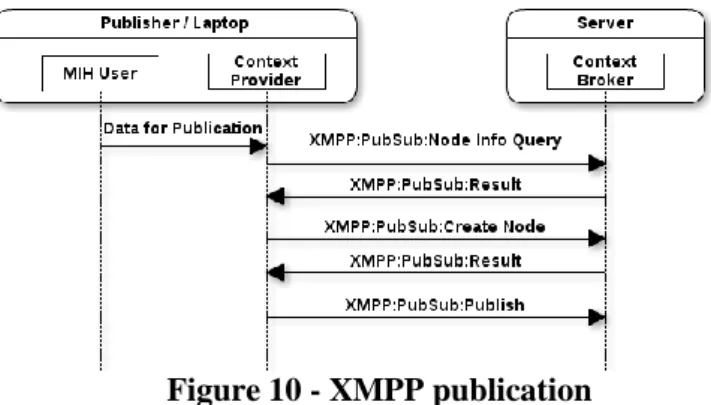
At the same time, the publisher also provides information for the context broker. Information that is available for any user outside the network, as shown in scenario 2. Figure 10 shows the XMPP publication message sequence. Once the publisher receives data for publication it has to make sure that the PubSub node exists, so, it first checks for its existence. If the node does not exist, it creates a new leaf node, if not, it begins publication without delay.
Figure 10 - XMPP publication
In the second scenario only the publisher has the abilities to receive messages depicted in figure 9. The context consumer will receive through discovery mechanism the node and address from which to subscribe and receive data. Once the consumer is subscribed, every time the data is updated in the context broker, the consumer will receive an update message from the server as showed in Figure 11.
Figure 11 - Update Message
V. PROTOTYPE EVALUATION
A. Message Size
Considering all used messages, the largest message was MIH Sensor Capabilities Discover.response (98 bytes), as it contains a large quantity of networks information, so users are aware of the network’s capabilities. The smallest messages were MIH Sensor Configure Thresholds.response and MIH Event Subscribe.response with the same size (30 bytes). This message’s size is due to the fact that it only is used as a ―successful‖ or ―unsuccessful‖ subscription notice. Comparing the MIH S messages size with other protocols for sensor networks [24] indicates that our solution has an acceptable size, considering the benefits of extending a media independent handover protocol to sustain context aware information on enriched environments.
B. Network Load and Scalability
Based on the worst case scenario where all messages have 98 bytes an estimate was provided to better understand the impact of extending MIH protocol to integrate sensor networks. If, in an hour, two messages per second are sent with the size of 98, a load of 705600 bytes is obtained at the end of this
period, corresponding to approximately 609KB. In an IEEE 802.15.4 connection with transmission rate of 250Kbps, each message will occupy approximately 0.03% of the network max transmission rate.
Taking into account the considerations previously addressed about network load, we’ve created a scalability chart, in Figure 12 which depicts the network usage from 1 to 1000 sensor nodes sending MIH S messages with the worst case message size of 98 bytes.
Figure 12 - Scalability chart
Analyzing Figure 12 we can conclude that only for numbers superior to 100 sensor nodes on 802.15.4 does the network load become high enough to congest the network and other protocols. In the worst case scenario, when the number of sensor nodes rise above 100 in 802.15.4, depending on the network usage by other existent protocols, it can contribute to the impact on existing connections. This study was not measured in a real life scenario, but consists of a theoretical evaluation showing the maximum possible capabilities under simple conditions. In [25] a study is presented showing that a network interface spends the same amount of energy sending 1KB at 100m of distance than a MIPS 100M instructions per second needs to process 3M instructions. Considering sending 1KB at 100m distance spends 1 Unit of Battery, relating bandwidth usage and battery consumption, we can provide a hypothetical performance graphic considering only bandwidth usage, battery consumption and its relation.
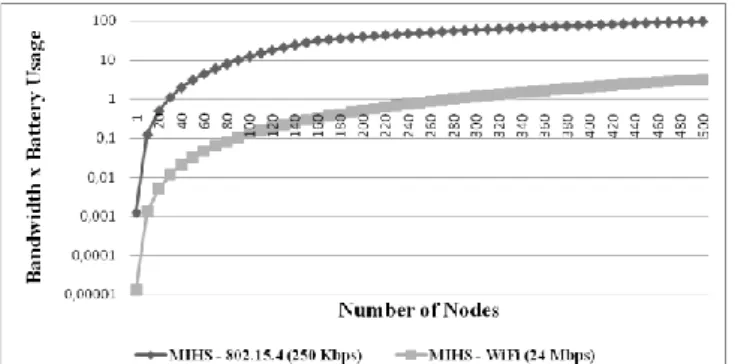
Figure 13 shows how varying the amount of number nodes in two different types of wireless networks can impact performance, when each sensor node sends 2 messages per second with 98 byte size.
Figure 13 - Bandwidth and Battery Relation
Comparing the difference between 24 Mbps and 250 Kbps based network it is clear that it is almost constant for node numbers between 1 and 150, this is due to the fact that they are directly proportionate. For node numbers superior to 150 that difference begins to narrow due to the bandwidth allocation in the 250 Kbps network. As it reaches allocation of 100% the Bandwidth x Battery usage ratio is only increased by the battery units used by new sensor nodes.
Though the analyzed scenarios are ideal ones, and do not contemplate other factors as beacon frames or other type of traffic. For node numbers near 100 it is safe to use IEE 802.15.4 based networks, but for bigger numbers it is advisable to use more capable technologies, such as IEEE 802.11.
Considering the data analyzed from Figure 12 and 13, the usage of 802.21 MIH protocol is acceptable as it does not create congestion by message overload and it is scalable for various technologies as seen in Figure 12.
VI. CONCLUSION
The presentation of MIH S and the prototype framework in which it is integrated is an innovative approach for heterogeneous networks, sensor networks and context management. The advantages of a cross layer framework in heterogeneous network are the reduction of protocol stack requirements and, simultaneously, provides a homogeneous communication protocol for vast sensor node technologies. Merging these advantages with context information provides an enriched environment which enables terminal and usability adaptation to physical and network context. At the same time, a dual access mechanism is presented, by which a user can approach a network directly through MIH S requiring only layer 2 connection or it can associate itself by layer 3 connection to its preferred internet connection and access that network’s context information by XMPP.
This prototype gives way for adaptation and abstraction at many levels ranging from application, resources and usability. Nevertheless, by integrating a MIH protocol in this type of scenarios we also empower 802.21 compliant entities to enrich their decision not only with network based information but also with context information.
Finally, we conclude that through all data presented in this paper, the extension of MIH to MIH S, and its integration in a context framework, is not only viable but also welcomed for its innovative approach to merging heterogeneous networks, sensor networks and context management.
Currently we are addressing the study of the proposed mechanisms in real-life scenarios where other factors such as the wireless medium, and the number of sensors, impact performance.
An evolution of this prototype is also being considered to extend the usage of 802.21 MIH S to other network and sensor technologies (such as Iris) concerning heterogeneous scenarios including mobility capabilities and context-aware environments, in ODTONE, Instituto de Telecomunicações, Aveiro, Portugal.
REFERENCES
[1] IEEE 802.21 Standard, ―Local and Metropolitan Area
Networks – Part 21: Media Independent Handover Services‖, January 2009.
[2] Diogo Gomes, Rui Aguiar, ―Quasi-omniscient
Networks: Scnearios on Context Capturing and New Services Through Wireless Sensor Networks‖, 2008
[3] Thomas Strang, Claudia Linnhof-Popien, Matthias Roeckl, ―Highlevel Service Handover through a Contextual Framework‖, 2006
[4] S. Tilak, N.B. Abu-Ghazaleh, W. Heinzelman, ― A taxonomy of wireless micro-sensor network models‖, 2002
[5] I.F. Akyildiz, W. Su, Y. Sankarasubramaniam, E. Cayirci, ―Wireless Sensor Networks: A survey‖, 2001
[6] Marc Danzeisen, Torsten Braun, Isabel Steiner, ―On the benefits of heterogeneous networking and how cellular mobile operators can help‖, 2005
[7] Hiroshi Sakakibara, Jin Nakazawa, Hideyuki Tokuda, ―PBN: A seamless Network Infrastructure of Heterogeneous Network Nodes‖, 2009
[8] Paolo Bellavista, Marcello Cinque, Domenico Cotroneo, Luca Foschini, ―Integrated Support for Handoff Management and Context Awareness in Heterogeneous Wireless Network‖, 2006
[9] Sun SPOT, ―Sun SPOT World‖,
http://www.SunSPOTSworld.com
[10] Wei Li, ―A Service Oriented SIP Infrastructure for
Adaptative and Context-Aware Wireless Services‖, 2003
[11] Christian Dannewitz, Stefan Berg, Holger Karl, ―An
IEEE 802.21-based Universal Information Service‖, 2006
[12] Peter Saint-Andre, ―XMPP: Lessons learned from ten years of XML Messaging‖, 2009
[13] Gregory Abowd, Maria Ebling, Guerney Hunt, Hui Lei, Hans Gellerson, ―Context-Aware Computing‖, 2002
[14] Guanling Chen, David Kotz, ―A survey of
Context-Aware Mobile Computing Research‖, 2000
[15] RFC3920, ―Extensible Messaging and Presence
Protocol (XMPP) – Core – RFC 3929‖, 2002
[16] RFC3921, ―XEP-0114: Jabber Component Protocol‖,
2005
[17] XEP0060, ―XEP-0060: Publish-Subscribe‖, 2004 [18] RFC2277, ―IETF Policy on Character Sets and
Languages‖, 2000
[19] ODTONE, ―Open Dot Twenty One‖,
http://hng.av.it.pt/projects/odtone , Instituto de Telelecomunicações, Aveiro, Portugal
[20] Diogo Gomes, João Gonçalves, Ricardo Santos, Rui Aguiar, ―XCOA – Xmpp based Context Management Architecture‖, in IEEE 4th Workshop on Enabling the Future Service-Oriented Internet: Towards Socially-Aware Networks – GLOBECOM 2010, December 2010.
[21] Ignite Realtime - ―Whack‖, 2008,
http://www.ignitereatime.org/org/projects/whack
[22] Ignite Realtime - ―Smack‖, 2008,
http://www.ignitereatime.org/org/projects/smack
[23] Ignite Realtime - ―Tinder‖, 2010,
http://www.ignitereatime.org/org/projects/tinder
[24] Mehmet C. Vuran, Ian F. Akyildiz, ―XLP: A
Cross-Layer Protocol for Efficient Communication in Wireless Sensor Networks‖, 2010
[25] Mehmet C. Vuran, Ian F. Akyildiz, ―Cross-layer Packet
Size Optimization for Wireless Terrestrial, Underwater, and Underground Sensor Networks‖, 2008
[26] G.J Pottie, W.J. Kaiser, Wireless integrated network sensors, Communications of the ACM 43, pp. 551-558, May 2000
![Figure 1 - MIH Entities and Services Figure 1 represents the MIH communication model as described by the IEEE 802.21 MIH standard [1]](https://thumb-eu.123doks.com/thumbv2/123dok_br/15967171.1100611/3.892.477.832.304.514/figure-entities-services-figure-represents-communication-described-standard.webp)