Exposure to endocrine- disrupting
chemicals and anthropometric measures
of obesity: a systematic review
and meta- analysis
Carolina Martins Ribeiro, Bruna Teles Soares Beserra, Nadyellem Graciano Silva, Caroline Lourenço Lima, Priscilla Roberta Silva Rocha, Michella Soares Coelho, Francisco de Assis Rocha Neves, Angélica Amorim Amato
To cite: Ribeiro CM, Beserra BTS, Silva NG, et al. Exposure to endocrine- disrupting chemicals and anthropometric measures of obesity: a systematic review and meta- analysis. BMJ Open 2020;10:e033509. doi:10.1136/ bmjopen-2019-033509 ►Prepublication history and additional material for this paper are available online. To view these files, please visit the journal online (http:// dx. doi. org/ 10. 1136/ bmjopen- 2019- 033509). Received 07 August 2019 Revised 06 December 2019 Accepted 13 December 2019 Laboratory of Molecular Pharmacology, Department of Pharmaceutical Sciences, University of Brasilia, Brasilia, Brazil
Correspondence to Dr Angélica Amorim Amato; angelicamato@ unb. br © Author(s) (or their employer(s)) 2020. Re- use permitted under CC BY- NC. No commercial re- use. See rights and permissions. Published by BMJ.
Strengths and limitations of this study
► This systematic review and meta- analysis were conducted in accordance to the Preferred Reporting Items for Systematic Reviews and Meta- Analyses guidelines and used a validated tool for quality as-sessment of included studies.
► Only human studies primarily addressing the asso-ciation between exposure to endocrine- disrupting chemicals (EDCs) and obesity were included. ► This systematic review and meta- analysis analysed
the association of a broad range of EDCs and mea-sures of generalised and abdominal obesity. ► The meta- analyses were based on a limited number
of studies due to the variability in how the measures of association between exposure to EDCs and an-thropometric measures of obesity were reported by individual studies.
AbStrACt
Objective Endocrine- disrupting chemicals (EDCs) are viewed as a major potential link between the environment and obesity development. We did a systematic review and meta- analysis to examine the association between exposure to EDCs and obesity.
Data sources, design and eligibility criteria PubMed, Scopus and Web of Science were searched from inception to 6 June 2018 for studies primarily addressing the association between exposure to EDCs after the age of 2 years and anthropometric measures of obesity or body fat. The Newcastle- Ottawa scale was used to assess the risk of bias.
Data extraction and synthesis Two independent reviewers screened and conducted data extraction and synthesis. A third reviewer resolved disagreements. results A total of 73 studies investigating bisphenol A (32 286 individuals), organochlorine compounds (34 567 individuals), phthalates (21 401 individuals), polybrominated biphenyls (2937 individuals), polycyclic aromatic hydrocarbons (5174 individuals), parabens (4097 individuals), benzoic acid (3671 individuals) and polyfluoroalkyl substances (349 individuals) met our inclusion criteria. Most had a cross- sectional design and low or medium risk of bias. In qualitative analysis, bisphenol A and phthalates were consistently associated with general and abdominal obesity, in children and adults, and some studies suggested this association was age- dependent and gender- dependent. Meta- analysis indicated a significant association between exposure to bisphenol A and overweight (OR 1.254, 95% CI 1.005 to 1.564), obesity (OR 1.503, 95% CI 1.273 to 1.774) and increased waist circumference (OR 1.503, 95% CI 1.267 to 1.783) in adults, and between exposure to 2,5- dichlorophenol and obesity in children (OR 1.8, 95% CI 1.1018 to 3.184).
Conclusion Most observational studies supported a positive association between obesity and exposure to EDCs. Although causality cannot be determined from these data, they underscore the need to limit human exposure to EDCs in light of the evidence from animal and cell- based studies indicating the effects of these chemicals on adiposity.
PrOSPErO registration number CRD42018074548.
IntrODuCtIOn
Obesity is a major worldwide health chal-lenge in multiple perspectives. The physiopa-thology and clinical impacts of excess body fat (BF) are incompletely understood, and there are many difficulties in developing safe and
effective long- term therapeutic strategies.1 In
addition, obesity- related health costs increase
at an alarming rate.2
Development of excess weight is the result of a chronic positive energy balance stem-ming from the complex interaction between genetic, lifestyle, behavioural and
environ-mental factors.3 Data from experimental
studies indicate that endocrine- disrupting
chemicals (EDCs) influence the development
and progression of obesity.4 These
chemi-cals, so- called environmental obesogens, are functionally defined by their properties to alter lipid metabolism and inappropriately
promote adipogenesis and fat accumulation.5
The potential mechanisms underlying their
on June 22, 2020 by guest. Protected by copyright.
http://bmjopen.bmj.com/
effects are a major focus of research, and a number of
them have been proposed.5 6 Obesogens can increase
commitment or differentiation of adipocytes from stem cells by activating nuclear receptor signalling path-ways that are critical for adipogenesis, such as retinoid
X receptor- alpha/peroxisome- proliferator activated
receptor gamma7 8 and glucocorticoid receptor.9
More-over, obesogens lead to the development of unhealthy adipocytes, with reduced insulin sensitivity and decreased
thermogenic capacity.10 11 Obesogens may also dysregulate
central integration of energy balance and the program-ming of metabolic setpoints, particularly at critical periods of development, increasing the susceptibility for devel-oping obesity later in life when metabolic homeostasis is challenged by factors such as diet composition and caloric
intake.12 13 Moreover, exposure to obesogens may lead to
a transgenerational thrifty phenotype, possibly caused by
changes in chromatin accessibility and organisation.12
Several human studies addressed whether exposure to EDCs was associated with obesity. However, their findings were varied. To provide a broad picture of the association between human exposure to different EDCs and obesity, we systematically reviewed human studies addressing the association between exposure to these chemicals outside the prenatal and lactation period and measures of excess body weight or adiposity.
MEthODS
Search strategy and selection criteria
This systematic review followed the Preferred Reporting
Items for Systematic Reviews and Meta- Analyses
guidelines.14
Inclusion criteria were based on the population, expo-sure, comparison, outcome and study design (PECOS)
approach,15 as follows: (1) population: humans aged over
2 years; (2) exposure: exposure to EDCs assessed by anal-ysis of a biological sample from participants; (3) compar-ison: participants with higher degrees of exposure versus participants with lower degrees of exposure; (4) outcome: excess weight or adiposity determined by body mass index (BMI), waist circumference (WC) or BF content; and (5) study design: cross- sectional, case–control and cohort studies. We therefore included observational studies addressing the association between exposure to EDCs outside the developmental period and BMI, WC or BF in humans. Studies were excluded if exposure to EDCs was determined by means other than analysis of a biolog-ical sample from participants, if exposure was assessed during the prenatal period or lactation, and if a measure of excess weight/adiposity was not considered a primary outcome. Reviews, abstracts, case reports and case series were excluded, in addition to studies addressing the effects of heavy metals, phytoestrogens or the synthetic oestrogen diethylstilbestrol.
PubMed, Scopus and Web of Science were searched from inception to May 3, 2017, and updated on 6 June 6, 2018, with no language restriction, using search terms that were
based on a combination of indexed and free- text terms reflecting the exposure and outcomes of interest to the review, and included the following keywords, which were used in combination to execute the search: “endocrine disrupting, endocrine disruptor, endocrine disrupting chemicals, obesity, overweight, obese, body weight, waist circumference, body mass index, adipogenesis, adipose tissue, adipocyte and obesogenic” (online supplementary appendix A). The reference lists of included articles were also manually searched.
Study selection and data extraction
Study selection was conducted in two phases. In the first phase, three reviewers (BTSB, CMR and NGS) inde-pendently screened the titles and abstracts to identify eligible studies according to the PECOS approach. In the second phase, the same two reviewers independently
assessed the full- text articles of the eligible studies
selected in the first phase. In both phases, disagreements were resolved through discussion, and when there was no consensus, the disagreements were resolved with the participation of a third reviewer (AAA). Data extraction was conducted independently by the same reviewers (BTSB, CMR and NGS) using a predesigned data extraction sheet, with information about sample charac-teristics, exposure assessment, outcome assessment and risk estimates for relevant comparisons. When necessary to clarify any information, the authors of the included study were contacted by email.
risk of bias within studies
Risk of bias within studies was assessed using the Newcastle- Ottawa Scale. According to prespecified criteria for risk of bias in sample selection, comparability of subjects in different outcome groups and assessment of outcomes, studies were considered to have a low, medium or high risk of bias (online supplementary appendix B).
Two reviewers independently conducted risk of bias assessment (BTSB and CMR); disagreements were resolved after discussion with a third reviewer (CLL).
Summary measures
The main outcomes assessed in this review were the measures of association between exposure to EDCs and BMI, WC or fat mass.
Meta-analysis
We aggregated the studies into five general groups, according to the type of EDC studied: bisphenol A (BPA), organochlorine (OC) compounds, phthalates (PHTs), brominated compounds (BCs) and other EDCs. Studies assessing OC compounds were further subdivided into those investigating polychlorinated biphenyls (PCBs), organochlorine pesticides (OCPs), chlorophenol pesti-cides and triclosan.
The methodological quality of each study was appraised, and sources of heterogeneity, including differences in exposure measurement (eg, categorical vs contin-uous, any adjustment) and clinical outcome (eg, type
on June 22, 2020 by guest. Protected by copyright.
http://bmjopen.bmj.com/
Figure 1 Flow diagram of literature search and selection criteria adapted from Preferred Reporting Items for Systematic Reviews and Meta- Analyses (adapted from Moher et al14). BPA, bisphenol A; DCP, dichlorophenol;
EDC, endocrine- disrupting chemical; PBB, polybrominated biphenyl; PBDE, polybrominated diphenyl ether; WC: waist circumference.
of anthropometric measure, categorical vs continuous) were identified. For studies with a similar data source, we included only the study with the largest sample size. Meta- analysis was performed when more than a single study per outcome had a similar design, exposure assessment and outcome measures so that we could have a meaningful pooled effect.
As heterogeneity was high among studies reporting continuous outcome data, only three different categorical outcomes were assessed: prevalent overweight, prevalent obesity and prevalent elevated WC. For each exposure (EDC) and outcome, adjusted OR with 95% CIs were extracted and pooled with random- effect model, as we expected some heterogeneity across the studies. Except for BC studies, we considered OR estimates from the highest versus lower EDCs levels. Because the association between exposure to some brominated metabolites and body mass measures in many studies showed an inverted U- shaped relationship, we collected OR estimates from intermediary categories of metabolite levels.
Hetero-geneity between study results was evaluated with χ2 test
and quantified by I2 statistic (I²>75% considered as high
heterogeneity).16 Possible causes of heterogeneity were
explored with additional sensitivity analyses clustering the results by age (children vs adults) or by EDC metabolite/ compound. Publication bias was assessed with a funnel plot and by using Egger’s regression test (with p<0.05 as an indication of the existence of publication bias). The metan package of STATA V.13.0 software was used for all meta- analysis.
risk of bias across studies
Clinical heterogeneity of studies was considered by comparing the variability among the participant's charac-teristics, the assessment of exposure and outcomes. Meth-odological heterogeneity was assessed by comparing the variability in study design and risk of bias.
Patient and public involvement
No members of the public and patients were directly involved in this study.
rESultS
A total of 5059 articles were identified; 108 abstracts were selected for full assessment; and 73 studies met our
inclu-sion criteria (figure 1). Thirty studies17–46 were conducted
in the USA, 17 in Europe,47–63 22 in Asia,64–85 2 in Latin
America,86 87 1 in Africa88 and 1 in Canada.89 In 72 studies,
the anthropometric measures of obesity were assessed by trained health professionals, and in one study, weight and
height were self- reported.77 The qualitative association
between exposure to the different EDCs examined and obesity found in these studies is summarised in online supplementary figure 1.
bisphenol compounds
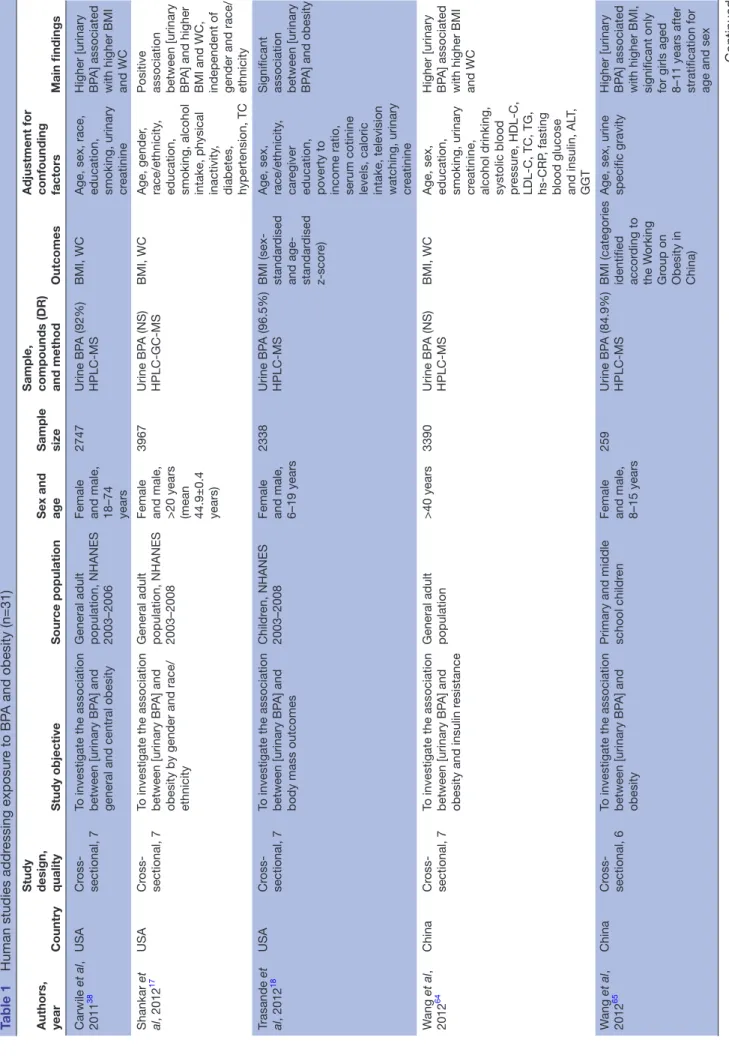
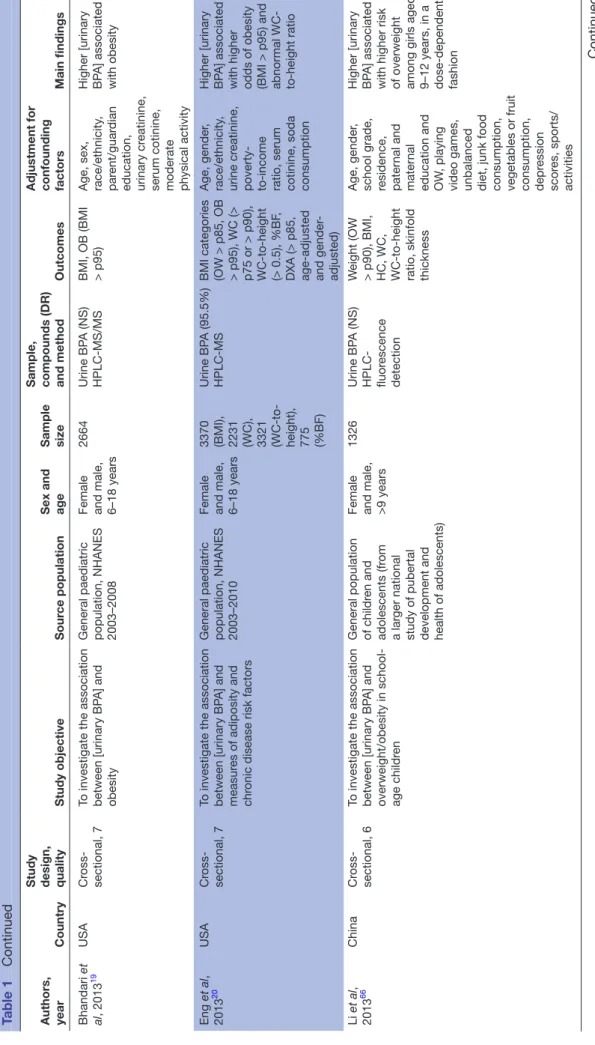
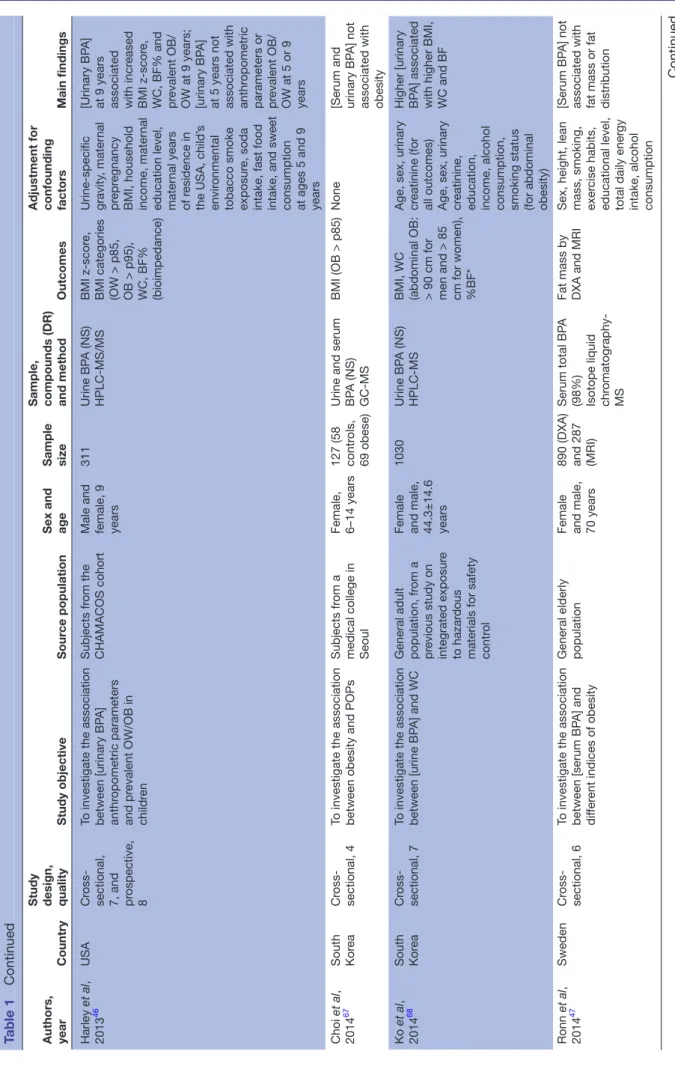
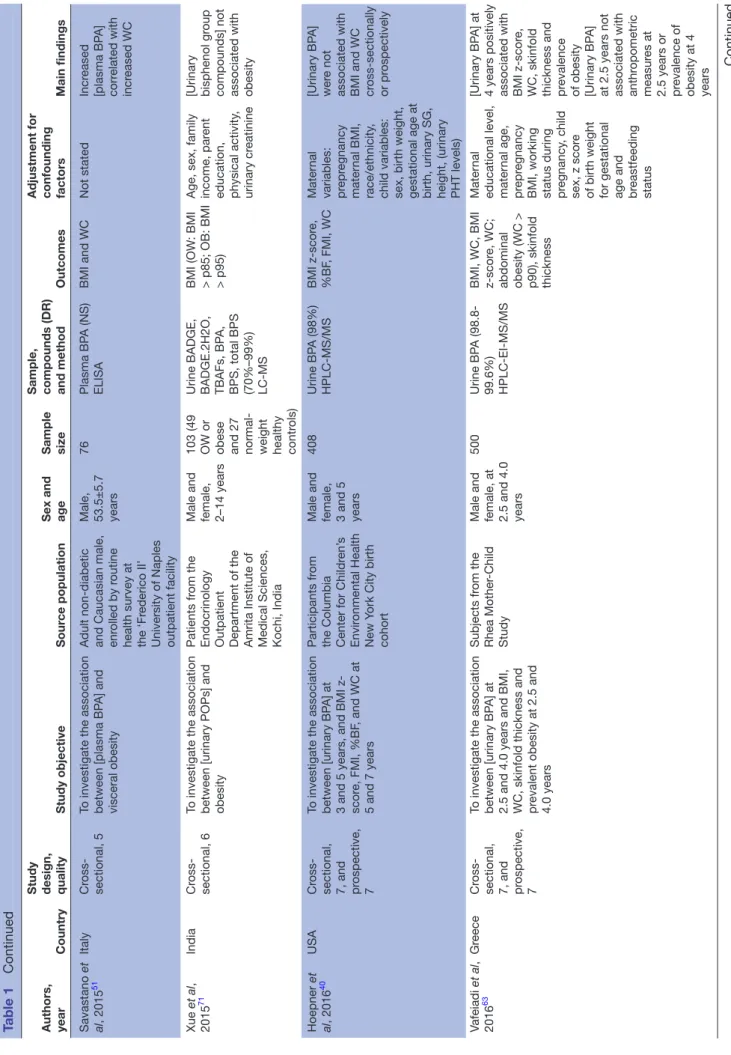
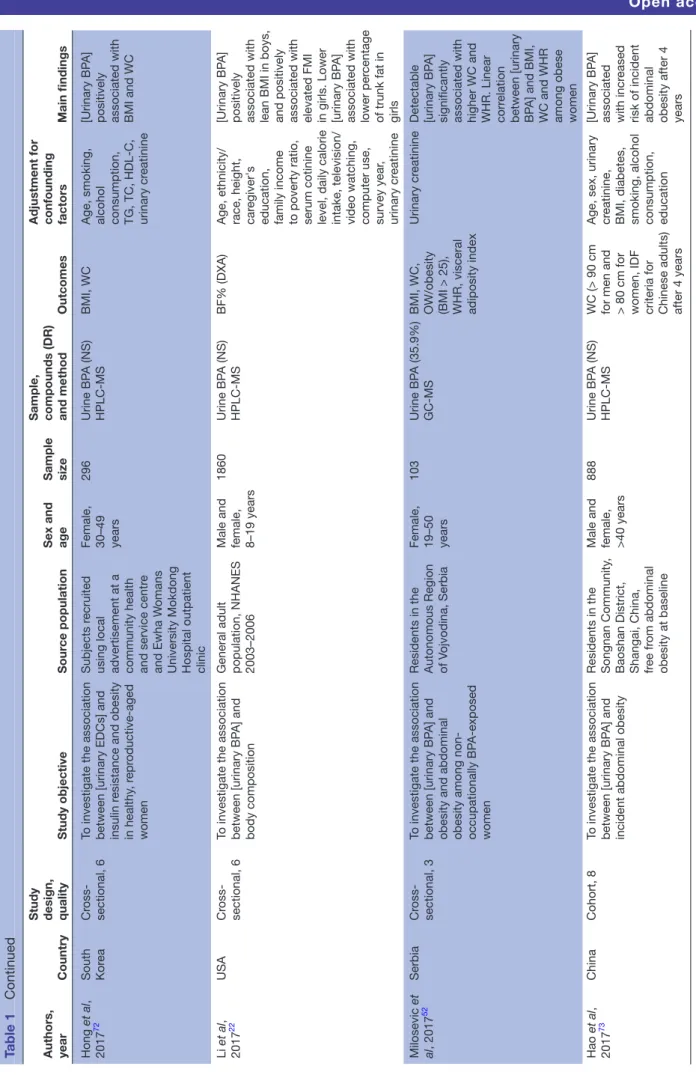
Thirty- one studies17–22 36–40 46–52 63–73 82 86 assessed the
asso-ciation between BPA exposure and obesity (table 1).
Three studies37 39 71 additionally assessed other bisphenol
compounds. Sixteen studies18–20 22 36 37 40 46 48 63 65–67 70 71 86 were
conducted in children or adolescents, and all but 436 40 46 63
were exclusively cross- sectional. Ten studies18–20 22 46 48 63 65 66 86
reported a positive association between exposure to BPA and obesity. In a subgroup analysis based on gender and
age, 3 studies65 66 86 indicated the association was
signifi-cant for girls, and 2 of them for girls aged 8–11 years65 or
9–12 years.66 Moreover, one study22 assessed BF by dual-
energy X- ray absorptiometry and found that urinary BPA levels were positively associated with elevated fat mass index in girls but were positively associated with lean body
mass in boys. Six studies36 37 40 67 70 71 found no association
between exposure to BPA and obesity.
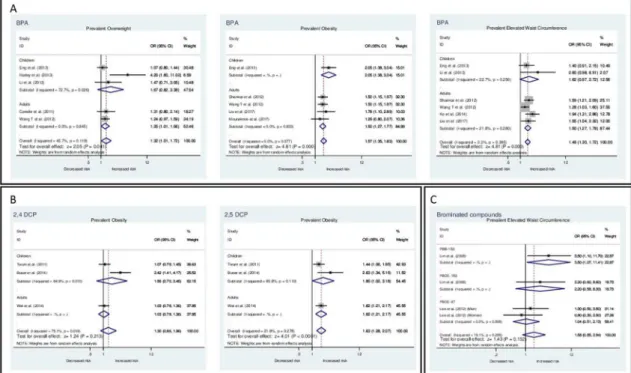
Synthesis of data from 3 cross- sectional studies including
5541 children20 22 46 indicated that BPA exposure was not
significantly associated with prevalent overweight, and synthesis of data from 2 cross- sectional studies including
5230 children20 22 indicated that BPA exposure was also
not significantly associated with increased WC (figure 2A
and table 2).
on June 22, 2020 by guest. Protected by copyright.
http://bmjopen.bmj.com/
Table 1
Human studies addr
essing exposur
e to BP
A and obesity (n=31)
Authors, year
Country
Study design, quality
Study objective
Sour
ce population
Sex and age Sample size Sample, compounds (DR) and method
Outcomes
Adjustment for confounding factors
Main findings Carwile et al , 2011 38 USA Cr oss-sectional, 7
To investigate the association between [urinary BP
A] and
general and central obesity
General adult population, NHANES 2003–2006 Female and male, 18–74 years
2747 Urine BP A (92%) MS BMI, WC
Age, sex, race, education, smoking, urinary creatinine Higher [urinary BP
A] associated
with higher BMI and WC
Shankar et al , 2012 17 USA Cr oss-sectional, 7
To investigate the association between [urinary BP
A] and
obesity by gender and race/ ethnicity General adult population, NHANES 2003–2008 Female and male, >20 years (mean 44.9±0.4 years)
3967 Urine BP A (NS) MS BMI, WC Age, gender , race/ethnicity ,
education, smoking, alcohol intake, physical inactivity
,
diabetes, hypertension, TC Positive association between [urinary BP
A] and higher
BMI and WC, independent of gender and race/ ethnicity
Trasande et al , 2012 18 USA Cr oss-sectional, 7
To investigate the association between [urinary BP
A] and
body mass outcomes
Childr
en, NHANES
2003–2008
Female and male, 6–19 years
2338
Urine BP
A (96.5%)
MS
BMI (sex- standar
dised
and age- standar
dised
scor
e)
Age, sex, race/ethnicity
,
car
egiver
education, poverty to income ratio, serum cotinine levels, caloric intake, television watching, urinary creatinine Significant association between [urinary BP
A] and obesity W ang et al , 2012 64 China Cr oss-sectional, 7
To investigate the association between [urinary BP
A] and
obesity and insulin r
esistance
General adult population
>40 years 3390 Urine BP A (NS) MS BMI, WC
Age, sex, education, smoking, urinary creatinine, alcohol drinking, systolic blood pressur
e, C, C, TC, TG, CRP , fasting
blood glucose and insulin, AL
T,
GGT
Higher [urinary BP
A] associated
with higher BMI and WC
W ang et al , 2012 65 China Cr oss-sectional, 6
To investigate the association between [urinary BP
A] and
obesity
Primary and middle school childr
en
Female and male, 8–15 years
259
Urine BP
A (84.9%)
MS
BMI (categories identified accor
ding to the W orking Gr oup on Obesity in China) Age, sex, urine specific gravity
Higher [urinary BP
A] associated
with higher BMI, significant only for girls aged 8–11 years after stratification for age and sex
Continued
on June 22, 2020 by guest. Protected by copyright.
http://bmjopen.bmj.com/
Authors, year
Country
Study design, quality
Study objective
Sour
ce population
Sex and age Sample size Sample, compounds (DR) and method
Outcomes
Adjustment for confounding factors
Main findings Bhandari et al , 2013 19 USA Cr oss-sectional, 7
To investigate the association between [urinary BP
A] and
obesity
General paediatric population, NHANES 2003–2008 Female and male, 6–18 years
2664 Urine BP A (NS) MS/MS BMI, OB (BMI > p95) Age, sex, race/ethnicity
, par ent/guar dian education, urinary cr eatinine,
serum cotinine, moderate physical activity Higher [urinary BP A] associated with obesity Eng et al , 2013 20 USA Cr oss-sectional, 7
To investigate the association between [urinary BP
A] and
measur
es of adiposity and
chr
onic disease risk factors
General paediatric population, NHANES 2003–2010 Female and male, 6–18 years
3370 (BMI), 2231 (WC), 3321 to-height), 775 (%BF) Urine BP A (95.5%) MS
BMI categories (OW > p85, OB > p95), WC (> p75 or > p90),
height (> 0.5), %BF , DXA (> p85, adjusted and gender - adjusted) Age, gender , race/ethnicity , urine cr eatinine, poverty- income
ratio, serum cotinine, soda consumption Higher [urinary BP
A] associated
with higher odds of obesity (BMI > p95) and abnormal WC-
height ratio Li et al , 2013 66 China Cr oss-sectional, 6
To investigate the association between [urinary BP
A] and
overweight/obesity in school- age childr
en
General population of childr
en and
adolescents (fr
om
a lar
ger national
study of pubertal development and health of adolescents) Female and male, >9 years
1326 Urine BP A (NS) HPLC- fluor escence detection W eight (OW > p90), BMI, HC, WC, height
ratio, skinfold thickness
Age, gender
,
school grade, residence, pater
nal and
mater
nal
education and OW
, playing
video games, unbalanced diet, junk food consumption, vegetables
or fruit consumption, depr ession scor es, sports/ activities Higher [urinary BP A] associated
with higher risk of overweight among girls aged 9–12 years, in a
dependent
fashion
Table 1
Continued
Continued
on June 22, 2020 by guest. Protected by copyright.
http://bmjopen.bmj.com/
Authors, year
Country
Study design, quality
Study objective
Sour
ce population
Sex and age Sample size Sample, compounds (DR) and method
Outcomes
Adjustment for confounding factors
Main findings Harley et al , 2013 46 USA Cr
oss-sectional, 7, and prospective, 8 To investigate the association between [urinary BP
A] anthr opometric parameters and pr evalent OW/OB in childr en Subjects fr om the CHAMACOS cohort
Male and female, 9 years
311 Urine BP A (NS) MS/MS BMI scor e,
BMI categories (OW > p85, OB > p95), WC, BF% (bioimpedance)
specific gravity , mater nal pr epr egnancy
BMI, household income, mater
nal
education level, mater
nal years
of r
esidence in
the USA, child’
s
envir
onmental
tobacco smoke exposur
e, soda
intake, fast food intake, and sweet consumption at ages 5 and 9 years
[Urinary BP
A]
at 9 years associated with incr
eased
BMI
scor
e,
WC, BF% and prevalent OB/ OW at 9 years; [urinary BP
A]
at 5 years not associated with anthr
opometric
parameters or prevalent OB/ OW at 5 or 9 years
Choi et al , 2014 67 South Kor ea Cr oss-sectional, 4
To investigate the association between obesity and POPs
Subjects fr
om a
medical college in Seoul Female, 6–14 years 127 (58 contr
ols,
69 obese)
Urine and serum BP
A (NS)
MS
BMI (OB > p85)
None
[Serum and urinary BP
A] not
associated with obesity
Ko et al , 2014 68 South Kor ea Cr oss-sectional, 7
To investigate the association between [urine BP
A] and WC
General adult population, fr
om a pr evious study on integrated exposur e to hazar dous
materials for safety contr
ol
Female and male, 44.3±14.6 years
1030
Urine BP
A (NS)
MS
BMI, WC (abdominal OB: > 90 cm for men and > 85 cm for women), %BF*
Age, sex, urinary creatinine (for all outcomes) Age, sex, urinary creatinine, education, income, alcohol consumption, smoking status (for abdominal obesity) Higher [urinary BP
A] associated
with higher BMI, WC and BF
Ronn et al , 2014 47 Sweden Cr oss-sectional, 6
To investigate the association between [serum BP
A] and
dif
fer
ent indices of obesity
General elderly population Female and male, 70 years 890 (DXA) and 287 (MRI)
Serum total BP
A
(98%) Isotope liquid chr
omatography-MS
Fat mass by DXA and MRI Sex, height, lean mass, smoking, exer
cise habits,
educational level, total daily ener
gy
intake, alcohol consumption
[Serum BP
A] not
associated with fat mass or fat distribution
Table 1
Continued
Continued
on June 22, 2020 by guest. Protected by copyright.
http://bmjopen.bmj.com/
Authors, year
Country
Study design, quality
Study objective
Sour
ce population
Sex and age Sample size Sample, compounds (DR) and method
Outcomes
Adjustment for confounding factors
Main findings Song et al , 2014 21 USA Cr
oss-sectional, 6, and prospective, 8 To investigate the association between [urinary BP
A] and
pr
ospective weight change
during
year
up
Adult female non- diabetic (contr
ol) population fr om NHS and NHSII Female, 53–79 years 977 Urine BP A (NS) MS
BMI, weight change (kg)
Age, urinary creatinine, cohort origin, menopausal status, smoking, physical activity
, alcohol
consumption, AHEI and total ener
gy intake
[Urinary BP
A] not
associated with baseline BMI Higher [urinary BP
A] associated
with modestly greater weight gain in a dose- dependent fashion
D’Aniello et al , 2015 48 Italy Cr oss-sectional, 4
To investigate the association between sleep deprivation/ fragmentation,
rich
diets and [urinary BP
A] and
obesity
Childr
en fr
om the
teaching hospital and at the local health service outpatient obesity clinics and
child visits in
Saler
no
Female and male, 5–16 years
54
Urine total (94.4%) and fr
ee BP A (90.7%) MS BMI (normal p85, OW p95, OB > p95), WC, WC- height ratio, hip ratio Urinary cr eatinine
Higher total and free [urinary BP
A]
associated with incr
ease in BMI, WC and to-height ratio Geens et al , 2015 49 Belgium Cr oss-sectional, 6
To investigate the association between [urinary BP
A] and
anthr
opometric data
OW and obese adults from the Endorup trial (Antwerp University Hospital), lean contr
ols fr
om hospital
staf
f and volunteers
Female and male, >18 years
194 Urine BP A (>99%) MS BMI, WC Age, gender ,
weight loss, urinary cr
eatinine Higher [ urinary BP A] in obese subjects Lee et al , 2015 69 South Kor ea Cr oss-sectional, 7
To investigate the association between [urinary BP
A] and
obesity
Participants of the Kor
ean Elderly
Envir
onmental Panel
study
Female and male, >60 years
558
Urine BP
A
(NS), average concentration from five samples collected at intervals fr
om 6 to 12 months MS BMI, OW (BMI > 25 kg/m 2) Age, sex, C, alcohol
consumption, regular exer
cise,
total calorie intake, fatty acid intake, urinary cotinine, diabetes Higher [urinary BP
A] significantly
associated with OW in elderly women
Milic et al , 2015 50 Serbia Cr oss-sectional, 3
To investigate the occurr
ence
of BP
A in mor
ning spot urine
and the association between [urinary BP
A] and obesity
Residents in Novi Sad, Serbia Female, 19–59 years 145 Urine BP A (29.3%–54.5%) MS BMI Urinary cr eatinine [Urinary BP A] not
associated with OW and OB
Sopon et al , 2015 70 Thailand Cr oss-sectional, 5 To investigate exposur e of childr en and adolescents to BP
A and the association
between [urinary BP A] and obesity Childr en and adolescents fr om
two schools in the Patumwan District of Bangkok Female and male, 3.58–17.17 years
376 Urine BP A (75.3%) MS BMI (OW : z-scor e > 1.036
or > p85 for age and sex; OB:
scor
e >
1.64 or > p95 for age and sex)
Urinary cr
eatinine
BP
A detection
rate significantly higher in obese childr
en, but ther e was no dif fer ence in BP A levels accor ding to BMI category Table 1 Continued Continued
on June 22, 2020 by guest. Protected by copyright.
http://bmjopen.bmj.com/
Authors, year
Country
Study design, quality
Study objective
Sour
ce population
Sex and age Sample size Sample, compounds (DR) and method
Outcomes
Adjustment for confounding factors
Main findings Savastano et al , 2015 51 Italy Cr oss-sectional, 5
To investigate the association between [plasma BP
A] and
visceral obesity
Adult
diabetic
and Caucasian male, enr
olled by r
outine
health survey at the ‘Fr
ederico II’
University of Naples outpatient facility Male, 53.5±5.7 years 76 Plasma BP A (NS) ELISA BMI and WC Not stated Incr eased [plasma BP A] corr elated with incr eased WC Xue et al , 2015 71 India Cr oss-sectional, 6
To investigate the association between [urinary POPs] and obesity
Patients fr
om the
Endocrinology Outpatient Department of the Amrita Institute of Medical Sciences, Kochi, India Male and female, 2–14 years
103 (49 OW or obese and 27 normal- weight healthy contr
ols)
Urine BADGE, BADGE.2H2O, TBAFs, BP
A, BPS, total BPS (70%–99%) MS BMI (OW : BMI > p85; OB: BMI > p95) Age, sex, family income, par
ent
education, physical activity
,
urinary cr
eatinine
[Urinary bisphenol gr
oup
compounds] not associated with obesity
Hoepner et al , 2016 40 USA Cr
oss-sectional, 7, and prospective, 7 To investigate the association between [urinary BP
A] at
3 and 5 years, and BMI z- scor
e, FMI, %BF
, and WC at
5 and 7 years
Participants fr
om
the Columbia Center for Childr
en’
s
Envir
onmental Health
New Y
ork City birth
cohort
Male and female, 3 and 5 years
408 Urine BP A (98%) MS/MS BMI scor e, %BF , FMI, WC Mater nal variables: prepr egnancy mater nal BMI, race/ethnicity ,
child variables: sex, birth weight, gestational age at birth, urinary SG, height, (urinary PHT levels)
[Urinary BP
A]
wer
e not
associated with BMI and WC cr
sectionally or pr ospectively Vafeiadi et al , 2016 63 Gr eece Cr
oss-sectional, 7, and prospective, 7 To investigate the association between [urinary BP
A] at
2.5 and 4.0 years and BMI, WC, skinfold thickness and prevalent obesity at 2.5 and 4.0 years
Subjects fr om the Rhea Mother - Child Study
Male and female, at 2.5 and 4.0 years
500 Urine BP A (98.8-99.6%) MS/MS
BMI, WC, BMI z- scor
e,
WC;
abdominal obesity (WC > p90), skinfold thickness
Mater
nal
educational level, mater
nal age,
pr
epr
egnancy
BMI, working status during pregnancy
, child
sex, z scor
e
of birth weight for gestational age and breastfeeding status
[Urinary BP
A] at
4 years positively associated with BMI
scor
e,
WC, skinfold thickness and prevalence of obesity [Urinary BP
A]
at 2.5 years not associated with anthr
opometric
measur
es at
2.5 years or prevalence of obesity at 4 years
Table 1
Continued
Continued
on June 22, 2020 by guest. Protected by copyright.
http://bmjopen.bmj.com/
Authors, year
Country
Study design, quality
Study objective
Sour
ce population
Sex and age Sample size Sample, compounds (DR) and method
Outcomes
Adjustment for confounding factors
Main findings Hong et al , 2017 72 South Kor ea Cr oss-sectional, 6
To investigate the association between [urinary EDCs] and insulin r
esistance and obesity
in healthy , r epr aged women Subjects r ecruited
using local advertisement at a community health and service centr
e
and Ewha W
omans
University Mokdong Hospital outpatient clinic Female, 30–49 years 296 Urine BP A (NS) MS BMI, WC
Age, smoking, alcohol consumption, TG, TC,
C,
urinary cr
eatinine
[Urinary BP
A]
positively associated with BMI and WC
Li et al , 2017 22 USA Cr oss-sectional, 6
To investigate the association between [urinary BP
A] and
body composition
General adult population, NHANES 2003–2006 Male and female, 8–19 years
1860 Urine BP A (NS) MS BF% (DXA)
Age, ethnicity/ race, height, car
egiver's
education, family income to poverty ratio, serum cotinine level, daily calorie intake, television/ video watching, computer use, survey year
,
urinary cr
eatinine
[Urinary BP
A]
positively associated with lean BMI in boys, and positively associated with elevated FMI in girls. Lower [urinary BP
A]
associated with lower per
centage
of trunk fat in girls
Milosevic et al , 2017 52 Serbia Cr oss-sectional, 3
To investigate the association between [urinary BP
A] and
obesity and abdominal obesity among non- occupationally
BP
exposed
women
Residents in the Autonomous Region of V
ojvodina, Serbia Female, 19–50 years 103 Urine BP A (35.9%) MS
BMI, WC, OW/obesity (BMI > 25), WHR, visceral adiposity index
Urinary cr
eatinine
Detectable [urinary BP
A]
significantly associated with higher WC and WHR. Linear corr
elation
between [urinary BP
A] and BMI,
WC and WHR among obese women
Hao et al , 2017 73 China Cohort, 8
To investigate the association between [urinary BP
A] and
incident abdominal obesity
Residents in the Songnan Community
,
Baoshan District, Shangai, China, free fr
om abdominal
obesity at baseline
Male and female, >40 years
888
Urine BP
A (NS)
MS
WC (> 90 cm for men and > 80 cm for women, IDF criteria for Chinese adults) after 4 years Age, sex, urinary creatinine, BMI, diabetes, smoking, alcohol consumption, education
[Urinary BP
A]
associated with incr
eased
risk of incident abdominal obesity after 4 years
Table 1
Continued
Continued
on June 22, 2020 by guest. Protected by copyright.
http://bmjopen.bmj.com/
Authors, year
Country
Study design, quality
Study objective
Sour
ce population
Sex and age Sample size Sample, compounds (DR) and method
Outcomes
Adjustment for confounding factors
Main findings Deierlein et al , 2017 36 USA Cohort, 9
To investigate the association between [urinary EDCs] and changes in adiposity measur
ements after 8 years,
in elementary
aged
girls
Subjects fr
om the
puberty cohort studies of the Breast Cancer and Envir
onment Resear ch Pr ogram Female, 6–8 years 1017 Urine BP A (>80%) MS
BMI, WC, BF% (bioelectrical impedance analysis) Age, urinary creatinine, race/ ethnicity
, site of
study
, car
egiver
education, early puberty
, baseline
weight
[Urinary BP
A]
not associated with changes in adiposity measur
ements after 8 years Kataria et al , 2017 37 USA Cr oss-sectional, 5
To investigate the association between [urinary bisphenols and PHT] and body mass in childr
en
Childr
en fr
om the
General Pediatric Clinic at Bellevue Medical Center Female and male, 10–13 years
41 Urine BP A, BPS, BPF (NS) MS/MS BMI
Urinary creatinine, gender
, age,
caloric intake, physical activity [Urinary bisphenols] not associated with BMI
Yang et al , 2017 86 Mexico Cr oss-sectional, 8
To investigate the association between exposur
e to BP A and PHT s and obesity Participants fr om the
year Early Life
Exposur
e in Mexico
to Envir
onmental
Toxicants cohort
Female and male, 8–14 years
249
Urine BP
A (85%)
MS/MS
WC, BF (skinfold thickness), BMI z- scor
e specific gravity , mother’ s
age, BMI, years of schooling and smoking status, child’
s age and
gender
[Urinary BP
A]
positively associated with skinfold thickness among girls but not boys
Liu et al , 2017 39 USA Cr oss-sectional, 7
To investigate the association between [urinary BP
A, BPF
and BPS] and obesity
General adult population, NHANES 2013–2014 Male and female, >20 years
1521
Urine BP
A
(94.94%), BPF (65.42%), BPS (90.6%)
MS/MS
OB and OW defined by BMI, abdominal obesity defined by WC Age, sex, urinary creatinine, race/ethnicity
,
education, family income, cigar
ette
smoking, physical activity
, total ener gy intake, BP A, BPF and BPS [Urinary BP A]
associated with general and abdominal obesity
Mouneimne et al , 2017 82 Lebanon Cr oss-sectional, 5
To investigate the association between [urinary BP
A] and metabolic disor ders Residents fr om the District of the Gr eater Beirut ar ea, random selection
Male and female, >18 years
501 Urine BP A (89%) MS OB defined by BMI Gender ,
education, age, smoking status, physical activity
[Urinary BP
A] not
associated with obesity
*No description of %BF assessment. AHEI, Alter
native Healthy Eating Index; AL
T, alanine aminotransferase; AST
, aspartate aminotransferase; BADGE, bisphenol A diglycidyl ether; BF
, body fat; BMI, body mass index; BP
A, bisphenol A;
BPF
, bisphenol F; BPS, bisphenol S; CHAMACOS, Center for the Health Assessment of Mothers and Childr
en of Salinas; DR, detection rate; DXA,
ener
gy
ray absorptiometry; EDC,
endocrine-disrupting chemical; ELISA,
linked immunosorbent assay; FMI, fat mass index;
MS, gas chr
omatography–mass spectr
ometry; GGT
,
glutamyl transferase; HA, hypothalamic
amenorrhea; HC, hip cir
cumfer ence; C, density lipopr otein cholester ol;
MS/MS, high performance liquid chr
omatography combined with electr
ospray ionisation and tandem mass
spectr ometry; MS, performance liquid chr omatography–gas chr omatography/mass spectr ometry;
MS, high performance liquid chr
mass spectr
ometry;
MS/
MS, high performance liquid chr
tandem mass spectr
ometry; CRP , sensitivity C r eactive pr otein; IDF , Inter
national Diabetes Federation;
MS, liquid chr mass spectr ometry; MS/MS, isotope liquid chr
tandem mass spectr
ometry;
C,
density lipopr
otein cholester
ol; NHANES, National Health and Nutrition Examination Survey;
NHS, Nurses’ Health Study; NHSII, Nurses' Health Study II; NS, not stated; OB, obesity; OW
, overweight; PCOS, polycystic ovary syndr
ome; PHT
, phthalate; POP
, persistent or
ganic pollutant; SG,
specific gravity; TBAFs, tetrabutylamonium fluorides; TC, total cholester
ol; TG, triglyceride; WC, waist cir
cumfer ence; WHR, hip ratio. Table 1 Continued
on June 22, 2020 by guest. Protected by copyright.
http://bmjopen.bmj.com/
Figure 2 Association between exposure to bisphenol A, 2,4- dichlorophenol, 2,5- dichlorophenol and brominated compounds and anthropometric measures of obesity.
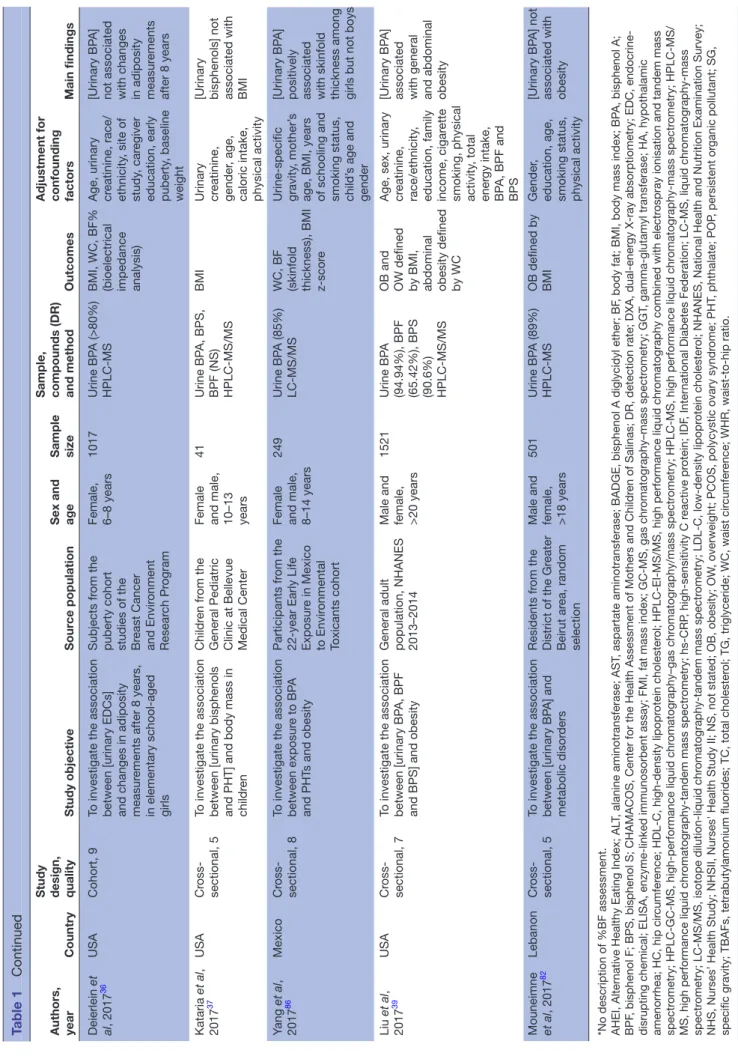
Among 15 studies involving adult participants, 12
studies17 21 38 39 49 51 52 64 68 69 72 73 found a positive
associa-tion between exposure to BPA and obesity. Two of these
studies were prospective; one of them21 reported that
higher urinary levels of BPA were modestly associated
with greater weight gain in women, whereas the other73
indicated that BPA exposure was positively associated with incident abdominal obesity in men and women.
Synthesis of data from 2 cross- sectional studies
including 3006 adults38 64 indicated that BPA
expo-sure was significantly associated with prevalent
over-weight, with a summary OR of 1.25 (figure 2A and
table 2). Synthesis of data from 4 cross- sectional studies
including 6248 adults17 39 64 82 indicated that BPA
expo-sure was significantly associated with prevalent obesity,
with a summary OR of 1.50 (figure 2A and table 2).
Moreover, synthesis of data from 4 cross- sectional
studies including 6777 adults17 39 64 68 indicated a
signif-icant association between BPA exposure and increased
WC, with a summary OR of 1.50 (figure 2A and table 2).
OC compounds
Twenty- five studies23–27 36 42–45 49 53–56 60–62 71 74 80 81 87–89
investigated the association between OC compounds
and obesity (table 3). Most obtained data from
population- based surveys or other epidemiological
studies. Among 12 studies involving children and
adoles-cents,23 25 26 36 42 44 53 56 62 71 74 81 6 reported positive
associ-ation23 25 26 36 53 81; 4 reported no association42 56 71 74; and
4 reported negative association23 44 53 62 between
expo-sure to specific OC compounds and obesity. Sixteen studies included adults; 11 reported positive associa-tion23 24 27 43 45 53–55 60 61 80; 4 reported no association49 87–89;
and 7 reported negative association23 44 45 53–55 60 between
OC compounds and measures of increased weight or adiposity. Three studies additionally indicated that the
association was age26 45 53 or gender26 53 55 dependent. Of
note, 5 studies24 36 55 56 74 had a prospective design. Two
of them reported positive association between exposure
to OCPs and prospective increases in BMI24 and WC55 in
adults. One study involving children reported a positive association between exposure to OCPs and prospective
changes in adiposity measures in girls aged 6–8 years,36
whereas 2 studies56 74 involving children found no
asso-ciation between exposure to OCPs or PCBs and
prospec-tive changes in BMI56 74 or WC.56
The individual OC compounds that were examined varied among the studies, and most assessed more than one compound. However, the association between specific OC compounds and obesity in children and adults was overall inconclusive. Pooled data from 2 studies assessing exposure to 2,4- dichlorophenol (DCP)
in childhood25 26 and one in adults27 indicated no
association with obesity (table 2). Data from 2 studies
assessing exposure to 2,5- DCP in childhood25 26
indi-cated a significant association with obesity (figure 2B
and table 2).
Phthalates
Eighteen studies21 28–31 37 41 57–59 67 72 75 76 83–86 examined
the association between exposure to PHTs and obesity (table 4). Seven studies30 37 41 67 75 76 86 were conducted
in children, 10 in adults21 28 31 57–59 72 83–85 and one in
both children and adults.29 An overall positive
asso-ciation between exposure to PHTs and measures of excess weight or adiposity was found; only 4 studies
on June 22, 2020 by guest. Protected by copyright.
http://bmjopen.bmj.com/
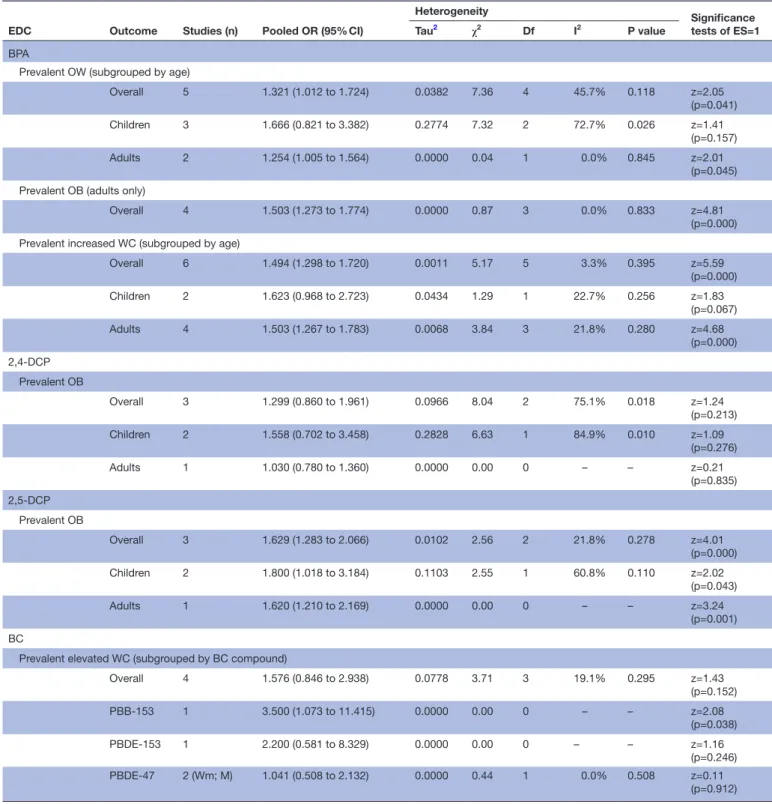
Table 2 Pooled estimates for the association between BPA, DCP or BC exposure and prevalent OW, OB and abdominal OB defined by WC; random- effect models
EDC Outcome Studies (n) Pooled OR (95% CI)
Heterogeneity Significance
tests of ES=1
Tau2 χ2 Df I2 P value
BPA
Prevalent OW (subgrouped by age)
Overall 5 1.321 (1.012 to 1.724) 0.0382 7.36 4 45.7% 0.118 z=2.05 (p=0.041) Children 3 1.666 (0.821 to 3.382) 0.2774 7.32 2 72.7% 0.026 z=1.41 (p=0.157) Adults 2 1.254 (1.005 to 1.564) 0.0000 0.04 1 0.0% 0.845 z=2.01 (p=0.045) Prevalent OB (adults only)
Overall 4 1.503 (1.273 to 1.774) 0.0000 0.87 3 0.0% 0.833 z=4.81
(p=0.000) Prevalent increased WC (subgrouped by age)
Overall 6 1.494 (1.298 to 1.720) 0.0011 5.17 5 3.3% 0.395 z=5.59 (p=0.000) Children 2 1.623 (0.968 to 2.723) 0.0434 1.29 1 22.7% 0.256 z=1.83 (p=0.067) Adults 4 1.503 (1.267 to 1.783) 0.0068 3.84 3 21.8% 0.280 z=4.68 (p=0.000) 2,4- DCP Prevalent OB Overall 3 1.299 (0.860 to 1.961) 0.0966 8.04 2 75.1% 0.018 z=1.24 (p=0.213) Children 2 1.558 (0.702 to 3.458) 0.2828 6.63 1 84.9% 0.010 z=1.09 (p=0.276) Adults 1 1.030 (0.780 to 1.360) 0.0000 0.00 0 – – z=0.21 (p=0.835) 2,5- DCP Prevalent OB Overall 3 1.629 (1.283 to 2.066) 0.0102 2.56 2 21.8% 0.278 z=4.01 (p=0.000) Children 2 1.800 (1.018 to 3.184) 0.1103 2.55 1 60.8% 0.110 z=2.02 (p=0.043) Adults 1 1.620 (1.210 to 2.169) 0.0000 0.00 0 – – z=3.24 (p=0.001) BC
Prevalent elevated WC (subgrouped by BC compound)
Overall 4 1.576 (0.846 to 2.938) 0.0778 3.71 3 19.1% 0.295 z=1.43 (p=0.152) PBB-153 1 3.500 (1.073 to 11.415) 0.0000 0.00 0 – – z=2.08 (p=0.038) PBDE-153 1 2.200 (0.581 to 8.329) 0.0000 0.00 0 – – z=1.16 (p=0.246) PBDE-47 2 (Wm; M) 1.041 (0.508 to 2.132) 0.0000 0.44 1 0.0% 0.508 z=0.11 (p=0.912) BC, brominated compound; BPA, bisphenol A; DCP, dichlorophenol; df, degree of freedom; EDC, endocrine- disrupting chemical; ES, estimate effect; M, men; OB, obesity; OW, overweight; PBB, polybrominated biphenyl; PBDE, polybrominated diphenyl ether; WC, waist circumference; Wm, women.
reported inverse associations,29 31 59 86 and 2 reported no
association.
Exposure to PHTs was assessed by determining
urinary21 28–31 37 41 58 59 67 72 75 76 83–86 or serum57 67 84 levels
of PHT metabolites in all studies. The exact set of metab-olites varied among studies. Likewise, the specific PHT metabolites associated with measures of obesity also varied. Of note, 6 studies involving both male and female
children and/or adults reported age- dependent and
gender- dependent associations between urinary concen-trations of PHT metabolites and measures of excess body
weight.29 30 57 59 85 86
Other EDCs
Five studies24 32 33 55 60 investigated the association
between polybrominated biphenyl (PBB) and obesity
on June 22, 2020 by guest. Protected by copyright.
http://bmjopen.bmj.com/
Table 3
Human studies addr
essing exposur
e to OC compounds and obesity (n = 25)
Authors, year
Country
Study design, quality
Study objective
Sour
ce
population
Sex and age
Sample size
Sample, compounds (DR) and method
Outcomes
Adjustment for confounding factors
Main findings Hue et al , 2007 89 Canada Cr oss-sectional, 5
To investigate the association between [plasma OC compounds] and obesity
NS
Male and female, steady body weight, contr
ol 38.8±9.4 years (n=16), obese 38.6±7.6 years (n=19), morbidly obese 44.3±9.2 years (n=18) 53
Plasma 14 PCBs (28, 52, 99, 101, 105, 118, 128, 138, 153, 156, 170, 180, 183, 187) (NS) 11 chlorinated pesticides (β-HCH, HCB, p,p’- DDE,
nonachlor , oxychlor dane, nonachlor , aldrin, α -chlor dane, γ-chlor dane) (NS) p,p’-DDT (7.5%) mir ex (22.4%) MS BMI Age [T otal plasma OC
compounds] not corr
elated with BMI Dhooge et al , 2010 53 Belgium Cr oss-sectional, 6
To investigate the association between exposur
e to
pollutants and body size
Selection fr
om a
stratified cluster
ed
multistage design, as a random sample of adolescents and adults r
esiding in
the study ar
ea
Male and female, 14–15 years and 50–65 years 1679 adolescents, 1583 adults Serum PCB 118, 138, 153, 180, HCB,
DDE, CALUX analysis of
the dioxin fraction of dioxin- like activity in plasma (NS)
ECD
BMI
Adolescents: blood lipids, age, height of father and mother
,
smoking, sexual maturation (Tanner), food intake. Adults: blood lipids, age, smoking, food intake
[Serum HCB, sum PCB 118, 153, 180] negatively associated with BMI, and [PCB118] positively associated with BMI in adolescents [Serum sum PCB 138, 153, 180] negatively associated with BMI, and [serum HCB, p,p’-DDE and PCB118, dioxin fraction] positively associated with BMI in adult men [Sum PCB138, 153, 180] negatively associated with BMI, and [HCB, p,p’-DDE and PCB118] positively associated with BMI in adult women
Elobeid et al , 2010 23 USA Cr oss-sectional, 5
To investigate the association between [serum OC compounds] and BMI/WC General population, NHANES 1999– 2002 Male and female, 6 years to > 40 years
2464
Serum HpCDD, OcDD, oxychlor
dane, nonachlor , p,p’-DDT (NS) MS BMI, WC Serum TC and TG
[Serum p,p’-DDT] positively associated with WC in all subjects [Serum oxychlor
dane
and HpCDD] positively associated with WC in subjects with detectable levels of these compounds [Serum OcDD] incr
eased
with higher WC and BMI [Serum
nonachlor]
decr
eased with higher BMI
Continued
on June 22, 2020 by guest. Protected by copyright.
http://bmjopen.bmj.com/
Authors, year
Country
Study design, quality
Study objective
Sour
ce
population
Sex and age
Sample size
Sample, compounds (DR) and method
Outcomes
Adjustment for confounding factors
Main findings Dirinck et al , 2011 54 Belgium Cr oss-sectional, 4
To investigate the association between [serum OC compounds] and BMI, WC, fat mass and
IR
Outpatients from the weight management clinic of the Department of Endocrinology
,
Diabetology and Metabolism of the Antwerp University Hospital (obese); hospital staf
f
and volunteers
weight
contr
ols)
Male and female, 21–60 years (median 40 years)
144 Serum PCB (153, 138, 180, 170, sum PCB), DDE, HCH (NS) MS
BMI, WC, FM (total abdominal, visceral abdominal, subcutaneous abdominal), FM%
None
[Serum PCB 153, 180, 180, sum PCB] negatively corr
elated with BMI,
WC, FM%, total and subcutaneous abdominal adipose tissue [Serum
HCH] positively
corr
elated with BMI,
WC, FM%, and total and subcutaneous abdominal adipose tissue
Lee et al , 2011 24 USA Cohort, 7
To investigate the association between [serum OC compounds] and adiposity
,
dyslipidaemia, and insulin resistance over 18 years
diabetic contr ols fr om the Cor onary Artery Risk Development in Y oung Adults study
Male and female, 18–30 years at baseline (27.2±3.3
years)
90
Serum 9°C pesticides (44%–100%), 35 PCB congeners (7%– 100%)
HRMS
BMI
Age, sex, race, TG, TC,
C,
IR,
baseline
BMI
[Serum p,p’-DDE] and PCBs with > 7 chlorines pr
edicted
higher BMI after 18 years (inverted
shaped curve acr oss quartiles) Twum et al , 2011 25 USA Cr oss-sectional, 6
To investigate the association between [urinary OC compounds] and obesity General population, NHANES 2003– 2004, NHANES 2005–2006 Male and female, 6–19 years
6770 Urine DCP (92%), DCP (99%), phenylphenol (<40%) MS
BMI, obesity (BMI > p95 for sex and age)
Age, gender
, race,
income, total fat intake
[Urinary
DCP] associated
with childhood obesity
Lee et al , 2012 55 Sweden Cr
oss-sectional, 6, and prospective, 7 To investigate the association between [plasma POPs] and pr
evalent
abdominal obesity
, cr
oss-sectionally and prospectively
Participants fr om the Pr ospective Investigation of the V asculatur e in Uppsala Seniors
Male and female, 70 years (at baseline)
970 (cr
oss-sectional) 511 (prospective) Plasma 17 PCB (98.7%–100%) 5°C pesticides (p,p’- DDE,
nonachlor , HCB, chlor dane, cis-chlor dane(3.4–100%)) HRMS WC, abdominal obesity (WC > 102 cm for men and > 88 cm for women)
Total calorie intake, exer
cise,
smoking, alcohol consumption, TG, TC [Plasma less chlorinated PCBs, p,p’-DDE and dioxin] associated with abdominal obesity (inverted
shape
relation, particularly in women) [Plasma highly chlorinated PCB] inversely associated with abdominal obesity Similar but weaker associations between [plasma POPs] and development of abdominal obesity after 5 years
Arr ebola et al , 2012 87 Bolivia Cr oss-sectional, 3
To describe [serum and adipose tissue OC compounds] in an urban adult population fr
om
Bolivia and its association with demographic characteristics Subjects under going non-cancer - r elated sur gery at a
general hospital in Santa Cruz de la Sierra Male and female, >16
years
(31.4±12.6
years)
112
Serum and adipose tissue p,p’-DDT (50%), p,p’-DDE (93%), HCB (21%), PCB congeners 138,153,180 (56%–80%)
ECD
BMI
None
[Serum and adipose tissue OC compounds] not corr
elated with BMI
Table 3
Continued
Continued
on June 22, 2020 by guest. Protected by copyright.
http://bmjopen.bmj.com/
Authors, year
Country
Study design, quality
Study objective
Sour
ce
population
Sex and age
Sample size
Sample, compounds (DR) and method
Outcomes
Adjustment for confounding factors
Main findings Ben et al , 2013 88 Tunisia Cr oss-sectional, 4
To describe [serum OC compounds] in the general population of Bizerte, T
unisia,
and investigate its association with age, gender and BMI Subjects visiting the Regional Hospital of Bizerte, in T
unisia
Male and female, >18
years,
not
pr
egnant and
without critical or heart disease
113
Serum HCB, p,p’-DDE, PCB 153, PCB 180 (100%) Dieldrin, heptachlor
, PCB 18, 28, 31, 52, 44 (0%) HCH, lindane, p,p’-DDD, p,p’-DDT , PCB congeners 101, 149, 118, 138, 194 (1.7%–95.6%) MS BMI Serum lipids
[Serum OCPs and PCB congeners 153, 138, 180 and sum PCB] not associated with BMI
Lankester et al ., 2013 43 USA Cr oss-sectional, 7
To investigate the association between [urinary TCS] and BMI General population, NHANES 2003– 2003 Male and female, >20 years
4037 Urine TCS (75%) MS/MS BMI Survey year , sex,
age, race, poverty index ratio, urinary BP
A, urinary
cotinine
[Urinary TCS] positively associated with incr
eased BMI Roos et al , 2013 60 Sweden Cr oss-sectional, 6
To investigate the association between [plasma OC compounds] and abdominal obesity Subjects aged 70 years randomly chosen fr
om
the r
egister of
community living from Uppsala, Sweden Male and female, 70 years
1016
Plasma 16 PCBs, p,p’-DDE, HCB, TNC (>95.5%); OcDD (80.6%);
chlor dane, chlor dane (<10%) HRMS BMI, V AT/SA T
ratio (determined by MRI)
Gender
, education,
exer
cise habits,
smoking
[Plasma less chlorinated PCBs, p,p’-DDE, HCB, TNC] positively associated with both V
AT and SA
T
[Plasma highly chlorinated PCBs] inversely r
elated to both V AT and SA T [Plasma PCB189] corr elated with V AT/SA T ratio in an inverted shaped manner Buser et al , 2014 26 USA Cr oss-sectional, 7
To investigate the association between [urinary POP] and BMI z- scor
e, WC and
obesity
General adult population, NHANES 2007–2008 and 2009–2010 Male and female, 6–19 years (mean 12.56±0.1
years) 1298 Urine DCP (98.5%), DCP (90%), TCS (79%) HRMS BMI scor e,
WC, overweight (BMI p85–p95), obesity (BMI > p95) Age, sex, race/ ethnicity
, calorie
intake, television and video game and computer usage (6–11 years), physical activity (12–19 years), serum cotinine, poverty income ratio, urinary cr
eatinine [Urinary DCP , DCP]
positively associated with BMI
scor
e, WC and
obesity
. After stratification
for age, the associations remained significant only in adolescents.
W ei et al , 2014 27 USA Cr oss-sectional, 7
To investigate the association between [urinary POP] and obesity General adult population, NHANES 2005– 2006, NHANES 2007–2008 Male and female, 20–85 years
2931 Urine DCP (92.6%), DCP (99%) MS
BMI, obesity (BMI >
30 kg/m 2), obese (< 30 kg/m 2) Age, gender , race,
income, education, total fat intake, physical activity
,
urinary cr
eatinine
[Urinary
DCP] positively
associated with obesity
Li et al , 2015 44 USA Cr oss-sectional, 6
To investigate the association between [urinary TCS] and obesity traits General adult population, NHANES 2003– 2010 Female and male, childr
en
(6–19 years) and adults
(>20 years) 2898 childr en 2066 adults Urine TCS (77%–79%) MS/MS BMI and WC Race/ethnicity ,
socioeconomic status, serum cotinine, (urinary BP
A)
[Urinary TCS] inversely associated with BMI and WC in childr
en and adults
Table 3
Continued
Continued
on June 22, 2020 by guest. Protected by copyright.
http://bmjopen.bmj.com/
Authors, year
Country
Study design, quality
Study objective
Sour
ce
population
Sex and age
Sample size
Sample, compounds (DR) and method
Outcomes
Adjustment for confounding factors
Main findings Zong et al , 2015 45 USA Cr oss-sectional, 7
To investigate the association between [serum OC compounds] and body fat General adult population, NHAES
1999–2004
Female and male, >20 years
2358 Serum p,p’-DDE, p,p’-DDT , b-HCH, HxCDD, OcDD, HpCDF , PCB (126, 138, 153, 169, 170, 180, 187, 194, 196,199) (30%–69%) HRMS FM% (DXA)
Serum lipids, gender
, age,
ethnicity
,
education, physical activity
,
smoking status, alcohol consumption, history of parity and lactation
[Serum
HCH, HpCDF
,
OcDD, PCB126] positively associated with trunk FM% (corr
elations str onger in subjects >40 years); [serum PCB 138, 153, 169, 170, 180, 187, 194, 196] inversely corr elated with FM% Tang- Pér onar d et al , 2015 56 Denmark Cohort, 7
To investigate the association between [serum POP] at 8–10 years of age and changes in measur
es of
obesity at 14–16 years and 20–22 years
Childr en form the Eur opean Y outh Heart Study , Danish component
Male and female, 8-10 years at baseline
392
Serum PCB sum (PCB 138, 153, 180), p,p’-DDE, HCB (NS) GC
BMI scor e, WC, %BF Baseline obesity , br east feeding, mater nal
educational level, mater
nal smoking,
mater
nal BMI,
pubertal status, physical fitness (maximal work test), dietary intake [Serum POP] not associated with subsequent changes in measur
es of obesity Geens et al , 2015 49 Belgium Cr oss-sectional, 6
To investigate the association between [urinary TCS] and anthr
opometric
data and serum thyr
oid hormones,
to evaluate the dynamics of [urinary TCS] during 1
year of
weight loss, to estimate daily TCS intake and investigate daily intake dif
fer
ences
during weight loss and to evaluate variations in exposur
e sour ces accor ding to tr eatment method
for weight loss (bariatric sur
gery/
diet)
OW and obese adults fr
om
the Endorup trial (Antwerp University Hospital); lean contr
ols fr
om
hospital staf
f and
volunteers
Female and male, >18 years
194 Urine TCS (>90%) MS BMI, WC Age, gender ,
weight loss, urinary cr
eatinine
No dif
fer
ence between
[urinary TCS] in obese and lean subjects at baseline No significant change of [urinary TCS] during weight loss
Xue et al , 2015 71 India Cr oss-sectional, 6
To investigate the association between [urinary POPs] and obesity Endocrinology Outpatient Department of the Amrita Institute of Medical Sciences, Kochi, India Male and female, 2–14 years 103 (49 OW or obese and 27 normal- weight healthy contr
ols)
Urine TCS (100%)
MS
BMI (OW defined by BMI > p85
and
obesity
defined by BMI > p95) Age, sex, family income, par
ent
education, physical activity
,
urinary cr
eatinine
(Urinary TCS) not associated with obesity
Table 3
Continued
Continued
on June 22, 2020 by guest. Protected by copyright.
http://bmjopen.bmj.com/
Authors, year
Country
Study design, quality
Study objective
Sour
ce
population
Sex and age
Sample size
Sample, compounds (DR) and method
Outcomes
Adjustment for confounding factors
Main findings Lee et al , 2016 74 South Kor ea Cohort, 8
To investigate the association between [serum OC compounds] and pr
ospective
change of metabolic components of metabolic syndr
ome
Subjects fr
om
the Ewha Birth & Growth Cohort study Female and male, 7–9 years 214 (158 completed
up)
Serum PCB (52, 101, 118, 138, 153, 156, 180), marker PCB (sum 28, 52, 101, 138, 153, 180),
like PCB (sum 77, 81, 114, 105, 126, 123, 156, 157, 169, 167, 189), nonachlor , HCB, HCH, p,p’-DDT , p,p’-DDE) (61.68%–99.53%) PCB (1, 3, 4, 15, 19, 28, 37, 77, 81, 104, 105, 114, 123, 126, 155, 157, 167, 169, 188, 189, 202, 205, 206, 208), oxychlor dane, chlor dane, heptachlor , heptachlor epoxide, HCH, HCH, HCH, o, p’-DDT , p,p’-DDD, o,p’-DDD, o,p’-DDE (NS) MS
BMI, BMI z- scor
e
Gender
, age,
monthly household income, baseline BMI, serum lipids No association between (serum OC compounds) and change in BMI after 1
year Deierlein et al , 2017 36 USA Cohort, 9
To investigate the association between [urinary EDCs] and changes in adiposity measur
ements
after 8 years, in elementary-
aged
girls
Subjects fr
om the
puberty cohort studies of the Breast Cancer and Envir
onment Resear ch Pr ogramme Female, 6–8 years 1017 Urine DCP (>80%) TCS (>80%) MS
BMI, WC, BF% (bioelectrical impedance analysis) Age, urinary creatinine, race/ ethnicity
, site of
study
, car
egiver
education, early puberty
, baseline
weight
(Urinary
DCP and TCS)
associated with incr
ease in adiposity measur ements after 8 years Harmouche et al , 2017 80 Lebanon Cr oss-sectional, 6
To investigate serum levels of six indicator PCBs and differ
ences in
PCBs levels by gender
, age and
BMI
Students and employees of Saint Joseph University Female and male, 17–65 years
316
Serum PCB 28, 52, 101, 138, 153, 180 (50%–60%)
ECD
BMI, BF% (bioelectrical impedance analyser) Total serum lipids, age, gender
,
smoking status, dairy pr
oduct,
fish and shellfish consumption (Serum sum PCB) associated with OW and OB in and
U shaped
manner
Table 3
Continued
Continued
on June 22, 2020 by guest. Protected by copyright.
http://bmjopen.bmj.com/
Authors, year
Country
Study design, quality
Study objective
Sour
ce
population
Sex and age
Sample size
Sample, compounds (DR) and method
Outcomes
Adjustment for confounding factors
Main findings Henriquez- Her nandez et al , 2017 61 Spain Cr oss-sectional, 4
To investigate the association between exposur
e to POPs
and OB and type two diabetes
Subjects fr
om the
Canary Islands Nutrition Survey Female and male, >18 years
429 Serum p,p DDT (<50%), DDE (<50%), DDD (<50%), p,p DDE (85.8%), p,p DDD
(<50%), aldrin (64.1%), dieldrin (<50%), endrin (68.3%), HCH
α (88.1%), HCH β (<50%), HCH δ (<50%), HCH γ (55.7%) PCBs 153 (77.2%), 180 (85.1%), 28, 52, 77, 81, 101, 105, 114, 118, 123, 126, 138, 153, 156, 157, 167, 169, 180, 189 (<50%) ECD (OCPs), MS (PCBs) BMI, to-hip ratio None
(Serum p,p’-DDE) higher among OW and OB subjects
Karlsen et al , 2017 62 Denmark Cr oss-sectional, 6
To investigate the association between [POPs] and obesity
Subjects fr
om the
National Hospital of the Far
ol Islands
Female and male, 5 years
349
Serum sum PCB 138, 153, 180 (100%), HCB (100%), p,p’DDE (100%)
ECD
BMI
scor
e, OW
(> p85)
Serum lipids, mater
nal nationality , age at delivery , pr epr egnancy BMI,
smoking during pregnancy
, child’ s gender , exclusive br eastfeeding duration, child’ s
fish intake at age 5 years (Serum OC compounds) inversely associated with BMI
scor e Parastar et al , 2017 81 Iran Cr oss-sectional, 2
To investigate the association between [urinary pesticides] and obesity in childr
en
and adolescents
Selection fr
om
households in differ
ent ar
eas of
Isfahan, Iran
Male and female, 6–18 years
242 Urine DCP (94.6%), DCP (95%), TCP (85.1%), TCP (38%) MS
BMI, BMI z- scor
e, WC
Urinary cr
eatinine,
physical activity
,
fasting blood sugar
, blood pr essur e, TC, C, C [Urinary DCP] positively
associated with BMI
scor
e
and WC; [urinary 2,4,5- TCP] positively associated with WC; [urinary
DCP]
associated with obesity
Table 3
Continued
Continued
on June 22, 2020 by guest. Protected by copyright.
http://bmjopen.bmj.com/