Adobe's Mechanical Characterization in Ancient Constructions: The
Case of Aveiro's Region
Tiago Martins
1,aand Humberto Varum
1,b1
Civil Engineering Department, University of Aveiro, 3810-193 Aveiro, Portugal a
[email protected], [email protected]
Keywords: Adobe, Mechanical behaviour, Compressive strength, Tensile strength, Young modulus
Abstract. Adobe is commonly found in Aveiro's ancient constructions. Preservation and rehabilitation of those constructions, some of them with architectural and historical interest, has been forgotten for many years. As a result, in Aveiro region, the majority of existing constructions in adobe is structurally weak, and, in several cases, they are in the threshold of ruin. Rehabilitation and/or strengthening urge.
Despite some efforts has been made, a great difficulty for technicians working on the rehabilitation of these constructions relies on the lack of knowledge on adobe's mechanical behaviour. In fact, in order to properly describe the structural behaviour of those constructions, there is a need to investigate the mechanical behaviour of adobe. Hence, this paper is based on a study intended to characterise the behaviour of adobe brick units. Specimens were prepared from selected representative constructions of the Aveiro region. The prepared specimens were tested in order to evaluate their mechanical behaviour in compression and tension.
Introduction
Adobe was for millenniums the main construction material in the world. Many ancient buildings were built with this material and some of them are still in good conditions to be used and appreciated as important constructions of architectural interest, which attests the considerable mechanical characteristics of these materials and structures, as per example the constructions in the south of Spain [2].
In Aveiro's region, it is still common to find ancient adobe buildings. In this ancient region, known by the time as Gandaresa, adobe was the principal structural material for the great majority of buildings made until about the middle of the previous century [3].
However, this important legacy was forgotten since the arrival of other structural materials, such as concrete. It was the beginning of a progressive decay in adobe construction. Even in the existing constructions, the preservation and rehabilitation of those structures have been neglected. Consequently, nowadays, adobe constructions are structurally weak, and, several of them, ruined. For that reason, it is essential the rehabilitation and/or strengthening of those structures. Despite some efforts that are being made by researchers and technicians working in the rehabilitation field, the lack of knowledge on adobe's mechanical behaviour still is the main obstacle in the preservation of those constructions. In fact, in order to describe properly the structural behaviour of those constructions, there is a need to investigate the mechanical behaviour of adobe. Therefore, the main purpose of the study presented in this paper is to characterise the mechanical behaviour of adobe blocks.
Testing procedure
The great variety of adobe in terms of dimensions, and the immeasurable different components used on its production, makes it a material with an enormous variability in terms of mechanical
All rights reserved. No part of contents of this paper may be reproduced or transmitted in any form or by any means without the written permission of the publisher: Trans Tech Publications Ltd, Switzerland, www.ttp.net. (ID: 193.136.173.43-18/04/07,16:22:15)
properties. Considering this difficulty, for the mechanical behaviour characterisation, it was selected a set of specimens representative of the adobe traditionally used in Aveiro's region.
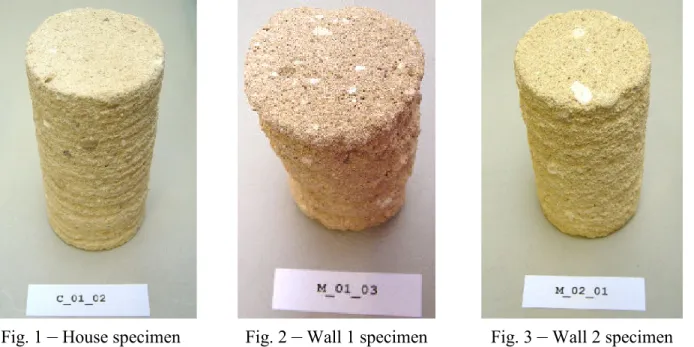
Cylindrical specimens were extracted from three different constructions in adobe. One series of specimens were extracted from a small (Fig. 1) house and the other two series were extracted from two walls (Fig. 2 and 3). The constitution of these three adobe's are significantly different, and consequently the strength also reflects that, as will be presented in the test results.
Fig. 1
–
House specimen Fig. 2–
Wall 1 specimen Fig. 3–
Wall 2 specimenA total of 16 cylindrical specimens were drilled from adobe brick units, to study their mechanical behaviour. The extracted specimens were prepared (regularization of the bases, normalization of the dimensions), in order to be tested in similar conditions of orthogonality and size (about 170 mm height and 85 mm diameter).
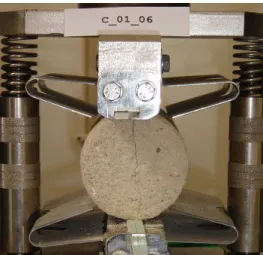
The specimens were divided in two groups, one to perform the compression tests (Fig. 4), and the other for the diametral compression tests (Fig. 5).
Due to adobe standard mechanical tests' inexistence, it were followed the RILEM technical recommendations for concrete specimen tests [4], to evaluate the compressive and tensile strength of the adobe specimens. The compressive strength was determined from the failure compression load divided by the specimen area resisting to the load and reported in units [N/mm2], as described in RILEM CPC4. The compressive strength is commonly used in the safety assessment and design of constructions.
The diametral compression test was used to determine the tensile strength of the adobe. A compressive load was applied across the diameter of the specimen creating a nearly uniform state of tension across a vertical plane. Tensile strength of the specimen was measured by increasing the compressive load until the specimen fails in tension. The tensile strength, as described in RILEM CPC6 [4], is given by:
σ = 2F/(πDH) [N/mm2] where:
F is the load applied [N];
D is the diameter of the specimen [mm]; and, H is the height of the specimen [mm].
Fig. 4
–
Compression tests Fig. 5–
Diametral compression testsAnalysis and discussion of the test results
In this section are presented the stress-strain behaviour curves obtained, for the compression and diametral compression tests (Fig. 6 to 9). The obtained results are discussed.
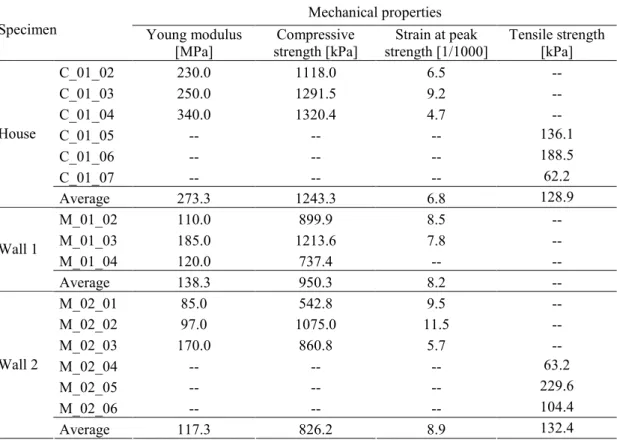
From the stress-strain behaviour curves, it was registered the peak strength (compressive strength and tensile strength, derived from the diametral compression test). The Young modulus was also estimated from the stress-strain curves for low levels of stress (between 10% and 20% of the specimen strength). In Table 1 are summarised the results obtained for each tested specimen. For the specimen M_01_05, the obtained curve was inconclusive, so this result was not included in the summary table.
Fig. 6
–
Compression test – House Fig. 7–
Diametral compression test – House0 40 80 120 160 200 0 5 10 15 20 25 30 Strain (/1000) S tr e s s ( k P a ) C_01_05 C_01_06 C_01_07 C_01_05 C_01_06 C_01_07 0 200 400 600 800 1000 1200 1400 0 5 10 15 20 25 30 35 Strain (/1000) S tr e s s ( k P a ) C_01_02 C_01_03 C_01_04 C_01_02 C_01_03 C_01_04
Fig. 8
–
Compression test – Walls Fig. 9–
Diametral compression test – WallsTable 1
–
Summary table of the test results Mechanical propertiesSpecimen Young modulus
[MPa] Compressive strength [kPa] Strain at peak strength [1/1000] Tensile strength [kPa] C_01_02 230.0 1118.0 6.5 -- C_01_03 250.0 1291.5 9.2 -- C_01_04 340.0 1320.4 4.7 -- C_01_05 -- -- -- 136.1 C_01_06 -- -- -- 188.5 C_01_07 -- -- -- 62.2 House Average 273.3 1243.3 6.8 128.9 M_01_02 110.0 899.9 8.5 -- M_01_03 185.0 1213.6 7.8 -- M_01_04 120.0 737.4 -- -- Wall 1 Average 138.3 950.3 8.2 -- M_02_01 85.0 542.8 9.5 -- M_02_02 97.0 1075.0 11.5 -- M_02_03 170.0 860.8 5.7 -- M_02_04 -- -- -- 63.2 M_02_05 -- -- -- 229.6 M_02_06 -- -- -- 104.4 Wall 2 Average 117.3 826.2 8.9 132.4
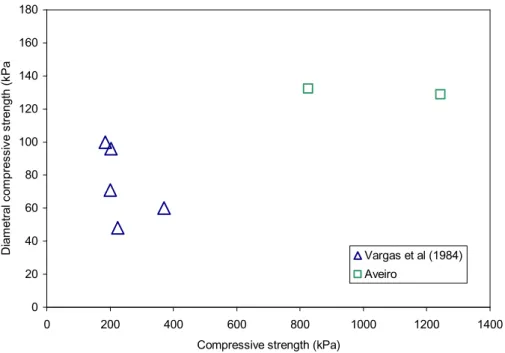
In Fig. 10 are plotted, for each test series, the average strength obtained from the compression test and from the diametral compression test.
In an attempt to find a correlation between the two strengths the obtained results for Aveiro's adobes were compared with the results presented in the study of Vargas et al. [1]. In this work, soils from six zones of Peru where adobe construction is traditional were selected, namely from Cajamarca, Cuzco, Huancayo, Huaraz, Pisco and PUC. It is underlined that in these zones the adobe is manufactured as a mixture of soil and water, without any additives. The soil samples were collected, prepared and tested to estimate the mechanical strength of the traditional adobe. For the mechanical characterization of these adobe samples, it was evaluated the compressive and tensile strength. In the graphic of Fig. 10, are confronted the mechanical strength results from the Aveiro
0 50 100 150 200 250 0 10 20 30 40 50 Strain (/1000) S tr e s s ( k P a ) M_02_04 M_02_05 M_02_06 M_02_04 M_02_05 M_02_06 0 200 400 600 800 1000 1200 1400 0 5 10 15 20 25 30 35 Strain (/1000) S tr e s s ( k P a ) M_01_02 M_01_03 M_01_04 M_01_05 M_02_01 M_02_02 M_02_03 M_01_02 M_01_03 M_01_04 M_01_05 M_02_01 M_02_02 M_02_03
and Peru adobes's. The adobe from Aveiro has higher strength (compressive and tensile). It is possible to perceive also a tendency for a correlation between the compressive and tensile strength.
0 20 40 60 80 100 120 140 160 180 0 200 400 600 800 1000 1200 1400
Compressive strength (kPa)
D ia m e tr a l c o m p re s s iv e s tr e n g th ( k P a ) Vargas et al (1984) Aveiro
Fig. 10
–
Compressive strength versus Diametral compressive strength ConclusionsThe main objective of this work was to estimate the strength of adobe and, to characterize its mechanical behaviour, in terms of behaviour curves.
The results obtained from the compression tests show significant compressive strength (0.5-1.2 MPa). For the tensile strength was obtained approximately 20% of the corresponding compressive strength. Comparing the results obtained for the walls and house specimens, it can be observed higher strength and stiffness (Young's modulus) values for the specimens' extracted form the house. The walls specimens' presented a higher heterogeneity, and consequently variability in the results. Attending to the great variability in the constitution and dimensions of the adobe blocks, a more exhaustive testing campaign would be required. Therefore, it was already started a complementary testing campaign in order to better represent the existing adobe construction in Aveiro's region. Finally, an important work has been already started in order to understand the influence of the adobe's granulometric composition in the mechanical properties (strength and stiffness) heterogeneity.
Acknowledgments
The authors would like to acknowledge the Ceramics and Glass Department for its technical support, who made possible the tests carried out.
References
[1] J. Vargas; J. Bariola; M. Blondet and K. Mehta (1984) - Seismic strength of adobe masonry - Tutorials on Earthquake-Resistant Housing Construction Practices – Adobe tutorials – Earthquake Engineering Research Institute - U.S. Agency for International Development (AID) Research Project DI-84-01.
[2] J.R. Arango González, Uniaxial deformation-stress behaviour of the rammed-earth of the Alcazaba Cadima, Materials and Structures, University of Granada (Spain), 1999.
[3] E. Veiga Oliveira and F. Galhano, Arquitectura Tradicional Portuguesa, Portugal de perto, Publicações D. Quixote, Lisboa, 1992.
[4] RILEM Technical Recommendations for the Testing and Use of Construction Materials (1994), E & FN Spon, London, England.