The impact of a writing programme on reading acquisition of
at-1
risk first grade children
2 3
Liliana Salvador & Margarida Alves Martins 4
Centro de Investigação em Educação (CIE-ISPA) & ISPA-Instituto Universitário 5
6
(Text received March 25, 2018; accepted April 15, 2018)
7 DOI: 8 9 10 11
Abstract: Our aim was to assess the impact of a writing programme on the reading
12
acquisition of first graders considered at-risk of developing reading difficulties. 13
Eighteen children from six classrooms of three primary schools attended this 14
programme. Their results on literacy tests at the end of the first trimester were very 15
low when compared to those of the remaining 91 children attending the same 16
classrooms. This programme, based on a socio-constructive approach, had 12 17
sessions. In each session, children were asked to discuss the writing of words and 18
sentences until they reached an agreement. The adult's role was to guide and question 19
children along their process of discovery and reflection. The dynamics that occurred 20
during the sessions and the adult’s help (scaffolding) were characterized. At the end of 21
the programme, children who underwent the intervention reached similar reading 22
results as the remaining children in the classrooms. 23
24
Keywords: Reading, learning, writing programme, scaffolding
25 26
Resumen: Nuestro objetivo fue evaluar el impacto de un programa de escritura en el
27
aprendizaje de la lectura de niños de primer grado considerados en riesgo de 28
desarrollar dificultades de lectura. Dieciocho niños de seis clases de tres escuelas de 29
Educación Primaria asistieron al programa. Sus resultados en pruebas de 30
alfabetización al final del primer trimestre fueron muy bajos en comparación con los 31
otros 91 niños de las mismas clases. Este programa, con un enfoque socio-32
constructivista, tuvo 12 sesiones. En cada sesión los niños debatieran sobre la escritura 33
de palabras y oraciones. El papel del adulto era guiar y cuestionar a los niños a lo 34
largo de su proceso de descubrimiento y reflexión. Se analizaron las dinámicas que 35
ocurrieron durante las sesiones y las ayudas del adulto (andamiaje). Al final del 36
programa, los niños que asistieron al programa alcanzaron resultados de lectura 37
similares a los otros niños de las mismas clases. 38
39
Palabras-clave: Lectura, aprendizaje, programa de escritura, andamiaje
40 41
Resumo: O nosso objetivo foi avaliar o impacto de um programa de escrita na
42
aprendizagem da leitura de crianças do 1º ano de escolaridade em risco de desenvolver 43
dificuldades de leitura. Dezoito crianças de seis turmas de três escolas de 1º ciclo 44
participaram neste programa. Os seus resultados em testes de literacia no final do 45
primeiro trimestre eram muito baixos quando comparados com os das restantes 91 46
crianças dessas turmas. Este programa, baseado numa perspectiva socio-construtivista, 47
teve 12 sessões. Em cada uma, foi pedido às crianças que discutissem a escrita de 48
palavras e de frases. O papel do adulto foi o de guiar e questionar as crianças ao longo 49
do processo de descoberta e de reflexão. Analisámos as dinâmicas ocorridas durante 50
as sessões assim como as ajudas do adulto (scaffolding). No final do programa, as 51
crianças que passaram pela intervenção atingiram resultados semelhantes em leitura 52
aos das restantes crianças das turmas. 53
54
Palavras-chave: Leitura, aprendizagem, programa de escrita, “scaffolding”
55 56
Introduction
57
Learning to read is often considered a rather simple task that many children acquire easily. 58
However, there are children that have difficulties that prevent them from acquiring reading 59
skills similar to those of children of their age and school year, and which may result in future 60
difficulties in other academic areas with impact on motivation and on learning in general. 61
In order to overcome the problems presented by children at-risk of reading failure, 62
several investigations involving phonological awareness and reading programmes were 63
developed (e.g. Ball & Blachman, 1988; Bradley & Bryant, 1983; Hatcher, Hulme, & 64
Snowling, 2004). However, these studies have not focused on the advantages of using writing 65
activities to enhance reading acquisition in the beginning of formal schooling. Recent studies 66
have evidenced the causal relationship between early writing activities and later reading 67
acquisition and, consequently, the development of skills that exceed phonological awareness 68
such as alphabetic knowledge and orthographic awareness (e.g., Alves Martins, Albuquerque, 69
Salvador, & Silva, 2013; Alves Martins, Salvador, Albuquerque, & Silva, 2016; Ouellette & 70
Sénéchal, 2008; Sénéchal, Ouellette, Pagan, & Lever, 2012). Writing activities seem to have, 71
therefore, an enormous pedagogical value by promoting reading and writing abilities in 72
children that may, or not, be at-risk of developing learning difficulties in these areas. 73
Learning how to read and write depends, in great extent, to how well children 74
understand the alphabetical principle, that is, the notion that the sounds of words can be 75
represented by letters in a more or less regular way (Adams, 1998). The difficulty or ease to 76
master these principles depends, in part, on orthographic language characteristics. European 77
Portuguese for instance, has a considerable degree of complexity as a result of various 78
irregularities and inconsistencies. According to Seymour, Aro and Erskine (2003), European 79
Portuguese, although being a language of simple syllabic structure, is a semi-transparent 80
orthography rather than a transparent one. In Portuguese, one letter can code several sounds 81
(e.g., x can represent the sound [ʃ] in xilofone, [s] in próximo, [z] in exato or [ks] in táxi), or 82
one sound can be coded by several letters (e.g.: the sound [s] can be represented by s in sino, 83
ss in assobio, ç in maçã or c in cesto). 84
Chomsky (1971, 1979) was one of the first authors who suggested that the first 85
approach to reading should be through children's own writing attempts. During writing 86
activities, the segmentation of words into sounds and the attempt to match a grapheme to a 87
phoneme helps to promote decoding skills (Frith, 1985). Moreover, when children read what 88
they wrote, they immediately consolidate the association between graphemes and phonemes 89
allowing, in the future, the storage of these words in memory (Lombardino, Bedford, Fortier, 90
Carter, & Brandi, 1997). The teaching and practice of early writing provides, therefore, an 91
appropriate and enriched context for the development of phonological awareness and 92
knowledge of the alphabet, skills that are essential to reading acquisition (Treiman, 1993). 93
The first studies that involved writing activities prior to formal instruction focused on 94
the analysis of the errors made by children. These errors, as they represent knowledge 95
children already have about writing, constitute an essential tool for understanding children's 96
functioning and processes underlying writing procedures (Bosman & Van Orden, 1997). This 97
developmental approach to literacy breaks with the traditional conception that the acquisition 98
of the multifaceted processes implicit in reading and writing is intrinsically dependent on 99
formal teaching (Tolchinsky, 2004, 2016). 100
According to Ferreiro (1988) and Ferreiro and Teberosky (1979) all children have 101
some knowledge about the writing system, which must be valued and should serve as a 102
starting point for any future learning. Ferreiro (1994, 2002) and Vernon and Ferreiro (1999) 103
showed that writing activities are, in fact, a privileged way to promote metalinguistic 104
reflection and to understand the relationship between oral and writing units that underlie the 105
alphabetic principle. 106
Lo que estamos proponiendo, para el aprendiz que es hablante de una lengua con una 107
representación alfabética de la misma, es un proceso dialéctico a múltiples niveles 108
donde, para empezar, el objeto lengua no está dado. Ese objeto debe ser construido en 109
un proceso de objetivación, proceso en el cual la escritura provee el punto de apoyo 110
para la reflexión. Tampoco las unidades de análisis están dadas; ellas se redefinen 111
continuamente, hasta corresponder (aproximadamente) con las que define el sistema 112
de representación. (Ferreiro, 2002, p. 167). 113
114
Ferreiro’s work has inspired many other studies in other languages and sociocultural 115
contexts, such as Portuguese (e.g., Alves Martins & Quintas Mendes, 1987; Alves Martins & 116
Silva, 2006). The innovative method used by Ferreiro and Teberosky (1979) consisted of 117
individual Piagetian interviews that require critical exploration by the child during situations 118
of writing productions, where cognitive conflicts and reflections about his/her own production 119
were promoted. 120
Recent studies by Alves Martins et al. (e.g. 2013, 2016, 2017) have sought to 121
understand and establish relationships between preschool children’s writing programmes and 122
reading acquisition, carried out individually or in small groups. These studies, following those 123
by Clarke (1988), Rieben, Ntamakiliro, Gonthier, & Fayol (2005) and Ouellette and Sénéchal 124
(2008), have contributed to the acknowledge that writing activities have great impact on 125
reading acquisition, supporting the theoretical assumptions that there is a causal relationship 126
between writing and reading and that they are interdependent. 127
These programmes, based on constructivist and socio-constructivist principles intend 128
to promote children’s reflection about their own writing and more evolved writings produced 129
by other children, with the help of an adult. 130
The programmes developed with children in groups also intended to expose children 131
to situations in which it is necessary to build a collective solution to a problem, think together 132
and present ideas about the writing processes, with the guidance or mediation of an adult. 133
According to Teberosky (1982), when children argue in order to reach a final solution to a 134
problem taking other children’s opinions into account they actually make a reflective 135
integration instead of a passive acceptance of their arguments. Group programmes also offer 136
the possibility of reaching more children at a time while they are closer to classroom contexts. 137
They promote metalinguistic thinking under the supervision of the adult who constantly 138
evaluate children’s difficulties in order to give them the help they need, whenever necessary. 139
The adult’s mediation process used in these programmes that may be fundamental to 140
explain their efficacy consists mainly in the use of scaffolding strategies, that is, the 141
assistance provided to each child, in order that he/she may successfully complete a task that 142
alone she/he would be unable to complete (Wood, Bruner, & Ross, 1976). Insofar as 143
scaffolding consists of a dynamic intervention well aligned with the student's continuous 144
progress, the help or support provided by the teacher depends on a large extent on the 145
characteristics of the situation, the type of task, and the student's responses (Pol, Volman, & 146
Beishuizen, 2010). Knowing when and how to withdraw support is also a basic function of 147
the adult (Cole, 2006) who must master a wide repertoire of scaffolding strategies, adapting 148
them as much as possible to the different needs of each child (Pentimonti & Justice, 2010). 149
In a recent study carried out by Alves Martins, Salvador, Albuquerque and Montanero 150
(2017) the authors analyzed and characterized the strategies used by the adults during a 151
writing programme to help children to think about their written productions facilitating, thus, 152
the development of reading and writing skills. The results show a predominance of 153
questioning strategies, especially those that promote children’s thinking and reasoning about 154
phoneme-grapheme correspondences. The authors also described many procedural 155
elaborations that provided modeling of the procedures to adopt in order to write words, 156
namely, linguistic procedures. One feature that clearly characterizes these programmes is the 157
residual occurrence of instructions/corrections. It is important to note that the amount of help 158
needed by the children substantially decreased along the programmes, which suggest that 159
children internalize procedures and require less guidance or mediation from the adult, passing 160
on the control of the learning process to them. With this study, is was possible to state the 161
idea that programmes like this are not limited to direct instruction and involve complex 162
scaffolding processes, which can, along with the promotion of diversified psycholinguistic 163
abilities, be the basis of its success (Cubero, 2005). 164
The main purpose of the present study is to assess the impact of a writing programme 165
carried out with children attending first grade at risk of developing learning difficulties on 166
their word reading ability and to analyse the scaffolding strategies used by the adult during 167
the intervention sessions. Several studies were developed in Portugal with pre-school children 168
(e.g. Alves Martins, 2013, 2016, 2017) but none with children at-risk of reading failure in the 169
initial year of formal schooling. 170
171
Method
172
Design. This was an intervention study that was developed in different phases: In the first, 173
there was an initial assessment of all the children that attended six classes of the first grade of 174
the primary schools that participated in this study (N=109). Children at-risk of having reading 175
problems were selected (N=18). In the second phase, these children underwent a writing 176
programme for six weeks (twice a week). In the third phase, there was a final assessment of 177
the reading performance of all children (N=109). 178
Participants. Participants were 109 children who attended six classes of three public 179
primary schools in the Lisbon area. Eighteen children (9 boys and 9 girls), were considered 180
at-risk of developing reading difficulties by their teachers at the end of the first trimester. 181
Their phonological awareness, alphabet knowledge and word reading performance when 182
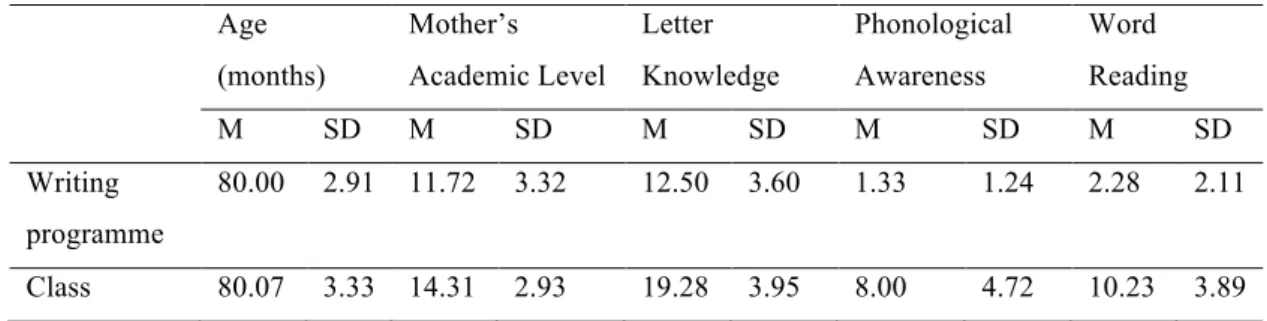
compared with those of the other children who attended these classes was very low as can be 183
seen in Table 1. Their age was equivalent, and their mother’s academic level was lower when 184
compared to the other children as can also be seen in Table 1. 185
The descriptive statistics (means and standard deviations) in terms of age, mother 186
academic level, letter knowledge, phonological awareness and word reading either for the 187
children at risk of reading failure (writing programme) and for the remaining children in the 188
different classrooms (class) are shown in Table 1. 189
190
Table 1. Descriptive statistics for age, mother academic level, letter knowledge, phonological awareness and
191 word reading. 192 193 Age (months) Mother’s Academic Level Letter Knowledge Phonological Awareness Word Reading M SD M SD M SD M SD M SD Writing programme 80.00 2.91 11.72 3.32 12.50 3.60 1.33 1.24 2.28 2.11 Class 80.07 3.33 14.31 2.93 19.28 3.95 8.00 4.72 10.23 3.89 194
The 18 children at-risk of reading failure underwent a writing programme in pairs in 195
order to improve their writing and reading abilities. 196
Measures. Letter knowledge was assessed by Test 4 (reading of letters) and Test 8 197
(writing of letters) from ALEPE (European Portuguese Reading Assessment Battery, 2011). 198
In Test 4 the child was asked to read all 23 letters from the alphabet, presented randomly in 199
the computer, excluding k, w, y (letters that are not usually used in Portuguese words). Test 8 200
is similar to test 4 but instead of reading, the child was asked to write down a sequence of 201
letters dictated. The maximum score for each test was 23 points. 202
To assess children’s phonemic awareness, we used two phonemic sub-tests from Sim-203
Sim’s (2006) phonological battery tests of ALO (Oral Language Assessment), the 204
reconstruction and segmentation tests. Thus, in the phonemic reconstruction task children 205
were asked to say the word that was given to them by the adult already segmented in 206
phonemes while in the segmentation task children should themselves decompose a word in 207
phonemes. Each task consisted of 10 items preceded by 2 examples, and every item was 208
scored with 1 point if the child answered correctly and 0 points if the answer wasn’t correct so 209
that the lowest score was 0 and the highest 10, for each task. 210
In order to assess children’s ability to read we used Test 2, A list (applied to first 211
graders or children of equivalent level) from ALEPE (Sucena & Castro, 2011) which consists 212
in a standardized test of word reading. The words have different levels of orthographic 213
complexity: simple orthographies, that is, words whose grapheme-phoneme correspondences 214
don’t change and are, therefore, bi-univocal (e.g., mota); consistent orthographies – words 215
with a low level of complexity that include complex graphemes (e.g., “lh”) and contextual 216
regularities (e.g., “s” that sounds [z]) that don’t admit variations in the way they are read; 217
inconsistent orthographies – words whose level of complexity is high and that involve lexical 218
and/or morphological knowledge, therefore, not depending on contextual regularities, as the 219
previous ones. In this test, all words are dissyllables with medium level of frequency in 220
Portuguese. It has 18 items preceded by 4 training items: 9 are simple words, 6 consistent 221
words and 3 inconsistent words. We asked the child to, successively, read each word as 222
quickly and accurately he/she could. The maximum score was 18 points, scoring 1 point for 223
each word correctly read and 0 points for a null or incorrect word reading. 224
Procedure. Children were individually assessed in a quiet room outside the classroom. 225
The initial assessment took place in January and the final one in May, just after the end of the 226
intervention programme. 227
The writing programme was carried out with children in pairs, during 12 sessions of 228
20-30 minutes each, twice a week, during March and April. 229
All the sessions - assessment and intervention programme – were audio recorded for 230
further analysis. A specially trained educational psychologist conducted the intervention 231
sessions. 232
After transcribing random interaction sessions of different groups, we analyzed them 233
in order to provide a characterization of the strategies the adult used to help children evolve in 234
their writing and the procedures children should be able to internalize once the programme 235
was over. Scaffolding messages or functional units were isolated without losing any 236
information about the context in which they occurred (Coll, Onrubia, & Mauri, 2008). Each 237
support message given by the adult was analyzed, using a system of educational support 238
categories based on the study of Alves Martins et al. (2017). 239
The writing programme. This programme was designed to lead the children, in pairs, 240
to discover the spelling of different words, to think about the grapheme-phoneme 241
correspondences, to understand and internalize the rules of the written code. The adults’ role 242
consisted of questioning the children’s ideas, guiding them, making them realize that certain 243
sounds are coded by certain letters, and that, in order to do so, they need to properly isolate 244
the sounds of the spoken words so that they can start using conventional letters in their 245
writing. Although with major differences, this programme was inspired mainly in the works 246
of Ferreiro (1988) and Alves Martins et al. (e.g. 2013, 2016, 2017). 247
In the beginning of each session, the adult introduced a contextualized activity, such as 248
reading a story, watching a short film, listening to music or watching a music video. These 249
activities provided a context and a meaning to the spelling activity that would follow. After 250
each child was asked to write, in interaction with his/her partner, several single words or short 251
phrases, and was encouraged by the adult to discuss the spelling of each word and to reach an 252
agreement. Then, the adult showed them the conventional writing of the words and asked 253
them to confront and compare both writings and to give reasons why they thought one was 254
better. The children were never told that the word the adult presented was the correct one in 255
terms of spelling, to encourage them to think about the different spellings. Children had to 256
make their own inferences, to think with their partner and present their own reasons. The 257
adult mediated and guided children’s discussions, using both linguistic analysis strategies 258
(drawing attention to some specific sounds, for the use of certain letters or for contextual 259
rules), as well as scaffolding strategies (such as asking questions, getting children to think and 260
reason, providing clues to facilitate inferences, managing the group). The adult always 261
avoided further interference, like teaching or instructing children. 262
The choice of the words was based on the following criteria: In the first sessions, we 263
used frequent words with a common syllabic structure in Portuguese (consonant-vowel-264
consonant-vowel) and with regular sound correspondences. The words used in the following 265
sessions were less frequent words with more complex syllabic structures; we also used 266
phrases in order to expose children to some formal aspects of writing that children usually do 267
not master when they enter formal schooling. We made sure that all words were 268
contextualized (came from the materials presented to them in the activity that was previously 269
developed), although we were careful not to expose them to their written form. 270
An example of an interaction that occurred between two children and the adult during 271
the third session of the writing programme is presented in Appendix I. Children were asked to 272
discuss how to write the title of a song they had previously heard. The adult wrote down in a 273
cardboard the letters children dictated him. The title was “A Dieta do Porco Toneladas” [The 274
diet of the Pig Toneladas] and the transcript presented in Appendix I is only of the words “do 275 Porco”. 276 277
Results
278Reading results at the end of the year. Concerning reading, Table 2 presents the descriptive 279
statistics for the measures of single word reading after the programme, for the children who 280
underwent the writing intervention programme, and for the other children. As shown in Table 281
1, there was a very big discrepancy between these two groups of children in January. Children 282
at risk of developing reading difficulties had a very low performance in the reading task 283
before the intervention, being able to correctly read 2 words out of 18 while the remaining 284
children had much better results, being able to read, approximately, ten words. 285
286
Table 2. Descriptive statistics for words correctly read by the children of the writing programme and the
287
remaining children in the classrooms after the intervention
288 289 Reading M SD Writing Programme 12.28 2.40 Class 13.54 3.69 290
After the implementation of the programme, we can verify that the group that 291
underwent the intervention reached mean values very close to those presented by the 292
remaining children, their performance having improved in a very significant way. There are 293
no statistically significant differences between the two groups t(107)=-1.39, p=.167. Children 294
who underwent the writing programme were actually able to reach the class level of 295
performance in reading at the end of the programme. 296
Adult’s scaffolding strategies. We isolated different scaffolding strategies used by the 297
adult: 298
a) Questioning, whose main intention is to obtain a response directly related to the task 299
(eg. 8.“ So, POR, how do we write POR?”; 39.“What is this letter, before the C? [points to 300
R]”). 301
b) Inferential questioning, used to make children think about the way words are 302
written (related to procedures or linguistic reasoning), taking into account what the child 303
already knows and giving implicit clues with the purpose of facilitating an inference (e.g. 44. 304
“What letter is written there that we didn’t write here?”). 305
c) Implicit clues, that many times follow questions that are, in fact, implicit guidelines 306
for procedures of linguistic analysis, concerning the sounds of the spoken words (e.g. 10. 307
“POOOR”; 41. “PORRRCO”). 308
d) Explanation request, that aims to request for clarification or justification of an idea 309
expressed by the child (e.g. 20.“Why do you think it’s the P and the T?”). 310
e) Asking for confirmation, a question directed to the child so that she/he expresses her 311
agreement or disagreement with what was said or written previously (e.g. 24.“He says it's P. 312
Let's agree on the first letter. Do you agree that it is P?”). 313
e) Positive feedback, used to motivate and encourage children to continue the task, 314
decreasing, therefore, the possibility of withdrawal when tasks get more difficult, as well as 315
increasing children’s independence and autonomy by providing a feeling of competency 316
during the completion of the task (e.g. 37.“Very well!”; 50.“Well done!”). 317
f) Procedural instruction that aims to provide the children with explicit procedures 318
that allow him/her to solve the task (e.g. 5. “Let's write PORCO. Say it, PORCO. Let’s divide 319
the word. First is POR and then CO."). 320
g) Explaining, that aims to explain or clarify (e.g. 47. “It's R. The R has the sound 321
[r]”). 322
h) Focusing, that aims to direct or redirect the attention of the child to a specific part 323
of the task (e.g. 30. “Now, let’s focus on the second syllable, CO.”). 324
The first six strategies (low-level of support strategies) were the most frequent. The 325
last three strategies (high- level of support strategies), occurred less frequently and were 326
gradually reduced or exclusively used in moments considered essential for the resolution of 327
the task. They occurred, typically, in the beginning of the programme, when children showed 328
the need for more guidance from the adult and decreased substantially, or even disappeared, 329
in the last sessions. 330
All scaffolding strategies were adapted to the needs of the children and varied between 331
different groups. Some groups needed a higher level of support than other ones. In all cases, 332
the help of the adult decreased from the first sessions to the last ones, even when the 333
complexity of the writing task increased. 334
335
Discussion
336
The main purpose of our research was to understand if a writing intervention programme, 337
carried out in pairs, with first grade children considered at-risk of developing difficulties in 338
reading acquisition had a positive and significant impact on reading abilities. In fact, the 339
results obtained allow us to state that writing activities, more specifically writing activities 340
based on a constructivist and socio-constructivist approach, designed to act in the zone of 341
proximal development, influence decisively the acquisition of the reading in children at-risk 342
of reading failure. In this sense, following other studies carried out for preschool children, it 343
seems possible to establish an effective relationship between the development of writing 344
activities and reading (Alves Martins et al., 2016; Ouellette & Sénéchal, 2008), even when 345
they are at-risk of reading difficulties (Sénéchal et al., 2012). 346
We also sought to understand whether the performance in terms of word reading of 347
children that underwent the writing programme improved in a way that made them get closer 348
to the results displayed by the remaining children in the classrooms. Although the initial 349
performance of the class was much superior to that of the at-risk children the final results 350
clearly point to the fact that children benefited greatly from the writing programme, being 351
able to attain the reading performances of the other children. 352
These results are similar to those obtained by Clarke (1988), who found that children 353
in classrooms where writing activities were used, as a curriculum resource, systematically 354
obtained higher values in tasks that involved word reading than children in classrooms where 355
such activities were not used. This effect was, in fact, superior in children who had low 356
performance in reading tasks. Therefore, writing activities where children are asked to contact 357
and explore the written code as a way to access the alphabetical principle can be especially 358
beneficial for children with difficulties. 359
It is important to note that, although these results clearly underline the success of the 360
writing programme in terms of word decoding, we did not measure the reaction times that 361
would help us to complement the information with reading fluency data. In fact, studies 362
indicate that children with difficulties in reading acquisition may easily decode words, 363
depending on their complexity and inconsistency; however, their reading fluency levels are 364
often below to those expected for their age (Lundberg, 2002). 365
In terms of knowing which strategies were included in the adult’s scaffolding 366
repertoire that had the purpose of inducing children thinking, making them argue and 367
cooperatively find together the solution to the problem of writing the words, we found that the 368
strategies more common in this programme were of low-level of support (Pentimonti & 369
Justice, 2010). They mainly consisted in questioning, helping children to make inferences and 370
giving certain linguistic clues as well as providing appropriate positive feedback. These 371
results are in line with those reported by Alves Martins et al. (2017). 372
It is important to mention that children showed the ability to integrate the procedures 373
modeled by the adult during the sessions. In most cases, less help was needed to perform the 374
task and there was a shift of the control of the task from the adult to the children that, 375
autonomously, begun to employ the linguistic analysis strategies and procedures necessary to 376
write words, without the adult’s intervention (Alves Martins et al., 2017). The adult also 377
adapted the strategies taking into account children’s needs, making this programme really 378
flexible and responsive in terms of individual differences. 379
The appropriateness of the scaffolding strategies used by the adult is one of the 380
essential characteristics of this programme that may have boosted the impact on reading 381
skills. By providing the child to become more autonomous, in control, and inducing self-382
regulation abilities, this writing programme has proved educational value and can be an 383
effective alternative or resource for children who are potentially at-risk of reading failure. 384
Finally, we point out some limitations to our study. Firstly, although our aim was to 385
assess the impact of the writing programme on reading, it would have been of interest to have 386
final measures of phonological awareness and writing of both at-risk children and classroom 387
children in order to compare them and evaluate if the impact of the writing activities on these 388
abilities were the same as for reading. Secondly, as we already stated, we have not assessed 389
children’s reading fluency. Thirdly, we did not analyze the interactions that occurred during 390
the sessions between the children, which might be relevant to understand which dynamics can 391
lead to better results. Regarding the educational implications of this study, we think it would 392
be interesting to adapt this type of programme to more naturalistic contexts, so that teachers 393
can implement them in their classes; we also think that the scaffolding strategies used in this 394
programme should be incorporated on teacher initial and in-service training, as they are 395
valuable tools to promote successful learning for all students. 396
397
Acknowledgments
398
This research was made possible through a grant from the Foundation for Science and 399 Technology, Portugal, SFRH/BD/90452/2012. 400 401
References
402Adams, M. (1998). Beginning to read: Thinking and learning about print (2nd ed.). 403
Cambridge, MA: MIT Press. 404
Alves Martins, M., Albuquerque, A., Salvador, L., & Silva, C. (2013). The impact of invented 405
spelling on early spelling and reading. Journal of Writing Research, 5(2), 215-237. 406
DOI: http://doi.org/10.17239/jowr-2013.05.02.3 407
Alves Martins, M., & Quintas Mendes, A. (1987). Evolução das conceptualizações infantis 408
sobre a escrita. Análise Psicológica, 5(4), 499-508. 409
Alves Martins, M., Salvador, L., Albuquerque, A., & Silva, C. (2016). Invented spelling 410
activities in small groups and early spelling and reading. Educational Psychology: An 411
International Journal of Experimental Educational Psychology, 36 (4) 738-752. DOI: 412
http://doi.org/10.1080/01443410.2014.950947 413
Alves Martins, M., Salvador, L., Albuquerque, A., & Montanero, M. (2017). "Otro niño lo 414
escribió así”. Ayuda educativa y resultados de actividades de escritura inventada. 415
Revista de Educación, 377, 161-183. DOI: http://doi.org/10.4438/1988-592X-RE-416
2017-377-357 417
Alves Martins, M., & Silva, C. (2006). The impact of invented spelling on phonemic 418
awareness. Learning and Instruction, 16(1), 41-56. DOI:
419
http://doi.org/10.1016/j.learninstruc.2005.12.005 420
Ball, E., & Blachman, B. (1988). Phoneme segmentation training: Effect on reading 421
readiness. Annals of Dyslexia, 38, 203-225. DOI: http://doi.org/10.1007/bf02648257 422
Bosman, A., & Van Orden, G. (1997). Why spelling is more difficult than reading. In C. 423
Perfetti, L. Rieben, & M. Fayol, (eds.), Learning to spell: Research, theory, and 424
practice across languages (pp.173-194). Hillsdale, NJ: Lawrence Erlbaum Associate. 425
Bradley, L., & Bryant, P. (1983). Categorizing sounds and learning to read: A causal 426
connection. Nature, 30, 419-421. 427
Chomsky, C. (1971). Write first, read later. Childhood Education, 47(6), 296-299. DOI: 428
http://doi.org/10.1080/00094056.1971.10727281 429
Chomsky C. (1979). Approaching reading through invented spelling. In L.B. Resnick & P. A. 430
Weaver (eds.), Theory and practice of early reading (Vol.2), (pp. 43–65). Hillside, NJ: 431
Erlbaum. 432
Clarke, L. K. (1988). Invented versus traditional spelling in first graders' writings: Effects on 433
learning to spell and read. Research in the Teaching of English, 22, 281-309. 434
Cole, A. (2006). Scaffolding beginning readers: Micro and macro cues teachers use during 435
student oral reading. The Reading Teacher, 59(5), 450-459. DOI: 436
http://doi.org/10.1598/RT.59.5.4 437
Coll, C., Onrubia J., & Mauri, T. (2008). Ayudar a aprender en contextos educativos: el 438
ejercicio de la influencia educativa y el análisis de la enseñanza. Revista de 439
Educación, 346, 33-70. 440
Cubero, R. (2005). Perspectivas constructivistas. La intersección entre el significado, la 441
interacción y el discurso. Barcelona: Graó. 442
Ferreiro, E. (1988). L’écriture avant la lettre. In H. Sinclair (Ed.), La production des notations 443
chez le jeune enfant (pp.18-69). Paris: Presses Universitaires de France. 444
Ferreriro, E. (1994). Diversidad y proceso de alfabetización: De la celebración a la toma de 445
conciencia, Lectura y Vida, 15(3), 5-14. 446
Ferreiro, E. (2002). Escritura y oralidad: unidades, niveles de análisis y conciencia 447
metalingüística. En Relaciones de (in)dependencia entre oralidad y escritura (pp. 448
151-171). Barcelona: Gedisa. 449
Ferreiro, E., & Teberosky, A. (1979). Los sistemas de escritura en el desarrollo del niño. 450
Mexico: Siglo XXI. 451
Frith, U. (1985). Beneath the surface of developmental dyslexia. In K. E. Patterson, J. C. 452
Marshall & M. Coltheart (eds.), Surface dyslexia: Neuropsychological and cognitive 453
studies of phonological reading (pp. 301-330). London: Earlbaum. 454
Hatcher, P., Hulme, C., & Snowling, M. (2004). Explicit phonological training combined with 455
reading instruction helps young children at risk of reading failure. Journal of Child 456
Psychology and Psychiatry, 45, 338-358. 457
Lombardino, L., Bedford, T., Fortier, C., Carter, J., & Brandi, J. (1997). Invented spelling: 458
developmental patterns in kindergarten children and guidelines for early literacy 459
intervention. Language, Speech, and Hearing Services in Schools, 28, 333-343. 460
Lundberg, I. (2002). The child's route into reading and what can go wrong. Dyslexia, 8(1), 1-461
13. DOI: http://doi.org/10.1002/dys.204 462
Ouellette, G., & Sénéchal, M. (2008). Pathways to literacy: A study of invented spelling and 463
its role in learning to read. Child Development, 79 (4), 899-913. DOI: 464
http://doi.org/10.1111/j.1467-8624.2008.01166.x 465
Pentimonti, J., & Justice, L. (2010). Teachers use of scaffolding strategies during read alouds 466
in the preschool classroom. Early Childhood Education Journal, 37, 241-248. DOI: 467
http://doi.org/10.1007/s10643-009-0348-6 468
Pol, J., Volman, M., & Beishuizen, J. (2010). Scaffolding in teacher-student interaction: A 469
decade of research. Educational Psychology Review, 22, 271-296. DOI: 470
http://doi.org/10.1007/s10648-010-9127-6 471
Rieben, L., Ntamakiliro, L., Gonthier, B, & Fayol, M. (2005). Effects of various early writing 472
practices on reading and spelling. Scientific Studies of Reading, 9(2), 145-166. DOI: 473
http://doi.org/10.1207/s1532799xssr0902_3 474
Sénéchal, M., Ouellette, G., Pagan, S., & Lever, R. (2012). The role of invented spelling on 475
learning to read in low-phoneme awareness kindergartners: A randomized-control-trial 476
study. Reading and Writing, 25, 917–934. DOI: http://doi.org/10.1007/s11145-011-477
9310-2 478
Seymour, P., Aro, M., & Erskine, J. (2003). Foundation literacy acquisition in European 479
orthographies. British Journal of Psychology, 94(2), 143-174. DOI: 480
http://doi.org/10.1348/000712603321661859 481
Sim-Sim, I. (2006). Avaliação da linguagem oral: Um contributo para o conhecimento do 482
desenvolvimento linguístico das crianças portuguesas. Lisboa: Fundação Calouste 483
Gulbenkian. 484
Sucena, A., & Castro, S. (2011). ALEPE: Avaliação da leitura em Português Europeu. 485
Lisboa: Cegoc. 486
Teberosky, A. (1982). Construcción de la escritura a través de la interacción grupal. En E. 487
Ferreiro & M. Gómez Palacio (eds.), Nuevas perspectivas en los procesos de lectura y 488
escritura (pp. 155-178). México: Siglo XXI. 489
Tolchinsky, L. (2004). Childhood conceptions of literacy. In, T. Nunes & P. Bryant (eds.), 490
Handbook of children’s literacy (pp. 11-29). Kluwer Academic Publishers. 491
Tolchinsky, L (2016). From text to language and back: The emergency of written language. In 492
Ch. A. MacArthur, S.Graham & J. Fitzgerald, (eds.), Handbook of Writing Research 493
2nd edition (pp. 144-159). New York: Guilford Press. 494
Treiman, R. (1993). Beginning to spell: A study of first-grade children. New York: Oxford 495
University Press. 496
Vernon, S., & Ferreiro, E. (1999). Writing development: A neglected variable in the 497
consideration of phonological awareness. Harvard Educational Review, 69(4), 395-498
415. 499
Wood, D., Bruner, J., & Ross, G. (1976). The role of tutoring in problem solving. Journal of 500
Child Psychology and Psychiatry, 17(2), 89–100. DOI: http://doi.org/10.1111/j.1469-501 7610.1976. tb00381.x 502 503
Appendix I
504Transcription of an interaction between two children and the adult in the 3rd session 505
1. Adult - And now another word: DO. 506
2. Child 1 - It's D and U. 507
3. Child 2 - No, no. (thinks for a while). Ah, yes it's D and U. 508
4. Adult - Like this? (Writes D and U). 509
5. Adult - Let's write PORCO. Say it, PORCO. Let’s divide the word. First is POR 510
and then CO.We are now writing POR. 511
6. Child 2 - It's the P and the O, PORCO, and then it's the U. 512
7. Child 1 - Wait, let me divide the word: POR-CO. 513
8. Adult - So, POR, how do we write POR? 514
9. Child 1 - It's the P and the U. 515
10. Adult - POOOR. 516
11. Child 2 - No, it’s not P and U. 517
12. Adult - POR. But do you agree that it has a P? 518
13. Child 2 - No, I do not agree. 519
14. Adult - Say POR. 520
15. Child 1 - It's P. 521
16. Adult - Let Catarina say. 522
17. Child 2 - POR. 523
18. Adult - Do you hear the sound of the P? 524
19. Child 2 - It's the P and the T. 525
20. Adult - Why do you think it’s the P and the T? Listen carefully: POR, do you hear 526
the sound [t]? 527
21. Child 2 - Wait, no, I was wrong. 528
22. Adult – So, what's the first letter? 529
23. Child 1 - It's P. 530
24. Adult - He says it's P. Let's agree on the first letter. Do you agree that it is P? 531
25. Child 2 - Starts with P. 532
26. Adult - And then? 533
27. Child 1 and Child 2 - It's the O. 534
28. Adult – It’s the O? [Writes down the O]. POR-CO. 535
29. Now, let’s focus on the second syllable, CO. 536
[They continue to write the rest of the word PORCO and afterwards the adult shows the 537
conventional writing of the part of the title they had just written never saying that it is the 538
correct one and asks the children to confront both writings. Children had written “DU POCO” 539
and the correct writing should have been “DO PORCO”] 540
30. Adult – DO, is it the same as ours or is it different? 541
31. Child 1 – It should be the O and not the U. 542
32. Adult - And why did we write U? 543
33. Child 1 - It's wrong. 544
34. Child 2 - It's wrong because U can only be read in a way [u] and O can be read in 545
... 546
35. Child 1 – The O can be read in two ways. 547
36. Child 2 - It can be read in three ways: it is [o], [u] and [ô]. 548
Bellaterra Journal of Teaching & Learning Language & Literature. 11.2 (May-June 2018) ISSN 2013-6196
37. Adult - Very well! And now, in the word PORCO. What is there (points out to the 549
correct writing) that is not here [points out to children's writing]? 550
38. Child 1 - Let's see, let's see ... 551
39. Adult – What’s this letter, before the C? [points to R] 552
40. Child 2 - It's R. 553
41. Adult -PORRRCO. Do you hear the [r] that the R has? PORRRCO. 554
42. Child 1 - Yes. 555
43. Child 2 - But we do not say "poreco". It is called "porco". 556
44. Adult - Catarina, say PORCO. We say the sound [r] so fast we can barely hear it. 557
What letter is written there that we didn’t write here? 558
45. Child 1 – It’s the R. 559
46. Adult - It's R. The R has the sound [r]. 560
47. Child 1 – Does it? 561
48. Child 2 - Yes, Diogo, it does. 562
49. Child 1 - I thought it was the sound [R]. 563
50. Adult – Ok, kids. Well done! 564
565 566
Información sobre las autoras:
567
Liliana Salvador es investigadora en el CIE, ISPA – Instituto Universitário, habiendo obtenido el grado de
568
doctor de Psicología Educacional en diciembre de 2017 en esta institución. Colabora en proyectos en el área de
569
la adquisición del lenguaje escrito y de las dificultades de aprendizaje de la lectura. Su tesis investigó el impacto
570
de un programa de escritura en interacción en la adquisición de la lectura.
571
Email: [email protected]
572 573
Margarida Alves Martins é doutorada em Ciências da Educação pela Universidade René Descartes, Paris V e
574
em Psicologia Pedagógica pela Universidade de Coimbra. É professora catedrática de Psicologia da Educação no
575
ISPA-Instituto Universitário, Lisboa, Portugal, onde leciona cursos de Mestrado e de Doutoramento. Dirige o
576
Centro de Investigação em Educação (CIE-ISPA), onde desenvolve investigação sobre os processos de
577
aprendizagem da escrita e da leitura. É autora de diversos livros e artigos e orienta teses de doutoramento e de
578
Mestrado na área da linguagem escrita.
579
Email: [email protected]
580 581 582
To cite this article:
583
Salvador, L. & Alves Martins, M. (2018). The impact of a writing programme on reading acquisition of at-risk
584
first grade children. Bellaterra Journal of Teaching & Learning Language & Literature, 11(2), 74-90. DOI:
585 xxxx 586 587 588 589