Research and practice: Bridging the gap or changing the focus?
1João Pedro da Ponte
University of Lisbon, Portugal
Abstract. Bridging the gulf that tends to persist between research in mathematics education and mathe-matics teaching practice is a timely issue. This comment addresses the impact of research not only on teachers’ practices and the curriculum, but also on students’ practices, teacher education practices, the educational market, and the society at large. It argues that for research to bring about changes in mathe-matics teaching and learning we need to act at a systemic level. It also argues that if we want to have a real influence on practice, we need to see that as a problem on itself. It concludes indicating that our con-fidence in the power of research to understand phenomena and intervene in practice must be combined with an attitude of social responsiveness, working closely with different social partners and being critical and reflective about what we do.
Key words:. Impact of research and practice, Teachers’ practices, Students’ learning, Curriculum change Resumo. Tapar o fosso que tende a persistir entre a investigação na educação matemática e a prática de ensino é uma questão urgente. Este comentário debruça-se sobre o impacto da investigação não apenas nas práticas de ensino dos professores e no currículo, mas também nas práticas dos alunos, nas práticas de formação de professores, no mercado educacional, e na sociedade em geral. Argumenta que, para que a investigação traga mudanças no ensino e na aprendizagem da Matemática, é necessário agirmos ao nível sistémico. Também argumenta que, se quisermos ter uma influência real na prática, precisamos de ver que isso constitui um problema em si mesmo. O artigo conclui indicando que a nossa confiança no poder da investigação para compreender os fenómenos e intervir na prática deve ser combinado com uma atitu-de atitu-de responsabilidaatitu-de social, trabalhando estreitamente com diferentes parceiros sociais e sendo críticos e reflexivos em relação ao nosso próprio trabalho.
Paralvaras-chave. Impacto da investigação na prática, Práticas dos professores, Aprendizagem dos Alu-nos, Mudança curricular.
This is a timely paper on a pressing issue: How to deal with the gulf that tends to persist between research in mathematics education and mathematics teaching practice? The author reviews some previous articles on this issue, discusses a number of success-ful cases, and contrasts them with her own experience. She provides several interesting and important reflections on which I wish to comment.
Teachers’ practices, researchers practices, and students’ practices
I find particularly important Boaler’s suggestion that in order to change teach-ers’ teaching practices it is absolutely necessary that something changes in their profes-sional culture – teachers need to become more adept at continuing learning throughout
1
Ponte, J. P. (2008). Research and practice: Bridging the gap or changing the focus? In M. Menghini, F. Furinghetti, L. Giacardi & F. Arzarello (Eds.), The first century of the International Commission on
their professional lives. Another suggestion that I wish to underline is that something also needs to change in the practices and culture of researchers, who should be more concerned with doing more relevant research (from the point of view of the needs of teachers and policy makers), with publicizing in new ways the ideas and results from research (in written form and using other media such as video), and with working in news ways with teachers and school systems.
In addition, I wish to emphasise that students’ learning practices are also im-portant when discussing the real impact of research on students’ learning. On a large scale, students’ learning practices are difficult to document. However, in small scale teaching experiments we have many examples of successful research that have contrib-uted to our knowledge about students’ learning practices and to the emergence of new learning practices. That has certainly been the case with a number of teaching experi-ments conducted in many countries. I can document this in the case of Portugal, where, under the heading of students’ exploring and investigating mathematics we have seen considerable change taking place with remarkable influence on students’ learning (see Ponte, 2001, 2007 for some examples). In fact, students’ exploring and investigating mathematics is a perspective that resonates with Boaler’s (1997) former research as well as with the stress she puts in her paper on the role of research as a process of construct-ing knowledge.
Impact of research on teaching practices
Boaler discusses in her paper the shortcomings of the “linear model” of dissemi-nation of research results and of several alternative models. She emphasises the idea that a proper use of research requires learning. She also indicates several features of research programs that had strong influence on teacher’s practices and policy documents: (i) providing living examples, in attractive form, (ii) valuing at least some aspects of what teachers already do, and (iii) providing continuous support to teachers who are commit-ted to change. These are all quite reasonable and resonate with my own experience as well as with my views about teachers’ practices and processes of changing (Ponte & Chapman, 2006).
On another level, Boaler indicates several examples of successful research pro-jects that had a significant influence on practice. It would be useful, perhaps, to use the distinction between “fundamental oriented research”, that seeks to produce knowledge
and results that are presented and convincingly argued on standard research papers (and this is the kind of research that is currently most valued by universities), and “applied oriented research” that seeks to produce artefacts and intervention programs that bear directly on teaching and teacher education. The best examples of research that impacted practice are those that produce educational materials (such as the Freudhental Institute) or intervention programs (such as the Cognitively Guided Instruction or the projects of Bob Wright or Julia Anghileri that Boaler describes in her paper). Boaler repeatedly presents her former research as an example of lack of impact on practice, but I find that unsurprising, since this was “fundamental oriented research” and (to my knowledge) did not produce many artefacts or intervention programs susceptible of influencing teaching practices, students’ learning practices, teaching education practices or curriculum de-velopment practices. This distinction between “fundamental” and “applied” research is not to mean that we should only carry out applied research. By the contrary, sound ap-plied oriented projects need to base themselves on fundamental oriented research. And because of this, some fundamental oriented research may have also an important indi-rect impact on practice. However, if this impact is not carefully crafted through applied projects, it may turn out to be more confusing and misleading than effective.
Impact on the curriculum
Discussing the issue of the gap between research and practice, Boaler considers for the most part the impact of research on teaching practice, but she also pays consider-able attention to the impact of research on the curriculum. These are two natural levels to address, but we must keep in mind that teaching practice affects directly students’ learning, and that is not the case with the curriculum.
As our speaker indicates, research has a very significant impact on the curricu-lum in a number of countries. Let me add another example, that she did not mention, the case of Portugal. A new curriculum for basic education (grades 1-9) has just been fin-ished by a team that I coordinated and that included teachers, mathematicians, and other mathematics educators. A quite difficult obstacle was the very narrow deadlines framed by the Ministry and this was solved by complex negotiations with the politicians. An-other obstacle were the radicalized positions of different groups and organizations that intervene in mathematics education, with rather opposite views in many matters (e.g., use of calculators, rote learning of algorithms, prescription of specific teaching guides
and learning objectives, etc.) and this required a careful decision of what to include. In-stead of putting “everything research says” in the curriculum, we weighted those ideas that were most important to stress and that were more likely to be accepted and put into practice by teachers.
Based on this strategy, we strived to design a coherent curriculum that would improve the existing curricula documents for different cycles (grades 1-4, 5-6, and 7-9) instead of having the pretension of starting everything from scratch with a brand new solution. In the same vein as the French researchers who worked on curriculum devel-opment that Boaler refers, we looked to research for ideas that were useful and suffi-ciently stable in the mathematics education discourse. We paid special attention to summaries of research such as Kilpatrick, Martin and Shifter (2003) and to mathematics education research handbooks and also to studies carried out in our country. Our solu-tion was to emphasise big ideas in mathematics educasolu-tion such as developing number sense, spatial sense and algebraic thinking. We also brought to a similar level the math-ematics themes (number and operations, geometry, data handling and algebra) and what we regarded as fundamental transversal capacities (problem solving, mathematics rea-soning, and mathematics communication). So, instead of a direct translation of results of research on curriculum into a curriculum document, we experienced another kind of connection between research and practice, as we brought our knowledge and expertise as researchers to mathematics education at an institutional level.
Now that the document was approved by the Ministry of Education (in Decem-ber 2007), we face a still bigger challenge. Will its main ideas find their way into the conceptions and practices of teachers and of those who are closely related to mathemat-ics teaching and assessment such as textbook authors and writers of exam papers? We are now beginning the implementation process, in which much negotiation and careful decisions will again be required but in which drawing on the results and products of former research and the expertise of Portuguese researchers and teachers involved with research will be certainly of key importance.
Looking beyond the relations between researchers and teachers
The paper by Boaler gives much attention to the relations between researchers and teachers. It also addresses, although with much lesser emphasis, the relations be-tween researchers and policy makers. I fully support most of what is said in the paper in
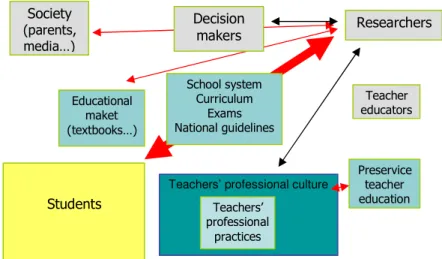
these two levels. However, I think that there are other relationships that need to be ad-dressed if we want to understand how mathematics education research may influence teaching practices and learning practices and what are the obstacles in achieving these goals. In particular, we need to consider the relationships of researchers with (i) the so-ciety at large, and particularly with parent organizations and the mass media; (ii) the educational market, that has an increasing influence on education and includes the text-book industry and the educational industry that produces all kinds of resources (espe-cially digital resources such as interactive CD, on-line materials…); and (iii) the stu-dents themselves, since they should not be seen as passive consumers of what the sys-tem offers them, but as active participants in the learning process (figure 1).
Figure 1 – Social players influencing mathematics teaching and learning
Another level that I find important in discussing the relationships of research and practice is preservice teacher education. Research can be brought into preservice education in several ways. For example, research results about students’ learning, properly translated, may be put into the curriculum of specific courses for preservice teachers. Research results and concepts about the design and the processes of effective teacher education may be used by teacher educators to improve their teacher education models and practices. And, on a more fundamental way, teacher education may be an important laboratory allowing the fusion of expert practice of experienced teachers with the controlled innovation promoted by teacher educators and the critical energy and ir-reverence proper of young preservice teachers and students. Bringing all these actors
Teachers’ professional culture
Society (parents, media…) Educational maket (textbooks…) Teachers’ professional practices Students Decision makers Researchers School system Curriculum Exams National guidelines Preservice teacher education Teacher educators
working together constitutes a significant source of energy to change teaching and learning practices. Of course, similar considerations could be made regarding inservice teacher education.
To conclude
In ending this paper, I would like to stress two ideas. The first one is that for re-search to bring about changes in mathematics teaching and learning we need to act at a
systemic level. As I indicated above, mathematics education researchers need to work together with teachers and decision makers, but they also need to address the media, parents, textbook authors, and students. And they need to work closely with school and district administrators as well. Lasting and enduring change will only come across from a change of cultures in all these settings and this requires also political and organiza-tional changes from mathematics education researchers.
The second idea is that if we want to have a real influence on practice, we need
to see that as a problem on itself. Influence on practice will not come just as a by prod-uct of a nice research project that was able to disseminate very well its prodprod-ucts. It is something that applied oriented projects need to consider as part of their research prob-lem and to carefully address on their research designs.
I find that the problem of influencing practice, albeit difficult, is tractable. It all depends on the social and institutional conditions and on the position of the researchers regarding them. We can get smarter about influencing practice but we must also ask ourselves if all such impact on practice is desirable. We must not forget that other scien-tific fields that had a strong impact on the natural world are now plagued with unfore-seen problems – just think of global warming, dilapidation of resources, and environ-mental disasters. Intervention towards change is barely needed, but we must be careful with the consequences of our interventions.
In sum, we may be quite positive about the power of mathematics education re-search as an essential way of generating knowledge about problems and processes. Tak-en in a broad perspective, research may be practiced not only by professional research-ers but also by teachresearch-ers and students, who also may experience the processes of inquir-ing, collecting and interpreting evidence and drawing implications from it. However, this confidence in the power of research to understand phenomena and intervene in practice must be combined with an attitude of social responsiveness, leading researchers
to work closely with different social partners and being critical and reflective about what they do. That is, I suggest, an essential element of the ethics of intervention orient-ed research.
References
Boaler, J. (1998). Experiencing school mathematics: Teaching styles, sex and setting. Buckingham: Open University Press.
Boaler, J. (2008). Bridging the gap between research and practice: International exam-ples of success. (This volume).
Kilpatrick, J., Martin, W. G., & Shifter, D. (Eds.) (2003). A research companion to
Principles and standards for school mathematics. Reston, VA: NCTM.
Ponte, J. (2001). Investigating in mathematics and in learning to teach mathematics. In F. L. Lin & T. J. Cooney (Eds.), Making sense of mathematics teacher education (pp. 53-72). Dordrecht: Kluwer.
Ponte, J. P. (2007). Investigations and explorations in the mathematics classroom. ZDM,
39(5-6), 419-430.
Ponte, J. P., & Chapman, O. (2006). Mathematics teachers’ knowledge and practices. In A. Gutierrez & P. Boero (Eds.), Handbook of research on the psychology of
mathematics education: Past, present and future (pp. 461-494). Roterdham: Sense.