CHRONIC DISEASE AND FAMILY COPING:
A STUDY IN URBAN PORTUGAL
The University of Connecticut 1 9 8 6
CHRONIC DISEASE AND FAMILY COPING:
A STUDY IN URBAN PORTUGAL
The University of Connecticut
Jose Manuel Calheiros, M.D., M.P.H., Ph.D. The University of Connecticut, 1986
Cerebrovascular Disease (CVD) is extremely frequent in Portugal, where it has been the leading cause of death for several decades. In 1979, CVD accounted for 23.4 percent of all deaths. Nevertheless, information describing sociocultural and epidemiological aspects of CVD is very limited in the Portuguese health and/or social sciences literatures. These disorders, which present themselves under a wide severity range, often require multidisciplinary, organized, and integrated forms of care , aiming at minimizing its impact on the individual, the family and the community.
In Portugal, despiste the importance of these disorders, an explicit national policy has never been formulated. Currently there are no organized programs for the support of CVD patients and their families.
This research was conducted in Porto - a large urban area in Northern Portugal - on patients with several forms of CVD. Quantitative and qualitative methods are used to describe the current patterns of disease in Porto, and the approaches of
the contemporary Portuguese social and health care systems that attempt to meet the broad needs of these patients and their families. Family coping abilities and strategies are studied here under the process of adaptation, using the ecological model of illness. Family variations are accounted for in terms of a set of sociocultural and economic variables .
The data show that: (1) the frequency of CVD in Porto is high when compared with equivalent studies in other communities. Particularly high frequencies were found for hemorrhagic stroke, especially in males aged 64 or less; (2) the contemporary Portuguese health care system heavily relies on families as a major source of care during both acute and non-acute phases;
(3) although most families were identified as coping satisfactorily, a small number of families is particularly vulnerable to the social consequences of stroke and have major difficulties in providing the family component of care implicit in the present health system. Education (patient and maximum family level) was identified as the major determinant of successful adaptation; (4) current rehabilitative approaches have major limitations both in terms of the type of services available and in patient selection.
Jose Manuel Lage Campelo Calheiros M.D., University of Porto, 1972 M.P.H., University of Connecticut, 1985
A Dissertation
Submitted in Partial Fulfillment of the Requirements for the Degree of
Doctor of Philosophy at
The University of Connecticut 1986
Jose Manuel Calheiros
Doctor of Philosophy Dissertation
CHRONIC DISEASE AND FAMILY COPING: A STUDY IN URBAN PORTUGAL
Presented by
Jose Manuel Lage Campelo Calheiros, M.D., M.P.H
Major Adviser: Associate Adviser Associate Adviser P e r t t i j ( _ ^ P e l t o ~T~ ' SVe p h a n , D / jjy6h e n s u 1 D a v i d T K G r e^go r i o
The University of Connecticut 1986
Cerebrovascular Disease (CVD) is extremely frequent in Portugal, where it has been the leading cause of death for several decades. In 1979, CVD accounted for 23.4 percent of all deaths. Nevertheless, information describing socio-;ultural and epidemiological aspects of CVD is very limited in the Portuguese health and/or social sciences literatures. These disorders, which present themselves under a wide severity range, often require multidiscipliaary, organized, and integrate.. forms of care, aiming at minimizing its impact on the individual, the family, and the community.
In Portugal, despite the importance of these disorders, an explicit national policy has never been formulated. Currently there are no organized programs for the support of CVD patients and their families.
This research conducted in Porto — a large urban area in Northern Portugal -- focus on patients with several forms of CVD. It also describes the current disease patterns in Porto, and examines the approaches of the contemporary
This research views the sum of the current individual management strategies as the implicit policy and/or programs and, accordingly, analyses the implications in a family perspective. Family coping abilities and strategies are studied here under the process of adaptation, using the ecological model of illness. Family variations are accounted for in terms of a set of sociocultural and economic variables .
Although this project is based in a major health institution, it should be emphasized that the research herein presented and the problems identified are not limited to the research institutional base. My previous experience in other areas and settings in Portugal, and the reported experiences of colleagues working in other health institutions throughout the country, clearly suggest that the problems associated with the care of CVD patients are of national character and constitute reason for a national concern .
I am therefore grateful to all institutions and individuals that made this research possible. My deepest gratitude is due to the members of the Clinical and Administrative Boards of the Hospital Geral de Santo Antonio, Porto, for their understanding of the need to develop this research from inside the hospital into the
(Hospital Director) for their support and confidence, which was also crucial in obtaining the required permissions from the Portuguese authorities in order for me to attend the present academic program at the University of Connecticut. I believe this research will help develop further activities and programs involving the community, the Hospital Geral de Santo Antonio, and the Instituto de Ciências Biomédicas, "Abel Salazar".
I also wish to convey my deepest gratitude to the Calouste Gulbenkian Foundation for the generous fellowship support which made possible this academic program, and to the University of Connecticut for the scholarship that covered tuition during this period. This research was also supported in part by a grant from the University of Connecticut Research Foundation.
To my major supervisor, Pertti J. Pelto, I owe special thanks. His vision of the relationships between Anthropology and Health Sciences deeply contributed to improve my understanding of the complexities of this multidisciplinar y area. I am particularly grateful for his understanding of my identity as a health professional to which social sciences have added new roles and responsibilities.
Stephen Schensul and David Gregório, associate advisors in this project, have been colleagues and friends as well.
stimulating academic environment I encountered at the University of Connecticut.
My deepest gratitude also goes to Professors Corino de Andrade (Instituto de Ciências Biomédicas "Abel Salazar", University of Porto), Aloisio Coelho (Director, National Institute of Health, Lisbon, and Chairman, Department of Community Health, Instituto de Ciências Biomédicas "Abel Salazar", University of Porto) and James E. C. Walker (former Chairman, Department of Community Medicine and Health Care, University of Connecticut Health Center). Professors Corino de Andrade and Aloisio Coelho have honored me with their support and confidence since the very beginning of my career in Community Health, while Professor's James Walker vision of international community health created the opportunity for this program. This research is dedicated to them.
I also wish to thank my colleagues and friends Antonio Leite Carneiro, M.D. (Department of Neurology, Hospital Geral de Santo Antonio), and Benjamin Crabtree (Doctoral Candidate, Department of Anthropology, University of Connec-ticut) for their professional help and support, especially for caring to take time from their busy schedules to provide answers to my requests. Antonio Carneiro reviewed neurologic information, particularly CT scans, and Benjamin
without whom this research was not possible. I thank Belarmino Gomes and his colleagues of the "Serviço de Doentes" (Hospital Geral de Santo Antonio) for their
patience and support, and the group of students from the Department of Community Health lead by Teresa Oliva, with whom I shared'the joys and hardships of field research.
Last and above all, I wish to convey my deepest gratitude to the patients and their families for accepting to participate in one more research that did not offer immediate solutions .to their often dramatic problems. The main intention of this research was to identify these problems and special vulnerable groups. I hope that, in the near future, the information gather this way will make possible the development of appropriate mechanisms which, through the involvement of patients and their families, local community authorities, health care providers, and other relevant agencies, result in shared responsibilities and the implementation of appropriate policies.
PREFACE AND ACKNOWLEDGEMENTS iii
TABLE OF CONTENTS viii LIST OF TABLES xiii LIST OF FIGURES xvii LIST OF ABBREVIATIONS xviii
CHAPTER 1 INTRODUCTION 1 1.1 Cerebrovascular Disease 4
1.2 Research Background 6 CHAPTER 2 THE RELATIONSHIPS BETWEEN EPIDEMIOLOGY
AND ANTHROPOLOGY (SOCIAL SCIENCES) 17
2.1 General Background 17 2.2 The Recent Paradigm Shift in the Health Field 23
2.3 Social Epidemiology - A Multidisciplinar y
Marriage 37 2.3.1 Applying the social epidemiological
paradigm 49 2.4 Chronic Disease, Adaptation, and the
Ecological Model of Illness: The Concept of
Family Coping 54
3.1 The Links between "Cardiovascular Disease"
and "Socio-cultural Modernization" 75
3.1.1 Hypertension 77 3.1.2 Cerebrovascular disease 86
3.1.3 Ischemic heart disease 94 3.1.3.1 The role of psycho-social factors 96
3.1.3.2 Current beliefs about the nature of
ischemic heart disease: a review 100 3.2 Socio-cultural Factors and Cardiovascular
Disease 108 3.2.1 The role of cultural factors 110
3.2.1.1 Behavior affects exposure 110 3.2.1.2 Culture affects behavior 110 3.2.1.3 Patterns of illness relate to specific
cultures 111 3.2.1.4 Illness is associated with culture change
and other stressful "life-events" 113 3.3 Pathways Leading from the Social Environment
to Physical Illness 115 CHAPTER 4 PORTUGAL AND ITS CONTEMPORARY SOCIAL SYSTEM 120
4.1 The Land and the People 123
4.1.1 Demography 125 4.1.2 Migration 130 4.1.3 Population distribution 134
4.2 Society 136 4.2.1 Family structure and rules 137
4.2.2 Kinship and patronage networks 141
4.4 The Social Sector 155
4.4.1 Welfare 155 4.4.2 Health 159 4.4.2.1 The current health situation 159
4.4.2.2 The health system 164 CHAPTER 5 METHODOLOGICAL APPROACHES IN A COMMUNITY
CONTEXT 182 5.1 Description of the Community 182
5.1.1 General description of the community 184
5.1.2 The research institutional base 194 5.1.2.1 Hospital Geral de Santo Antonio 195 5.1.2.2 Instituto de Ciências Biomédicas
"Abel Salazar" 200 5.2 Methodology for Approaching the Community 201
5.2.1 Hospital records and case identification 202
5.2.1.1 Hospital records 202 5.2.1.2 Case identification 206
5.2.2 Household interviews 208 5.3 Data Processing and Statistical Procedures 215
5.4 Research Schedule 217 CHAPTER ó CEREBROVASCULAR DISEASE IN THE COMMUNITY:
DISTRIBUTION AND PATTERNS OF ACUTE CARE 218 6.1 The Epidemiology of Cerebrovascular Disease
in Porto 225 6.1.1 Subjects studied 225
6.1.4 Comparison with other studies 234
6.1.5 Medical history 236 6.2 The Care of Acute Stroke 238
6.2.1 The role of the emergency department 242 6.2.2 Admission patterns for acute stroke
in Porto (HGSA) 245 6.2.3 The use of hospital resources 253
6.2.4 Summary 255 CHAPTER 7 STROKE CARE AND FAMILY ADAPTATION 258
7.1 Community Follow-up 259 7.2 The Family Adaptation System 264
7.2.1 Patients without family 272 7.2.2 Families and the unavailability of home
and/or long term care 274 7.3 The Determinants of Family Adaptation 276
7.3.1 Family adaptation and individual
characteristics 280 7.3.2 Family adaptation and family characteristics 285
7.3.3 Family adaptation and community resources 293 7.3.4 Follow-up length as a confounding variable 299 7.3.5 The relationships between individual and
family characteristics and family coping 299
CHAPTER 8 CONCLUSIONS AND RECOMMENDATIONS 303 8.1 The Social Construction of Disability 303
8.2 Society and Stroke Care 308
BIBLIOGRAPHY 324
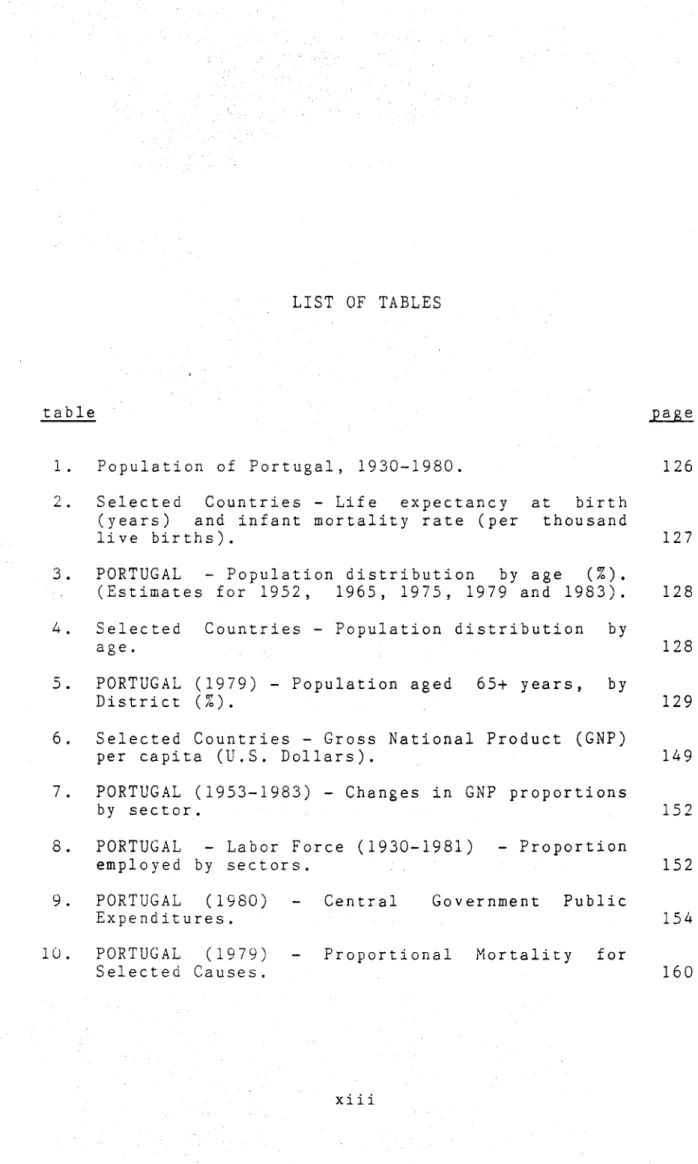
table page 1. Population of Portugal, 1930-1980. 126
2. Selected Countries - Life expectancy at birth (years) and infant mortality rate (per thousand
live births). 127 3. PORTUGAL - Population distribution by age (%).
(Estimates for 1952, 1965, 1975, 1979 and 1983). 128 A. Selected Countries - Population distribution by
age. 128 5. PORTUGAL (1979) - Population aged 65+ years, by
District (%). 129 6. Selected Countries - Gross National Product (GNP)
per capita (U.S. Dollars). 149 7. PORTUGAL (1953-1983) - Changes in GNP proportions
by sector. 152 8. PORTUGAL - Labor Force (1930-1981) - Proportion
employed by sectors. 152 9. PORTUGAL (1980) - Central Government Public
Expenditures. 154 10. PORTUGAL (1979) - Proportional Mortality for
Selected Causes. 160
12. PORTUGAL (1980) - Covered Population by Public and Private Sub-systems and the general Social
Medical Services subsystem. 169 13. Hospital Geral de Santo Antonio (1970-1984)
Emergency Department movement. 174 14. PORTUGAL (1983) - Health professionals
distribu-tion .
15. PORTUGAL (1983) - Population/Health Professionals ratios .
25. Cerebrovascular Disease (1978). Age-Adjusted Mortality Rates per 100,000 population (40-85+
year age group).
27. Number and percentage of study cases by sex and age group .
177 177
16. PORTO - Census populations (1864-1981). 186 17. PORTO - 1970 and 1981 census population and
pro-portion change by administrative division. 186 18. PORTO (1981 census) - population distribution by
age, sex and administrative division. 187 19. PORTO (1981 census) - resident and present
popu-lations. 188 20. PORTO (1981 census) - Proportion of families
affected by selected housing and sanitary
conditions (%). 193 21. HGSA (1984) - patient distribution (%) per place
of residence and department, 197 22. Household contacts by type of discharge. 209
23. Reasons for interview exclusion. 209
24. Research time-line. 217 220
26. Senility without mention of psychosis (1978). Age-Adjusted Mortality Rates per 100,000
popula-tion (40-85+ year age group). 221 225
cases by reason for exclusion. 227 30. Level of diagnostic confirmation by diagnostic
category (both sexes). 229 31. Percentage of acute strokes by age and diagnostic
category (males). 230 32. Percentage of acute strokes by age and diagnostic
category (females). 231 33. Age distribution in Porto and in the study
popu-lations. 232 34. Age-specific stroke incidence rates (per 100,000)
by sex in Porto's study population (October 1983
to September 1984). 233 35. Age-specific stroke incidence rates (per 100,000)
by sex in Porto (October 1983 to September 1984) and in the study population of the National
Survey of Stroke (NSS) (1975-1976). 234
36. Age-specific stroke incidence rates (per 100,000) by sex in Porto (October 1983 to September 1984) and in Lehigh Valley (L.V.) (July 1982 to June
1983). 235
37. Medical history of stroke patients, by sex and
age group (%). 237 38. Admission and discharge patterns (MALES). 248
39. Admission and discharge patterns (FEMALES). 249
40. Factors associated with admission. 251 41. Factors associated with admission to a non-ED
war d . 252 42. Use of hospital resources: Porto (October 1, 1984
- September 30, 1985), Monroe County (M.C.)
(March 1 to June 30, 1971). 254 43. Patient/interviewees relationships. 260
4
44. Community follow-up: Situation of all cases, as
of March 23, 1985. 261
46. Situation after complete follow-up (180 days). 47. Patients alive at the time of interview and
reasons for exclusion from subsequent analysis. 48. Number and percentage of community survey
patients by sex and age group.
49. Correlation matrix for independent individual factors and dependent variable family coping index .
50. Regression analysis for family coping index and age.
51. Regression analysis for family coping index and patient education.
52. Analysis of variance for family coping index and sex .
53. Analysis of variance for family coping index and stroke type .
54. Analysis of variance for family coping index and history of stroke.
55. Analysis of variance for family coping index and current disability.
56. Analysis of variance for family coping index and maximum disability.
57. Correlation matrix for independent family factors and dependent variable family coping index.
58. Regression analysis for family coping index and maximum family education level.
59. Multiple regression between family coping index, patient education, and maximum education.
60. Analysis of variance for family coping index and house ownership.
61. Analysis of variance between family coping index and type of health insurance.
263 279 280 281 282 282 283 283 284 284 285 286 288 289 290 290 xvi
63. Multiple regression between family coping index, patient education, and maximum family education, controling for type of health insurance (genearal
health insurance, SMS coverage). 292 64. Multiple regression between family coping index,
patient education, and maximum family education, controling for type of health insurance (non-SMS
coverage). 292 65. Service utilization in the follow-up group. 293
66. Families' participation in community activities. 294 67. (MALES) Stepwise multiple regression for
depen-dent variable use of physical therapy. 296 68. (FEMALES) Stepwise multiple regression for
depen-dent variable use of physical therapy. 297 69. Regression analysis for family coping index and
follow-up length. 299 70. (MALES) Stepwise multiple regression for
depen-dent variable family coping index. 300 71. (FEMALES) Stepwise multiple regression for
depen-dent variable family coping index. 301
LIST OF FIGURES
figure page 1. CONCELHO DO PORTO: Hospital Catchment Areas
(Emergency Departments). 183 2. Study and Follow-up Periods. 260 3. Predictive Model of Family Adaptation 277
NSS - National Survey of Stroke OBS - Intermediary ED Unit
SAH - Subarachnoid Hemorrhage SAS - Statistical Analysis System SMS - Serviços Medico-Sociais UCONN - University of Connecticut TIA - Transient Ischemic Attack
TIB - Thrombotic Infarction of the Brain WHO - World Health Organization
INTRODUCTION
In this research I examined socio-cultural and epidemiological aspects of Cerebrovascular Disease (CVD) in a population of the city of Porto, in northern Portugal. The main objectives of the study were: (1) to provide an accurate epidemiological description of CVD in a population selected from Porto's inner city, including the natural history of the disease; (2) to examine the current care practices available to CVD patients; (3) to built a composite picture of family coping mechanisms for home-based CVD cases; and (4) to account for the variation in family coping abilities in terms of a set of sociocultural and economic variables.
This study was carried out on an inner-city population that includes a large proportion of the poorest segments of the population of Porto. I have chosen to study this population and this topic for the following reasons: (1) there is a lack of clear-cut data on the impact of social and economic factors on the disease; (2) few
cally oriented studies have examine the natural history of this disease in Portugal, and (3) there has been limited attention paid to the social consequences of CVD, its impact on the family and the community, and its relationships with the prevailing patterns of care.
The experiences of families in which a member has survived stroke [1] are the central focus of this dissertation. The study recognizes the importance of examining a chronic disabling disease in terms of its impact on the socio-cultural system. An examination of the disease and its context provides a holistic perspective on both its biomedical and socio-cultural consequences. Ultimately, this provides some explanations for the various responses or adaptative styles of the families of the affected persons.
A major interest of this study involves human behavioral adaptation to stroke. This includes an interest in health care systems and delivery, the affected persons and their families, and the existent social support systems. It provides data and analyses pertinent to a better understanding of successful adaptation to disability, taking into consideration the facilities, the resources and the structure of the various systems involved ( i.e., cultural, social, and health systems). It also aims to provide quantitative data relevant to further program planning,
design, and implementation, by providing basic information on salient variables which enable patients and their families to cope or adapt successfully to this potentially fatal chronic disease. Finally, the information generated by this study is expected to contribute to the establishment of appropriate national and local health policies, aimed at effectively serving the populations in need, which may lead to new health care delivery configurations in Portugal.
This theoretical framework - "the ecological model of illness" - is central to recent Medical Anthropology research. It identifies and links aspects of health and illness which are often dealt with separately in health research, integrating the primary orientations of the epide-miological and social sciences in the study of an area of common concern. The "social epidemiologic paradigm" and the "ecological model of illness" will be addressed in detail in the next chapter.
Foster outlined what he considered to be the research priorities of the 1980s for anthropologic research on health problems. The author placed major emphasis on applied research (Foster, 1984:851) [1], and suggested three major research topics: (1) specific diseases, (2) specific health problems, and (3) health care delivery systems. This research follows the above priorities by emphasizing applied [1] See also DeWalt and van Willigen (1984).
suggested topics using CVD as the specific disease. In addition, rehabilitation issues are also addressed which, as Olesen (1975:423) points out, have been dealt with in Medical Sociology but not in Medical Anthropology.
1.1 CEREBROVASCULAR DISEASE
The term "cerebrovascular" denotes those disorders in which (1) an area of the brain is transiently or permanently affected by ischemia or bleeding, or in which (2) one or more blood vessels are primarily involved in a pathologic process, or (3) a combination of both. The term "cerebrovascular" is now well established as covering the range of disorders just mentioned (see World Health Organization, 1978). The more common term, "stroke", despite being frequently used rather loosely, is commonly used in English language literature to cover the same range of disorders. In this study, the definition formulated by the Advisory Committee of the National Survey of Stroke, sponsored by the National Institute of Neurological and Communicative Disorders, edited by Weinfeld (1981), will be adopted :
Stroke is a clinical syndrome consisting of a constela-tion of neurological findings, sudden or rapid in onset, which persists more than 24 hours, and whose vascular origins are limited to:
1. Thrombotic or embolic occlusion of a cerebral artery resulting in infarction, or
2. Spontaneous rupture of a vessel resulting in intra-cerebral or subarachnoid hemorrhage.
This definition excludes occlusion or rupture due to traumatic, neoplastic, or infectious processes which produce vascular pathology (Walker, et al. 1981:1-13).
Although sharing the same pathophysiology, cerebrovascular disorders of less than 24-hour duration are not the main focus of this research because these episodes, usually designated by Transient Ischemic Attacks (TIAs), do not leave sequelae. Nevertheless they equally require appropriate diagnosis and organized preventive actions.
Two main types of stroke hemorrhagic and ischemic -traditionally described in medical literature are recognized in the above study definition. Hemorrhagic strokes may consist of bleeding into brain tissue (parenchymatous) or into the subarachnoid space (subarachnoid hemorrhage). Ischemic strokes, may be due to an intrinsic occlusion of a vessel (thrombotic infarction), or an extrinsic or foreign body plugging the lumen of a vessel (embolic infarction). In order to facilitate a clear distinction between the different categories of stroke, the above-mentioned Advisory Committee developed a clinical algorithm that will also be
criteria allow the vast majority of individual patients to be identified as suffering from subarachnoid hemorrhage (SAH) , intraparenchimal hemorrhage (IPH) , thrombotic (TIB) or embolic (EIB) types of stroke (see Addendum A in Walker et al., 1981:1-32-37).
1.2 RESEARCH BACKGROUND
My interest in cerebrovascular disease is the direct result of previous professional experience and of my present professional activities. In 1972, when I graduated from the University of Porto Medical School, I felt just like a professional with a degree but with a limited understanding of medical realities. Initially, my career options included public health and/or general practice. Since internship programs in general practice did not exist in Portugal until 1981, a career move into that direction would mean no opportunity for further scholastic training after completing the post-graduation compulsory hospital residency (2 years). Due to my perceived limitations of undergraduate preparation, I strongly rejected this alternative.
With regards to the available public health alternative -- the graduate program of The National School of Public Health, Lisbon — I had a very limited understanding of its activities and career perspectives. Key personnel from
various health sectors recommended that I should try to complete a residency program in one of the "traditional" medical specialties as a way to protect my professional future and later consider public health. In Portugal, both general practice and public health have often been viewed as last-choice career alternatives by both the general public and the medical profession.
This advice, to which I am particularly grateful, was my first contact with a cultural and professional reality
that I had not been previously aware of. Fortunately, unexpected events in Portugal, provided me with the opportunities to develop my career along lines that ultimately integrated both general practice and public health.
When the Portuguese Revolution put an end to 48 years of dictatorship (April 25, 1974), and important social changes began to occur, I was a second-year resident working at the same university hospital where I 'had received my undergraduate training. This was a nearly 1,000-bed facility staffed by as many physicians as its number of beds. In the meantime, I began working part-time for the domiciliary sector of the Portuguese Medical-Social Services. This provided my first contact with services other than hospital care .
The Portuguese Medical-Social Services may be described as a social security scheme, run by the Portuguese
the vast majority of the population. The same social security plan also covers the expenses of hospital care and provides general benefits, such as for pregnancy, sickness, or retirement.
In June 1974 I was drafted and in January 1975 sent as a military doctor to the island of Santa Maria (Azores). There, together with the only local doctor, I provided care
to a population of approximately 6,000 people. This was part of a Portuguese Armed Forces' program to provide medical care to underserved areas which, by 1975, was also extended to nonmilitary physicians. A year of "rural practice" became compulsory for all physicians who planned to pursue their careers in government posts.
Much has been written on the rationale and the broad consequences of programs such as the one mentioned, which will not be discussed here. From my point of view, I consider that I greatly benefited from it both in terms of personal and professional development. I had the opportunity to develop skills in making decisions without relying on any additional help from senior colleagues, as would have been the case if I were still working in continental Portugal. I am sure that I must have made mistakes, some of which might have been important, but I am also sure that this period of my professional life has made me more cautiously evaluate
I also had a unique opportunity to understand the benefits of integrating preventive and curative care. Working at the government's Maternal and Child Health Clinics in Santa Maria, with the clinic's team of public health nurses, it soon became evident that with my arrival the population gained strong confidence in the services. My presence in the island meant easy access to a much-needed, reliable source of acute care which therefore resulted in a more cooperative and interested participation by the local population in preventive activities. For several years, the public health team had been working without the cooperation of a physician. This along with the local physician's opposition had severely limited its ability to provide preventive care.
My initial concern with cerebrovascular disease was the result of both my practice in ambulatory care in the Medical-Social Services and my work in Santa Maria. Both situations provided me the opportunity t'o experience the problems associated with "nonhospital" management of these patients, and to gain a broad understanding of its impact on the individual, family life, and community. I was struck by the lack of integration, which frequently meant the total non-existence, of the Portuguese Health and Social Services' responses to these problems.
In 1975 and 1976, still in the Azores, I also had the opportunity to participate in two major epidemiological
study of hypertensive disease in the population of the island of Flores by a team from the Hospitais Civis de Lisboa, under the direction of Drs. Alfredo Franco and Castel-Branco Mota (Franco et al., 1977). This study introduced me to field research and to epidemiological concepts to which I had not been previously exposed at the undergraduate level.
The second project was the study of a major degenerative central nervous system disorder affecting Portuguese families in the Azores, conducted by Prof. Corino de Andrade and Dr. Paula Coutinho from the Institute of Neurology, Department of Neurologic Diseases , Hospital Geral de Santo Antonio , Porto (Coutinho et al. 1977; Coutinho and Andrade, 1978). I greatly benefited from my participation in this project not only improving my field research abilities, but also developing clinical skills in the subjects being studied .
In 1976, after returning from the Azores, I started a five-year residency program in internal medicine at the Hospital Geral de Santo Antonio (HGSA), Porto. At the same time, I was invited by Prof. Andrade to join the faculty of a new medical school in Porto -- the Instituto de Ciências Biomédicas, "Abel Salazar" (IC3AS) — which would have an innovative curriculum based on a community perspective,
integrating the areas of teaching, research and service. I was offered a position in the Department of Community Health, where I would work under the direction of Professor Aloisio Coelho, and was given the opportunity to develop my knowledge in the areas of Community Health and Epidemiology. Subsequently (1977-1978), benefiting from a scholarship of the British Council, I attended the "Combined Course on Epidemiology and Biostastics" at the London School of Hygiene and Tropical Medicine (Professor Geoffrey Rose, Program Director), followed by a six-month training program in the teaching of community health and epidemiology at the Department of Community Medicine, University of Southampton School of Med icine (Professor E.W. Waters, Chairman).
These activities, and the present program at the University of Connecticut — sponsored by the Calouste Gulbenkian Foundation (which includes the Masters Program in Public Health and the current Ph.D. program in Medical Anthropology) — are part of the broad personnel development program of the ICBAS.
In 1978, ICBAS' Department of Community Health initiated its activities for undergraduate students. Since then, I have been teaching community health and epidemio-logy, as well as participating in associated research and educational activities.
health facilities, directly into what I consider to be relevant problems of the community. In 1978, I studied CVD mortality in Portugal and made the appropriate interna-tional comparisons (Calheiros, 1978). In 1980, as a develop-ment of my work at the Emergency Departdevelop-ment (ED) of the HGSA in a team lead by Dr. Castro Lopes, I presented evidence from the HGSA files supporting the need for redefinition of current admission criteria for CVD patients, as well as the need to evaluate the current types of health care available to these patients after discharge (Calheiros, 1980). This study was the result of my increasing awareness of the magnitude of the stroke problem in Portugal, and more specifically in the city of Porto, and of the need to expand epidemiologic research beyond traditional etiological issues .
My work at the ED and at the Internal Medicine and Neurology wards led to frequent contact with the families of these patients, and to a better identification of their problems — mainly those associated with admission and discharge. The majority of CVD cases have an initial contact with the health services at the ED due to some combination of the following: (1) the frequent life-threatening presen-tation of these disorders, (2) the practical impossibility of obtaining an emergency home visit by a physician, and (3) the increasing inability of the families to cope with this
extreme situation. When a visit occurs, the physician's need for diagnostic reassurance frequently requires the use of additional procedures, namely computerized axial tomography
(CT), leading to a visit to the ED where these services are currently easily accessible. Nevertheless, the feeling that little or nothing can be done for a CVD patient is common among both hospital- and nonhospital-based physicians, including its younger members. Therefore, low interest and low priorities are frequently given to these patients, as compared to individuals with less frequent and/or less severe disorders.
I have already mentioned that CVD is a major public health problem in Portugal. Its relative importance must be kept in perspective by considering the role of other potentially competing disorders, especially other cardio-vascular disease. I will address the social epidemiology of cardiovascular disease and the present Portuguese health situation in chapters to follow.
While CVD is linked with most risk factors known to affect atherosclerosis, its close association with hypertensive disease has been established beyond doubt
(Kannel et al., 1971 and 1976; Shekelle et al., 1974; Nicholls and Johansen, 1983). It is also well known that considerable risk reduction results from antihypertensive treatment (Veterans Administration Cooperative Study Group on Antihypertensive Agents, 1970 and 1972; Hypertension
Detection and Follow-Up Programe Cooperative Group, 1979). The epidemiology of CVD and the strategies for its
prevention have been extensively studied in developed countries such as the U.S.A., Great Britain, and Japan. They have not been as well studied in less developed countries of Europe and the Third World [1],
Regarding the prevention of CVD, an editorial in the British Medical Journal (Anonymous, 1981) and an extensive report by the Arterial Disease Working Party, appointed by the Royal College of General Practitioners of London (1981), estimate that 50% of all strokes in people under the age of 70 are preventable. However, multiple barriers must be removed in order to attain this objective, including those associated with current practice patterns, which often ignore that chronic diseases frequently share a number of common causes. As a result of this approach preventive programs have been usually oriented towards a specific factor or disease (heart disease, diabetes, salt consumption), taking one condition at a time in isolation from other diseases. A "multiple-disease strategy" was proposed by Epstein and Holland (1983) as a way to organize more effective and efficient preventive programs for a community. This integrated approach, was recently launched by the World Health Organization (WHO) in selected XT] See"; for example, Siekert (1980), Rose (1981),
Takahashi (1981), Weinfeld (1981), Tanaka et al. (1982a), ÎCimura (1983).
participating countries, aiming "to improve the health of total communities through a broadly structured program that can be integrated into the normal health services and will improve preventive activities on a broad front" (Epstein and Holland, 1983:136; see also Glasunov, 1983).
In recent years the concept of "primordial prevention" — that is, "preventing the emergence of predisposing conditions in countries in which they have not yet appear," has emerged in the literature (World Health Organization, 1982:9; Watkins, 1984). This concept, which elaborates on early notions such as "mass prevention" (see Rose, 1981) and "anticipatory care" (see Anonymous, 1981; Arterial Disease Working Party 1981:5), adds a new dimension to prevention. These efforts, particularly designed for areas of low prevalence of selected disorders, have the objective of averting the development of health problems similar to those currently experienced by developed societies (see Dodu, 1984). I will return to the issue of prevention in later chapters .
When prevention is either not possible or unsuccessful, CVD expresses itself under a wide variety of clinical presentations. Severity may range from a minor disturbance, sometimes lasting just a few minutes, to a life-threatening situation that can result in death or severe permanent disability. Frequently diagnosed and responded to on an acute-care basis, the curative care resources of health care
systems are relatively powerless to deal with those situations that result in significant physical and social sequelae. Beyond the acute phase, health care responses require a high level of integration and coordination of its various components. This does not seem to be present in countries where health care resources are limited and health systems are traditionally based on the "acute-curative care" and "medical" models. I will return to these issues later when discussing the present patterns of care for CVD cases in Portugal, and especially in Porto.
THE RELATIONSHIPS BETWEEN EPIDEMIOLOGY AND ANTHROPOLOGY (SOCIAL SCIENCES)
2.1 GENERAL BACKGROUND
Human communities have long been the concern of the historian, the anthropologist, and the sociologist. In more recent years, they have also engaged the interest of the epidemiologist, frequently considered the basic scientist of preventive medicine. Historically, however, it is possible to note the practice of epidemiology, centuries before it began to be recognized as a special branch of medical science. This recognition happened only a little more than a hundred years ago, with the establishment of the Epidemio-logical Society of London in 1850 and the publication in 1873 of John Parkin's book Epidemiology ; or the Remote Cause of Epidemic Disease in the Animal and Vegetable Creation (see Doll, 1982 :xi-xii).
The formal relationship between anthropology and medicine is believed to have begun one hundred years ago when Rudolf Virchow, pioneer of studies on the social etiology of disease and currently better known for his
pathology studies, helped found the first anthropological society of Berlin (von Mering, 1970:272).
Social variations in the distribution of health and disease have been observed for centuries. However, the reasons for these differences in physical health status are yet not well understood. For many years it was assumed that these differences could be explained by variations in ethnicity or genetic stock, exposures to noxious stimuli in the physical environment, or access to medical care resources. While these factors undoubtedly account for some of the differences in disease rates among members of different social groups, accumulating evidence suggests that certain conditions and circumstances within the social environment or social cultural milieu per se have disease consequences. It is these factors which are usually within the purview of the social epidemiologist.
Another perspective is that of historical materialist epidemiology. The field's antecedents include the classical research of Engels, Virchow, and of the nineteenth-century school of social medicine in Europe. Simply defined, histo-rical materialist epidemiology relates patterns of death and disease to political, economic, and social structures of the society. This field emphasizes changing historical patterns of disease and the specific material circumstances under which people live and work (Waitzkin, 1983:62), an approach
succeeding generation. Since the mid-1970s, historical materialist epidemiology has concerned itself with the social etiology of disease. Social contradictions, especially the contradiction between profit and safety, are thought to foster illness and impede change. These issues, however, did not emerge for the first time during the last decade; there is a long history of research and analysis that has been neglected, despite its relevance to current situations. Engels' The Condition of the Working Class in England (1845), Chadwick's Inquiry into the Sanitary Condition of the Labouring Population of Great Britain (1843), Shattuck's Report (1850), and several of Virchow's works are excellent examples of early research relating health to the social environment. The patterns and problems of life in the urban environment have since then engaged the attention of many social scientists and Robert E. Park was the first author to use the concept of "the city as social laboratory" (Smith and White, 1929).
For epidemiologists, despite the fact that a large number work in departments of "community health" or "community medicine," communities are not usually of primary interest in and of themselves. Epidemiologists' concerns are mainly to elucidate pathogenic mechanisms: identify risk factors in disease and, to the extent possible, etiologic agents. Nevertheless, it is clear that epidemiological
selected from clearly defined populations in order to insure the validity of inferences drawn from the study findings. In general we might say that "epidemiology is the study of the distribution of a disease or physiological condition in human populations and of the factors that influence this distribution" (A. Lilienfeld, 1976:3). McMahon and Pugh (1970:1) define it as "the study of the distribution and determinants of disease frequency in man." However, limited consensus exists as to what exactly is the scope of the discipline. David Lilienfeld, after reviewing 23 definitions of epidemiology elaborated between 1927 and 1976 (no one refers to "social epidemiology") proposes his own:
Epidemiology is a method of reasoning about disease that deals with biological inferences derived from observations of disease phenomena in population groups (D. Lilienfeld, 1973:89).
Implicitly or explicitly, this definition is currently the operational one in most biomedical sectors. According to David Lilienfeld (1978:89),
The biological inferences made by an epidemiologist "must" concern a disease phenomenon, e.g., a disease's etiology and/or natural history. Therefore, the evalua-tion of health care and its administraevalua-tion can "not" inherently be within the scope of epidemiology, unless such an evaluation directly results in an inference being made about a disease phenomenon; such evaluations should, therefore, be considered examples of medical sociology .
Social epidemiologists focus further on social condi-tions and disease processes. Syme (1974) has suggested that
social epidemiology may be seen as that part of epidemiology that is concerned with psychosocial determinants. Even though the boundaries of social epidemiology are somewhat vague and overlap with those of other social-behavioral sciences (medical anthropology, medical sociology, psycho-logy, psychosomatic medicine, etc.), within this segment of collaboration between the social sciences and medicine there is a primary concern with psychosocial determinants of the following (Kasl, 1977:161):
(a) illness or disease onset (incidence of new events)
(b) course of illness or disease (exacerbations, repeat events)
(c) outcome of disease process and/or degree of recovery
However, because of the ecological orientation of epidemiology and the centrality of such concepts as agent-host-environment, or person-place-time,, epidemiology is considered to have always been, to a certain extent, "social." In addition, to some investigators the term "social epidemiology" also means a broadening of "states of health" or "disease" to include health-relevant behaviors. Thus, these days one may also be studying the epidemiology of drug abuse or the epidemiology of smoking (Kasl, 1977:162) .
(1980:70-73), who embraces "as a matter of faith" that only one epidemiology exists, and that three significant classes of applications of epidemiology can be identified:
(a) epidemiology of specific diseases (b) evaluation of medical care
(c) ecologically based epidemiology
For Stallones, epidemiology is very properly a subset of the field of human ecology, and we may not have gained much by subdividing this field.
As the claims of potential contributions of social epidemiology to other disciplines and fields of endeavor grow (e.g., Cassei 1974a and 1976), so does, of course, the blurring of disciplinary boundaries. Overall, one is forced to conclude that one can neither set precise boundaries on "epidemiological methods" or discipline territories and constituencies, nor identify methodological approaches unique to epidemiology and not shared by other disciplines, such as social psychology, sociology, anthropology, or demo-graphy (Kasl, 1977:162).
Medical Anthropology, as a branch of social and cultural anthropology, is also concerned with a wide range of biological phenomena, especially in connection with health and disease. As a. subject, it therefore also overlaps the social and natural sciences in a similar way to that
described for social epidemiology.
The field of health is a field in crisis and transi-tion. Serious questions regarding the validity of traditional health theory are forcing a critical reexamination of the assumptions on which the theory is based and on the conceptual approach to which it has given rise (Ratcliffe, 1980:41). Indeed, it is probably not too much to say that the health field is experiencing a paradigm shift (Kuhn, 1970:77-91) a process that may ultimately give rise to a radical restructuring of health theory and a fundamental reorientation of the way health problems are defined and policies conceptualized. To a great extent, this shift comes from the convergence of the works and interests of social science and public health, and of increasing (although still limited) interdisciplinary work. These issues will be addressed next.
2.2 THE RECENT PARADIGM SHIFTS LN THE HEALTH FIELD
Rudolf Virchow said that medicine is social science, and politics is nothing but medicine on a large scale. The same belief is shared by many other social sciences and health professionals. John Knowles (1979:viii) states:
I believe that medicine is a social science as well as a physical and biological science and that it needs the social sciences and the effects of their study as never before in history.
This influence of social sciences in health care has not been confined to the work of persons trained and identified with social sciences themselves. The public health fields of epidemiology and health services research have also contributed to this by integrating and using theories and methods developed by the social sciences. Examples of these theories include those about complex orga-nizations, networks, and social support. Examples of methods include survey techniques and scaling of variables. In addition, some or all of the independent variables used in public health are also derived from social science research, such as social class, personality type, family/household types, and gross national product.
The above-mentioned social research has identified three broad effects of sociocultural conditions on health. In the first instance the matter of how health is defined in any society is itself an aspect of the culture, as are the behaviors usually associated with roles wholly or partially determined by an individual's health status. A second aspect is the already referred area of particular interest to social epidemiology, documenting the impact of socioeconomic and cultural variables on changing health levels. A third domain of social science concern is in matters of policy efforts intended to influence health levels by means of alterating the availability of medical care and changes in social, economic and political conditions.
Since the 1970s significant changes in anthropological methodology have been growing. According to DeWalt and van Willigen (1984:845), these changes have contributed to decrease the differences between anthropology and other social sciences at the level of data gathering techniques. In addition, these authors propose the adoption of more efficient and responsive ways of defining research foci. As a consequence, they recommend that in a Third World context, anthropologists should change their research focus from questions of acceptability of Western medicine to traditional consumers to questions of accessibility and allocation, and more research on providers.
To a large extent, these changes are already evident in selected groups and schools of thought, mainly the ones that support the action-research model. The maintenance of the above-mentioned trend and the extension of the suggested research strategy to include developed countries, will certainly contribute to further approximating anthropology and epidemiology, and to cross-disciplinary research, as it is increasingly recognized that no one discipline is equipped to adequately deal with the complex issues related to health.
Relationships between social sciences, in particular anthropology and epidemiology, have been slowly developed throughout the twentieth century, especially around public health issues (both inside and outside public health
arenas). Areas of mutual concern have been recognized. The concept of specialized training for public health, with its focus on health conditions and social problems in the context of the community, can be traced to the eighteenth century. Although the first school of public health was founded in Munich in the middle of the nineteenth century, it was not until the next century that schools of public health were established in the United States. Until the 1940s, public health schools were primarily concerned with the detection and control of specific communicable diseases, applying new biomedical and sanitary engineering technologies to disease control. Given these predominantly bactériologie perspectives, it is not surprising that anthropology and other behavioral sciences had little influence on public health in the early part of this century (Schreiber, 1975).
As the definitions of health and the ethical concerns of societies have changed, so too the content and goals of public health education have changed. Programs were originally concerned with sanitation, immunization, biostatistics , and epidemiology. They were directed first only at physicians, and then at medical professionals and engineers. Although most schools of public health developed relatively independent of medical schools in both the United States and many other countries, in many cases public health
schools were responsible for teaching subjects such as epidemiology in affiliated medical schools. Only in the 1960s did schools of public health began to accept nurses for additional training, and then people without any previous medical or health-oriented degrees.
Most current public health curricula concentrate on health problems and disease prevention in communities, which may also be regarded as the constituency of anthropologists. The style of individual institutions varies, but generally public health schools concentrate on both the basic public health sciences of biostatistics, disease control, environ-mental sciences, epidemiology, and the applied fields of health care organization and resource administration. Both areas have broadened to encompass the social factors that affect health and disease, ranging from the ecology of human interactions with the environment to cultural factors in the use of health services. As the research and teaching emphasis changed, more non-M.D.s were hired in a wide variety of fields, including the social sciences. As behavioral scientists began to work in public health, it became generally accepted that other disciplines had an earlier and more pervasive influence on this field than anthropology, including sociology, psychology, economics, and political science (Schreiber and Scrimshaw, 1979).
for some of the above-described changes, precipitated an enormous interest in the health of disadvantaged individuals and social groups. Awareness of the importance of social and economic factors as determinants of health became acute. Furthermore, the discrepancies of access to health care associated with social, economic, and cultural factors became clear. Medical students were outraged that these injustices had not been previously recognized and corrected. Curriculum "reform" became the by-word of the day. An important part of this reform was to be the enhancement of the social, especially behavioral, sciences in medical teaching and practice. New faculty members were recruited, new courses were developed, and whole new departments sprang into being. Students and faculty alike were urged to view the patient as a "whole" person and terms such as holistic medicine, comprehensiveness of care, continuity of services, began to appear frequently in the literature.
Simultaneous with this increased awareness of social factors as determinants of health in disadvantageous groups came an awareness of many unsatisfactory aspects of the health care system for all segments of society. Increased specialization and fragmentation of medical care as it was delivered by many specialists and subspecialists to a single individual led to the conviction that no one was keeping an overall eye on the health problems of any one person. The concept of a new health care provider, the
family physician [1], grew rapidly. If health and disease are seen as entities on a continuum ranging from excellent health at one end to severe disease at the other end it is clear that most physicians function at the disease end of the spectrum. The one notable exception is the family physician who is likely to function anywhere along this continuum (Bergner and Gilson, 1980:135). This is also true of a large proportion of the epidemiologists (clinical epidemiologists, genetic epidemiologists, etc.) who follow David Lilienfeld's concept and work almost exclusively at the disease end of the above mentioned spectrum. The majority of these researchers have sought little or no collaboration at all with the social sciences.
Over the last few years, developments at international and global levels (the United Nations' "New International Economic Order," the World Health Organization's "Alma-Ata Declaration," and "Health for All by the Year 2000 Strategy"), have also helped foster a major paradigm shift in the health field. John Ratcliffe (1980:41-42) describes it as follows:
"The Traditional Health Paradigm" is based on the assumption that health and mortality levels are primarily a function of the interaction between the individual and the physical environment, including physical contact with other diseased individuals. Another fundamental assumption is that the delivery of modern (i.e., western) medical technology and associated services has been primarily responsible for [1] "General practitioner" is the equivalent denomination in the United Kingdom and most European countries.
observed declines in mortality and broad improvements in national and international health trends and levels. These basic assumptions have given rise to particular definitions of health problems and issues; they have also generated two fundamental strategies for improving health levels among human populations. The first is the curative, or clinical, approach, which relies on medical technology and services to relieve disease symptoms and/or cure diseases after they have been contracted... The second strategy is the traditional public health, or preventive, approach, which utilizes medical technology to mediate between the individual and the physical environment in ways that will lessen the probability of contracting disease.
It is noteworthy that none of these conventional strategies attempts to influence health levels by modifying the "social", human-created environment in which the indivi-dual lives and must act. That is, attempts to influence health levels have taken place within the confines of the "system", which is taken as given. The result is that strategies of change that are of first order nature (incremental), in that they do not affect the established system itself. The social environment is not considered to be variable or instrumental, or even problematic, and perhaps in need of a second-order change as a condition necessary to effect widespread improvements in health trends and levels .
Given these basic assumptions and strategies, it is not surprising that the adoption and diffusion of innovations have been the conceptual approach that has dictated health research foci and priorities, conclusions drawn from
research findings, and policy recommendations for some four decades. Despite the recognition that "early adopters" of modern medical technology and services are consistently characterized by higher income and education levels, and by greater physical and material security, such features rarely are viewed as structural in nature. In fact, the key factors limiting the diffusion of modern health principles are assumed to be the conservative values and fatalistic attitudes of the poor and uneducated segments of the society .
Such approach also assumes that "modern" health behavior spreads from more to less innovative individuals through a "multiplier effect". The practical effect of this approach is to justify the concentration of available resources and services among the more advantageous groups and urban enclaves, while relying on an indirect, or "trickle down", effect to reach the poor and the disadvantaged.
"The Emergent Paradigm" is based on research relevant to the field of health that has illuminated the relationship between structural factors and health processes. Such research has shown that the available evidence does not support the proposition that observed mortality declines are attributable to the diffusion of medical technology and services. The implication is not that modern medicine has been without impact; rather, the impact of modern medicine
on mortality trends and levels has been vastly overrated. In fact, particular curative and preventive measures served only to slightly accelerate the substantial declines in mortality already well underway before either germ theory or specific causes of disease received wide acceptance.
Historical epidemiological and social sciences evidence indicates that improvements in such socioeconomic conditions as education, nutrition, housing, sanitation, and working conditions (rather than medical advances per se) combined to bring about mortality reductions and increased life-expectancies [1]. Evidence indicates that the effect of improved nutritional status in the control of communicable disease seems to be of particular importance and that education is a major factor influencing mortality and life expectancy, both in developed and developing countries. The study of Kitagawa and Hauser (1973), focusing on socio-economic differentials in mortality in the United States, demonstrated that education is the single most powerful explanatory variable, even more important than income.
Although improved levels of nutrition and education may rank first among the socioeconomic factors responsible for declining mortality, others are not far behind in impor-tance. Improved levels of personal income and employment also contribute to host improvement, and, thus, to reduced
[1] See, for example, Dubos (1965), Powles (1973), Illich (1975), McKeown (1979).
mortality and increased life expectancies.
However, a major point to be noted is that observed levels of income, education, socioeconomic class, and therefore nutritional and mortality levels, are themselves not determined by the physical environment but by the political and economic system in which they are embedded (Ratcliffe, 1980:44). Infant mortality rates, even in advanced industrial societies, are still largely dependent on fluctuations in the national economy, this being true not only for the United States, but also for countries such as England and Sweden (Brenner, 1983 and 1980).
Recent literature offers impressive evidence of the role that sociopolitical, socioeconomic, and sociocultural barriers have in the implementation of public health and health care. In this context, and addressing the roles of anthropologists in international health planning, Kleinman (1978:74) points out that:
If nedical an thropologists are to have a significant impact on the creation of international h ealth plans that address the cardinal effects cultural and social structural forces exert on health , sickness and health care , one reason will be b ecause they have legitimated the ethnomedical framework in the process of interna-tional health planning and further have translated its key concepts and findings into the problem framework and program objectives he Id by their co lleagues in international medicine an d public health.
Kleinman (1978:74-76) also emphasizes that the ethno-medical approach should not replace the bioethno-medical approach,
but rather complement it. The ethn "sickness" from the patients , Whereas sickness t social con as labels networks norms and omedic are s diffe f amil the b o mech text, of so of mea concre al model emantic sub ring ways ies, commu iomedical anical stat the ethnom cial status ning that t te interper
states that "health" and jects which are inseparable they are conceptualized by nities, and practitioners, model reduces health and es divorced from person and edical model interprets them es inextricably bound within ie them to general cultural sonal transactions.
Further works by Kleinman explored this relationship in what the author called "the borderland between anthropology, medicine, and psychiatry" [1].
Overall, social science research in health has given us invaluable information in many spheres that have extensively contributed to the formulation of this new theory. A brief listing of such studies would include the dynamics of illness generating socioeconomic conditions; the analysis of community health and needs; the influence of prepaid insurance programs on the use of health services; the dynamics of solo versus group practice; role expectations among the various categories of health workers, including doctors, nurses, physician assistants, social workers, dietitians, and medical researchers; the influence of social and economic class in the receipt and use of services; the evaluation of types of organizations designed to give
[1] See also Kleinman et al
comprehensive, continuing health care in ambulatory clinics; the internal organization of the hospital and its paradoxi-cal arrangements of authority and responsibility; public attitudes toward the general hospital, the mental health institution, the public health unit, and so on; the assessment of medical (health) care programs for special population groups such as ethnic minorities, the medical indigent, dependents of military personnel, and the chronic and mentally ill; the effect of cultural determinants on the use of health services; the cultural construction of clinical reality; the fundamental distinctions between illness and disease; and the recruitment, development, organization, and retention of health personnel.
Clearly the results of such studies have tremendous implications for all of us interested in the health of our communities, whether we are professional purveyors or non expert recipients of health care.
Some of this work has been the result of cooperation between social and medical sciences. The bases for this interdisciplinary approach have been multiple and varied. In many cases, their origins were shared institutional bases and/or constituencies, and shared social interventions. The action research and advocacy model in community health, and community development issues [1], and that of disease
IT] See, for example, S. Schensul (1973 and 1979), S. Schensul, and Borrero (1982b), J. Schensul et al., (1982).
prevention through health education and/or nutrition programs [1] constitute excellent examples of these developments .
Epidemiologists and other public health professionals and, to a certain extent, some physicians involved in clinical work, are increasingly aware of the impact of human behavioral variables on the transmission of infectious and parasitic disease, on the etiology of malnutrition and chronic degenerative disease, as well as on the acceptance of disease control programs. However, issues such as community development, although equally relevant, are usually given little or no attention by the medical establishment. Its traditional approaches have been either to ignore them, to deny them, or to consider that the problems lay out of the professional field of activities.
Yet the potential benefits of this collaboration seem evident. Social sciences and in particular anthropology, can communicate the value of the holistic approach to health-related problems to a group of professionals that frequently uses models that explore one disease factor at a time. They can also provide the precision and depth of understanding that can be obtained through the variety of methods used in ethnographic work. In addition, disease control programs (as "natural" experiments) and the epidemiological data that XT] Sëë~, for example, Jerome (1979), Ault (1983), J. Brown
(1983), P. Brown (1983), Foster and Deria (1983), Gruenbaum (1983) .
they generate can contribute to a better understanding of cultural systems, sociocultural change, and biocultural evolution - important research topics for both the applied and theoretical fields of anthropology and of other social sciences .
2.3 SOCIAL EPIDEMIOLOGY - A MULTIDISCIPLINARY MARRIAGE
The need for interdisciplinary work in studying health issues has translated into a wide variety of implicit and explicit "marriage proposals", present in the biomedical and social science literatures . Among the more recent and signi-ficant ones, one may refer the following:
1. THE MARRIAGE OF PRIMARY CARE AND EPIDEMIOLOGY (Hart, 1974; Morrell and Holland, 1981)
2. THE COMMUNITY MEDICINE-PRIMARY CARE CONNECTION (Deuschle and Bosch, 1981)
3. EPIDEMIOLOGY IN HEALTH POLICY (Terris, 1980; Modan and Barell, 1981)
4. APPLIED MEDICAL ANTHROPOLOGY AND COMPARATIVE HEALTH POLICY (Hill, 1984)
5. THE CASE FOR COMMUNITY-ORIENTED PRIMARY CARE (Kark, 1981; Madison, 1983)
Two other relevant, although less explicit, "proposals" refer to the responsibilities of medical education in meeting the health needs of the society (Fullop, 1977) and to the adoption of a new code of ethics that would lead to a