A N U P D AT E O F G L U C O C O R T I C O I D
T H E R A P Y I N R H E U M AT O I D A R T H R I T I S
:
D O B E N E F I T S O U T W E I G H T H E R I S K S
?
Johannes W. G. Jacobs
Johannes W. J. Bijlsma
University Medical Center Utrecht,The Netherlands.
A B S T R A C T
To use glucocorticoids prudently, it is important to weigh their risks and benefits. Some developments in the past decades have favored the use of low-dose glucocorticoids in rheumatoid arthritis. Firstly, the bet-ter handling of adverse effects, such as the prevention of glucocorticoid-induced osteoporosis by betbet-ter disease control and modern drugs, and the prevention of gastrointestinal complications by using thera-peutic strategies. Secondly, the probable disease-modifying potency of glucocorticoids. This article goes into detail about this latter effect of glucocorticoids.
Key-Words: Glucocorticoids; Rheumatoid Arthritis; Disease Modifying; Joint Sparing Effect;
Adverse-ef-fects.
R E S U M O
Para usar os glicocorticóides com prudência é importante pesar os riscos e os benefícios. Alguns dados obtidos nas últimas décadas favoreceram o uso de doses baixas de glicocorticóides na artrite reumatóide. Em primeiro lugar, a maior capacidade para lidar com os efeitos adversos, como por exemplo a prevenção da osteoporose induzida pelos glicocorticóides através de um melhor controlo da doença e fármacos mais modernos, e a prevenção das complicações gastrointestinais através de estratégias terapêuticas. Em se-gundo lugar, o provável efeito modificador dos glicocorticóides na doença. Este artigo detalha este últi-mo efeito dos glicocorticóides.
Palavras-Chave: Glicocorticóides; Artrite Reumatóide; Fármacos Modificadores da Doença; Redução
A R T I G O D E R E V I S Ã O
A N U P D A T E O F G L U C O C O R T I C O I D T H E R A P Y I N R H E U M A T O I D A R T H R I T I S
:
D O B E N E F I T S O U T W E I G H T H E R I S K S?
Johannes W.G. Jacobs
*, Johannes W. J. Bijlsma
**Introduction
The introduction of glucocorticoids by Hench in 1948 was a revolution in the treatment of
rheuma-toid arthritis.1The use of high doses generated
dra-matic results, which led to enthusiasm for this therapy. The positive opinion about glucocorticoids was reversed when the toxicity of this therapy, and especially high-dose therapy, became apparent some years after its introduction. Despite this, the general opinion is that with low-dose glucocorti-coids the adverse effects are balanced by positive
symptomatic effects.2A substantial proportion of
patients with rheumatoid arthritis is treated on a daily basis with low-dose glucocorticoids as addi-tive therapy for their symptomatic effect. Despite a series of older trials and publications on the posi-tive effects of glucocorticoids on radiographic disease progression, albeit in high doses in therapeutic strategies without disease-modifying
antirheumatic drugs (DMARDs),3-7up to about a
decade ago there was no firm proof that glucocor-ticoids had joint-sparing, disease-modifying po-tential. Recent studies demonstrating the poten-tial of glucocorticoids in rheumatoid arthritis have renewed the debate on the risks and benefits of glu-cocorticoids.
We here review more recent articles on the disea-se-modifying effects of glucocorticoids. We then draw a conclusion about the use of glucocorticoids, weighing risks and benefits of glucocorticoids in the light of new data, and give recommendations for the use of glucocorticoids in daily practice.
Studies on disease-modifying potential
of glucocorticoids
In the double-blind Arthritis and Rheumatism
Council low-dose glucocorticoid study,8128
pa-tients with active, relatively early rheumatoid ar-thritis (duration less than 2 years) were randomly allocated to 7.5 mg prednisolone (n = 61) or place-bo (n = 67) once daily for 2 years in addition to other therapies, including DMARDs, in more than 70% of the patients. The statistical analysis of ra-diographic scores was restricted to 106 patients for whom there were films at baseline and 2 years la-ter. During this period, the mean Larsen score in-creased by 0.7 units in the prednisolone group but by 5.4 units in the placebo group, a clinically and statistically significant difference. At 2 years, 15 of the 68 hands with no erosions at the start of the study in the prednisolone group (22%) and 36 of the 79 non-erosive hands in the placebo group (46%) had acquired erosions (p < 0.01). The reductions in joint scores, pain, and disability at 3 months; in pain at 6 months; and in disability at 6, 12, and 15 months were greater in the prednisolone group than in the placebo group (all p values < 0.05). The conclusion was that in patients with early, active rheumatoid arthritis, prednisolone (7.5 mg daily) given for 2 years in addition to other treatments substantially reduced the rate of radiographic di-sease progression and clinical signs and symptoms. At the end of the study period, the study medica-tion was discontinued and follow-up was
main-tained for a further year.9Of the 75 patients with
ra-diographs at baseline and at years 1–3, the mean progression in the prednisolone group was 0.2, 0.04, and 1.0 Larsen units at year 1, year 2, and year 3, respectively. The equivalent scores for the place-bo group were 2.3, 1.0, and 1.6 Larsen units. The percentage of hands which showed erosions at each time point was 28, 29, 35, and 39 for the predni-solone group and 28, 49, 59, and 67 for the placebo group, respectively. No clear flare in clinical symp-toms was observed after prednisolone was stopped in the third year. The conclusion after this addi-tional year of follow-up was that joint destruction resumed after discontinuation of prednisolone.
*MD, PhD,Associate Professor, Rheumatologist, University Medical Center, Utrecht,The Netherlands.
**Professor and Head, Dept. of Rheumatology and Clinical Immu-nology, University Medical Center, Utrecht,The Netherlands.
In the double-blind «combination therapy in early rheumatoid arthritis» (COBRA) trial, 155 pa-tients with early (duration less than 2 years) rheumatoid arthritis were randomly allocated to one of two groups of treatment: COBRA treatment
or sulphasalazine monotherapy.10COBRA
treat-ment comprised (i) a starting dose of 60 mg/day prednisolone, which was rapidly tapered to 7.5 mg/day within 6 weeks, continued unchanged for 20 weeks, and then withdrawn completely after 26 weeks; (ii) a low dose of methotrexate (7.5 mg/week at one time) for 40 weeks, and then withdrawn in 4 weeks; and (iii) a maintenance dose of sul-phasalazine (2000 mg/day). Patients randomized to the sulphasalazine monotherapy group received a maintenance dose of sulphasalazine (2000 mg/day). Outcomes were the pooled index (a weighted change score of five disease activity mea-sures) and the Sharp/Van der Heijde radiographic score of hands and feet. At week 28, the mean pooled change index was 1.4 in the COBRA treat-ment group and 0.8 in the sulphasalazine group (p < 0.0001). At this time, 55 (72%) and 39 (49%) pa-tients showed improvement according to Ameri-can College of Rheumatology criteria, respective-ly. However, after prednisolone was stopped the clinical difference between the groups decreased and was no longer significant. At 28 weeks, the ra-diographic damage score had increased by a me-dian of 1 in the COBRA group and by 4 in the sul-phasalazine group (p < 0.0001). The increases at week 56 (2 versus 6) and at week 80 (4 versus 12) were also significant. Because in two other double-blind randomized trials the effect of the combina-tion of methotrexate and sulphasalazine was not superior to that of either drug alone,11,12it is our
hy-pothesis that the superior effect of combination therapy in the COBRA trial can be ascribed to pred-nisolone. In a 4-5 year follow-up extension of the COBRA study, analysis of the data on an intent-to-treat basis revealed long-term beneficial benefits of the combination strategy on radiographic
dama-ge.13The Sharp/Van der Heijde progression rate
was 8.6 points per year in the sulphasalazine group and 5.6 in the COBRA group. After adjustment for differences in treatment and disease activity during follow-up, the between-group difference in the rate of radiographic progression was 3.7 points per year. The health-assessment questionnaire (HAQ) score did not change significantly over time.
In a 1-year randomized study by Hansen et al. 102 patients with active established rheumatoid
arthritis were allocated to treatment with a DMARD alone or a DMARD plus prednisolone, the latter given in a dose regimen adapted to the
disea-se activity of the individual patient.14At entry, the
median disease duration in the prednisolone plus DMARD group was significantly less than that in the DMARD alone group (2.8 versus 8.5 years,
p < 0.05). The mean dose of prednisolone was 6 mg
daily. At 1 year 26 patients had withdrawn from the investigation, leaving 76 patients for evaluation. Disease activity in the prednisolone-treated group was reduced within 2 weeks versus after some months in the DMARD alone group. At 6 months, no difference was observed between the groups, as evaluated by an improvement score using a num-ber of criteria of the American College of Rheuma-tology. Prednisolone was not able to protect signi-ficantly against radiographic disease progression, although a trend toward less progression in the Larsen score was observed in the prednisolone group. The conclusion was that the beneficial ef-fects of prednisolone are not as clear-cut in establi-shed rheumatoid arthritis as in early disease.
Another double-blind low-dose (5 mg/daily) prednisolone trial was performed by Wassenberg et al. with 192 patients with active early rheuma-toid arthritis (duration less than 2 years) who were also treated with either intramuscular gold or
methotrexate for 2 years.15Findings from this
2-year study have only been published as an abs-tract. Analyses were based upon 76 patients who completed the study according to protocol, of whom 34 were treated with prednisolone and 42 with placebo. At 24 months, the mean Sharp/Van der Heijde radiographic score increased from 10 at baseline to 15 in the prednisolone group, but from 12 to 24 in the placebo group. The authors con-cluded that treatment with 5 mg prednisolone dai-ly plus conventional DMARD therapy (intramus-cular gold or methotrexate) decreased radio-graphic progression in early rheumatoid arthritis. In a 2-year randomized, double-blind, placebo-controlled clinical trial (the Utrecht study) invol-ving 81 patients with early active rheumatoid arthritis who had not been treated with DMARDs, 41 patients were assigned to oral prednisone (10
mg/day) and 40 were assigned to placebo.16After 6
months, sulphasalazine (2 g/day) could be prescri-bed as rescue medication. After month 6, radiogra-phic scores showed significantly less progression in the prednisone group than in the placebo group, see Figure 1. In the first 6 months, the prednisone
group also showed more clinical improvement than the placebo group, but this effect was not seen after 6 months, probably because the use of addi-tional therapies, such as nonsteroidal anti-inflam-matory drugs (NSAIDs), was significantly higher in the placebo group than in the prednisone
group.17
In a double-blind trial (WOSERAC, West of Scot-land Early Rheumatoid Arthritis Corticosteroid-trial), 167 patients with early rheumatoid arthritis (median disease duration 12 months, range 2–84 months) were started on the DMARD sulpha-salazine and randomly allocated to prednisolone (7 mg) or placebo prednisolone for 2 years. Pred-nisolone was given to 84 patients. At 2 years, 61 (73%) of the patients were still on prednisolone and 59 (70%) were still on sulphasalazine. Of the 83 patients on placebo at 2 years, 80% still used place-bo and 64% sulphasalazine. No significant diffe-rence in radiographic scores (Sharp/Van der Hei-jde) or in clinical and laboratory measures was
observed between both groups at 0 and 2 years.18
The conclusion that can be drawn from these studies is that prednisolone seems to have the po-tential to retard the development of joint damage in rheumatoid arthritis, but probably not in all pa-tients. The disease-modifying potency of
gluco-corticoids probably depends on the dosage used, the stage of the disease (duration, joint damage), the activity of the disease, and therapeutic strate-gies (intensity of treatment). These factors differed in the aforementioned trials. Furthermore, in these trials the intensity of DMARD therapy was not tai-lored to the disease activity of individual patients in order to achieve remission, which is an objec-tive of modern daily clinical practice for patients with early rheumatoid arthritis. In neither trial were biological agents used, a therapeutic modali-ty that is being increasingly used in developed countries and which inhibits the development of
joint damage in rheumatoid arthritis.19So, the
re-sults of these trials cannot directly be translated to daily clinical practice. But in patients with early active rheumatoid arthritis, treatment with predni-solone at doses of at least 7.5 mg daily not only provides symptomatic relief but probably also re-tards the development of joint damage.
Weighing benefits and risks of therapy
with low-dose glucocorticoids in
rheumatoid arthritis
Rheumatoid arthritis probably is the only rheu-matic disease in which therapy with glucocorti-coids is often started and then continued, in low
doses, as adjunct therapy.20Glucocorticoids are
highly effective in relieving symptoms in patients with active rheumatoid arthritis when used in do-ses lower than 10 mg; many patients are functio-nally dependent on this therapy and continue it
long-term.21An explanation for the symptomatic
effect of this low-dose therapy could be a relative insufficiency of the adrenal gland in patients with
rheumatoid arthritis.22,23A review of seven studies
(in total 253 patients) concluded that glucocorti-coids, when administered for about 6 months, are
effective for the treatment of rheumatoid arthritis.24
However, after 6 months of therapy the beneficial
effects of glucocorticoids seem to diminish.8,16,25
Nevertheless, if this therapy is then tapered and stopped, patients often experience an aggravation of symptoms for several months. As described above, in patients with early active rheumatoid arthritis, treatment with prednisolone in doses of at least 7.5 mg daily not only provides symptomatic relief but possibly also retards the development of joint damage.
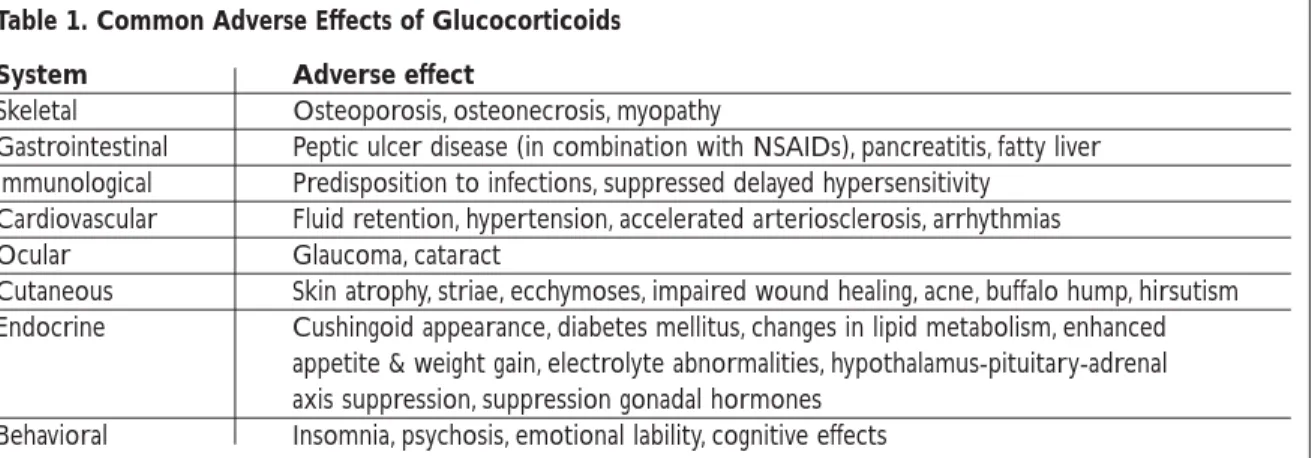
However, there are risks to glucocorticoid thera-py (see Table 1). In part, the negative effects of
J O H A N N E S W. G. J A C O B S E C O L. 50 35 40 45 30 25 20 15 10 5 0 0 6 12 18 24
: placebo group : prednisone group
Figure 1. Radiographic joint damage over time (months)
in the prednisone group versus the placebo group in the Utrecht study.16
Y-axis: radiographic score of hand and feet (Sharp/Van der Heijde score), means and standard errors of the mean; X-axis time in months. At month 12 and further on, joint damage is significantly less in the prednisone group compared to the placebo group (p=0,04 at 12 months and 0,02 at 24 months).
glucocorticoids can be prevented or diminished by taking precautions before therapy is started and by screening for adverse effects (see Table 2). Os-teoporosis is a well-known adverse effect of gluco-corticoids but can be prevented to a large extent. Internationally accepted guidelines have been de-veloped to minimize the occurrence of
glucocor-ticoid-induced osteoporosis.26Bisphosphonates
are, at present, the only class of drugs proven to be effective in the prevention and treatment of glu-cocorticoid-induced osteoporosis, and once week-ly regimens of effective bisphosphonates are
available nowadays. Active rheumatoid arthritis in itself is a risk factor for the development of osteo-porosis, being induced by inflammatory cytokines. In addition, impaired mobility, a consequence of rheumatoid arthritis, leads to fewer weight-bea-ring activities and diminished exposure to sun-light, which weaken bone and increase the risk of falls. The better control of the activity of rheuma-toid arthritis achieved with modern agents and
combination therapy diminishes this risk.27-29Also
beneficial in the light of the risk of osteoporosis is the trend to prescribe patients with rheumatoid
G L U C O C O R T I C O I D S I N R A
Table 2. Safe Usage of Glucocorticoids Therapy: Guidelines*
Before starting treatment, screen:
• blood pressure, check for peripheral edema and cardiac insufficiency
• other risk factors for osteoporosis than (consequences of) rheumatoid arthritis • co-medication, especially NSAIDs; history of peptic ulcer
• family history of glaucoma • serum lipids
• urine glucose test
At the start of treatment, prescribe:
• calcium and vitamin D suppletion always; biphosphonates on indication (see guidelines)
• in case of co-medication with NSAIDs, co-medication with proton pump inhibitors or prescribe a COX-1-sparing NSAID
During treatment, check: **
• blood pressure, check for peripheral edema and cardiac insufficiency • serum lipids
• urine glucose test
• ocular pressure in patients with a family history of glaucoma or on a high dose of glucocorticoids
*International guidelines not yet available. COX-1 = cyclo-oxygenase 1
**Frequency depends on individual patient’s risk or problems, assessed at screening before the start of therapy.
Table 1. Common Adverse Effects of Glucocorticoids System Adverse effect
Skeletal Osteoporosis, osteonecrosis, myopathy
Gastrointestinal Peptic ulcer disease (in combination with NSAIDs), pancreatitis, fatty liver Immunological Predisposition to infections, suppressed delayed hypersensitivity
Cardiovascular Fluid retention, hypertension, accelerated arteriosclerosis, arrhythmias Ocular Glaucoma, cataract
Cutaneous Skin atrophy, striae, ecchymoses, impaired wound healing, acne, buffalo hump, hirsutism Endocrine Cushingoid appearance, diabetes mellitus, changes in lipid metabolism, enhanced
appetite & weight gain, electrolyte abnormalities, hypothalamus-pituitary-adrenal axis suppression, suppression gonadal hormones
arthritis exercise, although this should not be over-done.30
The risk of gastrointestinal complications with the combination of NSAIDs and glucocorticoids can nowadays be tackled by comedication with proton pump inhibitors or by prescribing a cy-clooxygenase-1 (COX-1)-sparing NSAID. However, the jury is still out on to whether the group of cy-clooxygenase-1 (COX-1)-sparing NSAIDs increa-ses the incidence of cardiovascular incidents. Espe-cially in patients with rheumatoid arthritis using glucocorticoids, this is a serious issue as rheuma-toid arthritis itself and glucocorticoids could
in-crease cardiovascular morbidity.31-33Recently, a
record linkage database study on 68781 glucocor-ticoid-users (of whom 1115 patients with RA) and
82202 nonusers was published.34The incidence of
all cardiovascular diseases, including myocardial infarction, heart failure and cerebrovascular di-sease was not increased in patients using < 7.5 mg prednisolone on a chronic basis. However, it was
increased in patients using dosages ≥7.5 mg
dai-ly: relative risk adjusted for all known risk factors 2.6, 95% confidence interval 2.2 to 3. So in rheuma-toid arthritis patients on low-dose glucocorticoids, the disease itself seems to be more a risk factor for cardiovascular diseases than this medication. Pos-sibly intensive treatment of rheumatoid arthritis
can diminish the risk.35
Conclusion
The past decades several positive developments have tipped the balance further in favor of the use of low-dose glucocorticoid therapy (on indication) in rheumatoid arthritis. For example, glucocorti-coids may have disease-modifying potency in sub-sets of patients, and adverse effects can now be dealt with more effectively, such as glucocorticoid-induced osteoporosis and gastrointestinal com-plications. Low-dose glucocorticoid therapy seems safe if monitoring for adverse effects (Table 2) is part of the therapeutic strategy. Guidelines still have to be developed on how and when and in which dose to use low-dose glucocorticoids in (ear-ly) rheumatoid arthritis.
References
1. Hench PS, Kendall EC, Slocumb CH, Polley HF. The effect of a hormone of the adrenal cortex (17-hydro-xy-11-dehydrocorticosterone: compound E) and of pituitary adrenocorticotropic hormone on
rheuma-toid arthritis: Preliminary report. Proeedings Staff Meetings Mayo Clinic 1949; 24:181-97.
2. Jefferies WM. Low-dosage glucocorticoid therapy. An appraisal of its safety and mode of action in clinical disorders, including rheumatoid arthritis. Arch In-tern Med 1967; 119:265-78.
3. Joint Committee of the Medical Research Council and Nuffield Foundation. Cortisone and aspirin in rheumatoid arthritis. South Med J 1954; 47:1121-2. 4. Joint Committee of the Medical Research Council
and Nuffield Foundation. A comparison of cortisone and aspirin in the treatment of early cases of rheu-matoid arthritis. Br Med J 1954; 1:1223-7.
5. Medical Research Council and the Nuffield Founda-tion. Comparison of cortisone and codeine medica-tion as an adjuvant to manipulamedica-tion in rheumatoid arthritis. Br Med J 1954; 4856:233-5.
6. EMPIRE Rheumatism Council. Multi-centre con-trolled trial comparing cortisone acetate and acetyl salicylic acid in the long-term treatment of rheuma-toid arthritis; results up to one year. Ann Rheum Dis 1955; 14:353-70.
7. Joint Committee of the Medical Research Council and Nuffield Foundation. A comparison of cortisone and aspirin in the treatment of early cases of rheu-matoid arthritis; second report. Br Med J 1955; vol. 2:695-700.
8. Kirwan JR. The effect of glucocorticoids on joint des-truction in rheumatoid arthritis. The Arthritis and Rheumatism Council Low-Dose Glucocorticoid Study Group. N Engl J Med 1995; 333:142-6.
9. Hickling P, Jacoby RK, Kirwan JR. Joint destruction af-ter glucocorticoids are withdrawn in early rheuma-toid arthritis. Arthritis and Rheumatism Council Low Dose Glucocorticoid Study Group. Br J Rheumatol 1998; 37:930-6.
10. Boers M, Verhoeven AC, Markusse HM, van de Laar MA, Westhovens R, van Denderen JC, et al. Randomi-sed comparison of combined step-down prednisolo-ne, methotrexate and sulphasalazine with sulphasa-lazine alone in early rheumatoid arthritis. Lancet 1997; 350:309-18.
11. Dougados M, Combe B, Cantagrel A, Goupille P, Olive P, Schattenkirchner M, et al. Combination therapy in early rheumatoid arthritis: a randomised, controlled, double blind 52 week clinical trial of sulphasalazine and methotrexate compared with the single compo-nents. Ann Rheum Dis 1999; 58:220-5.
12. Haagsma CJ, van Riel PL, de Jong AJ, van de Putte LB. Combination of sulphasalazine and methotrexate versus the single components in early rheumatoid arthritis: a randomized, controlled, double-blind, 52 week clinical trial. Br J Rheumatol 1997; 36:1082-8. 13. Landewe RB, Boers M, Verhoeven AC, Westhovens R,
van de Laar MA, Markusse HM, et al. COBRA combi-nation therapy in patients with early rheumatoid arthritis: long-term structural benefits of a brief in-tervention. Arthritis Rheum 2002; 46:347-56. 14. Hansen M, Podenphant J, Florescu A, Stoltenberg M,
Borch A, Kluger E, et al. A randomised trial of diffe-rentiated prednisolone treatment in active rheuma-toid arthritis. Clinical benefits and skeletal side ef-fects. Ann Rheum Dis 1999; 58:713-8.
15. Wassenberg S, Rau R, Zeidler H. Low dose pred-nisolone therapy (LDPT) retards radiographically de-tectable destruction in early rheumatoid arthritis. Arthritis Rheum 2002; 42 (suppl):S243.
16. Van Everdingen AA, Jacobs JW, Siewertsz Van Reese-ma DR, BijlsReese-ma JW. Low-dose prednisone therapy for patients with early active rheumatoid arthritis: clini-cal efficacy, disease-modifying properties, and side effects: a randomized, double-blind, placebo-con-trolled clinical trial. Ann Intern Med 2002; 136:1-12. 17. Van Everdingen AA, Siewertsz Van Reesema DR,
Ja-cobs JW, Bijlsma JW. The clinical effect of glucocorti-coids in patients with rheumatoid arthritis may be masked by decreased use of additional therapies. Arthritis Rheum 2004; 51:233-8.
18. Capell HA, Madhok R, Hunter JA, Porter D, Morrison E, Larkin J, et al. Lack of radiological and clinical be-nefit over two years of low dose prednisolone for rheumatoid arthritis: results of a randomised con-trolled trial. Ann Rheum Dis 2004; 63:797-803. 19. Genovese MC, Bathon JM, Martin RW, Fleischmann
RM, Tesser JR, Schiff MH, et al. Etanercept versus me-thotrexate in patients with early rheumatoid arthritis: two-year radiographic and clinical outcomes. Arthri-tis Rheum 2002; 46:1443-50.
20. Buchanan WW, Stephen LJ, Buchanan HM. Are ‘homeopathic’ doses of oral corticosteroids effective in rheumatoid arthritis? Clin Exp Rheumatol 1988; 6:281-4.
21. ACR Subcommittee on Rheumatoid Arthritis Guide-lines. Guidelines for the management of rheumatoid arthritis: 2002 Update. Arthritis Rheum 2002; 46:328--46.
22. Gudbjornsson B, Skogseid B, Oberg K, Wide L, Hall-gren R. Intact adrenocorticotropic hormone secre-tion but impaired cortisol response in patients with active rheumatoid arthritis. Effect of glucocorticoids. J Rheumatol 1996; 23:596-602.
23. Chikanza IC, Petrou P, Kingsley G, Chrousos G, Panayi GS. Defective hypothalamic response to immune and inflammatory stimuli in patients with rheumatoid arthritis. Arthritis Rheum 1992; 35:1281--8.
24. Criswell LA, Saag KG, Sems KM, Welch V, Shea B, Wells G, et al. Moderate-term, low-dose corticos-teroids for rheumatoid arthritis. Cochrane Database Syst Rev 2000;CD001158.
25. Hansen M, Podenphant J, Florescu A, Stoltenberg M, Borch A, Kluger E, et al. A randomised trial of diffe-rentiated prednisolone treatment in active rheuma-toid arthritis. Clinical benefits and skeletal side ef-fects. Ann Rheum Dis 1999; 58:713-8.
26. Anonymous. Recommendations for the prevention and treatment of glucocorticoid-induced osteoporo-sis: 2001 update. American College of Rheumatology
Ad Hoc Committee on Glucocorticoid-Induced Os-teoporosis. Arthritis Rheum 2001; 44:1496-503. 27. Korpela M, Laasonen L, Hannonen P, Kautiainen H,
Leirisalo-Repo M, Hakala M, et al. Retardation of joint damage in patients with early rheumatoid arthritis by initial aggressive treatment with disease--modifying antirheumatic drugs: five-year experien-ce from the FIN-RACo study. Arthritis Rheum 2004; 50:2072-81.
28. Maini RN, Breedveld FC, Kalden JR, Smolen JS, Furst D, Weisman MH, et al. Sustained improvement over two years in physical function, structural damage, and signs and symptoms among patients with rheumatoid arthritis treated with infliximab and methotrexate. Arthritis Rheum 2004; 50:1051-65. 29. Grigor C, Capell H, Stirling A, McMahon AD, Lock P,
Vallance R, et al. Effect of a treatment strategy of tight control for rheumatoid arthritis (the TICORA study): a single-blind randomised controlled trial. Lancet 2004; 364:263-9.
30. Finckh A, Iversen M, Liang MH. The exercise pres-cription in rheumatoid arthritis: primum non no-cere. Arthritis Rheum 2003; 48:2393-5.
31. Dessein PH, Stanwix AE, Joffe BI. Cardiovascular risk in rheumatoid arthritis versus osteoarthritis: acute phase response related decreased insulin sensitivity and high-density lipoprotein cholesterol as well as clustering of metabolic syndrome features in rheumatoid arthritis. Arthritis Res 2002; 4:R5. 32. Nossent H. Risk of cardiovascular events and effect
on mortality in patients with rheumatoid arthritis. J Rheumatol 2000; 27:2282-3.
33. Raynauld JP. Cardiovascular mortality in rheumatoid arthritis: how harmful are corticosteroids? J Rheuma-tol 1997; 24:415-6.
34. Wei L, MacDonald TM, Walker BR. Taking glucocorti-coids by prescription is associated with subsequent cardiovascular disease. Ann Intern Med 2004; 141: 764-70.
35. Hurlimann D, Forster A, Noll G, Enseleit F, Chenevard R, Distler O, et al. Anti-tumor necrosis factor-alpha treatment improves endothelial function in patients with rheumatoid arthritis. Circulation 2002; 106: 2184-7.
Contact Address:
Johannes W.G. Jacobs
University Medical Center, F02.127 PO-Box 85500,
3508 GA, Utrecht, The Netherlands E-mail: [email protected] Phone: +31302507357 Fax: +31302523741