
Decision-making in adult unipolar depressed patients and healthy subjects: significant differences in Net Score and in non-traditional alternative measures
9
0
0
Texto
(2) Marco Moniz - Saul Neves de Jesus - Eduardo Gonçalves - Andreia Pacheco - João Viseu. 1. Introduction Iowa Gambling Task (IGT) (Bechara, Damasio, Damasio & Anderson, 1994) was developed with the purpose of simulating real-life judgment alterations, allowing to assess the emotions associated with decision-making in patients suffering damage to the orbitofrontal cortex (OFC). During the task, subjects perform a series of 100 selections from a group of four decks of cards (A, B, C and D), resulting the selection in a fixed monetary reward and, occasionally, in monetary losses. Yielding fixed rewards of 100$ for each choice, decks A and B are classified by Bechara et al. (1994) as “disadvantageous” because, in the long run, punishments surpass rewards; on the contrary, decks C and D, despite yielding rewards of half of that amount (50$ for each choice), are “advantageous” in the long run once rewards exceed punishments. This study used a IGT version from the Psychology Experiment Building Language (PEBL) (Mueller, 2013), a free access battery, following the application indications of Areias, Paixão and Figueira (2013). The classical 100 trials were performed, complying with changes of original instructions (Bechara, Damasio, Damasio & Lee, 1999), embedded in the application. According to Bechara (2000), in initial studies, subjects tended to think they could never win the game because they had the impression that reward and punishment schedules were generated by the computer. In the current study, subjects were therefore informed that there were decks better than others and that cards were in a predefined order (and then not likely to be changed by the computer). Decision-making corresponds to the cognitive processes involved in reaching a decision, allowing the adoption of a flexible behavior aimed toward a goal or the completion of a task in a dynamic environment. Impairments in decision-making are a main characteristic of many psychiatric pathologies, such as affective disorders, being difficulty and slowness in decision-making a clinical feature of depression (Clark & Robbins, 2009), and therefore, in IGT, depressed subjects are usually outperformed by controls (Cella, Dymond & Cooper, 2010). However, some authors suggest that alterations in decision making are only typical of mania (bipolar disorder) (Murphy et al., 2001; Chamberlain & Sahakian, 2006) and that lower results in depression are due to psychomotor alterations, entailing a prolonged deliberation time, rather than impairment in decision-making (Clark & Robbins, 2009). Regarding performance assessment, in addition to a conventional calculation (CD-AB Trials 1-100), we replicated other alternative measures (Gansler, Jerram, Vannorsdall & Schretlen, 2011), particularly D-A, as well as two measures which exclude the first trials (CD-AB Trials 21-100; CD-AB Neuropsychological Trends – 19/2016 http://www.ledonline.it/neuropsychologicaltrends/. 8.
(3) Decision-making in adult unipolar depressed patients and healthy subjects. Trials 41-100) in which choices are made without an explicit knowledge of reward and punishment contingencies (Areias et al., 2013). The purpose of this study was to compare the performance of a clinical sample of non-psychotic unipolar depressed subjects to adult healthy controls in a free version of IGT. Another objective was to provide initial normative data in order to allow its application in clinical contexts and future research. According to the literature, we hypothesized that depressed subjects would perform more poorly in IGT compared to healthy controls.. 2. Methods 2.1. Participants Both studied samples, experimental and control groups, were comprised of 30 subjects each. The experimental (patients’) group was composed by 22 women and 8 men, with a mean age of 42.20 years old (SD = 13.49), a mean of 8.50 (SD = 3.57) years of education and an age range of 17-67 years old. The participants from this group were recruited in the city of Faro (Portugal), more precisely from the Department of Psychiatry and Mental Health of Hospital Center of Algarve (a state owned entity). With analogous characteristics, healthy controls comprised 20 women and 10 men, with a mean age of 41.43 years old (SD = 15.18), a mean of 10.03 (SD = 3.59) years of education and an age range of 17-67 years old. Patients and controls did not differ significantly regarding gender (χ2 = .317, df = 1, p = .573), age (t = .207, df = 58, p = .837, d = .053), and education (t = -1.655, df = 58, p = .099, d = -.427). All participants were Caucasians and Portuguese speakers. 2.2. Measures The computerized IGT (Mueller, 2013), a free software from PEBL Test Battery (Mueller & Piper, 2014), similar to the commercial version of IGT from Psychological Assessment Resources (PAR), and a valid measure of decisionmaking (Parkhurst, Gelety, Greenhalgh & Birkett, 2014), was performed. The same computer running Microsoft Windows 8.1 was used with all subjects, with a touch screen in order to minimize the difficulties of older subjects in using a mouse or a keyboard. Neuropsychological Trends – 19/2016 http://www.ledonline.it/neuropsychologicaltrends/. 9.
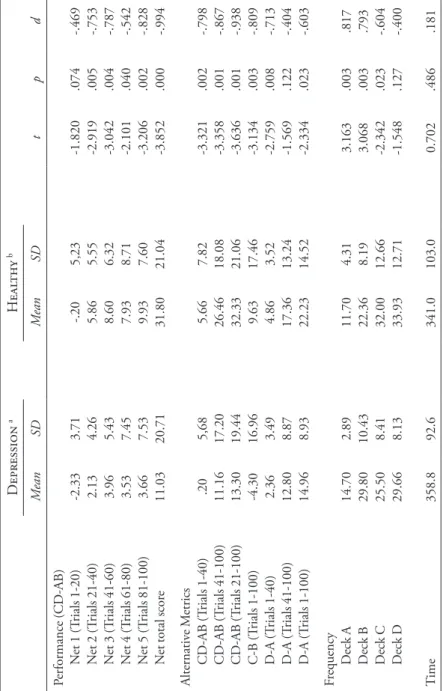
(4) Marco Moniz - Saul Neves de Jesus - Eduardo Gonçalves - Andreia Pacheco - João Viseu. 2.3. Procedures Each participant completed a health and demographic questionnaire and depression diagnoses were confirmed through the Mini International Neuropsychiatric Interview (MINI) (Sheehan et al., 1997) and the Brief Symptom Inventory (BSI) (Canavarro, 2007). Exclusion criteria were current or prior history of bipolar disorders, schizophrenia, major psychosis, substance abuse, dementia and neurologic disease, including head injury involving loss of consciousness. To discard malingering, Rey 15-Item Memory Test (15-IMT) was used (Simões et al., 2010). This study was approved by the Hospital Center of Algarve Ethics Committee, in conformity with the Helsinki declaration. After being provided with all the information about the study, all participants signed an informed consent statement. All analyzes were conducted using the Statistical Package for the Social Sciences (SPSS), version 20.0. The level of significance was set at p < .05.. 3. Results Differences between total scores for depressed subjects and healthy controls in general performance (Net total score t = -3.852, df = 58, p = .001, d = -.994) and most alternative metrics (CD-AB Trials 1-40) (t = -.2.873, df = 100, p = .005, d = -.569); (CD-AB Trials 41-100) (t = -.2.873, df = 100, p = .005, d = -.569); (CD-AB Trials 21-100) (t = -.2.873, df = 100, p = .005, d = -.569); (C-B Trials 1-100) (t = -.2.873, df = 100, p = .005, d = -.569); (D-A Trials 1-40) (t = -.2.873, df = 100, p = .005, d = -.569); (D-A Trials 1-100) (t = -.2.873, df = 100, p = .005, d = -.569) were found (Table 1). In terms of the influence of demographic variables, a one-way analysis of variance (ANOVA) only showed significant differences regarding age groups in healthy subjects (F[2, 27] = 9.97, p = .001, ηp2 = .425), with a shared variance of 33% in performance time (R 2 = .339, F[1, 28] = 14.372, p = .001).. Neuropsychological Trends – 19/2016 http://www.ledonline.it/neuropsychologicaltrends/. 10.
(5) .20 11.16 13.30 -4.30 2.36 12.80 14.96 14.70 29.80 25.50 29.66 358.8. Alternative Metrics CD-AB (Trials 1-40) CD-AB (Trials 41-100) CD-AB (Trials 21-100) C-B (Trials 1-100) D-A (Trials 1-40) D-A (Trials 41-100) D-A (Trials 1-100). Frequency Deck A Deck B Deck C Deck D. Time. Note: a n = 30, b n = 30.. -2.33 2.13 3.96 3.53 3.66 11.03. Performance (CD-AB) Net 1 (Trials 1-20) Net 2 (Trials 21-40) Net 3 (Trials 41-60) Net 4 (Trials 61-80) Net 5 (Trials 81-100) Net total score. Mean. 92.6. 2.89 10.43 8.41 8.13. 5,68 17.20 19.44 16.96 3.49 8.87 8.93. 3.71 4.26 5.43 7.45 7.53 20.71. SD. Depression a. 341.0. 11.70 22.36 32.00 33.93. 5.66 26.46 32.33 9.63 4.86 17.36 22.23. -.20 5.86 8.60 7.93 9.93 31.80. Mean. 103.0. 4.31 8.19 12.66 12.71. 7.82 18.08 21.06 17.46 3.52 13.24 14.52. 5,23 5.55 6.32 8.71 7.60 21.04. SD. Healthy b. Table 1. Descriptive statistics (n = 60). 0.702. 3.163 3.068 -2.342 -1.548. -3.321 -3.358 -3.636 -3.134 -2.759 -1.569 -2.334. -1.820 -2.919 -3.042 -2.101 -3.206 -3.852. t. .486. .003 .003 .023 .127. .002 .001 .001 .003 .008 .122 .023. .074 .005 .004 .040 .002 .000. p. .181. .817 .793 -.604 -.400. -.798 -.867 -.938 -.809 -.713 -.404 -.603. -.469 -.753 -.787 -.542 -.828 -.994. d.
(6) Marco Moniz - Saul Neves de Jesus - Eduardo Gonçalves - Andreia Pacheco - João Viseu. 4. Discussion As in Cella, Dymond, and Cooper’s (2010) study, and in contrast to the results obtained by Smoski et al. (2008), there were differences concerning total results between depressed subjects and healthy controls. It was not possible to corroborate that alterations in decision-making are specific features of bipolar disorders (Murphy et al., 2001) because, in the current study, depressed patients were outperformed by controls even in alternative measures, particularly CD-AB Trials 21-100 and CD-AB Trials 41-100, that exclude the first trials which may be related to a higher difficulty or slowness in adapting to the rules of the game (Areias et al., 2013). Concerning aging effects, older subjects (over 50 years old) took more time to perform the test, these results may be related to cognitive decline and motor functioning loss. The age effect is not recorded in the test performance, since there is no consensus on the existence of performance differences on the decision-making process between old and young (Wiesiolek, Foss & Diniz, 2014).. 5. Conclusion This study’s results reinforce the hypothesis that impairment in decisionmaking is not only specific to the maniacal state of bipolar patients, being also a main feature of affective disorders (Roiser, Rubinsztein & Sahakian, 2009), which has been corroborated by studies based on functional neuroimaging that have shown differences in neural responses to feedback during decision-making between depressed patients and healthy controls (Steele, Kumar & Ebmeier, 2007), revealing the unipolar depressive patients a hypersensitivity to negative feedback, with disrupted top-down control by the prefrontal cortex of the amygdala (Tavares et al., 2008). The main contribution of this study was to present initial normative data for this test (Table 2), hoping to help clinicians with future applications of IGT, once it represents a crucial tool to assess decision-making in depressive patients, as well as in subjects who do not suffer from any mental disorder. The main limitation was the sample size, regarding both patients’ group and health controls, which prevented us from validating more clearly normative data for IGT. Future research attempting to compare a wider samples is therefore recommended.. Neuropsychological Trends – 19/2016 http://www.ledonline.it/neuropsychologicaltrends/. 12.
(7) -29.25 -15.60 -6.00 14.00 20.50 40.60 52.50. (1-100). Note: a n = 30, b n = 30, c n = 60.. 5 10 25 50 75 90 95. Percentile -28.95 -8.00 -2.50 15.00 22.50 42.40 52.50. (21-100). Depression a. -22.95 -13.20 -1.00 12.00 20.00 41.80 46.00. (41-100) -.90 6.40 17.00 27.00 44.00 67.80 73.80. (1-100). Net Score. .20 6.60 16.00 26.00 52.00 67.20 73.80. (21-100). Healthy b. Table 2. Percentile of healthy and depressed subjects. 0 4.20 12.00 23.00 40.50 60.00 60.00. (41-100) 525.0 498.7 405.2 346.9 278.3 233.9 199.0. Time c.
(8) Marco Moniz - Saul Neves de Jesus - Eduardo Gonçalves - Andreia Pacheco - João Viseu. References Areias, G., Paixão, R., & Figueira, A.P.C. (2013). O Iowa Gambling Task: uma revisão crítica. Psicologia: Teoria e Pesquisa, 29 (2), 201-210. Bechara, A. (2000). Characterization of the decision-making deficit of patients with ventromedial prefrontal cortex lesions. Brain, 123 (Pt 11), 2189-2202. Bechara, A., Damasio, A.R., Damasio, H., & Anderson, S.W. (1994). Insensitivity to future consequences following damage to human prefrontal cortex. Cognition, 50 (1-3), 7-15. Bechara, A., Damasio, H., Damasio, A.R., & Lee, G.P. (1999). Different contributions of the human amygdala and ventromedial prefrontal cortex to decisionmaking. Journal of Neuroscience, 19 (13), 5473-5481. Canavarro, M.C. (2007). Inventário de Sintomas Psicopatológicos (BSI): uma revisão crítica dos estudos realizados em Portugal. In: Simões, M.R., Machado, C., Gonçalves, M.M., & Almeida, L.S. (eds.), Avaliação psicológica: instrumentos validados para a população portuguesa, vol. 3. Coimbra, Portugal: Quartet, pp. 305-330. Cella, M., Dymond, S., & Cooper, A. (2010). Impaired flexible decision-making in major depressive disorder. Journal of Affective Disorders, 124 (1-2), 207-210. Chamberlain, S.R., & Sahakian, B.J. (2006). The neuropsychology of mood disorders. Current Psychiatry Reports, 8 (6), 458-463. Clark, L., & Robbins, T.W. (2009). Decision-making. In: Wood, S.J., Allen, N.B., & Pantelis, C. (eds.), The neuropsychology of mental illness. Cambridge: Cambridge University Press, pp. 138-156. Gansler, D.A., Jerram, M.W., Vannorsdall, T.D., & Schretlen, D.J. (2011). Comparing alternative metrics to assess performance on the Iowa Gambling Task. Journal of Clinical and Experimental Neuropsychology, 33 (9), 1040-1048. Mueller, S.T. (2013). The Psychology Experiment Building Language (Version 0.13) [software]. Mueller, S.T., & Piper, B.J. (2014). The Psychology Experiment Building Language (PEBL) and PEBL Test Battery. Journal of Neuroscience Methods, 222, 250-259. Murphy, F.C., Rubinsztein, J.S., Michael, A., Rogers, R.D., Robbins, T.W., Paykel, E.S., & Sahakian, B.J. (2001). Decision-making cognition in mania and depression. Psychological Medicine, 31 (4), 679-693. Parkhurst, D.K., Gelety, C., Greenhalgh, J., & Birkett, M. (2014). Differences in affective decision-making between types of drinkers as assessed by two versions of the Iowa Gambling Task. Pebl Technical Report, 1, 1-10. Roiser, J.P., Rubinsztein, J.S., & Sahakian, B.J. (2009). Neuropsychology of affective disorders. Psychiatry, 8, 91-96. Sheehan, D., Lecrubier, Y., Harnett Sheehan, K., Janavs, J., Weiller, E., Keskiner, A., & Dunbar, G. (1997). The validity of the Mini International Neuropsychi-. Neuropsychological Trends – 19/2016 http://www.ledonline.it/neuropsychologicaltrends/. 14.
(9) Decision-making in adult unipolar depressed patients and healthy subjects. atric Interview (MINI) according to the SCID-P and its reliability. European Psychiatry, 12 (5), 232-241. Simões, M., Sousa, L., Duarte, P., Firmino, H., Pinho, M.S., Gaspar, N., & França, S. (2010). Avaliação da simulação ou esforço insuficiente com o Rey 15-Item Memory Test (15-IMT): estudos de validação em grupos de adultos idosos. Análise Psicológica, 28 (1), 209-226. Smoski, M.J., Lynch, T.R., Rosenthal, M.Z., Cheavens, J.S., Chapman, A.L., & Krishnan, R.R. (2008). Decision-making and risk aversion among depressive adults. Journal of Behavior Therapy and Experimental Psychiatry, 39, 567-576. Steele, J.D., Kumar, P., & Ebmeier, K.P. (2007). Blunted response to feedback information in depressive illness. Brain, 130 (Pt 9), 2367-2374. Tavares, J.V.T., Clark, L., Furey, M.L., Williams, G.B., Sahakian, B.J., & Drevets, W.C. (2008). Neural basis of abnormal response to negative feedback in unmedicated mood disorders. NeuroImage, 42 (3), 1118-1126. Wiesiolek, C.C., Foss, M.P., & Diniz, P.R.B. (2014). Normal aging and decisionmaking: a systematic review of the literature of the last 10 years. Jornal Brasileiro de Psiquiatria, 63 (3), 255-259.. Neuropsychological Trends – 19/2016 http://www.ledonline.it/neuropsychologicaltrends/. 15.
(10)
Imagem

Documentos relacionados
Neste trabalho o objetivo central foi a ampliação e adequação do procedimento e programa computacional baseado no programa comercial MSC.PATRAN, para a geração automática de modelos
Ousasse apontar algumas hipóteses para a solução desse problema público a partir do exposto dos autores usados como base para fundamentação teórica, da análise dos dados
Methods: We studied 49 patients with bv-FTD diagnosis and 30 patients diagnosed with unipolar depression compared to a control group of 26 healthy controls using the INECO
Revista Veja - Edição 2033 de 7 de novembro de 2007 "Para mim, ética não é pose" Relator do caso Renan diz que não se intimida e chama de canalhas os responsáveis pelo dossiê
Although there was no statistically significant difference between the OCD group and the healthy control group for decision making performance, the mean score of the IGT tended
Introduction: The objective of this study was to compare patients with bipolar disorder (BD), their first-degree relatives and a group of healthy controls in terms
Tais condições estão relacionadas com as medidas previstas no Acordo sobre Medidas Sanitárias e Fitossanitárias (SPS 81 ). 82 O Artigo 6 refere-se as disciplinas
Legendas: Td MTE (Temperatura distal do membro torácico esquerdo); Tm MTE (Temperatura medial do membro torácico esquerdo); Td MPE (Temperatura distal do membro
