In vitro
multiplication of
Eucalyptus hybrid
via
temporary immersion bioreactor: culture media
and cytokinin effects
Wesley Pires Flausino Máximo
1, Paulo Augusto Almeida Santos
2,
Guilherme Silva Martins
3, Evânia Galvão Mendonça
4and
Luciano Vilela Paiva
1*Abstract: This study aimed to assess the influence of culture medium and cy
-tokinin type on in vitro multiplication of an Eucalyptus grandis x E. urophylla
hybrid clone via temporary immersion bioreactor (TIB®). JADS, modified MS at a
(NO3ˉ):(NH4+) ratio, and WPM were used as liquid media; and BAP, KIN, and TDZ were the cytokinins used in the study. According to the results, explants under the influence of modified MS presented better results for all traits. BAP was the most suitable plant growth regulator for axillary bud shoot proliferation. By the leaf histological analysis, most of the shoots grown in the presence of BAP either exhibited normal morphology or only a few hyperhydricity symptoms. All these results were obtained at 19 days after in vitro cultivation, a shorter period when compared with other works in the literature, showing the protocol efficiency in the multiplication of this hybrid clone using TIB®.
Key words: 6-benzilaminopurine, hyperhydricity, plant biotechnology, in vitro propagation.
Crop Breeding and Applied Biotechnology 18: 131-138, 2018 Brazilian Society of Plant Breeding. Printed in Brazil
http://dx.doi.org/10.1590/1984-70332018v18n2a19 ARTICLE
*Corresponding author:
E-mail: [email protected]
Received: 25 March 2017 Accepted: 29 August 2017
1 Universidade Federal de Lavras, Departa-mento de Química, Laboratório Central de Biologia Molecular, 3037, 37.200-000, Lavras, MG, Brazil
2 Universidade Federal de Sergipe,
Depar-tamento de Biologia, Av. Marechal Rondon, Jardim Rosa Elze, 49.100-000, São Cristóvão, SE, Brazil
3 Université de Sherbrooke, Department de
Biologie, Boulevard de l'Université, Zip Code J1K 2R1, Sherbrooke, Québec, Canada
4 Universidade Federal Rural do Rio de
Janei-ro, Departamento de Floresta, Rod. BR-465, km 7, 23.895-000, Seropédica, RJ, Brazil INTRODUCTION
Bioreactor technology is a mechanized system used in plant tissue culture to improve the large-scale micropropagation in laboratories and biofactories. Therefore, bioreactor comes as an alternative technological tool to the conventional micropropagation process aimed at optimizing the in vitro cultivation by the automation of the process (Maciel et al. 2016, Mariateresa et al. 2014, Oliveira et al. 2011b). These mechanized systems can help achieve a higher plant biomass gain and reduce the time needed for propagation (Máximo et al. 2015). Such gains are the result of the greater contact between explant and culture medium. This fact enables a higher nutrient absorption by the explant and a greater in vitro environment aeration, which renews the gaseous atmosphere inside culture vessels (Mariateresa et al. 2014, Zobayed et al. 2001).
is more adequate for each species or hybrid.
Besides determining the culture medium composition, the evaluation on which growth regulator is the most efficient for the in vitro multiplication of each species is fundamental. This is because regulators are associated to plant morphogenetic responses (Garcia et al. 2011). At the in vitro multiplication stage, cytokinins are essential growth regulators for the apical dominance rupture and induction of axillary bud proliferation. Furthermore, the cytokinins type strongly influences the success of in vitro propagation of many species, including Eucalyptus sp. (Brondani et al. 2012).
This study aimed to assess the efficiency of culture media and cytokinin types in the cultivation of a commercial
Eucalyptus grandis x E. urophylla hybrid as an effort to establish a specific protocol for such procedure by using a temporary immersion bioreactor (TIB®).
MATERIAL AND METHODS
Plant material
Shoots from an E. grandis x E. urophylla hybrid matrix were excised and sterilized with paraformaldehyde for 40 minutes. Shoot tips were isolated and inoculated onto MS medium (Murashige and Skoog 1962) supplemented with 20 g L-1 sucrose and Phytagel® (SIGMA) gelling agent at 5.8 pH. Explants were kept in darkness for five days and transferred
to MS medium supplemented with 5.7 μM of indol-3-acetic acid (IAA) and 0.14 μM of 6-benzilaminopurine (BAP). Afterward, the plant material was maintained for 40 days in growth room, with 16 h photoperiod, with 40 µmol m-2 s-1
irradiancy, at a temperature of 26 ± 2 0C.
Temporary immersion bioreactor (TIB®)
A temporary immersion bioreactor (TIB®) coupled to a pneumatic chassis MFE – 1001 (Fitoclone, Viçosa, MG, Brazil)
was used in all experiments. The temporary immersion cycle was controlled by an electronic system (timer) set as follows: transfer of medium between vessels every 2 h; contact between explant and medium was kept for 10 s; and finally, air was injected for in vitro atmosphere renewal every 1 h. Air injection was performed using 0.20-µm-pore filters to promote sterilization. All vessels were chemically sterilized with a 0.036% (m/v) sodium hypochlorite solution during 12 h. The media had their pH adjusted to 5.8. The bioreactor was kept in a growth room at 26 ± 2 0C, with 16 h photoperiod,
and 40 µmol m-2 s-1 irradiancy, provided by white fluorescent lamps, which were controlled by the electronic system.
Liquid medium employed in the TIB®
The stem of in vitro shoots, each one containing two nodal segments, were used as explants. The explants were inoculated into bioreactor vessels containing 400 mL of the following liquid media: MS medium (Murashige and Skoog 1962) modified on nitrate: ammonium ratio 3:1 (NO3-):(NH
4+) (for more information, see Máximo et al. 2015), JADS
(Correia et al. 1995), and WPM (Lloyd and McCown 1981). All media were supplied with 20 g L-1 sucrose. Inoculation
was conducted in a horizontal laminar flow chamber, and the explants were maintained according to the cultivation conditions previously established for TIB® section.
At 19 days after inoculation, the following traits were assessed: number of shoots, fresh weight, length of the highest shoot, and number of leaves of the highest shoot. A completely randomized design was used, with 30 repetitions, each one represented by two nodal segments.
In vitro multiplication by cytokinin supplementations
After the selection of the adequate medium in the previous experiment, the effect of different cytokinins during in vitro multiplication was assessed. Explants were the same as mentioned above: stem of in vitro shoots. These explants were inoculated into bioreactor vessels containing 400 mL of modified MS medium 3:1 (NO3-):(NH
4+) added of 5.7 μM
of IAA and 20 g L-1 sucrose. Treatments with cytokinin consisted of applying 0.14 µM of either 6- benzilaminopurine
At 19 days after inoculation, the evaluated traits were the same as the prior experiment, but with 21 repetitions (two nodal segments each) per treatment.
Histological analysis
Shoots cultivated in TIB® containing modified MS 3:1 (NO
3-):(NH4+) supplemented or not with cytokinins BAP, KIN,
and TDZ at 0.14 µM had their leaves cut from the third node to undergo light microscopy. The leaves from the third node of each explant were used in the experiment as a standard. Furthermore, these leaves were apparently more physiologically active and completely expanded.
All samples were fixed in FAA 70 (Johansen 1940) and stored in 70 % ethanol (v/v). Each sample was dehydrated for 1 h with the 80, 90, and 100 % ethanol concentration series – the last one was applied twice. Samples were infiltrated by a 1:1 epoxy resin solution (Historesin®Leica) added with ethanol for 24 h and transferred to a 100 %
concentration-epoxy-resin solution for 48 h. The infiltrated material was blocked in 15:1 resin+polymer by water-soluble cylindrical capsules and maintained in an oven (HL-2000 Hybrilinker) at 37 0C, for approximately 72 h. A semiautomatic microtome
(Easypath EP-31-20091) was used to make 3.0 µm-thick transversal cuts, which were fixed in glass slides. These materials were stained with safrablau (0.1% safranin + 1% astra blue) (Kraus and Arduin 1997) and finally evaluated under light microscopy (Zeis, Axio Scope). The UTHSCSA Image Tool was used to analyze the adaxial epidermis, leaf and mesophyll thicknesses, and palisade and spongy parenchyma thicknesses.
A completely randomized design was used, using three leaves from each shoot. For slide assembly, each leaf yielded ten transversal cuts, being five cuts per slide. Three visual fields were selected from each cut to measure the variables.
Statistical data analysis
All data were submitted to the analysis of variance (ANOVA) through the Sisvar software (Ferreira 2014) for statistical analysis. Mean values were compared by the Tukey’s test at 5% significance.
RESULTS AND DISCUSSION
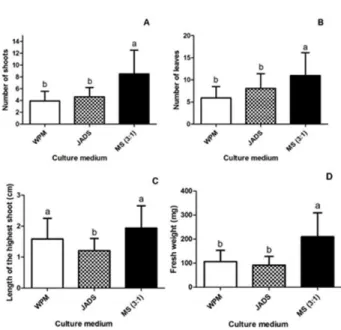
Little information about using temporary immersion bioreactors is available for Eucalyptus spp. in vitro multiplication, especially on the use of different culture media (Oliveira et al. 2011a). Most of the discussion of this study is mainly based on results found in semisolid medium cultivation. A statistical difference was observed for all studied traits by the Tukey’s test (p<0.05). The shoots taken from the modified MS medium presented the best results. Conversely, no significant effect was observed in shoot growth when using the JADS medium (Figure 1).
Explants cultivated in the modified MS medium had a mean of 8.5 shoots per explant, 11 leaves in the highest shoot, 1.94 cm also in the highest shoot, and a total fresh weight of 210.28 mg. These data are consistent with those found in the literature, confirming that MS provides promising results for cultivation, regeneration, and multiplication of Eucalyptus spp. when compared with JADS and/or WPM (Oliveira et al. 2011a,). Other works have demonstrated that modifications on nitrate and ammonium ratio in the MS medium can also provide enhanced results during in vitro multiplication of E. grandis x E. urophylla clones (Máximo et al. 2015, Oliveira et al. 2011b).
Oliveira et al. (2011a) reported about 8 shoots per
Figure 1. Effect of culture media WPM, JADS, and modified MS
3:1 (NO3-):(NH
4+) on the development of explants grown on TIB®
explant and a fresh weight of about 300 mg after cultivating shoot tips of an E. grandis x E. urophylla clone in RITA®
bioreactors. Although these results are similar to those found in the present work, the cultivation period in RITA® was
28 days, while the cultivation period in TIB® was 19 days. In general, RITA® vessels are smaller than TIB®, and thus bigger
vessels are expected to have more headspace. Considering the same aeration time in both bioreactors, TIB® might have
accumulated less toxic gases (like ethylene) in the in vitro environment, and thus had less influence on plant growth, explaining the similar performance in both TIB® and RITA® explants growth, but with a shorter period in TIB®.
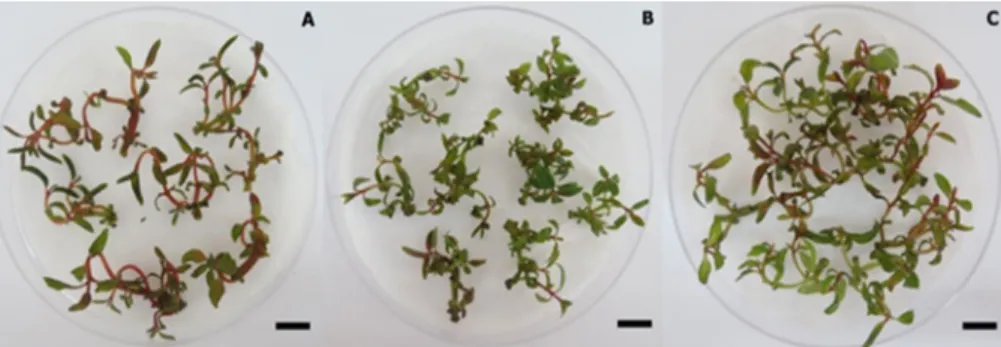
Shoots cultivated under influence of the modified MS medium morphologically presented greater strength, greener leaves, and greater uniformity. Conversely, explants cultivated on JADS were smaller and less homogenous. Regarding shoots grown on WPM, some morphological alterations were noted, such as twisted reddish stems and a smaller number of leaves (Figure 2). Works using clone shoots from this hybrid cultivated on WPM also presented reddish stems and callus formation on leaves, while those cultivated on MS showed better morphological traits (Oliveira et al. 2011a).
Reportedly, MS is a saline medium, rich in nutrient and nitrogen, while WPM presents low nitrogen levels (Pinto et al., 2008). Furthermore, adequate (NO3-):(NH
4+) ratios could also stimulate plant morphogenesis (Ramage and Williams
2002), suggesting the results found for the two media were different due to the less nitrogen availability in WPM. Therefore, this fact indicates that the 3:1 (NO3-):(NH
4+) ratio applied in MS was the most appropriate for shoots of the E. grandis x E. urophylla hybrid clone.
When the nitrate level is higher than the ammonium level, the nitrate reductase (NR) activity may increase as a response of the enzyme to its substrate (Lea et al. 2006). The result of the enzyme activity is the greater nitrate absorption and shoot growth. In addition, under aerobic soil conditions, nitrate is the main source of nitrogen absorbed by plants. This ion acts as a signaling molecule regulating the expression of genes related to root development and leaf expansion, consequently adjusting plant growth according to its availability (Ho and Tsay 2010). Thus, such resemblance between soil condition and TIB® may have occurred when nitrate availability was higher in modified MS medium.
As the proportion between nitrate and ammonium is very similar in the WPM medium composition, such ammonium availability might be impairing a properly nitrate absorption. Ammonium absorption is more energetically economical than nitrate owing to its reduced form; however, higher ammonium levels in tissues may be toxic (Britto and Kronzucker 2002, Ho and Tsay 2010). Although plant toxicity responses are little understood, external environment acidification, acid/base balance disruption, and energy loss caused by excessive export of ammonium may negatively affect plant growth and subsequently its survival (Ho and Tsay 2010). This could explain, for example, the twisted reddish stems observed in shoots cultivated in WPM.
Works using JADS as culture medium to cultivate E. grandis have demonstrated positive results during the in vitro multiplication stage (Correia et al. 1995), even though the composition of the medium is formulated with significantly reduced salt concentrations, specifically potassium ions when compared with MS. These results show that genotype is dependent on the culture medium, emphasizing that a few changes in the medium composition may be considered as essential to elucidate shoot phenotype and explain differences in efficiency of culture media on plant growth.
Figure 2. Visual aspect of shoots cultivated for 19 days in TIB® using the media A) WPM; B) JADS; C) modified MS 3:1 (NO
3-):(NH4+).
All traits, except for fresh weight, were statistically influenced by the cytokinin type used in the cultivation on TIB® (Figure 3). Mean number of shoots (8.1 shoots)
and mean number of leaves (11.71 leaves) from explants grown in media containing BAP were the best results among cytokinin treatments. Although shoots cultivated under BAP influence showed better results for the traits analyzed, they presented no significant difference when compared with those cultivated under KIN influence regarding the length of the highest shoot. BAP is directly related to cell division and adventitious shoot development (Andrade et al. 2006), while KIN not only influences cell division but also increases the number of microtube cells (Romanov et al. 2000), which might promote elongation over new shoot production.
Shoots grown in medium containing BAP not only were outstanding and numerous but also presented greener leaves, sturdier stems, and no apparent hyperhydricity aspect. Conversely, explants under the influence of KIN presented a smaller number of shoots, thinner and more translucent stems, and apparent hyperhydric leaves (Figure 4C). The choice of the cytokinin type during the in vitro cultivation has been considered as a crucial factor that might affect the developmental stage and quality of shoots, once cytokinins may act on the photosynthetic apparatus function and interfere in the leaf chlorophyll content (Dobránszki and Mendler-Drienyovszki 2014).
In another research, shoots from E. grandis x E.
urophylla hybrids cultivated in a RITA® bioreactor at low BAP
concentrations did not present hyperhydricity symptoms (Oliveira et al. 2011a). Hyperhydric plants show sturdier, thicker, more wrinkled, more translucent, more rigid stems and leaves (Kevers et al. 2004, Picoli et al. 2001), as well as node shortening, and an apparent water accumulation (Vasconselos et al. 2012). Shoots cultivated in medium containing TDZ displayed abnormal formation, small size, and less developed vitrified leaves, besides callus formation at the stem base of shoots and on the leaf surface (Figure 4B). In vitro works with Aloe polyphylla have also demonstrated that the use of TDZ led to callus formation, abnormal morphology leaf, and vitrified small shoots (Ivanova and Van Staden 2011).
A statistical difference (p < 0.05) was also observed for leaf histological analysis of shoots cultivated under cytokinins influence. Shoots grown in the presence of BAP had higher means of leaf, mesophyll, and palisade thicknesses, besides displaying a spongier parenchyma. Nevertheless, both TDZ and KIN showed greater adaxial epidermis thickness (Table 1).
Figure 3. Influence of the cytokinins BAP, KIN, and TDZ (all at 0.14
μM) on the development of shoots cultivated on TIB®. Graphics
show the mean of A) number of shoots; B) number of leaves
from the highest shoot; and C) length of the highest shoot for E.
grandis x E. urophylla explants. Control contains no cytokinin in
the modified MS medium 3:1 (NO3-):(NH
Usually, the palisade tissue of vitrified leaves is either absent or greatly reduced, while the mesophyll has a spongy and vacuolated aspect, as well as a great number of intercellular space (Vasconcelos et al. 2012). In hyperhydric compact leaves, a poorly differentiated palisade cell layer is commonly present, while vitrified lacunae leaves present a decreased differentiation of the palisade tissue, with both intercellular space and spongy mesophyll enlargement (Picoli et al. 2001). Such information confirms the results found in the present study since the shoots from the BAP treatment presented relatively normal leaves, while the leaves from the other cytokinin treatments exhibited a higher quantity of intercellular space (ratio between the thickness of palisade and spongy parenchyma), which evidences the profile of lacunous hyperhydric leaves (Figure 5). Other studies have reported this disorder and adverse results in the multiplication of some species cultivated with TDZ (Bosela and Michler 2008, Sunagawa et al. 2007), confirming that this plant growth regulator was not appropriate for the Eucalyptus hybrid evaluated in our study.
CONCLUSIONS
The modified MS medium with 3:1 (NO3-):(NH
4+) ratio containing BAP at 0.14 μM is efficient for in vitro multiplication
of E. grandis x E. urophylla hybrid clone using TIB®. Most shoots exhibited hyperhydricity symptom; however, the shoots
under BAP influence presented lower evidence of this abnormality. Therefore, the protocol developed in this study can provide a greater number of vigorous shoots to be used in subsequent micropropagation steps.
Figure 4. Morphological aspect of shoots cultivated on TIB® under the influence of different cytokinin in the modified MS medium
(NO3-):(NH4+) for 19 days. Shoots grown in the absence of cytokinin (control) (A) and in the presence of TDZ (B) exhibited small number
of shoots; however, callus formation occurred only in (B). Explants cultivated on medium containing KIN (C) were more elongated, whereas explants grown in the presence of BAP (D) presented greater number of shoots. All petri dishes above contain ten explants. Bar = 10 mm.
Table 1. Mean of leaf thickness (LT), mesophyll thickness (MT), adaxial epidermis (AE), palisade parenchyma (PP), spongy parenchyma
(SP), and spongy and palisade parenchyma ratio (SOR) during TIB® cultivation of shoots under the influence of different cytokinin
types. All variables were measured in micrometers (μm)
Cytokinin LT MT AE PP SP SOR
Control 182.23 b 149.27 b 17.39 bc 54.12 b 99.44 ab 1.84
TDZ 184.20 b 142.03 b 20.06 ab 52.69 b 93.94 b 1.78
KIN 182.91 b 143.38 b 20.28 a 51.71 b 95.09 b 1.84
BAP 214.97 a 181.28 a 17.18 c 73.23 a 114.55 a 1.56
*Similar letters in the columns do not statistically differ by the Tukey’s test at 5% significance (P < 0.05).
Figure 5. Mesophyll aspects of shoots cultivated under the
influence of different types of cytokinin on TIB®. Above, a leaf
ACKNOWLEDGEMENTS
We would like to thank the National Council for Scientific and Technological Development (CNPq) and the Foundation of Support Researh of the State of Minas Gerais (FAPEMIG) for the financial support for this researh, and the Coordination for the Improvement of Higher Education Personnel (CAPES) for the grants awarded to the authors.
REFERENCES
Andrade WF, Almeida M and Gonçalves AN (2006) Multiplicação in vitro de Eucalyptus grandis sob estímulo com benzilaminopurina. Pesquisa Agropecuária Brasileira 41: 1715-1719.
Bosela MJ and Michler CH (2008) Media effects on black walnut (Juglans nigra L.) shoot culture growth in vitro: evaluation of multiple nutrient formulations and cytokinin types. In Vitro Cellular and Developmental Biology – Plant 44: 316-329.
Britto DT and Kronzucker HJ (2002) NH4+ toxicity in higher plants: a critical
review. Journal of Plant Physiology 159: 567-584.
Brondani GE, Ondas HWW, Baccarin FJB, Gonçalves AN and Almeida M (2012) Micropropagation of Eucalyptus benthamii to form a clonal micro-garden. In Vitro Cellular and Developmental Biology – Plant 48: 478-487.
Correia D, Gonçalves AN, Couto HTZ and Ribeiro MC (1995) Efeito do meio de cultura líquido e sólido no crescimento e desenvolvimento de gemas de Eucalyptus grandis X Eucalyptus urophylla na multiplicação in vitro. IPEF 49: 107-116.
Dobránszki J and Mendler-Drienyovszki N (2014) Cytokinin-induced change in the chlorophyll content and fluorescence of in vitro apple leaves. Journal of Plant Physiology 171: 1472- 1478.
Ferreira DF (2014) Sisvar: a Guide for its Bootstrap procedures in multiple comparisons. Ciência e Agrotecnologia 38: 109-112.
Garcia R, Pacheco G, Falcão E, Borges G and Mansur E (2011) Influence of type of explant, plant growth regulators, salt composition of basal medium, and light on callogenesis and regeneration in Passiflora suberosa L. (Passifloraceae). Plant Cell, Tissue and Organ Culture 106: 47-54.
Ho CH and Tsay YF (2010) Nitrate, ammonium, and potassium sensing and signaling. Current Opinion in Plant Biology 13: 604-610.
Ivanova M and Van Staden J (2011) Influence of gelling agent and cytokinins on the control of hyperhydricity in Aloe polyphylla. Plant Cell, Tissue and Organ Culture 104: 13-21.
Johansen DA (1940) Plant microtechnique. McGraw-Hill, New York, 523p. Kevers C, Franck T, Strasser RJ, Dommes J and Gaspar T (2004)
Hyperhydricity of micropropagated shoots: at typically stress-induced change of physiological state. Plant Cell, Tissue and Organ Culture 77: 181-191.
Kraus JE and Arduin M (1997) Manual básico de métodos em morfologia vegetal. EDUR, Seropédica, 198p.
Lea US, Leydecker M-T, Quilleré I, Meyer C and Lillo C (2006) Posttranslational regulation of nitrate reductase strongly affects
the levels of free amino acids and nitrate, whereas transcriptional regulation has only minor influence. Plant Physiology 140: 1085-1094.
Lloyd G and McCown B (1981) Commercially feasible micropropagation of Montain laurel, Kalmia latifolia, by use of shoot tip culture.
International Plant Propagation Society Proceedings 30: 421-327.
Mariateresa C, Maria CSC and Giuseppe C (2014) Influence of ozone treatments on in vitro propagation of Aloe barbadensis in continuous immersion bioreactor. Industrial Crop and Products 55: 194-201. Maciel ALR, Rodrigues FA, Pasqual M and Carvalho CHS (2016) Large-scale,
high-efficiency production of coffee somatic embryos. Crop Breeding and Applied Biotechnology 16: 102- 107.
Máximo WPF, Santos PAA, Mendonça EG, Santos BR and Paiva LV (2015) Nitrate (NO3-) and
ammonium (NH4+) ratios for propagation of Eucalyptus hybrid in
two different in vitro cultivation systems. Australian Journal of Crop Science 9: 1242-1248.
Murashige T and Skoog F (1962) A revised medium for rapid growth and bio assays with tobacco tissue cultures. Physiologia Plantarum 15: 473-497.
Oliveira ML, Xavier A, Penchel RM and Santos AF (2011b) Multiplicação in vitro de Eucalyptus grandis x E. urophylla cultivado em meio semissólido e em biorreator de imersão temporária. Scientia Forestalis 39: 309-315.
Oliveira ML, Xavier A, Penchel RM, Otoni WC and Teixeira JB (2011a) Efeitos do meio de cultura e da relação BAP/ANA na multiplicação in vitro de clones de Eucalyptus grandis x E. urophylla em biorreator de imersão temporária. Revista Árvore 35: 1207-1217.
Picoli EAT, Otoni WC, Figueira ML, Carolino SMB, Almeida RS, Silva EAM, Carvalho CR and Fontes EPB (2001) Hyperhydricity in in vitro eggplant regenerated plants: structural characteristics and involvement of BiP (Binding Protein). Plant Science 160: 857-868.
Pinto G, Silva S, Park Y-S, Neves L, Araújo C and Santos C (2008) Factors influencing somatic embryogenesis induction in Eucalyptus globulus Labill.: basal medium and anti-browning agents. Plant Cell, Tissue and Organ Culture 95: 79-88.
Ramage CM and Williams RR (2002) Mineral nutrition and plant morphogenesis. In Vitro Cellular and Developmental Biology – Plant 38: 116-124.
This is an Open Access article distributed under the terms of the Creative Commons Attribution License, which permits unrestricted use, distribution, and reproduction in any medium, provided the original work is properly cited.
245-251.
Sunagawa H, Sakae A, Makiko U, Yuko M and Akihiro N (2007) Effect of urea-type cytokinins on the adventitious shoots regeneration from cotyledonary node explant in the common ice plant,
Mesembryanthemum crystallinum. Plant Production Science 10:
47-56.
Vasconcelos AGV, Tomas LF, Camara TR and Willadino L (2012) Hiperidricidade: uma desordem metabólica. Ciência Rural 42: 837-844.