Ana Patrícia Nunes Fernandes
Bachelor in Computer Science and Informatics Engineering
App Threat Analysis:
Combining static analysis with users’ feedback to
accelerate app store response to mobile threats
Dissertation submitted in partial fulfillment of the requirements for the degree of
Master of Science in
Computer Science and Informatics Engineering
Adviser: António Ravara, Associate Professor, NOVA University of Lisbon
Co-adviser: João Casal, Head of R&D, Aptoide
Examination Committee
Chairperson: Dr.João Leite, NOVA University of Lisbon Raporteur: Dr.Ibéria Medeiros, University of Lisbon
App Threat Analysis: Combining static analysis with users’ feedback to accel-erate app store response to mobile threats
Copyright © Ana Patrícia Nunes Fernandes, Faculty of Sciences and Technology, NOVA University Lisbon.
The Faculty of Sciences and Technology and the NOVA University Lisbon have the right, perpetual and without geographical boundaries, to file and publish this dissertation through printed copies reproduced on paper or on digital form, or by any other means known or that may be invented, and to disseminate through scientific repositories and admit its copying and distribution for non-commercial, educational or research purposes, as long as credit is given to the author and editor.
This document was created using the (pdf)LATEX processor, based in the “novathesis” template[1], developed at the Dep. Informática of FCT-NOVA [2].
Ac k n o w l e d g e m e n t s
“It is impossible to live without failing at something, unless you live so cautiously that you might as well not have lived at all - in which case, you fail by default. - J.K. Rowling”
I can not believe that I am actually here, writing the final words for this thesis. I am not going to lie by saying that all this process was a mixture of wonder and fear. I would probably not repeat it so soon, but now I can only think that I am at the finish line - “finally”. However, I did not arrive here alone. I had help from lots of people who I now
express my gratitude.
First, I have to thank my mother, for all the hard work, for all the cosy meals, for never giving up of me. Thank you mom for giving me your everything, even when there was nothing to give. To my sister for always listening to my complaints and for always know how to distract me when I needed. You are forever my Mega Sis. To my father for the patience with my late night projects, and for always being available to cross cities in the latest hours.
Even though my friends did not help me writing this thesis, I have to acknowledge some of them for making this 5 years more than bearable. To my friend Ana for all your fight spirit, for teaching me to fight in lost battles and get out winning. To my friend David, for the rescue in my first year when I nothing knew about coding (after all I was not a lost cause). To my friend Raquel for showing me that we can escape our little world by doing something so simple as singing together in a crowd of despairing people. To my friend Beatriz for showing me that unicorns are real. To my friends Joana and Mariana for showing me some good times and for being a fantastic duo. All of you made me a little more happier even in the gloomiest days.
Last but not least, I would like to thank and express sincere appreciation to my advisor António Ravara and co-adviser João Casal for the constant assistance and support during the development of this dissertation. This thesis was partially supported by NOVA LINCS grant UID/CEC/04516/2013 and by Aptoide app store. I would also like to thank for the support provided by the company, particularly the R&D and QA team.
A b s t r a c t
Today’s smart-phones are ubiquitous in people’s lives, collecting and storing private and confidential data. At the same time, users are exposed to mobile apps with bad engineering practices and to malicious apps, both endangering the security of their data. This happens because app stores face considerable challenges, like the efficient analysis of the huge volume of apps received, the moving target nature of the threats and the lack of accuracy of users’ feedback.
In this dissertation we present a study on the use of automated verification tools of applications at the app market level for improving the security of the end users. This study led to a platform that combines static analysis tools for Android apps with users’ feedback to determine the apps threat level. We implemented this platform as a module and evaluated it in Aptoide - an Android app store - to support the quality assurance decisions of app inspection, which might lead to the removal of the app from the store.
The assessment shows that for the 19% of the APKs ranked with the highest threat level, the proposed module only failed in 2%. This means that, in a context of an app store that receives thousands of apps per day, the module is able to inform with considerable certainty which apps need to be inspected by the quality assurance team with urgency, because are likely a threat to consumers. Therefore, the proposed solution contributes to accelerate the app store response to mobile threats and, consequently, to the reduction of its impact on app consumers.
Although the module improves and strengthens the application verification process by uncovering problems that were not previously exposed, after we made more tests we realised that the specification of these problems could be further adjusted.
Keywords: android apps, app store services, mobile quality assurance, software testing, static analysis
R e s u m o
Hoje em dia temos à nossa disposição telefones sofisticados,tablets e wearables, que nos
permitem fazer quase tudo. Com uma peça de hardware tão pequena, temos o mundo à nossa disposição dentro do alcance de uma app. No entanto a utilização destas aplicações que coletam e armazenam dados privados e confidenciais, representam uma ameaça à segurança do utilizador quando são compostas por más práticas de engenharia ou de más intenções. Isto acontece devido aos grandes desafios que as app stores enfrentam num
mundo cada vez mais digital, como a análise eficiente do grande volume de aplicações recebidas diariamente, a constante mudança da origem das ameaças móveis e devido à falta de precisão de feedback dada pelos utilizadores.
Nesta dissertação apresentamos um estudo sobre a utilização de ferramentas de verifi-cação automatizada de aplicações ao nível dasapp stores de modo a melhorar a segurança
dos seus utilizadores. Este estudo levou nos ao desenvolvimento de uma plataforma que combina ferramentas de análise estática para aplicações Android com o feedback dos utilizadores, de modo a determinar o nível de ameaça de uma aplicação. Implementamos esta plataforma como um módulo que suporta as decisões da equipa que controla a quali-dade das aplicações e a sua avaliação foi feita no contexto da Aptoide - uma app store de aplicações Android.
A avaliação mostrou-nos que, para os 19% dos APKs classificados com o maior nível de ameaça, o módulo proposto falha apenas em 2%. Isso significa que, num contexto de uma app store que recebe milhares de aplicações por dia, este módulo é capaz de informar com considerável certeza que aplicações necessitam de urgentemente passar por uma inspeção manual da equipa que controla a qualidade. Pois, provavelmente, são uma ameaça para os consumidores. Portanto, a solução proposta contribui para acelerar a resposta daapp store às ameaças móveis e, consequentemente, para reduzir o impacto
negativo sobre os consumidores.
Embora este módulo melhore e fortaleça o processo de verificação de aplicações, des-cobrindo problemas que não eram anteriormente expostos, depois de termos efetuado mais testes, percebemos que a especificação destes problemas poderia ser ajustada.
Keywords:aplicações Android, serviços de app store, controlo da qualidade de apli-cações móveis, testes de software, análise estática
C o n t e n t s
List of Figures xv
List of Tables xvii
Acronyms xxiii 1 Introduction 1 1.1 Context . . . 1 1.2 Problem. . . 2 1.3 Goals . . . 3 1.3.1 General . . . 3 1.3.2 Specific . . . 3 1.4 Contributions . . . 4 2 Related Work 5 2.1 Software Verification and Validation Techniques . . . 5
2.2 Static Analysis . . . 6
2.3 Security Vulnerabilities . . . 6
2.4 Static Analysis Tools. . . 11
3 Framing of the Work 15 3.1 Android Basics . . . 15
3.2 Obfuscation . . . 16
3.3 Aptoide App Store. . . 16
3.4 Problem. . . 17
3.5 Goal . . . 18
4 Implementation of the Solution 19 4.1 Main Ideas . . . 19
4.2 Architecture of the Solution . . . 19
4.3 App Threat Analysis Module. . . 21
4.4 Database Structure . . . 25
C O N T E N T S
5 Evaluation 29
5.1 Sequential and Parallel Processing. . . 29
5.1.1 Test Case Procedure. . . 29
5.1.2 Measurement of the analysis time with a sequential composition of the tools . . . 31
5.1.3 Measurement of the analysis time with a parallel composition of the tools . . . 31
5.1.4 Discussion of the Results . . . 33
5.2 Module Tools Composition . . . 35
5.2.1 Test Case Procedure. . . 35
5.2.2 Measurement of the analysis time with a parallel composition of all tools . . . 36
5.2.3 Measurement of the analysis time with a parallel composition, when removing Qark . . . 37
5.2.4 Discussion of the Results . . . 38
5.3 Modules Accuracy . . . 39
5.3.1 Evaluation of the accuracy of the module, when using all tools . . 41
5.3.2 Evaluation of the accuracy of the module, when removing Qark . 46 5.3.3 Comparative analysis of the accuracy results . . . 51
5.3.4 Discussion of the Results . . . 58
5.4 Metrics Results. . . 59 5.5 Discussion . . . 63 5.5.1 Summary . . . 67 6 Conclusions 69 6.1 Contributions . . . 70 6.2 Limitations . . . 70 6.3 Future Work . . . 71 Bibliography 73 A Results of AndroBugs 81 A.1 Tested APKs . . . 81
A.1.1 Banking . . . 81
A.1.2 In-app Purchases . . . 85
A.1.3 Games . . . 90 A.1.4 Privacy . . . 95 A.1.5 Tools . . . 99 B Results of EviCheck 103 B.1 Tested APKs . . . 103 B.1.1 Banking . . . 103 xii
C O N T E N T S
B.1.2 In-app Purchases . . . 104
B.1.3 Games . . . 105
B.1.4 Privacy . . . 106
B.1.5 Tools . . . 107
C Results of Mobile Security Framework 109 C.1 Tested APKs . . . 109 C.1.1 Banking . . . 109 C.1.2 In-app Purchases . . . 114 C.1.3 Games . . . 118 C.1.4 Privacy . . . 122 C.1.5 Tools . . . 124 D Results of Qark 129 D.1 Tested APKs . . . 129 D.1.1 Banking . . . 129 D.1.2 In-app Purchases . . . 134 D.1.3 Games . . . 138 D.1.4 Privacy . . . 143 D.1.5 Tools . . . 148
E Results of Super Android Analyser 153 E.1 Tested APKs . . . 153
E.1.1 Banking . . . 153
E.1.2 In-app Purchases . . . 157
E.1.3 Games . . . 159
E.1.4 Privacy . . . 162
L i s t o f F i g u r e s
3.1 Aptoides’ validation process [Ico; Teca] . . . 17
4.1 Proposed architecture for the module [Ico; Teca] . . . 20
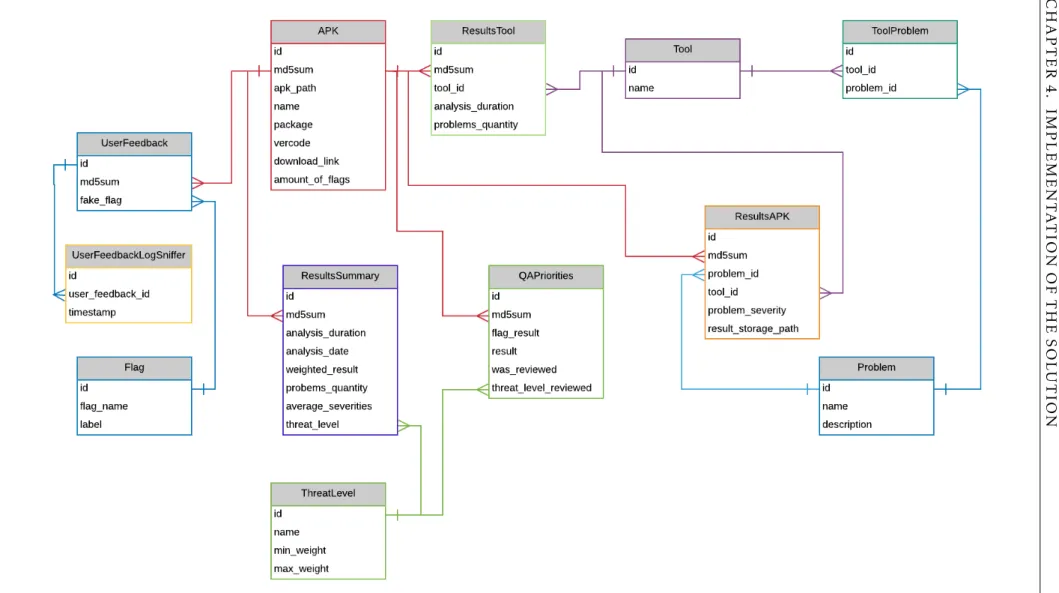
4.2 Proposed entity–relationship model for the module. . . 26
5.1 Scenarios to test the analysis time of the module [Ico; Teca] . . . 30
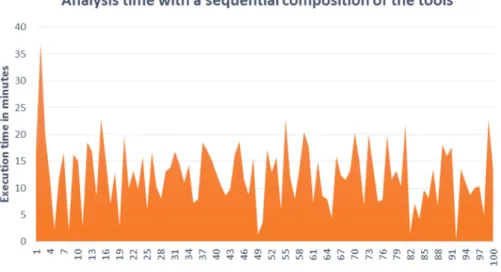
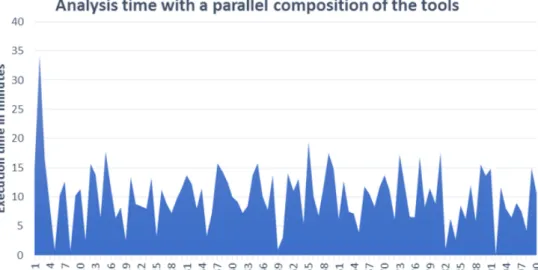
5.2 Graphic of the time analysis per APK with a sequential composition of the tools 31 5.3 Graphic of the time analysis per APK with a parallel composition of the tools 32 5.4 Graphic of the time analysis per APK comparing a parallel and sequential composition of the tools . . . 33
5.5 Analysis time of an APK distributed by the tools . . . 34
5.6 The percentage of the total time distributed by each tool of the module, after the analysis of Sample_1 . . . 34
5.7 Scenarios to test the composition of the tools in the module [Ico; Teca] . . . . 35
5.8 Graphic of the analysis time of the Sample_2, with a parallel composition of all tools . . . 37
5.9 Graphic of the analysis time of the Sample_2, with a parallel composition the tools when removing Qark . . . 37
5.10 Graphic of the analysis time of the Sample_2, comparing the scenario with all tools and removing Qark . . . 38
5.11 Threat prioritisation with all tools, for W1=0,3 and W2=0,7; W3=0,5 and W4=0,5; W5=0,7 and W6=0,3 . . . 41
5.12 Threat prioritisation with all tools, for W1=0,4 and W2=0,6; W3=0,5 and W4=0,5; W5=0,7 and W6=0,3 . . . 42
5.13 Threat prioritisation with all tools, for W1=0,5 and W2=0,5; W3=0,5 and W4=0,5; W5=0,7 and W6=0,3 . . . 43
5.14 Threat prioritisation with all tools, for W1=0,6 and W2=0,4; W3=0,5 and W4=0,5; W5=0,7 and W6=0,3 . . . 44
5.15 Threat prioritisation with all tools, for W1=0,7 and W2=0,3; W3=0,5 and W4=0,5; W5=0,7 and W6=0,3 . . . 45
5.16 Threat prioritisation removing Qark, forW1=0,3 and W2=0,7; W3=0,5 and W4=0,5; W5=0,7 and W6=0,3 . . . 46
L i s t o f F i g u r e s
5.17 Threat prioritisation removing Qark, forW1=0,4 and W2=0,6; W3=0,5 and
W4=0,5; W5=0,7 and W6=0,3 . . . 47
5.18 Threat prioritisation removing Qark, forW1=0,5 and W2=0,5; W3=0,5 and W4=0,5; W5=0,7 and W6=0,3 . . . 48
5.19 Threat prioritisation removing Qark, forW1=0,6 and W2=0,4; W3=0,5 and W4=0,5; W5=0,7 and W6=0,3 . . . 49
5.20 Threat prioritisation removing Qark, forW1=0,7 and W2=0,3; W3=0,5 and W4=0,5; W5=0,7 and W6=0,3 . . . 50
5.21 Modules accuracy forW1=0,3 and W2=0,7; W3=0,5 and W4=0,5; W5=0,7 and W6=0,3 . . . 51
5.22 Modules accuracy forW1=0,3 and W2=0,7; W3=0,5 and W4=0,5; W5=0,7 and W6=0,3 . . . 52
5.23 Modules accuracy with all the tools and removing the slower tool . . . 54
5.24 Modules accuracy with all the tools and removing the slower tool . . . 55
5.25 Modules accuracy with all the tools and removing the slower tool . . . 57
5.26 Threat prioritisation for Sample_3W1=0,3 and W2=0,7; W3=0,4 and W4=0,6; W5=0,5 and W6=0,5. . . 60
5.27 Threat prioritisation for Sample_3W1=0,4 and W2=0,6; W3=0,5 and W4=0,5; W5=0,5 and W6=0,5. . . 61
5.28 Threat prioritisation for Sample_3W1=0,5 and W2=0,5; W3=0,3 and W4=0,7; W5=0,5 and W6=0,5. . . 61
5.29 Threat prioritisation for Sample_3W1=0,6 and W2=0,4; W3=0,6 and W4=0,4; W5=0,4 and W6=0,6. . . 62
5.30 Threat prioritisation for Sample_3W1=0,7 and W2=0,3; W3=0,4 and W4=0,6; W5=0,3 and W6=0,7. . . 63
5.31 Distribution of the APKs labelled as a threat after our manual review . . . . 64
5.32 Total amount of problems found in Sample_3, distributed by “threat” and “not a threat” labels . . . 65
5.33 Three applications with different IDs but with the same architecture . . . 66
L i s t o f Ta b l e s
2.1 Security vulnerabilities summary. . . 7
2.2 Features of the static analysis tools . . . 14
5.1 Summary of the analysis time between the two scenarios. . . 32
5.2 Summary of the analysis time between the two scenarios. . . 38
5.3 Scenario for a 100% accuracy . . . 39
5.4 Scenario for a 80% accuracy . . . 40
5.5 Weight combinations for the test cases . . . 40
5.6 Comparative analysis of the highest threat levels for the labelled threat APKs 51 5.7 Comparative analysis of the lowest threat levels for the labelled not a threat APKs . . . 52
5.8 Comparative analysis of the highest threat levels for the labelled threat APKs 53 5.9 Comparative analysis of the lowest threat levels for the labelled not a threat APKs . . . 53
5.10 Comparative analysis of the highest threat levels for the labelled threat APKs 54 5.11 Comparative analysis of the lowest threat levels for the labelled not a threat APKs . . . 55
5.12 Comparative analysis of the highest threat levels for the labelled threat APKs 56 5.13 Lowest threat levels for the scenario with all tools. . . 56
5.14 Lowest threat levels for the scenario where the slowest tool was removed . . 56
5.15 Comparative analysis of the highest threat levels for the labelled threat APKs 57 5.16 Comparative analysis of the lowest threat levels for the labelled not a threat APKs . . . 58
5.17 Comparative analysis between the 5 best results of Sample_3 (T-Threat and NT-Not a threat) . . . 64
5.18 Analysis result of three different APKs . . . 66
A.1 Result of AndroBugs for MB Way . . . 81
A.2 Result of AndroBugs for MB Way . . . 82
A.3 Result of AndroBugs for Wallet . . . 83
A.4 Result of AndroBugs for Wallet . . . 84
A.5 Result of AndroBugs for Wallet . . . 85
L i s t o f T a b l e s
A.7 Result of AndroBugs for Drink Water . . . 86
A.8 Result of AndroBugs for Drink Water . . . 87
A.9 Result of AndroBugs for Freelectics Bodyweight. . . 88
A.10 Result of AndroBugs for Freelectics Bodyweight. . . 89
A.11 Result of AndroBugs for Freelectics Bodyweight. . . 89
A.12 Result of AndroBugs for Clash-Royale . . . 90
A.13 Result of AndroBugs for Clash-Royale . . . 91
A.14 Result of AndroBugs for Clash-Royale . . . 92
A.15 Result of AndroBugs for Millionaire 2018 . . . 92
A.16 Result of AndroBugs for Millionaire 2018 . . . 93
A.17 Result of AndroBugs for Millionaire 2018 . . . 94
A.18 Result of AndroBugs for LOCKit . . . 95
A.19 Result of AndroBugs for LOCKit . . . 96
A.20 Result of AndroBugs for LOCKit . . . 97
A.21 Result of AndroBugs for My Passwords . . . 97
A.22 Result of AndroBugs for My Passwords . . . 98
A.23 Result of AndroBugs for My Passwords . . . 98
A.24 Result of AndroBugs for Always on AMOLED . . . 99
A.25 Result of AndroBugs for Always on AMOLED . . . 100
A.26 Result of AndroBugs for Always on AMOLED . . . 101
A.27 Result of AndroBugs for Flashlight . . . 101
A.28 Result of AndroBugs for Flashlight . . . 102
A.29 Result of AndroBugs for Flashlight . . . 102
B.1 Result of EviCheck for MB Way . . . 103
B.2 Result of EviCheck for Wallet . . . 104
B.3 Result of EviCheck for Drink Water . . . 104
B.4 Result of EviCheck for Freelectics Bodyweight . . . 105
B.5 Result of EviCheck for Clash-Royale . . . 105
B.6 Result of EviCheck for Millionaire 2018 . . . 105
B.7 Result of EviCheck for LOCKit . . . 106
B.8 Result of EviCheck for My Passwords . . . 106
B.9 Result of EviCheck for Always on AMOLED . . . 107
B.10 Result of EviCheck for Flashlight . . . 107
C.1 Result of Mobile Security Framework for MB Way. . . 109
C.2 Result of Mobile Security Framework for MB Way. . . 110
C.3 Result of Mobile Security Framework for MB Way. . . 110
C.4 Result of Mobile Security Framework for Wallet . . . 111
C.5 Result of Mobile Security Framework for Wallet . . . 112
C.6 Result of Mobile Security Framework for Wallet . . . 112 xviii
L i s t o f T a b l e s
C.7 Result of Mobile Security Framework for Wallet . . . 113
C.8 Result of Mobile Security Framework for Wallet . . . 113
C.9 Result of Mobile Security Framework for Wallet . . . 114
C.10 Result of Mobile Security Framework for Drink Water . . . 114
C.11 Result of Mobile Security Framework for Drink Water . . . 115
C.12 Result of Mobile Security Framework for Drink Water . . . 115
C.13 Result of Mobile Security Framework for Drink Water . . . 116
C.14 Result of Mobile Security Framework for Freelectics Bodyweight . . . 116
C.15 Result of Mobile Security Framework for Freelectics Bodyweight . . . 117
C.16 Result of Mobile Security Framework for Freelectics Bodyweight . . . 117
C.17 Result of Mobile Security Framework for Clash-Royale . . . 118
C.18 Result of Mobile Security Framework for Clash-Royale . . . 118
C.19 Result of Mobile Security Framework for Clash-Royale . . . 119
C.20 Result of Mobile Security Framework for Millionaire 2018 . . . 120
C.21 Result of Mobile Security Framework for Millionaire 2018 . . . 120
C.22 Result of Mobile Security Framework for Millionaire 2018 . . . 121
C.23 Result of Mobile Security Framework for LOCKit . . . 122
C.24 Result of Mobile Security Framework for LOCKit . . . 123
C.25 Result of Mobile Security Framework for LOCKit . . . 123
C.26 Result of Mobile Security Framework for LOCKit . . . 124
C.27 Result of Mobile Security Framework for Always on AMOLED . . . 124
C.28 Result of Mobile Security Framework for Always on AMOLED . . . 125
C.29 Result of Mobile Security Framework for Always on AMOLED . . . 126
C.30 Result of Mobile Security Framework for Always on AMOLED . . . 126
C.31 Result of Mobile Security Framework for Flashlight. . . 127
C.32 Result of Mobile Security Framework for Flashlight. . . 127
C.33 Result of Mobile Security Framework for Flashlight. . . 127
D.1 Result of Qark for MB Way . . . 129
D.2 Result of Qark for MB Way . . . 130
D.3 Result of Qark for MB Way . . . 130
D.4 Result of Qark for MB Way . . . 130
D.5 Result of Qark for MB Way . . . 131
D.6 Result of Qark for Wallet . . . 131
D.7 Result of Qark for Wallet . . . 132
D.8 Result of Qark for Wallet . . . 132
D.9 Result of Qark for Wallet . . . 132
D.10 Result of Qark for Wallet . . . 133
D.11 Result of Qark for Wallet . . . 134
D.12 Result of Qark for Drink Water . . . 134
L i s t o f T a b l e s
D.14 Result of Qark for Drink Water . . . 135
D.15 Result of Qark for Drink Water . . . 135
D.16 Result of Qark for Drink Water . . . 136
D.17 Result of Qark for Freelectics Bodyweigh . . . 136
D.18 Result of Qark for Freelectics Bodyweigh . . . 136
D.19 Result of Qark for Freelectics Bodyweigh . . . 137
D.20 Result of Qark for Freelectics Bodyweigh . . . 138
D.21 Result of Qark for Clash-Royale . . . 138
D.22 Result of Qark for Clash-Royale . . . 139
D.23 Result of Qark for Clash-Royale . . . 139
D.24 Result of Qark for Clash-Royale . . . 139
D.25 Result of Qark for Clash-Royale . . . 140
D.26 Result of Qark for Millionaire 2018 . . . 140
D.27 Result of Qark for Millionaire 2018 . . . 141
D.28 Result of Qark for Millionaire 2018 . . . 141
D.29 Result of Qark for Millionaire 2018 . . . 141
D.30 Result of Qark for Millionaire 2018 . . . 142
D.31 Result of Qark for Millionaire 2018 . . . 143
D.32 Result of Qark for LOCKit . . . 143
D.33 Result of Qark for LOCKit . . . 144
D.34 Result of Qark for LOCKit . . . 144
D.35 Result of Qark for LOCKit . . . 145
D.36 Result of Qark for LOCKit . . . 145
D.37 Result of Qark for My Passwords . . . 146
D.38 Result of Qark for My Passwords . . . 146
D.39 Result of Qark for My Passwords . . . 146
D.40 Result of Qark for My Passwords . . . 147
D.41 Result of Qark for Always on AMOLE . . . 148
D.42 Result of Qark for Always on AMOLE . . . 148
D.43 Result of Qark for Always on AMOLE . . . 148
D.44 Result of Qark for Always on AMOLE . . . 149
D.45 Result of Qark for Flashlight . . . 150
D.46 Result of Qark for Flashlight . . . 151
E.1 Result of Super Android Analyser for MB Way. . . 153
E.2 Result of Super Android Analyser for MB Way. . . 154
E.3 Result of Super Android Analyser for Wallet . . . 155
E.4 Result of Super Android Analyser for Wallet . . . 156
E.5 Result of Super Android Analyser for Drink Water . . . 157
E.6 Result of Super Android Analyser for Drink Water . . . 157
E.7 Result of Super Android Analyser for Freelectics Bodyweight . . . 158 xx
L i s t o f T a b l e s
E.8 Result of Super Android Analyser for Freelectics Bodyweight . . . 159
E.9 Result of Super Android Analyser for Clash-Royale . . . 159
E.10 Result of Super Android Analyser for Clash-Royale . . . 160
E.11 Result of Super Android Analyser for Millionaire 2018 . . . 160
E.12 Result of Super Android Analyser for Millionaire 2018 . . . 161
E.13 Result of Super Android Analyser for LOCKit . . . 162
E.14 Result of Super Android Analyser for LOCKit . . . 163
E.15 Result of Super Android Analyser for My Passwords . . . 164
E.16 Result of Super Android Analyser for My Passwords . . . 164
E.17 Result of Super Android Analyser for Always on AMOLED . . . 165
E.18 Result of Super Android Analyser for Always on AMOLED . . . 165
E.19 Result of Super Android Analyser for Flashlight. . . 166
Ac r o n y m s
API Application Programming Interface. APK Android Package.
app Application.
MOBSF Mobile Security Framework. QA Quality Assurance.
C
h
a
p
t
e
r
1
I n t r o d u c t i o n
This chapter contains an introduction to the accomplished work in this dissertation. It begins by presenting a description of its context and problem, and what its goals are. The main contributions are also presented below.
1.1
Context
Android has become the most used mobile operating system in the world. In March 2017, the world’s largest app store, Google’s Play Store, had 2.8 million applications, Apple App Store 2.2 million and the Amazon app store (Android) had 600,000 applications, the same number of Aptoide [Staa]. In 2016 alone there were over 149 billion downloaded applications, worldwide [Stab]. However the noticed exponential growth of mobile ap-plications downloaded has been followed by an increase of security threats of the mobile devices. These threats are made to sensitive data, such as the location, contacts and finan-cial information of the user, stored by these applications. The Nokia threat intelligence report has shown that the overall monthly smart-phone infection rate averaged 0.90% in the second half of 2016 - up 83% from the first half of the year and also highlights the most prolific threats facing mobile devices. Where mobile applications are concerned, this variety of applications can be harmful to the integrity and security of devices and data by leaking sensitive information. These applications are usually free, and have the ability to carry out their proposed functions, but also extract important information from devices. This sensitive information is then sent to a remote server where the cybercrim-inals can exploit it [Com]. With millions of applications in an app store environment, and more being created every day, the developers goal is to make the next most popular app. They are not focused on security [Inf]. Thus, many of the problems found in an application stem not only from the illicit tries to capture information but also from the
C H A P T E R 1 . I N T R O D U C T I O N
lack of good security practices in application development, which facilitates the success of threats. Software weaknesses have become one of the top problems in recent years, for there are many ways software developers can make mistakes that can lead to insecurity. Every one of these weaknesses is subtle and many are tricky. Software developers are not taught about these weaknesses in school and most receive no training on the job about these problems [OWAa].
This is a global issue, spanning most countries that have a significant smart-phone user base. Different countries have different threat profiles, depending on the nature of mobile phone usage in the country [McA]. The fact that these threats have been changing makes them continue to succeed in their illicit purposes, due to the lack of automatic intelligent mechanisms capable of detecting and mitigating them efficiently [Nar+16]. Given the moving target nature of the threats on the mobile security arena and the considerable challenge that outcomes from the high volume of applications received on the app stores, the users are key actors on the detection and response to attacks not blocked by app stores. The fast analysis of their feedback is key to a swift removal of the threats from the repositories and, thus, reduce the impact on consumers. Even if the users’ feedback is not frequently accurate, during this paper we have taken it into consideration. We find it to be a key on the detection and response to attacks not blocked by app stores, given that their feedback could be a way of work around the moving target nature of the threats stemming from the poor engineering choices.
1.2
Problem
The recent survey made by the Stackoverflow website about the developers profile (favourite technologies, coding habits, and work preferences, as well as how they learn) shows that about 65% of mobile developers work with Android [Staa]. This platform has gained over 85% of the smart-phone market, [Stab] and just its official app store contains more than 2.8 million applications. As a result, a security mistake in an in-house applica-tion may jeopardise the security and privacy [CVE] of billions of users. The security of smart-phones has been studied from various perspectives such as the device manu-facturer [Wu+13], its platform [Xu+16], and end users [JC15]. Manifold security APIs, protocols, guidelines, and tools are proposed. Nevertheless, security concerns, in effect, are outweighed by other concerns [BC14]. Many developers undermine their significant role in providing security [Xie+11]. As a result, applications still suffer from serious proliferating security issues. For instance, the analysis of 100 popular applications down-loaded at least 10M times, revealed that over 90% of them, due to development mistakes, are prone to SSL vulnerabilities that allow criminals to access credit card numbers, chat messages, contact list, files, and credentials [OC15].
After an empirical study made by a research team in Switzerland [Gha+17], where they have statically analysed 46 000 applications from the AndroZoo and Google Play data set they have concluded that despite the diversity of applications in popularity, size,
1 . 3 . G OA L S
and release date, the majority suffer from at least three different security vulnerabilities (XSS-like code injection, dynamic code loading and the use of custom scheme channels and expose a unique hardware identifier).
Despite the best efforts of app stores, the existing markets provide little meaningful security or privacy guarantees because market providers have neither the tools nor the re-sources to perform a detailed analysis of submitted applications [ME10]. Then malicious applications can enter their ecosystem e.g., app installation from untrusted sources, in-ability to detect malicious behaviour in applications, access of malicious websites. Hence, there is a need to develop automatic tools and techniques that can detect vulnerabilities in the submitted applications [RM18].
1.3
Goals
1.3.1 General
An automated validation of applications at the app market level is a promising approach for improving the security of the end users. In this thesis, we foresee a validation process applied by app stores to applications submitted by the developers and we present a system that aims to achieve this goal.
At a high level, the system goal is of devising an automatic tool for targeting the inspection of applications with programming malpractices (due to poor implementation / engineering choices).
1.3.2 Specific
For that purpose we propose the construction of a tool supported by automated analysis tools that would analyse applications and based on that analysis would estimate the threat that an application represents.
To estimate the threat level of an application, we propose the elaboration of metrics based on the quantity of the problems found as well as the amount of users’ feedback that an application has. During this dissertation we gave value to the users’ feedback, so we could analyse its impact on the detection and response to attacks not blocked by app stores. Giving us a way of work around the moving target nature of the threats stemming from the poor engineering choices.
By elaborating metrics related to quantity parameters, it is possible to promote adjust-ments and changes in the development process, in order to reduce or eliminate causes of problems that significantly affect the threat level estimation system.
The proposed metrics will undergo an experimental evaluation and a validation ap-plied to a set of real case studies.
C H A P T E R 1 . I N T R O D U C T I O N
1.4
Contributions
The main contribution of this dissertation is the definition, implementation and evalua-tion of a module capable of targeting the inspecevalua-tion of applicaevalua-tions with programming malpractices, in order to provide to app stores an automatic tool able to give a threat level system of the submitted applications after a detailed analysis.
This threat level system would inform an app store of which of the submitted applica-tions pose the biggest threat to their ecosystem. Giving to an app store a tool to improve security or privacy guarantees.
Another contribution is the definition and evaluation of metrics for the threat level system, in order to support the quantitative evaluation of the submitted applications. Based on the related work there is still no well-accepted solution to the problem; quoting from the paper Static Analysis of Android Apps: A Systematic Literature Review [Li+17] ”There is no single work that has been proposed to tackle all challenges of static analysis that are related to Android programming”. Therefore, the metrics are proposed according to the data we obtained from the analysis of the module.
We also performed an experimental evaluation where the metrics are applied to a set of real case studies.
C
h
a
p
t
e
r
2
R e l a t e d Wo r k
This chapter contains important concepts pertaining to software verification and vali-dation techniques, security vulnerabilities and static analysis tools. Its main objective is to introduce some important concepts that are related to this dissertation, making a framework of it.
2.1
Software Verification and Validation Techniques
The verification and validation of software is typically done through three techniques: manual code review[Gee16], automatic analysis comprehended between dynamic[Bal99] or static[Wic+95] approaches and semi-automatic with theorem provers [Duf91].
A manual code review depends entirely on the reviewer and it is conducted to find bugs and improve overall quality of the software [Sma], while an automated code review checks source code for compliance with a predefined set of properties, rules or best practices [Cas]. In conclusion automated code review solutions have advantages over a manual audit, for they are able to complete the review at a much faster pace, there is not the possibility of human error, they improve code coverage, and are more effective and ultimately more affordable. However, an automatic review does not eliminate the need for a human reviewer, as they produce both false positive and false negative results [Sma].
The techniques used in automated code analysis can be either static or dynamic. Static analysis is done by inspecting a program (on source, binary or byte code level) without actually executing the program. Dynamic analysis runs a program to observe its actions in an effort to uncover more subtle defects or vulnerabilities.
C H A P T E R 2 . R E L AT E D WO R K
analysis reveals subtle defects or vulnerabilities whose cause is too complex to be discov-ered by static analysis. It plays a role in security assurance, but it will only find defects in the part of the code that is actually executed. In the other hand, static analysis examines all possible execution paths and variable values, not just those invoked during execution [Int].
After we weigh these considerations with the complexities of our own project, we have chosen static analysis as the selection criteria of the tools to be integrated in our system.
2.2
Static Analysis
Static analysis is a method of computer program debugging that is done by examining the code without executing the program [Tecb]. In most cases the analysis is performed on some version of the source code, and in the other cases, some form of the object code. There are also some static analysis tools that make their analysis at the byte-code level. There are multiple advantages to static analyse code such as revealing errors, or identify-ing code fragments that can lead to errors in the future [PVS]. Besides many automatic static analysis tools can detect problems at security, reliability and functionality levels. They are useful for security threats such as buffer overflows, SQL Injection Flaws, and so forth [Tecb]. However, there are weaknesses too. There are many types of security vul-nerabilities that are very difficult to find, such as authentication problems, access control issues, insecure use of cryptography, etc. The current state-of-the-art only allows such tools to automatically find a relatively small number of application security flaws. Config-uration issues are also something hard to find since they are not represented in the code. The same happens to proving that an identified security issue is an actual vulnerability. Many of these tools have difficulty analysing code that cannot be compiled. Analysts frequently cannot compile code because they do not have the right libraries, all the com-pilation instructions, all the code, etc [OWAb]. There is also the problem of false positives. Correct tools/approaches never give false negatives, i.e., never say a “bad” program (one that has violations of the property) has no problems. Complete tools/approaches are unattainable for non-trivial properties, since by the Rice’s Theorem [Wika], they are un-decidable for Turing-complete computational mechanisms [Wikb]. Furthermore, Godel’s incompleteness theorems [Sci] ensure that some properties are improvable and moreover, there are no “interesting” reasoning mechanisms both consistent and complete. There-fore, static analysis cannot be precise and to be correct must over-approximate and give false positives.
2.3
Security Vulnerabilities
There is a vast amount of published work on the topic of Android security analysis. We began our research by learning and analysing the different types of vulnerabilities to be expected in Android applications. According to a present study on security smells in
2 . 3 . S E C U R I T Y V U L N E R A B I L I T I E S
Android [Gha+17], in resume, there are 28 code smells (symptoms in the code that signal the prospect of a security vulnerability) that may lead to vulnerabilities in applications and show their prevalence in real-world Android applications. From those 28 identified code smells, we have selected a 14 according to the conclusions observed in the study.
From the category Insufficient Attack Protection, we selected 3 problems: untrustwor-thy libraries, outdated libraries and unnecessary permissions. From the category Security Validation, we selected one problem: weak cryptographic algorithm. From the category Broken Access Control, we selected 4 problems: unauthorised intent, unconstrained inter-component communication, exposed adb-level capabilities and debuggable release. From the category sensitive data exposure, we selected 3 problems: exposed persistent data, insecure network protocol and exposed credentials. From the category lax input valida-tion, we have chosen 3 problems: XSS-like code injecvalida-tion, dynamic code loading and SQL injections.
The categorisation and explanation of the selected problems are described below and are summarised inTable 2.1.
Category Security Vulnerability
Insufficient Attack Protection Untrustworthy Libraries, Outdated Library, Unnecessary Permissions
Security Invalidation Weak Crypto Algorithm
Broken Access Control Unauthorised Intent Receipt,
Unconstrained Inter-Component Communication, Exposed adb-level Capabilities,
Debuggable Release
Sensitive Data Exposure Sensitive Data Exposure, Insecure Network Protocol,
Exposed Credentials
Lax Input Validation XSS-like Code Injection, Dynamic Code Loading,
SQL Injection
C H A P T E R 2 . R E L AT E D WO R K
Insufficient Attack Protection • Untrustworthy Libraries
To cope with the complexity of modern software systems and as way to speed up the process of development of an application, the developers usually rely on the func-tionalities provided by off-the-shelf libraries. This is a problem since these libraries are often maintained by different developers and, as the result, their update cycles generally do not coincide when there are bug fixes and improvements in newer releases [Gha+17]. Consequently, a security breach in an old library or a deprecated API could lead to serious issues, i.e., introduce vulnerabilities and compromise user data [Wat+17].
• Outdated Library
Libraries usually offer various bug fixes and improvements in newer releases, but often different developers maintain libraries and applications, and their update cycles generally do not coincide. Consequently, a security breach in an old library or a deprecated API could lead to serious issues [Gha+17]
• Unnecessary Permissions
The use of protected features on Android devices requires explicit permissions, and developers occasionally ask for more permissions than necessary [TM16]. The more permission-protected features an app can access, the more sensitive data it can reach. Consequently, a more permission-hungry app may expose users to addi-tional security risks [TM17].
Security Invalidation • Weak Crypto Algorithm
The fundamental set of cryptograph algorithms can be categorised into symmetric, asymmetric, and hash functions. The use of weak cryptographic hash functions like SHA1 or MD5, insecure modes e.g., ECB for block ciphers, could subject to security issues [Gha+17].
Broken Access Control
• Unauthorised Intent Receipt
An intent is an abstract specification of an operation that applications can use to utilise the actions provided by other applications. An explicit intent guarantees communication with the specified recipient, but it is the Android system that de-termines the recipient(s) of an implicit intent among available applications. The existence of an intent with private data, but without a particular component name (the fully-qualified class name) [Gha+17], can be a target for a threat called intent
2 . 3 . S E C U R I T Y V U L N E R A B I L I T I E S
hijacking could arise in which user information carried by the intent could be ma-nipulated or leaked [Chi+11].
• Unconstrained Inter-Component Communication
Since Android applications can reuse components (e.g., activities, services, content provider, and broadcast receivers) from other applications trough the intent-filter element or android:exported = true attribute in the manifest file without any per-mission check to ensure that a client app is originally permitted to receive that service, a threat called component hijacking can arise when a malicious app esca-lates its privilege for originally prohibited operations through other applications that access those operations [Wu+16], [Dav+11].
• Exposed adb-level Capabilities
The Android Debug Bridge (adb) is a versatile tool that provides communication with a connected Android device. Many developers opt for adb-level capabilities to legitimately access a subset of signature-level resources [Lin+14]. If an app communicates locally with an adb-level proxy through the TCP sockets opened on the same device, which exposes the adb server to any app with the INTERNET permission, a malign app with ordinary permissions can command the adb and establish serious attacks [Hwa+15].
• Debuggable Release
During app development there exist two major build configurations, debug and release. The first is meant for active development, while the latter is for signed in-market releases. However, developers may forget to switch to release mode before publishing an app [Xu+13]. Hence the manifest file will contain the attribute an-droid:debuggable = true. Applications shipped with debugging enabled always try to connect to a local Unix socket opened by the Android Debug Bridge (adb). While adb is not running on every consumer device, a malign app could disguise itself as an adb service and connect to random debuggable applications. Consequently, a malicious app is able to gain full access to the Java process and can execute arbitrary code in the context of the debuggable app [MWR].
Sensitive Data Exposure • Exposed Persistent Data
Android provides various storage options to store persistent data. These options vary depending on the size, type, and accessibility of data [Dav+11]. If a developer chooses a particular option without considering its security implication, , private
C H A P T E R 2 . R E L AT E D WO R K
data can be exposed. For example if in the application there is a private storage with global access scope (i.e., MODE_WORLD_READABLE or MODE_WORLD _WRITEABLE), the app relies on ContentProvider to access data, but there is no access restriction for other applications.
• Insecure Network Protocol
There are many channels devoted to data transportation, however insecure ones like HTTP are more prevalent and easy to maintain. These insecure channels transfer un-encrypted data, giving a chance to relay the data and possibly alter it by the attackers.
• Exposed Credentials
Passwords, private keys, secret keys, certificates, and other similar credentials are commonly used for authentication, communication, or data encryption. If the app contains hard-coded credentials, or they are stored without any password protec-tion such as when the KeyStore.Protecprotec-tionParameter is null, in some circumstances such data is inadvertently disclosed to unauthorised parties. Which could break the intended security [Gha+17].
Lax Input Validation
• XSS-like Code Injection
WebView is an essential component that enables developers to use web technolo-gies such as HTML and JavaScript to deliver web content within an app. Unlike Web browsers like Chrome, FireFox, etc. which are developed by well-recognised companies that we trust, each app using a WebView is like a customised browser which may not have undergone thorough security tests. If the setJavaScriptEnabled call with value true which enables execution of JavaScript exists in the code, and the app fetches web content from untrustworthy sources (e.g., by calling loadUrl or loadData on WebView) without applying proper sanity checks [Gha+17], this means that the app may load web content unsafely i.e., without sanitising the input from any code. Consequently, an adversary could inject malicious code through any channel that the app uses to get web content [Jin+14].
• Dynamic Code Loading
Android allows applications to load and execute external code and resources, trough the use of any class loader. Although dynamic code loading is widely adopted, devel-opers are often unaware of the risks associated to this generally unsafe mechanism or fail to implement it securely [SPV14]. An attacker can replace the code that is to be loaded with a malicious one. Consequently, this can lead to severe vulnerabilities
2 . 4 . S TAT I C A N A LY S I S T O O L S
such as remote code injection [Fal+15].
• SQL Injection
If a developer does not make a proper validation of the input that is passed to the database and if the application was developed to directly use the input to build a query that will be run by the database engine; an attacker who succeeds at insert-ing malicious code into SQL statements, can access or modify the data from the database.
2.4
Static Analysis Tools
In this section we present our search process on static analysis tools and the decisions made during that process. To select tools for the module, we have restricted the search to the following factors:
• Free
We searched for solutions that were freely available, ignoring the payed ones. • Maintained
During the selection of the tools we gave preference to the solutions that were actively maintained. Since in most cases the unmaintained/abandoned tools do not support the currently supported versions of Android.
• Security Vulnerabilities Detection
From the multiple tools we have encountered, we have selected the ones capable of flag signs of malicious behaviour in an application according to the security vulnerabilities we have chosen to target (seesection 2.3). Despite the many tools available for vulnerability detection (typically used by app developers), we have chosen to not pursue them since our target are APKs1. For using such tools it would be necessary to have the source code of the application and for that purpose we would have to get the source code from each APK1. Although we tried to follow that path through the use of reverse engineering tools, it showed us that due to the obfuscation of parts of the code that some applications have, combined with the fact that some tools are restrained to a limited set of android versions, this was not a viable solution.
• Minimal Adaptation
We were also interested in solutions that could detect malicious behaviours with none or minimal adaptation, e.g., build an extension to detect a specific vulnera-bility. The ground behind this decision was to eliminate human bias and errors
C H A P T E R 2 . R E L AT E D WO R K
involved in identifying, creating, and using the proper modifications. This way we could maintain a typical workflow: build the tool, follow the documentation, and apply it to the APKs.
To select tools for this evaluation, we collected information from repositories and blog posts approaching Android security solutions. We then considered 8 tools: AndroBugs [Gita], AndroWarn [Deb], Argus-SAF [Gitb], DroidRA [Li+16], Evicheck [Evi], MobSF [Gitc], Qark [Gitd] and SUPER [Gite]; and evaluated them by reading their documentation and the available resources.
Since we focused on selecting only maintained tools, we rejected AndroWarn as it was not updated after 2013 [Deb]. We also rejected a tool if we had error messages that has no clear fixes by exploring the available bug report. This resulted in rejecting DroidRA [Li+16].
Of the remaining tools, we tested 6 local tools using 10 APKs (Android Package) from Google Play store. The APKs tested were divided into 5 categories, Banking, In-app purchases, Games, Privacy and Tools. For the banking category we have chosen MB Way [Plag] and Wallet [Plaj]; for the in-app purchases category we have chosen Drink Water [Plac] and Freeletics Bodyweight [Plae]; for the games category we have chose Clash Royale [Plab] and Millionaire 2018 [Plah]; for the privacy category we have chosen LOCKit [Plaf] and My Passwords - Password Manager [Plai]; finally for the tools category we have chosen Always On AMOLED [Plaa] and Flashlight [Plad]. We executed each tool with each of the above applications as input on an Ubuntu Xenial Xerus with the following features: Processor: Intel Core i5-6200U CPU @ 2.30GHz × 4 and Memory: 7,2 GiB. If a tool failed to execute successfully on all of these applications, then we rejected the tool. We rejected Argus-SAF because it ran out of time or memory while processing the test apps [Gitb]. The results were grouped by the remaining 5 tools in appendixes:A, B,C,DandE.
In the following we will describe and present each tool and point out some of their main features.
AndroBugs is an android vulnerability scanner. It is a Python framework that targets application developers only. It is based on AndroGuard, which it uses to decompile APKs. Based on a present list of vulnerability vectors, it scans code hotspots to find any potentially vulnerable code, function calls or fields, and then goes to the source function of those issues and reanalysis the code to confirm its findings [Pet]. Once it discovers security issues, AndroBugs will dump data inside the user’s terminal, data that holds information on the vulnerability vector’s type, code path inside the APK’s source, severity level, detailed explanations, mitigation recommendations, and even some reference research papers, if available [Cim].
Evicheck is a tool for the verification, certification and generation of lightweight fine-grained policies for Android. It uses a lightweight static analysis to show the conformance between policies and application behaviour. These policies are a set of rules defined by the
2 . 4 . S TAT I C A N A LY S I S T O O L S
user and can be about the use of APIs, permissions allowed or anti-malware patterns. In the verification mode, it takes an application together with a policy as input, and answers whether the policy is satisfied by the application and eventually outputs a certificate (digital evidence). EviCheck also returns diagnosis pointing to the first violated rule of policy [Seg].
Mobile Security Framework is an open source mobile application (Android/iOS) au-tomated pen-testing framework capable of performing static and dynamic analysis. The static analyser can perform automated code review, detect insecure permissions and con-figurations, and detect insecure code like SSL overriding or bypass, weak cryptography, obfuscated codes, improper permissions, hard-coded secrets, improper usage of danger-ous APIs, leakage of sensitive/PII information, and insecure file storage [Cyb].
Qark is a static code analysis tool, designed to recognise potential security vulnera-bilities and points of concern for Java-based Android applications. It stands for Quick Android Review Kit and is a tool capable of inform developers about potential risks re-lated to Android application security, providing clear descriptions of issues and links to authoritative reference sources [Tru].
Super Android Analyser is a command-line application that analyses APKs in search for vulnerabilities. It does this by decompressing them and applying a series of rules to detect those vulnerabilities. It is written in Rust and detects SQL injections, XSS attacks, superuser checking applications, URL disclosure, weak algorithms, dangerous permis-sions, sending sms-mms, get device ID, cell location, get SIM serial and bad practices [Egu].
Although, there are tools that find the same issues we have chosen to use them all together. This decision was made because we observed that even if the same issues are reported, these tools do not operate the same way. For several apps we got, for some of the tools, different outputs for the analysis of the same issue (weak cryptography use, for example, is reported differently between Androbugs and SUPER). We concluded that the tools complement each other and decided to use them together. Meaning that we can have two tools that analyse, for example weak cryptography use, but have different outputs. So these different results complement each other.
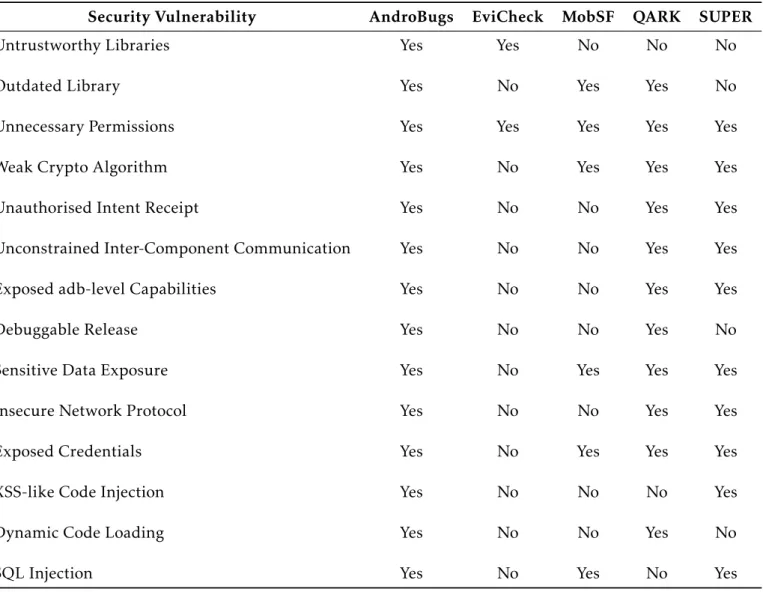
Table 2.2shows the relation between the selected tools and the security vulnerabilities we have chosen to target.
C H A P T E R 2 . R E L A T E D W O R K
Security Vulnerability AndroBugs EviCheck MobSF QARK SUPER
Untrustworthy Libraries Yes Yes No No No
Outdated Library Yes No Yes Yes No
Unnecessary Permissions Yes Yes Yes Yes Yes
Weak Crypto Algorithm Yes No Yes Yes Yes
Unauthorised Intent Receipt Yes No No Yes Yes
Unconstrained Inter-Component Communication Yes No No Yes Yes
Exposed adb-level Capabilities Yes No No Yes Yes
Debuggable Release Yes No No Yes No
Sensitive Data Exposure Yes No Yes Yes Yes
Insecure Network Protocol Yes No No Yes Yes
Exposed Credentials Yes No Yes Yes Yes
XSS-like Code Injection Yes No No No Yes
Dynamic Code Loading Yes No No Yes No
SQL Injection Yes No Yes No Yes
Table 2.2: Features of the static analysis tools
C
h
a
p
t
e
r
3
F r a m i n g o f t h e Wo r k
This chapter introduces some important concepts related to Android applications and obfuscation. We also make an introduction on the Aptoide app store and its app valida-tion system. Since this app store is the context of our dissertavalida-tion, we will also provide a description of its problem and goals.
3.1
Android Basics
Android is an open source platform based on Linux, consisting essentially of operating system and middleware, a software structure that manages the functionality of the device and integrates a set of APIs (Application Programming Interface) that allow the devel-opment of applications and the interface with the user, developed primarily for mobile platforms such as smart phones and tablets [Col+11;Mei08].
All Android applications run through the Dalvik VM (Virtual Machine). Although it is a virtual machine that allows to execute applications developed in Java, this one is not truly a virtual machine of Java and has some differences. The Dalvik VM runs only Java files after they have been compiled in its own format (.dex - Dalvik executable) and has been specially developed so that executions of multiple instances of this virtual machine are possible [KM12].
Android applications have multiple entry points. They can rather use parts of other Android applications on-demand and can require their services by calling their event handlers, directly or through the operating system. In particular, Android applications contain activities (code interacting with the user through a visual interface), services (background operations with no interaction with the user), content providers (data con-tainers such as databases) and broadcast receivers (objects reacting to broadcast messages). These Android application are installed in the form of application package files and
C H A P T E R 3 . F R A M I N G O F T H E WO R K
commonly known as APK (Android Package) files, which is, basically a zip compressed archive. APK files are container files that contain both Application code, resources as well as the application manifest file [Sch+16].
3.2
Obfuscation
During the development of an Android application the developer may choose to protect his intellectual property by using obfuscation techniques in his code. For instance, some companies may decide to obfuscate the application code as a post-processing step to the class file generation, so as to make reverse-engineering an application difficult or impossible. This decisions poses as a double-edged sword by the security community. To a legitimate software company, obfuscation keeps its competitors away from copying the code and quickly building their own products in an unfair way. To a malware au-thor, obfuscation raises the bar for automated code analysis and manual investigation [Don+18].
In general, obfuscation attempts to garble a program and makes the source or machine code more difficult for humans to understand. Programmers can deliberately obfuscate code to conceal its purpose or logic, in order to prevent tampering or deter reverse engi-neering.There are several common obfuscation techniques used by Android applications, including identifier renaming, string encryption, excessive overloading, reflection, and so forth [Don+18].
3.3
Aptoide App Store
Founded in 2011, Aptoide is an Android app store with over 200 million users and 1 million applications that has partnerships with more than 15 thousand developers (numbers of 2017). In 2018, Aptoide is receiving over 15 thousand applications per day (new applications or new versions), which need to be tested in order to assure the quality of service and the security of the users. It is an alternative marketplace for mobile applications which runs on the Android operating system and according to a study on security management of global third-party Android marketplaces [Ish+17], is one of the safest. In Aptoide there is not a unique and centralised store but each user manages their own store. This means that any user can create and manage its own app store, not being necessarily a developer.
When an application is submitted to Aptoide, it needs to pass on two testing processes to be available for consumers: the Aptoide Sentinel and the Fake Detector (see Figure 3.1). Sentinel emerged as a system to automatically detect malicious software, PUAs (Potentially Unwanted Applications) and aggressive adware libraries [Pir]. Each uploaded application goes through a verification process composed by 8 antiviruses. Given that this system is in continuous upgrade and improvement (antivirus updates or more antivirus
3 . 4 . P R O B L E M
added to the process), the apps already on the repository are periodically re-tested to assure the users protection to recently discovered threats.
The Fake Detector is a tool that automatically detect fake apps, like apps that have just ads. It is based on rules or heuristics detected by Aptoide’s QA team, whose pattern is modelled to automatically block apps that not being malicious, are not offering genuine functionalities to users. The fake detector is also a process in development, so if there are any new faulty patterns those will be added to the process. This ensures that the process will always be updated and prepared for new known threats.
Figure 3.1: Aptoides’ validation process [Ico;Teca]
3.4
Problem
Even if Aptoides’ validation process protects the app store against known malware, there is so little it can do about uploaded applications containing bad engineering choices. Like applications that are a vulnerability due to development mistakes, e.g. SSL vulnerabilities that allow criminals to access credit card numbers. These applications are then analysed by the quality assurance (QA) team if an application receives bad user feedback. In Aptoide an user is allowed to give feedback to an application by raising a flag. The flag system is constituted by 5 types of flag: good, needs a license, fake, freeze and virus. However, there was in average around 1753 negative user feedbacks per day between 2016 and 2018, and since the QA team workload is ordered by a FIFO policy, where apps with recent feedbacks appear in first place to be reviewed, this huge amount of feedback increases the QA team backlog and does not provide them an effective work methodology. It is also important to point out that most of the negative user feedback is not accurate (e.g. a user can make a complaint about the result of a game and give an unsatisfactory feedback with no regard for the feedback system implemented), which results in a waste of time when the applications analysed by a QA member are good instead of bad.
Despite the best efforts of Aptoide app store, the existing security and privacy guaran-tees are still not enough. The lack of an automated approach to check for these security vulnerabilities and the growing QA workload are two of the reasons that makes it neces-sary to develop an automatic approach that can detect vulnerabilities in the submitted applications even after they passed all the Aptoides’ validation system.
C H A P T E R 3 . F R A M I N G O F T H E WO R K
3.5
Goal
In order to respond to the problem and the context of Aptoide, previously presented, the proposed solution will be modelled as to serve as a decision support to the QA team. It will automatically analyse an application for security vulnerabilities that would most likely put at risk the security of both the user and marketplace. Combining that analysis with the users feedback the solution will provide a prioritised APK list. Thus the time spent manually reviewing apps with some bad feedback would be better used since the ones with a higher threat level would be reviewed first instead of others that represent a lesser threat. This combination can be rather challenging since the user feedback tends to not be accurate, however the users’ feedback can also help us surpass the challenges posed by code obfuscation and to better target the moving threats.
It is important to notice that the applications that will go through this solution were already checked for virus and for common malicious patterns. Hence the solution will not have the power to exclude an uploaded APK based only by the issues it might find, nor will it replace the existing validation processes. Moreover, this solution depends on the validation made by the two main processes, the Sentinel and the Fake Detector (if any of these validation processes finds any threat on an uploaded application, then that application will be rejected and will not even go through the solution we propose).
C
h
a
p
t
e
r
4
I m p l e m e n ta t i o n o f t h e S o lu t i o n
This chapter presents the implementation main ideas that were considered, followed by the description of the modules’ architecture and information about the technologies used in the development of the module that allows an automatic validation of applications.
4.1
Main Ideas
To achieve our goal, we propose a module to integrate in the Aptoides’ system and check automatically APKs for infractions that could put at risk the security of both the user and marketplace.
This module is supported by our selected static analysis tools and work as a decision support for the QA team. The support is given trough a prioritised collection of APKs, made according to the analysis of the static analysis tools and according to the users feedback. The module will allow the members of the QA team to better manage their time by manually reviewing the applications with more security vulnerabilities.
4.2
Architecture of the Solution
In order to better visualise our goal we have designed and followed the architecture shown inFigure 4.1.
The first thing we would like to point out from the architecture is that our system will not interfere with the already used and operable Aptoides validation system. In fact, our proposed module will depend on the validation made by the two main processes, the Sentinel and the Fake Detector: if they find a virus on an APK or a malicious pattern, the module will not even process that APK. We also have chosen to follow a modular design so that this solution can be independently created and then used in different systems.
C H A P T E R 4 . I M P L E M E N T A T I O N O F T H E S O L U T I O N
Figure 4.1: Proposed architecture for the module [Ico;Teca]
4 . 3 . A P P T H R E AT A N A LY S I S M O D U L E
4.3
App Threat Analysis Module
In order to have a clear understanding of the module and how it works, we will describe the process that an APK goes trough as well as the response of the module when a user uploads an APK that is validated. AsFigure 4.1shows there are 5 stages of operations in the implementation of the module:
• Retrieving APKs
First, the module will extract the uploaded APKs that already went through the validation process, as the architecture shows. These APKs will be fetched from the point where they are available in the app store. For this part, it was necessary to resort to the Aptoide’s API.
• APK Analysis
After retrieving the APKs we will submit them to the analysis of each one of the five selected static analyse tools. Despite this process being represented as a parallel execution, we have tested the modules performance against the two methodologies: sequence and parallel. More details about this option are displayed on the results. • Results Normalisation
Once the analysis is complete, we will have 5 different results that will need to be normalised so we can have some quantifiable results. Each tool has already a system to quantify the severity of each problem found:
– AndroBugs
The AndroBugs tool has a severity system of 4 levels (Critical, Warning, Notice and Info).
– Evicheck
This tool is the only one with a binary severity system, which means that or there is a problem or there is not.
– MOBSF
The MobSF tool has a severity system of 4 levels (High, Warning, Info and Good).
– Qark
Qark has a severity system of 4 levels (Vulnerability, Warning, Error and Info). – Super
Super has a severity system of 5 levels (Critical, High, Warning, Medium and Low).
Since all tools have different severity rating systems, to better comprehend the results we took those systems, and we made an unique correspondent one capable of including all of them. We have transformed those rating systems into one that
C H A P T E R 4 . I M P L E M E N TAT I O N O F T H E S O LU T I O N
could only have values between 0 and 1 (where 0 is not a threat and 1 is a threat). We took the severity of each problem found by these tools and we have associated it to a normalised result. Hence, instead of getting words as the quantifiable variable of the problem we gave it a value:
– AndroBugs
The corresponding severity system of 4 levels (Critical=4/4; Warning=3/4; Notice=2/4 and Info=1/4).
– Evicheck
The corresponding severity system of 2 levels (True=1; False=0). – MOBSF
The corresponding severity system of 4 levels (High=4/4; Warning=3/4; Info=2/4 and Good=1/4).
– Qark
The corresponding severity system of 4 levels (Vulnerability=4/4; Warning=3/4; Error=2/4 and Info=1/4).
– Super
The corresponding severity system of 5 levels (Critical=5/5; High=4/5; Warn-ing=3/5; Medium=2/5; and Low=1/5).
• APK Threat Categorisation
The APK threat categorisation combines (a) the normalised results of the static analysis tools with (b) the users’ feedback. During this dissertation we have given value to the users’ feedback, since it could be a means to the detection and response to attacks not blocked by app stores. Hence, helping our solution block the moving target nature of the threats made on the mobile security arena and to overcome the considerable challenges that outcomes from the high volume of apps received on the app stores.
Thus the users’ feedback is important for this categorisation given the motives previously mentioned. However, since frequently the users’ feedback is not accurate, we propose to combine the results of static analysis tools with the users’ feedback. The hypothesis we suggest is that if an APK has several severe problems reported by the static analysis tools and there is a big quantity of negative user’s feedback, then it is likely that the application is harmful to the consumers. Therefore, the quality assurance team should be notified. In this hypothesis we take into consideration not only the quantity of problems observed during the second stage of the process (APK Analysis) but also the severity of the problems found. So we also added more two variables into consideration: the quantity of user feedback that the analysed APK has and the type of user feedback.
![Figure 4.1: Proposed architecture for the module [Ico; Teca]](https://thumb-eu.123doks.com/thumbv2/123dok_br/19170445.940955/44.1262.169.1102.123.653/figure-proposed-architecture-module-ico-teca.webp)
![Figure 5.1: Scenarios to test the analysis time of the module [Ico; Teca]](https://thumb-eu.123doks.com/thumbv2/123dok_br/19170445.940955/54.892.222.672.206.644/figure-scenarios-test-analysis-time-module-ico-teca.webp)