R E S E A R C H A R T I C L E
Evaluation of ammonium and phosphate release
from intertidal and subtidal sediments of a shallow coastal
lagoon (Ria Formosa – Portugal): a modelling approach
Dalila SerpaÆ Manuela Falca˜oÆ Pedro DuarteÆ Luı´s Cancela da Fonseca ÆCarlos Vale
Received: 16 August 2006 / Accepted: 1 December 2006 / Published online: 9 February 2007
Springer Science+Business Media B.V. 2007
Abstract During an annual cycle, overlying water and sediment cores were collected simultaneously at three sites (Tavira, Culatra and Ramalhete) of Ria Formosa’s intertidal muddy and subtidal sandy sediments to determine ammonium, nitrates plus nitrites and phosphate. Organic carbon, nitrogen and phosphorus were also determined in superfi-cial sediments. Ammonium and phosphate dis-solved in porewater were positively correlated with temperature (P< 0.01) in muddy and sandy sed-iments, while the nitrogen-oxidized forms had a negative correlation (P< 0.02) in muddy
sediments probably because mineralization and nitrification/denitrification processes vary season-ally. Porewater ammonium profiles evidenced a peak in the top-most muddy sediment (380lM) suggesting higher mineralization rate when oxygen is more available, while maximum phosphate concentration (113 lM) occurred in the sub-oxic layer probably due to phosphorus desorption under reduced conditions. In organically poor subtidal sandy sediments, nutrient porewater con-centrations were always lower than in intertidal muddy sediments, ranging annually from 20 lM to 100 lM for ammonium and from 0.05lM to 16lM for phosphate. Nutrient diffusive fluxes predicted by a mathematical model were higher during summer, in both muddy (104 nmol cm–2d–1–– NH4+; 8 nmol cm–2d–1––HPO4–2) and sandy
sedi-ments (26 nmol cm–2d–1––NH4+; 1 nmol cm–2d–1
––HPO4–2), while during lower temperature
peri-ods these fluxes were 3–4 times lower. Based on simulated nutrient effluxes, the estimated annual amount of ammonium and phosphate exported from intertidal areas was three times higher than that released from subtidal areas (22 ton year–1–– NH4+; 2 ton year–1––HPO4–2), emphasizing the
importance of tidal flats to maintain the high productivity of the lagoon. Global warming sce-narios simulated with the model, revealed that an increase in lagoon water temperature only pro-duces significant variations (P< 0.05) for NH4+in
porewater and consequent diffusive fluxes, what
D. Serpa (&)M. Falca˜o
Environmental department, INIAP/IPIMAR – CRIPSul, Instituto Nacional de Investigac¸a˜o Agra´ria e das Pescas – Centro Regional de Investigac¸a˜o Pesqueira do Sul, Avenida 5 de Outubro, s/n, 8700-305 Olha˜o, Algarve, Portugal
e-mail: [email protected]
P. Duarte
CEMAS, Centro de Modelac¸a˜o e Ana´lise de Sistemas Ambientais, Universidade Fernando Pessoa, Prac¸a 9 de Abril, 349., 4249-004 Porto, Portugal
L. C. da Fonseca
FCMA, Faculdade de Cieˆncias e do Mar, Universidade do Algarve, Campus de Gambelas, 8005-139 Faro, Portugal
C. Vale
INIAP/IPIMAR, Instituto Nacional de Investigac¸a˜o Agra´ria e das Pescas, Avenida de Brası´lia, 1449-006 Lisboa, Portugal
will probably affect the system productivity due to a N/P ratio unbalance.
Keywords AmmoniumCoastal lagoon Geochemical processesModellingPhosphate Ria Formosa
Introduction
In shallow coastal ecosystems, most part of partic-ulate organic matter reaching bottom sediments is mineralised in the top sediment layer. As diage-netic processes depend on organic matter, temper-ature, oxygen availability and sediment grain size (Lerat et al. 1990; Kristensen 1993; Forja et al.
1994; Chapelle 1995; Asmus et al.2000), benthic fluxes are influenced by these environmental fac-tors (Nowicki and Nixon 1985; Van Raaphorst et al.1992; Kristensen1993; Wilson and Brennan
2004) leading to a spatial and temporal variability in sediment-water nutrient exchanges in most coastal environments (Lerat et al. 1990; Forja et al.1994; Vidal and Morguı´1995).
Ammonium, the predominant form of inor-ganic nitrogen found in marine sediments, often differ from steady-state conditions reflecting the balance between production through organic matter mineralization (Bally et al. 2004), nitrifi-cation/denitrification (Vidal and Morguı´ 1995) and consumption by primary producers living near the sediment-water interface (Nian-Zhi and Wang1994). Insufficient oxygen diffusion through the sediment, mainly in muddy areas, reduces rates of nitrification and may explain low concen-trations of nitrates found in these sediments. Nitrification/denitrification processes are also temperature-dependent. Thus, during the period of higher temperature, denitrification of nitrate to gaseous forms of nitrogen (N2 and N2O) and
ammonium may contribute to drop nitrate levels in porewater (Cartaxana et al.1999).
Phosphorus reacts with a wide variety of surfaces, being taken up and released from biogenic and abiogenic particles (Van Raaphorst and Kloosterhuis1994). The retention/release of phosphate in marine systems is controlled by temperature and dissolved oxygen as referred in several studies (Slomp et al. 1998; Asmus et al.
2000). Phosphorus accumulated in solid phase during winter, partially due to P-sorption onto iron oxides, is released to porewater and trans-ferred to the overlying water in periods of higher temperature due to reducing sediment conditions (Ohtake et al. 1984; Van Raaphorst and Kloos-terhuis 1994). Sorption of phosphate in aerobic sediment layers can temporarily trap phosphate, thus affecting the productivity of marine systems (Kristensen 1993; Asmus et al. 2000; Benitez-Nelson2000; Aigars2001).
In Ria Formosa, a shallow coastal lagoon with reduced freshwater inputs and intense water mass exchanges with the sea (40–75% during each semi-diurnal tidal cycle), bottom sediments may contribute largely for the lagoon water nutrient enrichment and consequently for the high pro-ductivity of this system (Falca˜o and Vale 2003). The aim of the present study was to quantify the annual amount of ammonium and phosphate exported from intertidal muddy and subtidal sandy areas in order to evaluate their contribution to the lagoon nutrient budget. This study is particularly important since little information is available for N and P cycling of organic-poor subtidal sandy sediments (Van Raaphorst et al.
1990). In order to achieve our goal, field data was used to calibrate and validate a mathematical model based on geochemical processes (sedimen-tation, mineralization, nitrification/denitrification, P-sorption/desorption and molecular diffusion), which predicts the daily sediment-water transport of ammonium and phosphate from these areas, allowing a more realistic evaluation of their contribute to the lagoon N and P cycles.
Material and methods
Study area
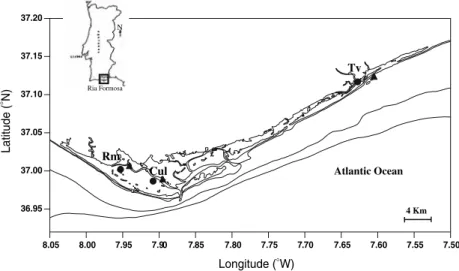
Ria Formosa is a shallow mesotidal coastal lagoon located at the south coast of Portugal, with a wet area of 105 km2(Fig.1). The lagoon, constituted
varies from 0.6 m to 3.5 m, implying that a rather intense exchange of water mass (40–75%) occurs at each tide (Sprung1994) and large intertidal areas are exposed for several hours at each semi-diurnal tidal period. Fresh water input to the lagoon is negligible and salinity remains close to 36 except during sporadic and short periods of winter run-off (Falca˜o and Vale1990).
Field sampling
Sediment cores and overlying water (three repli-cates) were collected monthly throughout the year, at three sampling sites (Tavira-Tv, Culatra-Cul and Ramalhete-Rm). Samples were collected in intertidal muddy stations (Tvm, Culm, Rmm)
and in subtidal sandy stations (Tvs, Culs, Rms). At
each station, six sediment cores (5 cm of diameter and 5 cm in length) were sampled. Cores were divided in two groups of three replicates: one for nitrogen (N) analysis and the other for phospho-rus (P) analysis. Sediment cores of muddy stations were sliced in 0.5 cm sediment layers while sandy cores were sliced in 2 cm layers. Samples were immediately stored in polyethylene vials avoiding air presence by filling up completely. In order to eliminate any sediment oxidation, each sediment layer for P analysis was preserved under N2
atmosphere in loco. Sediment samples were transported to the laboratory under refrigerated
conditions. Overlying water was collected 2 cm above the sediment surface directly with pre-cleaned syringes. In each sampling site, suspended particles were also collected using a sediment-trap with six PVC tubes (5 cm of diameter, 50 cm in length).
Laboratory analysis
Samples of overlying water were filtered through 0.45 lm Millipore filters and stored at 4C until analysis. Sediment samples for porewater analysis were centrifuged for 30 min at 3000 rpm to sepa-rate the solid fraction. Ammonium (NH4+), nitrate
plus nitrite (NO3–+ NO2–) and phosphate (HPO42–)
in porewater and overlying water were determined by colorimetry (Grasshoff1983) using a ‘‘Skalar’’ autoanalyser with a detection limit of 0.2lM for NH4+ and 0.05lM for NO3–+ NO2– and HPO42–.
Total and inorganic carbon, and nitrogen were determined in solid samples previously dried at 80C until a constant weight was reached and grounded to a fine powder, using a CNH analyser ‘‘NC 2500 CE instruments’’ with acetanilide as reference material (Byers et al.1978). Total phos-phorus was determined by digestion ‘‘Bu¨chi 430 digestor’’ with HCl (1 N) during 20 min at 200C according to Andersen (1976). Inorganic phospho-rus was sequentially extracted according to Hos-omi and Sudo (1982). Sediment granulometry was
8.05 8.00 7.95 7.90 7.85 7.80 7.75 7.70 7.65 7.60 7.55 7.50
Longitude (°W) 36.95
37.00 37.05 37.10 37.15 37.20
Latitude (
°N)
N
Rm
Tv
Cul
Ria Formosa
Atlantic Ocean
4 Km
determined by wet separation of muddy from sandy fractions with a sieve of 63 lm. Afterwards, each fraction was dried and weighted. Grain size of the sandy fraction was measured through several sieves from 2 mm to 63lm set in a stirring. Porosity was calculated from sediment weight loss at 105C.
Model development
The transport of NH4+ and HPO42– across the
sediment–water interface was modelled taking into account three major processes: sedimenta-tion, mineralization and molecular diffusion. The NH4+model also considers nitrification and
deni-trification processes, whereas to simulate HPO42–
porewater concentrations and diffusive fluxes, sorption and desorption processes were taken into account, allowing sediments to act not only as a source but also as a sink for this nutrient.
Although model formulations were similar to those described in Chapelle (1995), some adapta-tions were made to account for the semi-diurnal tidal inundation of intertidal areas. Tide level (m)
was considered as one of the model forcing functions being simulated according to the following equation: Tide_level = 1.5 + 1.5*SIN (hour (6–6/2))/(6/2)*p/2).
Formulation of geochemical processes
To simulate the different geochemical processes in intertidal muddy areas and subtidal sandy areas, a suitable set of values for each type of sediment was set up as model parameters (Table1).
Organic matter sedimentation
Particulate organic matter (POM) settled in the upper sediment layer is mineralised, recycling nutrients in porewater (Bally et al. 2004). The deposition rate of POM was considered constant over time, assuming values of 0.5 lg g–1d–1 for particulate organic nitrogen (PON) and particu-late organic phosphorus (POP) in muddy sedi-ments, according to an estimation based on data from the present study (Table3), of PON and POP concentrations in superficial sediments and
Table 1 Model parameters
Parameter Definition Value Reference
minNs Benthic mineralization of organic N at 0C (d–1) 0.005 Billen and Lancelot (1988)
KT Temperature increasing rate (C–1) 0.07 Ruardji and Van Raaphorst (1994)
minPs Benthic mineralization of organic P at 0C (d–1) 0.005 Van der Molen (1991)
KminO2 Half-saturation coefficient for O2limitation of
mineralization (g m–3) 0.5 Henriksen and Kemp (1988)
knit Nitrification rate at 0C (d–1) 0.2 Henriksen and Kemp (1988)
knitO2 Half-saturation coefficient for O2limitation of
nitrification (g m–3) 5 (mud); 9(sand) Model calibration
kdenit Denitrification rate at 0C (d–1) 0.3 Henriksen and Kemp (1988)
kdenitO2 Half-saturation coefficient for O2limitation of
denitrification (g m–3)
3 (mud); 4 (sand)
Model calibration
/mud Porosity of muddy sediments 0.6 Field data
/sand Porosity of sandy sediments 0.35 Field data
Dm[NH4+] Diffusion coefficient for ammonium in sediment
(cm–2s–1)
18·10–6 Aller (1980)
Dm[HPO42–] Diffusion coefficient for phosphates in sediment
(cm–2s–1)
7·10–6 Aller (1980)
ka Adsorption rate in oxic conditions (d–1) 200 (mud); 60
(sand)
Furumai et al. (1989) ;model calibration
Pmax Maximum P adsorption capacity for sediment
(lg g–1) 500 (mud); 500(sand) Field data
kd Desorption rate (lg g–1d–1) 80 (mud); 110
(sand)
Furumai et al. (1989); model calibration
k’a Adsorption rate in anoxic conditions (d–1) 40 (mud); 40
(sand)
in particles deposited in the sediment trap. In sandy-sediments, PON and POP deposition rates were considered to be respectively, 0.4 and 0.3lg g–1d–1.
Mineralization
In the present work, this process was modelled as a function of temperature (using monthly time series) and of dissolved oxygen. Oxygenation of the upper sediment layer is determined by the depth penetration of oxygen into sediment and varies semi-diurnally with tide (Brotas et al.1990). In this lagoon, O2 concentrations of 0.5 and
0.1 g m–3 were measured in intertidal muddy sediments during the flood and ebb tide respec-tively, while at subtidal sandy sediments oxygen in porewater remained constant over time (0.5 g m–3). Mineralization rates (lmol dm–3d–1) followed a first-order equation (Chapelle1995) dependent on temperature and oxygen:
Nmin¼minNseðkTTÞNosf(O2)
Pmin = minPseðkTTÞPosf(O2)
where minNs and minPs are respectively the
benthic mineralization rates of organic nitrogen and phosphorus, at 0C (d–1); KT is the temper-ature increasing rate (C–1); T is temperature (C); Nosand Posare the PON and POP sediment concentrations (lg g–1dw) and f (O2) is the
oxygen limitation expressed by a Michelis–Men-ten equation:
fðO2Þ ¼
O2
O2þkminO2
wherekminO2is the half-saturation coefficient for
mineralization (g m–3). Nitrification/Denitrification
Nitrification was described by a first-order equa-tion according to Ruardji and Van Raaphorst (1994):
Nnitrif =knitNH4seðkTTÞg(O2)
knit is the nitrification rate (d–1) at 0C; NH4s is
the ammonium concentration in porewater (lmol dm–3); KT is the temperature increasing
rate (C–1) andTis temperature (C). The oxygen effect on this process is expressed in the equation byg(O2) term:
gðO2Þ ¼ O2
O2þknitO2
whereknitO2is the half-saturation coefficient for
O2limitation of nitrification (g m–3).
Nitrate produced by nitrification is then reduced to NH4+ through denitrification. This
process follows a first order kinetics and is also temperature and oxygen dependent as shown by the Billen and Lancelot (1988) equation:
Ndenit =kdenitNO3seðkTTÞh(O2Þ
The influence of oxygen on denitrification can be expressed by the following formula:
hðO2Þ ¼
O2
O2þkdenitO2
where kdenitO2 is the half-saturation coefficient
for O2limitation of denitrification (g m–3).
Adsorption/Desorption
The kinetics of phosphorus adsorption (Padsorp)
and desorption (Pdesorp) processes was formulated
according to Furumai et al. (1989): Padsorp¼ka ð1Pads=PmaxÞ Ppw
Pdesorp=kd (Pads/Pmax)
where ka is the adsorption rate (d–1), kd is the
desorption rate (lmol dm–3d–1), Padsis the inorganic
phosphorus adsorbed to the sediment (lg g–1dw), Ppw is the inorganic phosphorus in porewater
(lM) and Pmax is the maximum P adsorption
oxic and anoxic situations however different adsorption rates were assumed.
Molecular diffusion
Nutrients dissolved in the upper sediment layer are released to the water column according to concentration gradients between sediment and overlying water. Ammonium and phosphate dif-fusive fluxes across the sediment–water interface (F) were modelled according to the Fick’s first law of diffusion (Berner1980):
F = /Ds (Co -Cp) / (Dx)
where / is the porosity, Dm is the molecular
diffusion coefficient (Dm = 18·10–6cm2s–1 for
NH4+; Dm= 7·10–6cm2s–1 for HPO42– in Aller
1980), Co is the [NH4+] or [HPO42–] in overlying
water, Cp is the [NH4+] or [HPO42–] in porewater
andDxis the distance across the interface where concentrations were measured (2 cm).
Model implementation
The model was implemented in StellaTM 5.1.1. Nutrient concentrations and diffusive fluxes were simulated over a period of 1 year at the scale of 1 cm2. After determination of initial and
bound-ary conditions and input of model parameters, fluxes and porewater concentrations were com-puted over time using Runge-Kutta fourth-order integration with a time step of 1 h.
Statistical analysis
The existence of significant seasonal differences on nutrient concentrations were tested using the
non-parametric Wilcoxon test of the Statistica 3.2. software.
The overall correspondence between observed and predicted porewater nutrient concentrations was analysed with a Model II linear regression analysis, following Laws and Archie (1981), with the major axis regression method as recom-mended by Mesple´ et al (1996) and described in Sokal and Rohlf (1995). The significance of the slopes and y-intercepts obtained were tested as well as the significance of the variance explained by the model, using ANOVA. When the slope is not significantly different (s.d.) from one and the y-intercept not s.d. from zero, there is a good agreement between model and observations. When the y-intercept is s.d. from zero, there is a constant difference between model and obser-vations. When the slope is not s.d. from one but s.d. from zero, the differences between model and observations are proportional to the value of the variable, but the model may explain a significant proportion of total variance.
Results
Sediment characterization
Intertidal muddy sediments were mostly consti-tuted by silt and clay (<0.063 mm) while subtidal sandy sediments have a minor fraction of these particles (0.01%), being mainly fine sands. Sedi-ment granulometry agrees with its porosity, which was two times higher in muddy sediments (Table 2). Organic carbon, nitrogen and phos-phorus in the upper layer of muddy sediments were clearly higher than in sandy sediments, mainly during summer (Table3).
Table 2 Grain size (in percentage) and porosity of superficial sediments (0–2 cm) from muddy and sandy stations
Grain size (%) Porosity
Gross sands Fine sands Silt + clay
>2 (mm) 0.5–0.063 (mm) <0.063 (mm)
Muddy-sediments (0–2 cm) 8 36 56 0.64 ± 0.021
Intertidal muddy sediments
Ammonium, nitrate+nitrite and phosphate in overlying water and porewater
Ammonium dissolved in overlying water varied annually from 0.2lM to 4lM while in porewater, concentrations were 2 to 3 orders of magnitude higher, reaching a maximum of 380lM in the upper sediment layer (Fig.2). In porewater, this nutrient exhibited a clear seasonal pattern, with values significantly higher during the warmer period (Wilcoxon test; P< 0.01). A significant exponential fit was obtained between NH4+ in
porewater and water temperature (T): [NH4+] = 10.904*e(0.129*T); r2= 0.89; (P< 0.01).
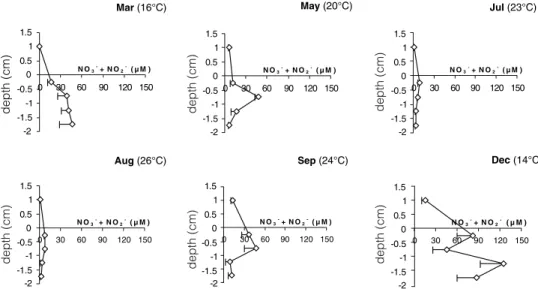
Conversely, nitrogen oxidized forms (NO3–+ NO2–)
dissolved in porewater along sediment profiles reached the maximum values in December (46–125lM), contrasting with those obtained in July–August (Fig.3). Thus, seasonal variabil-ity of NO3–+ NO2– may be traduced by the
significant inverse linear relationship between porewater concentrations and water tempera-ture: [NO3–+ NO2–] = –0.1387T+ 23.7; r2= 0.6;
(P <0.02).
Low HPO42–concentrations in overlying water
(0.2–2.3lM) contrasted with those obtained in porewater, which were 1 to 2 orders of magnitude higher, reaching the maximum (113lM) in deeper layers (Fig.4). When temperature reached the peak (August), HPO42– exhibited large variability
Table 3 Mean percentage (±s.d.) of total organic carbon (TOC), total organic nitrogen (TON) and total organic phosphorus (TOP) in superficial sediments (0–2 cm) of
muddy and sandy stations and, in particles deposited in sediment-trap: summer and winter values
TOC (lmol g–1) TON (lmol g–1) TOP (lmol g–1)
Summer Winter Summer Winter Summer Winter
Superficial sediments Mud 1477 ± 450 1038 ± 86 54 ± 35 46 ± 7.5 4.9 ± 2.29 1.3 ± 0.62
Sand 708 ± 247 417 ± 12 6.5 ± 2.5 1.1 ± 0.30 3.6 ± 0.99 1.8 ± 0.50
Particles in sediment-trap 1790 ± 110 1660 ± 300 176 ± 91 91 ± 26 10 ± 4.7 3.1 ± 1.23
Mar
-2 -1.5 -1 -0.5 0 0.5 1 1.5
0 100 200 300 400 N H4+ ( µ M )
May
-2 -1.5 -1 -0.5 0 0.5 1 1.5
0 100 200 300 400 N H4+ ( µ M )
Ju
-2 -1.5 -1 -0.5 0 0.5 1 1.5
0 100 200 300 400 N H4+ ( µ M )
Aug
-2 -1.5 -1 -0.5 0 0.5 1 1.5
0 100 200 300 400
N H4+ ( µ M )
Sep
-2 -1.5 -1 -0.5 0 0.5 1 1.5
0 100 200 300 400
N H4+ ( µ M )
Dec
-2 -1.5 -1 -0.5 0 0.5 1 1.5
0 100 200 300 400
N H4+ ( µ M )
(14°C) (24°C)
(26°C)
l(23°C)
(16°C) (20°C)
depth (cm)
depth (cm)
depth (cm)
depth (cm) depth (cm)
depth (cm)
Fig. 2 Average (-s.d.) NH4+concentrations in overlying water and along porewater profile (0–2 cm) of muddy stations
along porewater profiles, while during the period of lower temperature HPO42–varied within a narrow
range (1.4–6.7 lM). During the warmer period, HPO42– concentrations were significantly higher
than in winter (Wilcoxon test;P< 0.01) as it can be accurately described by the exponential equation: [HPO42–] = 0.250*e(0.208*T);r2= 0.95 (P< 0.01).
Subtidal sandy sediments
Ammonium, nitrate+nitrite and phosphate in overlying water and porewater
Ammonium in overlying water varied within a narrow range in all stations (0.2–3.2lM), while in
Mar
0 25 50 75 0 25 50 75
0 25 50 75
0 25 50 75
0 25 50 75
HPO42 - ( µ M )
May -2 -1.5 -1 -0.5 0 0.5 1 1.5 -2 -1.5 -1 -0.5 0 0.5 1 1.5 -2 -1.5 -1 -0.5 0 0.5 1 1.5 -2 -1.5 -1 -0.5 0 0.5 1 1.5 -2 -1.5 -1 -0.5 0 0.5 1 1.5 -2 -1.5 -1 -0.5 0 0.5 1 1.5
0 25 50 75
HPO42 - ( µ M )
Jul
HPO42 -( µ M )
Aug
HPO42 - ( µ M )
Sep
HPO42 - ( µ M )
Dec
HPO42 - ( µ M ) (14°C) (24°C)
(26°C)
(23°C) (16°C) (20°C)
113 depth (cm) depth (cm) depth (cm) depth (cm) depth (cm) depth (cm)
Fig. 4 Average (-s.d.) HPO42–concentrations in overlying water and along porewater profile (0–2 cm) of muddy stations
(Rmm, Culm, Tvm) in March, May, July, August, September and December
Mar (16°C)
-2 -1.5 -1 -0.5 0 0.5 1 1.5
0 30 60 90 120 150 N O3
-+ N O2
-( µ M )
Dec (14°C)
0 30 60 90 120 150
N O3
-+ N O2
( µ M ) Sep (24°C)
0 30 60 90 120 150
N O3-+ N O2-( µ M ) Aug (26°C)
0 30 60 90 120 150
N O3
-+ N O2
-( µ M )
Jul (23°C)
0 30 60 90 120 150 N O3-+ N O2-( µ M ) May (20°C)
0 30 60 90 120 150 N O3
-+ N O2
-( µ M )
depth (cm) depth (cm) depth (cm) depth (cm) depth (cm) depth (cm) -2 -1.5 -1 -0.5 0 0.5 1 1.5 -2 -1.5 -1 -0.5 0 0.5 1 1.5 -2 -1.5 -1 -0.5 0 0.5 1 1.5 -2 -1.5 -1 -0.5 0 0.5 1 1.5 -2 -1.5 -1 -0.5 0 0.5 1 1.5
Fig. 3 Average (-s.d.) NO3–+ NO2– concentrations in overlying water and along porewater profile (0–2 cm) of muddy
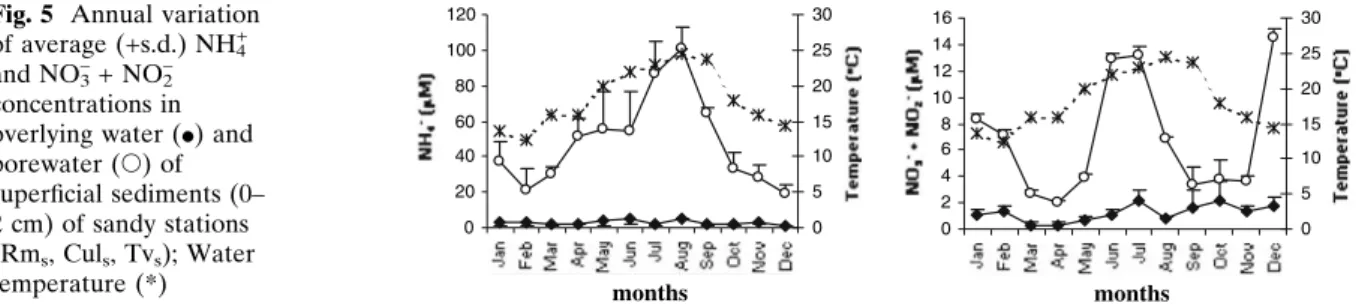
porewater, concentrations were up to 2–3 orders of magnitude higher (19.4–110lM), as shown in Fig.5. As for intertidal muddy sediments, the clear seasonal pattern described by porewater NH4+ concentrations may be explained by a
significant exponential relationship between
NH4+ in porewater and water temperature:
[NH4+] = 9.344*e(0.09*T); r2= 0.64 (P< 0.02). For
sandy sediment, no relationship was found be-tween NO3–+ NO2–and temperature since higher
concentrations (12lM), were reached in both winter and summer (Fig.5).
Phosphate in overlying water remained low throughout the year (0.3–1.7 lM), contrasting with porewater concentrations that varied from 1.7lM to 16lM (Fig.6). A sharp increase of HPO42– in
porewater occurred when water temperature rose above 22C, while the lowest levels were recorded in December (14C). Seasonal variation of HPO42– in porewater is accurately described by the equation: [HPO42–] = 0.177*e(0.184*T); r2= 0.86
(P< 0.01). Model simulations
The slope of Model II regressions between predicted and measured porewater nutrient val-ues was not significantly different from one and 0
20 40 60 80 100 120
months
0 5 10 15 20 25 30
0 2 4 6 8 10 12 14 16
months
0 5 10 15 20 25 30 Fig. 5 Annual variation
of average (+s.d.) NH4+
and NO3–+ NO2–
concentrations in overlying water (d) and porewater (s) of
superficial sediments (0– 2 cm) of sandy stations (Rms, Culs, Tvs); Water
temperature (*)
0 2 4 6 8 10 12 14 16 18 20
months
0 5 10 15 20 25 30
Fig. 6 Annual variation of average (+s.d.) HPO42–
con-centrations in overlying water (d) and porewater (s) of superficial sediments (0–2 cm) of sandy stations (Rms,
Culs, Tvs); Water temperature (*)
0 5 10 15 20
0 50 100 150 200 250 300 350 400
days 0
10 20 30 40 50 60
0 50 100 150 200 250 300 350 400
days 0
50 100 150 200 250 300 350 400
0 50 100 150 200 250 300 350 400
0 20 40 60 80 100 120 140
0 50 100 150 200 250 300 350 400
b) a)
a) b)
Fig. 7 Simulated (—) and average (+s.d.) field (d) NH4+and HPO42–
they-intercept was not s.d. from zero (P< 0.05) in the cases of NH4+ porewater concentrations
(Fig. 7) in sandy sediments, demonstrating the good model fit to observed data. In all remaining cases both the slopes and they-intercepts differed significantly from zero. However, the variance explained by the model was significant (P< 0.01) for all simulations, suggesting that, even though the model could under or over estimate observed data, it explained a significant part of data variance. Furthermore, the difference between predicted and observed average values was gen-erally less than 10%.
As expected from porewater nutrient concen-trations simulated by the model, NH4+and HPO42–
diffusive fluxes of muddy and sandy sediments exhibited a clear seasonal variation (Fig.8). In muddy sediments, NH4+ fluxes varied from 18
nmol cm–2d–1 to 104 nmol cm–2d–1, while in sandy sediments this variation was smoother (10–26 nmol cm–2d–1). Regarding HPO42– fluxes,
values varied from 0.8 nmol cm–2d–1 to 8 nmol
cm–2 d–1 in muddy sediments, while in sandy sediments the range was narrower (0.2–1.1 nmol cm–2d–1).
Several scenarios of global warming were simulated with the model in order to predict the effects on NH4+and HPO42–cycling. Changes of a
2C increase in mean annual lagoon water tem-perature resulted in a significant 5% variation of NH4+ in porewater of muddy and sandy
sediments (P< 0.01), whereas HPO42–
concentra-tions remained practically unchanged. As expected, a significant variation (P< 0.01) was also observed for NH4+diffusive fluxes although at
a lower level (2% variation). According to some authors (Miranda et al. 2002) there is a general tendency in the Portuguese climate for the increase of both minimum and maximum tem-peratures. For that reason we looked at two scenarios, respectively of 1C and 2C increase in water temperature during winter and summer seasons. For both situations, only NH4+ in
pore-water varied significantly (P< 0.01), increasing respectively 2 and 3%. In what concerns NH4+
sediment-water fluxes, a significant variation (P< 0.05) was only observed for the 2C increase scenario for the winter and summer periods.
Discussion
In muddy areas of high organic matter content, NH4+ dissolved in porewater reached the peak at
top layer sediment during the warmer period (380 lM), since its accumulation is linked to the breakdown of fresh organic matter, temperature and oxygen availability (Lerat et al. 1990; Kris-tensen 1993; Chapelle 1995; Vidal and Morguı´
1995). Organic material, settled in the upper sediment layers associated to high temperatures, accelerates mineralization processes due to an increase in the microbial metabolism, leading to intense NH4+ production during that period
0 1 2 3 4 5 6 7 8 9
0 50 100 150 200 250 300 350 400 days
0 0.3 0.6 0.9 1.2 1.5
0 50 100 150 200 250 300 350 400
days 0
5 10 15 20 25 30
0 50 100 150 200 250 300 350 400 0
20 40 60 80 100 120
0 50 100 150 200 250 300 350 400
a) b)
b) a)
Fig. 8 Simulated NH4+
and HPO42–diffusive
(Nowicki and Nixon 1985; Van Raaphorst et al.
1992; Kristensen 1993; Chapelle 1995; Asmus et al. 2000; Wilson and Brennan 2004). On the other hand, nitrification/denitrification processes are also temperature-dependent (Cartaxana et al.
1999). The low NO3–+ NO2– levels found in
porewater profiles during the warmer period may be explained by denitrification of NO3– to
gaseous forms of N and NH4+ as described by
other authors (Cartaxana et al. 1999).
The large variability of HPO42– in muddy
sediment porewater profiles during the warmer period, that reaches higher concentrations in deeper layers (>50lM), may be explained by the increase of organic matter mineralization rates under high temperatures and P-desorption due to iron oxides reduction (Chapelle 1995; Asmus et al.2000). These findings are reinforced by other studies, in which HPO42– in porewater
were positively correlated with bottom water temperature (Jensen et al. 1995; Lillebø et al.
2004), and negatively correlated with dissolved oxygen (Jensen et al. 1995). During the period of lower temperatures, the oxygen availability increases in porewater due to an increase of its solubility (Ohtake et al. 1984; Moutin 1992), which turns the iron and sulphur cycles very
reactive (Sundby et al. 1992; Bally et al. 2004; Caetano et al. 2003). The low levels of HPO42–
found in porewater of muddy sediments (<10lM) may be partially explained by P-sorp-tion onto iron oxides formed under oxic condi-tions (Sundby et al. 1992; De Jonge et al. 1993; Van Raaphorst and Kloosterhuis 1994; Slomp et al. 1998; Perkins and Underwood2001), since there is a large iron availability in the intertidal muddy sediments of this lagoon (Caetano et al.
2002).
A sensitivity analysis performed to the model, consisting of a 10% variation in model parame-ters and initial conditions, revealed that NH4+ in
porewater was particularly sensitive to organic matter deposition, N mineralization rate (minNs),
temperature (KT) and sediment porosity, which
agrees with field data (Table 4). Conversely, an increase/decrease in nitrification/denitrification related parameters did not change NH4+
concen-trations. Phosphate in porewater was more sen-sitive to adsorption/desorption processes than to organic matter deposition and mineralization. Indeed, a 10% increase/decrease on the rate of organic matter deposition and minPs did not
affect HPO42– in porewater, whilst the same
variation ofk’a, Pmaxandkdproduced a significant
variation (P< 0.01) on HPO42– concentrations
(Table 4).
Studies developed in this lagoon have shown that N and P entering the system are quickly removed by primary producers (Falca˜o and Vale
2003) what might explain the low NH4+ (<4lM)
and HPO42–levels (<2 lM) in overlying water over
the year. These values, 2–3 orders of magnitude lower than those found in porewater lead to concentration gradients between sediment and overlying water that drives nutrient sediment-water exchanges (Trimmer et al.1998; Wilson and Brennan 2004). Solute diffusion is particularly important for nutrient cycling in muddy sediments where diagenesis takes an active part in the biogeochemical cycles of elements (Aller 1980; Nowicki and Nixon 1985; Lerat et al. 1990; Bally et al. 2004). The annual range of NH4+ (10–104 nmol cm–2 d–1) and HPO42– (0.2–
8 nmol cm–2d–1) effluxes, predicted by the model for both types of sediments, are similar to those described by other authors for this system (Falca˜o Table 4 Variation coefficient (%) of NH4+and HPO42-in
porewater obtained from the model sensitivity analysis
Variation coefficient (%)
Model parameters NH4+ HPO42–
Organic matter deposition rate 6 0.3
Initial N and P organic concentrations
4 0.1
Initial porewater concentrations
0.02 0
minNs 4
KT 4 0.05
minPs 0.2
kminO2 2 0.2
knit 0.03
knitO2 0.02
kdenit 0.03
kdenitO2 0.03
/ 10 0.1
ka 3
Pmax 10
kd 8
and Vale 1998; Asmus et al. 2000). In those studies, muddy sediments NH4+fluxes ranged from
72 nmol cm–2d–1 to 127 nmol cm–2d–1 whereas for HPO42–, negative fluxes were determined
pointing to sediment P-uptake. The present fluxes were also comparable with those found in other marine systems (Pregnall and Miller 1988; Lerat et al. 1990; Kristensen 1993; Asmus et al. 2000). Maximum NH4+ exchange rates of 96 and
144 nmol cm–2d–1have been reported for marine
environments in the coast of Ireland (Wilson and Brennan 2004). In the organically-rich Tamar estuary (SW of England), a broader range of NH4+ (-57–408 nmol cm–2d–1) and HPO42– fluxes
(–17–48 nmol cm–2d–1) were referred by Watson et al. (1993), while in the carbonate-rich sands of the Great Barrier Reef (Australia), NH4+effluxes
varied from 14 nmol cm–2d–1to 48 nmol cm–2d–1 and HPO42– from 0 nmol cm–2d–1 to 3 nmol
cm–2 d–1(Hansen et al.1987).
Based on nutrient fluxes simulated by the model, and assuming that in Ria Formosa inter-tidal muddy areas correspond to 2000 ha of Ria Formosa and subtidal sandy areas to 2500 ha, the contribution of N and P effluxes to the lagoon nutrient budget was evaluated. The amount of NH4+and HPO42–released from muddy areas was
estimated respectively in 61 ton y–1and 6 ton y–1 while subtidal sandy areas contribute annually with 22 ton of NH4+ and 2 ton of HPO42–. This
evaluation shows the importance of mudflats for the maintenance of a high productivity in this system (Falca˜o and Vale 2003), since the contri-bution of these areas to the water column nutrient enrichment is clearly higher than the one from sandy areas.
Given the importance of bottom sediments to the water column nutrient enrichment of shal-low coastal ecosystems (Falcao and Vale 1998), it is important to predict what will happen to sediment-water nutrient exchanges as a result of global warming. The general trend for increase in the mean annual surface air temperature in Portuguese land areas at an average warming rate of 0.17–0.6C per decade (Miranda et al.
2002), will be accompanied by an ocean warm up (IPCC 2001). For the scenarios simulated with the model, a significant variation (P< 0.05) was only observed for NH4+ in porewater and
consequent diffusive fluxes, what will probably affect the system productivity due to a N/P ratio unbalance.
Acknowledgements This work was has been supported by several projects developed within the IPIMAR (National Institute of Fisheries and Sea Research) and by the EU funded Project DITTY (Development of Information Technology Tools for the management of European Southern lagoons under the influence of river-basin runoff) in the Energy, Environment and Sustainable Development programme of the European Commission (EVK3-CT-2002-00084). The authors would also like to thank Prof. Dr. Leonor Fonseca for her helpful commentaries on the manuscript and to M. L. Ina´cio for her help in field and laboratory work.
References
Aigars J (2001) Seasonal variation in phosphorus species in the surface sediments of the Gulf of Riga, Baltic sea. Chemosphere 45:827–834
Aller RC (1980) Diagenetic processes near the sediment-water interface of Long Island Sound. Decomposition and nutrient element geochemistry (S, N, P). Adv Geophys 22:237–350
Andersen JM (1976) An ignition method for determina-tion of total phosphorus in lake sediments. Water Res 10:329–331
Asmus RM, Sprung M, Asmus H (2000) Nutrient fluxes in intertidal communities of a south European lagoon (Ria Formosa) – similarities and differences with a northern Wadden Sea bay (Syl-R˘m˘bay). Hydro-biologia 436:217–235
Bally G, Mesnage V, Deloffre J, Clarisse O, Lafite R, Dupont J-P (2004) Chemical characterization of porewaters in an intertidal mudflat of the Seine estuary: relationship to erosion-deposition cycles. Mar Pollut Bull 49:163–173
Benitez-Nelson CR (2000) The biogeochemical cycling of phosphorus in marine systems. Earth-Sci Rev 51:109– 135
Berner RA (1980) Early diagenesis - a theorical approach. Series in geochemistry. Princeton University Press, Princeton, New Jersey
Billen G, Lancelot C (1988) Modelling benthic nitrogen cycling in temperate coastal ecosystems. In: Black-burn TH, Sorensen J (eds) Nitrogen cycling in coastal marine environments. John Wiley & Sons, New York, pp 341–378
Brotas V, Ferreira AA, Vale C, Catarino F (1990) Oxygen profiles in intertidal sediments of Ria Formosa (S. Portugal). Hydrobiologia 207:123–129
Caetano M, Madureira M, Vale C (2003) Metal remobil-isation during resuspension of anoxic contaminated sediment - short-term laboratory study. Water Air Soil Pollut 143(1–4):23–40
Caetano M, Vale C, Bebianno MJ (2002) Distribution of Mn, Fe, Cu and Cd in upper sediments and sediment-trap material of Ria Formosa (Portugal). J Coastal Res 36:118–123
Cartaxana P, Cac¸ador I, Vale C, Falca˜o M, Catarino F (1999) Seasonal variation of inorganic nitrogen and net mineralization in a salt marsh ecosystem. Man-groves Salt Marsh 3:127–134
Chapelle A (1995) A preliminary model of nutrient cycling in sediments of a Mediterranean lagoon. Ecol Model 80:131–147
De Jonge VN, Engelkes MM, Bakker JF (1993) Bio-availability of phosphorus in sediments of the western Dutch Wadden Sea. Hydrobiologia 253:151–163 Falca˜o M, Vale C (1990) Study of the Ria Formosa
ecosystem: benthic nutrient remineralization and tidal variability of nutrients in the water. Hydrobiologia 207:137–146
Falca˜o M, Vale C (1998) Sediment-water exchanges of ammonium and phosphate in intertidal and subtidal areas of a mesotidal coastal lagoon (Ria Formosa). Hydrobiologia 373/374:193–201
Falca˜o M, Vale C (2003) Nutrient dynamics in a coastal lagoon (Ria Formosa, Portugal): the importance of lagoon-sea water exchanges on biological productiv-ity. Cienc Mar 23(3):425–433
Forja JM, Blasco J, Go´mez-Parra A (1994) Spatial and seasonal variation of in situ benthic fluxes in the Bay of Cadiz (South-west Spain). Estuar Coast Shelf Sci 39:127–141
Furumai H, Kondo T, Ohgaki S (1989) Phosphorus exchange kinetics and exchangeable phosphorus form in sediments. Water Res 6:685–691
Grasshoff K (1983) Methods of seawater analysis. Verlag Chemie, New York
Hansen JA, Alongi DM, Moriarty DJ, Pollard PC (1987) The dynamics of benthic microbial communities at Davies Reef, central Great Barrier Reef. Coral Reefs 6:63–70
Henriksen K, Kemp WM (1988) Nitrification in estuarine and coastal marine sediments. In: Blackburn TH, Sorensen J (eds) Nitrogen cycling in coastal marine environments. John Wiley & Sons, New York, pp 207–249
Hosomi M, Sudo R (1982) Release of phosphorous from lake sediments. Environ Int 7:93–98
IPCC (2001) Climate change 2001: synthesis report. In: Third assessment report of the intergovernmental panel on climate change. Intergovernmental panel on climate change.http://www.ipcc.ch/
Jensen HS, Mortensen PB, Andersen F˘, Rasmussen E, Jensen A (1995) Phosphorus cycling in a coastal marine sediment, Aarhus bay, Denmark. Limnol Oceanogr 40:908–917
Kristensen E (1993) Seasonal variations in benthic com-munity metabolism and nitrogen dynamics in a
shallow, organic-poor Danish lagoon. Estuar Coast Shelf Sci 36:565–586
Laws EA, Archie JW (1981) Appropriate use of regression analysis in marine biology. Mar Biol 65:99–118 Lerat Y, Lasserre P, Corre P (1990) Seasonal changes in
porewater concentrations of nutrients and their diffu-sive fluxes at the sediment-water interface. J Exp Mar Biol Ecol 135:135–160
Lilleb˘AI, Neto JM, Flindt MR, Marques JC, Pardal MA (2004) Phosphorus dynamics in a temperate intertidal estuary. Estuar Coast Shelf Sci 61:1001–1009 Mesple´ F, Trousselier M, Casellas C, Legendre P (1996)
Evaluation of simple statistical criteria to qualify a simulation. Ecol Model 88:9–18
Miranda P, Coelho F, Tome´ A, Valente M (2002) 20th century Portuguese climate and climate scenarios. In: Santos FD, Forbes K, Moita R (eds) Climate change in Portugal. Scenarios, Impacts and Adaptation Mea-sures – SIAM Project, Gradiva, Lisbon, pp 25–83 Moutin T (1992) L’e´tude du cycle du phosphate dans les
e´cosyste`mes lagunaires. The`se de Doctorat, Univer-site´ des Sciences et Techniques du Languedoc, France Nian-Zhi J, Wang R (1994) Ammonium uptake and regeneration fluxes of the microplankton communities in Jiaozhou Bay. Chin J Oceanol Limnol 12:163–174 Nowicki BL, Nixon SW (1985) Benthic nutrient
reminer-alization in a coastal lagoon ecosystem. Estuaries 8:182–190
Ohtake H, Kato S, Date Y (1984) The role of tides in removing phosphorus from Lake Nakanoumi,
a coastal lagoon in Japan. Arch Hydrobiol
99(4):443–462
Perkins RG, Underwood GJG (2001) The potential for phosphorus release across the sediment-water inter-face in an eutrophic reservoir dosed with ferric sulphate. Water Res 35(6):1399–1406
Pregnall AM, Miller SL (1988) Flux of ammonium from surf-zone and nearshore sediments in Nahant Bay, Massachusetts, USA in relation to free-livingPilayella littoralis. Mar Ecol Prog Ser 50:161–167
Ruardij P, Van Raaphorst W (1994) Benthic nutrient regeneration in the ERSEM ecosystem model of the North Sea. In: Publication 67 of the Project ‘‘Applied Scientific Research’’, Netherlands Institute for Sea Research
Slomp CP, Malschaert JF, Van Raaphorst W (1998) The role of absorption in sediment-water exchange of phosphate in North Sea continental margin sediments. Limnol Oceanogr 43(5):832–846
Sokal RR, Rohlf FJ (1995) Biometry - the principles and practise of statistics in biological research. W.H. Freeman and Company, San Francisco
Sprung M (1994) Macrobenthic sedendary production in the intertidal zone of the Ria Formosa - a lagoon in southern Portugal. Estuar Coast Shelf Sci 38:539–558 Sundby B, Gobeil C, Siverberg N, Mucci A (1992) The phosphorus cycle in coastal marine sediments. Limnol Oceanogr 37:1129–1145
Great Ouse, England: the role of the bottom sedi-ments. Mar Ecol Prog Ser 163:109–124
Van der Molen DT (1991) A simple dynamic model for the simulation of the release of phosphorus from sedi-ments in shallow eutrophic systems. Water Res 25:737–744
Van Raaphorst W, Kloosterhuis HT, Cramer A, Bakker KJ (1990) Nutrient early diagenesis in the sandy sediments of the Doggerbank area, North Sea: pore water results. Neth J Sea Res 26:25–52
Van Raaphorst W, Kloosterhuis HT (1994) Phosphate sorption in superficial intertidal sediments. Mar Chem 48:1–16
Van Raaphorst W, Kloosterhuis HT, Berghuis EM, Gieles AJM, Malschaert JFP, Van Noort GJ (1992) Nitrogen
cycling in two types of sediments of the southern north sea (frisian frint, broad fourteens): field data and mesocosm results. Neth J Sea Res 28(4):293–316 Vidal M, Morguı´ J-A (1995) Short-term pore water ammonium variability coupled to benthic boundary layer dynamics in Alfacs bay, Spain (Ebro Delta, NW Mediterranean). Mar Ecol Prog Ser 118:229–236 Watson PG, Frickers PE, Howland RJM (1993) Benthic