http://dx.doi.org/10.1590/0104-070720180003810016
PROPOSAL FOR STEPS TOWARDS PATIENT SAFETY IN MOBILE
EMERGENCY CARE
1Grayce Louyse Tinôco de Castro2, Francis Solange Vieira Tourinho3, Maria de Fátima da Silva Vieira Martins4, Kleyton Santos de Medeiros5, Patricia Ilha6, Viviane Euzébia Pereira Santos7
1 Article extracted from the thesis – Mobile emergency care: mapping risks and preventing erros, presented to the Graduate Nursing Program at Universidade Federal do Rio Grande do Norte (UFRN), in 2013.
2 M.Sc. in Nursing. Graduate Nursing Program at UFRN. Nurse in Samu Natal. Natal, Rio Grande do Norte, Brazil. E-mail: [email protected]
3 Ph.D. in Child and Adolescent Health. Professor, Nursing Department and Graduate Nursing Program at Universidade Federal
de Santa Catarina (UFSC). Florianópolis, Santa Catarina, Brazil. E-mail: [email protected]
4 Ph.D. in Sociology. Professor, Escola Superior de Enfermagem, Universidade do Minho. Portugal. E-mail: [email protected] 5 Nurse, League Against Cancer. Natal, Rio Grande do Norte, Brazil. E-mail: [email protected]
6 Doctoral student in Nursing. Graduate Nursing Program at UFSC. Florianópolis, Santa Catarina, Brazil. E-mail: ilha.patricia@ gmail.com
7 Ph.D. in Nursing. Professor, Nursing Department Graduate Nursing Program, UFRN. Natal, Rio Grande do Norte, Brazil. E-mail: [email protected]
ABSTRACT
Objective: propose steps for patient safety based on the analysis of risks in mobile emergency care from nurses’ perspective.
Method: quantitative and descriptive study. Intentional sample consisting of 23 nurses. The photographic research method was used to identify the risks for patient safety in a Mobile Emergency Care Service in a city in Rio Grande do Norte (Brazil). The data were collected between March and June 2012 and organized in five phases: collection of pictures from safe and non-safe situations; selection of pictures based on the image quality; selection of pictures by experts on the theme; random selection of ten images; and application of picture analysis tool by the professionals. Content analysis and descriptive analysis were used.
Results: the risks appointed in the study were: difficulties to store equipment and material; particularities of work in mobile emergency
care; risk of infection; risk of traumas; and medication administration difficulties. Based on this information and confrontations with the literature, ten steps were suggested towards patient safety in emergency care, focused on the needs to reduce the risks presented.
Conclusion: the risk analysis and the intervention proposal towards patient safety favor the quality of health care, with benefits in the
following spheres: patient, team, equipment, professional and environment. These should be developed in accordance with the needs of each service.
DESCRIPTORS: Patient safety. Quality of health care. Risk management. Prehospital care. Emergency medical services. Photography.
PROPOSTA DE PASSOS PARA A SEGURANÇA DO PACIENTE NO
ATENDIMENTO PRÉ-HOSPITALAR MÓVEL
RESUMO
Objetivo: propor passos para a segurança do paciente a partir da análise dos riscos no atendimento pré-hospitalar móvel sob a ótica dos enfermeiros.
Método: estudo quantitativo, e descritivo. Amostra intencional, composta por 23 enfermeiros. Utilizou-se o método de pesquisa fotográfica
para identificar os riscos à segurança do paciente em um Serviço de Atendimento Móvel de Urgência de uma cidade do Rio Grande do Norte. A coleta foi realizada de março a junho de 2012 e organizada em cinco etapas: obtenção das fotos de situações de segurança e não segurança; seleção de fotos pela qualidade de imagem; seleção de fotos pelos experts da temática; seleção de dez imagens de modo aleatório;
e aplicação do instrumento de análise das fotos pelos profissionais. Foi utilizada a análise de conteúdo e análise descritiva.
Resultados: os riscos apontados no estudo foram: dificuldades no acondicionamento de equipamentos e materiais; especificidades do
trabalho no atendimento pré-hospitalar móvel; risco de infecção; risco de traumas; e dificuldades na administração de medicamentos. A partir dessas informações e confrontos com a literatura, foram sugeridos dez passos para a segurança do paciente no atendimento pré-hospitalar, voltados às necessidades de redução dos riscos apresentados.
Conclusão: a análise de riscos e proposta de intervenções para a segurança do paciente favorecem a qualidade do atendimento em saúde,
com benefícios na esfera: paciente, equipe, profissional e ambiente. Sugere-se que sejam desenvolvidas de acordo com as necessidades de cada serviço.
DESCRITORES: Segurança do paciente. Qualidade da assistência à saúde. Gestão de riscos. Assistência pré-hospitalar. Serviços médicos
PROPUESTA DE PASOS A SEGUIR PARA LA SEGURIDAD DEL PACIENTE
EN LA ATENCIÓN PRE-HOSPITALARIA MÓVIL
RESUMEN
Objetivo: proponer los pasos a seguir para la seguridad del paciente a partir del análisis de los riesgos en la atención pre-hospitalaria móvil y bajo la óptica de los enfermeros.
Método: estudio cuantitativo, y descriptivo. Muestra intencional compuesta por 23 enfermeros. Se utilizó el método de investigación fotográfica para identificar los riesgos para la seguridad del paciente en un Servicio de Atención Móvil de Urgencia de una ciudad del estado de Rio Grande do Norte. La recolección se realizó de Marzo a Junio del 2012 y se organizó en cinco etapas: obtención de las fotos de situaciones de seguridad y sin seguridad, selección de fotos por la cualidad de imagen, selección de fotos por los peritos en la temática, selección de diez imágenes de forma aleatoria y aplicación del instrumento de análisis de las fotos por los profesionales. Se usó el análisis del contenido y el análisis descriptivo.
Resultados: los riesgos mencionados en el estudio fueron las dificultades en el acondicionamiento de equipamientos y materiales,
especificidades del trabajo en la atención pre-hospitalaria móvil, riesgo de infección, riesgo de traumas y dificultades en la administración de medicamentos. A partir de estas informaciones y cotejos con la literatura fueron sugeridos diez pasos a seguir para la seguridad del paciente en la atención pre-hospitalaria relacionados con las necesidades de reducción de los riesgos presentados.
Conclusión: el análisis de riesgos y propuesta de intervenciones para la seguridad del paciente favorece la cualidad de la atención en la salud y con beneficios en las áreas paciente, equipo, profesional y ambiente. Se sugiere que sean desarrolladas de acuerdo con las necesidades de cada servicio.
DESCRIPTORES: Seguridad del paciente. Cualidad de la asistencia para la salud. Gestión de riesgos. Asistencia pre-hospitalaria. Servicios
médicos de urgência. Fotografía.
INTRODUCTION
The concept of patient safety refers to the prevention of possible damages caused during the health care of patients and other subjects involved in this process, who are always susceptible to a chain of errors, due to the complexity of the factors that involve care. For this prevention to be achieved ef-fectively, some basic patient safety strategies need to be implemented, such as professional training for safety, organizational and institutional awareness-raising, resource distribution and constant updating of processes, with a critical assessment, in order to build a system conducive to the development of a positive and structured safety culture for risk reduc-tion and error prevenreduc-tion.1
According to the specificity of each sector
and the needs of the professionals who work in the service, as well as the different actions per-formed, each service needs to elaborate a plan or
guideline that fits these needs and the profile of its
professionals, constructed with the participation and articulation of the triad government, service and teaching.2
Emergency medical services (EMS), being an
area with broad knowledge and specific activities,
has required that professionals be trained compat-ible with the reality of the services requested by the population, and this care encompasses several
pro-fessional groups with specific practices and knowl -edge, constituting collectively interrelated teams, resulting in actions each and all of them develop. Professionals should be prepared to attend to any type of problem in all age groups. Thus, technical
knowledge is dominant in and runs through all
cat-egories, considering the specificities, competencies
and responsibilities of each team member.3
One of the characteristics of mobile EMS is that they provide early care to the victim, after the occurrence of a medical, surgical, traumatic and psychiatric health problem has occurred which can lead to suffering, sequelae or even death. There-fore, it is necessary to provide proper care and/or transportation to a health service of the appropriate complexity level, so that rapid, high-quality and safe care is provided to the population.4
Achieving a quality index in emergency medical care means not aggravating the patient’s
health until his arrival to the definitive treatment
environment, usually the hospital, minimizing complications and seeking hemodynamic stability within the shortest time possible.5
Unsafe health care results in significant avoid -able morbidity and mortality as well as additional spending on health system maintenance, being a major concern today.6 On the other hand, high
quality care and surveillance allow many adverse outcomes to disappear, resting on the knowledge resulting from the quality of research and the analy-sis of previously produced care, thus generating a safety culture.7
actions are guidelines for quality in patient safety,
international institutions have not yet defined action
plans directly focused on emergency medical care, being more comprehensive plans.
Professionals from the Regional Nursing Council of São Paulo (COREN-SP), with accumu-lated experience in care, teaching and/or research, and many years of dedication to the health area, developed the ten steps for patient safety, based
on up-to-date scientific evidence, and worked to
present them in an objective and practical way.
These are: 1) patient identification. 2) clean care
and safe care - hand hygiene. 3) catheters and tubes - correct connections. 4) safe surgery. 5) blood and blood components - safe administra-tion. 6) patients engaged in their own safety. 7) effective communication. 8) fall prevention. 9) pressure ulcer prevention. 10) safety in the use of technology.10 Ensuring the safety of all who get
in touch with health services is one of the most important challenges facing health care today,11
which turns it into a serious global health issue. Identifying, analyzing and managing patient-related risks and possible incidents permits safer patient care and minimal damage.12
In this context, the performance of health agencies and professionals to improve the qual-ity of services, using strategies such as the cre-ation of steps towards patient safety, stimulates reflections on safe practices and contributes to effective action. Nevertheless, in the Brazilian emergency medical care area, specific research on the theme is scarce.
In international studies that seek strategies to insert safe practices in EMS, the investigation of risks and unsafe practices is mentioned and, as recommended by the World Health Organization, they depart from safety interventions focused on the context and need of the environment and pro-fessionals, and also criticize the need for patient
safety guidelines focused specifically on EMS, as
the unhealthy and hostile conditions of the environ-ment where the actions are carried out also require
specific orientations that diverge from the other
health services.13
Other findings also aimed to develop safe pro -cesses in emergency medical care, but with actions more directed to one professional category, and not to the multiprofessional work emergency medical care requires. They also criticize that, despite the existence of protocols that guide emergency medical care practice, there is a lack of guidelines directly related to patient safety.14-15
Although there are international sources underlying some steps for safety, the needs, re-sources and contexts differ from those experienced in Brazil, thus requiring Brazilian studies that analyze and suggest interventions to improve patient safety. Hence, the aim of the research was to propose steps for patient safety based on the analysis of the risks in mobile emergency medical care from the nurses’ perspective.
METHOD
This is a descriptive study with a quantita-tive approach. An intentional research sample was obtained by inviting 28 nurses who worked in the Mobile Emergency Care Service (SAMU) in a city in Rio Grande do Norte and worked in Advanced Life Support Units, and who met the criteria for participation. Twenty-three of them agreed to participate in the research, constituting
the final sample.
As inclusion criterion, we considered the time of experience for specialists recommended by the Brazilian Association of Intensive Care Nursing (ABENTI), based on COFEN Resolution n. 389/2011,16 which updates the procedures for
the registration of nursing specialties, and who
have taken at least one specific training course in
the care area.
Data collection took place at SAMU headquarters from March to June 2012 and was
organized in five stages, using the photographic
analysis method, which permits the actual visualization of the data obtained for the sake of a valid and reliable evaluation of organizational
factors that may influence patient safety, as the
digital photographs were taken in the participants› work place and environment.17
The collection consisted of the following steps: 1st) several images were randomly collected
through digital photographs of environments and actions, these being safe and/or unsafe, together
with the cooperation of the study participants; 2nd)
blurred photos or without other conditions of use
were excluded; 3rd) the images collected were sent
to patient safety experts to select the images to be
used in the research; in total, 22 photographs were chosen; 4th) through the function of Microsolft Excel
2010, the ten images that were used in the work
were randomly selected; and 5th) the images were
consisted of three open questions that evaluated: general safety condition of the photographed area in
terms of invasive procedures; general safety assess -ment of the photographed area concerning the use
of personal protective equipment; and free space for
comments about the photograph. A closed question was also used, which requires a score from 1 to 10, according to the representativeness of the image for environmental safety.17
The data analysis was based on the content analysis technique18 to categorize the open answers,
after which descriptive analyses of the contents were performed.
The research complied with the ethical aspects, according to resolution 466/12, and received approval from the Research Ethics Committee of the Federal University of Rio Grande
do Norte, registered under CAAE certificate 0122.0.051.000-11.19
RESULTS
The results revealed different risks the nurses
identified on the photographs, without linearity
in the answers. After reading these observations repeatedly, themes were categorized.18 Initially,
12 categories emerged. Then, a new categorization
was performed, totaling five categories. The sym -bols C1, C2, C3, C4 and C5 were used for their
iden-tification and these were analyzed in the light of
the ten steps towards patient safety recommended by COREN/SP,10 the theoretical framework used to
develop the proposed steps towards patient safety in mobile emergency medical care.
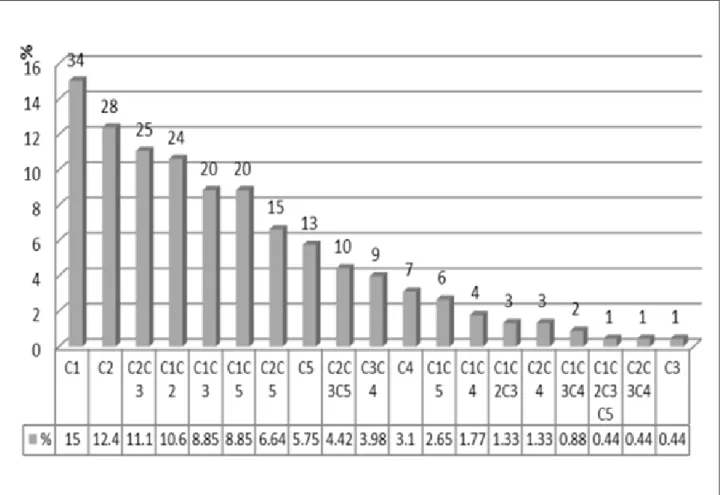
Figure 1 – Distribution of risk categories found in the 230 answers, totaling 19 possible answer combinations. Natal, RN, 2013
The 230 responses obtained in the results reflected different aspects of the photographed environments and point out that the subjects most
addressed individually by photo were: difficulties in equipment and material storage (C1) with 15%; specificities of the work in mobile emergency care (C2) with 12.4%; combinations of work specificities
in mobile emergency care and risk of infection (C2,
C3) with 11.1%; and combinations of difficulties in equipment and material storage and work specifici -ties in mobile emergency care (C1, C2) 10.6%,
(Fig-ure 1). Still in fig(Fig-ure 1, the item difficulties in drug
administration (C5) appears isolated with 5.75%, as
well as combined with five other possibilities. With
regard to the risk of trauma and falls (C4), it appears
in combination with risk of infection (C3) 3.98%, as well as alone with 3.1%, which does not mean that it is not important, as work in mobile emergency care offers a risk of falling as a result of care, especially, due to the shaking of the ambulances when moving.
Based on these categories of risks the nurses who participated in the study evidenced and the ten steps for patient safety,10 a ten-step proposal
for patient safety in mobile emergency care was elaborated, aiming to target professionals in this
specific area and the continuous improvement of
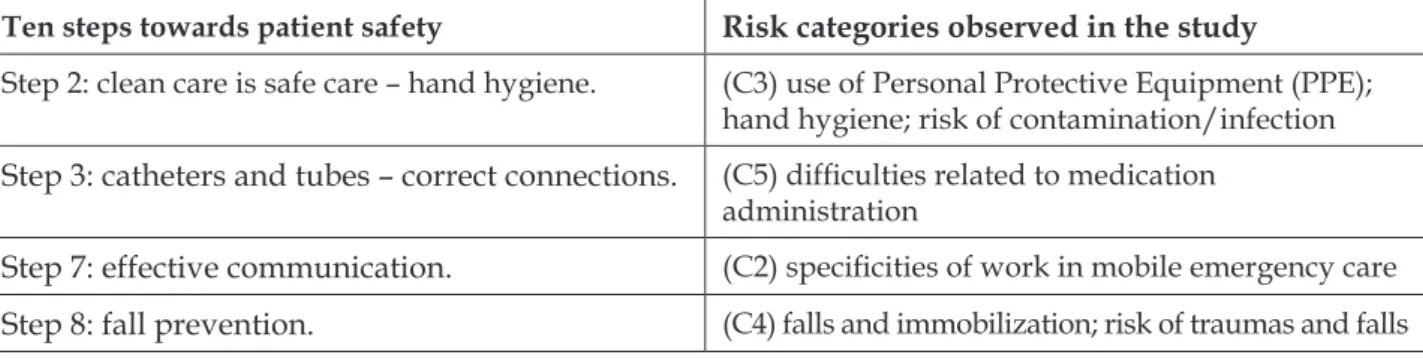
safety through knowledge and risk prevention. Table 1 presents the similarity between the ten steps towards patient safety10 and the risk categories
ob-served in the study.
Table 1 – Similarity between the ten steps towards patient safety and the risk categories observed in the study. Natal, RN, 2013
Ten steps towards patient safety Risk categories observed in the study
Step 2: clean care is safe care – hand hygiene. (C3) use of Personal Protective Equipment (PPE);
hand hygiene; risk of contamination/infection
Step 3: catheters and tubes – correct connections. (C5) difficulties related to medication administration
Step 7: effective communication. (C2) specificities of work in mobile emergency care
Step 8: fall prevention. (C4) falls and immobilization; risk of traumas and falls
It is also observed in figure 2 that there were
no risk categories directly related to some steps of COREN-SP.10 This is due to the fact that the
in-terviewees did not make direct reference to risks that correspond to one of the steps towards patient
safety. There were risks specific to mobile emer
-gency medical care though, such as difficulties in
the storage of equipment and materials (C1), as well
as other specificities of work in EMS (C2). Relating
the similarities between the steps and the risks evidenced and analyzing the steps that were not assessed but are relevant, in table 2, the proposal for steps towards safety in mobile emergency medical care is suggested.
Table 2 – Ten steps towards patient safety in mobile emergency medical care. Natal, RN, 2013
Proposal for steps towards patient safety in mobile emergency medical care
Step 1: identify the patient through a wristband, using colors to signal his/her severity, mainly in cases with multiple victims.
Step 2: safety related to hand hygiene.
Step 3: safety in medication administration.
Step 4: safety and standardization of equipment and material storage.
Step 5: attention to specificities in mobile emergency medical care.
Step 7: promote communication with the regulation center through correct radio communication or other technologies, such as telemedicine and telenursing.
Step 8: prevention of traumas and falls; proper fixation of equipment in ambulance; verification of
safety belts and stretcher locks.
Step 9: protect the skin against additional injuries due to friction and shear; remove dirty and moist clothing from the contact area with the board; avoid direct contact between the skin and the hard
board.
Step 10: understand the benefit and impact of using all equipment in the ambulance; watch over and
verify the functioning of machinery and equipment.
DISCUSSION
Based on the results, it is noted that, although two steps do not apply to mobile emergency medi-cal services (Step 4 - safe surgery and step 5 - blood and blood components - safe administration), others that would apply did not emerge. The interviewed nurses did not directly mention categories with
relevant steps, such as: patient identification (Step 1); patients engaged in their safety (Step 6); preven
-tion of pressure ulcer (Step 9); and Step 10: safety in
technology use. Nevertheless, these steps should be considered relevant in any health service and, there-fore, it is necessary to implement similar solutions that promote patient safety in mobile emergency medical care.
In line with the proposal of COREN-SP,10
categories emerged that also suggest steps towards patient safety in mobile emergency medical care: risk of infection (C3), risk of trauma and falls (C4) and risks for medication administration (C5), which refer, respectively, to clean care and safe care (Step
2); fall prevention (Step 8); catheters and tubes - cor -rect connections (Step 3).
With respect to the risk of infection (C3), of
the 19 combinations of answers in figure 1, this cat -egory emerges in nine, corresponding to 47.37% of the results. In this premise, the exposures to risks of contamination and infection, some authors mention that the surfaces carry a minimal risk of direct infec-tion transmission. They occur secondarily through the hands of health professionals and instruments or products though, which may be contaminated through contact with these surfaces and, subse-quently, contaminate patients or other surfaces.20
Referring to the risk of trauma (C4), men-tioned in isolation by 3.1% of the sample, and in combinations with other categories (31.57%), in the literature, the importance of dimensioning falls involving patients is evidenced with a view to the prevention of vulnerabilities in the care process,
which implies considering them as events that can be controlled. The attention the team pays to the correct safety techniques mitigates possible errors that could compromise the patient’s safety.21
One of the categories that emerged in the results of this research refers to the risks for medica-tion administramedica-tion. It is known that concern about the impact of medication errors in patient safety is the responsibility of nursing professionals, aiming to assure patients of care free from recklessness, malpractice or negligence. Errors related to drug administration occur in many hospitals though, and can have serious consequences for patients, institu-tions and professionals.22
We can define medication errors as “any pre -dictable incident that may cause harm to the patient or lead to inappropriate use of the medication when it is under the control of professionals. In general, these incidents are related to professional practice, procedures or systems, including errors in the prescription, communication, labeling, bottling, de-nomination, preparation, dispensing, distribution, administration, education, follow-up and use”,23 so
that emergency medical care, with its peculiarities regarding the precariousness of the places of care, the management during unexpected actions and the stress the professionals are submitted to, turns all the error characteristics described above more likely to happen.
The nurses interviewed also showed the
dif-ficulty in the storage of materials and equipment.
In this sense, it is understood that it is the nurse’s responsibility to check and replace the materials of the ambulance, as well as to make a daily checklist of equipment and materials.24 In addition, the
stan-dardization of the care kits and the medicine bag, aiming to facilitate the use of these materials at the moment of care, is another responsibility of the nurse.25 It is known that the ambulance is a restricted
space though, a fact that makes this organization
As observed in the results, the nurses cite the
category Specificities of mobile emergency medical
care (C2) as a factor predisposing to errors. These
re-sults are expected and justified because emergency
medical care is subject to environmental factors,
such as climatic changes, traffic accident risks and
the need for immediate decisions, so that the pro-fessionals needs to constantly develop in order to overcome the adversities found in your routine. In addition, the physical space and time are restricted.26
We can also point out that emergency medi-cal care professionals, due to the harsh conditions of the work environment, face situations that make them more vulnerable to occupational risks, such as:
difficult access to victims, insecurity at the scene of
the accident, development of procedures with the vehicle standing still or oving, so that these profes-sionals perform their activities in different places and, in most cases, under unfavorable lighting
conditions, rain, heat, cold, flow of vehicles, lack of
hygiene, presence of animals, aggressive persons, social upheaval, and these factors are conditions that distinguish this work from what happens inside the hospital.27
In adverse events of invasive procedures, such as in pre-hospital airway treatment, errors are common and potentially harmful. Studies and opinions highlight other risks for patient safety, such as incorrect handling of equipment, equip-ment malfunctioning, poor medical manageequip-ment and deviations from protocol. These facts often provoke stress and a feeling of exhaustion, directly
influencing the safety of care.25
Despite the fact that there were no risks related to some steps for patient safety in this study,10 it is
known that several studies now show an increas-ing interest in involvincreas-ing the patient and family in the care process, in order to improve the quality of
care, with a view to increasing their confidence in
the health system. In addition, the patient develops an active and participant role in the safety of his/ her own care process,28 an important factor for a
good prognosis.
Likewise, with regard to Step 7,10 clear and
ef-fective communication among health professionals should be understood as a determining factor, so that adverse events do not occur. Studies reveal that ineffective communication enhances these events that the nurses should respect and value the pa-tient’s beliefs and values for the sake of their safety.26
Another point that is considered important, even if it has not been mentioned as a risk in mobile emergency medical care, is the prevention of
pres-sure ulcers. In this premise, it is confirmed that some
factors inherent to the patient, such as immobiliza-tion (duraimmobiliza-tion), hygiene, exposure to environmental dirt and humidity contribute to the development of pressure ulcers.29
Thus, improvements in the quality of health care are linked to the implementation of a safety culture in health institutions and may be directly related to the reduction of adverse events and mortality.28
CONCLUSION
It is observed that the adversities of working at home, on the street, to the detriment of a theoreti-cally controlled environment like a hospital, turn the environment more risky, whether due to
environ-mental, traffic, emotional, physical or safety factors,
and therefore more prone to errors. Therefore, it is considered that, when knowing the risks, we can prevent error behaviors, a fact that generates the necessary security in extra-hospital care.
By recognizing these errors in mobile emer-gency medical care, steps for safety are suggested, based on the Brazilian steps that already exist, such as those of COREN-SP. Some of the topics in those steps did not directly apply to EMS routines though, such as safe surgery, administration of blood com-ponents and pressure ulcer prevention.
Based on the categories that most emerged in this study, we suggest the following steps for safety in EMS: 1) identify the patients by means of a bracelet, with colors that indicate their severity, especially in cases of multiple victims. 2) safety related to infection prevention. 3) safety in medica-tion administramedica-tion. 4) safety and standardizamedica-tion of equipment and material storage. 5) attention to the
specificities of mobile emergency medical care. 6)
encourage and value patient and family participa-tion in the care process. 7) promote communicaparticipa-tion with the regulation center through the best technol-ogy. 8) prevention of trauma and falls. 9) protect skin
from further injury. 10) understand the benefit and
impact of using all ambulance equipment.
In order to do so, training and continuing education that stimulate safe practices is also neces-sary, as well as technological resources that facilitate the activities, such as telenursing and telemedicine.
cat-egory and in an environment with specific contexts
and diversities. Therefore, it would be interesting, due to the dynamic and multiprofessional nature of mobile emergency medical care, that the study be developed with multiple professional categories and multicenter features, in order to establish ac-tions that meet the quality levels in patient safety for EMS as a whole. It should be kept in mind that, no matter how extensive protocols and actions are created, it is important to consider the individuali-ties and needs of each service.
REFERENCES
1. Ministério da Saúde (BR). MS e Anvisa anunciam ações para segurança do paciente.2013. Avaliable from: http:// portalsaude.saude.gov.br/portalsaude/arquivos/ pdf/2013/Abr/01/PPT_COLETIVA_SEGURANCA_ PACIENTE_FINAL.pdf. Acesso em: 21 mar. 2017. 2. Celedônio, RM; et al. Políticas de Educação Permanente
e Formação em Saúde: uma análise documental. Revista da Rede de Enfermagem do Nordeste, Fortaleza, v. 5, n. 13, p.1100-1110, jan. 2012.
3. Ciconet RM. Atuação e articulação das ações das equipes de suporte básico de um serviço de atendimento móvel de urgência com a central de regulação e as portas da urgência [Internet]. Porto Alegre (RS): Escola de Enfermagem, Universidade Federal do Rio Grande do Sul; 2009 [cited 15 Mar 2012]. Available from: http://www.lume.ufrgs. br/bitstream/handle/10183/19036/000734785. pdf?sequence=1
4. Ministério da Saúde (BR). Política Nacional de Atenção às Urgências /Ministério da Saúde. 2. ed. Brasília: Ministério da Saúde; 2004
5. Feldman LB. Como alcançar a qualidade nas instituições de saúde: critérios de avaliações, procedimentos de controle, gerenciamento de riscos hospitalares até a certificação. São Paulo: Martinari; 2004.
6. World Health Organization (WHO). World Alliance for Patient Safety. Research for patient safety: better knowledge for safer care [Internet]. Geneva (Sw); 2008. [cited 2012 Jul 06]. Available from: www.who. int/patientsafety/information_centre/documents/ ps_research_brochure_en.pdf
7. Blegen MA. Patient safety in hospital acute care units. Annu Rev Nurs Res. 2006; 24: 103-25.
8. Gomes AQF. Iniciativas Globais para Segurança do Paciente. Fundação Oswaldo Cruz: Rio de Janeiro: Proqualis; 2010.
9. Pedreira MLG, Harada MJCS, organizadores. Enfermagem dia a dia – segurança do paciente. São Caetano do Sul (SP): Yendis Editora; 2009.
10. Conselho Regional de Enfermagem do Estado de São Paulo (COREN-SP). 10 passos para a segurança
do paciente. São Paulo (SP): COREN-SP; 2010. 32 p. 11. Department of Health. About Patient Safety.
2010 [cited 2011 Jun 03]. Available from: http:// www.dh.gov.uk/en/Publichealth/Patientsafety/ Patientsafetygeneralinformation/D H_4066328 12. World Health Organization (WHO). 10 facts on
patient safety; 2002. [cited 2011 Nov 19]. Available from: http://www.who.int/features/factfiles/ patient_safety/en/index.html
13. Hagiwara et al. Scandinavian Journal of Trauma, Resuscitation and Emergency Medicine [Internet]. 2016 [cited 2017 Mar 21]; 24(14):1-7. Available from: https://www.ncbi.nlm.nih.gov/pmc/articles/ PMC4751749/
14. Bosch J, Nooji J, Visser M, Cannegieter SC, Terpstra NJ, Heringhaus C, et al. Prehospital use in emergency patients of a laryngeal mask airway by ambulance paramedics is a safe and effective alternative for endotracheal intubation. Emerg Med J 2014;31:750–53. Available from: https://www.ncbi.nlm.nih.gov/ pubmed/23771898
15. Hansen M, Meckler G, O’Brien K, Engle P, Dickinson C, Dickinson K, et al. Pediatric Airway Management and Prehospital Patient Safety: Results of a National Delphi Survey by the Children’s Safety Initiative-Emergency Medical Services for Children. Pediatr Emerg Care [Internet]. 2016 Sep;32(9):603-7. Available from: https://www.ncbi.nlm.nih.gov/pubmed/27253653 16. Conselho Federal de Enfermagem (Cofen). Resolução
COFEN nº 389 de 18 de outubro de 2011. Atualiza, no âmbito do Sistema Cofen /Conselhos Regionais de Enfermagem, os procedimentos para registro de título de pós-graduação lato e stricto sensu concedido a enfermeiros e lista as especialidades.
17. Marck P, Cassiani SHB. Teorizando sobre sistemas: uma tarefa ecológica para as pesquisas na área de segurança do paciente. Rev. Latino-Am Enfermagem [Internet]. 2005 [cited 2011 Feb 10]; 13(5):750-3. Available from: http://www.scielo.br/pdf/rlae/ v13n5/v13n5a21.pdf
18. Bardin L. Análise de conteúdo. 4ª ed. Lisboa (PT): Edições 70; 2011.
19. Brasil. Conselho Nacional de Saúde. Resolução nº. 466, de 12 de dezembro de 2012. Avaliable from: <http:// conselho.saude.gov.br/resolucoes/2012/Reso466. pdf>. Cited: 21 março 2017.
20. Reis AM, Marques TC, Opitz SP, Silva AE, Gimenes FR, Teixeira TC, et al. Errors in medicine administration – profile of medicines: knowing and preventing. Acta Paul Enferm [Internet]. 2010 [cited 2012 Jun 30]; 23 (2):181-6. Available from: http://www.scielo.br/pdf/ ape/v23n2/05.pdf
from: http://www.scielo.br/scielo.php?script=sci_ arttext&pid=S141481452014000100122&lng=en 22. Richard N. Keers, Steven D. Williams, Jonathan
Cooke, Darren M. Ashcroft causes of medication administration errors in hospitals: a systematic review of quantitative and qualitative evidence. Drug Saf [Internet]. 2013 [cited 2016 Mai 03]; 36(11):1045-67. Available from: doi:10.1007/s40264-013-0090-2 23. Santos DS, Souza OV, Nascimento ALS, Pereira JS,
Santos MJC, Alves MC, et al. Segurança do Paciente: fatores causais de eventos adversos a medicamentos pela equipe de enfermagem. Ciências Biológicas e da Saúde. 2014; 2( 2): 19-30
24. Mello JF, Barbosa SFF. Patient safety culture in intensive care: nursing contributions. Texto Contexto Enferm. [Internet]. 2013 Dec [cited 2016 May 03]; 22(4):1124-33. Available from: http://www. scielo.br/scielo.php?script=sci_arttext&pid=S0104-07072013000400031&lng=en
25. Thomaz RR, Lima FV. A atuação do enfermeiro no atendimento pré hospitalar na cidade de São Paulo. Acta Paul Enf [internet]. 2000 [cited 2012 Dec 15]; 13(3):59-65. Available from: http://www.unifesp.br/acta/sum. php?volume=13&numero=3&item=res7.htm
26. Romazini EM, Bock LF. Conceptions and feelings of nurses working in emergency medical services about their professional practice and training. Rev Latino-Am Enfermagem [Internet]. 2010 [cited 2012 Dec 15]; 18(2):105-12. Available from: http://www. scielo.br/scielo.php?script=sci_arttext&pid=S0104-11692010000200015&lng=en&nrm=iso&tlng=en 27. Leite HDCS; Carvalho MTR; Cariman SRL; Araujo
ERM; Silva NC; Carvalho AO; Risco ocupacional entre profissionais de saúde do serviço de atendimento móvel de urgência – SAMU. Enferm. Foco. 2016; 7 (3/4): 31-35.
28. Patterson PD, Huang DT, Fairbanks RJ, Simeone S, Weaver M, Wang HE. Variation in emergency medical services workplace safety culture. Prehosp Emerg Care [internet]. 2010 [cited 2012 Dec 15]; 14(4):448-60. Available from: http://www.ncbi.nlm.nih.gov/ pubmed/20809688
29. Menegon DB, Bercini RR, Santos CT, Lucena AF, Pereira AGS, Scain SF. Braden subscales analysis as indicative of risk for pressure ulcer. Texto Contexto Enferm [Internet]. 2012 [cited 2016 May 03]; 21(4):854-61. Available from: http://www. scielo.br/scielo.php?script=sci_arttext&pid=S0104-07072012000400016&lng=en
Correspondência: Francis Solange Vieira Tourinho Universidade Federal de Santa Catarina - Enfermagem CCS bloco I Sala 501
88015700 - Campus Universitário, Florianópolis, SC, Brasil E-mail: [email protected]