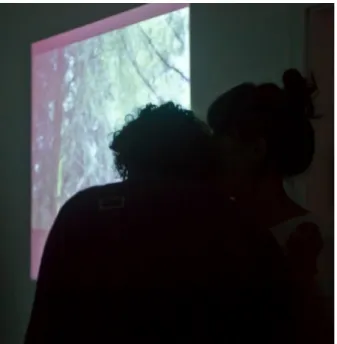
From Me To You:
Onetoone interaction based performance in
music and sonic arts
Min Kim Queen’s University Belfast, Northern Ireland [email protected] Abstract: My paper will examine the potential that is offered by adopting onetoone performance within music and sonic arts. I will discuss how this approach can contribute to broadening the spectrum of sound performances by expanding and blurring the boundaries with other forms of performing arts. In Intimate Interactions: Returning to the body in One to One performance, performance art scholar Rachel Zerihan recognises how onetoone performance format has recently gained popularity within theatre and live art (2006: 2). Likewise, an increasing number of artists within music and sonic arts can be observed creating onetoone live performance works. Their recent works offer new methods of sonic exchange and provoke different forms of human interaction as well as liberating performances from conventional venues. I will draw on recent live performance pieces including my own works that deploy this strategy. My aim is to illustrate how these works successfully managed to present a new performance experience and led the audience to discover sonic qualities that would be difficult to demonstrate in conventional performance settings. Keywords: Sonic Arts, Live Art, Onetoone Performance, Practicebased ResearchIntroduction The term onetoone performance describes performances that seek to deliver an intimate, performed interaction. In a onetoone performance, only one spectator is invited at any one time by one performer to engage in an interaction. This type of performance can take place in any setting, ranging from a premeditated isolated environment to public places out in the open. The essence is that the interaction that takes places is aimed at engaging only one spectator at a time, with the focus on creating an immersive experience. OnetoOne Interaction in Performance Art The format of onetoone performance is by now rather established in performance art. An early example includes ‘Five Days Locker Piece’ (1971) by Chris Burden (Zerihan 2009: 4). In this piece, Burden confined himself in a foot locker without food for five days and invited the audience to sit outside the locker, initially intended to be one of his performative acts to test his endurance and physical limitations. However, to Burden’s surprise, when the audience came in, they started telling Burden about their problems and life stories, likely to have been influenced by the contemplative atmosphere that had emerged from the performance (Carr 1994: 18). Burden was turned into some sort of ‘a priest in his confession box’ (Zerihan 2009: 5) and effectively an intimate relationship was established between the artist and the spectator. Another earlier work that exhibits the notion of onetoone interaction is ‘Le Baiser de l’artiste’ (1977) by ORLAN (Kartsaki & Zerihan 2012: 158).
ORLAN built a slot machine that consisted of a life size image of her torso. This sculpture, as ORLAN originally categorised it, was placed in a public place, behind which she stood in person. Viewers were invited to insert a coin in this slot machine, and in exchange they were awarded with “the kiss of the artist”. The onetoone interaction occurs twice in one performance of this piece once when one inserts the coin into the physical representation of the artist, emulating intimacy, and once again through the personal kiss of the artist. This engagement by ORLAN can be seen as a provocation in that it would trigger voyeuristic sensations in the accidental spectators outside of the onetoone interaction, by witnessing such an intimate interaction in a public sphere. The demand for onetoone performances can be observed by the recent rise of works that are featured in live and performance art festivals as well as independent commissions (Zerihan 2009: 4), which partly seems to represent the audience’s desire for individuality
and intimacy in an era of industrial massproduction in Western culture. Among many interesting projects reflecting this trend is The Performance Shop1, offering intimate performances to be ‘ordered’. This “business”, started by performance artist Lia Haraki, strikes as a performance already in itself. It attempts to reappropriate ‘performance’ that is often regarded as a unidirectional service aimed to please a mass as a mutual exchange of action between two individuals.2 Notion of OnetoOne Interaction in Sound Art Works It seems quite natural that the notion of onetoone performance has been explored by artists who are labelled as performance artists. They are often inspired by various aspects of human nature and interested in examining these through practice. I argue that the format of onetoone performance can be equally well applied and integrated in music and sonic arts performances. In fact, there are works, in which characteristics of onetoone interaction form a part of the basis on which they were founded and even rely. The environmental sound artist and soundscape composer Hildegard Westerkamp certainly has taken advantage of ‘suggested intimacy’. She has composed soundscape pieces such as ‘Kit’s Beach Soundwalk’ (1989), in which she narrates alongside the composition of field recordings to ‘guide’ the listeners to be attentive to certain sonic elements in order to enhance their aural perception. She takes advantage of the intimate nature of narrating softly as a compositional strategy, which is utilised to gently direct the listeners to pay attention to certain things that ultimately she wants to emphasise. This seemingly benign act affirms her physical and conceptual presence within the soundscape, placing her between the source and the listeners. This establishes that the sounds are not directly presented by the source but mediated through her the composer. Furthermore, her direct addressing the listeners as ‘you’ provokes an inner personal connection to occur on the part of the listeners towards Westerkamp. Admittedly, this ‘you’ might be meant as plural, which seemingly eliminates the possibility of onetoone interaction, yet the listeners are prompted to feel ‘personally spoken to’, thus creating a temporary relationship in an intimate way. Implication of onetoone interaction can be also found in the works of Janet Cardiff. She 1 http://theperformanceshop.org [accessed 31/01/2016] 2 The conception of the shop is based on the idea that any individual can gain accessibility to the world of performance which is treated here as an experience rather than a spectacle, as a pathway to selfawareness rather than entertainment, as the ultimate luxury of our time which comes down to experiencing something totally unique.
is renowned for creating audio walks such as ‘Missing Voice (Case Study B)’ (1999) that are guided by her own performed voice. Her guide consists of the actual directions as to where to go and a fictional story related to particular sites within the route of the walk. The audience is provided with headphones and a sound playing device. The pieces are made with the aim to immerse the audience in an ultimately imaginary environment that is partly real and partly fictional: an illusion created by blending the appropriate sounds. This immersion within the listener possibly occurs by listening to the disembodied voice that triggers the sensation as if she was inside one’s head. The immersion is enhanced by Cardiff’s acting skills and her almost whispering voice, often telling stories of a personal nature. It is an intimate communication, initiated by the artist, which results in further interaction from the listener’s part to trust the given directions and follow them, marking a mutually intimate relationship between the listener and the artist. Integration of OnetoOne Performance Format in Music and Sonic Arts While these predecessors in sound art have only touched on the notion of onetoone interaction, a number of artists in recent years have fully embraced this performance format and explored its potential. ‘Inside Voices’ (2015) is a ‘performance in process’ by viola da gamba player Liam Byrne, created during his artist residency at Victoria and Albert Museum, London. Members of the public were invited one by one to listen to Byrne performing on his viola da gamba inside the Victorian plaster cast of Trajan’s column. Byrne deployed the strategy of onetoone interaction in this performance in process in order to explore his interest in ‘the way in which the listener’s presence impacts musical performance’ and ‘giving people the opportunity to experience the vibrancy, intimacy and expressivity of Baroque music’ (Carderera 2015). His integration of onetoone performance format has successfully contributed to creating a performance environment that was meant to be the opposite of the contemporaneous conventional musical performances.
Figure I. source: http://www.angelosolari.com/#!takeaseat/c2464 Similar to Byrne’s instance, Angelo Solari employed the format of onetoone performance in his piece ‘Audition’ (2014), in order to experiment with social, human interactive aspects. Solari is a poet, composer and performer who creates works that often question and challenge the conventional audienceperformer expectation and subsequently established relationship. ‘Audition’ is to be performed by the composer himself and one audience member at a time according to Solari’s original score of “music theatre for composer and audience”. He dressed a minimalist set for this performance, in which the composer and the audience member were to sit across a table from each other that was placed in between two partition walls. This set created the appropriate atmosphere to enhance the intensity of the intimate interaction that was prescribed in the piece. His original score is written with the traditional musical notation, which resulted in a meticulous manipulation of spoken words, enforcing the dramaturgy of the piece.
Figure II. © Angelo Solari His programme note reads, “This piece lasting for about 7 minutes is to be performed privately and individually: the composer and a voluntary member of the audience perform the text score. At first the composer guides the spectator. Ultimately, they both end up being interpreters of a musicaldramatic situation. It invites the spectator to “live” a music theatrical experience” (Solari 2014). It suggests that Solari intended to emphasise on the experiential quality that is embedded in a onetoone performance. He explored the extent to which this particular form of interaction possibly triggers a transformation within the attitude of the audience member effected by the given immersion over time. He sought to provoke a particular type of human interaction that can be passively manipulative and to experiment with the amount of control that the initiator the composer can sustain in such a situation. In contrast with Solari and Byrne, Hülcker acquired the format of onetoone performance in order to convey quiet sounds. Composer and sound artist Neele Hülcker has been engaging, among other subjects, with the practice of ASMR. This neologism refers to a perceptual phenomenon, which is a distinct, pleasurable tingling sensation typically appearing on the scalp and down the spine in response to specific sounds such as
whispering and tapping, among many others. Enthusiasts avidly experiment with this newly acknowledged sensation, which includes making and/or watching videos with binaural sound recording that are produced with the sole intention to trigger ASMR in the viewers.3 Figure III. http://www.neelehuelcker.de/installation Hülcker’s piece ‘ASMR**soft spoken**tapping’ (2014) is based on the method of ASMR trigger as demonstrated in one of these particular videos. In an open space of a gallery, Hülcker positioned herself on an elevated part of the floor and performed an emulation of ASMR video on the microphone. The sounds that would be barely audible to naked ears in such an exposed setting were transmitted clearly through the headphones that the spectators were invited to put on. The intimacy and connection between the performer and spectator as conveyed in the original video were translated into a live performance. Furthermore, she reenacted not only the actions that made the particular sounds but also the overall look of the ASMR artist, which resulted in creating an illusion of the content of the video being brought out of the virtual realm and revived in reality. She posed herself like a moving sculpture to be viewed, even exposed to those who were not experiencing the performance within the onetoone interaction. This is somewhat reminiscent of ‘Le Baiser de L’artiste’ (ORLAN 1977) in that the piece offers different experiences depending on the situation of the spectator, whether she is inside or outside of the interaction. 3 https://www.youtube.com/watch?v=hxsA_yRo7c [accessed 31/01/2016]
Figure IV. Una Lee © Jordan Hutchings My piece ‘It winded the humming of sea’ (2015), published under my persona Una Lee, was conceived as a onetoone performance in order to facilitate the effective delivery of whispering sound. Whispering is an intimate act that involves only two people, one sender and one recipient at a time. It is seen in a particular context in our society by its inherent implications of a ‘secret’, on account of which it usually takes place in less intimate situations. However, the visible motion and body position of the involved are rather distinctive thus making it impossible to maintain the nature of interaction of a secret. On the contrary, it would raise attention in those who are not involved but might be observing. I attempted to emphasise on this dualistic nature of whispering with my piece – of being ‘secretive’ but ‘exposed’ at the same time. The performance took place at an exhibition opening with an already provided pool of spectators that I could approach and whisper to. I was holding a wireless bluetooth earbud in my mouth that would serve as speaker for my sound piece, receiving signal from a bluetooth mp3 player hidden underneath my dress. I drew close to one person at a time and ask ‘can I tell you something?’ in written words on my palm. If the person gives consent, I would lean over to the person’s ear to play the prepared sound piece, in place of my livespeaking voice.4 In doing so, on the inside of the onetoone interaction, the audience of one would be imposed on with the experience of being whispered by a stranger. This exposed exchange of an intimate interaction would subsequently awaken voyeuristic desire in the rest of the spectators on the outside of the 4 https://soundcloud.com/unalee/itwindedthehummingofsea/sMd2ZO [accessed 31/01/2016]
interaction. As opposed to ‘It winded the humming of sea’, in which the audience was rather ambushed with my interventional interaction, the visitors in ‘Show me your palms (and I’ll give you stones)’ (2015) were welcomed in a fully isolated, relaxing, calm but staged environment. This piece was a reimagination and reappropriation of an original composition for two performers ‘score for sucking stones’ by writer and sound artist lo wie. In the original piece, two performers are to exchange a number of stones on to each other’s hands sitting on a table across from each other according to the visual score. Figure V. © lo wie This score was based on a section in ‘Molloy’ by Samuel Beckett, in which the main protagonist Molloy tries to establish a system to suck his sixteen stones one by one and distribute them equally throughout his four pockets. Having learned of this piece at first, it struck me as an ideal context that I could translate in a onetoone performance, which I subsequently executed I would perform the score with one audience member at a time. The sounds made in this piece are quiet, such as pebbles being rubbed against each other and gently laid on to a wooden table.5 In order to enhance the perception of these quiet sounds, I built a tent out of bed sheets with a dim lamp in it, in which the performance would take place. The room, inside which the tent was placed, was completely dark. This ‘set’ contributed to adding physical intimacy between myself and the 5 https://soundcloud.com/unalee/showmeyourpalmsandillgiveyoustones/sJtYQW [accessed 31/01/2016]
other by being confined in a very small space, almost touching each other’s knees. The integration of the tent and surrounding has inspired me to employ a persona as a fortune teller, which was then implicated in the overall performance. The programme note sounded more like an invitation, extending the onetoone interaction: “I’d like you to play with me; to play a little piece for stones and hands, our hands. So, take a seat, show me your palms, and I’ll give you stones. And then we begin.” Conclusion These emerging artists whose works were examined within the onetoone performance context have not only experimented with the format itself but incorporated elements that would allow them to investigate other aspects of ‘performance’. Their works emphasise the selfexperiential quality of musical and/or theatrical performance, which is intensified by immersive environment set up by the composers/performers. By doing so, they encourage the spectators, as consumers of performances, to view the concept of performance in a different way. It is notable that these pieces border on performance art, in that the composers and makers of the performance themselves act also as performing bodies and furthermore as medium. They also serve as remarkable examples for carrying out practice as research, using the format of onetoone performance to make enquires about the interests of the practitioners themselves such as human interaction, the role of a performer and performance, spectatorship and performeraudience relationship. References Carr, C. (1994) On Edge: Performance at the End of the Twentieth Century. London & New York: Routledge Carderera, Laura (2015) “Inside Voices, a performance in process by music resident Liam Byrne”. http://www.vam.ac.uk/blog/artistsresidenceva/insidevoicesaperformancein processbymusicresidentliambyrne [accessed 31/1/2016] Haraki, Lia (2014) “About”. http://theperformanceshop.org [accessed 31/1/2016] Kartsaki, Eirini and Zerihan, Rachel (2012) “Slots, Slaps, Sluts and Other Cheap Thrills: Promiscuity, Desire and Labour in Onetoone Performance” in Performing Ethos, 3(2): 15517 Solari, Angelo (2014) “Audition”. http://www.angelosolari.com/#!takeaseat/c2464 [accessed 31/01/2016]
Zerihan, Rachel (2006) “Intimate Interactions: Returning to the Body in One to One Per formance” in Body, Space & Technology Journal, 6(1) http://people.brunel.ac.uk/bst/vol0601 [accessed 31/01/2016] Zerihan, Rachel (2009) “ONE TO ONE PERFORMANCE” in Live Art Development Agency Study Room Guide. http://www.thisisliveart.co.uk/resources/catalogue/rachel zerihansstudyroomguide [accessed 31/01/2016]