D
ABSTRACT
Recovery of silver residues from dental amalgam
Heloísa Aparecida Barbosa da Silva PEREIRA1, Flávia Godoy IANO2, Thelma Lopes da SILVA3,
Rodrigo Cardoso de OLIVEIRA4, Manoel Lima de MENEZES5, Marília Afonso Rabelo BUZALAF6
1- Graduate student, Department of Biological Sciences, Bauru School Of Dentistry, University of São Paulo, Bauru, SP, Brazil. 2- Pharm, Department of Biological Sciences, Bauru School of Dentistry, University of São Paulo, Bauru, SP, Brazil.
3- BSc, MSc, Department of Biological Sciences, Bauru School of Dentistry, University of São Paulo, Bauru, SP, Brazil.
4- DDS, MSc, PhD, Associate Professor, Department of Biological Sciences, Bauru School of Dentistry, University of São Paulo, Bauru, SP, Brazil. 5- Chem, MSc, PhD, Associate Professor, Department of Chemistry, School of Sciences, State University of São Paulo, Bauru, SP, Brazil. 6- DDS, MSc, PhD, Full Professor, Department of Biological Sciences, Bauru School of Dentistry, University of São Paulo, Bauru, SP, Brazil.
Corresponding address: Marília Afonso Rabelo Buzalaf - Faculdade de Odontologia de Bauru - USP - Departamento de Ciências Biológicas - Al. Octávio Pinheiro Brisolla, 9-75 Bauru-SP, 17012-901 Brasil - Phone: + 55 14 32358246 - Fax + 55 14 32271486 - e-mail: [email protected]
Received: August 26, 2009 - Modification: July 21, 2009 - Accepted: November 11, 2009
ental amalgam residues are probably the most important chemical residues generated from clinical dental practice because of the presence of heavy metals among its constituents, mainly mercury and silver. Objective: The purpose of this study was to develop an alternative method for the recovery of silver residues from dental amalgam. Material and Methods: The residue generated after vacuum distillation of dental amalgam for the separation of mercury was initially diluted with 32.5% HNO3, followed by precipitation with 20% NaCl. Sequentially, under constant heating and agitation with NaOH and sucrose, the sample was reduced to metallic silver. However, the processing time was too long, which turned this procedure not viable. In another sequence of experiments, the dilution was accomplished with concentrated HNO3 at 90ºC, followed by precipitation with 20% NaCl. After washing, the pellet was diluted with concentrated NH4OH, water and more NaCl in order to facilitate the reaction with the reducer. Results: Ascorbic acid was efficiently used as reducer, allowing a fast reduction, thus making the procedure viable. Conclusions: The proposed methodology is of easy application and does not require sophisticated equipment or expensive reagents.
Ke y w or ds: Dental amalgam. Silver. Solid wastes. Environment.
I N TROD UCTI ON
The unbridled development of the population and industry has led to an increase in the generation of residues2. The natural environment is not able to support the increasing exposure to chemical products caused by this development6. The acknowledgement that human intervention has been contributing to the deterioration of the natural environment has led several countries to search for alternatives for its restructuring7.
Regarding the residues generated in dental practice, the most concerning ones are those deriving from dental amalgam8,9,14,16 because this metal alloy has, among its constituents, mercury,
silver, tin and copper1,12. The use of amalgam separators has been recommended to physically remove dental amalgam from waste water in dental clinics thus reducing the mercury emissions9,18.
cosmetic disorder3. In addition, silver is commonly used in the industry and its recovery could allow some financial return3,8.
Despite some studies have described processes to recover mercury from dental amalgam10,13, only one study focused on the recovery of silver using sucrose as a reducing agent11. In the present study, the purpose was to develop an alternative method for the recovery of silver residues from dental amalgam.
M ATERI AL AN D M ETH OD S
Dental amalgam residues were received from the dental clinics of Bauru Dental School and Hospital for Rehabilitation of Craniofacial Anomalies (HRAC), University of São Paulo, Bauru, SP, Brazil. The amalgam was initially processed by vacuum distillation for mercury removal10,13, generating an amount of 5,516.93 g.
Pr oce ss of silve r r e cove r y u sin g su cr ose a s a r e du cin g a ge n t
This process was adapted from the methodology proposed by Lee and Fung11 (1980). The amount of samples (residues of dental amalgam after recovering mercury) used ranged
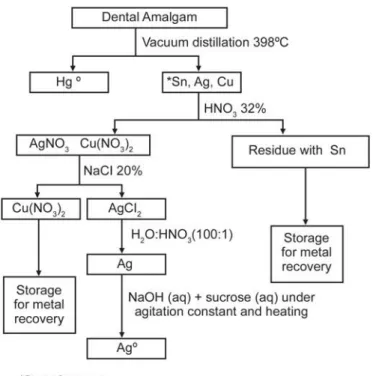
between 25 and 150 g. For residue dilution, 32.5% nitric acid was used for the formation of AgNO3 (aq) (Table 1). The solution containing AgNO3 was collected in another vial, where 20% NaCl was added to promote the precipitation of silver as AgCl2 (solid). This pellet was washed with nitric acid and deionized water (1:100 v/v) until the supernatant became colorless. In sequence, a solution of sucrose (concentrations ranging between 2.5 and 20%) and NaOH (concentrations ranging between 10 and 40%) was added to the pellet (Table 1) and, under agitation and heating, the AgCl2 was reduced to Ag0 (Figure 1).
Pr oce ss of silv e r r e cov e r y u sin g a scor bic a cid a s a r e du cin g a ge n t
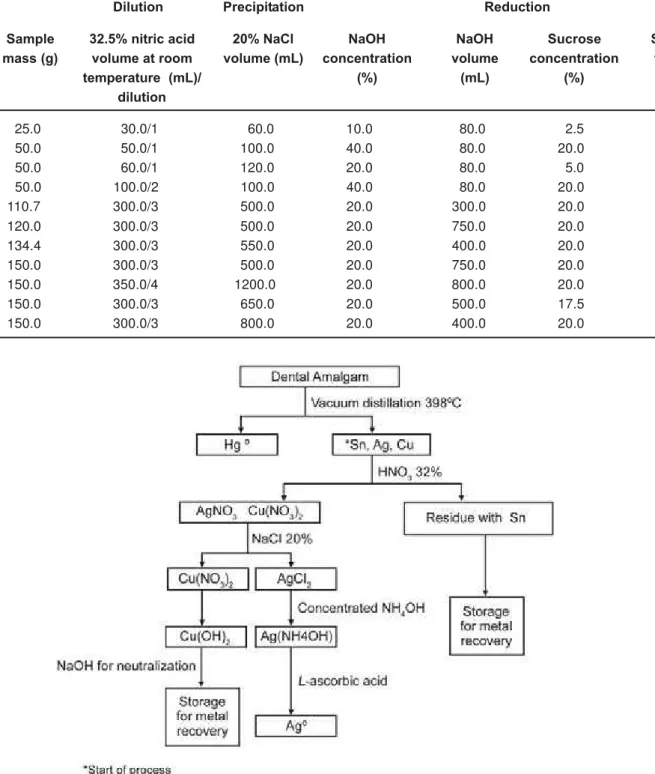
The amount of samples used ranged between 150 and 200 g. The tests were done in duplicates, as displayed in Table 2. For dilution, concentrated nitric acid at 90°C was used. The silver nitrate formed was collected in another vial. The precipitation with 20% NaCl was then accomplished as described above. After washing with nitric acid and deionized water (1:100 v/v), NH3*H2O, water and additional 20% NaCl were added, in order to solubilize the pellet, thus making easier the reaction with ascorbic acid.
Ascorbic acid (75-100 g, according to the amount of sample) was then added under agitation and silver was immediately reduced to Ag0 (Figure 2).
An a lysis of r e cove r y e fficie n cy
In order to assess the efficiency of recovery, Volhard method was used19. Initially, the
recovered sample was weighed (±0.01 mg) and then diluted in concentrated nitric acid at 90°C. The resulting solution was titrated with potassium thiocyanate, in the presence of Fe2+, that was added as a saturated solution of ammonium ferrous sulfate in 20% nitric acid. In contact with thiocyanate, silver precipitates as AgSCN, which has a very low solubility. A slight excess of
Dilution Precipitation Reduction
Sample mass (g)
32.5% nitric acid volume at room temperature (mL)/
dilution
20% NaCl volume (mL)
NaOH concentration
(%)
NaOH volume
(mL)
Sucrose concentration
(%)
Sucrose volume
(mL)
25.0 30.0/1 60.0 10.0 80.0 2.5 400.0
50.0 50.0/1 100.0 40.0 80.0 20.0 400.0
50.0 60.0/1 120.0 20.0 80.0 5.0 400.0
50.0 100.0/2 100.0 40.0 80.0 20.0 400.0
110.7 300.0/3 500.0 20.0 300.0 20.0 700.0
120.0 300.0/3 500.0 20.0 750.0 20.0 1600.0
134.4 300.0/3 550.0 20.0 400.0 20.0 440.0
150.0 300.0/3 500.0 20.0 750.0 20.0 2400.0
150.0 350.0/4 1200.0 20.0 800.0 20.0 1600.0
150.0 300.0/3 650.0 20.0 500.0 17.5 1100.0
150.0 300.0/3 800.0 20.0 400.0 20.0 2100.0
Table 1- Procedure of silver recovery from dental amalgam residues using sucrose as reducing agent
thiocyanate is identified by the formation of a soluble ferric complex [FeSCN]2+, which is intensively stained in red. The titration error in the Volhard method is small as the indicator is extremely sensitive to the thiocyanate ions. The reaction occurs as described below:
1- AgNO3(aq) + KSCN–(aq) AgSCN(s)
KNO3(aq)
2- Fe3+(aq) + SCN–(aq) [FeSCN]2+(aq) (dark red ferric complex)
Dilution Precipitation Solubilization Reduction
Sample mass (g)
Concentrated nitric acid volume
at 90°C (mL)/ dilution
20% NaCl volume (mL)
Concentrated NH4OH volume
(mL)
Deionized water volume
(mL)
Amount of ascorbic
acid (g)
A1150.0 150.0/1 300.0 500.0 1000.0 - 75.0
A2 150.0 150.0/1 300.0 500.0 1000.0 - 75.0
B1 150.0 500.0/5 750.0 200.0 2000.0 1000.0 75.0
B2 150.0 500.0/5 750.0 200.0 2000.0 1000.0 75.0
C1 200.0 400.0/3 1200.0 300.0 2000.0 1000.0 100.0
C2 200.0 400.0/3 1200.0 300.0 2000.0 1000.0 100.0
D1200.0 500.0/5 1200.0 300.0 2000.0 1000.0 100.0
D2200.0 500.0/5 1200.0 300.0 2000.0 1000.0 100.0
E1 200.0 400.0/3 1400.0 300.0 2000.0 1500.0 100.0
E2 200.0 400.0/3 1400.0 300.0 2000.0 1500.0 100.0
F1 200.0 500.0/5 1400.0 300.0 2000.0 1500.0 100.0
F2200.0 500.0/5 1400.0 300.0 2000.0 1500.0 100.0
20% NaCl volume (mL) Table 2- Procedure of silver recovery from dental amalgam residues using ascorbic acid as reducing agent
25.0 303 3.9 99.9 24.4
50.0 430 15.5 49.3 48.4
50.0 360 9.2 94.2 28.8
50.0 373 23.0 87.1 71.9
110.7 390 41.5 52.6 58.6
120.0 330 61.1 44.1 79.6
134.4 455 54.0 19.6 62.8
150.0 600 59.1 84.1 61.6
150.0 440 64.5 86.0 67.2
150.0 365 62.1 52.9 64.7
150.0 565 87.9 37.0 91.6
Sample mass (g)
Total time (min)
Amount of Ag0
produced (g)
% recoverya
(32.5% of amalgam) Purity (%)
Table 3- Silver recovery from dental amalgam residues using sucrose as reducing agent
aBased on the American Dental Association (ADA)1, which considers that the percentage of silver in dental amalgam is
32.5%.
RESULTS
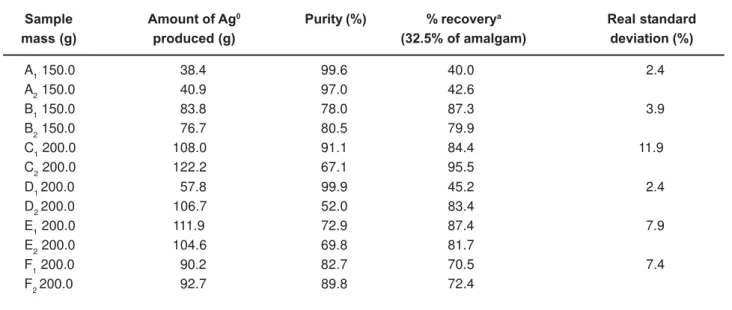
in Table 4. In this case, the reduction occurred immediately, differently from what was seen when the sucrose was used. In addition, the recovery in this case was higher (40% to 95.5%) when compared to the use of sucrose as reducing agent.
D I SCUSSI ON
This is the first study that used ascorbic acid as a reducing agent for recovering silver from dental amalgam. In this study, two methods were tested to recover the silver that is left after the mercury is removed from dental amalgam: one using sucrose as a reducing agent, and the one using ascorbic acid as a reducing agent. The only study in the literature that attempted to recover silver from dental amalgam residues used sucrose as a reducing agent11. However, when sucrose was tested as a reducing agent in the present study, the total time required in the reduction process was too long (ranging between 303 and 600 min, depending on the conditions used). Due to this long processing time, a different reducing agent was used in attempt to speed the processing time. The selected reducing agent was ascorbic acid, since it has been reported as a strong reducing agent for metals17. In this case, the reduction occurred immediately, differently
from what was seen when the sucrose was used. In addition, the recovery was slightly higher when compared to the use of sucrose as reducing agent.
It must be highlighted that some modifications done in the processing technique when the ascorbic acid was used instead of sucrose may have facilitated the reduction process, such as the use of concentrated nitric acid at 90°C, which allowed a faster and more efficient dilution. In the case of sucrose, dilution was performed by the use of 32.5% nitric acid at room temperature. Also the use of NaOH in the case of sucrose leads to the formation of a complex of AgO2, which has a very low solubility20. Thus, it was necessary to heat this mixture in order to solubilize it, thus demanding a long time for completion of the reducing process (Table 3). In the case of ascorbic acid, NH4OH was used instead of NaOH. Thus, a soluble complex is formed and there is more Ag+ available to be reduced20.
It should also be noted that the procedure of silver recovery using ascorbic acid does not require too much practice, specific knowledge or sophisticated equipments. Thus, its use seems to be viable, due to the high market value of the recovered silver. In addition, the reagents used are not expensive, since for every 150 g of
A1 150.0 38.4 99.6 40.0 2.4
A2 150.0 40.9 97.0 42.6
B1 150.0 83.8 78.0 87.3 3.9
B2 150.0 76.7 80.5 79.9
C1 200.0 108.0 91.1 84.4 11.9
C2 200.0 122.2 67.1 95.5
D1200.0 57.8 99.9 45.2 2.4
D2200.0 106.7 52.0 83.4
E1 200.0 111.9 72.9 87.4 7.9
E2 200.0 104.6 69.8 81.7
F1 200.0 90.2 82.7 70.5 7.4
F2200.0 92.7 89.8 72.4
Sample mass (g)
Real standard deviation (%) Amount of Ag0
produced (g)
% recoverya
(32.5% of amalgam) Purity (%)
aBased on the American Dental Association (ADA)1, which considers that the percentage of silver in dental amalgam is
32.5%.
treated silver residues, the cost is approximately around US$ 12.00. The amount of recovered silver is around 65 g, and the cost to buy 1 g of Ag (99% purity) is as high as US$ 2.40. Thus, the recovery of silver using the proposed technique with reduction by ascorbic acid, in addition to reducing the environmental impact caused by the discharge of this metal into the ecosystem, can also provide additional resources to the laboratory that can be used in other investigations.
CON CLUSI ON S
The developed methodology was shown to be viable, since it does not require sophisticated equipments or specialized personnel, and is a cost-effective alternative.
ACKN OW LED GEM EN TS
The authors thank FAPESP (#2006/03164-0) for the concession of a scholarship to the first author and ODONTOPREV (Dental Services) for the financial support to this study.
REFEREN CES
1- American Dental Association. Council on dental materials and devices. American Dental Association. Specification no. 1 for alloy for dental amalgam. In: Guide to dental materials. 2nd ed. Chicago:
ADA; 1964. p. 85.
2- Boyd AS, Seger D, Vannucci S, Langley M, Abraham JL, King LE Jr. Mercury exposure and cutaneous disease. J Am Acad Dermatol. 2000;43(1 Pt 1):81-90.
3- Ckelman MJE; Graedel TE. Silver emissions and their environmental impacts: a multilevel assessment. Environ Sci Technol. 2007;41(17):6283-9.
4- Drake PL, Hazelwood KJ. Exposure-related health effects of silver and silver compounds: a review. Ann Occup Hyg. 2005;49(7):575-85.
5- Edlich RF, Greene JA, Cochran AA, Kelley AR, Gubler KD, Olson BM, et al. Need for informed consent for dentists who use mercury amalgam restorative material as well as technical considerations in removal of dental amalgam restorations. J Environ Pathol Toxicol Oncol. 2007;26(4):305-22.
6- Gorsuch JW, Klaine SJ. Toxicity and fate of silver in the environment. Environ Toxicol Chem. 1998;17(4):537-8. 7- Harjula H. Hazardous waste: recognition of the problem and response. Ann N Y Acad Sci . 2006;1076:462-77.
8- Hiltz M. The environmental impact of dentistry. J Can Dent Assoc. 2007;73(1):59-62.
9- Hylander LD, Lindvall A, Uhrberg R, Gahnberg L, Lindh U. Mercury recovery in sit u of four different dental amalgam separators. Sci Total Environ. 2006;366(1):320-36.
10- Iano FG, Sobrinho OS, Silva TL, Pereira MA, Figueiredo PJM, Alberguini PJMF, et al. Optimizing the procedure for mercury recovery from dental amalgam. Braz Oral Res. 2008;22(2):119-24.
11- Lee CW, Fung KW. Recovery of silver and mercury from dental amalgam waste. R esource Recovery and Conservation. 1981;5:363-71.
12- Cenci MS, Pereira-Cenci T, Donassollo TA, Sommer L, Strapasson A, Demarco FF. Influence of thermal stress on marginal integrity of restorative materials. J Appl Oral Sci. 2008;16(2):106-10.
13- Pécora JD, Silva RS, Souza RA, Guimarães LFL, Shuhama T. Recycling of dental amalgam residues for the recovery of mercury and silver. Rev Fola/Oral. 1998;4(14):234-7.
14- Pichay TJ. Dental amalgam: regulating its use and disposal. CDA Journal. 2004;32(7):580-2.
15- Purcell TW, Peters JJ. Sources of silver in the environment.
Environ Toxicol Chem. 1998;17(4):539-46.
16- Richards D. Amalgam, risk, benefits and the precautionary principle. Evid Based Dent. 2008;9(1):2.
17- Roig MG, Rivera ZS, Kennedy JF. L-ascorbic acid: an overview. Int J Food Sci Nutr. 1993;44:59-72.
18- Stone ME, Cohen ME, Berry DL, Ragain JC Jr. Design and evaluation of a filter-based chairside amalgam separation system. Sci Total Environ. 2008;396(1):28-33.
19- Triebold HO. Quantitative analysis. Read books: New York; 2007. p. 9-11.
20- Vogel AL. Vogel’s qualitative inorganic analysis. 7th ed. London:
Longmans; 1996.