A Gendered Tone: Representations of Sexuality
and Power in Cuban Batá Performance
Vicky Jassey
Cardiff University, Wales
Abstract: Fundamento or Añá are the three hour-glass consecrated batá drums central to the worship of the orichas (deities) in Cuban Santería and belong to initiated heterosexual men. Taboos prevent women and homosexual males from coming into close proximity with these sacred objects. Thirty years ago however, Cuban men began teaching women to play non-consecrated batá called aberikulá. Three decades later there are now six all-female batá groups and a growing contingent of female batá players in Cuba. Furthermore, in Santiago in 2015, women started playing fundamento batá in a historical break from tradition. There has been extensive research focusing on men’s sacred batá performance and its associated religious and cultural practices but in-depth studies which focus on gender and the growing number of female batá players have been few. Addressing gender asymmetry, this article examines representations of power and sexuality in male/female, sacred/secular batá performance.
Although I had been performing in ritual and secular batá performances1 for twelve years
in the UK, there had only ever been two tambores (religious musical ceremonies) using fundamento2. However, by the time I returned from my Cuban field trip where I had been
researching gender and batá in October 2015, a second set3 of consecrated batá had
arrived in my home city of London in June 2015. Previously there had been on average one tambor a year on aberikulá. Crispin Robinson, the owner of this second set of fundamento has already delivered six tambors in the first nine months of the drums’ arrival. His social spheres, religious commitment and musical knowledge have revived a sense of purpose, authenticity and cohesion among the religious and musical community. With the arrival of these sacred instruments however, come their gender prohibitions, meaning female batá players like myself are no longer able to play alongside men in ritual settings. I had experienced many tambores in Europe and Cuba and thought I fully
understood the gender prohibition4. I now realise the taboo existed as an orientalist (Said
1977) conception in my head. It has taken seeing the gender divides and hierarchies imported and transposed onto my local musical community, and finding myself an ‘outsider’ where I had previously been an ‘insider’ for the ‘taboo concept’ to become tangible and real. Needless to say, as a female batá player and feminist I am implicated in my research. My deep interest in the sacro-socio-political power of the batá drums and the profound music they inspire goes over and above academic interest alone. This research draws on eight months of auto-ethnographic, practice-based research in Cuba (2014-2015) and twelve years of secular and ritual batá performance. By relating two
ethnographic vignettes this article explores constructs of gender, power and sexuality. In addition, I demonstrate how batá performance in the sacred/secular domain inverts gender binaries of female = private/domestic, male = public/culture (Koskoff 2014: 23). Further, I query whether women’s secular batá performance is a counterpoint to male hegemony in the sacred tradition.
Male-Sacred-Private
In a tradition passed from generation to generation the heterosexual male brotherhood, omo Añá, are entrusted with fundamento, their vast musical corpus and secrets of their making and maintenance. Whilst not all drum owners are drummers or know the secrets of making fundamento, those that can perform both roles wield greater power in the
1 Batá drumming is almost always accompanied by singing, clapping, dancing, spirit possession and ritual
tropes. I use the term ‘batá performance’ to encapsulate the entire musical event.
2 The first tambor in the U.K took place on 9th February 2009. The second was in 2011. Both used the
fundamento belonging to a Cuban drummer and Ifá priest Javier Campos who lives in Paris.
3 The first set of fundamento to live in the U.K arrived on 4th February 2014 and belongs to Jorge Armando de
Armas Sarria “Gerardo”. To my knowledge this set has not yet been played in a tambor.
community with better access to income from ritual performance, the hiring out of the drums, making and selling new sets of batá and teaching foreigners to play. Gender prohibitions form one part of a series of taboos integral to these sacred drums. Drum owners and other initiated drummers guard the “sacred space and ritual secrets with ferocity” (Villepastour 2015: 160) from contamination by the ‘unclean’: women,
homosexuals and men who have had sex with a woman within 24 hours before a tambor. Fundamento are ‘born’ following a weeklong ritual where the deity Añá is brought to life and placed inside the drum vessels. On the final day there is a public ‘transmission’ ceremony where an older set of fundamento are played in order to transmit spiritual energy to the new set. One by one the older drums, whilst being played, are replaced with the new drums.
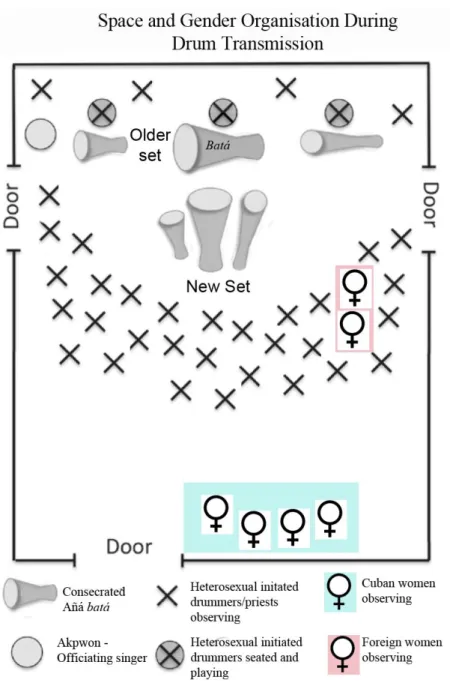
Drum Transmission at La Corea, La Habana
The three drummers sat playing the older set of fundamento while the new set, with shining wood and clean looking skins, lay on a mat at the drummers’ feet. Forming a tight semi-circle, Cuban and foreign initiated drummers and babalawos (divining priests) and two women, a French woman and myself, packed into the small front room. Facing the drummers everybody joined in singing and clapping with all our focus directed towards the drummers and of course the new drums soon to be played. The excitement was palpable. Part of the way through, four women from the house who had earlier been preparing food came in and stood at the back of the room. Smiling, laughing and dancing they stayed only for a short while and then left, leaving once again the French woman and myself as the only two women in the room full of male priests, drummers and drum owners. (Field notes 23/06/2016)
This ethnographic vignette provides an example of how the space surrounding the Añá drums can be gendered and delimited
Figure I. Diagram adapted from Kenneth Schweitzer (2015: 185).
Gender stratifications can be seen on a continuum and are relational to Añá who resides at the nexus of power. To clarify this gradation I have adapted a diagram first produced by Katherine Hagedor (2015: 185). This diagram provides an overview5 of how access
(musical knowledge, experience, secrets) and power (status, access to income) in the Añá fraternity is delimited by gender and sexuality.
5 There are fluctuations and deviations to this model especially with regards to negotiations of power between
Figure II. Sacred Batá Performance: Access to Knowledge & Power
Moshe Morad explains that sexual identity in Cuba is based on conceptions related to behaviour and sexual roles and identifies two ‘social-sex’ categories: Feminine = EPH (effeminate penetrated homosexuals) and women; Masculine = Men, masculine lesbians, and insertive partners in male-to-male sex (Dianteill 2000 cited in Morad 2015: 160). It is these fluid conceptions, associated with male-to-male sex, that cause pronounced anxiety around sexual identity in Cuban society generally (Allen 2011: 126; Morad 2015: 160) and the Santería community specifically. Women and homosexuals become ‘outsiders’ as tension between female sexuality and Añá provides conceptualized male and female zones in the physical space. These zones are policed by the brotherhood (Schweitzer 2015: 184) and expand and contract depending on many variables: type of tambor, attitudes of the drummers and female/homosexual devotees, size of ritual space, etc. Women who live with or are around Añá frequently, like the women in this vignette, grow up being told to move away from the sacred drums. They learn to ‘know their place’ and maintain the ‘female zone’ through repeated embodied practice (Farnell 1999) of keeping their distance. This in part can explain why the Cuban women of the house may have stood at the back of the room. Foreign women become re-gendered (Block 2008)
meaning they have marginally more access to the ‘male zone’ as demonstrated in fig.1, partly because they are transient visitors and are not seen as a threat to the status quo. The men in the room during this drum transmission were all initiated drummers, drum owners and/or Ifá priests and therefore identify as heterosexual. "Hombría (manhood) is among the most prized values in [Cuban] society because it is always already constitutive of honor, dignity, strength, and bravery, the ‘opposite’ of homosexuality” (Allen 2011: 126). Access to religious power is dependent on hombria, the performing of a ‘heterosexual masculine script’6. Patriarchal religious, hetero-normative ideologies form part of a
broader gamut of sacro-socio-political processes where heteronationalism becomes a foundational requirement of anti-colonial nation building (Lazarus 2011: 82, Beliso-De Jesús 2015). An opinion highlighted by Angel Pedro Bolaños Corrales, a renowned elder of the Añá fraternity who explained:
“If an effeminate person comes here with 20,000 CUC [Cuban currency] wanting a drum, he’d be off back down the stairs not on his feet but on his hands […] Money has corrupted the men here. They sell themselves. That's like being a traitor to your country.” (Pers. comm. 04/08/2015)
Although research has been limited within the Cuban gay Santería community, Morad explains, EPHs do not appear to contest their subordinate position in relation to the Añá drumming fraternity (2015: 167), unlike the growing number of female batá players in Cuba.
Female-Secular-Private
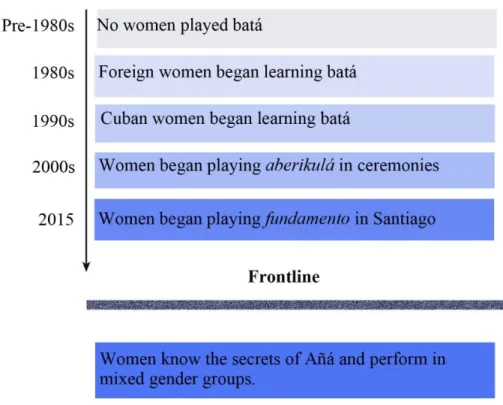
Women were prohibited from learning and playing any batá drums until the early 1980s, after which some ritual drummers agreed to teach foreign women and some years later Cuban women on aberikulá. Since this time there has been a steady progression towards what I call the ‘batalera frontline’, a conceptual continuum where women are progressively moving nearer to greater equality in batá performance.
6 One drummer explained how on the day he was ‘sworn’ (initiated) to Añá he was issued with a list of names
considered to be Cuban homosexual drum owners. He was told that he must not play with anyone on the list. If he did he would be blacklisted and denied access to playing with the reputable Añá houses. (pers. comm., Antoine Miniconi 04/02/2016)
Figure III. The Batalera Frontline
Although Cuban women remain prohibited from playing Añá drums it appears more are learning to play and many now speak openly of their desire to play consecrated drums in ritual settings7. The following vignette offers a snapshot from an internationally acclaimed
all-female, secular performance group, Obini Batá (see Rodriguez 2014; Hagedorn 2015) who are subsidised by the state.
Obini Batá Performance – Yoruba Association, Havana 2015
The three batá drummers and the lead singer stood in front of me, their white dresses and headscarves evocative of ‘folkloric’ ritual attire. I marvelled at how lucky I was to be invited to film Obini Batá at such close distance. Standing slightly behind and to the right I was within touching distance of the drums. They cut a striking image as they played the three batá on stands, standing in a row, their powerful arms lifting and falling dramatically as their drumming filled the room. Their smiles were fixed as they gazed defiantly ahead. The female dancer, dressed as the male orisha Elegua, filled the large performance area with colour and energy as he interacted with an audience made up mostly of tourists eagerly
7 During my field research, fifteen out of nineteen female batá players I interviewed expressed a desire to play
consecrated drums. Their willingness to publicly convey these desires appears to be a recent development according to previous research (see Flores 2001, Vincent [Villepastour] 2006).
taking photos. Set amid the beautiful cavernous colonial building, Obini Batá’s presence conveyed strength and elegance. (Field notes 5/09/2015).
Permission to film at such close quarters stood in stark contrast to my experiences in male-sacred-private batá performance, where female prohibitions prevented me getting too close or behind the sacred drums. Initially, the inverted binaries of female-secular-public batá performance give an impression of gender hegemony rebalancing. Certainly the rhetoric from some academic discourse and journalism promotes Obini Batá as representing a subversive counterpoint to the male sacred musical tradition (see Scherpf 2011; Rodriguez 2014; Hagedorn 2015). Further, Eva Despaigne, Obini Batá’s director explains, “We are representing the importance of women, confronting the ancestral machismo that exists.” (pers. comm., 30/08/2014). However, below the surface of this collective rhetoric another picture emerges, one which also reveals anxieties over sexual identity, mirroring that of the male-sacred domain.
I don’t have to act like a man for them to pay attention to me. No, I am a woman […] I have already explained to you that this isn’t the case for many female groups who wear men’s costumes and things like that, horrible things, or are lesbians for example, in order to get recognition. (Pers. comm., Eva Despaigne 31/08/2015)
The international success of a lesbian identified all-female batá group, Ibbu Okun, who started at a similar time as Obini Batá, may play some part in Despaigne’s need to demonstratively identify the group as heterosexual. Further, many female batá players have been accused of being lesbian by male batá players, heightening the need for heterosexual female players to publicly define and defend their sexual orientation. Nagybe Pouymiro, a batá player and leading campaigner for women’s rights to play consecrated drums condemned homosexuality as “impure” and “unnatural”, and complained that “despite that La Ocha [Santería] is full of gays” (pers. comm., 06/08/2014). Many all-female batá groups demonstrate a heterosexual identity through hyper-feminine tropes and visual aesthetic.
Figure IV. Obini Batá 1996/97: Eva Despaigne, Dayami Pelladito, Deborah Carmen Mendez Frontela, Mirtha
Ocanto (photo courtesy of Frontela 2015).
For example, Obini Batá play batá on stands and later in their show play congas whilst seated with their legs crossed. Although neither position is considered traditional
Despaigne suggests it is “for a touch of feminine distinction” (pers. comm., 31/08/2014). During one performance I witnessed a conga drum roll over when a performer lost control whilst trying to play seated with her legs crossed. At odds in some ways with Despaigne’s assertion that they “confront ancestral machismo”, I argue that by employing
hyper-feminine tropes and self-segregating, all-female batá ensembles reinforce their social and musical subordination. ‘Hyper-feminine’ is diametrically opposite to ‘hyper-masculine’, thus perpetuating simple binaries, including heterosexual-homosexual.
Female batá performance therefore, remains in female designated spaces away from the male gaze (Doubleday 2008: 16). Although Obini Batá enjoys international and national attention they are largely ignored by the Añá brotherhood8 allowing for marginalizing
practices limiting female access to ritual musical domains, musical knowledge and
training, to continue un-challenged. My privileged position as a foreigner provided several opportunities for me to meet and play batá alongside many initiated players in Cuba, in both secular and ritual sites on non-consecrated drums9. I appeared to act as a bridge
between male and female ‘zones’. For example, my ability to play often instigated debate on gender and batá among initiated drummers without me bringing it up. Further, I have now met four drum owners and several male initiated drummers who confided that they do not agree with the female gender taboo or some aspects of the taboo.10 They all explained
8 Most of the initiated batá players I spoke with had heard of Obini Batá but had never seen them play. 9 Performances include dance classes at Teatro America (2014 & 2015) and tambores playing aberikula
(2015) in private home situations.
10 Some drummers explained they did not understand why women could not play once they had reached their
however, that they do not contest the status quo out of respect for the tradition and fear of being ostracized.
In conclusion, secular and sacred batá drumming is a locus of sacro-socio power. Physical and metaphysical space around the drums becomes delimited into male and female zones. Access is largely governed by gender and sexuality or one’s ability to perform a ‘heterosexual masculine script’. As women's batá performance does not operate outside of patriarchal heteronationalist social processes, their performance continues to embody, reinforce and maintain the hegemonic status quo.
References
Allen, Jafari S. (2011) Venceremos?: the erotics of black self-making in Cuba. Durham [N.C.]: Duke University Press.
Beliso-De Jesús, Aisha M. (2015) “Contentious Diasporas: Gender, Sexuality, and
Heteronationalisms in the Cuban Iyanifa Debate”. Signs: Journal of Women in Culture and Society. 40(4): 817-840.
Block, Adrienne Fried (2008) “Matinee Mania, or the Regendering of Nineteenth-Century Audiences in New York City.” 19th-Century Music 31(3): 193–216.
Doubleday, Veronica (2008) “Sounds of Power: An Overview of Musical Instruments and Gender.” Ethnomusicology Forum 17(1): 3–39.
Farnell, Brenda M. (1999) "Moving bodies, acting selves”. Annual Review of Anthropology.
Castro Flores, María Margarita (2001) "Religions of African origin in Cuba: a gender perspective”. Nation Dance: Religion, Identity, and Cultural Difference in the Caribbean. 54-62.
Hagedorn, Katherine J. (2015) “Ochún and Añá: Engendering Spiritual Power and Empowering Gendered Spirits.” in Villepastour, A. (ed) The Yoruba God of Drumming: Transatlantic Perspectives on the Wood That Talks. University Press of Mississippi. Koskoff, Ellen (2014) A Feminist Ethnomusicology: Writings on Music and Gender. University of Illinois Press.
Morad, Moshe (2014) Fiesta de diez pesos: music and gay identity in special period Cuba. Farnham: Ashgate.
Rodriguez, Andrea (2014) “Women Drummers Break Barriers in Cuba Percussion | Reading Eagle - LIFE”. The Associated Press. Reading Eagle.
http://readingeagle.com/life/article/women-drummers-break-barriers-in-cuba-percussion. [Accessed 2015-02-16]
Said, Edward W. (1977) Orientalism. Knopf Doubleday Publishing Group.
Afro-Cuban Group”. http://stephaniescherpf.blogspot.co.uk/2011/09/obini-bata-pioneering-all-women-afro.html [accessed 2015-04-08]
Schweitzer, Kenneth (2015) “The Cuban Añá Fraternity: Strategies for Cohesion.” In Villepastour, A. (ed) The Yoruba God of Drumming: Transatlantic Perspectives on the Wood That Talks. University Press of Mississippi.
Villepastour, Amanda (2015) “Anthropomorphizing Àyàn in Transatlantic Gender Narratives.” in The Yorùbá God of Drumming: Wood That Talks. University Press of Mississippi.
Vincent [Villepastour], Amanda (2006) Batá Conversations: Guardianship and Entitlement Narratives about the Bata in Nigeria and Cuba. Ph.D. Thesis, School of Oriental & African Studies.