Associação entre a saúde bucal e as mudanças na rotina dos atletas e condição física: revisão sistemática
Association between oral health and changes in athlete’s
routine and physical condition: systematic review
Correspondence: Fábio André Santos, Department of Dentistry, Ponta Grossa State University, Av. Carlos Cavalcanti, n.4748, 84030-900 Ponta Grossa PR, Brazil. [email protected]
Received on February 29, 2020; Accepted on June 8, 2020.
Jullian Josnei de Souza1, Juliana Squizatto Leite1, Ricardo Bahls2, Rodrigo Stanislawczuk Grande3, Bárbara
Capitanio de Souza4, André Luiz Lopes4, Fábio André Santos1.
1. Universidade Estadual de Ponta Grossa, Ponta Grossa, PR, Brazil. 2. Clínica Privada, Ponta Grossa, PR, Brazil. 3. Centro de Educação Superior dos Campos Gerais, Ponta Grossa, PR, Brazil.
4. Universidade Federal do Rio Grande do Sul, Porto Alegre, RS, Brazil.
ABSTRACT
Objectives: Oral health can affect athlete’s training routine negatively impacting their performance. The-refore, the objective of this review was to evaluate the influence of oral health on the physical condition of athletes. Design: Systematic review. Methods: A systematic search of multiple databases was conduc-ted to identify studies that reporconduc-ted the association between oral health and the physical performance of athletes. The inclusion criteria were observational studies that evaluated the impact of oral health on the physical performance of athletes in English, Portuguese and Spanish. Results: Twelve papers were included, and most of the relevant papers evaluated the influence of oral health conditions on physical performance, using self-assessment type questionnaires, with heterogeneous methodology. The associa-tion between oral health and physical performance varied from 7% to 88%. Conclusion: We observed an association between oral health in physical performance of athletes, however, there is still insufficient evidence to quantify this influence.
Key-words: Oral health, Athletic performance, Athletes, Observational study. RESUMO
Objetivo: A saúde bucal pode afetar a rotina de treinamento dos atletas de forma a impactar negativa-mente no seu desempenho físico. Sendo assim, o objetivo dessa revisão sistemática foi de avaliar a influ-ência da saúde bucal na condição física dos atletas. Desenho da pesquisa: Revisão sistemática. Métodos: Realizou-se uma busca sistemática de múltiplas bases de dados para identificar estudos que reportassem associação entre a saúde bucal e o desempenho físico dos atletas. Foram incluídos estudos observacionais que avaliavam o impacto da saúde bucal no desempenho físico dos atletas escritos em inglês, português e espanhol. Resultados: Doze artigos foram incluídos, e a maioria dos artigos relevantes avaliaram a in-fluência da condição de saúde bucal no desempenho físico por meio de questionários de autoavaliação, cuja metodologia era heterogênea. A associação entre a condição de saúde bucal e o desempenho físico variou de 7% a 88%. Conclusão: Observou-se associação entre a condição de saúde bucal e o desempenho físico dos atletas, entretanto, ainda não há evidência científica suficiente para quantificar essa influência. Palavras-chave: Saúde bucal, Desempenho atlético, Atletas, Estudo observacional.
Systematic Review
Brazilian Journal of
Exercise Physiology
ISSN Online: 2675-1372 ISSN Printed: 1677-8510RBFEx
Introduction
Athletes are commonly regarded as completely healthy individuals, even though studies in the literature have shown that they often are not [1]. Oral health may be closely linked to systemic health; a great example of this is the periodontal disease, which is the second leading cause of dental pathology, is presented as a risk factor for some systemic complications such as respiratory disease, heart complica-tions and diabetes control [2-5].
The last systematic review of the oral health of athletes showed a 75% occur-rence of caries among the studied athletes, who also presented several other oral problems such as periodontal disease, dental erosion and facial trauma [6]. It has been reported in the literature that the oral health of athletes can impact on their well-being and in the development of their physical activities; a negative effect on their daily life was observed in 41% of athletes and 5% reported changes in their ac-tivity routine [7]. In the case of elite athletes, one study found an even higher level of impact on physical condition, about 18% [8]. Given the investment that is made in the careers of high-performance athletes it is important to consider the impact of oral health conditions, which can potentially have a huge effect on athletes’ health and in the development of training activities and competitions.
Thus, the aim of this systematic review was to evaluate the influence of oral health status on the physical condition of athletes, as well as analysing the methodo-logies of those studies. The central research question of this review was to answer the following question: can poor oral health influence in the development of training activities and competitions of athletes compared to the performance of athletes with good oral health?
Methods
Protocol and registration
This study was registered at the International Prospective Register of Syste-matic Reviews (CRD42018096935) and followed the recommendations of the Preferred Reporting Items for Systematic Reviews and Meta-Analysis (PRISMA) statement [9].
Eligibility criteria
The electronic search strategy was based on the following PECO categories: • Population (P): athletes;
• Exposure (E): poor oral health; • Comparison (C): good oral health;
• Outcome (O): changes in the development of sports activities
No date restrictions were applied to the search; there was a limitation in ter-ms of language because the assessed studies were in English, Spanish and Portugue-se. Observational studies were included if they contained any variable to measure the impact of oral health on athletic physical activities. In which the development of sports activities could be assessed by questionnaires. The questionnaires were as-sessed either self-reported association between oral health and physical condition of athletes.
Information sources and search strategy
The search was performed using the following databases: CAPES Periodic Portal; Cochrane Library; Google Scholar; Lilacs; PEDro; PubMed; SciELO; Scopus and Web of Science (Table I). Grey literature was also searched via the Catalogue of Theses and Dissertations of CAPES; the Grey Literature Report; Open Grey; and Penn Libraries. The reference lists of all the primary studies were manually searched for additional relevant studies.
When using Pubmed the search strategy used the following MeSH terms: athletes; athletes/medical; athletes/sports; athletes amateurs; athletes care sports; athletes elite; athletes physical activity; athletes population; plaque index; gingival bleeding; dental calculus; tooth loss; gingivitis; inflammation; dental mobility; pe-riodontal bleeding index; probing depth; bleeding on probing; plaque control; oral hygiene; periodontal health; clinical attachment level; oral health and preventive dentistry; oral health/education; oral health; oral hygiene; toothbrushing frequen-cy; interdental cleaning; oral home care; oral health promotion and any changes in the routine of physical activities.
The data extraction started with dividing the keywords and adjusting them for each specific database. For example, in PubMed we used MeSH (medical subject heading), and in Lilacs we used DeCS (health science descriptors).The search stra-tegy was not solely restricted to the key-words subject; entry terms were added in Medline, such as text words, synonyms, acronyms, related words, spelling variations, previous indexing or derivations of the subject, which contributed to the efficacy of the strategy.
Risk of bias
The search and the quality assessments of the selected trials were carried out by two independent reviewers SJJ and LSJ. During the data selection and quality as-sessment, any disagreements between the reviewers were resolved through discus-sion and, if needed, consultation with a third reviewer SFA.
Three evaluations were performed. First, we checked if the selected articles complied with the STROBE guidelines. Then, we evaluated the quality of the articles by using the Newcastle Ottawa Scale and Quality Assessment Tool for Observational Cohort and Cross-Sectional Studies (National Heart, Lung and Blood Institute, Natio-nal Institute of Health, USA).
During the analysis of the studies regarding STROBE, if the recommendations from the guidelines were followed completely the study was represented as “+” in the topic; if the recommendations were only partially followed than it was represented as “+-”; and if the recommendations were not followed at all than it was represented as “-”. Consequently, studies with more “+-” and “-” did not follow the STROBE gui-delines.
The Quality Assessment Tool for Observational Cohort and Cross-Sectional Studies was adjusted and the questions that involved follow-up were removed be-cause this systematic review analysed cross-sectional studies. Therefore, questions 6-10, and 12-13 were not included in this quality assessment. Each question could be answered with either “yes”, “no”, “cannot determine” (CD), “not applicable” (NA) or “not reported” (NR). If the answer was “no”, “cannot determine” or “not reported” the risk of bias increased.
The Newcastle-Ottawa Scale was also adjusted, and the questions that invol-ved follow-up and control groups were remoinvol-ved because this study reviewed cross--sectional studies only. In the selection domain, if the sample size was justified it was
graded 1 point, if not 0; if the sample was homogenous it was graded 1 point, if not 0; and if the data was obtained from structured questionnaire or clinical evaluation it was graded 1 point, if it was from non-structured questionnaire it was graded 0. In the outcome domain, if the data was assessed by clinical evaluation, it was graded 1 point; if it was assessed by self-report it was graded 0 point.
The quality rating for each analysis could be either “poor” (0-50%), “fair” (51-70%) or “good” (71-100%).
Results
Study selection
The search was conducted in June 2018 by two reviewers. The following 2386 records were identified through searching the databases: 200 articles from Google Scholar; 117 from Lilacs; 18 from PEDro; 519 from CAPES Periodic Portal; 764 from PubMed; 27 from Scielo; 370 from Scopus; 303 from Web of Science; six from Cochra-ne Library; and 62 from Grey Literature. During the database search, articles iden-tified through the database searching that were related to the PECO question were hand-searched; therefore, an additional 64 titles were screened. After removing the duplicates, which was carried out with the support of Endnote Studies software, as well as the articles without the outcomes evaluated in this systematic review, 49 arti-cles remained for full-text assessment for eligibility. Eleven artiarti-cles were included for the quality analysis (Figure 1).
Figure 1 - Flow diagram of literature searches and selection, according to the PRISMA statement. Stu-dy characteristics
The articles were mostly from Brazil (45%) and were published from 2011- 2018. The influence of oral health on physical performance was mostly evaluated from questionnaires; only in three studies was this evaluation not self-reported, and in the latter three studies, the data were analysed from clinical evaluations. Soccer was the most frequent sport in which the influence of oral health on physical activi-ties was evaluated (Table 1).
Table I - Char
act
eristics of the studies
. A uthor Sport Study t ype Sample D ata sour ces Inf luenc e of or al health in ph ysical perf or manc e Oliv eir a RS et al., 2007 [10] Canoeing Handb al l Cr oss-sectional Canoeing : n=17 Han -db al l: n=20 Str uctur ed ques -tionnair e Canoeing 33.33% Handb al l 87.5% Ga y-Sc oda C et al., 2011 [11] Footb al l Cr oss-sectional n=30 Clinical e xamina
-tion and int
ervie ws Plaque inde x (p=0.022) sho w ed statistical ly sig ni -ficant c or
relation with intrinsic injuries
, and with Ging iv al Inde x sho w ed statistical ly sig nif icant c or re -lations (p=0.022 and p=0.032) t o muscle injuries Souza BC et al., 2012 [12] Soc cer Long itudinal Observ ational n=15 Clinical e valuation Sho w ed c or relation betw
een periodontal inf
lamma
-tion and ser
um le vel of cr eatinin kinase Needleman I et al., 2013 [13] Athlet es f rom London 2012 Olympic Games Cr oss-sectional n=278 Clinical e valuation and Questionnair e 18% N asciment o BL et al., 2015 [14] Triathlon Cr oss-sectional n=254 Str uctur ed ques -tionnair e 38.6% Sol le ved H et al., 2015 [15] Soc cer Cr oss-sectional n=215 Str uctur ed ques -tionnair e When ther e w er e tw o or mor e t ypes of or al health pr oblems ther e w er e higher odds of ha ving r epeat ed ex er cise associat ed muscle cr amps , muscle or t endon
reinjury and multiple t
ypes of r einjury (odds r atio rang ing f rom 2.48 t o 3.40) Alshail F et al., 2016 [16] Soc cer Cr oss-sectional n=27 Clinical e valuation and Str uctur ed questionnair e Incr eased bleeding on pr obing and pr obing pock et depth w er e associat ed with incr eased ser um cr eatin kinase le vels in y oung soc cer pla yer s (p<0.01) Chantar amane A et al., 2016 [17] Soc cer Cr oss-sectional n=25 Clinical e valuation and Questionnair e 18% Needleman I et al., 2016 [18] Footb al l Cr oss-sectional n=187 Clinical e valuation and Questionnair e 6.9% Alv es , D CB et al., 2017 [19] Soc cer Bask etb al l Cr oss-sectional Soc cer : n=42 Bask etb al l: n=40 Semi-str uctur ed questionnair e Soc cer : 73.8% Bask etb al l: 40% Gal lagher J , 2018 [8] UK elit e athlet es f rom dif fer ent sport s Cr oss-sectional n=352 Clinical e valuation and Questionnair e 32.0%
Risk of bias within studies
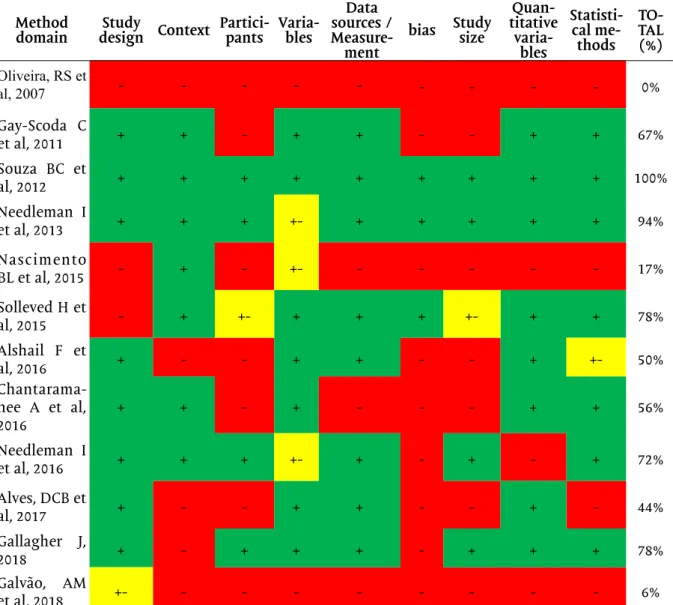
The compliance of the articles with the method domain of the STROBE gui-delines was fair to good in most articles (56 to 100%) (Table II), although this was not the case with the result domain (25 to 50%) (Table III).
In most studies the quality rating in terms of the Quality Assessment Tool for Observational Cohort and Cross-Sectional Studies was fair to good (57 to 71%) (Table IV). In Newcastle-Ottawa Scale the rating was mostly poor, from 25 to 50% (Table V).
Table II - Compliance of the studies included in the qualitative analysis with the method domain of the Strobe guidelines.
Method
domain design ContextStudy Partici-pants Varia-bles
Data sources /
Measure-ment
bias Study size
Quan-titative varia-bles Statisti-cal me-thods TO-TAL (%) Oliveira, RS et al, 2007 - - - 0% Gay-Scoda C et al, 2011 + + - + + - - + + 67% Souza BC et al, 2012 + + + + + + + + + 100% Needleman I et al, 2013 + + + +- + + + + + 94% Nascimento BL et al, 2015 - + - +- - - 17% Solleved H et al, 2015 - + +- + + + +- + + 78% Alshail F et al, 2016 + - - + + - - + +- 50% Chantarama-nee A et al, 2016 + + - + - - - + + 56% Needleman I et al, 2016 + + + +- + - + - + 72% Alves, DCB et al, 2017 + - - + + - - + - 44% Gallagher J, 2018 + - + + + - + + + 78% Galvão, AM et al, 2018 +- - - 6%
Table IV - Quality assessment tool for observational cohort and cross-sectional studies. Criteria 1 2 3 4 5 11 14 TOTAL (%)
Oliveira, RS et al, 2007 Yes Yes NR Yes No Yes No 57%
Gay-Scoda C et al, 2011 Yes No NR NR No Yes No 29%
Souza BC et al, 2012 Yes Yes NR Yes No Yes No 57%
Needleman I et al, 2013 Yes Yes NR Yes No Yes No 57% Nascimento BL et al, 2015 No Yes NR NR No Yes No 29% Solleved H et al, 2015 Yes Yes Yes Yes No Yes No 71%
Alshail F et al, 2016 Yes No NR NR No Yes No 29%
Chantaramanee A et al, 2016 Yes Yes NR NR No Yes No 43% Needleman I et al, 2016 Yes Yes Yes NR No Yes No 57%
Alves, DCB et al, 2017 Yes Yes NR NR No Yes Yes 57%
Gallagher J, 2018 Yes Yes Yes Yes No Yes No 71%
Galvão, AM et al, 2018 No Yes NR NR No Yes No 29%
1- Was the research question or objective in this paper clearly stated? 2- Was the study population clearly specified and defined? 3- Was the participation rate of eligible persons at least 50%? 4- Were all the subjects selected or recruited from the same or similar populations (including the same time period)? Were inclusion and exclusion criteria for being in the study prespecified and applied unifor-mly to all participants? 5- Was a sample size justification, power description, or variance and effect estimates provided? 11- Were the outcome measures (dependent variables) clearly defined, valid, relia-ble, and implemented consistently across all study participants? 14- Were key potential confounding variables measured and adjusted statistically for their impact on the relationship between exposure(s) and outcome(s)? NR- not reported.
Table III - Compliance of the studies included in the qualitative analysis with the result domain of the Strobe guidelines.
Result Domain Participants Descriptive data Outcome Main Results TOTAL (%)
Oliveira, RS et al, 2007 + +- + - 63% Gay-Scoda C et al, 2011 - - + - 25% Souza BC et al, 2012 +- +- + - 50% Needleman I et al, 2013 + +- + +- 75% Nascimento BL et al, 2015 - +- +- - 25% Solleved H et al, 2015 + +- + - 63% Alshail F et al, 2016 - +- + - 38% Chantaramanee A et al, 2016 +- +- + - 50% Needleman I et al, 2016 + + + +- 88% Alves, DCB et al, 2017 - +- + +- 50% Gallagher J, 2018 + + + +- 88% Galvão, AM et al, 2018 - +- + - 38%
Results of individual studies
All studies showed an association between oral health and physical activities; however, this association was assessed by questionnaires in most studies. Among the observed and self-reported changes were the modifications of the sports routine suffered. The influence by self-assessment ranged from 7-88%.
Discussion
The main outcome was that all the studies reported the influence of oral he-alth conditions on difficulties in developing training routines and competitions. The data source from most studies were questionnaires [8,13-22], therefore the results were obtained by self-report answers from the athletes. One limitation of this review is that the results were self-assessed, however, the biggest issue was due to the fact that the questionnaires used were not validated, generating a lack of standardization and an increased risk of bias since each study applies its own questionnaire. The best suggestion is the conduct of clinical trials that perform the treatment of these con-ditions associated with physical performance evaluation tests.
Other way to obtain more reliable data could be by the evaluation of oral cli-nical parameters associated with physical parameters of performance. Three studies tried to that, by assessing periodontal clinical parameters with muscle injuries or serum creatin kinase levels, these studies work with the physiological microlesions that occur with the physical activity itself, suggesting an important potential ac-tion of the oral health condiac-tion on the muscular inflammatory reacac-tion [11,12,16]. Gay-Escoda et al. [11] observed a statistically significant correlation between plaque index and probing pocket depth with muscle injuries (p<0.05). Souza et al. [12] found that depth of probing and bleeding probing were associated with changes in serum creatin kinase levels during training. Alshail et al. [16] found that soccer players with periodontal complication exhibited raised serum creatin kinase levels compared to those without this disease.
Table V - Newcastle-Ottawa Scale or assessing the quality of nonrandomised studies.
Newcastle-Ottawa Scale
Selection Outcome Total
(%)
Representativeness Homogeneity Exposure Evaluation
Oliveira, RS et al, 2007 0 1 1 0 50% Gay-Scoda C et al, 2011 0 0 1 1 50% Souza BC et al, 2012 0 1 1 1 75% Needleman I et al, 2013 0 1 1 0 50% Nascimento BL et al, 2015 0 0 1 0 25% Solleved H et al, 2015 1 1 1 0 75% Alshail F et al, 2016 0 0 1 1 50% Chantaramanee A et al, 2016 0 0 1 1 50% Needleman I et al, 2016 1 0 1 1 75% Alves, DCB et al, 2017 0 0 1 0 25% Gallagher J, 2018 1 1 1 1 100% Galvão, AM et al, 2018 0 0 1 1 50%
There are some animal studies that have found a relationship between oral health and changes in muscle recovery [23], which justifies their inclusion. The data suggested that the association between the pro-inflammatory state induced by pe-riodontal disease and exercise load may play an important negative role in muscle hypertrophy. Another study conducted in animals found that a group that was with immobilized, and with periodontal disease, presented greater degeneration of mus-cle tissue and increased inflammatory cells compared to other groups. This was due to decreased capillaries and increased connective tissue, which may be indicative of the fact that muscle recovery may be affected by problems of oral origin such as periodontal disease [24]. Hence, periodontal disease may also be a risk factor for a decrease in functional performance of the musculature, since the elevation of pro--inflammatory systemic cytokines can modify the muscular metabolism, leading to the loss of mass and decrease in strength, which is an important factor of physical performance [25].
There are other factors which are important to consider, such as the fact that professional athletes are constantly exposed to maximum stress and recovery situa-tions, which may consequently impact on athlete’s activities.
Most of the studies included in this review were performed in Brazil. There was also a higher percentage of studies regarding soccer players. Which can be ex-plained by the fact that it is one of the sports with a greater number of athletes and also due to the huge popularity of soccer, which is the most practiced sport worl-dwide [26]. The sample size of the studies also revealed a lack of standardization, knowing the specific characteristics of each study; we noticed a high rate of sample variation from 15 to 352 athletes, which may indicate a limitation for these observa-tional studies. This can be explained because most samples are convenience samples due to the difficulty of working with athlete patients, considering that the interven-tions cannot interfere with the training routine. However, more important than the standardization of the sample size, would be to do follow-ups in these athletes, be-fore and after dental treatment to evaluate in the same population if the oral health really impacts on physical performance.
A systematic review prior to the present study showed four studies assessed this association in which 5 to 18% of the athletes reported negative impact of poor oral health or dental trauma and changes in the development of sports activities [6]. Their methodological quality analysis, Newcastle-Ottawa Scale adjusted, was mostly poor, which was also observed in this review.
Conclusion
Oral health influences in the development of the sportsman’s routine, which may impair his adaptation to training of athletes. We suggest that further studies should be conducted with qualitative and quantitative variables to better measure this influence.
Potential conflict of interest
No conflicts of interest with potential potential for this article have been reported.
Financing source
Professor Dr. Fábio André Santos is a CAPES (Coordenação de Aperfeiçoamento de Pessoal de Nível Superior) Scholar as a visiting researcher at Columbia University - College of Dental Medicine - USA.
Academic link
There is no link between this study and graduate programs.
Acknowledgements
The authors wish to thank Dr. Sean Stroud for reading this manuscript and offering valuable com-ments.
Authors’ contributions
Conception and design of the research: Santos FA, Souza JJ. Data collection: Souza JJ, Leite JS, Bahls R, Grande RS, Lopes AL. Data Analysis and interpretation: Souza JJ, Leite JS. Obtaining financing: Souza JJ. Writing of the manuscript: Souza JJ, Leite JS, Souza BC, Santos FA. Critical review of the manuscript for important intellectual content: Souza BC and Santos FA.
References
1. Maffetone PB, Laursen PB. Athletes: Fit but unhealthy? Sports Med Open 2015;2:24. https://doi. org/10.1186/s40798-016-0048-x
2. Joshipura KJ, Hung HC, Rimm EB, Willett WC, Ascherio A. Periodontal disease, tooth loss, and in-cidence of ischemic stroke. Stroke 2003;34:47-52. https://doi.org/ 10.1161/01.str.0000052974.79428.0c. 3. Emy TN, Montenegro CLE, Joel FL, Magid L, de Souza FJA, Sampaio LE. Condições de saúde bucal e diabetes mellitus na população nipo-brasileira de Bauru-SP. J Appl Oral Sci 2003;11:15-20. https://doi. org/10.1590/S1678-77572003000100004
4. Saremi A, Nelson RG, Tulloch-Reid M, Hanson RL, Sievers ML,Taylor GW et al. Periodontal disease and mortality in type 2 diabetes. Diabetes Care 2005;28:27-32. https://doi.org/10.2337/diacare.28.1.27. 5. Söder PO, Söder B, Nowak J, Jogestrand T. Early carotid atherosclerosis in subjects with periodontal diseases. Stroke 2005;36:1195-200. https://doi.org/10.1161/01.STR.0000165916.90593.cb
6. Ashley P, Di Iorio A, Cole E, Tanday A, Needleman I. Oral health of elite athletes and association with performance: a systematic review. Br J Sports Med 2015;49:14-19. https://doi.org/10.1136/bjs-ports-2014-093617
7. Soler BD, Batchelor PA, Sheiham A. The prevalence of oral health problems in participants of the 1992 Olympic Games in Barcelona. Int Dent J 1994;44:44-8.
8. Gallagher J, Ashley P, Petrie A, Needleman I. Oral health and performance impacts in elite and pro-fessional athletes. Community Dent Oral Epidemiol 2018;46:563-8. https://doi.org/10.1111/cdoe.12392 9. Moher D, Liberati A, Tetzlaff J, Altman DG; PRISMA Group. Preferred reporting items for systema-tic reviews and meta-analyses: the PRISMA statement. PLoS Med. 2009;6:e. https://doi.org/1000097. 10.1371/journal.pmed.1000097
10. Oliveira RS, Lemos LFC. A influência de patologias odontológicas em atletas de canoagem e hande-bol. Rev Digital Educ Fis Deportes 2007;107.
11. Gay-Escoda C, Vieira-Duarte-Pereira DM, Ardèvol J, Pruna R, Fernandez J, Valmaseda-Castellón E. Study of the effect of oral health on physical condition of professional soccer players of the Football Club Barcelona. Med Oral Patol Oral Cir Bucal 2011;16:e436-439. https://doi.org/ 10.4317/medoral.16. e436
12. Souza BC, Ribas ME, Oliveira AR, Burzlaff JB, Haas AN. Impact of periodontal inflammation on changes of a marker of muscle injury in young soccer players during training. Revista Odonto Ciencia 2012;27:294-9.
13. Needleman I, Ashley P, Petrie A, Fortune F, Turner W, Jones J, et al. Oral health and impact on per-formance of athletes participating in the London 2012 Olympic Games: a cross-sectional study. Br J Sports Med 2013;47:1054-8.
14. Nascimento BL, Zen IR, Demenech LS, Mazzetto NCO, Spada PCP. of triathlon athlete about the relationship between oral health and performance. RSBO 2015;12:352-5.
15. Solleveld H, Goedhart A, Vanden Bossche L. Associations between Knowledge poor oral health and reinjuries in male elite soccer players: a cross-sectional self-report study. BMC Sports Sci Med Rehabil 2015;7:11. https://doi.org/ 10.1186/s13102-015-0004-y
soccer players: A preliminary report. Niger J Clin Pract 2016;19:655-8. https://doi.org/10.4103/1119-3077.188708
17. Chantaramanee A, Siangruangsaeng K, Chittaputta P Daroonpan P, Jaichum P, Jommoon P et al. Oral health status of the professional soccer players in Thailand. J Dent Ind 2016;23:1-4. https://doi. org/ 10.14693/jdi.v23i1.633
18. Needleman I, Ashley P, Meehan L, Petrie A, Weiler R, McNally S et al. Poor oral health including active caries in 187 UK professional male football players: clinical dental examination performed by dentists. Br J Sports Med. 2016;50:41-44. http://doi.org/10.1136/bjsports-2015-094953
19. Alves DCB, Anjos VDL, Giovannini JFBG, Lima RPE, Mendonça SMS. Odontologia no esporte: co-nhecimento e hábitos de atletas do futebol e basquetebol sobre saúde bucal. Rev Bras Med Esporte 2017;23:407-11.
20. Galvão AM, Bonis R. Sports dentistry: the influence of oral health in the performance of the athle-tes of the olympic village of Manaus. Boletim Informativo Unimotrisaúde em Sociogerontologia. 2018;9:79-91.
21. Oliveira RS, Lemos LFC. The influence of dental pathologies on canoe and handball athletes. Edu-cación Física y Deportes 2007;12:107.
22. Stephen KW, Kay EJ, Tullis JI. Combined fluoride therapies. A 6-year double-blind school-based preventive dentistry study in Inverness, Scotland. Community Dent Oral Epidemiol 1990;18:244-248. https://doi.org/10.1111/j.1600-0528.1990.tb00068.x
23. Souza BC, Ribas ME, Lopes AL, Teixeira BC, Lamers ML. Periodontal disease influences the recovery processes in the muscles in trained mice. Journal of Physical Education and Sport 2017;17:572-81. ht-tps://doi.org/10.1007/s10753-019-01128-5
24. Leite MA, Mattia TM, Kakihata CMM, Bortolini BM, Carli Rodrigues PH, Bertolini GRF, et al. Ex-perimental periodontitis in the potentialization of the effects of immobilism in the skeletal striated muscle. Inflammation 2017;40:2000-1. https://doi.org/10.1007/s10753-017-0640-3
25. Oliveira JA, Hoppe CB, Gomes MS, Grecca FS, Haas AN. Doença periodontal como indicador de risco para baixa aptidão física: um estudo observacional transversal. J Periodontol 2015;86:44-52.
26. Zynda AJ, Sabatino MJ, Meagan J, Ahn J, Miller SM. Gender differences in same-day return to play following concussion among pediatric soccer players. Pediatrics 2018;142:412. https://doi.org/10.1542/ peds.142.1_MeetingAbstract.412

![Table I - Characteristics of the studies. AuthorSportStudy typeSampleData sourcesInfluence of oral health in physical performance Oliveira RS et al., 2007 [10] Canoeing HandballCross-sectionalCanoeing: n=17 Han- dball: n=20](https://thumb-eu.123doks.com/thumbv2/123dok_br/19227630.965708/5.892.116.795.101.1188/characteristics-authorsportstudy-typesampledata-sourcesinfluence-performance-oliveira-handballcross-sectionalcanoeing.webp)