PRODUCT DEVELOPMENT IN APP BUSINESS
A corporate project of the moovel Group GmbH (Ltd)
Thomas Christian Gruber
Project submitted as partial requirement for the conferral of Master in International Management
Supervisor:
Prof Renato Telo de Freitas Barbosa Pereira, ISCTE Business School, Department of Marketing, Operation and Management
PR
OD
UC
T
D
EV
EL
OPM
EN
T
IN
A
PP
BUS
IN
ES
S
Th
om
as
Ch
ris
tia
n
G
ru
ber
Executive Summary
The aim of this master thesis is to describe the development of an in-app survey feature with the goal to widen the service range of the mobility app provider moovel Group GmbH. The theory of product development, according to Harry Igor Ansoff, is combined with the modern and structured process of Design Thinking. This leads to new ways to design and develop products or services. The thesis is structured in the Design Thinking steps itself to guarantee a precise workflow. First, the topics app business, digital marketing, growth strategies and Design Thinking are explained in detail. Secondly, by means of interviews the requirements on the survey feature are defined. In the analysis part, different suppliers of the technical base of the feature are examined. In the next phase the content of the survey is evaluated and a clickable prototype is designed. In the last phase the prototype is tested by real users. According to their feedback the survey feature was finalised.
In order to not exceed the framework of this thesis, the technical side of the project, regarding development and engineering processes, is not considered.
JEL classification: M310 (Marketing), M110 (Production Management)
Sumário
O objetivo desta tese de mestrado é descrever o desenvolvimento de um recurso de pesquisa In-app, que tem como foco ampliar a gama de serviços do provedor de aplicações para mobilidade Moovel Group GmbH. A teoria do desenvolvimento de produtos, de acordo com Harry Igor Ansoff, é combinada com o processo moderno e estruturado de Design Thinking, o que leva a novas formas de projetar e desenvolver produtos ou serviços. A tese, por si mesma, também está estruturada nas etapas do Design Thinking, de forma a garantir um fluxo de trabalho preciso. Na primeira fase, os tópicos app business, Marketing digital, Estratégias de crescimento e Design Thinking são explicados em detalhe. Em seguida, são definidos os requisitos relativos à característica do inquérito, através de entrevistas. Uma análise é então realizada para os diferentes fornecedores da base técnica da característica. Na fase seguinte, o conteúdo da pesquisa é avaliado e um protótipo clicável é projetado. Na última fase, o protótipo é testado por usuários reais. De acordo com o seu feedback, a funcionalidade do inquérito é então finalizada.
A fim de não exceder o âmbito desta tese, o lado técnico do projeto, em relação aos processos de desenvolvimento e engenharia, não é considerado.
JEL classificação: M310 (Marketing), M110 (Production Management)
Palavras-chave: desenvolvimento de produtos, negócios de aplicativos, mobility-as-a-service,
Table of Content
Executive Summary III
Sumário IV
List of Tables VI
List of Figures VII
List of Abbreviations VIII
1 Introduction 9
1.1. Project description & problem statement 9
1.2. Objectives & approach 10
1.3. Company profile 11
2 Literature Review 13
2.1 Mobile App Business 13
2.2 Urban mobility 15
2.3 Growth Strategies 17
2.4 Design Thinking 19
3 Methodology 21
4 Analysis 22
4.1 Design Thinking Method & Process 22
4.2 Requirements on survey tool 23
4.3 Survey tool analysis 26
4.4 Benchmark: Feedback and rating surveys of Uber, Lyft and Grab 34 4.5 User segmentations for surveys 36 4.6 Prototyping: Content, survey journey and design 37
4.6.1 Questionnaire 37
4.6.2 Question logic 41
4.6.3 Placement 42
4.6.4 Design 44
4.7 Testing: Finalization of the product 46
4.7.1 User testing 46
4.7.2 Prototype improvements 48
5 Conclusion 51
Bibliography 53
List of Tables
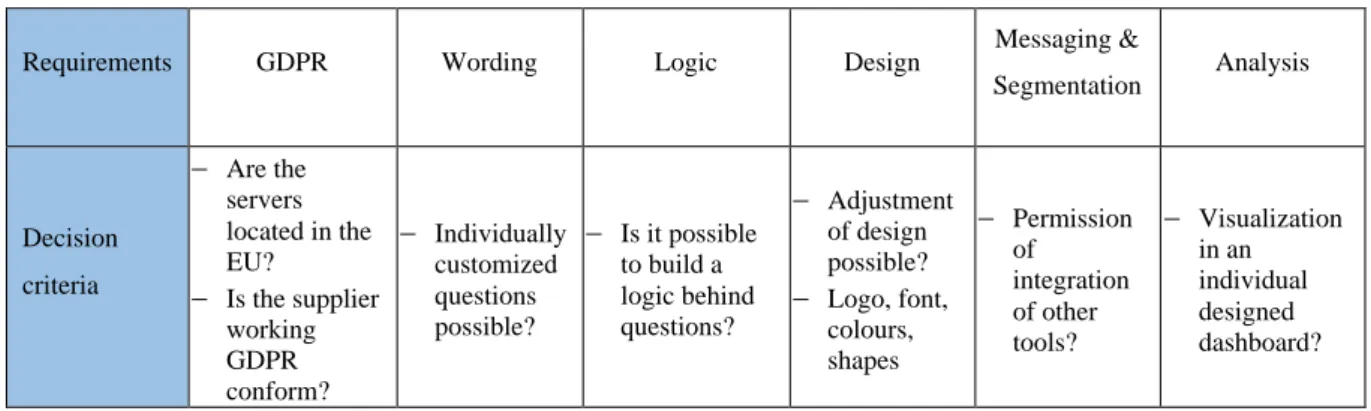
Table 1 - Requirements and decision criteria on survey tool ... 25
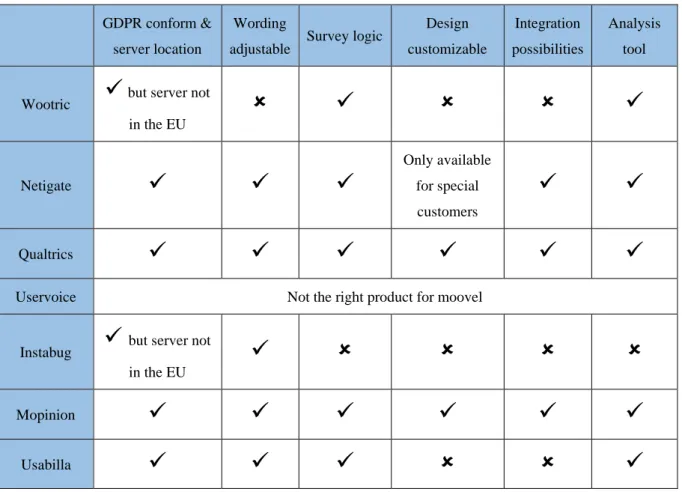
Table 2 - Analyzed product features of survey tools with requirements ... 33
Table 3 - Exemplary list of relevant and qualitive questions for public transport surveys ... 39
Table 4 - Exemplary list of relevant and qualitive questions for car sharing surveys ... 39
Table 5 - Exemplary list of relevant and qualitive questions for bike sharing surveys ... 40
List of Figures
Figure 2 – Wootric Inc. logo ... 26
Figure 3 - Netigate AB logo ... 27
Figure 4 - Qualtrics LLC logo ... 28
Figure 5 - Uservoice Inc logo ... 29
Figure 6 - Instabug Inc. logo ... 30
Figure 7 - Mopinion B.V. logo ... 31
Figure 8 - Usabilla B.V. logo ... 32
Figure 9 - Comparison of feedback and rating screens between Uber, Lyft and Grab ... 35
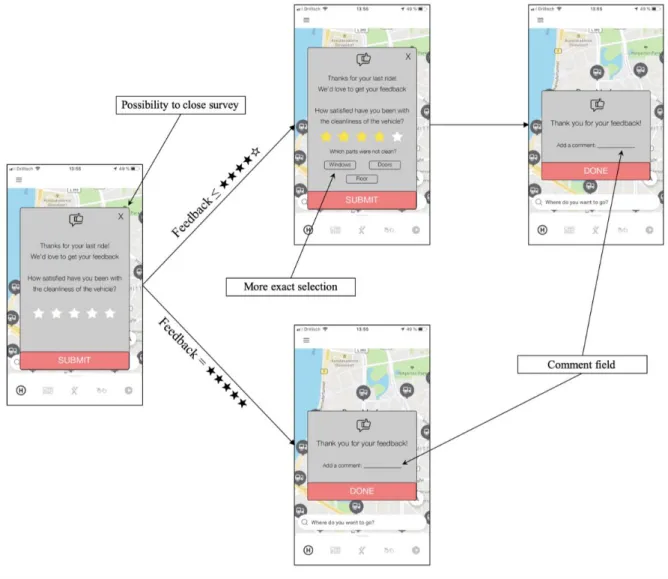
Figure 10 - Exemplary survey logic of the first and following questions ... 41
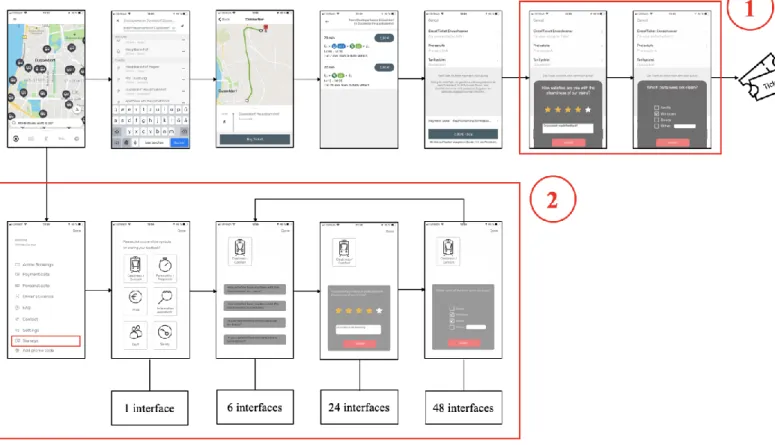
Figure 11 - App wireframe: Existing app flow plus added survey interfaces (red mark) ... 43
Figure 12 - Design elements of the survey feature in detail... 45
List of Abbreviations
ACEA Association des Constructeurs Européens d'Automobile (European Automobile Manufacturers Association) ACT Association for Commuter Transportation
API Application Programming Interface
App Application
AUS Australia
B2B Business to Business
CSO Chief Sales Officer
EG Egypt
EU European Union
GDPR General Data Protection Regulation
GER Germany
GmbH Gesellschaft mit beschränkter Haftung (German limited Company) GPS Global Positioning System
HPI Hasso-Plattner-Institut
km kilometer
KPI Key Performance Indicator
Ltd. Private company limited by shares MaaS Mobility-as-a-Service
NL Netherlands
NOR Norway
PTO Public Transport Operator
SGPR Singapore
SWE Sweden
UK United Kingdom
Introduction
9
1 Introduction
In 2017, studies counted 465 million unique mobile subscribers in Europe, which equalled a penetration rate of 85% of the European population. Out of the total connections 70% were smartphone users. Forecasts say that the distribution of smartphone users will increase to 85% by 2025 (GSMA Intelligence. 2018. p. 6). Until 2022, smartphone traffic in Western Europe is expected to increase by seven times and 90% of mobile data traffic will come from smartphones (Telefonaktiebolaget LM Ericsson. 2016). These figures show that the smartphone is a permanent companion of end users and it is possible to reach prospects and customers almost anytime and anywhere. This offers new business models and can be seen as a benefit for internet and mobile data companies.
The urban mobility company moovel Group GmbH (Ltd.), which is a partner of this master thesis, uses the smartphone technology to sell and promote their mobile applications (apps). Its mission “A world without traffic jams” is supposed to be achieved by combining all available transport possibilities within a city. Therefore, the company builds apps which integrate route descriptions, public transport ticketing, vehicle sharing or ride hailing booking. The definition of specific terms will follow in chapter 3.1: Literature Review and more details of the moovel Group GmbH (Ltd.) in chapter 3.1.4: Company Profile. In the thesis the company is often mentioned just as “moovel”.
The focus of this master thesis is a four-month company project with the goal to widen moovel’s product and service portfolio and to improve moovel’s products and apps. The author has a leading role in the project.
1.1. Project description & problem statement
To improve its products moovel plans to implement a feedback and survey tool which appears after every ticket or ride booking. The reason behind this feature is to widen moovel’s product range and thus, to offer more services for their clients, which are Public Transport Operators (PTOs), such as deep user insights or product improvements. There are two departments interested in this feature – the marketing and the product department. Since the author is working in the marketing department, the thesis approaches the topic mainly from the marketing side and its respective advantages. A valuable article from Vasudha Mamtani underlined the importance of user feedback. Developers spend much time and effort in user research to
Introduction
understand customer wishes and needs in order to build products that fulfill these requirements. Before a product is released on the market, multiple rounds of user testing with potential customers are performed. However, key insights can only be received from the real customer. That is why gathering user feedback is essential. Some issues can only be identified once the app is used frequently. By providing the possibility of giving quick feedback, the product can be modified and optimized for the everyday use. Another advantage is that a feedback interface increases the users’ satisfaction because they can contribute recommendations and be part of the improvement process. As a result, a certain level of trust between customer and company gets established (Mamtani. 2018).
The idea of a survey feature was developed by the Chief Sales Officer (CSO) of moovel and executed by the marketing department. The focus of the thesis thus lies more on the executive part than on the brainstorming part.
From the scientific business perspective the process describes the method of product development according to Harry Igor Ansoff - meaning, an additional product is developed and sold in an existing market. This is a vital strategy to diversify the product range and to increase market share and sales. Hence extensive testing and piloting is recommended (Koks. Kilika. 2016. p. 95).
Testing is also an essential part of Design Thinking, a modern method for solving problems such as the development of a new product or service. Until the start of the thesis preparation, there was no exact product development process at moovel. For this reason, the author wants to proof if and how Design Thinking can be a valid method for developing an in-app feature for the company. This thesis is guiding through the different steps of Design Thinking and applying several measures and tools.
1.2. Objectives & approach
From the company perspective two main departments are interested in this project – marketing and product. The marketing department wants to introduce a new feature, which may be sold to transport agencies and widen their product range. In addition, it is possible to gain deep user insights which allow to advertise the market more specifically. The product department wants to use the feedback of the survey to improve the product and as an alert when issues occur in the apps. The overall objective of the company is to attract and retain more users and thereby increasing the revenue.
Introduction
11 The objective of the university and the supervisor is to collect modern knowledge of app- and digital businesses. In addition, the project allows to find new product management methods by using Ansoff’s popular matrix and the modern method of Design Thinking.
Regarding the aspired approach, the master thesis evaluates the project from a scientific view. To have a clear project process the steps of Design Thinking are applied:
1. Understanding and observation: Research
On the research side it is crucial to understand the topic and fields of the app business, digital marketing, growth strategies and Design Thinking.
2. Ideation: Analysis
In the analysis part, the requirements on the survey feature and their decision criteria will be defined and examined. In addition, the task is to find an ideal supplier who has the knowledge and expertise to develop the technical base of the survey tool and helps to integrate it into the existing apps. Therefore, the defined requirements and their decision criteria will be compared with several suppliers.
In addition, the survey interfaces of Uber, Lyft and Grab are analyzed to achieve a base of necessary features for building the prototype.
3. Prototyping: Content and survey journey
In the prototyping part, the content of the surveys is evaluated. Related to this, different survey questions and routes have to be developed, to collect different user insights. This is shown with screenshots from the actual surveys in the app.
4. Testing: Finalization of the product
The prototype is tested by user groups inside and outside the company, feedback is collected, and the product is improved.
1.3. Company profile
The vision of moovel is a planet without traffic jams (moovel Group GmbH. 2018). This goal is supposed to be achieved by combining relevant and sustainable mobility solutions such as public transport, bike sharing, car sharing, ride sharing or ride hailing. moovel is building apps and providing concepts to achieve this goal.
Introduction
To fulfill the goals and aims of moovel, the corporate start up, which is a 100 % subsidiary of the Daimler AG, employs 260 people globally. The offices are in Berlin (GER), Stuttgart (GER), Hamburg (GER) and Portland (USA). In August 2018, moovel counted five million users globally with bookings at every 1.2 seconds for a ticket or a ride (Daimler. 2018).
moovel combines mobility solutions with their products, which are mainly apps for smartphones or tablets. Overall, the corporate start up offers three kind of apps. A white label solution for PTO’s to display their transport connections and tickets (1). On-demand shuttles, which are picking up the users from a set location, pooling them at best with other users and drive them to their desired destination. This service is available in Stuttgart (GER), Los Angeles (USA) and Singapore (SGPR) (2). The third product solution is also the pilot project of moovel: an app which is combining all relevant mobility solutions in a city, the moovel own-branded app (3) (moovel Group GmbH. 2018a; moovel Group GmbH. 2018b.). The mentioned survey feature will be implemented in the apps of the first category.
Next to the mentioned products, moovel is offering also a wide range of services for B2B clients. After the successful roll out of the apps in a city or region, moovel continues to promote the apps with a range of performance marketing solutions. These are app store optimization, online advertising and campaign optimization, user engagement, ad set production, reporting on a regular basis and in future user surveys.
App store optimization means the monitoring and optimization of the app store ranking. By means of descriptions, specific keyword selection and image varieties, it is possible to influence the ranking of an app in the respective app stores. Online advertising and the connected campaign optimization are key elements in online marketing. Activities here are the setting up of campaigns at Facebook, Instagram, Google, YouTube, Twitter or Apple Search Ads. Here it is important to select appropriate keywords, to target the right audience and to distribute the budget. To keep the user engaged, it is possible to send them push notifications on their phone with an incentive to use the app more often. The ad set production includes the creation, editing and adjusting of advertising assets, which can be images, videos or sounds. With regular reports, the client receives insights into running advertising campaigns on the basis of relevant KPIs such as install rate, cost per install, impressions, clicks, transactions or registrations.
Literature Review
13
2 Literature Review
This chapter serves as a theoretical framework to comprehend the topic and to analyse it. To conduct a relevant and qualitative analysis it is important to understand the theory, method and functionality behind the subject. Therefore, an extensive literature review of the fields of mobile app business, digital marketing, growth strategies and Design Thinking is essential to proceed with the analysis. In the literature review the terms used are defined, backgrounds are discussed and additional information is provided.
2.1 Mobile app business
First of all, it is important to define the characteristics and factors of an app. Later on, the terms
mobile device and smartphone are explained, before the app business market is introduced.
Dr. Md. Rashedul Islam defines a mobile app as a software or set of programs that runs on a mobile device and performs certain tasks for the user. He explains that mobile applications are running on a small hand hold mobile device which is easy to use, moveable and accessible anytime and anywhere. In addition, Islam mentions that an app takes advantages of the features of a smart device such as calling, messaging, browsing, chatting, social network communication, audio, video, game etc. (Islam. 2010. p. 72).
In 2005, Ivo Salmre defined in his software engineering guide five important characteristics of successful mobile applications. First of all, quick start up time (1) is essential, because users tend to use mobile devices frequently but for short sessions of time. The ability to quickly launch an app is indispensable. He recommends that the session time should be much longer than any launch time the user endures. Responsiveness (2) is the second important characteristic. Users expect a physical or visual response when interacting with the device. Otherwise users will become impatient and frustrated. The best acknowledgement users can receive is the completion of the requested action or a notice that the request is being worked on. Another characteristic of successful mobile application is focused purpose (3). The app should have a clearly defined set of tasks. The objective of the user should be achieved with a minimum number of clicks, taps or other gestures. The goal is to have the smoothest customer journey as possible. Further it is important that off-device information is included and published seamlessly in the interface of the app. This kind of information could be for example a map or address integration from the internet. The challenge is to overcome weak network availability
Literature Review
when the user is not in a stable internet connection. Salmre recommends limiting the size of relevant content being downloaded. The last important application characteristic is the consistency of experience (5). That means that the app should be perfectly integrated into the user experience of his or her device. Therefore, tailored and specific app versions for each device and operating system are required (Salmre. 2005. p. 31-34).
In addition, Ulrike Sturm defined some recommendations for app development from the perspective of urban and citizen science in a workshop with her colleagues in 2017. According to these, the aspects can be distinguished into three overarching sections. First sharing of outcomes and interoperability (1). Under this aspect some key factors are listed: The app should have an API (Application Programming Interface) to share as much data as possible. Further there should be transparency about which data is collected and where the data is stored. Another factor is to provide the app in several languages, related to the city where it operates.
The second aspect for app development in urban and citizen science is communication and design (2). This represents an app design and performance that appreciates the users time and lowers the barriers for market entry. In addition, it makes sense to communicate constantly with the participants and react to feedback and ideas. Also, communication should be direct as possible and both sides should profit.
The last aspect is ethics (3). This means a responsible handling of the users’ data and respect of privacy as well as a protected app environment, which is safe from third party accesses (Sturm et al. 2017. p. 8-10).
After making clear what the app needs to consider, it is now necessary to determine often-mentioned terms mobile device and smartphone. Priya Viswanathan defined the terms in a tech article. According to her, “mobile device” is a general term for any handheld device. Tablets, e-readers, smartphones and portable music players are all mobile devices. The characteristics of mobile devices are having an access to the internet, a battery, a keyboard for entering information, a portable size and weight and wireless operation (Viswanathan. 2018).
S. M. Jacob and B. Issac characterised a smartphone as a mobile device that integrates telephone features along with a camera, music player, access to the internet, and the possibility to edit, create and store data (Jacob. Issac. 2008. p. 2). According to that a smartphone is a mobile device with all its functions plus the telephone feature.
To determine the size of the business segment of apps, the download and usage figures of app stores is helpful. In 2017, 197 billion apps were downloaded via the app stores. According to a
Literature Review
15 forecast, by 2021, the total app downloads number will almost double to 352 billion (Statista. 2019). A comparison of the two main operating systems – Android (Google) and iOS (Apple) shows that Google is gaining significantly more installs than Apple (App Annie. 2017. p. 9). This could be explained with the different strategy of the two companies. While the Android operating system can be installed also on external, non-Google, devices, the iOS operating system is exclusively for Apple products. However, a glance at revenue discloses that Apple’s App Store is twice as successful as Google’s Play Store (App Annie. 2018. p. 10). The discrepancy is not linked to different monetization models but rather to different user behaviour. iOS users are more likely to invest in Apps. 46% of iOS users indicated to make an in-app purchase to avoid ads. This compares to only 38% of the Android users (Milanesi. 2018). The lucrativeness of the app market can be seen at the revenues of app publishers such as moovel. In 2016, publishers were paid over $35 billion across the App Store and Google Play. Including third-party Android stores and advertising revenues the total amount increases to almost $89 billion. Thereby in-app purchases as tickets or bookings are not counted (App Annie. 2018. p. 10).
2.2 Urban mobility
moovel's goal is to shape the future of urban mobility. The term urban mobility attracted more and more attention over the past five years (Google Trends. 2019). But what does this actual mean? This subsection serves to clarify and define common and modern trend words of urban
mobility such as vehicle sharing.
In 1998 Patricia L. Mokhtarian and Ilan Salomon defined mobility as a demand for activities or travel, where the costs are an integral part of the demand (Salomon. Moktarian. 1998. p. 131). Dr Jean-Paul Rodrigue distinguishes between three categories of urban mobility: collective transportation (public transit), individual transportation and freight transportation. According to Rodrigue the purpose of collective transportation is (1) to provide publicly accessible mobility in a city. Its efficiency is based on transporting a large amount of people and achieving economies of scale. Examples are trams, buses, trains, subways and ferries. Individual transportation (2) are modes of personal choice such as the automobile, motorbike, cycling and walking. The last category freight transportation (3) is characterized by delivery trucks moving between industries, distribution centres, or warehouses and ports, rail yards or airports (Rodrigue. 2013. p. 206).
Literature Review
For the business model of moovel, mainly the first two categories are relevant. Essential parts of individual transportation in a shared economy are Mobility-as-a-Service (MaaS), on-demand mobility, vehicle sharing, ride sharing, and ride hailing.
moovel sees itself as a pioneer in the field of MaaS. Jittrapirom and his colleagues formed a task force in the Netherlands to compare several definitions of this term. They concluded that MaaS can be seen as a mobility concept, phenomenon or transport solution. The core is to have access to multiple transport service provider by using only one platform or app. To differentiate clearly from other concepts, the authors set up the following nine characteristics (Jittrapirom et al. 2017, p. 14-16).
1. The integration of transport modes. Meaning that different public transport services are combined and available for the user. Following transport modes can be included: public transport, ride hailing, car sharing, ride sharing or bike sharing.
2. The tariff options. Normally, there are two options available: A monthly package of a certain amount of kilometres or time, or the exact account of the used service.
3. The user can access all services, such as trip planning, booking, ticketing, payment, and real-time information, via one platform only.
4. Interactions between the multiple actors involved, which are users, suppliers of the transport service, platform owners or local authorities.
5. Different technologies are combined, such as mobile devices, internet network, GPS, e-ticketing and e-payment systems.
6. The service is user-centred and demand oriented. 7. Registration and validation of the account is required.
8. Personalisation: Based on the user’s profile, preferences and behaviours the platform provides specific recommendations.
9. Customisation: Trips and routes and mobility packages can be freely composed.
On-demand mobility, which is part of moovel’s business model, means the use of shared vehicles that are accessible on demand. Typically, a passenger reserves a ride via the smartphone before the trip. On-demand mobility is part of the sharing economy within a city (Greenblatt. Shaheen. 2015. p. 77).
Within vehicle sharing, car sharing is the most important part. A car sharing report from 2014 by the European Automobile Manufacturers Association provided some information about the terminology. According to the organisation there is no uniform definition, but the following characteristics could be determined. The user must validate himself or herself with a driving
Literature Review
17 license and is then able to access the car without interacting with the company providing the vehicles. The price for the services often depends on minutes or the distance travelled. Some operators allow multi-day packages to better conditions. Typically, the vehicles are available from distributed locations across a service area. Servicing as cleaning or refuelling is conducted by the operator. In some cases, users are incentivised to undertake the service (ACEA. 2014. p. 3-4). Similar to this concept is bike sharing. According to Shaheen, Guzman and Zhang, the shared use of a bicycle fleet, is a mobility strategy that could help address sustainable transportation (Shaheen. Guzman. Zhang. 2014. p. 159). moovel is operating in both segments by collaborations with the sister company car2go (car sharing) and the partner company nextbike (bike sharing).
The Association for Commuter Transportation in 2014 defined the term ride sharing as a non-commercial service. Ride sharing means people are pooling from a common origin, like their residence, to a common destination, like their employer. In some cases, arrangements exist where costs are shared between passengers and driver, but not for commercial profit (ACT. 2014).
Ride hailing is a more modern term. Because of the technological advancements in the transportation industry and mobile devices, it has become possible to connect driver and passengers in a fast and easy way. Hunaiti et al mentioned recently that due to the dissemination of smartphones and fast communication, ride sharing transformed to ride hailing (Hunaiti et al. 2018. p. 244). The company Uber was the first operator to turn ride hailing into an app-based business model by using the new technology in 2009 (Uber Technologies Inc. 2019). moovel is using ride hailing by including the services of its sister company mytaxi and shuttles in Los Angeles (USA), Singapore (SGPR) and Stuttgart (GER).
2.3 Growth strategies
On the one hand this company project is an example for a modern operational case in the digital business world, but on the other hand it follows the well-known theory of traditional product development. Already in 1957, Harry Igor Ansoff, a pioneer of product market strategies, pointed out that business firms must go through continuous growth and change to retain or improve its position. He mentions four basic growth alternatives for a business: market penetration, market development, product development or diversification (Ansoff. 1957. p. 113). In this section the four strategies are briefly explained and it is demonstrated how moovel’s project can be described as product development.
Literature Review
The strategies are explained by means of the original literature provided by Ansoff from 1957 and of a more contemporary source of Dr Al-Bostanji from 2015. The reason is that Al-Bostanji expanded Ansoff’s theories valuably by including risks estimations and strategic approaches. Ansoff’s strategies contain two dimensions: product and market. With the first strategy “market penetration”, a company uses their current product in the existing market (Ansoff. 1957. p. 114). The goal is to achieve greater sales for the current products for the same consumers. This should be accomplished without a change or modification of the product or its image. The best way to penetrate a market is a combination of competitive pricing strategies, advertising, sales promotion and personal selling. With this strategy, companies focus on markets and products it knows well. Thus, there is not a lot of investment in market research required and ultimately the risk is relatively low (Al-Bostanji. 2015. p. 73).
“Market development” describes a strategy of introducing a current product into a new market (Ansoff. 1957. p. 114). This could be a new targeted group of consumers or a new geographical market. Other approaches can be new distribution channels (e.g. e-commerce) or adjusting prices to attract new customers. Market development may be linked to some risks: Non-acceptance of a product from new market and expensive market researches (Al-Bostanji. 2015. p. 73-74).
A “product development” strategy describes the introduction of a product with new and different characteristics (Ansoff. 1957. p. 114). The goal is to develop new competencies and to meet needs, desires and preferences of existing customers. Important, however, is the awareness that these factors are changing continuously. Product development requires a detailed market and customer analysis, which may be cost intensive. Therefore, product development can be considered as relatively risky (Al-Bostanji. 2015. p. 74). The company project, to build a survey feature inside existing apps, can be described as product development, because it’s aiming to meet the needs of the moovel’s customers which are Public Transport Operators. By using insights from commuters and passengers, PTOs are able to improve their vehicles and services. moovel sells this additional service of collecting insights to its customers, which may lead to growing revenue. In addition, moovel itself can collect user opinions about the satisfaction level of interface, handling or customer journey within an app. Based on of this information, apps and services can be improved.
“Diversification” is the final growth strategy. It describes the step to enter a new market with a new developed product (Ansoff. 1957. p. 114). This strategy is associated with the highest level
Literature Review
19 of risk. Companies must have clear ideas based on studies and researches on new markets and products. This can be linked to high costs. On the other hand, diversification could increase customer number and revenue in a fast way (Al-Bostanji. 2015. p. 74).
2.4 Design Thinking
The method of Design Thinking is a fundamental process in this thesis. In the last years Design Thinking has received increased attention in business settings. Reason therefore is, that design of products and service is a major component of business competitiveness now (Razzouk. Shute. 2012. p. 331). According to Christian Mueller-Roterberg, Design Thinking is a comprehensive customer-oriented innovation approach that aims and develop creative business ideas. Thereby it is an integrative approach which means that the solution development functions systematically and holistically by following a process. In addition it focuses on early customer orientation by observing user behaviour and habits. A central element of Design Thinking is empathy. It is necessary to put oneself in the position of a user. Developments can thus be better aligned with the customers. Finally at a certain point prototype is created and tested with real users (Mueller-Roterberg. 2018. p. 1).
The process of Design Thinking consists six phases. First the problem is defined and must be understood. According to Plattner this is the most important phase in the model since occurring errors affect the entire process. The next phase the knowledge is evaluated and interpreted and weighted. The outcome of a clear idea of the problem leads to the ideation phase which consists brainstorming and generating ideas that contain a solution. Afterwards these ideas are transformed into a tangible prototype which does not have to be perfect. Design Thinking ends with the testing phase where the prototype is applied with real users. Observing and interviewing these users help to gain learnings and improve the prototype for the actual product (Plattner et al. 2009. p. 113 ff.)
Design Thinking contains a large number of methods and tools. The persona method helps to identify the user’s expectations and needs. Personas are “fictitious, specific, concrete representations of target users” (Pruitt. Adlin, 2006. p. 11). Personas represent a character which allows to engage with in the design process. Another tool is the stakeholder map which shows a visual representation of all groups involved in a particular product or service, such as customers, partners, companies or colleagues. A different tool is the customer journey map which shows all touchpoints from the user point of view from the first to the last interaction. A further tool is the so called rapid prototyping. It represents a quick formation of ideas and helps
Literature Review
to determine which solutions are technologically possible (Chasanidou. Gasparini. Lee. 2015. p. 4-5).
An interview with a Design Thinking expert is conducted and gives more insights. The discussion with her helps to define how the Design Thinking process in moovel’s case could look like and which tools and measures can be applied. The interview is applied in the analysis part of this thesis.
Methodology
21
3 Methodology
This thesis serves an applied process by solving a practical problem. Thereby two major frameworks play the key roles: The established product development method by Harry Igor Ansoff as well as the new concept of Design Thinking. The reason for that is to have a planned and organized approach to find new ideas and to develop a flawless product. The deductive research aims the goal to test if Design Thinking is an appropriate method to develop products or services for the company moovel.
Regarding the type of research data, in the literature review mainly secondary data is collected and analyzed while in the conducted interviews primary data is gathered. Due to the interviews and the testing observations the applied method on the thesis is a qualitative research.
The thesis is structured as the project itself. The six steps of Design Thinking form the construct of the thesis, whereby the focus lies on ideation, prototyping, testing and the following implementation. These four stages were among the author’s responsibility.
In the ideation part the idea of an in-app survey feature is developed and then the appropriate partner is selected. The selection process is the main part of the analysis. The defined requirements for the survey tool are decisive factors in this step. Afterwards, the prototyping phase, design and nature of the questions are determined. In the end, during the test phase, the product is finalized before being implemented.
The interviews give interesting and essential insights, which are important for the requirements on the survey feature and the correct application of the Design Thinking concept. The decision criteria for choosing the interview partners were their expertise level, relevance and accessibility.
In order to emphasize on the core of this thesis - marketing and management, technical details about how the tool is integrated will not be discussed. In addition, confidential information as for example pricing, offer and contract details are not part of the thesis.
Analysis
4 Analysis
In this chapter the Design Thinking process starts. A discussion with Miriam Steckl, a Design Thinking expert, lead to further and deeper knowledge, how the process flow should be. Later are the requirements of the survey tool defined. Afterwards several suppliers of a survey tool are analysed. For confidential reasons pricing, offer and contract details are not named. In total a number of seven suppliers who offer survey tools for mobile apps was preselected on the basis of an internet research. These are Wootric Inc., Netigate AB, Qualtrics LLC, UserVoice Inc.,
Instabug Inc., Mopinion B.V. and Usabilla B.V. In the following the suppliers are named
without the legal form. Every defined requirement is analysed with the publicly available information of each suppliers.
In addition, in a second analysis, the rating and feedback surveys of three moovel competitors Uber, Lyft and Grab are examined. This step is important to verify which features are necessary for building the prototype.
Finally, it is analysed which users are the best to target and are requested to submit the feedback form.
4.1 Design Thinking Method & Process
The conducted interview with Miriam Steckl, a Design Thinking coach from the Hasso-Plattner-Institut (HPI) near Berlin, provided deeper and applied information regarding the technics and process of Design Thinking. The complete interview is located in the annex (interview 2). The goal of the concept is to improve an existing process and to gain more creativity and innovations inside of a company. According to Steckl, Design Thinking is a mindset and holistic approach towards more user-centric solutions (Interview 2. 2019. Annex p. 65).
Design Thinking is a process which consists of six steps. First, it starts with an understanding phase where research is key to gain essential knowledge. Afterwards, observation is a vital method to understand a specific problem such as user behaviour. The next phase is the synthesis phase where all information is compiled and considered. Then ideation is the following phase where thoughts and ideas are collected and discussed. The chosen ideas are developed further to a prototype, which is a way to make concepts, services or products tangible in high or low resolution. In the end the prototype is tested and finalized. Design Thinking is an iterative
Analysis
23 process where the team is regularly switching between the phases when problems occur (Interview 2. 2019. Annex p. 66-67).
To apply Design Thinking on the given case of product development, it is necessary to show the methods of the individual phases in more detail. As mentioned in the observation part the focus lies on the user behaviour. For that reason, it is essential to visualize and internalize the users’ journey through a product or service (Interview 2. 2019. Annex p. 68). The survey feature will be included at one point of this journey, so it must be placed very carefully to not disrupt the experience.
In the ideation phase it stars with brainstorming and finding ideas. The principle is quantity over quality. Everyone who participates in the project should bring in his ideas and input. In this phase it is not important if ideas are feasible or risky (Interview 2. 2019. Annex p. 68). The ideation phase in this thesis is the analysis of the task in order to find the ideal supplier who had the knowledge and expertise to develop the technical basis of the survey tool and helped to integrate it into the existing apps.
Afterwards the process leads to prototyping. A common mistake here is to try to build an already perfect product. It is very time consuming and in the testing phase it might come out that the product is not finished completely (Interview 2. 2019. Annex p. 68). The survey feature is built by taking into account the survey journey, the content, and logic of the survey as well as the design.
In the test phase the most important functions of the prototype are tested. Different ways for testing can be used, such as conducting interviews and asking for opinions or using a clickable dummy and let volunteers experience the product or the service. A very far developed prototype would be to have a test version then let possible users come to test it and give feedback. The most accurate test group would be users of the existing apps (Interview 2. 2019. Annex p. 69).
4.2 Requirements on survey tool
An interview with one of moovel’s performance marketing managers, Daniel Hurrle, was very useful to define which requirements are important to find an appropriate survey tool. According to him the following aspects are important for the implementation of the tool. The complete interview can be found in the annex (interview 1).
First it is important that the software partner provides a tool, which is compliant with the General Data Protection Regulation (GDPR) of the European Union. This regulation came into
Analysis
force on 25th of May 2018. In terms of lawfulness and fairness there were not many considerable
amendments. It is still necessary that a party needs a specific ground for processing of data as for example a contractual agreement. Fairness means that only personal data which is absolutely necessary is collected and handled in ways that people would find reasonable. One of the crucial changes are the new requirements on transparency. Now it must be clearly signposted what happens to the users’ data (Information Commissioner’s Office. 2018. p. 18-20). That is why it is crucial for moovel to work together with a partner who observes the GDPR law. Here, an important issue is that it is forbidden to store user data outside of the European Union since it is an EU law. Therefore, the company has to find a supplier who is operating its servers in an EU country (Interview 1. 2019. Annex p. 61).
The second important part is the placement of the survey. The questions should appear within the flow of the user journey to have a high visibility and participation rate. At the same time the appearance should not disrupt the user experience and increase the danger of cancelling a ticket purchase or route navigation. To make sure to find the right placement, intense testing of the integrated feature is necessary (Interview 1. 2019. Annex p. 61). Hence, the location of the survey depends not on technical issues, the placement is not a requirement for finding the perfect partner. It is more important for the implementation. To have a flawless result the process of Design Thinking containing prototyping and testing will be applied.
Thirdly, messaging or wording is another central factor. The tool must allow the possibility that text and questions can be customized individually. This is crucial because the feature will be used for different cities or transport means. Next to this benefit the survey software should permit the integration of another tool, which is already used to send out push notifications to the user’s smartphone (Interview 1. 2019. Annex p. 62). A push notification is a message to users about relevant and valuable information even when the respective application is not running. It is a powerful tool to increase engagement with an app and improve user retention rates (Isikligil. Samakay. Kılınç. 2017. p. 8).
The same tool that is used for push notifications can be used for segmenting the users. Here it is possible to filter after actions or events the users conducts in an app. For example, searching a trip, booking a ticket or creating an account. Based on these events different users will be asked different questions (Interview 1. 2019. Annex p. 63).
After defining the message and the wording, it is crucial that the tool has the opportunity to adjust the design of the surveys in different apps and different PTOs. This includes logo, colour, font or shapes. Next to the design another requirement is the logic behind the survey. It means
Analysis
25 that depending on the answer of a question, another question is following. So, for example when the answer to the cleanliness of a train was negative, the next question should ask which part of the train was not clean. Here it is important to not ask too many questions at once to not disturb the user experience to much (Interview 1. 2019. Annex p. 64).
The last requirement for the survey software is linked to analysing the collected data. Next to the pure raw data, a dashboard or something similar is needed where the information is evaluated. A visualization in the form of graphs, tables or diagrams will be an advantage (Interview 1. 2019. Annex p. 64).
The following table sums up the requirements and their decision criteria. The requirement placement is not part of the evaluation to find the right supplier because it is part of the own implementation process.
Requirements GDPR Wording Logic Design Messaging &
Segmentation Analysis Decision criteria − Are the servers located in the EU? − Is the supplier working GDPR conform? − Individually customized questions possible? − Is it possible to build a logic behind questions? − Adjustment of design possible? − Logo, font, colours, shapes − Permission of integration of other tools? − Visualization in an individual designed dashboard?
Table 1 - Requirements and decision criteria on survey tool
To measure the requirements accurately their decision criteria were also defined. This is useful to classify a tool as being beneficial or not for the company. To find out if the supplier works in a GDPR conform way it is necessary to carefully analyse the partner’s product description. An important question here is if customer data is stored on servers in the EU or not.
For the wording requirements it is necessary to have the possibility to individually customize the questions of the survey. This can be linked to the logic requirement. Depending on how a question was answered the one following is referring to the answer.
The design of the displayed surveys must be adjustable since the tool will be integrated in different apps with have different logos, fonts, colours or shapes.
For the correct messaging and audience segmentation which will be conducted by the use of a different tool the option of integrating other tools is important.
Analysis
The last requirement is the analysis part. Here, the service of an individually designed dashboard for the different apps is needed.
4.3 Survey tool analysis
Figure 1 – Wootric Inc. logo
Wootric Inc. is based in San Francisco (USA) and offers a wide range of survey options for customers. On their homepage the company expresses their commitment to GDPR. They allow the option to export or delete all collected data linked to a customer. After the termination of the account subscription the customer’s data is completely deleted within a day. In addition, Wootric appointed a data protection officer who oversees and advises the data management (Wootric Inc. 2019a). Wootric stores the collected data on servers in the United States but the company claims that it commits to the EU-US Privacy Shield Framework (Wootric Inc. 2019b). This regulates the collection, use and retention of personal data from European Union member countries and the transfer to the United States for commercial purposes (European Commission. 2019). In conclusion, Wootric operates GDPR compliant but does not store its collected data in the European Union as demanded from moovel.
Regarding the wording requirement, Wootric, offers three kind of products. With Net Promoter Score it is possible to measure the customer loyalty and to activate promoters. The feature Customer Satisfaction Score allows to measure the customer satisfaction with a recent interaction as a purchase. The Customer Effort Score is useful to measure the ease of the user journey. All these products are relevant in moovel’s case, but it is not possible to combine these products or to set up a survey without pre-settings (Wootric Inc. 2019c). Due to the individual nature of the different apps, a survey with the option of complete individualisation is more suitable.
Wootric allows to set up specific logics behind the questions. It is possible to follow up on questions depending on the answer. For example, if there is a negative answer the next question could ask for space for improvements. Another example for asking a positive question would be, what the user of the product likes in particular (Wootric Inc. 2019d). The logical set up of questions is useful for moovel.
Analysis
27 and to upload an own logo (Wootric Inc. 2019e). These limited options do not allow a coherent user experience.
Wootric allows several integrations with other tools. It is important to have a variety of different features that can be integrated seamlessly. moovel would like to integrate Wootric with a messaging and engagement tool which is not possible directly but only via the tool Xplenty (Wootric Inc. 2019f). This detour over a different tool must be seen critical due to an increase of technical issues that could potentially occur.
Finally, Wootric also provides a dashboard, where the results are visualized and analysed instantly. Results can be segmented after location, operating system or frequency of travels. In addition, it is possible to reach out directly to the respondents and reply on the feedback (Wootric Inc. 2019g). Wootric’s dashboard contains all features required for the project at moovel.
Figure 2 - Netigate AB logo
The Swedish software company Netigate AB operates offices in Stockholm (SWE), Frankfurt am Main (GER) and Oslo (NOR). Next to customer surveys Netigate offers also employee surveys and market researches. The company’s servers where the collected user data is stored are located in Sweden and Germany. Regarding GDPR, Netigate claims on its homepage to abide the data protection regulation. The survey provider promises to grant customers the right to control how their data is collected, stored and used. To guarantee data protection Netigate installed a dedicated GDPR team, which consists of employees of every department and position. In addition, the company uses only certified data centres which all match international information security standards (Netigate AB. 2019a).
Netigate offers, similar to Wootric, also the Net Promoter Score apart from customer satisfaction. The questioning and wording can be individually adjusted. Furthermore, it is possible to choose between media, info text, star rating, slider, dropdown, checkboxes or more (Netigate AB. 2019b). A free combination of all possibilities allows a tailored survey package for each of moovel’s app.
Also, Netigate offers logical question routing in its surveys. The provider calls this feature “jump” logic and it allows respondents to receive different follow up questions depending on their answer. For example, respondents with a negative answer will receive the question “What
Analysis
can we do to improve?”, whilst the respondents with a positive rating will be asked “What do you like especially well?” (Netigate AB. 2019c).
Netigate provides customers with a design editor to tailor and adjust and add colours, fonts, size or logos. In Netigate’s product description it is written that the editor is only available for certain customers since it is recommended to use one of Netigate’s templates (Netigate AB. 2019d). Since it is necessary for moovel to adjust the surveys for each app, using templates is no option. Regarding integrations of other tools, Netigate offers an API, which allows two systems to communicate with each other (Netigate AB. 2019e). This is useful in moovel’s case to see which customers have finished a ride or is using the app multiple times. With an API integration segmentation and messaging of users is possible.
Netigate does not offer a dashboard like Wootric does, but a reporting feature, where the report can be individually designed and filled with content. The report serves all relevant KPIs and is a valuable replacement for a dashboard (Netigate AB. 2019f).
Figure 3 - Qualtrics LLC logo
Qualtrics LLC with its headquarter in Provo (USA) and offices in nine countries is a software company which offers customer or employee surveys or market research (Qualtrics LLC. 2019a). Since the beginning of 2019, Qualtrics LLC is part of the enterprise application software company SAP SE (SAP SE. 2019). To guarantee GDPR compliance, Qualtrics lets its customers have control about their data. The user is able to modify and delete individual data points, complete survey responses and entire projects. In addition, Qualtrics provides security documentation that describes processes and procedures for safeguarding the data (Qualtrics LLC. 2019b). In Qualtrics’ security statement they make sure that customer data a is processed in a specific location known to the customer within a specific region such as North America, Europe and Australia. The customer data is stored in the respective region where the customer’s primary data centre resides. So, all European customers will have their data stored in a European data centre (Qualtrics LLC. 2019c).
The product portfolio of Qualtrics’ customer surveys consists of the Net Promoter Score and a variety of customer experience and feedback surveys. The survey editor enables the user to create different surveys with several options to adjust questions and set different answer
Analysis
29 possibilities. Different kinds of content such as texts, graphics, multiple choice, matrix, ranks or sliders are also available (Qualtrics LLC. 2019d).
In addition, Qualtrics supports logic or conditions in the questionnaires. Similar to the other software, Qualtrics leads to different questions depending on the answers. A further feature is that the logic recognizes words in open questions. That means it can measure if an answer is positive or negative and automatically leads the user to a different question. Also, it is possible to ask a block of questions at once or several questions after one another (Qualtrics LLC. 2019e).
With the survey editor it is also possible to adjust layout and design of the survey individually. Here colours and fonts can be changed and logos or pictures uploaded. It is notable that every detail as backgrounds, headers or footers can be adjusted. In addition, Qualtrics serves already a number of design themes which can be used (Qualtrics LLC. 2019f).
For conducting segmentation and messaging, Qualtrics offers an integration of specific tools. For additional tools a connection via an API, similar to Netigate, is possible. This is useful for moovel but depends also on the experience of Qualtrics integration to moovel’s used software (Qualtrics LLC. 2019g).
Finally, Qualtrics survey tool includes also an analysis feature where dashboards can be individually created and designed. Thereby relevant KPIs can be imported and evaluated. A great advantage is that relations between metrics can be set and so lead to further results. With the help of demographic, behavioural or further factors it is possible to cluster results (Qualtrics LLC. 2019h).
Figure 4 - Uservoice Inc logo
UserVoice Inc. with its headquarter in San Francisco (USA) and an additional office in Raleigh (USA) offers software which enables to create feedback portals on desktop or in app. In addition, UserVoice serves questions to calculate the Net Promoter Score. In comparison to the other tools, UserVoice does not offer the option to create complex surveys. It offers more a feedback interface on customer’s websites or apps. While browsing through the website or app content at a certain point a window with request for submitting feedback appears (UserVoice Inc. 2019a). This tool is not perfect for the use case of moovel but another feature of UserVoice, the so called SmartVote, could be interesting. Here, predefined questions and answer
Analysis
possibilities are delivered to the user. On the other hand, it is always only possible to predefine two answer possibilities at the same time (UserVoice Inc. 2019b). To have a coherent and holistic result UserVoice is not the right tool to create extensive surveys. Therefore, it is not taken into further consideration.
Figure 5 - Instabug Inc. logo
The Egyptian software company Instabug Inc. with one office in Cairo (EG) offers tools for end customers to report and discover problems in a software. In addition, the company serves the feature to create customizable in-app surveys. Instabug claims that is fully compliant with the European GDPR. The company allows deletion of the data of a specific user on-demand. Every personally identifiable information, custom attributes, logs, screenshots and any data can be irreversible erased. In addition, one can customize how long Instabug retains their users’ data (Instabug Inc. 2019a). There is no information available where Instabug stores its data, but due to the location of its only office it can be assumed that the servers are also located in Cairo and not in Europe as demanded from moovel.
With Instabug it is possible to create own custom surveys with any number of questions displayed to the users. Here three types of answers are possible: a text field where the users answer the question by typing their response in a text field (1), multiple choice where the users answer the question by choosing one of the predefined answer possibilities (2), and finally the users can rate a question with five stars (3). Unfortunately, Instabug surveys do not allow a specific logic behind the questions. So, it is not possible to display different questions depending on the answer given previously (Instabug Inc. 2019b).
Regarding the design perspective, Instabug, however, allows to adjust the colours of a survey but not fonts, shapes or logo upload (Instabug Inc. 2019c).
Instabug allows the integration into several software as problem trackers, communication tools or support desks. In contrast to other survey tools, Instabug is limited in its ability to integrate only to a small number of software (Instabug Inc. 2019d). For moovel, this is not the perfect solution because the necessary flexibility of data transfer is not given.
Finally, Instabug provides a dashboard where responses can be analysed. It is possible to filter by timeframe, keyword, specific user or replies. A visual representation in the dashboard sums
Analysis
31 up the results. A keyword text analysis as well as rating overviews provide more insights (Instabug Inc. 2019e).
Figure 6 - Mopinion B.V. logo
The Dutch Software as a Service company Mopinion B.V. operates offices in Rotterdam (NL) and London (UK). Mopinion offers a user feedback software as surveys for websites and mobile apps as well as Net Promoter Score research (Mopinion B.V. 2019a). Regarding GDPR aspects Mopinion claims to fulfil all necessary regulations. The company stores data for as long as the contract with the client exists. In addition, data can be removed automatically based on custom time intervals. Further Mopinion promises that all privacy sensitive data like contact details, telephone numbers, email addresses and names will be encrypted. Regarding server location, Mopinion makes sure that for all European clients the data is stored in Ireland (Mopinion B.V. 2019b).
The rich question and answer possibilities allows for a large variety of different question forms. It is possible to display rating scales, text fields, radio buttons, Likert scales, checkboxes, matrixes or the ability to upload media as screenshots. In addition, an advanced question routing option allows a certain logic behind the feedback forms. Depending on how the user answers he receives different questions afterwards (Mopinion. B.V. 2019c). The combination of all these features allows a high flexibility for moovel.
Mopinion surveys can be completely customised and adjusted in terms of design. It is possible to change foreground and background colours, fonts, shapes and allows to upload own logos. Some pre-provided themes allow a clean and smooth user journey (Mopinion. B.V. 2019c). Mopinion allows integration into a large number of different tools from the fields of web analytics, customer relationship, ticketing and support, project management, testing and content management. In addition, it offers an own API which allows to connect further external software (Mopinion B.V. 2019d). This allows great versatility regarding data traffic and usage for moovel.
Finally, Mopinion serves a customisable dashboard which displays data in real-time. The dashboards can be individually designed and compared to each other. In addition, it is possible to upload own data which allows a holistic view on insights. This is a useful aspect for moovel
Analysis
because the company can operate in one software and build different dashboards for different customers (Mopinion. B.V. 2019e).
Figure 7 - Usabilla B.V. logo
Usabilla B.V. with its headquarter in Amsterdam (NL) and further offices in New York (USA), Berlin (GER), London (UK) and Sydney (AUS), distinguishes its survey offer into passive and active feedback. Passive feedback is a form where user can report and share something with the app developer when a problem occurs. What is more interesting for the purposes of moovel, though, is the active feedback form which allows to ask specific questions to users. Regarding GDPR, Usabilla expresses its commitment in several statements. First the company claims that all user data is stored in in the European Union, in Ireland. In addition, Usabilla gives full control over data storage to the customer. This means the customer can delete or adjust the given data at any time. To align further with the GDPR compliance, Usabilla anonymise all data and excludes or removes any screenshots, IP addresses, email addresses or text responses which could identify its origin (Usabilla B.V. 2019a).
Questions can be individually designed in Usabilla with the exception that the first question is always a mood rating which consists of stars, emojis or individually specified images. Afterwards additional questions are possible where several forms as text, ratings, multiple choices or comments are possible. In general, less options for individualizing the surveys are possible in contrast to Mopinion e.g. (Usabilla B.V. 2019b).
Using the feature called “control visibility” or page jumps it is possible to include certain logics behind a survey. Depending on the given answer, specific follow up questions can appear. This allows to adjust questions to the mood rating score a user provides (Usabilla B.V. 2019c). Inside the Usabilla survey editor the customer has the ability to adjust the colour of all elements which are used in the survey. Although texts, sliders, checkboxes or background colours can be changed but it is not possible to upload own logos (Usabilla B.V. 2019d). Consequently, it is not entirely possible to create an app related look and feel as desired by moovel.
Usabilla offers an integration into a limited selection of different software which enlarges the possibilities of segmenting and processing data. However, in comparison to other survey tools Usabilla is not offering an API interface whereby a connection to any other software can be
Analysis
33 established (Usabilla B.V. 2019e). Therefore, the options are limited to Usabilla’s preselected tools which is not the perfect solution for moovel.
Usabilla provides a dashboard, which allows to have a quick overview over all relevant KPIs generated by a survey campaign. Predefined filters as platform, app, feedback form or date enable to segment the obtained information. Three types of graphs like trendline, amount of feedback and Net Promoter Score give relevant insights from the users’ feedback. Similar to the integration, the customisation of the dashboard is limited to a certain point which restricts the flexibility for moovel (Usabilla. B.V. 2019f).
After analysing the seven survey tools it is now possible to conclude which software fits best for the projects of moovel. As it is stated out in the beginning of the chapter, the requirements for the tool are GDPR conformity with server location in the EU, individually customizable wording and design, possibility of logics behind a survey, the integration of further tools and the option of an analysis section as for example a dashboard. Table 2 gives an overview of the analysed information.
GDPR conform & server location
Wording
adjustable Survey logic
Design customizable Integration possibilities Analysis tool
Wootric
✓
but server not in the EU
✓
✓
Netigate✓
✓
✓
Only available for special customers✓
✓
Qualtrics✓
✓
✓
✓
✓
✓
Uservoice Not the right product for moovel
Instabug
✓
but server not in the EU✓
Mopinion
✓
✓
✓
✓
✓
✓
Usabilla
✓
✓
✓
✓
Analysis
As it can be observed from the table there are two survey tools which perfectly fit to the needs of moovel: Qualtrics and Mopinion. The next step was to enter negotiations with both providers, compare prices and terms and select the best option. For negotiations the procurement department of moovel is responsible. Due to compliance reasons, the decision of which survey tool was finally selected and sensitive data like prices or conditions are not part of this master thesis.
4.4 Benchmark: Feedback and rating surveys of Uber, Lyft and Grab
Uber, Lyft and Grab, three of moovel largest competitors in the field of ride hailing, already implemented feedback and rating surveys in their apps. Thereby users are empowered to rate their finished trip, driver and vehicle.
Uber, founded in 2009 in San Francisco, operates in 65 countries and completes 15 million rides every day (Uber Technologies Inc. 2019). According to Bloomberg Uber generated $11.4 billion net revenue in 2018 (Newcomer. 2019). Lyft, founded in 2012 also in San Francisco, operates in the United States and Canada and completes over one million rides per day (Welch. 2017). Forbes revealed that Lyft’s revenue reached $2.2 billion in 2018 (Carson. 2019). Grab, founded in 2012 in Singapore, is Southeast Asia’s leading ride hailing platform and operates in eight countries (Grab Holdings Inc. 2019a.). Grab provides nearly four million rides every day and had a revenue of $1 billion in 2018 (Grab Holdings Inc. 2019b. Lee. Giles. Amin. 2018). In all three apps the user has the opportunity to rate his finished trip. After the customer arrived at his desired destination the feedback screen is appearing in the respective app. The decision of rating the trip or skipping the form is up to the user. Additionally, Uber introduced the ability to rate, compliment, and share feedback during the ride (Uber Technologies Inc. 2019). Figure 9 on the next page shows the three feedback and rating screens of the Uber, Lyft and Grab.
Analysis
35
Figure 8 - Comparison of feedback and rating screens between Uber, Lyft and Grab
Noticeable is that all three companies are using five stars for rating the service. The rating scale is displayed at the most prominent areas and immediately catches the user’s attention. According to that the rating is the customer’s first action in this interface. It is interesting that the commonality between the three examples is the usage of stars for rating. Star ranking was first used to classify hotels according to their service and facility quality. The reason behind it, therefore was to inform potential guests about what to expect. Afterwards the star rating became the standard in online reviews. Prospects orient themselves on customers’ ratings on product or services (Ganjalyan. 2018). This form of rating still exists and is now used by the ride hailing operators. By rating the service, namely the driver and his or her vehicle, the passenger influences the driver’s average rating. In an official driver guide from 2014, Uber explained how the driver-rating system works. The document says that if the average rating is below 4.6, Uber considers ceasing the service of the driver (Cook. 2015). On the other hand it is also possible for drivers to rate their passengers. The reason for that, according to Uber, is that both sides have a better idea about the person they are riding with and can thus keep the experience safe, comfortable and enjoyable. A high rating on both sides means to be more likely to be prioritized above others (Uber Technologies Inc. 2018). The Lyft two-way rating system works identically to Uber (Lyft Inc. 2019). Grab offers also a two-way rating system with the difference that the driver is able to rate the whole trip including the passenger. There it is additionally possible to report a crash or toll payments (Grab Holdings Inc. 2019c).