RBCCV 44205-1646
DOI 10.5935/1678-9741.20150035
Chronotropic incompetence in Chagas disease:
effectiveness of blended sensor (volume/minute
and accelerometer)
Competência cronotrópica em chagásicos: eicácia do duplo sensor (volume/minuto e acelerômetro)
Antonio da Silva Menezes Junior
1, MD, PhD; Aline Pereira da Silva
1, MD; Giovana Gurian Batista
Profahl
1, MD; Catarine Ottobeli
1, MD; Jutay Fernando Silva Louzeiro
1, MD
1Pontifícia Universidade Católica de Goiás (PUC-GO), Goiânia, GO, Brazil.
This study was carried out at Hospital Santa Helena e Pontifícia Universi-dade Católica de Goiás (PUC-GO), Goiânia, GO, Brazil.
No inancial support.
Correspondence address: Antonio da Silva Menezes Junior
Hospital Santa Helena e Pontifícia Universidade Católica de Goiás Rua 95, nº 99, Setor Sul – Goiânia, GO, Brazil - Zip code: 74083-100 E-mail: [email protected]
Article received on November 21st, 2014
Article accepted on May 17th, 2015
Abstract
Introduction:Technological progress of pacemakers has al-lowed the association of two or more sensors in one heart rate system response. The accelerometer sensor measures the inten-sity of the activity; it has a relatively rapid response to the
be-ginning of it, however, it may present insuficient response to
less strenuous or of less impact exercise. The minute ventilation sensor changes the pacing rate in response to changes in respi-ratory frequency in relation to tidal volume, allowing responses to situations of emotional stress and low impact exercises.
Objective:To evaluate the cardiorespiratory response of the accelerometer with respect to the blended sensor (BS=acceler-ometer sensor+minute ventilation sensor) to exercise in chagasic patients undergoing cardiopulmonary exercise test.
Methods: This was a prospective, observational, random-ized, cross-sectional study. Patients who met the inclusion criteria were selected. The maximum heart rate of the sensor was programmed by age (220-age). The results were analyzed through t test with paired samples (P<0.05).
Results:Sample was comprised of 44 patients, with a mean
age of 66±10.4 years, 58% were female, 54% as irst implant, in
74% were functional class I and 26% were functional class II, left ventricular ejection fraction was 58±7. As for the
cardio-pulmonary test, maximum expected heart rate and VO2 were
not achieved in both the accelerometer sensor and the blended sensor, however, metabolic equivalent in the blended sensor was higher than the expected, all data with P<0.001.
Conclusion:Even though the maximal heart rate was not reached, the blended sensor provided a physiological electrical sequence when compared to the accelerometer sensor, providing
better physical itness test in cardiopulmonary hemodynamics and greater eficiency.
Descriptors:Chagas Cardiomyopathy. Cardiac Pacing,
Arti-icial. Heart Rate. Prospective Studies.
Resumo
siste-INTRODUCTION
Recent estimates from the World Health Organization in-dicate that 18 million people are infected by the Trypanoso-ma cruzi. In addition, two hundred thousand new cases hap-pen every year. After the acute phase of the Chagas Disease, the infected individuals go through its undetermined stage, which has low morbimortality rates. Half of those will re-main stable for the rest of their lives. The other half will de-velop a chronic form of the illness, followed by cardiac and/ or digestive involvement. The chagasic cardiopathy is the most frequent chronic form of the Chagas Disease and it re-sults in, at least, 21,000 deaths around the world every year[1]. Morphological studies have shown that Chagas patients have parasympathetic denervation due to three mechanisms: T. cruzi direct parasitism, degeneration caused by perigan-glionar inlammation, and autoimmune reaction against the neurons. Besides, these patients have abnormal autonomic cardiac regulation (dysautonomia). Available studies show that it happens because of a lower sensitivity in the sinus node to the sympathetic stimulation and circulating catechol-amines as well as some damage to the vagal mediated mech-anism, which responds to transitory pressure changes[2].
ma de resposta de frequência cardíaca. O sensor acelerômetro afere a intensidade da atividade, possui uma resposta relati-vamente rápida ao início da mesma, porém pode apresentar
respostas insuicientes a exercícios físicos menos intensos ou
de menor impacto. O sensor volume-minuto altera a taxa de estimulação cardíaca em resposta à variação da frequência respiratória quanto ao volume corrente, permitindo, assim, respostas a situações de estresse emocional e exercícios de bai-xo impacto.
Objetivo: Avaliar a resposta cardiorrespiratória do acele-rômetro em relação ao duplo sensor ao exercício em pacientes chagásicos submetidos ao teste ergoespirométrico.
Métodos: Pesquisa prospectiva, observacional, randomizada e cruzada. Foram selecionados pacientes que preenchiam os cri-térios de inclusão. A frequência cardíaca máxima do sensor foi programada por idade (220-idade). Os resultados obtidos foram
analisados pelo Teste T com amostras pareadas (P<0,05).
Resultados: Amostra de 44 pacientes, com idade média de 66±10,4, com 58% do sexo feminino, 54% como primeiro implan-te, classe funcional I em 74% e II em 26%, fração de ejeção do ventrículo esquerdo de 58±7. Quanto ao ergoespirométrico, a
fre-quência cardíaca máxima prevista e a VO2 máxima prevista não
foram atingidas tanto no sensor acelerômetro quanto no sensor volume-minuto, contudo, o equivalente metabólico no sensor vo-lume-minuto foi superior à prevista, todos os dados com P<0,001.
Conclusão: Apesar da frequência cardíaca máxima não ter sido atingida, o duplo sensor proporcionou uma sequência
elé-trica mais isiológica quando comparado ao sensor acelerômetro.
Descritores: Cardiomiopatia Chagásica. Estimulação Cardíaca
Artiicial. Estudos Prospectivos. Frequência Cardíaca. Abbreviations, acronyms & symbols
APMHR Age-predicted maximal heart rate
BS Blended sensor
CI Chronotropic incompetence
GAPC Goiás’ Arrhythmia and Pacemaker Center
HR Heart rate
MCA Accelerometer
MET Metabolic equivalent MVS Minute ventilation sensor
PUC Pontiical Catholic University
REC Research Ethics Committee
TV Tidal volume
Chronotropic Incompetence
Low tolerance to exercising in patients who have Chagas’ disease may be attributed, among other causes, to chrono-tropic incompetence (CI), deined as the heart’s inability to elevate the HR to proportionally fulil the raise in metabolic demand[3,4].
An inappropriate chronotropic response to exercising in Chagas Disease patients lowers the maximal O2 consumption (VO2 max) to between 15% and 20%. It reduces the capacity to exercise. The lack of standardization in the CI diagnostic criteria contributes to the large range of estimated prevalence in medical literature (9% to 89%). CI has been commonly diagnosed when there is failure in reaching an arbitrary per-centage (85%, 80% and, less frequently, 70%) of the age-pre-dicted maximal heart rate (APMHR), usually estimated by Astrand’s formula (APMHR=220 – age±10) in the exercise stress test[3].
with similar clinical repercussion are recognized: (a) failure to reach maximal HR, (b) delay in reaching maximal HR, (c) post-exercise HR inadequate recovery and (d) HR instability during exercise.
Sensing equipment
Sensing equipment was introduced in the cardiac stimula-tion area as an attempt to mimic the sinus node physiological response by promoting heart rate elevation due to the raise in metabolic demand during physical exercise and emotional stress. When compared to ixed heart rate, its beneits are a result of the improvement in hemodynamic status, which is acchieved through the restoration of the cardiac debt to lev-els that are closer ideal, and a reduction in the arteriovenous oxygen difference. It results in performance and standard of living improvement.
In clinical practice, the most used sensing equipment are the accelerometer (ACCEL), which monitors variations in the individual’s acceleration through piezoresistive or piezo-electric material, and the minute volume (MVS), which de-tects the thoracic impedance resulting from the raise in respi-ratory rate and tidal volume (TV).
The accelerometer sensor (ACCEL) measures the intensity of the activities. Moreover, it responds relatively fast in the beginning of the movements, yet it might present different in-suficient responses to less intense or low impact physical ex -ercises. The minute volume sensor (MVS) changes the cardiac stimulation ratio in response to the variation of the respiratory rate concerning the tidal volume. Hence, it allows responses to emotional stress situations and low impact exercises.
The recently obtained technological advance regarding the development of the sensing equipment[4], especially the double sensors, and the poor literature on how to use them, particularly in Chagas Disease patients must be taken into account. Therefore, our study aims at evaluating the cardio-respiratory response of the accelerometer towards the double sensor (ACCEL + MVS) as far as exercising in chagasic pa-tients who underwent the ergoespirometry test is concerned.
METHODS
This is a forward-looking, observational, randomized and cross-sectional study, which evaluated 44 patients. They were selected according to the following criteria: presence Chagas Disease, age between 18 and 70 years old, living in Goiânia’s metropolitan zone, having the sinus node disease associated to chronotropic incompetence, and using an artii -cial dual chamber pacemaker with two sensors, accelerome-ter and minute volume.
VO2 max represents the maximal oxygen consumption as also being the maximal amount of energy that may be pro-duced by the aerobic metabolism in a given time unit. The energy cost in patients in the exercise stress test is given
in METS, deined as metabolic equivalent, or the enough amount of energy for an individual to keep resting. When the cost is expressed in METS, we know how many times the resting metabolism was multiplied during an activity[6].
Patients signed a n informed consent, and the project was approved by the Research Ethics Committee (REC) from PUC (Pontiical Catholic University)/Goiás, registered under the number 210.294/2013. Patients also underwent anamnesis, be-sides physical and ergoespirometry tests. The latter happened according to the Bruce protocol, on a treadmill. First, the pa-tients remained in the biosensor ACCEL programming for 6.2±2 months and in DS for 7.1±2.5 months (r>0.05).
The biosensors programming corresponded to Astrand’s formula (220 – age). Thus, they were individually pro-grammed (named predicted rate). The patients were encour-aged to exercise up to their maximal age or predicted HR (sensor-programmed).
The participants were chosen at random among those who used only one sensor or a double one and, then, they were cross-checked. Quantitative variables were described by the average and measure of dispersion (standard devia-tion). The obtained results were analyzed in the T Test with paired samples (r<0.05) and IBM SPSS 21 program.
RESULTS
The 44 patients data were kept in their electronic health records, protected with a password in the Goiás Arrhythmia and Pacemaker Center (GAPC). Gender and age were ana-lyzed as epidemiological characteristics. There was predom-inance of the female gender (58%) and the average age was 66±10.4 years old. Among these patients, 54% underwent the irst implant, and 74% had heart failure class I and 26% had class II. The average ejection fraction from the LV through Simpson’s method was 58±7%.
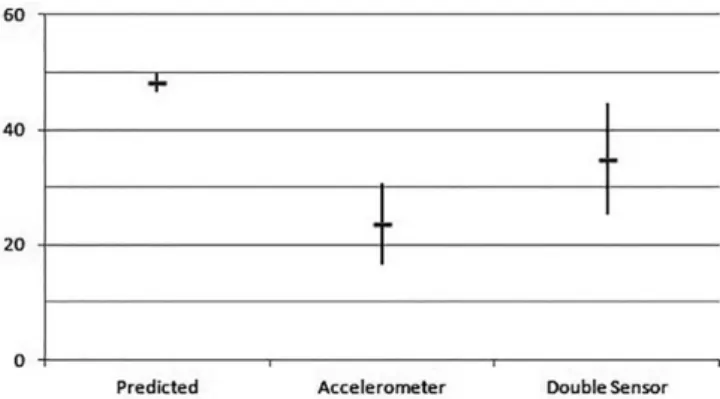
In the ergoespirometry test, the maximal predicted HR average obtained by patients was 153.0±9,4 bpm. In the pa-tients whose pacemakers were programmed with the acceler-ometer, this rate reached 106.3±2.7 bpm, while the ones with double sensor had a 132.5±6.3 bpm value (r<0.0001, shown in Figure 1). As for oxygen consumption, the predicted val-ue of VO2 max was 48.2±1.7. The accelerometer reached 34.9±9.7 and the double sensor reached 23.6±7.1 (r<0.0001). Eventually, the predicted metabolic equivalent (MET) reached a 6.8±1.6 value, with 5.8±1.7 METs in the acceler-ometer and 7.8±2.3 METs in the double sensor (r<0.0001) (Figures 2, 3 and 4).
Arrhythmia Density Analysis
a) Atrial: there was no statistically relevant difference be-tween the two groups (r>0.05)
Fig. 1 - Averages obtained in the erogoespirometry test.
ACCEL=Accelerometer; MET=Metabolic equivalent; DS=Double Sensor
Fig. 2 - Maximal Heart Rate and standard deviation (in bpm) obtained in the ergoespirometry test.
Fig. 3 - VO2 max: value in the ergoespirometry test in the different groups (average and standard deviation).
Fig. 4 - Average and standard deviation of metabolic equivalent in the different groups.
DISCUSSION
sensor measures the body’s activity or movement associated with physical activity. It is the most used sensor due to its low cost and easy programming. Nevertheless, it might not respond well in very intense exercises that involve less body movements or in emotional stress moments at rest[7- 9].
These data support our results. In fact, the statistically rel-evant difference in the metabolic equivalent (MET), compar-ing the ACCEL activity to the DS (ACCEL + MVS), works in a complementary way and shows great advantages and improvements in the chronotropic response. The high cost, need for closer following and reduction in the pacemaker op-erating life may be considered as disadvantages[7,9].
In our results, none of the groups reached maximal pre-dicted HR. That is why we cannot ascertain whether the chro-notropic insuficiency is the one that leads to a lower aerobic capacity or vice-versa. In the Rocha et al.[10] study, similar results were found, as far as HR is concerned. It is import-ant to note that, after the adjustment for maximal estimated oxygen consumption, the chagasic patients went on having less aerobic capacity. It proves that the lower aerobic capac-ity is not the main cause of the chronotropic insuficiency observed amongst the Chagas Disease patients.
CONCLUSION
Even though the heart rate was not reached, the double sensor provided a more physiological electric sequence com-pared to the accelerometer sensor.
Authors’ roles & responsibilities
ASMJ Researcher
APS Analysis and/or interpretation of data; statistical analysis; implementation of projects and/or experiments
GGBP Performing operations and/or experiments; manuscript writing or critical review of its content
CO Analysis and/or interpretation of data; statistical analysis; study design
JFSL Conception and design; implementation of projects and/or experiments
REFERENCES
1. Rassi A Jr, Rassi A, Rassi SG. Predictors of mortality in chronic Chagas disease: a systematic review of observational studies. Circulation. 2007;115(9):1101-8.
2. Marin-Neto JA, Cunha-Neto E, Maciel BC, Simões MV. Pathogenesis of chronic Chagas heart disease. Circulation. 2007;115(9):1109-23.
3. Menezes Junior AS, Comerlatto GC, Lopes LHM. O uso da frequência adaptativa na terapia de ressincronização cardíaca: revisão literária. Relampa. 2012;25(2):134-45.
4. Arce M, VAN Grieken J, Femenía F, Arrieta M, McIntyre WF, Baranchuk A. Permanent pacing in patients with Chagas’ disease. Pacing Clin Electrophysiol. 2012;35(12):1494-7.
5. Okin PM, Lauer MS, Kligield P. Chronotropic response to exercise. Improved performance of ST-segment depression criteria after adjustment for heart rate reserve. Circulation. 1996; 94(12):3226-31.
6. Coelho-Ravagnani CF, Melo FCL, Ravagnani FCP, Burini FHP, Burini RC. Estimation of metabolic equivalent (MET) of an exercise protocol based on indirect calorimetry. Rev Bras Med Esporte. 2013;19(2):134-8.
7. Gilliam FR 3rd, Giudici M, Benn A, Koplan B, Berg KJ, Kraus SM, et al. Design and rationale of the assessment of proper physiologic response with rate adaptive pacing driven by minute ventilation or accelerometer (APPROPRIATE) trial. J Cardiovasc Transl Res. 2011;4(1):21-6.
8. Occhetta E, Bortnik M, Marino P. Usefulness of hemodynamic sensors for physiologic cardiac pacing in heart failure patients. Cardiol Res Pract. 2011;2011:925653.
9. Pilat E, Mlynarski R, Wlodyka A, Kargul W. Inluence of DDD rate response pacing with integrated double sensors on physical eficiency and quality of life. Europace. 2008;10(10):1189-94.