Non-instrumental clinical evaluation for oropharyngeal
dysphagia in Parkinson’s disease: systematic review
Instrumentos de avaliação clínica para disfagia orofaríngea na
doença de Parkinson: revisão sistemática
Annelise Ayres
1, Lais Alves Jacinto-Scudeiro
2, Maira Rozenfeld Olchik
3ABSTRACT
Introduction: Parkinson’s disease (PD) is the second most prevalent neurodegenerative disease in the world, with a predominance of motor and non-motor symptoms. Among these, dysphagia stands out.
Purpose: Systematically review the non-instrumental clinical evaluations available for the screening and assessment of dysphagia in individuals with PD. Research strategy: For the selection of the studies, we used the descriptors: Parkinson disease, swallowing, dysphagia, deglutition disorders, questionnaire, health surveys, evaluation, screening, and evaluation, in a variety of combinations, aiming at a greater number of studies. The databases were PubMed, Cochrane Library, and SciELO.
Selection criteria: Articles published in English, Portuguese, and Spanish that were published between January 2006 and July 2016 were selected, whose methodological approach met the objective of this review. A descriptive analysis was performed. Two independent reviewers reviewed the articles in order to verify the eligibility. When there was disagreement, a consensus was reached by the evaluation of a judge who did not know the previous evaluations. Results:
Eight hundred forty-six articles were founded. After considering the inclusion/exclusion criteria and the judge’s analysis, only four studies were analyzed, which were four different instruments, and all of the instruments were self-perception questionnaires of dysphagia. There was no instrument that performed a clinical evaluation of dysphagia with the food supply. Conclusion: It has been verified there are no instruments for the screening and clinical evaluation of dysphagia in patients with PD who use a food supply and not only the self-perception of the patient in the period that included the bibliographic survey of this study.
Keywords: Parkinson disease; Deglutition disorders; Evaluation; Surveys and questionnaires
RESUMO
Introdução: Adoença de Parkinson (DP) é a segunda doença neurodegenerativa mais prevalente no mundo, com predomínio de sintomas motores e não motores. Dentre estes, destaca-se a disfagia.
Objetivo: Realizar a revisão sistemática da litera tura que trata das avaliações clínicas não instrumentais disponíveis para rastreio e avaliação da disfagia em indivíduos com DP. Estratégia de pesquisa:
Para a seleção dos estudos, foram utilizados os descritores Parkinson disease, swallowing, dysphagia, deglutition disorders, questionnaire, health surveys, evaluation, screening e assessment, em combinações variadas, nas seguintes bases de dados: PubMed, Biblioteca Cochrane e SciELO. Critérios de seleção: Artigos em inglês, português e espanhol, publicados no período de janeiro de 2006 a julho de 2016, cuja abordagem metodológica atendesse ao objetivo desta revisão. Dois revisores independentes analisaram os artigos, a fim de verificar a elegibilidade. Quando houve discordância, o consenso foi alcançado pela avaliação de um juiz que não conhecia as avaliações anteriores.
Resultados: Foram encontrados 846 artigos. Após consideração dos critérios de inclusão/exclusão e análise do juíz, apenas 4 estudos foram analisados, nos quais foram utilizados 4 instrumentos diferentes, todos eles questionários de autopercepção da disfagia. Não houve nenhum instrumento que tivesse realizado avaliação clínica da disfagia com oferta de alimentos. Conclusão: Verificou-se que não existem instrumentos de rastreio e de avaliação clínica da disfagia em paciente com DP que utilizem oferta de alimento e não somente auto-percepção do paciente, no período que compreendeu o levantamento bibliográfico deste estudo.
Palavras-chave: Doença de Parkinson; Transtornos de deglutição; Avaliação; Inquéritos e questionários
Work conducted at Universidade Federal do Rio Grande do Sul – UFRGS – Porto Alegre (RS), Brazil.
(1) Graduate Program in Health Sciences, Universidade Federal de Ciências da Saúde de Porto Alegre – UFCSPA – Porto Alegre (RS), Brazil. (2) Hospital de Clínicas de Porto Alegre – Porto Alegre (RS), Brazil.
(3) Speech Therapy Course, Department of Surgery and Orthopedics, Universidade Federal do Rio Grande do Sul – UFRGS – Porto Alegre (RS), Brazil.
Conflict of interests: No
Authors’ contribution: AA design and study design, data collection, analysis, and interpretation; essay writing and review in an intellectually important way;
LAJC design and study design, data collection, analysis, and interpretation; essay writing and review in an intellectually important way; MRO design and study design, data collection, analysis and interpretation; essay writing and review in an intellectually important way, final approval of the version to be published.
Corresponding author: Maira Rozenfeld Olchik. E-mail: [email protected]
INTRODUCTION
Parkinson’s disease (PD) is the second most prevalent
neurodegenerative disease in the world with a worldwide
incidence of 1 to 20, per 1,000 individuals/year
(1). Brazilian
studies have estimated an incidence of 36,000 new cases
per year, with a prevalence of 0.7% individuals with PD in
the 60-69 age group and 1.5% in the 70-79 age group
(2). In a
Brazilian population study, a prevalence of 3.3% was observed
in individuals over 64 years old
(3).
According to the London Brain Bank Criteria
(4), PD is a
predominant disease of motor symptoms, characterized by
stiffness, postural tremor, and bradykinesia, but the prevalence
of non-motor symptoms is high. Among these, dysphagia is
observed, which, even though it is an alteration involving the
musculature of phonoarticulatory organs, it is classified as a
non-motor symptom according to the Movement Disorders
Society
(5). Dysphagia is an aggravating symptom in PD, which
is not directly associated with the severity of the disease and
may have an adverse impact on the quality of life, impairs
the intake of food and medication, and may frequently lead
to laryngotracheal aspiration. According to the literature, it
is verified that the prevalence rates of dysphagia in PD range
from 70% to 100%. Moreover, there is a relative risk of 3.2%
of the presence of this symptom in individuals with PD when
compared with healthy control groups
(6,7,8,9,10).
When the mechanics of airway protection are deficient, the
symptom of dysphagia tends to result in complications, such
as aspiration pneumonia, malnutrition, and dehydration, with
the latter two resulting from lower food intake or changes in
consistency, according to the severity of the disease. The data
from the literature indicate that respiratory infection is the
leading direct cause of death in patients with PD and is highly
associated with immobility and dysphagia.
There is a prevalence of 30% to 45% of pneumonia among
the causes of death in patients with PD
(7,8,9,10). In Brazil, recent
data indicate pneumonia as the leading cause of death in this
population
(11).
Dysphagia in PD can affect all of the phases of swallowing,
with the most prevalent signs and symptoms: increased oral
transit time; Difficulty in forming the bolus; Residue in
oral cavity; Poor bolus ejection of food; Multiple swallows;
Posterior escape of the bolus; Decreased swallowing reflex;
Oropharyngeal bradykinesia; Alteration in vocal fold closure;
Reduction in the anterior movement of the hyoid bone;
Reduction in pharyngeal and esophageal motility; Pharynx food
stasis; Esophageal sphincter dysfunction; gastroesophageal
reflux; Laryngeal penetration and tracheal aspiration
(12,13,14,15).
OBJECTIVE
In view of the high prevalence of dysphagia in PD and its
significant impact on the course of the disease, the aim of this
article was to make a systematic review of the literature about
non-instrumental clinical evaluations available for screening
and evaluation of dysphagia in individuals with Parkinson’s
disease.
RESEARCH STRATEGY
The literature review was conducted with the delimitation
of the following steps: identification of the problem with the
formulation of the research question; keyword establishment;
determination of the criteria for the inclusion and exclusion
of articles; selection of papers; analysis of articles by a blind
judge; information to be extracted. The question that led to
this review was: “What are the non-instrumental assessments
available for the screening and clinical evaluation of swallowing
in Parkinson’s disease?”.
A survey of the national and international literature was
conducted in the online databases PubMed, Cochrane Library,
and SciELO. The descriptors based on the DeCS (Health
Sciences Descriptors) and free terms used for the research
were: Parkinson disease, swallowing, dysphagia, deglutition
disorders, questionnaire, health surveys, evaluation, screening,
and assessment, in varied combinations, aiming at a greater
number of studies.
SELECTION CRITERIA
We included articles whose methodological approach
referred to screening instruments and a clinical evaluation of
oropharyngeal dysphagia, elaborated for patients with PD; The
publications from January 2006 to July 2016 in the English,
Portuguese, and Spanish languages, with full texts available,
describing the use of non-instrumental assessments; Articles
referring to swallowing, swallowing, or dysphagia. Publications
that did not have the abstract or full text, review articles,
dissertations were excluded, those that were not compatible
with the topic covered, and those that were repeated in the
databases.
Two independent reviewers reviewed the original abstracts
and publications selected, by the inclusion and exclusion
criteria, in order to verify eligibility. In articles where there
was disagreement between the two reviewers, a consensus was
reached by the evaluation of a third judge who did not know
the previous evaluations.
DATA ANALYSIS
and specificity of the instrument. Descriptive analysis was
performed.
RESULTS
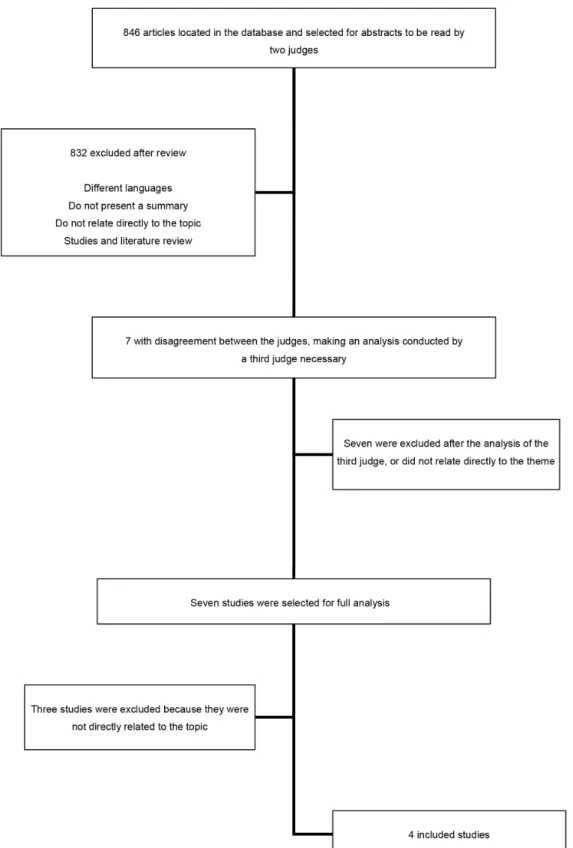
Initially, 846 articles were found. After considering the
inclusion/exclusion criteria and the judge’s report, only four
studies were analyzed and, in these articles, four different
instruments were found (Figure 1).
Concerning instruments for the screening and clinical
evaluation of swallowing in Parkinson’s disease, the four studies
(100%) used self-perception questionnaires for dysphagia,
in which higher scores were related to higher perceived
dysfunctions (Chart 1).
Chart 1. Analysis of protocols found
Author/year Article Population Screening Instrument Characterization of
the instrument
Psychometric measures and conclusions
Manor et al., 2007(14)
Validation of a Swallowing Disturbance Questionnaire for Detecting Dysphagia
in Patients with Parkinson’s Disease
57 patients with PD
Swallowing Disturbance Questionnaire (SDQ)
Five questions related to the oral phase of swallowing
and ten questions related to the pharyngeal phase. Fourteen items were
rated on a 4-point scale (0 for non-disability and 3 for
severe disability), and one was a yes/
no question.
Cronbach’s α value: 0.89. Sensitivity:
80.5%. Speciicity:
81.3%. SDQ has been shown to be a validated tool for detecting early dysphagia in patients
with PD.
Simons et al., 2014(15)
Development and validation of a new screening questionnaire for dysphagia in early stages of Parkinson’s
disease
105 patients during questionnaire construction and 82
during validation
Munich Dysphagia Test and Parkinson’s
disease (MDT-PD)
Composed of four subscales that
interrogate. Diiculty
in swallowing food
and liquids, diiculty
in swallowing, regardless of food intake, how swallowing negatively
inluences aspects of
daily life and general health issues. This
questionnaire is available in an online
version.
The Cronbach’s
α value: 0.91. Sensitivity: 82.4 to
90%. Speciicity:
61.9 to 85.7%. MDT-PD is a valid screening tool for the
early diagnosis of swallowing problems and risk of aspiration,
in addition to assisting in the initial
graduation of the dysphagia severity in
patients with PD.
Jones and Ciucci, 2016(16) Multimodal swallowing evaluation with high-resolution manometry reveals subtle swallowing changes in early and
midstage Parkinson disease
26 patients with PD and 26 control group
Sydney Swallow Questionnaire (SSQ)
The SSQ has 17 items and is intended to obtain
the individual’s perception during
swallowing. The values of each question range from
0 to 100. In all, the maximum possible score is 1,700. The SSQ was validated for use in patients with PD [33], and the range for healthy
patients is between 10 and 235.
Individuals with PD present changes in swallowing and
can self-assess the aspects of swallowing with the
protocol studied at the beginning and some stages of PD.
Kalf et al., 2011(17)
Reproducibility and Validity of Patient-Rated Assessment of Speech, Swallowing, and Saliva Control in Parkinson’s Disease
129 patients with PD or atypical Parkinsonism
Radboud Oral Motor Inventory for Parkinson’s Disease
(ROMP)
The protocol is divided into three
subscales. Each question has up to 5 points (1 normal and
ive worst score) and
limits the number per subscale to 7.
Reproducibility was 95% total. Cronbach’s α value: 0.95. ROMP provides
a valid and reliable instrument for assessing patients’ perceived problems
with speech, swallowing and saliva
control in patients with Parkinson’s
There was no instrument that had performed a clinical
evaluation of dysphagia with the food supply.
DISCUSSION
After the full analysis of the articles, only the self-perception
of swallowing questionnaires for the assessment of dysphagia
in patients with PD was verified
(16,17,18,19)in the period of the
literature review of this study. However, it is known that, in
this population, dysphagia may be subclinical or asymptomatic
(patient does not report symptoms). Even with the presence of
clinical signs, patients gradually adapt to them, believing it to
be a natural consequence of the progression of the disease. The
main examples of such adaptations are the decrease in the size
of the bolus, change of alimentary consistency, and exclusion
of foods that cause greater difficulty in feeding. In addition,
cognitive impairment or sensory problems may hinder the
self-perception of dysphagia symptoms. All of these factors
tend to cause an increased risk of complications due to the
underestimation of dysphagia and emphasize the need for a
proactive clinical approach to dysphagia, primarily because of
the serious clinical consequences of this symptom. Therefore,
the instruments of self-perception of dysphagia are not sensitive
for this population
(6).
Studies with other neurological diseases, such as stroke,
have presented several protocols for the clinical evaluation
of swallowing, with an investigation of the clinical signs of
dysphagia after food supply in the most various consistencies
(liquid, pasty, and solid)
(20). However, the evaluation and
treatment of patients with PD have a different approach than
that for post-stroke patients, considering the degenerative factor
of PD, which makes it impossible to use the same protocols.
An article that was aimed at the comparative analysis of
an instrument for the clinical evaluation of swallowing with
videofluoroscopy presented a sample of 85 patients wherein
only 24 of them had different neurological diseases, and of
those, only two had PD
(21). Although it was the only study
found on the subject, the author did not describe the relevance
of the protocol for patients with PD because of the reduced
number of the sample.
Several studies have reported respiratory infection as the
main direct cause of death in patients with PD
(7,8,9,10,22). Because
such comorbidity is highly associated with immobility and
dysphagia, the importance of speech-language therapy for
dysphagia in these individuals is perceived as preventing or
delaying the onset of aspiration pneumonia.
Limitations and prospects
Given the lack of clinical assessment instruments in the
population with PD, in places where objective evaluation is not
available, it is possible that patients are being diagnosed in more
advanced stages, when there are complaints or complications
related to the presence of dysphagia. This factor reduces the
therapeutic possibilities in patients with PD and the possibility
of a good prognosis.
The International Parkinson’s and Movement Disorder
Society (MDS) advocates the use of various scales of evaluation
in the various changes in movement disorder. Among them,
about speech-language pathology, there are only two vocal
evaluation scales. Considering the absence of protocols for
the clinical evaluation of dysphagia in PD, it is possible for
future studies to create a clinical evaluation scale, which
could positively impact the early diagnosis and quality of life
of the patients, since these present a high mortality risk due
to dysphagia.
CONCLUSION
In the period that included the bibliographic survey of this
study, no clinical screening or clinical evaluation instruments
of dysphagia were found in patients with Parkinson’s disease
who used a food supply and not only the self-perception of the
patient. Therefore, it is necessary to establish rapid and sensitive
protocols for the screening and evaluation of dysphagia in
this population and not only to use self-perception, since the
prevalence of dysphagia is high in Parkinson’s disease and
few patients, even with the presence of the symptom, report
swallowing complaints.
REFERENCES
1. Van Den Eeden SK, Tanner CM, Bernstein AL, Fross RD, Leimpeter A, Bloch DA et al. Incidence of Parkinson’s disease: variation by age, gender, and race/ethnicity. Am J Epidemiol. 2013;157(11):1015-22. https://doi.org/10.1093/aje/kwg068
2. Souza CFM, Almeida HCP, Sousa JB, Costa PH, Silveira YSS, Bezerra JCL.A Doença de Parkinson e o processo de envelhecimento motor: uma revisão de literatura. Rev Neurosci. 2011;19(4):718-23. 3. Barbosa MT, Caramelli P, Maia DP, Cunningham MC, Guerra HL, Lima-Costa MF et al. Parkinsonism and Parkinson’s disease in the elderly: a community-based survey in Brazil (the Bambuí study). Mov Disord. 2006;21(6):800-8. https://doi.org/10.1002/mds.20806 4. Hughes AJ, Daniel SE, Kilford L, Lees AJ. Accuracy of clinical
diagnosis of idiopathic Parkinson’s disease: a clinicopathological study of 100 cases. J Neurol Neurosurg Psychiatry. 1992;55(3):181-4.
5. Chaudhuri KR, Healy DG, Schapira AHV. Non-motor symptons of Parkinson´s Disease: diagnosis and management. Lancet Neurol. 2006;5(3):235-45. https://doi.org/10.1016/S1474-4422(06)70373-8 6. Kalf JG, Swart BJM, Bloem BR, Munneke M. Prevalence of
oropharyngeal dysphagia in Parkinson’s disease: a meta-analysis. Parkinsonism Relat Disord. 2012;18(4):311-5. https://doi. org/10.1016/j.parkreldis.2011.11.006
population-based study. J Neurol. 2006;253(1):33-7. https://doi.org/10.1007/ s00415-005-0916-7
8. Pennington S, Snell K, Lee M, Walker R. The cause of death in idiopathic Parkinson’s disease. Parkinsonism Relat Disord. 2010;16(7):434-7. https://doi.org/10.1016/j.parkreldis.2010.04.010 9. Macleod AD, Taylor KS, Counsell CE. Mortality in Parkinson’s
disease: a systematic review and meta-analysis. Mov Disord. 2014;29(13):1615-22. https://doi.org/10.1002/mds.25898
10. Pinter B, Diem-Zangerl A, Wenning GK, Scherfler C, Oberaigner W, Seppi K et.al. Mortality in Parkinson’s disease: a 38-year follow up study. Mov Disord. 2015;30(2):266-9. https://doi.org/10.1002/ mds.26060
11. Fernandes GC, Socal MP, Schuh AFS, Rieder CRM. Clinical and epidemiological factors associated with mortality in Parkinson’s disease in a brazilian cohort. Parkinson’s Dis. 2015;2015:ID-959304. https://doi.org/10.1155/2015/959304
12. Smith SK, Roddam H, Sheldrick H. Rehabilitation or compensation: time for a fresh perspective on speech and language therapy for dysphagia and Parkinson’s disease? Int J Lang Commun Disord. 2012;47(4):351-64. https://doi.org/10.1111/j.1460-6984.2011.00093.x
13. Kim YH, Oh BM, Jung IY, Lee JC, Lee GJ, Han TR. Spatiotemporal characteristics of swallowing in Parkinson’s disease. Laryngoscope. 2015;125(2):389-95. https://doi.org/10.1002/lary.24869
14. Argolo N, Sampaio M, Pinho P, Melo A, Nóbrega AC. Swallowing disorders in Parkinson’s disease: impact of lingual pumping. Int J Lang Commun Disord. 2015;50(5):659-64. https://doi. org/10.1111/1460-6984.12158
15. Nicaretta DH, Rosso AL, Mattos JP, Maliska C, Costa MMB. Dysphagia and sialorrhea: the relationship to Parkinson’s disease. Arq Gastroenterol. 2013;50(1):42-9. https://doi.org/10.1590/S0004-28032013000100009
16. Manor Y, Giladi N, Cohen A, Fliss DM, Cohen JT. Validation of a swallowing disturbance questionnaire for detecting dysphagia in patients with Parkinson’s disease. Mov Disord. 2007;22(13):1917-21. https://doi.org/10.1002/mds.21625
17. Simons JA, Fietzek UM, Waldmann A, Warnecke T, Schuster T, Ceballos-Baumann AO. Development and validation of a new screening questionnaire for dysphagia in early stages of Parkinson’s disease. Parkinsonism Relat Disord. 2014;20(9):992-8. https://doi. org/10.1016/j.parkreldis.2014.06.008
18. Jones CA, Ciucci MR. Multimodal swallowing evaluation with high-resolution manometry reveals subtle swallowing changes in early and mid-stage Parkinson disease. J Parkinsons Dis. 2016;6(1):197-208. https://doi.org/10.3233/JPD-150687
19. Kalf JG, Borm GF, Swart BJ, Bloem BR, Zwarts MJ, Munneke M. Reproducibility and validity of patient-rated assessment of speech, swallowing, and saliva control in Parkinson’s disease. Arch Phys Med Rehabil. 2011;92(7):1152-8. https://doi.org/10.1016/j. apmr.2011.02.011
20. Almeida TM, Cola PC, Pernambuco LA, Junior HVM, Silva RG. Instrumentos de rastreio para disfagia orofaríngea no acidente vascular encefálico. Audiol Commun Res. 2015;20(4):361-70. https://doi.org/10.1590/2317-6431-2015-1571
21. Clavé P, Arreola V, Romea M, Medina L, Palomera E, Serra-Prat M. Accuracy of the volume-viscosity swallow test for clinical screening of oropharyngeal dysphagia and aspiration. Clin Nutr. 2008;27(6):806-15. https://doi.org/10.1016/j.clnu.2008.06.011 22. Monteiro L, Souza-Machado A, Pinho P, Sampaio M, Nóbrega AC,