*Correspondence: D. R. Oliveira. Núcleo de Pesquisa de Produtos Naturais, Bloco H, Centro de Ciências da Saúde, Cidade Universitária, Ilha do Fundão - 21941-590 - Rio de Janeiro – RJ, Brasil. E-mail: [email protected]
A
rti
Pharmaceutical Sciences vol. 46, n. 1, jan./mar., 2010
Evaluation of medicine package inserts: a study of two cases of
Pelargonium sidoides
D.C. phytomedicines
Tiago Duarte Linhares
1, Danilo Ribeiro de Oliveira
2,*, Michele Feitoza Silva
31Universidade Estácio de Sá, 2Núcleo de Pesquisa de Produtos Naturais, Centro de Ciências da Saúde, Universidade Federal
do Rio de Janeiro, 3Instituto Nacional de Controle de Qualidade em Saúde, Fundação Oswaldo Cruz
In order for a phytotherapeutic drug be approved and sold in Brazil, it must be registered with the National Sanitary Surveillance Agency (ANVISA), where the quality, safety and eficacy of the product are carefully appraised. In addition, the drug must also meet a number of criteria one of which is the adequacy of the package inserts. Therefore, the aim of this study was to appraise the package inserts of all phytotherapeutic drugs produced using a standardized extract of Pelargonium sidoides, which were registered and available from Brazilian pharmacies. This checking was to ascertain whether these inserts fulilled the requirements stipulated by RDC 140/03. The information required under RDC 140/03 was appraised through a previously devised standard form. Evaluation of the package inserts revealed that neither of the two brands fully met the requirements of the legislation. Manufacturer ‘A’ met only 37.0% of the requirements satisfactorily, while 16.0% of the information was considered unsatisfactory and 47.0% of the information was absent. Regarding manufacturer ‘B’, 64.2% of the analyzed requirements were considered satisfactory, while 16.0% were considered unsatisfactory and 19.8% of the information was absent. A package insert should contain information about medicine for consumers, pharmacists and doctors. However, the results obtained in this study showed that the information presented in the package insert of both medicines was unsatisfactory, and in many cases, violates the legislation.
Uniterms: Medicines/formulation of package inserts. Phytotherapeutic drugs. Package inserts/evaluation.
Pelargonium sidoides.
Para que um medicamento itoterápico seja comercializado no Brasil, este deve ser registrado junto à ANVISA, onde são avaliados todos os aspectos referentes à qualidade, segurança e eicácia do produto, além de veriicar se estes atendem alguns requisitos, sendo um deles a adequação da bula. Por esta razão, neste estudo foram avaliadas as bulas de todos os itoterápicos elaborados à base do extrato padronizado de
Pelargonium sidoides, registrados e disponíveis no mercado brasileiro, com o intuito de veriicar se estas atendem aos requisitos exigidos pela RDC 140/03. No presente trabalho, as informações exigidas pela RDC 140/03 foram avaliadas através de um formulário padrão previamente elaborado. Após avaliação das bulas pode ser veriicado que nenhuma das duas marcas atendia por completo as exigências da legislação, sendo que o fabricante “A” atendeu apenas 37,0% dos requisitos exigidos de forma satisfatória, enquanto 16,0% das informações foram consideradas insatisfatórias e em 47,0% as informações estavam ausentes. Com relação ao fabricante “B”, 64,2% dos itens analisados foram considerados satisfatórios, enquanto 16,0% foram considerados insatisfatório e em 19,8% as informações estavam ausentes. A bula deveria conter informações sobre o medicamento para consumidores, farmacêuticos e médicos, no entanto, os resultados obtidos neste estudo mostram que as informações apresentadas nas bulas foram insatisfatórias, e em muitos casos, violavam a legislação vigente.
INTRODUCTION
Initial Considerations
Up until the beginning of the twentieth century, plants and vegetal extracts were the main sources of the-rapeutic resources. With the impact caused by the advent of important pharmaceutical synthetic elements, natural medicines started to become relegated as a second option. Nevertheless, in the past few years, the resumption of phytotherapeutic medicine use has increased markedly
(Bello et al., 2002). The population on the other hand,
has little information concerning the use of this kind of medicine and the majority thinks that phytotherapeutic medicines offer no risks to their health and have no side effects. These beliefs can lead to their irrational use and
self-medication (Amaral et al., 2007).
About the medicine register
Brazilian legislation has steadily been regulating the register of phytotherapeutic medicines in Brazil, initially
with SVS decree number 6 of January 31st, 1995,
upda-ted in 2000 through resolution RDC number 17, by the National Sanitary Surveillance Agency (ANVISA) and more recently with the enactment of RDC number 48 of 2004 (Virgílio, Marques, 2004). According to Carvalho
et al. (2007), for a phytotherapeutic medicine to be com-mercialized in Brazil it must be registered by ANVISA. This register represents the irst intervention concerning product quality, safety and eficacy.
For the industry to achieve the register of the medi-cine it must petition ANVISA, also known as a procedure, with a technical dossier containing information about the product concerning production, quality control, safety and eficacy assays, legally required company data, besides
medicine labeling and package insert data (Carvalho et
al., 2007).
In Brazil, the most important source of information
for medicine users is the package inserts (Silva et al.,
2000; Farias et al., 1985). In light of this, and assuming
the medicine package inserts should effectively guide both patients and health professionals regarding the rational use of the medicine, resolution RDC number 140/03 was im-plemented, establishing rules for medicine package inserts for the beneit of both patients and health professionals.
In spite of the compulsory nature of the package inserts in the medicine package, they provide very little information for patients and health professionals. This is the case because of the lack of adaptation of the package inserts to meet the current legislation.
Pelargonium sidoides
The Perlagonium sidoides DCis a plant belonging to the family of Geraniaceae, which is found in the Afri-can continent at a height of 2.300 meters, mainly in South
Africa and is popularly called umckaloabo. It is
characte-rized for presenting massive dark brown roots, big round tipped leaves, an inlorescence that ranges from reddened to dark purple, with petals that vary in color. The leaves and particularly the roots are the most commonly used parts medicinally (Alonso, 2004; Bladt, Wagner, 2007).
Chemical composition
P. sidoides roots present mainly condensed taninns
in their particular metabolism, highlighting the oligome-ric proantocianidines formed by at least eight units of lavan-3-ol like monomers (afzelequine, catequine and
galocatequine), and the coumarins escopoletine, fraxidin,
isofraxedin, arteline, umckalin and its 7-O-methilether
(5,6,7-trimethoxycoumarin) (Alonso, 2004; Kaiser, Ko-lodziej, 1995; Bladt, Wagner, 2007; KoKo-lodziej, 2007b). It is also possible to ind lavonoids (quercetin), terpenes (mono and sesquiterpens), phenylpropanoids, and anacar-dic acid (Alonso, 2004; Bladt, Wagner, 2007).
Pharmacological activities
Several authors (Alonso, 2004; Mativandlela et al.,
2006; Conrad et al., 2007; Matthys, Heger, 2007b;
Kolo-dziej, Kiderlen, 2007a), report that the roots of P. sidoides
have antimicrobial activity, inhibiting Gram-positive ger-ms (Staphylococcus aureus, Streptococcus pneumoniae, S. beta-hemolitico 1451), Gram-negative germs (Escherichia coli, Klebsiella pneumoniae, Proteus mirabilis), virus (Haemophilus influenzae, Moraxella catarrhalis), and
fungus(Aspergillus niger, Fusarium oxysporum, Rhizopus
stolonifer).Among the components that make this activity possible are the coumarins (Alonso, 2004).
The P. sidoides also has, according to traditional use,
activity for the treatment of tuberculosis (Kolodziej et al.,
2003). Mantivandlela et al. (2006) reported
antimycobac-terial activity of the P. sidoides roots, in vitro, against M.
tuberculosis.
Several studies, both in vitro and in vivo, as well as
formation of cytokines that intervene defending against anaerobic microorganism infections (Alonso, 2004).
Ac-cording to Neugebauer et al. (2005), EPs 7630 present an
increase in the frequency of the beating movement of the nasal epithelium. This beating movement is an important mechanism of physical defense against infections. In the
in vitro model of fibroblasts infected with the virus of
brain-miocarditis, the extract of P. sidoides was shown to
produce alpha and beta interferons, which have recognized antiviral effect, where the umckalin and the gaelic acid are the main components responsible for these effects
(Marcucci et al., 1992 apud Alonso, 2004 ). The EPs 7630
extract also demonstrates action in relieving lu symptoms (Noldner, Schotz, 2007).
A study performed using extracts of roots of P.
si-doides, involving 641 patients with infections in the oro-pharynx (tonsil infection, rhinopharyngitis) and breathing (bronchitis, sinusitis), demonstrated that 85% of the pa-tients experienced signiicant clinical improvement after a fourteen-day course of treatment (Heil, Reitermann, 1994
apud Alonso, 2004). Several clinical studies (Chuchalin
et al., 2005; Matthys et al., 2003; Matthys et al., 2007a; Matthys, Hereg, 2007b) have also proven the eficacy of Eps 7630 for treating bronchitis.
Cumarinic derivates are among the main
com-ponents of P. sidoides. Given this, and considering the
possibility of this plant having anticlotting activity, Koch, Biber (2007) investigated the parameters of blood clotting in mice, after administration of the substance, comparing it to warfarin. After the oral administration of Eps 7630 for two weeks, no effect was observed, in contrast to warfarin, which over the same period resulted in signiicant changes in the clotting factor.
Adverse effects
No adverse effects have been reported in patients
older than 12 years old, noting that the extract of P.
si-doides is well tolerated in therapeutic doses (Tsyrkunov,
1989; Kolodziej et al., 1997 apud Alonso, 2004; Correia
et al., 1984 apud Alonso, 2004; Anderson et al., 1992;
Edenharder et al., 1995 apud Alonso, 2004; Heil,
Rei-termann, 1994 apud Alonso, 2004; Matthys et al., 2003;
Schotz et al., 2007).
A study performed with extracts of roots of P.
si-doides in 259 children aged up to12 years old that had acute bronchitis events, showed that it had good tolerance. However, 6 patients (2.3%) showed some adverse effects such as: exantema, light dyspnea, intestine spasms, lack of appetite, vomiting and restlessness. After suspending use of the medicine, patients’ clinical pictures returned to
normal (Dome, Schuster, 1996 apud Alonso, 2004).
Contraindication
Due to the lack of data indicating the safety of P.
sidoides use during pregnancy, the use of the product must be avoided during gestation and breast-feeding (Alonso, 2004).
MATERIALS AND METHODS
Analysis of Package Inserts
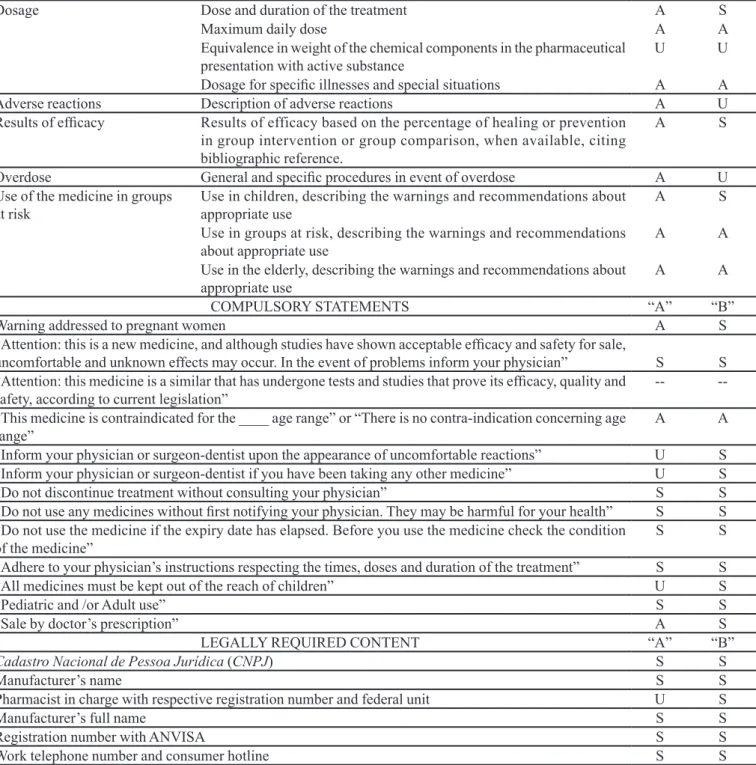
The study was developed initially through a vast bibliographic revision, centering its source of research on scientiic papers, books, laws, decrees, and resolutions, for substantiation and formation of a theoretical basis, followed by the devising of a standard form relecting reso-lution RDC number 140/03 (Brasil, 2003a), transforming its articles into items on a checklist (Table I).
The purpose of the form was to conirm the presen-ce of compulsory statement, indications for use, speciic technical information and legally required content. To this end, the previously devised standard form was divided
into six parts: the 1st part evaluates the size of the lettering;
the 2nd part evaluates the identiication of the medicine;
the 3rd part, information to patients; the 4th part, technical
information for health professionals; the 5th part,
compul-sory statement, and the 6th part, legally required content.
Each aspect checked was classiied into one of three pos-sible categories: (S) Satisfactory - when the information conforms to the legislation in a complete or satisfactory way; (U) Unsatisfactory - when the information fails to fully conform to the legislation; (A) Absent - when no information is provided. All the items on the form were considered indispensable and, therefore, the weight for the evaluation fulilled only one criterion (weight 1). All the items for the medicine package inserts were evaluated by three competent pharmaceutical professionals and the same result was presented as a whole for the interpretation of the forms.
To evaluate if the package insert information was rendered in accessible language for the patients and in accordance with the International Classiication of Dise-ases (ICD), pursuant to RDC 140/03, both the Brazilian
Center for Disease Classiication (Centro Brasileiro de
Acquisition of sample
The sample was formed by the package inserts of phytotherapeutic medicines derived from standardized
extract of roots of Pelargonium sidoide commercialized
in Brazil. Two such products were found to be registered on ANVISA’s oficial site. The samples were acquired from drugstores in the municipalities of Campos dos Goytacazes-Rio de Janeiro State, between September and October / 2007, with the manufacturer “A” product bearing batch number 70628 while the manufacturer “B” product had a batch number of 702720.
RESULTS AND DISCUSSION
These products containing standardized extract
of roots of P. sidoides found registered by ANVISA up
to the year of 2007 were both produced by far-reaching laboratories which have strong advertising and marketing appeal in the national milieu, achieving notable success in pharmaceutical sales according to data available on the oficial sites of the respective companies. Manufacturer “A” is an Anonymous Society (Inc.), and therefore has to release its inancial statements and results in the Oficial
Gazette of the Federal Executive (Diário Oicial da União)
or a prevalent newspaper with a broad coverage, every end of business year. Manufacturer “B” was a Limited Society (Ltd.) and made available on its site information concerning its annual revenues, which in 2007 was higher
than R$ 500.000.000,00 (five hundred million reais).
Concerning sanitary regulations in Brazil, the company may be rated as far-reaching (Group I) if it has a turnover
which is higher than ifty million reais (ANVISA, 2008).
Analysis of Package Inserts
1st Part: Size of the lettering
Both medicine package inserts conformed to the legislation concerning the compulsory characteristic of the presentation of the lettering at a minimum size of 1.5 mm (Table I), allowing reading without dificulties, es-pecially for elderly patients who often have more trouble reading.
2nd Part: Identiication of the medicine
As evidenced in Table I, manufacturer “A” confor-med to the legislation satisfactorily on 77.8% of the items and no items were considered unsatisfactory, although 22.2% of these were found to be absent. Manufacturer “B” conformed to the legislation on 77.8% of requirements satisfactorily and on 22.2% unsatisfactorily (Figure 1).
The commercialized presentations were properly described by both manufacturers, including the pharma-ceutical forms, commercial name or brand of the medicine, oficial botanic nomenclature, administration route, liquid volume and the part of the plant used.
Concerning the qualitative and quantitative des-cription of the active ingredients, “A” described this incompletely in stating that the product contained 825 mg
of liquid extract of the root of P. sidoides and a suficient
amount for 1ml of the vehicle, but omitted the informa-tion on which vehicle was being referred to. Manufac-turer “B” presented glycerol as its vehicle and a wide spectrum of variation of levels of a non-speciied class of active ingredient (0.08% to 0.32% of total phenols) as markers. However, the medicines should clearly state the active ingredients, such as coumarins and taninns (Alonso, 2004; Kaiser, Kolodziej, 1995; Kolodziej, 2007b), and therefore the information presented by both manufactures was considered lacking.
In addition, the two manufacturers cited here also omitted other components in the formula, such as coloring, lavoring, edulcoloring, stabilizers among other common items used in the manufacture of oral solutions for both
pediatrics and adult use (Ansel et al., 2000).
It is important to highlight that, according to Resolu-tion RDC 137/2003 (Brasil, 2003b), there are substances for which it is necessary to include compulsory sentences in the package inserts where packages must highlight the danger of their use by special groups (i.e. diabetics, ce-liacs, phenylketonurics), or provide warnings for patients who have allergies to them (i.e. tartazine yellow). As the excipients which have been used were not described in the package inserts, in the manner stipulated by RDC 140/2003, these could not be evaluated (Brasil, 2003a).
Furthermore, the absence and total non-speciication
FIGURE 1 – Evaluation of the item “identification of the
of excipients infringes not only sanitation regulations, but also the Consumer Defense Code (Brasil, 1990).
3rd Part: Information to patients
The required items that constitute correct informa-tion for the patient are presented in Table I, which shows
that manufacturer “A”conformed to the legislation
satis-factorily on 41.7% of the items, unsatissatis-factorily on 25% whereas for 33.3% of items the information was absent.
Manufacturer “B”conformed to the legislation in
appro-ximately 58.4% of items satisfactorily, in 20.8% unsatis-factorily while 20.8% of items were absent (Figure 2).
With regard to the “information to patients”, the package inserts of both medicines satisfactorily presen-ted physical aspects, procedures for use of the medicine, intervals of administration, dosage, in accordance with the pharmaceutical form, administration route, warnings, contraindication and precautions.
However, with regard to the “medicine action”, ma-nufacturer “A” only reported the pharmacological action of the medicine, not informing the estimated average time of action, in contrast to manufacturer “B” that reported pharmacological action, estimated average time for the action of the medicine, and the estimated time for full patient treatment.
Concerning the “medicine storage”, manufacturer “A” omitted this item, not giving any information about the correct storage procedure, before or after opening. Regarding manufacturer “B”, the information was also incomplete, in that it only informed the expiry date after opening, while omitting the precautions patients should take in storing the medicine before and after opening. Manufacturer “B” also reported that the medicine was made up by vegetal extracts, and for this reason may
present a tendency for darkening, small variations in both color and taste, without altering the effectiveness of the product. However, these problems may be caused by the inappropriate storage of the product (Brasil, 2001; Brasil, 2006).
The inappropriate storage of the medicine may cause the growth of fungus and bacteria, or may provoke altera-tions in the consistency, taste, odor and color, besides the acceleration of chemical reactions which lead to decom-position of the product and alterations in its effectiveness (Brasil, 2001; Brasil, 2006).
In the part indicating use of the medicine, both ma-nufacturers “A” and “B” proved satisfactory in reporting this information.
Concerning the language approach, manufacturer “A” presented satisfactory language, although it did not fully meet ICD requirements, presenting terminologies that are not easy for patients to understand, such as: “im-munomodulating action”, “immunologic system restora-tion”, “rhinopharyngitis”. The insert for Manufacturer “B” medicine not only presented a clear text, but also reported the main symptoms for each illness. However, this also failed to fully conform to ICD requirements by using ter-minology such as: “tonsilar angina”, “rhinopharyngitis”. None of the manufacturers fully presented the orga-noleptic characteristics of the medicine. In both package inserts, only the color was described while omitting the other characteristics such as the consistency and odor, making it impossible for patients to check if the medicine was within the standards for consumption or was “rotten”. Manufacturer “A” omitted information concerning the required conduct in the event of forgetting to take the medicine. The lack of this information may lead the pa-tient to taking an overdose, due to the false notion that the skipped doses should all be taken at once. Manufacturer “B” informed the correct procedure for patients, besides explaining that the patient should not take a double dose. Manufacturer “B” also clearly stated the duration of the treatment, and presented supplementary information on the maximum treatment period, besides recommen-dations against stopping the treatment immediately after symptoms disappear, explaining that the treatment should be continued for some days to avoid recurrence of the ill-ness. Manufacturer “A” presented no information about the duration of the treatment, although it presented instruc-tions on continuing the treatment for some days after the resolution of symptoms in order to prevent recurrence. The lack of complete information on the package inserts could lead to patients using the medicine continually.
Concerning the dosage, according to the pharma-ceutical form and its respective instructions for use, both
FIGURE 2 - Evaluation of item “Information to patients” in
package inserts by manufacturers “A” and “B” for P.
manufacturers described them satisfactorily. Manufacturer “B” also instructed the patient about the recommended amount and dosage in case of subsequent treatment (chro-nic evolution of the illness or frequent recurrence), thus not limiting the information only to that required by the legislation. However, neither of the manufacturers pre-sented the dosage for special illnesses or situations. The adverse reactions were reported by both manufacturers, although neither of them informed the adverse reactions including migraine, light dyspnea, lack of appetite and restlessness, which may occur in children aged up to 12
years old (Dome, Schuster, 1996 apud Alonso, 2004).
In the medicinal part, both manufacturers “A” and “B” described feeding and laboratory test interactions only with coumarin derivates owing to their increase in
the anticlotting action of the medicine. As P. sidoides
contains large amounts of coumarins in its composition, the administration of this phytotherapeutic in combination with others rich in coumarin (i.e. meliloto) and/or anticlot-ting (warfarin) may lead to an increase in the inhibianticlot-ting effect of clotting.
A more detailed study of the possible interactions of P. sidoides with other medicines is recommended as well as on feeding interactions and laboratory tests (Koch, Biber, 2007).
Regarding restrictions for groups at risk, manufac-turer “A” reported no restrictions concerning the use of the medicine, which may lead the patient to understan-ding that this medicine may be safely used by anybody, including new-borns, children, adults, elderly people, sick individuals and so on. On the other hand, manufacturer “B” advised against the use of the medicine by pregnant women or those who are breast feeding, without doctors’ advice, or in infants younger than one year old, due to the lack of clinical trials.
Both manufacturers omitted the statements on the risks of use by non-recommended administration routes required by law.
Neither of the manufacturers satisfactorily described the measures to be taken by patients in the event of over-dose. Manufacturer “A” reported an absence of studies on overdose, and that in the event of overdose the patient should seek medical attention immediately. In contrast, manufacturer “B” reported that this was a phytotherapeutic medicine which is well tolerated, and in case of accidental ingestion of doses much higher than those recommended, the patient should take the usual measurements for con-trolling vital functions. It is important to highlight that most of the population do not know what “control of vital functions” stands for, and therefore neither the procedure, nor the language is easily accessible to patients.
4th Part: Technical information for health professionals The items required according to RDC 140/03 for the “technical information for health professional” are presented in Table I, which shows that manufacturer “A” conformed to the legislation satisfactorily on only 3.4% of the items, and unsatisfactorily for 10.3% while 86.3%
of the items were absent. Manufacturer “B”met the
requi-rements of the legislation satisfactorily in 44.8% of items, 20.7% were regarded as unsatisfactory and 34.5% of the items were absent (Figure 3).
In the part on technical information, manufacturer “A” was totally lacking informing this in an unsatisfac-tory way providing only the care with storage, pharma-cological characteristics and indications of the medicine. The further information required by the legislation was not included.
On the other hand, manufacturer “B” satisfactorily informed the warning concerning the use of the medicine by children and adults, administration route, besides the advice against taking the medicine without a doctor or surgeon dentist’s recommendation in case of pregnancy or breast feeding. Both manufacturers “A” and “B” unsa-tisfactorily described the steps for storing the medicine, since it was only reported that the medicine must be kept at ambient temperature, ranging from 15 ºC to 30 ºC, not specifying that the medicine must not be stored in damp places or those exposed to sun. Both manufacturers also omitted the product care concerning the keeping of the medicine after opening. Manufacturer “B” however, pre-sented the expiry date after the lask was opened.
Improper medicine storage may cause the growth of fungi and bacteria, and may lead to alterations in its consistency, taste, odor and color, besides alterations and
FIGURE 3 – Evaluation of the item “Technical Information
deterioration of the medicine, accelerating chemical reac-tions causing rotting of the products and alteration in their effectiveness (Brasil, 2001; Brasil, 2006).
Manufacturer “B” presented incomplete information regarding its storage and reported on the package inserts that the medicine is made up of vegetal extracts and that for this reason, it may present darkening, small variations of color and taste, which do not alter the eficacy of the product. However, as was reported above, the inappro-priate storage of the product may also cause alteration in taste, color and eficacy.
Regarding pharmacological characteristics, manu-facturer “A” informed them in an unsatisfactory way, in that it presented the medicine indications while not infor-ming either its pharmacodynamics or pharmacokinetic action, and justifying it with the statement: “no pharma-cokinetic studies are available”. The same occurred with manufacturer “B”, in that it also presented only the indi-cations of the medicine, omitting its pharmacodynamics and pharmacokinetic action, and justifying this with the statement “the pharmacokinetic data about the individual
substances present in the vegetal extracts of P. sidoides
(EPs 7630) are not yet available”.
Manufacturer “A” informed the indications of the medicine in a confusing manner, whereas manufacturer “B”, besides informing the indications in a very clear manner, also described the main symptoms of each illness and the mechanism of action of the indications of the medicine, in the part on pharmacological characteristics, facilitating understanding for health professionals. Regar-ding medicinal and feeRegar-ding interactions and laboratory tests, manufacturer “A” reported no information about the possible interactions. In contrast, manufacturer “B” reported interaction with coumarin derivates, because it may have anti clotting effect (Koch, Biber, 2007). As the P. sidoides contains large amounts of coumarins in its composition, the administration of this phytotherapeutic
in combination with others rich in coumarin (i.e. Melilotus
oficinalis) and/or anti clotting (warfarin) agents may lead to an increase in clotting inhibiting effects.
Concerning the language used, manufacturer “A” presented information using simple and easy to unders-tand language. Manufacturer “B”, besides presenting very understandable text, reported the main symptoms for each illness.
Manufacturer “B” reported by means of statements and illustrations, the correct handling of the medicine, besides the correct way of preparing and applying the medicine, thereby easing understanding. Manufacturer “A” omitted this information.
Regarding the dose and duration of the treatment,
manufacturer “B”, besides describing this in a satisfactory way, advised which dose was recommended in cases of subsequent treatments, thereby not limiting information to that stipulated by the legislation. However, information on the maximum daily dose was not given. Manufacturer “A” did not report any information about the dose, duration of the treatment or maximum daily dose.
According to the current regulation, it is compulsory to express quantitatively the active components present in the standardized extracts per dose, data which was not found in either of the analyzed package inserts.
Although both of the inserts indicated proportions regarding the amount of liquid extract, they did not cite the percentage or amount of their constituent active chemicals (coumarins and taninns).
Manufacturer “A” did not report any adverse re-actions of the medicine, omitting therefore the several reactions that the medicine may cause.
Manufacturer “B” on the other hand reported the due adverse reaction, but did not inform some reactions such as: migraine, light dyspnea, lack of appetite and restless-ness, which may manifest in children aged up to 12 years
old (Dome, Schuster, 1996 apud Alonso, 2004).
Concerning the results on eficacy, manufacturer “B” reported the results incompletely, with the due sources incorrectly citing the author, title of the article, journal page and date of publication. Manufacturer “A” omitted all the data, raising a doubt concerning the truth of the in-formation described in directions. Moreover, manufacturer
“A”did not report clinical assays in humans, which may
suggest that the medicine has no truly proven eficacy or safety.
In the case of information on overdose, manufacturer “A” did not report anything about measures that should be taken. Manufacturer “B” on the other hand, reported that this is a phytotherapeutic medicine which is well tolerated and that in case of accidental ingestion of doses which are much higher than those recommended, patients must take the usual actions to ensure control of vital functions.
5th Part: Compulsory statements
The required items for compulsory statements, ac-cording to the legislation, are presented in Table I, which
shows that manufacturer “A”complied with the legislation
satisfactorily on 50% of items, but on 25% was considered unsatisfactory and failed to present 25% of the items.
Ma-nufacturer “B”satisfactorily conformed to the legislation
on 91.7% of items while 8.3% of the items were absent (Figure 4).
In the part on compulsory statements, manufacturer “A” did not include 25% of these, which were: warning to pregnant women; statement indicating contra-indication in
speciic age ranges or that there was no contra-indication regarding age range; and the statement “Sale under medi-cal prescription”. The lack of these statements is regarded as extremely serious in nature in failing to warn patients about the necessary care when using the medicine.
Concerning the statement “Inform the physician or the surgeon-dentist upon the appearance of uncomfortable reactions”, Manufacturer “A” did not cite the surgeon-dentist, although this is understandable given that this medicine is not commonly prescribed by dentists. Also, the statement “All medications must be kept far from children’s reach” was located incorrectly, placed in the section addressing health professionals.
Regarding manufacturer “B”, it presented most of the compulsory statements (91.67%), however, it failed to mention the statement “This medicine is contra-indicated in the _____ age range.” or “There are no contra-indica-tions concerning age range”.
6th Part: Legally required content
Concerning the legal statements, both manufacturers presented them all in a satisfactory way, however, manu-facturer “A” did not cite which Federal unit the technical pharmacist responsible for it belonged to (Table I).
The legal content allows veriication that the com-pany is properly regulated, as well as the product it ma-nufactures. It is important to remember that the inclusion of a pharmacist who is technically responsible for the manufacture of the medicine is essential.
FIGURE 4 – Evaluation of the item “Compulsory Statements”
for manufacturer “A” and “B” of P. sidoides –based phytotherapeutics
TABLE I – Standard form for evaluation of package inserts according to RDC 140/2003, employed in the veriication of package
inserts of P. sidoides medicines produced by manufacturers “A” and “B”
SIZE OF LETTERING “A” “B”
Letters a minimum size of 1.5 millimeters S S
IDENTIFICATION OF THE MEDICINE “A” “B”
Commercialized presentations S S
Qualitative and Quantitative description of active compounds A U
Qualitative Description for the other components of the formulation A U
Pharmaceutic Form S S
Commercial name or Brand of the medicine S S
Oficial botanic nomenclature S S
Part of the plant being used S S
Route of administration S S
Liquid Volume S S
INFORMATION TO PATIENTS “A” “B”
Action of the medicine Action of the medicine after an average time estimated from the onset of
pharmacological action U S
Storage of the medicine Speciic care for keeping the medicine before and after opening it A U
INFORMATION TO PATIENTS “A” “B” Language Approach Information in accessible language, according to ICD, when referring to
signs, symptoms and illnesses U U
Easy-to-understanding text S S
Method of Use
Physical aspect S S
Organoleptic characteristics of the product A A
How to use the medicine S S
Necessary procedure in case of omitting to administrate A S
Duration of the treatment U S
Interval of administration S S
Dosage according to each pharmaceutical form and their respective
instructions of use S S
Dosage for speciic illnesses and special situations A A
Route of administration S S
Adverse Reactions Most important adverse reactions U U
Warnings S S
Contraindications S S
Precautions S S
Main feeding interactions A A
Risks of the medicine Main interactions with laboratory tests A A
Main medicinal interactions U U
Restrictions for groups at risk A S
Risks of using a route of administration that is not recommended A A
Overdose Procedure in case of overdose, describing the symptoms and measures
before seeking medical attention U U
TECHNICAL INFORMATION FOR HEALTH PROFESSIONALS “A” “B”
Warnings Warnings about the medicine A S
Adjustment of dose for elderly patients or groups at risk A A
Categories of risk during pregnancy A S
Recommendations concerning the appropriate use of the medicine A S
Restrictions concerning the use of the medicine A A
Risks of use via a route of administration that is not recommended A A
Storage Care needed for storing U U
Care needed for storing after opening A U
Pharmacological Characteristics Pharmacological characteristics (pharmacodynamics and
pharmacotechnical) U U
Contraindication Description of contraindications A S
Indications Indications of the medicine U S
Interactions Feeding interactions A A
Interactions with laboratory exams A A
Medicinal interactions A S
Language Approach According to the recommended terminologies by the ICD 10, when
referring to symptoms and sicknesses S S
Way of use Handling and Application A S
Correct method of preparing A S
Correct administration route A S
Necessary procedure in case of omitting to administrate. A A
TABLE I – Standard form for evaluation of package inserts according to RDC 140/2003, employed in the veriication of package
TECHNICAL INFORMATION FOR HEALTH PROFESSIONALS “A” “B”
Dosage Dose and duration of the treatment A S
Maximum daily dose A A
Equivalence in weight of the chemical components in the pharmaceutical
presentation with active substance U U
Dosage for speciic illnesses and special situations A A
Adverse reactions Description of adverse reactions A U
Results of eficacy Results of efficacy based on the percentage of healing or prevention
in group intervention or group comparison, when available, citing bibliographic reference.
A S
Overdose General and speciic procedures in event of overdose A U
Use of the medicine in groups
at risk Use in children, describing the warnings and recommendations about appropriate use A S
Use in groups at risk, describing the warnings and recommendations
about appropriate use A A
Use in the elderly, describing the warnings and recommendations about
appropriate use A A
COMPULSORY STATEMENTS “A” “B”
Warning addressed to pregnant women A S
“Attention: this is a new medicine, and although studies have shown acceptable eficacy and safety for sale,
uncomfortable and unknown effects may occur. In the event of problems inform your physician” S S
“Attention: this medicine is a similar that has undergone tests and studies that prove its eficacy, quality and
safety, according to current legislation” --
--“This medicine is contraindicated for the ____ age range” or “There is no contra-indication concerning age
range” A A
“Inform your physician or surgeon-dentist upon the appearance of uncomfortable reactions” U S
“Inform your physician or surgeon-dentist if you have been taking any other medicine” U S
“Do not discontinue treatment without consulting your physician” S S
“Do not use any medicines without irst notifying your physician. They may be harmful for your health” S S “Do not use the medicine if the expiry date has elapsed. Before you use the medicine check the condition
of the medicine” S S
“Adhere to your physician’s instructions respecting the times, doses and duration of the treatment” S S
“All medicines must be kept out of the reach of children” U S
“Pediatric and /or Adult use” S S
“Sale by doctor’s prescription” A S
LEGALLY REQUIRED CONTENT “A” “B”
Cadastro Nacional de Pessoa Jurídica (CNPJ) S S
Manufacturer’s name S S
Pharmacist in charge with respective registration number and federal unit U S
Manufacturer’s full name S S
Registration number with ANVISA S S
Work telephone number and consumer hotline S S
A = Absent, U = Unsatisfactory, S = Satisfactory
TABLE I – Standard form for evaluation of package inserts according to RDC 140/2003, employed in the veriication of package
inserts of P. sidoides medicines produced by manufacturers “A” and “B” (cont.)
CONCLUSIONS
Analysis of “A” and “B” manufacturers’ package inserts revealed that neither fully conformed to the cur-rent legislation, either omitting or presenting information
necessary for both patients and health professionals, in an unsatisfactory manner, even almost five years after normative publication (RDC 140/03).
items, whereas 16.05% of the information was regarded as unsatisfactory and 46.91% of items were absent. The technical information was of extremely poor quality, describing only 3.45% of the items satisfactorily, 10.34% unsatisfactorily while omitting 86.21% of the legally re-quired information.
Moreover, manufacturer “B” conformed to the legislatory requirements satisfactorily on 64.20% of items, whereas 16.05% were considered unsatisfactory and 19.75% absent. This manufacturer attempted to meet requirements in a simple and clear fashion, besides fully outlining the sources used for its production and provided evidence for these claims.
According to the Consumer Defense Code, all ci-tizens have the fundamental right to access appropriate and clear information about products and services (Brasil, 1990). However, this right was not fully respected by ei-ther manufacturer, particularly in the case of manufacturer “A”.
The directions provided by manufacturer “A” do provide suficient instructions for patients or health pro-fessionals.
A medicine package insert is expected to present quality information for both user and health professional. However, the results obtained in this study indicated that the information presented in the package inserts for both medicines were incomplete and in many cases breached the current legislation.
REFERENCES
ALONSO, J. Tratado de itofármacos y nutracéuticos. Rosario (Argentina): Corpus Libros, 2004. p.1052-1055.
AMARAL, C. L. F.; COELHO, L. A.; SILVA, A. B.; SOUZA, M. F. Análise das bulas de medicamentos fitoterápicos comercializados no município de Jequié, Bahia, Brasil.
Diálogos Cienc., v.5, n.10, p.1-7, maio 2007.
ANSEL, H. C.; POPOVICH , N. G.; ALLEN JR, L. V. Soluções orais, xaropes e elixires. Farmacotécnica - Formas farmacêutica e sistema de liberação de fármacos. São Paulo: Editorial Premier, 2000. 251 p.
ANVISA – Agência Nacional de Vigilância Sanitária.
Enquadramento de Porte da Empresa. Available at: http://www.anvisa.gov.br/servicos/arrecadacao/porte. htm#enquadra. Accessed on: 20 oct. 2008
BELLO, C. M.; MONTANHA, J. A.; SCHENKEL, E. P. Análise das bulas de medicamentos itoterápicos comercializados em Porto Alegre, RS, Brasil. Rev. Bras. Farmacogn., v.12, n.2, p.75-83, 2002.
BLADT, S.; WAGNER, H. From the Zulu medicine to the European phytomedicine Umckaloabo. Phytomedicine, v.14, suppl.6, p.2-4, 2007.
BRASIL. Lei nº 8.078, de 11 de setembro de 1990. Diário Oficial [da] República Federativa do Brasil, Poder Executivo, Brasília, DF, 12 set.1990. Seção I, p.133-134.
BRASIL. Ministério da Saúde. Secretaria de Políticas de Saúde.
Assistência farmacêutica na atenção básica: Instruções técnicas para sua organização. Brasília, DF: MedMídia e Associados, 2001. 114 p.
BRASIL. Ministério da Saúde. Secretaria de Ciência, Tecnologia e Insumos Estratégicos. Departamento de Assistência Farmacêutica e Insumos Estratégicos.
Assistência farmacêutica na atenção básica:Instruções técnicas para sua organização. 2.ed. Brasília: Círculo de Brasília, 2006. 100 p.
BRASIL. Resolução RDC nº 17, de 24 de fevereiro de 2000.
Diário Oicial [da] União, Poder Executivo, Brasília, DF, 25 fev. 2000. Seção I, p.25-26.
BRASIL. Resolução RDC nº 140, de 29 de maio de 2003. Diário Oicial [da] União, Poder Executivo, Brasília, DF, 02 jun. 2003a. Seção I, p.39-41.
BRASIL. Resolução RDC nº 137, de 29 de maio de 2003. Diário Oicial [da] União, Poder Executivo, Brasília, DF, 02 jun. 2003b. Seção I, p.31-33.
BRASIL. Resolução RDC nº 48, de 16 de março de 2004. Diário Oicial [da] União, Poder Executivo, Brasília, DF, 18 março 2004. Seção I, p.34-37.
CARVALHO, A. C. B.; NUNES, D. S. G.; BARATELLI, T. G.; MAHMUD, N. S.; SHUQAIR, S. A. Q.; NETO, E. M. Aspectos da legislação no controle dos medicamentos itoterápicos. T&C Amazônia, v.5, n.11, p.26-32, jun. 2007.
CHUCHALIN, A. G.; BERMAN B.; LEHMACHER W. Treatment of acute bronchitis in adults with a Pelargonium sidoides preparation (Eps 7630): A randomized, double-blind, placebo-controlled trial. Explore, v.1, n.6, p.437-445, 2005.
CONRAD, A; JUNG, I.; TIOUA, D.; LALLEMAND, C.; CARRAPATOSO, F.; ENGELS, I.; DASCHNER, F. D.; FRANK, U. Extract of Pelargonium sidoides (Eps 7630) inhibits the interactions of group A-streptococci and host epithelia in vitro. Phytomedicine, v.14, suppl.6, p.52-59, 2007.
FARIAS, M. R.; SCHENKEL, E. P.; BERGOLD, A. M.; PETROVICK, P. R. O problema da qualidade dos itoterápicos. Cad. Farm., v.1, n.2, p.73-82, 1985.
KAYSER, O.; KOLODZIEJ, H. Highly oxygenated coumarins from Pelargonium sidoides. Phytochemistry, v.39, n.5, p.1181-1185, 1995.
KOCH E.; BIBER A. Treatment of rats with the Pelargonium sidoides extract EPs 7630 has no effect on blood coagulation parameters or on the pharmacokinetics of warfarin.
Phytomedicine, v.14, suppl.6, p.40-45, 2007.
KOLODZIEJ, H. Fascinating metabolic pools of Pelargonium sidoides and Pelargonium reniforme, traditional and phytomedicinal sources of the herbal medicine Umckaloabo.
Phytomedicine, v.14, suppl.6, p.9-17, 2007b.
+KOLODZIEJ, H.; KAYSER, O.; RADTKE, O. A.; KIDERLEN, A. F.; KOCH, E. Pharmacological proile of extracts of Pelargonium sidoides and their constituents.
Phytomedicine, v.10, suppl.4, p.18-24, 2003.
KOLODZIEJ, H.; KIDERLEN, A. In vitro evaluation of antibacterial and immunomodulatory activities of
Pelargonium reniforme, Pelargonium sidoides and the related herbal drug preparation Eps 7630. Phytomedicine, v.14, suppl.6, p.18-26, 2007a.
MATIVANDLELA, S. P. N.; LALL, N. MEYER, J. J. M. Antibacterial, antifungal and antitubercular activity of (the roots) Pelargonium reniforme (CURT) and Pelargonium sidoides (DC) (Geraniaceae) root extracts. S. Afr. J. Bot., v.72, n.2, p.232-237, 2006.
MATTHYS H; KAMIN, W.; FUNK, P.; HEGER, M.
Pelargonium sidoides preparation (Eps 7630) in the treatment of acute bronchitis in adults and children.
Phytomedicine, v.14, suppl.6, p.69-73, 2007a.
MATTHYS, H.; HEGER M. Eps 7630-solution – an effective therapeutic option in acute and exacerbating bronchitis.
Phytomedicine, v.14, suppl.6, p.65-68, 2007b.
MATTHYS, H.; EISEBITT, R.; SEITH, B; HEGER, M. Eficacy and safety of an extract of Pelargonium sidoides (Eps 7630) in adults with acute bronchitis. Phytomedicine, v.10, suppl.4, p.7-17, 2003.
NEUGEBAUER P.; MICKENHAGEN, A.; SIEFER, O; WALGER, M. A new approach to pharmacological effects on ciliary beat frequency in cell cultures-exemplary measurements under Pelargonium sidoides extract (Eps7630). Phytomedicine, v.12, n.1-2, p.46-51, 2005.
NOLDNER, M.; SCHOTZ, K. Inhibition of lipopolysaccharid-induced sickness behavior by a dry extract from the roots of
Pelargonium sidoides (Eps7630) in mice. Phytomedicine, v.14, suppl.6, p.27-31, 2007.
ORGANIZAÇÃO MUNDIAL DE SAÚDE. Centro Colaborador da OMS para a Classiicação de Doenças em Português.
Classificação estatística internacional de Doenças e problemas relativos à saúde. 6. ed. São Paulo: EDUSP, 1998. v.1, p.33-108.
SCHOTZ, K; NOLDNER, M. Mass spectroscopic characterisation of oligomeric proanthocyanidins derived from an extract of Pelargonium sidoides roots (Eps7630) and pharmacological screening in CNS models. Phytomedicine, v.14, suppl.6, p.32-39, 2007.
SILVA, M. I. G.; GONDIM, A. P. S.; NUNES, I. F. S.; SOUSA, F. C. F. Utilização de itoterápicos nas unidades básicas de atenção à saúde da família no município de Maracanaú (CE). Rev. Bras. Farmacogn., v.16, n.4, p.455-462, 2000.
VIRGÍLIO, L. J.; MARQUES, L. C. Avaliação dos efeitos da resolução RDC 17 sobre itoterápicos de registros antigos.
Rev. Bras. Farmacogn., v.14, n.1, p.3-6, 2004.