DEVELOPMENTAL MILESTONES OF VERTICALLY
HIV INFECTED AND SEROREVERTERS CHILDREN
Follow up of 83 children
Isac Bruck
1, Tony Tannous Tahan
2, Cristina Rodrigues da Cruz
3,
Luzilma Terezinha Flenik Martins
3, Sérgio Antonio Antoniuk
1,
Marcelo Rodrigues
4, Sílvia Mara de Souza
4, Laís Regina de Bruyn
4ABSTRACT - The aim of the study was to detect neurological abnormalities in human immunodeficiency virus (HIV) infected children. This was achieved by a prospective evaluation, from November/1995 to April/2000, of 43 HIV infected children (group I) and 40 HIV seroreverters children (group II) through neurological exam and neurodevelopmental tests: Denver Developmental Screening Test (DDST) and Clinical Adaptive Test / Clinical Linguistic and Auditory Milestone Scale (CAT/CLAMS). A control group (III), of 67 children, were evaluated by CAT/CLAMS. Hyperactivity, irritability and hypotonia were the findings on neurological examination, without statistical differences between group I and II. On CAT/CLAMS, the group I developmental quotient (DQ) was significantly lower than the other groups. The same occurred in DDST, with group I presenting significantly more failures than group II. Nineteen HIV children of group I had brain computed tomographic scan, with abnormalities in three of them (basal ganglia calcification, white matter hypodensity and asymmetry of lateral ventricles). We conclude that in HIV infected children a neurodevelopment delay occur early in the disease, and it can be detected by screening tests.
KEY WORDS: human immunodeficiency virus (HIV), neurodevelopment delay, neurological screening test.
Desenvolvimento psicomotor de crianças verticalmente infectadas pelo HIV e sororevertidas: seguimento de 83 crianças
RESUMO Objetivou-se com o presente estudo detectar anormalidades neurológicas em crianças infectadas pelo vírus da imunodeficiência humana (HIV). Avaliou-se prospectivamente, de novembro de 1995 a abril de 2000, 43 crianças infectadas pelo HIV (grupo I) e 40 crianças sororevertidas (grupo II), por meio de exame neurológico, testes de screening de neurodesenvolvimento: Teste Denver de Triagem de Desenvolvimento (DDST) e Teste de Adaptação Clínica / Escala Linguística e Desenvolvimento Auditivo (CAT/CLAMS). Como grupo controle (III), foram avaliadas 67 crianças pelo CAT/CLAMS. Hiperatividade, irritabilidade e hipotonia foram as alterações encontradas ao exame neurológico, não ocorrendo diferenças estatísticas entre as crianças infectadas ou sororevertidas. No CAT/CLAMS o quociente de desenvolvimento (QD) do grupo I foi significati-vamente mais baixo que dos outros . O mesmo ocorreu no DDST, com o grupo I apresentando reprovações mais frequentes que o grupo II. Tomografia axial computadorizada de crânio foi realizada em 19 crianças do grupo I, sendo anormal em três delas (calcificação de gânglios da base, hipodensidade de substância branca e assimetria de ventrículos laterais). Conclui-se que, nas crianças infectadas, o atraso do neurodesenvolvimento ocorre precocemente e pode ser detectado por testes de screening.
PALAVRAS-CHAVE: vírus da imunodeficiência humana (HIV), atraso no neurodesenvolvimento, testes neurológicos de screening.
Pediatric Department, Clinical Hospital (HC) Federal University of Parana (UFPR), Curitiba PR, Brazil: 1Professor Assistente em Neurologia
Pediátrica, Centro de Neurologia Pediátrica (CENEP), Departamento de Pediatria (DP), HC/UFPR; 2Médico Residente em Infectologia
Pediátrica, DP/HC/UFPR; 3Professor Assistente em Infectologia Pediátrica, DP/HC/UFPR; 4Médico(a) Residente em Neurologia Pediátrica,
DP/HC/UFPR.
Received 13 February 2001, received in final form 9 May 2001. Accepted 18 May 2001.
Dr. Isac Bruck - CENEP, Centro de Neurologia Pediátrica - R. Floriano Essenfelder 81 80060-270 Curitiba PR - Brasil. FAX: 41 2649101 / 41 3629385
The Human Immunodeficiency Virus (HIV), the
etiologic agent of the acquired immunodeficiency
syndrome (AIDS), is a RNA retrovirus that belongs to
lentiviridae
subfamily, and it is a lymphotropic and
neurotropic virus. Central nervous system (CNS)
invol-vement is common and delay in neurodevelopmental
milestones can be the first presenting symptom
1-4.
in CNS are neuropathologic findings, showing
corti-cal and subcorticorti-cal atrophy, encephalitis, neuronal
apoptosis, diffuse leucoencephalopathy and basal
ganglia calcification
2. At neuroimaging, brain
com-puted tomographic (CT) scan can show brain
atro-phy and basal ganglia calcification
1-2.
Some children with vertically transmitted HIV may
show mild symptoms, such as muscle tone
abnor-mality. Other children show progressive
developmen-tal growth deceleration characterized by slowing of
developmental gain followed by loss of previously
acquired milestones. A third group exhibits a static
encephalopathy, functioning below the average
ran-ge but continuing to progress along their own
de-velopmental growth curve without further decline
3.
Some studies
3-5suggest that the
neurodevelop-ment delay of pediatric HIV disease may be seen even
before 6 months of age. The goals of this study were
to compare mental and motor growth and to
descri-be the spectrum of neurodevelopment outcome in
a sample of infected and uninfected children born
from HIV-infected mothers; the children were
fol-lowed up prospectively from 6 to 72 months of age.
METHOD
Subjects were recruited between November 1995 to April 2000, from the outpatient clinic of Clinical Hospital (HC) of the Federal University of Paraná (UFPR), and follo-wed by a prospective, longitudinal and transversal neuro-logic evaluation. We studied two groups of patients sepa-rated by HIV infection status and compared with a con-trol group. Written consent to participate in the study was given by parent (s) or caregiver (s) and the study was ap-proved by the ethical commission of the HC-UFPR.
The groups were: (I) HIV vertically infected patients (n=43); (II) HIV seroreverter patients (n=40); and (III) con-trol group (n=67). Socioeconomic status was the same for the three groups. Maternal mean age was 25 years old (17 to 40 years old). Forty two percent were boys and 58% were girls.
Drug ingestion during pregnancy was not evaluated, because the information was not available in the medical record. It was also analyzed if the child lived with the pa-rent(s), were adopted or institutionalized.
The HIV infected patients (Group I) were seen in Pedi-atric Infectious outpatient Clinic at HC-UFPR and they had a total of 61 assessments. Some of them were evaluated more than once. The mean age of this group was 50.7 months (11-72 months).
The children of Group II who were born from HIV-in-fected women had a total of 111 assessments and were considered seroreverter after 2 negative tests by ELISA HIV antibodies, which were undertaken until 18 months of age. The mean age of this group was 39.6 months (20 64 months).
The control group was selected from the same envi-ronment of the patients and matched by age6. The mean
age of this group was 16.7 months (4 35.2 months). All children underwent at least one clinical assessment between 6 and 72 months of age. Five children with con-genital infection or neonatal meningitis were excluded from the study. We detected 2 patients with congenital toxoplasmosis in the seroreverter group and one in HIV-infected group, and one child in each group with neona-tal meningitis.
The evaluation consisted by neurological examination and neurodevelopmental screening tests - Denver Develop-mental Screen Test (DDST)7 and Clinical Adaptive
Test/Clini-cal Linguistic and Auditory Milestone STest/Clini-cale (CAT/CLAMS)8-12.
These were applied to group I and II, while group III only performed CAT/CLAMS. Nineteen children of group I under-went CT scan, as part of the neurologic assessment.
CAT/CLAMS is a 100-item scale administered in a stan-dardized manner in two parts and is obtained through observation (CAT) and parental report (CLAMS). This test is used in children between 1 and 36 months old. CAT con-sists of visual-motor problem-solving items, which are per-formed directly with the child. CLAMS items consist of language acquisition. A score is derived for CAT and CLAMS separately. CAT/CLAMS score is the numerical average of the two, converted to a developmental quotient (DQ) by dividing total score by the chronological age in months and multiplying by 1008-12. The DQ of 85 to 120 is normal;
70 to 85 is borderline; under 70 is delayed.
The DDST was chosen because it could be applied in children between 1 and 72 months of age. This test evalua-tes four developmental areas: language, personal-social, fine motor-adaptive and gross motor. The child can pass or fail on each of the items, in which 90% of children pass at this age7.
These tests (DDST and CAT/CLAMS) were applied at 6 months intervals by a pediatric neurologist (IB), or residents (neuropediatric and infectopediatric), under direct su-pervision by the former. In case of a premature child, defi-ned as under 37 weeks of gestational age (7 patients), both tests were corrected for the degree of prematurity until they achieved 24 months old.
Assessment was established by age, as follows: 1) chil-dren under 13 months old had 9 assessments in group I, 40 in group II and 33 in group III. The small number of HIV infected children is due to the fact that most of them are asymptomatic at this age. 2) between 14 to 24 months of age we performed 11 assessments in group I, 37 in group II and 16 in group III. 3) between 25 and 36 months of age we had 16 assessments in group I, 21 in group II and 18 in group III. 4) finally in children between 36 and 72 months we applied only DDST with 25 assessments in group I and 13 in group II.
Statistical Methods
1-13, 14-24, 25-36, 37-72 months, for CAT/CLAMS test and DDST. The t Student test was used to identify relationships between outcome measures. Fisher test was used to per-centile correlation. It was considered significant when p < .05.
RESULTS
We found no significant statistical differences in
the 3 groups when comparing parameters of sex,
prenatal intercurrences, gestational age, birth
wei-ght, obstetrical characteristics and mothers mean age.
When analyzing family structure, 29% of children
in group I and none in group II lived in a institution.
Considering the children who live with one or both
parent(s) our study showed: group I: 32% and 18%;
and group II: 50% and 42%, respectively.
Consider-ing the adopted children the results were group I:
21% and group II: 8%. All these results showed no
significant statistical differences between them.
Head circumference was stable during evolution
of both groups (I and II) with the mean in 50
per-centile
13. Mild neurological abnormalities were found
in group I (55% of assessments) and group II (40%
of assessments) such as hyperactivity, low grades of
hypotonia and irritability but without significant
dif-ferences between them. Two children in group I (1
boy and 1 girl) had spastic paraparesis.
Mean values of CAT/CLAMS scores under 13,
14-24, and 25-36 months of age are shown in Table 1.
Highly significant differences were noted among the
HIV infected children when comparing with the other
two groups at all ages. No significant differences
were found between seroreverter and control group.
Although all mean values are within the normal
range for the test, 33.3% of HIV infected children
had values below 70 at age under 13 months, 45.4%
between 14 and 24 months and 37.5% between 25
and 36 months (Table 2).
DDST, showed more failures (50-80%) in HIV
in-fected group at all ages when comparing with
sero-reverter group (20-40%) and the results were
statis-tically significant at ages under 13 and between 25
and 36 months (Table 3).
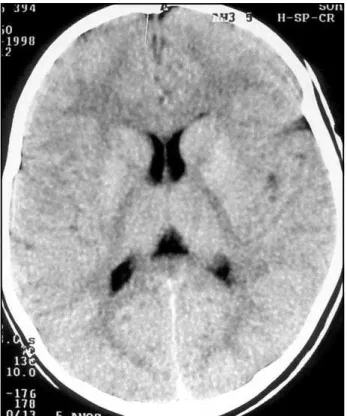
Nineteen HIV infected children had brain CT scans:
16 were normal and 3 abnormal - white matter
hypo-Table 3. Percent of DDST failures in HIV infected and seroreverters children.
Age (months) HIV infected Seroreverters P
1-13 78.0 30.0 .01*
14-24 54.0 24.0 .07
25-36 62.5 23.8 .02*
37-72 60.0 30.7 .17
DDST, Denver Developmental Screening Test; *, P = < .05.
Table 2. Percent of children with low CAT/CLAMS scores (below 70).
Age HIV infected Seroreverters Controls
(months) (n=43) (n=40) (n=67)
1-13 33.3 0 0
14-24 45.4 2.0 0
25-36 37.5 4.0 0
CAT, clinical Adaptive Test; CLAMS, Clinical Linguistic and Auditory Milestone Scale. Table 1. Mean CAT/CLAMS scores in HIV infected and uninfected children.
HIV infected Seroreverters Controls
Mean SD Mean SD Mean SD P
1-13 months 77.2 9.3 90.8 9.5 97.7 9.1 <.05
14-24 months 72.2 13.5 86.2 9.7 93.5 7.3 <.05
25-36 months 74.2 17.9 84.9 9.4 87.0 7.3 <.05
density, asymmetry of lateral ventricles and basal
ganglia calcification (Fig 1).
DISCUSSION
HIV infected children with neurologic and
neuro-developmental manifestations of central nervous
system infection have been termed neuro-AIDS
1,4,14.Although the prevalence of neurodevelopmental
ma-nifestations of HIV infection has been reported in
several series to vary between 8% and 62%
1, few
studies have been done prospectively.
Similar results were reported by Wachtel et al.
4,
who demonstrated worse performance in CAT/CLAMS
of HIV infected children when comparing with
seroreverter and control groups. While no significant
differences could be detected at 6 months of age,
highly significant differences were noted over this
age among the three groups. Actually CAT/CLAMS is
more sensible in detecting abnormalities at ages over
12 months, as reported by Kube et al
12.
Recently, it has been mentioned that a highly
pro-portion of HIV infected infants show early marked
cog-nitive and motor delays or declines, that may be an
important early indication of HIV disease progression.
These abnormalities are independent of other risk
factors for developmental delay
15,16and were also seen
in the present study. The aim of the study was to
exa-mine the frequency and the age when occurred
dur-ing the first 6 years of life, abnormalities in
cogni-tive and motor development in infants born from
HIV-infected women. The CAT/CLAMS seems to fit well
for the first 36 months of life. Based on studies
com-paring CAT/CLAMS with Bayley Scales of Infant
De-velopment (BSID), both have good correlation, as
mentioned in the literature
4, 12,15.The DDST has low sensitivity
17-21but in this study
it achieved a good correlation with CAT/CLAMS;
pro-bably it was more accurate in our cases because it
was assessed by the same Pediatric Neurologist. Our
results are in agreement with Greer S et al.
22who
showed that a child with an abnormal DDST is likely
to have a poor school outcome.
When comparing with other Brazilian Centers, as
in the study of Tellechea et al.
14, there was also a trend
of developmental delay in HIV infected children in
the first few months of life, until 5 years, an
indica-tion of early encephalopathy.
De Carli et al.
23, analyzed 100 consecutive brain
computed tomographic (CT) scans in symptomatic
acquired immunodeficiency syndrome children. They
found that cerebral calcification on CT scan
sugges-ted vertically acquired HIV infection and the
pres-ence of pres-encephalopathy, as in our case (Fig 1).
A great number of HIV infected children lived in
institutions or were adopted. This fact could be a
cause of developmental delay, but there was not
sta-tistical significant differences when comparing with
the other two groups.
We conclude that HIV contributes to the damage
of developing brain and can be detected by the
pres-ence of alterations in the neurological assessment,
including neurological examination and
neurodeve-lopmental tests.
The low CAT/CLAMS scores and the prevalence
of failures on DDST demonstrate that some degree
of encephalopathy occurs in HIV infected children
group since early ages.
Finally it must be emphasized that pediatric AIDS
is considered a chronic and systemic disease and for
this reason the follow up must be multidisciplinary,
including a sequential neurological evaluation.
Acknowledgements We are grateful for Dra Monica Cat for the statistical analysis and Marlene Terezinha Gomes da Silva, social worker, who helped us on contacting par-ents and caregivers.
REFERENCES
1. Belman AL. Acquired immunodeficiency syndrome and the child’s central nervous system. Pediatr Clin North Am 1992;39:691-714. 2. Tardieu M. HIV-1 and the developing central nervous system. Dev Med
Child Neurol 1998;40:843-846.
3. Chase C, Vibbert M, Pelton SI, Coulter DL, Cabral H. Early neurodevelop-mental growth in children with vertically transmitted human immuno-deficiency virus infection. Arch Pediatr Adolesc Med 1995;149: 850-855. 4. Wachtel RC, Tepper VJ, Houck D, McGrath CJ, Thompson C. Neuro-development in pediatric HIV infection: the use of CAT/CLAMS. Clin Pediatr 1994;33:416-420.
5. Chase C, Coulter D, Vibbert M, Woodward P, Harris M, Mitrano J. Mental and motor development in HIV-infected and seroreverter in-fants. In Programs and abstracts of neuroscience of HIV infection: ba-sic clinical frontiers. Eighth International Conference on AIDS/STD World Congress. Amsterdam 1992:Abstract 34.
6. França SN. Análise clínico laboratorial dos pacientes com hipotiroi-dismo congênito diagnosticado pelo programa de rastreamento neo-natal no Estado do Paraná: pacientes do grupo controle avaliados no período de junho a agosto de 1995. Dissertação de Mestrado, Universidade Federal do Paraná, Curitiba, 1997.
7. Frankenburg WK, Dodds JB. The Denver Developmental Screening Test. Pediatrics 1967;71:181-191.
8. Wachtel RC, Shapiro BK, Palmer BF, Allen MC, Capute AJ. CAT/ CLAMS: a tool for the Pediatric Evaluation of infants and young chil-dren with developmental delay. Clin Pediatr 1994,33:410-415. 9. Capute AJ, Shapiro BK, Wachtel RC, Gunter VA, Palmer FB. The
Clini-cal Linguistic and Auditory Milestone SClini-cale (CLAMS). Identification of cognitive defects in motor-delayed children. AJDC 1986;140:694-698. 10. Capute AJ, Accardo PJ. The infant neurodevelopmental assessment: a clinical interpretive manual for CAT-CLAMS in the first two years of life. Part 1. Curr Probl Pediatr 1996;26:238-256.
11. Rossman MJ, Hyman SL, Rorabaugh ML, Berlin LE, Allen MC, Modlin JF. The CAT / CLAMS assessment for early intervention services. Clin Pediatr 1994;33:404-409.
12. Kube DA, Wilson WM, Petersen MC, Palmer FB. CAT / CLAMS: its use in detecting early childhood cognitive impairment. Pediatr Neurol 2000;23:208-215.
13. Nellhaus G. Head circumference from birth to eighteen years. Pediat-rics 1968;41:106.
14. Tellechea N, Silva CLO, Colvero M, Schirmer M, Afonso-Galvão N. Neurosida. Rev Neurol (Barc) 1997;25:903-905.
15. Chase C, Ware J, Hittelman J, et al. Early cognitive and motor develop-ment among infants born to women infected with human immunode-ficiency virus (Abstract). Pediatrics 2000;106:334.
16. Smith R, Malee K, Charutat M, et al. Timing of perinatal human immu-nodeficiency virus type 1 infection and rate of neurodevelopment. Pediatr Infect Dis J 2000;19: 862-871.
17. Borowitz KC, Glascoe FP. Sensitivity of the Denver Developmental Screening Test in speech and language screening. Pediatrics 1986; 78:1075-1078.
18. Meisels SJ, Margolis LH. Is the early and periodic screening, diagnosis, and treatment program effective with developmentally disabled chil-dren? Pediatrics 1988;81:262-271.
19. Meisels SJ. Can developmental screening tests identify children who are developmentally at risk? Pediatrics 1989;83:578-585.
20. Applebaum A. Validity of the revised Denver Developmental Screen-ing Test for referred and non-referred samples. Psychol Rep 1978;43:227-233.
21. Sciarrilo WG, Brown MM, Robinson NM, Bennett FC, Sells CJ. Effec-tiveness of the Denver Developmental Screening Test with biologically vulnerable infants. J Dev Behav Pediatr 1986;7:77-83.
22. Greer S, Bauchner H, Zuckerman B. The Denver developmental screen-ing test: How good is its predictive validity? Dev Med Child Neurol 1989;31:774-781.