Quality of life in patients submitted to
surgical treatment for minor salivary
gland neoplasms
Qualidade de vida em pacientes submetidos
a tratamento cirúrgico para neoplasias de
glândulas salivares menores
Abstract: This study was aimed at assessing the quality of life in patients submitted to surgical treatment for minor salivary gland neoplasms (MSGN). Twelve patients (10 women and 2 men, mean age: 49.4 years) with histopathologic diagnosis of pleomorphic adenoma (PA, 3 cases), polymorphous low-grade adenocarcinoma (PLGA, 2 cases), cystic adenoid carcinoma (CAC, 4 cases), and muco-epidermoid carcinoma (MEC, 3 cases) were evaluated. All of them were treated by surgical excision; patients with CAC received ra-diotherapy as well. The patients’ quality of life was evaluated through a self-administered questionnaire concerning their physical well-being, emotional status, normal daily activi-ties, and family relationships. The results showed that patients with MEC – the youngest among all patients – reported a signiicantly greater worsening of their physical well-being and emotional status after treatment as compared with patients treated for PA (P < 0.05), and also of their functional activities as compared with those treated for PA and PLGA (P < 0.05). In conclusion, age of development of the neoplasm and type of disease produce more impact on patients’ quality of life than does the therapy’s degree of aggression. Descriptors: Salivary gland neoplasms; Salivary glands, minor; Surgery; Quality of life.
Resumo: Este estudo teve por objetivo avaliar a qualidade de vida em pacientes submeti-dos a tratamento cirúrgico para neoplasias de glândulas salivares menores (NGSM). Doze pacientes (10 mulheres e 2 homens, idade média de 49,4 anos) com diagnóstico histopato-lógico de adenoma pleomórico (AP, 3 casos), adenocarcinoma polimorfo de baixo grau de malignidade (APBG, 2 casos), carcinoma adenóide cístico (CAC, 4 casos), e carcinoma muco-epidermóide (CME, 3 casos) foram avaliados. Todos os pacientes foram tratados por excisão cirúrgica; pacientes com CAC receberam radioterapia complementar. A qua-lidade de vida dos pacientes foi avaliada através de um questionário de auto-avaliação referente ao bem-estar físico, estado emocional, atividades normais diárias, e relações familiares. Os resultados mostraram que os pacientes com CME – os mais jovens entre todos os pacientes – relataram uma piora signiicativamente maior em seu bem-estar físico e estado emocional após o tratamento quando comparados com pacientes tratados de AP (P < 0,05), e também em suas atividades funcionais quando comparada com indivíduos tratados de AP e APBG (P < 0,05). Em conclusão, a idade de desenvolvimento da neopla-sia e o tipo de doença produzem maior impacto na qualidade de vida do paciente do que faz o grau de agressão do tratamento.
Descritores: Neoplasias das glândulas salivares; Glândulas salivares menores; Cirurgia; Qualidade de vida.
Sílvio Kenji Hirota(a) Sibele Sarti Penha(b) Carlos Neutzling Lehn(c) Norberto Nobuo Sugaya(b) Dante Antônio Migliari(b)
(a)Research fellow; (b)Assistant Professors – Department of Stomatology, School of Dentistry, University of São Paulo.
(c)Researcher, Physician and Chief of the Head and Neck Surgery Service, Heliópolis Hospital, São Paulo.
Corresponding author: Sílvio Kenji Hirota
Faculdade de Odontologia da Universidade de São Paulo (USP) – Departamento de Estomatologia (Disciplina de Semiologia) Av. Prof. Lineu Prestes, 2227, Cidade Universitária
São Paulo - SP - Brazil CEP: 05508-900
E-mail: [email protected]
Introduction
Salivary gland neoplasms account for 1 to 4% of head and neck neoplasms.7,10 The majority of
salivary gland tumors affect the major salivary glands; 10 to 15% of them involve the minor sali-vary glands.3,4,8,18 According to many reports, a
sig-niicant number of minor salivary gland neoplasms (MSGN) are of malignant nature, and treatment of these neoplasms usually produces sequelae which can affect individuals’ quality of life.3,10,17
Surgical management with resection of adjacent structures has been the most successful method for the treatment of malignant salivary gland neo-plasms. However, ablative operations produce large tissue defects and functional impairment, usually affecting the patient’s quality of life.2,6
Most studies dealing with quality of life ques-tionnaires have applied them to patients treated for head and neck squamous cell carcinoma. However, little is known of patients with MSGN evaluated by quality of life questionnaires.6,12-15 The aim of the
present study was to evaluate quality of life in pa-tients submitted to surgical treatment for MSGN.
Materials and Methods
This study was carried out between January 1998 and December 2002 (a 5-year period) at the Head and Neck Surgical Service, Heliópolis Hospi-tal, São Paulo, SP, Brazil. During this period, there were 51 patients who had been treated by surgical excision for MSGN. For this study, however, only
12 patients with MSGN had their quality of life evaluated, the other 39 patients had either died of the disease or from other causes, or refused to par-ticipate.
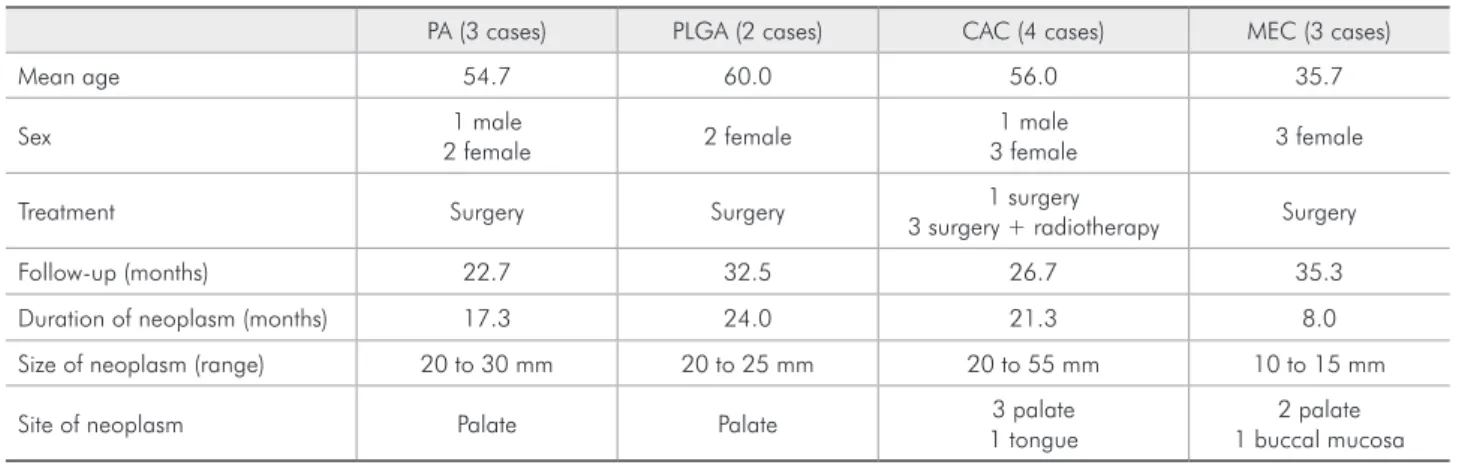
These 12 patients with MSGN (10 women and 2 men, mean age: 49.4 years) had been diagnosed by histologic analysis as having pleomorphic adenoma (PA, 3 cases), polymorphous low-grade adenocar-cinoma (PLGA, 2 cases), cystic adenoid caradenocar-cinoma (CAC, 4 cases) and muco-epidermoid carcinoma (MEC, 3 cases). All patients were submitted to a surgical excision of the glandular neoplasm. Three patients with CAC received radiotherapy in addi-tion to the surgical management. The principal data of these patients are detailed in Table 1. This study was approved by the Ethics Committee, Heliópolis Hospital, São Paulo, SP, Brazil; patients who agreed to participate were asked to sign a written informed consent.
Evaluation of quality of life
For evaluation of their quality of life, patients were given a self-administered questionnaire con-sisting of 4 topics: physical well-being, family re-lationships, emotional status and functional ac-tivities. Each topic was scored according to the following characterizations: (1) “not at all”; (2) “a little bit”; (3) “somewhat”; (4) “quite a bit”; and (5) “very much” (Table 2). The quality of life ques-tionnaire was applied only once to each patient at the time when he or she returned to the Hospital
Table 1 - Clinical characteristics of the patients (n = 12).
PA (3 cases) PLGA (2 cases) CAC (4 cases) MEC (3 cases)
Mean age 54.7 60.0 56.0 35.7
Sex 1 male
2 female 2 female
1 male
3 female 3 female
Treatment Surgery Surgery 1 surgery
3 surgery + radiotherapy Surgery
Follow-up (months) 22.7 32.5 26.7 35.3
Duration of neoplasm (months) 17.3 24.0 21.3 8.0
Size of neoplasm (range) 20 to 30 mm 20 to 25 mm 20 to 55 mm 10 to 15 mm
Site of neoplasm Palate Palate 3 palate
1 tongue
2 palate 1 buccal mucosa
for follow-up. At the consultation, each patient was given the quality of life questionnaire and in-structed to circle the answer that best described their physical and emotional status in the period
following surgery as compared with their life pre-viously to the onset of their condition. The short-est time after surgery that a patient was contacted for quality of life evaluation was 4 months and the longest was 59 months (average: 29.3 months). Sta-tistical analysis was performed with the Kruskal-Wallis test followed by the Dunn test; signiicance was set at P < 0.05.
Results
The quality of life evaluation in the 12 patients of this study showed that, overall, they were not having dificulties in keeping their normal lifestyles (Table 3). However, patients with MEC (who were the youngest), despite presenting the smallest tumor and requiring the least aggressive surgical treat-ment, showed a signiicantly greater worsening in terms of their physical well-being and emotional status as compared with patients treated for PA (P < 0.05), and also in terms of functional activities as compared with those treated for PA and PLGA (P < 0.05).
Table 2 - Contents of the questionnaire used to evaluate patients’ quality of life.
Topics Items
Physical well-being
loss of energy nauseas pain feeling ill • • • •
Familiar relationship
family support is deficient
communication about disease is poor partner support is deficient
• • •
Emotional status
feeling sad
life after treatment is bad feeling nervous worrying about death •
• • •
Functional activities
difficulty to work
difficulty in normal daily activities difficulty to sleep
• • •
Based on the questionnaire of Radiation Therapy Oncology Group11,
funded by the National Cancer Institute, Philadelphia, PA, USA.
Table 3 - Evaluation of patients’ quality of life according to their answers using the score below to characterize their current status: (1 = not at all; 2 = a little bit; 3 = somewhat; 4 = quite a bit; 5 = very much).
Topics Diseases (n = number of patients)
PA (n = 3) PLGA (n = 2) CAC (n = 4) MEC (n = 3)
Physical well-being*
Loss of energy 1 1 1 1 3 3 1 1 1 3 3 1
Nauseas 1 1 1 1 1 4 1 1 1 2 1 1
Pain 1 1 1 1 2 3 1 1 2 3 1 1
Feeling ill 1 1 1 1 2 1 1 1 3 2 2 1
Familiar relationship(ns)
Family support is deficient 1 1 1 1 1 1 3 1 1 1 1 1
Communication about disease is poor 3 4 2 3 3 1 1 5 3 5 3 3
Partner support is deficient 1 1 1 1 3 1 3 1 5 1 1 1
Emotional status**
Feeling sad 1 2 1 1 1 1 1 1 3 3 2 3
Life after treatment is bad 1 1 1 3 1 1 1 1 3 1 1 2
Feeling nervous 1 1 1 1 2 3 1 1 3 3 1 2
Worrying about death 1 3 1 1 3 1 1 1 1 3 1 3
Functional activities***
Difficulty to work 1 1 1 3 1 1 3 2 2 2 3 2
Difficulty in normal daily activities 1 1 1 1 1 1 5 1 1 2 2 2
Difficulty to sleep 1 1 1 1 1 1 1 1 1 2 2 1
Discussion
Functionally, the mouth is an important organ for speech, swallowing, chewing, taste and saliva-tion. After surgical treatment of malignant MSGN, large physical defects and functional impairment may result, severely affecting the patient’s quality of life. In the present study, 12 patients with MSGN (3 benign and 9 malignant types) were evaluated for quality of life after surgical treatment. The site in-volved was mainly the palate (83%), predominantly in women (83%). These indings are similar to those of other studies on salivary gland neoplasms.3,5,7,16
Most studies using a quality of life questionnaire in patients with head and neck squamous cell carci-noma have applied the questionnaire pre-operatively and several times (3, 6 and 9 months) during recov-ery after surgrecov-ery.6,9,12-15,19 The postoperative quality
of life scores – including disigurement, chewing, speech, and shoulder function – were usually low-er than those evaluated before treatment, with no signiicant overall improvement during follow-up.9
However, partially dentate people without dentures feel worse and tend to report a worse quality of life and more problems with their teeth, trouble eating and trouble enjoying meals. Thus, oral rehabilita-tion is important and osteointegrated implants can help the patient to adapt and cope better with the oral changes after resection of tumors. Implants help to provide a sound base for dentures and improve chewing function, and this had a good inluence on the psychological well-being in edentulous patients after primary surgery for oral cancer.14
In the present study, the quality of life question-naire was applied only once during the patients’ fol-low-up evaluation. Most of the patients had been treated for their salivary neoplasm for over a year (mean: 29.3 months). This amount of time was probably suficient for these patients to have formed a clear opinion on any change in their quality of life and, thus, to provide relevant data on the question-naire.
According to the analysis of the answers given by the patients they were having an acceptable qual-ity of life. Patients treated for benign neoplasm pre-sented, as expected, the best quality of life. They were, however, often sad and worried about death.
Patients with malignant MSGN complained more frequently of loss of energy, pain, nervousness and, particularly, concern about death. They also com-plained of a sort of “loneliness” since their diseases were hardly ever discussed among their relatives. Those with MEC were the ones who reported the worst quality of life, although they were treated with a less aggressive approach than the other patients with malignant MSGN. This study did not ind any speciic reason why the patients with MEC reported the worst quality of life. One possible explanation is that being the youngest among all patients, they had greater psychosocial dificulties in dealing with life due to their lower experience with major medi-cal problems.
In Finland, a recent study (2006) which, among many sociodemographic factors, analyzed quality of life in patients with oral and pharyngeal cancer, found that age and employment can inluence the pa-tient’s quality of life after cancer treatment.9,19 This
study found that unemployed and young patients have much more dificulties in trying to regain their normal lives than employed and older patients.9
MSGNs are located mainly in the hard-soft pal-ate, and oral squamous cell carcinoma occurs main-ly in the lateral border of the tongue and loor of the mouth. Even after extensive surgery for malignant MSGN in the palate, there is a chance for a better improvement in the quality of life through use of a prosthetic reconstruction, while patients who under-go surgery for a malignant neoplasm in the tongue and/or loor of the mouth will hardly have the func-tion of that organ recovered satisfactorily.
In accordance with this analysis, a recent study1
Conclusion
All patients presented some degree of distur-bance to their lives, but they were able to carry on with their daily activities. Among patients with
ma-lignant MSGN, perceived changes to quality of life are more associated with the age of development of the neoplasm and type of disease than with the ther-apy’s degree of aggression.
References
1. Brown JS, Rogers SN, Lowe D. A comparison of tongue and soft palate squamous cell carcinoma treated by primary sur-gery in terms of survival and quality of life outcomes. Int J Oral Maxillofac Surg. 2006;35(3):208-14.
2. Chandu A, Smith ACH, Rogers SN. Health-related qual-ity of life in oral cancer: a review. J Oral Maxillofac Surg. 2006;64(3):495-502.
3. Eveson JW, Cawson RA. Tumors of the minor (oropharyngeal) salivary glands: a demographic study of 336 cases. J Oral Pathol. 1985;14(6):500-9.
4. Ito FA, Ito K, Vargas PA, de Almeida OP, Lopes MA. Salivary gland tumors in a Brazilian population: a retrospective study of 496 cases. Int J Oral Maxillofac Surg. 2005;34(5):533-6. 5. Jaber MA. Intraoral minor salivary gland tumors: a review of
75 cases in a Libyan population. Int J Oral Maxillofac Surg. 2006;35(2):150-4.
6. Konstantinovic VS. Quality of life after surgical excision fol-lowed by radiotherapy for cancer of the tongue and floor of the mouth: evaluation of 78 patients. J Craniomaxillofac Surg. 1999;27(3):192-7.
7. Lopes MA, Santos GC, Kowalski LP. Multivariate survival analysis of 128 cases of oral cavity minor salivary gland car-cinomas. Head Neck. 1998;20(8):699-706.
8. Luukkaa H, Klemi P, Leivo I, Koivunen P, Laranne J, Makitie A et al. Salivary gland cancer in Finland 1991-96: an evalua-tion of 237 cases. Acta Otolaryngol. 2005;125(2):207-14. 9. Markkanen-Leppanen M, Makitie AA, Haapanen ML,
Suom-inen E, Asko-Seljavaara S. Quality of life after free-flap recon-struction in patients with oral and pharyngeal cancer. Head Neck. 2006;28(3):210-6.
10. Matsuba HM, Thawley SE, Simpson JR, Levine LA, Mauney M. Adenoid cystic carcinoma of major and minor salivary gland origin. Laryngoscope. 1984;94(10):1316-8.
11. Radiation Therapy Oncology Group. Intergroup Study NCCTG R9714. Available from: http://www.rtog.org/mem-bers/forms/9714/9714fa.pdf.
12. Rogers SN, Hannah L, Lowe D, Magennis P. Quality of life 5-10 years after primary surgery for oral and oropharyngeal cancer. J Craniomaxillofac Surg. 1999;27(3):187-91. 13. Rogers SN, Laher SH, Overend L, Lowe D. Importance-rating
using the University of Washington Quality of Life question-naire in patients treated by primary surgery for oral and oro-pharyngeal cancer. J Craniomaxillofac Surg. 2002;30(2):125-32.
14. Rogers SN, Lowe D, Fisher SE, Brown JS, Vaughan ED. Health-related quality of life and clinical function after primary sur-gery for oral cancer. Br J Maxillofac Surg. 2002;40(1):11-8. 15. Schliephake H, Jamil MU. Prospective evaluation of quality of
life after oncologic surgery for oral cancer. Int J Oral Maxil-lofac Surg. 2002;31(4):427-33.
16. Toida M, Shimokawa K, Makita H, Kato K, Kobayashi A, Kusunoki Y et al. Intraoral minor salivary gland tumors: a clinicopathological study of 82 cases. Int J Oral Maxillofac Surg. 2005;34(5):528-32.
17. van Heerden WFP, Raubenheimer EJ. Intraoral salivary gland neoplasms: a retrospective study of seventy cases in an African population. Oral Surg Oral Med Oral Pathol. 1991;71(5):579-82.
18. Waldron CA, El-Mofty SK, Gnepp DR. Tumors of the intraoral minor salivary glands: A demographic and histologic study of 426 cases. Oral Surg Oral Med Oral Pathol. 1988;66(3):323-33.