Emmanuelle da Cunha Ferreira
I, Maria Helena Barbosa
II, Helena Megumi Sonobe
III, Elizabeth Barichello
II I Universidade Federal do Triângulo Mineiro, Postgraduate Program in Health Care. Uberaba, Minas Gerais, Brazil.II Universidade Federal do Triângulo Mineiro, Hospital Care Nursing Department, Postgraduate Program in Health Care. Uberaba, Minas Gerais, Brazil.
III Universidade de São Paulo, Ribeirão Preto College of Nursing. Ribeirão Preto, São Paulo, Brazil.
How to cite this article:
Ferreira EC, Barbosa MH, Sonobe HM, Barichello E. Self-esteem and health-related quality of life in ostomized patients. Rev Bras Enferm [Internet]. 2017;70(2):271-8. DOI: http://dx.doi.org/ 10.1590/0034-7167-2016-0161
Submission: 07-17-2016 Approval: 09-28-2016
ABSTRACT
Objective: to assess self-esteem (SE) and health-related quality of life (HRQoL) in ostomized patients due to colorectal cancer.
Method: cross sectional research with a quantitative approach. Three instruments were used for data collection: one instrument
containing sociodemographic and clinical data, Rosenberg’s Self-Esteem Scale, and the European Organization for Research and Treatment of Cancer Quality of Life Questionnaire. Results: SE and HRQoL were considered satisfactory. Signifi cant statistical difference was found in the social function domain and marital status, ostomy duration, location, and time; global health scale and ostomy type; cognitive function and pain in the ostomy site. There was a correlation between self-esteem and all the functional scales and the global health scale. Conclusion: knowing SE and HRQoL levels, in addition to the variables that infl uence them, supports ostomized patients’ care planning, rehabilitation, and social autonomy.
Descriptors: Ostomy; Colorectal Neoplasms; Self Concept; Quality of Life; Oncology Nursing.
RESUMO
Objetivo: avaliar a autoestima (AE) e a qualidade de vida relacionada à saúde (QVRS) de pacientes estomizados por câncer
colorretal. Método: estudo transversal com abordagem quantitativa. Utilizaram-se três instrumentos para a coleta de dados: um contendo dados sociodemográfi cos e clínicos, a Escala de Autoestima de Rosenberg e o European Organization for Research and Treatment of Cancer Quality of Life Questionnaire. Resultados: a AE e a QVRS foram consideradas satisfatórias. Verifi cou-se diferença estatisticamente signifi cante entre: o domínio função social e situação conjugal, duração, localização e tempo de estomia; a escala global de saúde com o tipo de estomia; a função cognitiva e dor com local da estomia. Houve correlação entre a autoestima e todas as escalas funcionais e a escala global de saúde. Conclusão: conhecer os níveis de AE e QVRS, e como as variáveis que os infl uenciam subsidiam o planejamento do cuidado, a reabilitação e a autonomia social do estomizado.
Descritores: Estomia; Neoplasias Colorretais; Autoimagem; Qualidade de Vida; Enfermagem Oncológica.
RESUMEN
Objetivo: evaluar autoestima (AE) y calidad de vida relacionada a la salud (QVRS) de pacientes ostomizados por cáncer
colorrectal. Método: estudio transversal con abordaje cuantitativo. Datos obtenidos mediante tres instrumentos: uno incluyendo datos sociodemográfi cos y clínicos; la Escala de Autoestima de Rosenberg y el European Organization for Research and Treatment of Cancer Quality of Life Questionnaire. Resultados: La AE y la QVRS fueron consideradas satisfactorias. Se verifi có diferencia estadísticamente signifi cativa entre: dominio función social y situación conyugal, duración, localización y tiempo de ostomía; escala global de salud con tipo de ostomía; función cognitiva y dolor con lugar de ostomía. Hubo correlación entre autoestima y todas las escalas funcionales y la escala global de salud. Conclusión: conocer los niveles de AE y QVRS y cómo los infl uyen las variables, ayuda con la planifi cación del cuidado, la rehabilitación y la autonomía social del ostomizado.
Descriptores: Estomía; Neoplasias Colorrectales; Autoimagen; Calidad de Vida; Enfermería Oncológica.
Self-esteem and health-related quality of life in ostomized patients
Autoestima e qualidade de vida relacionada à saúde de estomizados
Autoestima y calidad de vida relacionada a la salud de ostomizados
Elizabeth Barichello E-mail: [email protected]
INTRODUCTION
The magnitude of noncommunicable diseases (NCDs) is measured by the ratio of deaths, limitations and handicaps, impact on quality of life, and economic burden shared among the health care system, families and society in general.In Bra-zil, NCDs are the most critical health problem and account for 72% of deaths, especially cardiovascular diseases, chronic respiratory illnesses, diabetes, and cancer(1).
By 2030, global estimates are 27 million cancer cases and 13.2 million deaths caused by NCDs. According to the es-timates for cancer incidence in Brazil for 2016 (which are also valid for the year of 2017), approximately 596,000 new cases of cancer will be diagnosed. The most common will be nonmelanoma skin cancer, followed by prostate, female breast, colon and rectum, lung, and cervix tumors. These data strengthen the magnitude of this illness worldwide, in addi-tion to its social and economic impact(2).
Colorectal cancer (CRC) is one of the most frequent malig-nant neoplasms of the gastrointestinal tract(3-4). The name CRC
refers to the type of cancer that affects the colon, rectosigmoid junction, rectum, anus, and anal canal(5). In Brazil, the
esti-mate for 2016 is 16,660 cases in men and 17,620 in women(2).
Surgery is the main treatment for most of the colon and rec-tum cancers. The surgery type and extension depend on the tu-mor location and size. In general, the surgery demands wide resection of the intestinal loop and adjacent lymphatic tissue(6).
Colostomies and ileostomies can be both temporary and permanent. Temporary stomas are created to preserve an anastomosis and perform a later reconstruction of the intesti-nal transit, whereas permanent stomas are usually created in the treatment of cancer when the reconstruction is impossible after the distal segment of the bowel has been removed(7).
The result of surgical treatment depends on patients’ psy-chosocial preparation in the preoperative period, when feel-ings of anxiety and fear related to the anesthesia, changes in the body image and in life style, concerns with the death risk and with the surgical procedure itself may surface(6).
Despite the enhancement of the techniques used, oncol-ogy surgeries to open a stoma have mutilation consequences that cause functional and anatomic losses. Ostomized patients are confronted with a multitude of physical, psychological, spiritual, social, and sexual changes that impact their self-es-teem (SE) and health-related quality of life (HRQoL)(8).
Self-esteem is an important issue in terms of colorectal cancer. In addition to the stigma of cancer and its body loca-tion, patients’ concerns are intensified by some therapeutic possibilities, among which divert the intestinal transit through the creation of a stoma. A social stigma is incorporated by these patients, that is, they feel different in comparison with their family and society as a whole, which may hinder their acceptance and adaptation process(9).
Self-esteem is evidenced in the answers given by individuals to different situations and life events(10). It is the most frequently
used construct in terms of the thoughts and feelings individuals have of themselves(11). The creation of a stoma may result in a
distorted image and reduced self-esteem, echoing in patients’
perception of themselves. People see themselves as lacking at-traction. The sudden change in body image creates confusion and negative changes in the way people perceive themselves(12).
The increasing emphasis on HRQoL assessment among individuals who underwent anti-neoplasic treatment derives from factors such as the advances in the detection and treat-ment of the disease, the need to measure the impact of the therapy, more optimistic social attitudes, increasing number of survivors, and concerns with patients’ rights(13).
The HRQoL terminology refers to the value that may be at-tributed to life or perceived health state resulting from changes that may occur because of damages in the functional state, per-ceptions and social factors when influenced by diseases, treat-ment, and health policies(14). Therefore, the evaluation of this
construct assumes an instrumental character as it offers health-care professionals a better understanding of how different prac-tices and therapies influence the results among individuals(15).
In face of this, the objectives of this study were to assess SE and determine the influence of sociodemographic and clini-cal data on SE, to determine the domains of HRQoL, and to analyze the influence of sociodemographic and clinical data and self-esteem on health-related quality of life.
METHOD
Ethical aspects
The development of the current study began after approval by a human research ethics committee. Participants signed a free consent agreement.
Study design, setting, and period
A cross-sectional study was conducted with 36 ostomized patients at the outpatient specialty clinic of the Triângulo Min-eiro Federal University (UFTM), in the city of Uberaba, state of Minas Gerais. Ostomized patients were actively sought in the records of the Multidisciplinary Care Program for Ostomized Patients (PAMPO, as per its acronym in Portuguese), in the period of June and July 2015.
Population or sample; inclusion and exclusion criteria
This study included ostomized patients diagnosed with colorectal cancer, aged 18 years or older, who had attended at least one appointment at the outpatient clinic. Those whose intestinal ostomy was not related to colorectal cancer, with cognitive disability, or physical handicap to answer the inter-views were excluded.
Study protocol
Three instruments were used to collect data: a questionnaire containing sociodemographic and clinical data, Rosenberg’s self-esteem scale (RSS), and the European Organization for Re-search and Treatment of Cancer Quality of Life Questionnaire Core 30 items (EORTC-QLQ-C30) to assess HRQoL aspects.
To assess SE, the RSS was applied. The scale comprised 10 questions, with the following answers to chose from: I fully agree, I agree, I disagree, and I fully disagree(16). A score varying
from 1 to 4 was applied to each answer. For questions 2, 5, 6, 8, and 9, the score was applied in decreasing order; for the remain-ing questions, an increasremain-ing order was applied. Thus, the higher the score in the scale, the lowest the participant’s self-esteem.
The European Organization for Research and Treatment of Cancer Quality of Life Questionnaire Core 30 items is a HRQoL questionnaire duly validated for our population(17), for
specific use among patients with cancer. It comprises 30 ques-tions that make up five functional scales: physical, emotion-al, cognitive and social functions, and role playing; a global health status scale (GHS/QoL), three symptom scales to mea-sure fatigue, pain, nausea and vomiting, and six single items to evaluate dyspnea, insomnia, appetite loss, constipation, diarrhea, and financial impact of the treatment and illness. The scores of scales and measures vary from 0 to 100. A high value score represents a high response level. High GHS and functional scale scores represent a healthful functional level, whereas a high score in the symptom and single items scales represents a high level of symptoms(17).
Analysis of results and statistics
For the data analysis, software SPSS version 20.0 was used, additionally to Cronbach’s Alpha internal consistency test to assess the reliability of the instruments. In a bivariate analysis, the self-esteem scores for groups defined by category variables were compared using the t-Test, and the quality of life scores were compared via nonparametric Mann-Whitney’s test. The ratio between the self-esteem and quality of life scores and the quantitative variables was produced by using Pearson’s correlation.
This study it is part of a research project called Qualidade de vida nos pacientes com câncer (Quality of life of patients with cancer), which was financially sponsored by the Minas Gerais State Agency for Research and Development (FAPE-MIG, as per its acronym in Portuguese).
RESULTS
Of the 36 ostomized patients due to colorectal cancer, 20 (55.6%) were male and 16 (44.44%) were female. Their mean age was 63.97 years, varying from 30 to 81 years old. Regard-ing schoolRegard-ing, the mean number of years of study was 6.94. Thirteen patients (36.1%) had between one and four years of schooling; seven (19.5%) had between five and eight years; thirteen (36.1%) had between nine and eleven years; and three (8.3%) had no schooling at all. In terms of marital status, 19 patients (52.8%) had a spouse; seven (19.4%) were single; six (16.7%) were widowed; and four (11.1%) were divorced. As far as occupation and religion were concerned, most par-ticipants, 24 (66.7%), were retired and 25 (69.4%) were Ro-man Catholic, respectively.
In terms of clinical data, the time living with the stoma was divided into three ranges: 14 patients (38.9%) had had the stoma for 12 months or less; 12 (33.3%) had had it for a period
between 13 and 60 months; and 10 (27.8%) had been with a stoma for more than 60 months. Regarding the ostomy type, there was a predominance of colostomies: 33 (91.7%), locat-ed in the left abdominal quadrant and permanent (63.9%). As far as complications related to the stoma were concerned, 27 (75%) patients reported having none and nine (25.0%) said they had some. Of these, four participants (11.1%) had had hernia, two (5.6%) had had prolapse, and one (2.8%) had had bleeding, stenosis, and dermatitis. The majority of the osto-mized patients said they had not been previously informed about the opening of the stoma (77.8%).
When analyzing results referring to SE, the minimum score was 10 and the maximum was 31. The mean was 18.88 and the median was 20.0. Cronbach’s alpha was 0.9, which points out to high internal consistency and homogeneity of the items. Rosenberg’s self-esteem scale does not have cut-off points; thus, the entire scores were analyzed, considering that the higher the score, the lower the self-esteem. Comparing the SE means and category variables, only the clinical variable stoma location had a significantly statistic difference (p=0.03). Indi-viduals whose ostomy was on the left side had lower means; therefore, their self-esteem was better. Regarding the variables sex, marital status, stoma type, and time of stoma, there were no statistically significant results.
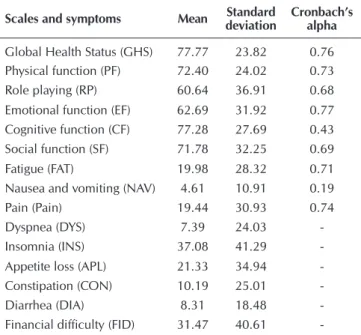
Table 1 shows the calculations of means, standard devi-ations, and the result of the Cronbach’s alpha test for each EORTC QLQ-C30 domain with more than one item. The Global Health Status/QoL reached the mean 77.77. This shows that ostomized patients consider their quality of life sat-isfactory as their score is close to 100 (maximum score).
Table 1 – Position and variability measures for domains
of the European Organization for Research and Treatment of Cancer Quality of Life Question-naire Core 30 items (EORTC-QLQ-C30) in osto-mized patients secondary to colorectal cancer, Uberaba, Minas Gerais, Brazil, 2015
Scales and symptoms Mean deviationStandard Cronbach’s alpha
-In terms of the functional scales, the mean results were higher than 60. Among those, the most compromised domain was role playing and its lowest mean was 60.64. The highest mean refers to the cognitive function domain (77.28).
The symptom scale had low means, which represents a low level of symptoms. The predominant symptom was insomnia, whose mean was 37.08, followed by loss of appetite, fatigue, pain, constipation, dys-pnea, diarrhea, and nausea and vomiting. In the scale of financial difficulties, the mean found was 31.47.
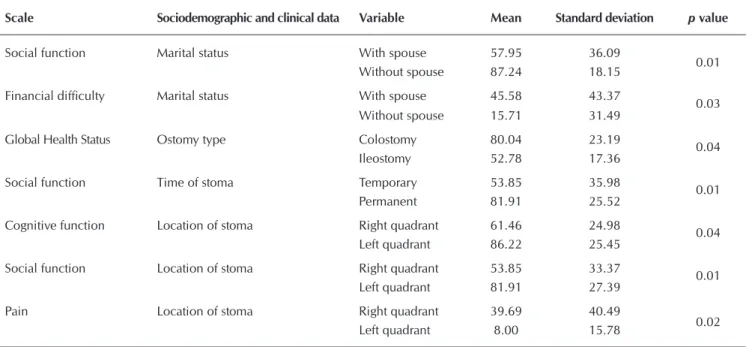
To verify whether sociodemographic and clinical category variables interfered with the domains investigated by the EORTC-QLQ-C30, the Mann-Whitney’s nonpara-metric test was applied. The results were considered statistically significant when p≤ 0.05, according to Table 2.
The comparison between the EORTC do-mains and sex did not show any significant difference, that is, men and women had a similar perception of their quality of life.
The statistically significant comparisons found were: marital status, social function scale, and the financial difficulty item; os-tomy type and GHS; time of stoma with the social function scale and place of stoma with the cognitive and social function scales, and the symptom pain (Table 2).
Table 3 shows the correlation between the QoL domains and the quantitative variables.
Table 2 – Mean, standard deviationand statistic significance of Quality of Life Questionnaire Core 30 items(QLC-C30)
ap-plication with sociodemographic and clinical data, Uberaba, Minas Gerais, Brazil, 2015
Scale Sociodemographic and clinical data Variable Mean Standard deviation p value
Social function Marital status With spouse 57.95 36.09
0.01 Without spouse 87.24 18.15
Financial difficulty Marital status With spouse 45.58 43.37
0.03 Without spouse 15.71 31.49
Global Health Status Ostomy type Colostomy 80.04 23.19 0.04 Ileostomy 52.78 17.36
Social function Time of stoma Temporary 53.85 35.98 0.01 Permanent 81.91 25.52
Cognitive function Location of stoma Right quadrant 61.46 24.98
0.04 Left quadrant 86.22 25.45
Social function Location of stoma Right quadrant 53.85 33.37
0.01 Left quadrant 81.91 27.39
Pain Location of stoma Right quadrant 39.69 40.49
0.02 Left quadrant 8.00 15.78
Table 3 – Pearson’s correlation between domains of the European
Orga-nization for Research and Treatment of cancer Quality of Life Questionnaire Core 30 items (EORTC-QLQ-C30) and the so-ciodemographic and clinical variables and self-esteem, Ubera-ba, Minas Gerais, Brazil, 2015
Age Schooling Time of
ostomy
Self-esteem score
Scale r* p** r* p** r* p** r* p**
Global Health Status 0.35 0.03 -0.10 0.53 0.19 0.24 -0.64 <0.001
Physical function 0.20 0.22 -0.93 0.58 0.07 0.65 -0.56 <0.001
Role playing 0.32 0.05 -0.13 0.41 0.41 0.01 -0.55 0.001
Emotional function 0.29 0.07 -0.05 0.74 0.24 0.15 -0.63 <0.001
Cognitive function -0.05 0.75 -0.05 0.76 0.22 0.18 -0.5 <0.001
Social function 0.15 0.35 0.09 0.59 0.32 0.05 -0.51 0.001
Fatigue -0.34 0.04 0.19 0.26 -0.19 0.26 0.67 <0.001
Nausea and vomiting -0.21 0.21 0.08 0.64 -0.29 0.08 0.14 0.01
Pain -0.19 0.24 -0.07 0.66 -0.21 0.20 0.52 0.001
Dyspnea -0.25 0.13 0.06 0.71 -0.15 0.35 0.26 0.11
Insomnia -0.29 0.08 0.05 0.76 -0.41 0.01 0.53 0.001
Appetite loss 0.008 0.96 -0.08 0.63 -0.31 0.06 0.39 0.01
Constipation 0.01 0.94 -0.06 0.68 -0.04 0.77 0.17 0.29
Diarrhea 0.01 0.93 -0.09 0.58 0.01 0.92 0.25 0.12
Financial difficulty -0.17 0.29 -0.18 0.28 -0.17 0.30 0.37 0.02
No statistically significant correlations were found for the QLQ-C-30 scales and the variable schooling. The variable age significantly influenced the QoL of ostomized patients in the domains GHS (r=0.35, p=0.03), role playing (r=0.32, p=0.05), and fatigue (r= - 0.34, p=0.04).
When correlating time of ostomy and the QoL domain scores, there was moderate, statistically significant correlation in role playing (r=0.41), social function (r=0.32), and in the symptom insomnia (r=0.41).
Pearson’s correlation between the QoL domains and self-esteem scores was significant, inverse, and had strong inten-sity in the GHS domains and in all the functional scales. The negative value of this correlation shows that the instruments are inversely measured, that is, the higher the EORTC score, the better the QoL and physical functioning. In contrast, the higher the RSS score, the lower the SE. Therefore, these results demonstrate that both instruments correlate inversely because it is expected that in order to have good QoL, it is necessary to have good SE.
In the symptom scales, there was significant correlation in most of the items. The weakest was in nausea and vomiting (r=0.14) and the strongest in fatigue (r=0.67). The correla-tions were positive, showing that high scores in the self-es-teem scale increase the scores in these symptoms.
DISCUSSION
In terms of the sociodemographic characterization of the sample for this study, there was a predominance of male, el-derly, retired ostomized patients with low schooling, which characterizes the public assisted by the Brazilian Unified Health System.
Self-esteem is evidenced in the answers given by individu-als to different situations and life events(10). It is also
consid-ered to be an important indicator of mental health because it interferes with affective, social, and psychological conditions. Having a stoma is something that may result in a distorted self image and decreased self-esteem, echoing in one’s self per-ception and in seeing oneself as unattractive(10). The sudden
change in the body image creates confusion and a negative change in the way people perceive themselves(6,10).
Regarding SE, the mean of the RSS scores was 18.88. These results enable researchers to conclude that, since the mean SE scores are far from the maximum score (40), this group’s self-esteem is satisfactory, considering that the score of the scale varies from 10 to 40 and that the closer to ten, the better their self-esteem and the closer to 40, the worse their self-esteem. Different results have been found in another study(18), whose
goal was to assess self-esteem in patients with an intestinal stoma. The authors of that study concluded that the ostomized patients had their self-esteem compromised.
Among the analyzed variables (sex, marital status, age, schooling, family income, time of ostomy, type of ostomy, time of stoma), none showed a significant difference in re-lation to self-esteem (p>0.05), that is, this finding suggests that this attribute is not necessarily associated with the above-mentioned variables. Further research is necessary to clarify
this issue, taking into account that relations among these variables impacted on SE in a similar study where male, mar-ried participants aged 60 years or older, with incomplete el-ementary school and with permanent ostomy had reduced self-esteem(18).
In the past, the concern of healthcare professionals was the survival of patients diagnosed with cancer(19). With a shift
in focus, a current growing emphasis on HRQoL assessment among individuals who underwent anti-neoplasic treatment derives from factors such as advances in the detection and treatment of the disease, the need to measure the impact of the therapy, more optimistic social attitudes, increasing num-ber of survivors, and concerns with patients’ rights(13).
The opening of a stoma is considered one of the most important surgical accomplishments for people affected by colorectal cancer. It may alleviate symptoms, and restrict or hinder the evolution of the disease(20). However, it implies
changes in one’s body image, loss of waste control, and need to use collector equipment(21-22). Thus, ostomized patients
de-velop physical, psychological, and social changes that may influence their HRQoL(13).
Regarding quality of life, a study conducted in Malaysia(23)
that also used the QLQ-C30 with patients with colorectal can-cer found better scores for the GHS, with a mean of 85.16.
In the functional scales, the physical, emotional, cognitive, and social functions had means that varied between 62.69 and 77.28. Role playing (60.64) was the most affected, as in another study(13) where this domain had a 12.96 mean,
show-ing that there is some level of hindrance to work or perform leisure activities, assessed by answers six and seven of the instrument.
Regarded as handicapped people, the ostomized patients live with biopsychosocial difficulties caused by the presence of a stoma, including barriers to social inclusion. A qualita-tive study(24) described the changes occurred in the daily life
of ostomized patients and identified restrictions in their lei-sure activities such as traveling, practicing sports, and going to clubs because of their insecurity about the bag adhesion. Another study(25) used the questionnaire World Health
Organi-zation Quality of Life (WHOQOL)-bref to assess and compare the QoL between patients temporarily and permanently osto-mized, finding in more than 50% of both groups dissatisfac-tion with the leisure opportunities and concerns regarding the exposure, rupture, and leaking of the collecting equipment.
The low scores in the symptom scale and single items showed that they are adequately controlled. In the scales of symptoms and single items, insomnia (37.08) was the most affected domain. Researchers suggest that additional research be made on sleeping problems in ostomized patients surviv-ing CRC given the scarcity of studies about this issue.
financial difficulties arise. Moreover, governmental aids and retirement bring significant wage reductions. A study conduct-ed in Rio de Janeiro(26) with ostomized patients showed that,
among the 20 interviewees, 15 performed labor activities. Among the latter, 12 simultaneously received governmental help, alleging that this was not enough to support the family.
When relating QoL with the variable sex, no significant difference was found in the EORTC domains. Another study(27)
found high scores of pain, fatigue and dyspnea in women. Regarding marital status, it was possible to observe that osto-mized patients without a spouse scored higher in the social domain, pointing out that the physical condition and treat-ment interfere less with the family life and social activities in comparison with participants who had a spouse. The opposite was expected, though. This result may be explained by the fact that the ostomized patients took into account the qual-ity of the relationship rather than its mere existence. Still in terms of marital status, the physical condition and treatment caused greater financial difficulty in the group of patients with a spouse. An ostomy generates biopsychosocial changes, such as not returning to one’s job, which explains this result.
The fact that the GHS is better perceived by colostomy car-riers can be explained by the characteristic of consistency and volume of the effluent that are different between these and those who were submitted to the anastomosis from the ileum to the abdominal wall.
Regarding the time of stoma, patients who have been per-manently ostomized had higher mean scores than those with a temporary ostomy; however, the social function was the only one to present a significant difference. A study(25) that
compared HRQoL between patients with permanent and tem-porary ostomy concluded that both suffer from the same dis-tress, which equally affects quality of life. Having an intestinal ostomy for limited period does not exempt these people from suffering once they need to face the challenges caused by the impact of the ostomy in their lives.
As far as the location of the stoma is concerned, the cognitive and social functions were higher among patients who had been ostomized in their left side, whereas pain was higher among those with a right ostomy. It was difficult to compare these re-sults with literature data on QoL because specific studies on the location of stomas were not found in Brazil or abroad.
Ostomies located in the lower right quadrant have effluents of a more liquid consistency that becomes thicker, with frequent discharges, more alkaline fluids and rich in enzymes. This may cause dermatitis and generate pain. It is possible to imply that so-cial relations are more harmed in this group because of the need for frequent emptying and sanitation of the collecting equipment. The variable age had a moderate and positive correlation with GHS and role playing; therefore, the older the age, the higher the scores in these domains. It was also moderate and inverse with fatigue, showing that fatigue increases as the age decreases. Different data were found in another study where age was one of the variables that did not have any correlation with any of the QoL domains(28).
As expected, the ostomy time represents an important influ-ence on the HRQoL factors. It has a correlation with role playing
and social function, showing that the longer the ostomy time, the higher the scores in these domains. There is an opposite correlation with insomnia, that is, fewer symptoms with the longer ostomy time. These results are consistent with the lit-erature that states that the adjustment to the ostomy requires time and the period for adjustment varies according to the individual(22,26).
As time passes by and through the use of adjustment strategies found, the ostomized patients integrate changes more easily in all their multiple dimensions. Their acceptance may be enhanced by the integration with family members and friends and through a systematized intervention by healthcare professionals(22).
The correlations between SE and the EORTC instrument were significant in all of the dimensions of the functional scales and GHS. This finding emphasizes the relation ex-pected between SE and HRQoL, that is, the lower the self-es-teem, the greater the harm to health-related quality of life. In the symptom scales, only dyspnea, constipation and diarrhea did not present any statistically significant correlations. The other dimensions of the symptoms and single items scales had positive correlations with the RSS. The higher the RSS score, the higher the scores in the symptom scales, which indicates limitations in HRQoL.
An ostomy may be a limiting factor for the HRQoL of CRC patients because physical and psychological difficulties coexist. Not only are they related to the illness, but also to the limiting aspects of the stoma(25), such as those related to daily and labor
capacity activities, that is, activities of the physical domain. Attention to the emotional impact is essential in the care given to ostomized patients. It can be considered an impor-tant factor in these individuals’ body image as it produces considerable psychological impact, changing their self-es-teem and sometimes their social relations. An ostomization changes a person’s image of oneself and one’s body. It also brings up concerns about other people’s perception of the patient’s new condition(29).
There was a correlation between SE and financial diffi-culty, showing that the lower the SE, the greater the financial difficulty, an important aspect that compromises HRQoL. An ostomy causes multiple limitations in quality of life, including a withdrawal from the job market. It is possible to conclude that the lack of financial resources may become very expres-sive, mainly when the disease affects the family member who is responsible for supporting the household(30).
Study limitations
This study had limitations in terms of its cross-sectional cut-off and sample size. This fact is attributed to the previous can-cer diagnosis where the survivors are those who managed to control their illness. Regarding the assessment of self-esteem and quality of life of ostomized patients by intestinal cancer, the literature is rather scarce. Researchers found the need for further research, especially with a quantitative approach.
Contributions for the nursing field
well as on the changes caused in their daily lives, offers sup-port for planning the care provided by healthcare profession-als, especially nurses. Provided with this knowledge, nurses can develop intervention strategies that minimize the upheav-als resulting from ostomy, in addition to train professionupheav-als involved in health care.
CONCLUSION
The results of this study allowed for the analysis of self-esteem and health-related quality of life in ostomized pa-tients due to CRC.
Their self-esteem was considered satisfactory. Individuals with a stoma located in the left abdominal quadrant pre-sented higher SE.
In the relation between HRQoL and marital status, this study identified that ostomized patients without spouses had higher scores in the social function scale than those with spouses, in addition to greater financial difficulty. Individuals with colostomy had higher scores in the GHS. Patients with a permanent ostomy had higher scores in the social function.
Those whose ostomy was located in the left side had higher scores in the cognitive and social functions, whereas those whose ostomy was located on the right side had higher score in pain. Age was correlated to the GHS and role playing. The older the age, the higher these domains were. In contrast, the younger the age, the greater the fatigue.
As far as the ostomy time was concerned, in correlation to role playing and social function, the longer the ostomy time, the fewer the limitations in terms of work, leisure, and social interaction.
Regarding the EORTC domains and the self-esteem scores, this study found a strong inverse correlation in terms of GHS and all the functional scales. In other words, the higher the RSS scores, the lower the scores in the abovementioned do-mains with more harm to HRQoL.
FUNDING
Financial support (APQ – 02411-14) provided by the Minas Gerais State Agency for Research and Development (FAPEMIG).
REFERENCES
1. Francisco PMSB, Segri NJS, Malta DC. Desigualdades sociodemográfica nos fatores de risco e proteção para doenças crônicas não transmissíveis: inquérito telefônico em Campinas, São Paulo. Rev Epidemiol Serv Saúde[Internet]. 2015[cited 2016 Jan 10];24(1):7-18. Available from: http://www.scielo.br/pdf/ress/v24n1/2237-9622-ress-24-01-00007.pdf
2. Brasil. Ministério da Saúde. Instituto Nacional de Câncer. Estimativa 2016: incidência de câncer no Brasil Rio de Janeiro (RJ): INCA[Internet] 2016[cited 2016 Jan 10]. Available from: http://www.inca.gov.br/wcm/dncc/2015/dados-apresentados.pdf
3. Campos FG, Calijuri-Hamra MC, Imperiale AR, Kiss DR, Nahas SC, Cecconello I. Locally advanced colorectal cancer: results of surgical treatment and prognostic. Rev Arq Gastroenterol[Internet]. 2011[cited 2016 Jan 10];48(4):270-75. Available from: http://www.scielo.br/pdf/ag/v48n4/v48 n4a10.pdf
4. Manso MM, Kitamura NE, Souza JRM, Gonçalves JE, Matos LL, Mader AMAA, et al. Níveis séricos e imunoexpressão tecidual do mar-cador CA 19-9 no carcinoma colorretal e comprometimento linfonodal. Rev Arq Bras Ciênc Saúde[Internet]. 2011[cited 2016 Jan 10]; 36(1):29-34. Available from: http://files.bvs.br/upload/S/1983-2451/2011/v36n1/a1921.pdf
5. Huwe FG, Anton EM, Eisenhardt MF, Foletto E, Jackisch S, Severo B, et al. Avaliação das características clínicas e epidemiológi-cas e sobrevida global de pacientes portadores de câncer colorretal. Rev Epidemiol Control Infec[Internet]. 2013[cited 2016 Jan 10];3(4):112-6. Available from: http://online.unisc.br/seer/index.php/epidemiologia/article/view/4117/3253
6. Mota MS, Gomes GC. Mudanças no processo de viver do paciente estomizado após a cirurgia. Rev Enferm UFPE[Internet]. 2013[cited 2014 Jul 10];7(esp):7074-81. Available from: http://www.revista.ufpe.br/revistaenfermagem/index.php/revista/article/ download/3435/8133
7. Nicolussi AC. Qualidade de vida de pacientes com câncer de cólon e reto: revisão integrativa da literatura[Internet]. [Dissertação]: Uni-versidade de São Paulo, Escola de Enfermagem de Ribeirão Preto; 2008[cited 2016 Jan 10]. Available from: http://www.teses.usp.br/teses/ disponiveis/22/22132/tde-03092008-111111/pt-br.php
8. Torres CRD, Andrade EMLR, Ribeiro FMSS, Gonçalves Neta FCC, Luz MHBA. Qualidade de vida de pessoas estomizadas: revisão integrativa. Rev de Enferm UFPI[Internet]. 2015[cited 2016 Jan 10];4(1):117-22. Available from: http://www.ojs.ufpi.br/index.php/reufpi/ article/view/2242/pdf
9. Nascimento CMS, Trindade GLB, Luz MHBA, Santiago RF. Vivência do paciente estomizado: uma contribuição para a assistência de enfermagem. Texto Contexto Enferm[Internet]. 2011[cited 2015 Aug 10];20(3):357-64. Available from: http://www.scielo.br/pdf/tce/ v20n3/18.pdf
10. Schultheisz TSV, Aprile MR. Autoestima, conceitos correlatos e avaliação. Rev Equil Corp Saúde[Internet]. 2013[cited 2014 Aug 16];5(1):36-48. Available from: http://www.pgsskroton.com.br/seer/index.php/reces/article/view/22/19
12. Sampaio FMC. A autoestima na pessoa portadora de ostomia de eliminação intestinal. Rev Port Enferm Saúde Mental[Internet]. 2010[cit-ed 2014 Sep 10];3:31-7. Available from: http://comum.rcaap.pt/bitstream/123456789/6153/1/Revista4-Artigo4%20%281%29.pdf
13. Kameo SY, Sawada NO. Qualidade de vida relacionada à saúde do paciente com estoma intestinal secundária ao câncer cólon-retal. Rev Iberoamericana Educ Invest Enferm[Internet]. 2014[cited 2016 Jan 10];4(2):19-26. Available from: http://www.enfer-meria21.com/revistas/aladefe/articulo/118.pdf
14. Freire MEM, Sawada NO, França ISX, Costa SFG, Oliveira CDB. Qualidade de vida relacionada à saúde de pacientes com câncer avan-çado: uma revisão integrativa. Rev Esc Enferm USP[Internet]. 2014[cited 2015 Jun 10];48(2):357-67. Available from: http://www.scielo.br/ pdf/reeusp/v48n2/pt_0080-6234-reeusp-48-02-357.pdf
15. Gimenes GF. Usos e significados da qualidade de vida nosdiscursos contemporâneos de saúde. Rev Trab Educ Saúde [Internet]. 2013[cited 2015 Jan 10];11(2):291-318. Available from: http://www.scielo.br/pdf/tes/v11n2/a03v11n2.pdf
16. Dini GM, Quaresma MR, Ferreira LM. Adaptação cultural e validação da versão brasileira da Escala de Autoestima de Rosenberg. Rev Soc Bras Cir Plást[Internet]. 2004[cited 2015 Jun 10];19(1):41-52. Available from: http://www.rbcp.org.br/imagebank/pdf/19-01-04pt.pdf
17. Brabo EP, Paschoal MEM, Biasoli I, Nogueira FE, Gomes MCB, Gomes IP, et al. Brazilian version of the QLQ-LC13 lung cancer module of the European Organization for Research and Treatment of cancer: preliminary reliability and validity report. Qual Life Res[Internet]. 2006[cited 2015 Jun 10];15(9):1519-24. Available from: http://download.springer.com/static/pdf
18. Salomé GM, Almeida SA, Silveira MM. Quality of life and self-esteem of patients with intestinal stoma. J Coloproctol [Internet]. 2014[cited 2015 Oct 10];34(4):231-9. Available from: http://www.scielo.br/pdf/jcol/v34n4/2237-9363-jcol-34-04-0231.pdf
19. Chaves PL, Gorini MIPC. Qualidade de vida do paciente com câncer colorretal em quimioterapia ambulatorial. Rev Gaúcha Enferm[Internet]. 2011[cited 2016 Oct 10];32(4):767-73. Available from: http://www.scielo.br/pdf/rgenf/v32n4/v32n4a18.pdf
20. Taylor C, Morgan L. Quality of life following reversal of temporary stoma after rectal cancer treatment. Rev Europ J Oncol Nurs[Internet]. 2011[cited 2014 Jun 10];15(1):59-66. Available from: http://www.sciencedirect.com/science/article/pii/S1462388910000943
21. Franco VQ. et al. Inclusão laboral da pessoa estomizada sob a ótica do capitalismo neoliberal. Rev Enferm Prof[Internet]. 2014[cited 2015 Jun 10];1(2):291-303. Available from: http://www.seer.unirio.br/index.php/enfermagemprofissional/article/view/3699/pdf_1410
22. Sousa CF, Santos C, Graça LCC. Construção e validação de uma escala de adaptação a ostomia de eliminação. Rev Enf Ref[Internet]. 2015[cit-ed 2015 Jun 10];4(4):21-30. Available from: http://www.r2015[cit-edalyc.org/articulo.oa?id=388239974002
23. Wan Puteh SE, Saad NM, Aljunidet SM, Manaf MRA, Sulong S, Sagap I, et al. Quality of life in Malaysian colorectal cancer pa-tients. Rev Asia Pacific Psych[Internet]. 2013[cited 2015 Jun 10]; 5(suppl.1):110-7. Available from: http://onlinelibrary.wiley.com/ doi/10.1111/appy.12055/epdf
24. Coelho AR, Santos FS, Dal Poggetto MT. A estomia mudando a vida: enfrentar para viver. REME Rev Min Enferm[Internet]. 2013[cited 2015 Sep 10];17(2):22-31. Available from: http://www.reme.org.br/artigo/detalhes/649
25. Fortes RC, Monteiro TMRC, Kimura CA. Quality of life from oncological patients with definitive and temporary colostomy. Journal of Coloproctology [Internet]. 2012[cited 2015 Mar 16];32(3):253-9. Available from: http://www.scielo.br/pdf/jcol/v32n3/a08v32n3
26. Mauricio VC, Souza NVDO, Lisboa MTL. O sentido do trabalho para o ser estomizado. Texto Contexto Enferm[Internet]. 2014[cited 2015 Sep 10];23(3):656-64. Available from: http://www.scielo.br/pdf/tce/v23n3/pt_0104-0707-tce-23-03-00656.pdf
27. Natrah MS, Ezat S, Syed MA, Rizal AM, Saperi S. et al. Quality of life in Malaysian colorectal cancer patients: a preliminary result. Asian Pac J Cancer Prev[Internet]. 2012[cited 2015 Sep 10];13(3):957-62. Available from: http://journal.waocp.org/article_26273_d5b381c-01cb6beec28db76d65715fe1d.pdf
28. Pereira APS, Cesarino CB, Martins MRI, Pinto MH, Netinho JG. Associação dos fatores sociodemográficos e clínicos à qualidade de vida dos estomizados. Rev Latino-Am Enfermagem[Internet]. 2012[cited 2015 Sep 10];20(1):93-100. Available from: http://www.scielo.br/pdf/ rlae/v20n1/pt_13.pdf
29. Souza ECA, Figueiredo GLA, Lenza NFB, Sonobe H. Consequências da estomia intestinal para os estomizados e seus familiares. Rev Enferm UFPE[Internet]. 2010[cited 2015 Sep 10];4(esp):1081-6. Available from: http://www.revista.ufpe.br/revistaenferma-gem/index.php/revista/article/viewFile/942/pdf_102