1 Programa de Mestrado e Doutorado em Fisioterapia, Universidade Cidade de São Paulo (UNICID), São Paulo, SP, Brazil 2 Curso de Fisioterapia, Universidade Cidade de São Paulo (UNICID), São Paulo, SP, Brazil
Received: 11/05/2013 Revised: 01/24/2014 Accepted: 02/05/2014
a r t i c l e
Assessment of the measurement properties of quality of
life questionnaires in Brazilian women with breast cancer
Indiara S. Oliveira1, Lucíola C. M. Costa1, Ana C. T. Manzoni2, Cristina M. N. Cabral1
ABSTRACT | Background: There areseveral questionnaires available to assess quality of life in breast cancer, however the choice of the best questionnaire often does not take into account the adequacy of these questionnaires’ measurement properties. Objective: To test the measurement properties of two generic quality of life questionnaires and one quality of life questionnaire specific for women with breast cancer. Method: We assessed 106 women after surgery for breast cancer. The assessment included application of the SF-36, WHOQOL-bref, and FACT-B+4 questionnaires as well as the Global Perceived Effect and Pain Numerical Rating scales. The participants were interviewed on three occasions to investigate internal consistency, floor and ceiling effects, construct validity, reproducibility, and responsiveness. Results:
Most of the instruments’ domains showed adequate internal consistency (Cronbach’s alpha varying from 0.66 to 0.91). Reliability varied from poor to substantial (ICC2,1 between 0.39 and 0.87) and agreement varied from negative to very good. The SF-36 presented doubtful agreement and showed floor and ceiling effects in three domains. The domains of the generic questionnaires presented moderate to good correlation with the FACT-B+4 (Pearson varying from 0.31 to 0.69). The internal responsiveness varied from small to large (ES varying from –0.26 to 0.98) and external responsiveness was found in only some of the instruments’ domains. Conclusions: Most of the measurement properties tested for the WHOQOL-bref and FACT-B+4 were adequate as was their ability to assess quality of life in women with breast cancer. The SF-36 showed inadequacy in agreement and floor and ceiling effects and should not be used in women with breast cancer.
Keywords: breast cancer; questionnaires; quality of life; reliability and validity; physical therapy.
HOW TO CITE THIS ARTICLE
Oliveira IS, Costa LCM, Manzoni ACT, Cabral CMN. Assessment of the measurement properties of quality of life questionnaires in Brazilian women with breast cancer. Braz J Phys Ther. 2014 July-Aug; 18(4):372-383. http://dx.doi.org/10.1590/bjpt-rbf.2014.0045
Introduction
Breast cancer is a significant public health issue
in Brazil, and it is considered the second most
common cause of death among women
1. After surgical
treatment, the patient experiences severe physical and
motor consequences that negatively influence the
clinical condition. Some examples of these changes
are limitation of the upper limb movements, pain
and functional impairment, paresthesia, postural
asymmetries, fibrosis of the glenohumeral joint, and
lymphedema
2-5. Some studies show the correlation
between the treatment of breast cancer and functional
impairment and demonstrate that the measurement of
quality of life related to health becomes important to
understand how the functional impairment interferes,
in general, in the daily activities of the women
diagnosed with breast cancer
6-9.
Quality of life (QoL) assessment consists basically
of questionnaires, most of which have been created
in English and are aimed toward English-speaking
populations
10-12. The number of instruments available
to assess QoL in cancer patients has increased
and today there are several breast cancer-specific
questionnaires in the literature
12,13. The Functional
Assessment of Cancer Therapy - Breast plus Arm
Morbidity (FACT-B+4) is a QoL questionnaire
specific for women with breast cancer. The FACT-B+4
has been already tested in the Brazilian population
and showed appropriate internal consistency,
reproducibility, and construct validity
14compared
with other specific QoL questionnaires.
Study 36 - Item Short-Form Health Survey (SF-36)
and World Health Organization Quality of Life - bref
(WHOQOL-bref) questionnaires have been used to
assess general QoL in Latin America
15-20. However,
measurement properties are not always tested in most
instruments, taking into account the language and
target population. To date, no published studies have
completely tested the measurement properties of QoL
assessment questionnaires in Brazilian-Portuguese
and applied them to women with breast cancer.
Considering the choice of the most appropriate
questionnaire for women with breast cancer, the
aim of the present study is to test the measurement
properties of the SF-36 and WHOQOL-bref compared
to the FACT-B+4. The secondary objectives are to
determine the preference and acceptance of the QoL
questionnaire and assess its ease of comprehension.
The hypothesis of this study is that the generic
questionnaires available for general clinical purposes
will be acceptable and will have good clinimetric
results for the population of women with breast
cancer when compared to the FACT-B+4.
Method
Sample
The study included 106 women who underwent
breast cancer surgery, constituting a convenience
sample that was assessed between 27 March and
28 November 2012. The inclusion criteria were:
women aged 18 years or more with a primary
diagnosis of breast cancer at any stage of the disease,
submitted to breast cancer surgery in the last 5
years, discharged from hospital (to avoid immediate
postoperative adaptations and consequent influence
on the QoL), having received or currently receiving
treatment with radiotherapy, chemotherapy, and/
or hormone therapy, and recruited at Hospital do
Câncer AC Camargo – Fundação Antônio Prudente,
in the city of São Paulo, SP, Brazil. The exclusion
criteria were: breast cancer as a secondary diagnosis
and inability to read, write or speak fluently in
Portuguese.
The participants who agreed to participate
signed an informed consent form prior to data
collection. The study was approved by the
Research Ethics Committee of Universidade
Cidade de São Paulo (UNICID), São Paulo, SP,
Brazil (protocol 13616825) and by the Human
Research Ethics Committee of Fundação Antônio
Prudente – Hospital do Câncer AC Camargo, São
Paulo, SP, Brazil (protocol 1627/11).
Assessment instruments
Assessment sheet
An assessment sheet was used to gather
sociodemographic, clinical data, and clinical
characteristics of the cancer. Some data were obtained
directly from the patient’s electronic medical records.
Medical Outcomes Study 36 – Item
Short - Form Health Survey (SF-36)
The SF-36
21, adapted to Brazilian-Portuguese
22,
is a generic QoL questionnaire composed of
11 questions with 36 items divided into eight
dimensions: physical functioning (questions 3 to
12), role limitations due to physical health
(role-physical - questions 13 to 16), role limitations due
to emotional problems (role-emotional - questions
17 to 19), bodily pain (questions 21 and 22), general
health perceptions (questions 1 and 33 to 36), vitality
(questions 23, 27, 29 and 31), social functioning
(questions 20 and 32), mental health (questions 24
to 26, 28 and 30), and one extra question (question
2) not included in the total score. The score for each
dimension varies from 0 to 100, with zero being the
worst possible health condition and 100 being the best
possible health condition
22. The score was calculated
according to the scoring rules of the RAND 36 Health
Survey item 1.0, in two phases: 1) all of the items
were scored on a scale of 0 to 100; and 2) the mean
of the items of each dimension were calculated to
create the eight scores of the scale. Any unanswered
questions were not included in the calculation. At last,
the scores for each dimension represent the mean of
all answered items
23.
World Health Organization Quality of
Life – bref (WHOQOL-bref)
The WHOQOL-bref questionnaire is an
abbreviated version of the WHOQOL-100
24that has
been adapted to Brazilian-Portuguese
25. It contains
26 questions, including 2 general questions, and
the remaining 24 questions representing each of the
24 aspects of the original instrument. It is divided
into four domains: physical health (questions 3, 4,
10 and 15 to 18), psychological (questions 5, 6, 7,
11, 19 and 26), social relationships (questions 20 to
22), and environment (questions 8, 9, 12 to 14 and
23 to 25). The WHOQOL-bref scores are calculated
according to an algorithm
26that considers the number
condition and 100 being the best health condition.
The algorithm inverts the score values for questions
3, 4, and 26 to calculate the final score
25,27,28.
Functional Assessment of Cancer
Therapy – Breast plus Arm Morbidity
(FACT-B+4)
The breast cancer-specific questionnaire
FACT-B+4 consists of 36 questions, 27 of which
refer to overall QoL and 9 to specific problems of
patients with breast cancer
29. In 2001, a four-question
subscale was added to the FACT-B questionnaire to
assess arm morbidity in patients submitted to breast
surgery
30. The FACT-B+4 has been adapted into
Brazilian-Portuguese
31. It is divided into six scales
with independent scores: physical well-being ranging
from 0 to 28 (questions GP1 to GP7), social/family
well-being ranging from 0 to 28 (questions GS1
to GS7), emotional well-being ranging from 0 to
24 (questions GE1 to GE6), functional well-being
ranging from 0 to 28 (questions GF1 to GF7), breast
cancer subscale ranging from 0 to 36 (questions B1 to
B9) and arm subscale ranging from 0 to 20 (questions
B3 and B10 to B13). The answers are presented on
a five-point Likert scale. The score is calculated
separately for each scale by adding up the points for
each question. The values for some questions (GP1
to GP7, GE1, GE3 to GE6, B1 to B3, B5 to B8, B10
to B13) are inverted in the calculation of the final
score. When there were any unanswered questions,
the mean of the answered questions was considered
for that scale. The results are added to obtain the final
total score ranging from 0 to 164. The higher the score
is, the better the patient’s QoL
29,30.
Global Perceived Effect scale (GPE)
For this research, the GPE scale
32was adapted to
assess the patient’s level of perception of recovery
since the day of diagnosis with breast cancer. The
guiding question was “Compared to when you
received your diagnosis, how would you describe
your quality of life these days?”. It is an 11-point
numerical scale (–5 to 5), with –5 being vastly worse;
0 being no change; and 5 being complete recovery.
The higher the score is, the better the recovery from
the condition
32.
Pain Numerical Rating scale (PNR)
The five-point adapted PNR scale
33was used to
verify the patient’s degree of understanding regarding
the QoL questionnaires. The guiding question
is: “Did you understand what was asked in the
questionnaire?” The minimum value is 0, meaning
“I did not understand anything”, and the maximum
value is 5, meaning “I understood perfectly and did
not have any questions”
33.
Procedures
The researcher collected the participants’
sociodemographic and clinical data and administered
the QoL questionnaires at baseline. After that, the
participants were informed of the subsequent days
when the questionnaires would be administered over
the phone, i.e. 48 hours and 30 days after the first
session. The 48-hour interval between the first and
second session was established to avoid significant
changes in the patient’s QoL, thus allowing the
evaluation of the test-retest reproducibility of the
questionnaire. The 30-day interval between the
first and third session was established to allow
sufficient time for changes in QoL and thus test the
responsiveness of the questionnaires
34.
Statistical analysis
The assessments of the measurement properties,
described in detail in Table 1, were conducted
according to procedures recommended by
Maher et al.
11and Terwee et al.
34.
Results
A total of 111 eligible women were invited to
take part in the study: 5 women declined to answer
the questionnaires and 106 women agreed to
participate. Of the 106 participants, 99 responded to
the second assessment session after 48 hours and 94
responded to the third assessment session after 30
days. These drop outs were caused by side effects of
chemotherapy, pneumonia associated with hospital
stay, low immunity, infection, necrosis of surgical
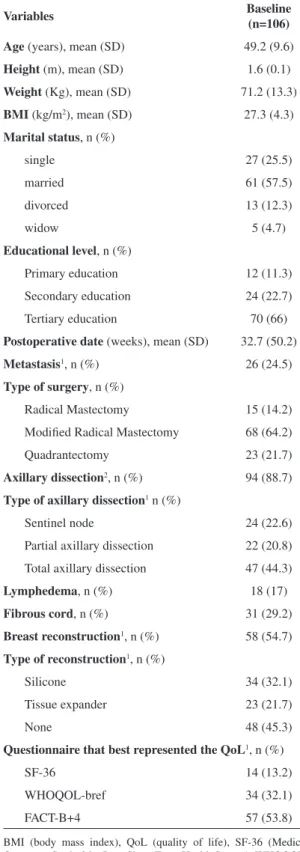
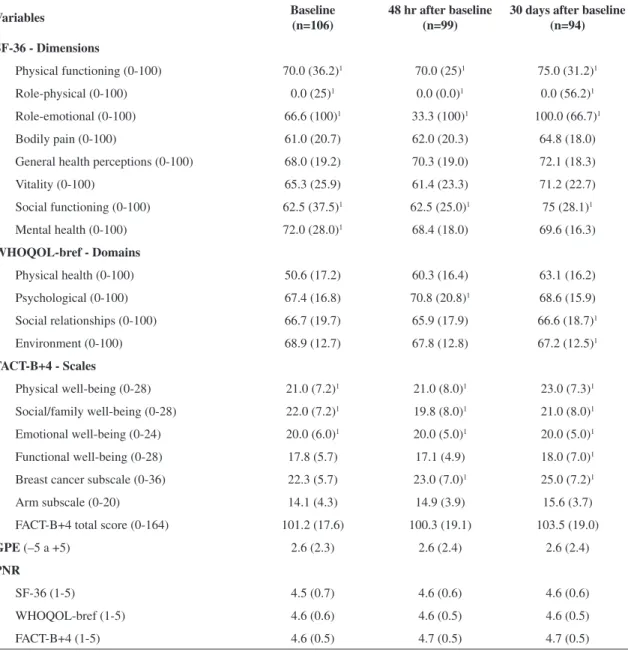
wound, and second surgery. Table 2 shows the clinical
and demographic characteristics, and Table 3 shows
the scores for the QoL questionnaires applied in the
three assessment sessions. The postoperative period
ranged from 3 days to 4 years.
Regarding acceptance and preference for the
questionnaire that best represented QoL, 53.8% of the
participants chose the FACT-B+4 (Table 2). Regarding
ease of comprehension of the questionnaires, the
means were similar (Table 3).
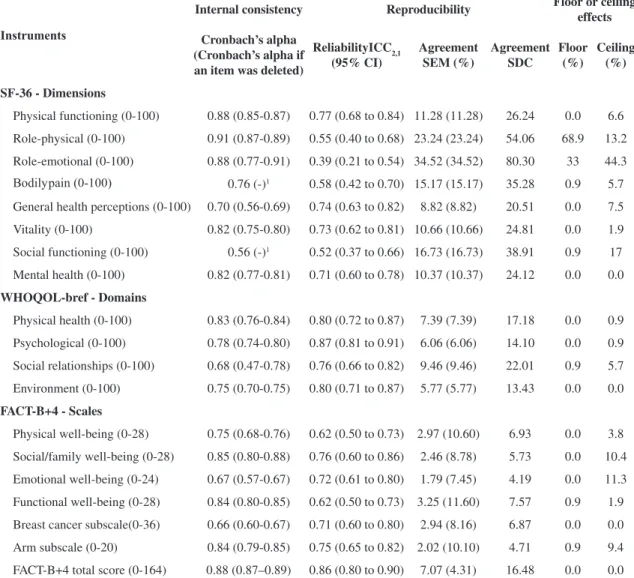
value of Cronbach’s alpha if item deleted reached
when question 21 was deleted; and the emotional
well-being scale and breast cancer subscale of the
FACT-B+4, with no change when using Cronbach’s
alpha if item deleted (Table 4).
Considering reliability, the SF-36 had six
dimensions with moderate reliability, the
WHOQOL-bref had substantial reliability in all domains, and the
FACT-B+4 had five scales with moderate reliability
(Table 4). In most dimensions of the SF-36, agreement
was classified between doubtful and negative; the
Table 1. Measurement properties tested.Measurement properties
Internal consistency The homogeneity of the items of the questionnaire was tested using Cronbach’s alpha11,35 and
Cronbach’s alpha if an item deleted. The Cronbach alpha values are considered adequate when equal to or greater than 0.70 and less than 0.9511,35.
Reproducibility The term reproducibility incorporates two measurement properties: reliability and agreement.
Reliability was tested using Type 2,1 Intraclass Correlation Coefficient (ICC2,1) with 95% confidence
intervals (CIs). An ICC of less than 0.40 represents poor reliability; between 0.40 and 0.75 represents moderate reliability; between 0.75 and 0.90, substantial reliability; and greater than 0.90, excellent reliability. Agreement was measured using the following measurements: Standard Error of the Measurement (SEM)36 and Smallest Detectable Change (SDC)11,35. The SEM was calculated by the
ratio of the standard deviation of the mean difference to the square root of two. The percentage of the SEM related with the total score of the questionnaire can be interpreted as follows: ≤5%: very good; >5% and ≤10%: good; >10% and ≤20%: doubtful and >20%: negative37. The SDC was
calculated using the formula SDC=1.645 × √2 x SEM, with 90% CI, which reflects the smallest detectable change in an individual’s score. Thus, it can be interpreted that values above the SDC describe a change in the individual’s score above the error of the measurement35.
Construct validity We correlated the domains with the most similarities, e.g. the SF-36 dimensions physical functioning, role-physical, role-emotional, and social functioning with the FACT-B+4 scales functional well-being, physical well-well-being, emotional well-well-being, and social/family well-well-being, respectively, and the WHOQOL-bref domains physical health, psychological, and social relationships with the FACT-B+4 scales physical well-being, emotional well-being, and social/family well-being, using Pearson’s correlation test (r). When r<0.30, the correlation was considered weak, when r≥0.30 and <0.60 the correlation was considered moderate and when r≥0.60 the correlation was considered good36. It is expected that the generic quality of life questionnaires SF-36 and WHOQOL have a
positive correlation with the FACT-B+4 with r≥0.60, assuming that the construct of the evaluated domains of the three questionnaires were similar.
Responsiveness The analysis of the responsiveness was based on the participants who showed clinical changes,
considering a two-point change (negative or positive) in the GPE scale. The internal responsiveness was assessed by calculating the effect size (ES: mean of difference between initial assessment and 30-day follow-up, divided by the standard deviation of the initial assessment) with 84% CI. We chose 84% CI to allow a direct comparison of the ES of different instruments since CIs that do not exceed 84% are equivalent to Z scores at 95%38,39. A value for ES ≤0.20 represents a change of approximately
1/5 of the standard deviation at the beginning of treatment and it is considered small. A value of 0.50 is considered moderate and a value ≥0.80 is considered large40. The external responsiveness was measured
by two tests: 1) Pearson’s Correlation test to determine the correlation between the initial and 30-day assessments of the dimensions of the SF-3622, WHOQOL-bref25, FACT-B+429 and the GPE scale32
assessed on the 30-day assessment session. This type of responsiveness test compares the instruments’ sensitivity to change in relation to a global measurement of quality of life; and 2) the construction of ROC (Receiver-Operator Characteristics) curves using the differences between the initial and 30-day assessments of the SF-36, WHOQOL-bref, FACT-B+4 and the GPE scale dichotomized in patients who changed their quality of life status. The cut-off point to categorize change was based on the number of women who changed their quality of life considering a two-point variation in the GPE scale assessed in the 30-day assessment session. The analysis was based on the area under the curve (AUC) and values of 0.7035 or more were considered responsive. This type of responsiveness measures the questionnaire’s
ability to distinguish patients who changed quality of life status from those who did not11,35.
WHOQOL-bref had good agreement in all domains;
and the agreement levels of the FACT-B+4 varied
from very good to doubtful (Table 4). Regarding
the floor or ceiling effects, values above 15% were
only found in three dimensions of the SF-36, with
floor effect in the role-physical and role-emotional
dimensions and ceiling effect in the role-emotional
and social functioning dimensions (Table 4).
For the construct validity, the correlations
between the scales of the FACT-B+4 and the SF-36
varied from good to moderate (correlation between
role-physical dimension of the SF-36 and physical
well-being scale of the FACT-B+4: r=0.31, p=0.001;
correlation between role-emotional dimension of the
SF-36 and emotional well-being scale of FACT-B+4:
r=0.41, p=0.000; correlation between physical
functioning dimension of the SF-36 and functional
well-being scale of FACT-B+4: r=0.39, p=0.000).
The association of the scales of the FACT-B+4
and WHOQOL-bref showed good correlation
(correlation between physical health domain of the
WHOQOL-bref and physical well-being scale of
FACT-B+4: r=0.69, p=0.000; correlation between
social relationships domain of the WHOQOL-bref
and social/family well-being scale of FACT-B+4:
r=0.62, p=0.000; correlation between psychological
domain of the WHOQOL-bref and emotional
well-being scale of FACT-B+4: r=0.61, p=0.000).
In the assessment session after 30 days, 62 patients
had changes <2 points and 32 patients had clinical
changes
≥
2 points in the GPE scale. The analysis
of responsiveness considered the data from these
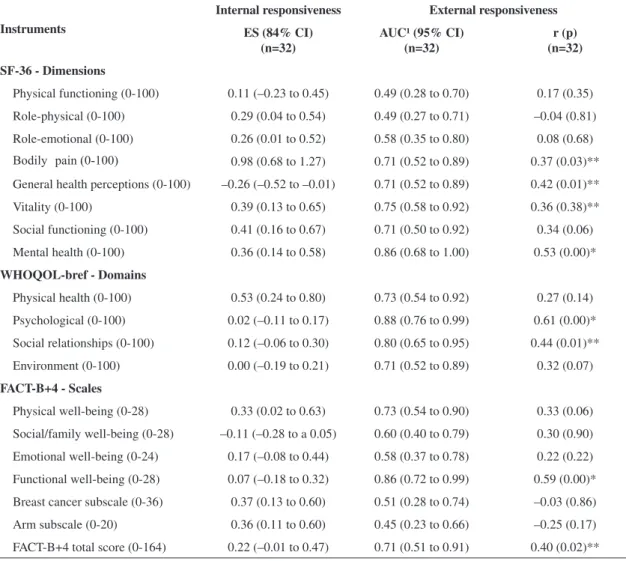
32 patients. Regarding internal responsiveness, the
SF-36 showed moderate ES in all dimensions except
physical functioning and general health perceptions,
which had small ES, and bodily pain, which had
large ES. The WHOQOL-bref showed small ES in
all domains, except physical health, with moderate
ES. The FACT-B+4 showed moderate ES in all scales
except social/family being, emotional
well-being, and functional well-well-being, which had small
ES. With 84% CI, there was no difference between
similar domains, i.e. in all comparisons there was
overlapping between the CIs. For example, the
role-physical dimension of the SF-36 presented ES=0.29
with 84% CI of 0.04 to 0.54 which overlapped the
CI of the physical health domain of the
WHOQOL-bref, with ES=0.53 and 84% CI of 0.24 to 0.80, and
of the physical well-being scale of the FACT-B+4,
with ES=0.33 and 84% CI of 0.02 to 0.63.
In the external responsiveness assessment using
ROC curve analysis, all dimensions of the SF-36
were responsive, except for physical functioning,
Table 2. Characteristics of study participants.Variables Baseline
(n=106)
Age (years), mean (SD) 49.2 (9.6)
Height (m), mean (SD) 1.6 (0.1)
Weight (Kg), mean (SD) 71.2 (13.3)
BMI (kg/m2), mean (SD) 27.3 (4.3)
Marital status, n (%)
single 27 (25.5)
married 61 (57.5)
divorced 13 (12.3)
widow 5 (4.7)
Educational level, n (%)
Primary education 12 (11.3)
Secondary education 24 (22.7)
Tertiary education 70 (66)
Postoperative date (weeks), mean (SD) 32.7 (50.2)
Metastasis1, n (%) 26 (24.5)
Type of surgery, n (%)
Radical Mastectomy 15 (14.2)
Modified Radical Mastectomy 68 (64.2)
Quadrantectomy 23 (21.7)
Axillary dissection2, n (%) 94 (88.7)
Type of axillary dissection1 n (%)
Sentinel node 24 (22.6)
Partial axillary dissection 22 (20.8)
Total axillary dissection 47 (44.3)
Lymphedema, n (%) 18 (17)
Fibrous cord, n (%) 31 (29.2)
Breast reconstruction1, n (%) 58 (54.7)
Type of reconstruction1, n (%)
Silicone 34 (32.1)
Tissue expander 23 (21.7)
None 48 (45.3)
Questionnaire that best represented the QoL1, n (%)
SF-36 14 (13.2)
WHOQOL-bref 34 (32.1)
FACT-B+4 57 (53.8)
BMI (body mass index), QoL (quality of life), SF-36 (Medical Outcomes Study 36 – Item Short-Form Health Survey),
WHOQOL-bref(World Health Organization Quality of Life – bref), FACT-B+4
(Functional Assessment of Cancer Therapy – Breast plus Arm
Morbidity). 1Missing data (%): Metastasis (2.8), Type of axillary
dissection(0.9), Breast reconstruction(0.9), Type of reconstruction
(0.9), Questionnaire that best represented the QoL(0.9); 2Patients
role-physical, and role-emotional. In the
WHOQOL-bref, all domains had values above 0.70. The physical
well-being, functional well-being, and total score
scales of the FACT-B+4 were responsive. The
Pearson correlation analysis showed a significant and
moderate correlation in the dimensions bodily pain,
general health perceptions, vitality, and mental health
of the SF-36. The WHOQOL-bref showed significant
good and moderate correlation for the domains
psychological and social relationships, respectively.
The FACT-B+4 showed a moderate correlation for
the functional well-being and total score scales of the
FACT-B+4 (Table 5).
Discussion
Most of the domains of the SF-36,
WHOQOL-bref, and FACT-B+4 showed acceptable values
for the measurement properties. All instruments
showed good comprehension represented by similar
means. With regard to the questionnaire which
best-represented QoL, 53.8% of the participants
chose the FACT-B+4, possibly due to the fact that
Table 3. Scores of quality of life questionnaires and scales used in the study in the three assessment sessions, in mean and standard deviation.Variables Baseline
(n=106)
48 hr after baseline (n=99)
30 days after baseline (n=94)
SF-36 - Dimensions
Physical functioning (0-100) 70.0 (36.2)1 70.0 (25)1 75.0 (31.2)1
Role-physical (0-100) 0.0 (25)1 0.0 (0.0)1 0.0 (56.2)1
Role-emotional (0-100) 66.6 (100)1 33.3 (100)1 100.0 (66.7)1
Bodily pain (0-100) 61.0 (20.7) 62.0 (20.3) 64.8 (18.0)
General health perceptions (0-100) 68.0 (19.2) 70.3 (19.0) 72.1 (18.3)
Vitality (0-100) 65.3 (25.9) 61.4 (23.3) 71.2 (22.7)
Social functioning (0-100) 62.5 (37.5)1 62.5 (25.0)1 75 (28.1)1
Mental health (0-100) 72.0 (28.0)1 68.4 (18.0) 69.6 (16.3)
WHOQOL-bref - Domains
Physical health (0-100) 50.6 (17.2) 60.3 (16.4) 63.1 (16.2)
Psychological (0-100) 67.4 (16.8) 70.8 (20.8)1 68.6 (15.9)
Social relationships (0-100) 66.7 (19.7) 65.9 (17.9) 66.6 (18.7)1
Environment (0-100) 68.9 (12.7) 67.8 (12.8) 67.2 (12.5)1
FACT-B+4 - Scales
Physical well-being (0-28) 21.0 (7.2)1 21.0 (8.0)1 23.0 (7.3)1
Social/family well-being (0-28) 22.0 (7.2)1 19.8 (8.0)1 21.0 (8.0)1
Emotional well-being (0-24) 20.0 (6.0)1 20.0 (5.0)1 20.0 (5.0)1
Functional well-being (0-28) 17.8 (5.7) 17.1 (4.9) 18.0 (7.0)1
Breast cancer subscale (0-36) 22.3 (5.7) 23.0 (7.0)1 25.0 (7.2)1
Arm subscale (0-20) 14.1 (4.3) 14.9 (3.9) 15.6 (3.7)
FACT-B+4 total score (0-164) 101.2 (17.6) 100.3 (19.1) 103.5 (19.0)
GPE (–5 a +5) 2.6 (2.3) 2.6 (2.4) 2.6 (2.4)
PNR
SF-36 (1-5) 4.5 (0.7) 4.6 (0.6) 4.6 (0.6)
WHOQOL-bref (1-5) 4.6 (0.6) 4.6 (0.5) 4.6 (0.5)
FACT-B+4 (1-5) 4.6 (0.5) 4.7 (0.5) 4.7 (0.5)
SF-36 (Medical Outcomes Study 36 – Item Short - Form Health Survey), WHOQOL-bref (World Health Organization Quality of Life – bref),
FACT-B+4 (Functional Assessment of Cancer Therapy – Breast plus Arm Morbidity), GPE (Global Perceived Effect scale), PNR (Pain
this instrument included specific questions to breast
cancer and upper limb limitations.
In our study, the SF-36 showed adequate
Cronbach’s alpha in all dimensions except social
functioning. Similar studies with different samples
were found in the literature. In a population of
Chinese medical students, Cronbach’s alpha ranged
from 0.63 to 0.82, with the lowest value in the social
functioning dimension. This result may be due to the
fact that the items of this dimension are not sensitive
to cultural variations and may need to be adapted
to the characteristics of the target population
41. In
Chinese patients with chronic diseases, Cronbach’s
alpha ranged from 0.54 to 0.93, with the lowest
values in the dimensions bodily pain (0.54) and social
functioning (0.62)
42. In contrast, in a study with a
population of 50 healthy individuals and 80 patients
with chronic disease, Cronbach’s alpha ranged from
0.72 to 0.89
43.
Moderate reliability was found in all dimensions
of the SF-36 except role-emotional, which had poor
reliability, making it impossible to obtain similar
results among the participants of this study. Other
studies found in the literature show substantial to
excellent reliability. In a population of Chinese
patients with chronic disease, ICC values ranged from
0.83 to 0.96
42. In a sample of 130 Arabic individuals,
ICC ranged from 0.95 to 0.98
43. However, both of
these studies may have overestimated the results
because they did not report the type of ICC used.
Table 4. Values of internal consistency, reproducibility and floor or ceiling effects.Instruments
Internal consistency Reproducibility Floor or ceiling effects
Cronbach’s alpha (Cronbach’s alpha if an item was deleted)
ReliabilityICC2,1 (95% CI)
Agreement SEM (%)
Agreement SDC
Floor (%)
Ceiling (%)
SF-36 - Dimensions
Physical functioning (0-100) 0.88 (0.85-0.87) 0.77 (0.68 to 0.84) 11.28 (11.28) 26.24 0.0 6.6
Role-physical (0-100) 0.91 (0.87-0.89) 0.55 (0.40 to 0.68) 23.24 (23.24) 54.06 68.9 13.2
Role-emotional (0-100) 0.88 (0.77-0.91) 0.39 (0.21 to 0.54) 34.52 (34.52) 80.30 33 44.3
Bodilypain (0-100) 0.76 (-)1 0.58 (0.42 to 0.70) 15.17 (15.17) 35.28 0.9 5.7
General health perceptions (0-100) 0.70 (0.56-0.69) 0.74 (0.63 to 0.82) 8.82 (8.82) 20.51 0.0 7.5
Vitality (0-100) 0.82 (0.75-0.80) 0.73 (0.62 to 0.81) 10.66 (10.66) 24.81 0.0 1.9
Social functioning (0-100) 0.56 (-)1 0.52 (0.37 to 0.66) 16.73 (16.73) 38.91 0.9 17
Mental health (0-100) 0.82 (0.77-0.81) 0.71 (0.60 to 0.78) 10.37 (10.37) 24.12 0.0 0.0
WHOQOL-bref - Domains
Physical health (0-100) 0.83 (0.76-0.84) 0.80 (0.72 to 0.87) 7.39 (7.39) 17.18 0.0 0.9
Psychological (0-100) 0.78 (0.74-0.80) 0.87 (0.81 to 0.91) 6.06 (6.06) 14.10 0.0 0.9
Social relationships (0-100) 0.68 (0.47-0.78) 0.76 (0.66 to 0.82) 9.46 (9.46) 22.01 0.9 5.7
Environment (0-100) 0.75 (0.70-0.75) 0.80 (0.71 to 0.87) 5.77 (5.77) 13.43 0.0 0.0
FACT-B+4 - Scales
Physical well-being (0-28) 0.75 (0.68-0.76) 0.62 (0.50 to 0.73) 2.97 (10.60) 6.93 0.0 3.8
Social/family well-being (0-28) 0.85 (0.80-0.88) 0.76 (0.60 to 0.86) 2.46 (8.78) 5.73 0.0 10.4
Emotional well-being (0-24) 0.67 (0.57-0.67) 0.72 (0.61 to 0.80) 1.79 (7.45) 4.19 0.0 11.3
Functional well-being (0-28) 0.84 (0.80-0.85) 0.62 (0.50 to 0.73) 3.25 (11.60) 7.57 0.9 1.9
Breast cancer subscale(0-36) 0.66 (0.60-0.67) 0.71 (0.60 to 0.80) 2.94 (8.16) 6.87 0.0 0.0
Arm subscale (0-20) 0.84 (0.79-0.85) 0.75 (0.65 to 0.82) 2.02 (10.10) 4.71 0.9 9.4
FACT-B+4 total score (0-164) 0.88 (0.87–0.89) 0.86 (0.80 to 0.90) 7.07 (4.31) 16.48 0.0 0.0
ICC (Intraclass Correlation Coefficient), CI (confidence interval), SEM (standard error of the measurement), SDC (smallest detectable change),
SF-36 (Medical Outcomes Study 36 – Item Short - Form Health Survey), WHOQOL-bref(World Health Organization Quality of Life – bref),
FACT-B+4 (Functional Assessment of Cancer Therapy – Breast plus Arm Morbidity). 1Insufficient number of items for calculating Cronbach’s
That may be the reason why these studies found
higher ICC values than those in our study. For
agreement, the present study found high standard
error of measurement (SEM) values (most of the
dimensions showed values >10% and
≤
20%) and
smallest detectable change (SDC) ranging from
20.51 to 80.30, characterizing the SF-36 as having
doubtful agreement.
We found the presence of floor effect in the
dimensions role-physical and role-emotional and
the presence of ceiling effect in the dimensions
role-emotional and social functioning. These specific
dimensions were probably unable to detect change
in the patients’ health condition, with implications
on reproducibility and responsiveness. For construct
validity, analyzed by the combination of dimensions
from the SF-36 and the FACT-B+4, the results
indicated a significant correlation in all dimensions
except the social functioning dimension of the
SF-36. No studies were found that conducted a similar
correlation between these two questionnaires.
The assessment of the internal responsiveness
showed that responsiveness ranged from small to
large. Considering external responsiveness, the
SF-36 was characterized as a responsive instrument.
Furthermore, a significant correlation was found
between the dimensions that had AUC values above
0.70. The SF-36 showed at least one dimension with
inadequate values in all measurement properties
Table 5. Internal and external responsiveness.Instruments
Internal responsiveness External responsiveness
ES (84% CI) (n=32)
AUC¹ (95% CI) (n=32)
r (p) (n=32)
SF-36 - Dimensions
Physical functioning (0-100) 0.11 (–0.23 to 0.45) 0.49 (0.28 to 0.70) 0.17 (0.35)
Role-physical (0-100) 0.29 (0.04 to 0.54) 0.49 (0.27 to 0.71) –0.04 (0.81)
Role-emotional (0-100) 0.26 (0.01 to 0.52) 0.58 (0.35 to 0.80) 0.08 (0.68)
Bodily pain (0-100) 0.98 (0.68 to 1.27) 0.71 (0.52 to 0.89) 0.37 (0.03)**
General health perceptions (0-100) –0.26 (–0.52 to –0.01) 0.71 (0.52 to 0.89) 0.42 (0.01)**
Vitality (0-100) 0.39 (0.13 to 0.65) 0.75 (0.58 to 0.92) 0.36 (0.38)**
Social functioning (0-100) 0.41 (0.16 to 0.67) 0.71 (0.50 to 0.92) 0.34 (0.06)
Mental health (0-100) 0.36 (0.14 to 0.58) 0.86 (0.68 to 1.00) 0.53 (0.00)*
WHOQOL-bref - Domains
Physical health (0-100) 0.53 (0.24 to 0.80) 0.73 (0.54 to 0.92) 0.27 (0.14)
Psychological (0-100) 0.02 (–0.11 to 0.17) 0.88 (0.76 to 0.99) 0.61 (0.00)*
Social relationships (0-100) 0.12 (–0.06 to 0.30) 0.80 (0.65 to 0.95) 0.44 (0.01)**
Environment (0-100) 0.00 (–0.19 to 0.21) 0.71 (0.52 to 0.89) 0.32 (0.07)
FACT-B+4 - Scales
Physical well-being (0-28) 0.33 (0.02 to 0.63) 0.73 (0.54 to 0.90) 0.33 (0.06)
Social/family well-being (0-28) –0.11 (–0.28 to a 0.05) 0.60 (0.40 to 0.79) 0.30 (0.90)
Emotional well-being (0-24) 0.17 (–0.08 to 0.44) 0.58 (0.37 to 0.78) 0.22 (0.22)
Functional well-being (0-28) 0.07 (–0.18 to 0.32) 0.86 (0.72 to 0.99) 0.59 (0.00)*
Breast cancer subscale (0-36) 0.37 (0.13 to 0.60) 0.51 (0.28 to 0.74) –0.03 (0.86)
Arm subscale (0-20) 0.36 (0.11 to 0.60) 0.45 (0.23 to 0.66) –0.25 (0.17)
FACT-B+4 total score (0-164) 0.22 (–0.01 to 0.47) 0.71 (0.51 to 0.91) 0.40 (0.02)**
SF-36 (Medical Outcomes Study 36 – Item Short - Form Health Survey), WHOQOL-bref (World Health Organization Quality of Life – bref), FACT-B+4 (Functional Assessment of Cancer Therapy – Breast plus Arm Morbidity), ES (Effect size), AUC (area under the curve), CI
(Confidence interval). ¹Cutoff for improvement ≥2 in the Global Perceived Effect scale; *Statistically significant correlations (p<0.01),
tested. This result implies that the SF-36 should not
be used to evaluate QoL in patients with breast cancer.
The WHOQOL-bref presented adequate internal
consistency in most of the domains, except for the
social relationships domain. No studies were found
on assessment of the measurement properties of the
WHOQOL-bref in patients with breast cancer. In
other populations, studies that tested the internal
consistency of the WHOQOL-bref found similar
values
25,28,44-46. One study in which the internal
consistency of the WHOQOL-bref was compared to
that of the WHOQOL-100 found a higher Cronbach’s
alpha. Thus, the low value of the abbreviated
questionnaire can be explained by the low number
of questions in the social relationships domain given
that Cronbach’s alpha is dependent on the number of
items of a scale
25,34.
Reliability was substantial in all domains of the
WHOQOL-bref. These results are similar to those
of one study
28, in which the values varied from
substantial to excellent. However, this study
28does
not report the type of ICC used. For the agreement,
good SEM values were found and an SDC of 13.43
to 22.01, characterizing the WHOQOL-bref as having
good agreement.
There were no floor or ceiling effects. The construct
validity presented a good correlation. No study was
found that conducted a similar correlation between the
two questionnaires. Internal responsiveness showed
small responsiveness in most of the domains. A study
with smokers also found small responsiveness for
all domains except the psychological domain
44. The
assessment of the external responsiveness by the AUC
showed responsiveness in all domains. However, only
the psychological and social relationship domains
showed significant correlation. After the analysis, the
WHOQOL-bref can be used to assess QoL in patients
with breast cancer given that the measurement
properties were adequate and the instrument was able
to detect clinical changes over time.
The FACT-B+4 showed adequate values for
internal consistency, with the exception of the
emotional well-being scale and the breast cancer
subscale. Other studies found lower internal
consistency values for the same scales, suggesting
that there is no homogeneity in these scales. For
example, in the original validation study of the arm
subscale of the FACT-B+4, the internal consistency
ranged from 0.62 to 0.83
30; in a sample of breast
cancer patients before surgery with upper limb
lymphedema, the internal consistency varied from
0.52 to 0.92
47.
For reliability, most scales showed moderate
reliability. Conflicting results were found in a sample
of patients with lymphedema, with reliability ranging
from 0.40 to 0.88
47, and the study did not report the
type of ICC used. The agreement values for the scales
of the FACT-B+4 were characterized between good
and doubtful. For the FACT-B+4 total score, a very
good agreement was observed. Floor or ceiling effects
were not observed. In contrast, another study on
women with breast cancer showed ceiling effects in
the physical well-being and social/family well-being
scales and the arm subscale
47. For construct validity,
the FACT-B+4 presented better correlation with the
WHOQOL-bref, with good correlation between all
scales.
The assessment of internal responsiveness
showed small to moderate responsiveness. External
responsiveness, based on the analysis of the AUC,
was only found for the physical well-being, functional
well-being, and total score scales. The correlation
analysis showed moderate correlation for the
functional well-being scale and total score.
The measurement of QoL is important to
understand how functional impairment interferes in
the daily activities of women undergoing treatment
for breast cancer. Considering that the assessment of
QoL is multidimensional
48,49, with different meanings
depending on the variety of life contexts, maintenance
of functional capacity, general satisfaction, personal
fulfillment, and social interaction
48,49, physical
therapists should investigate QoL with the goal
of improving the treatment and monitoring the
evolution of the clinical condition, which contributes
to prevention interventions or treatment directions
6,50.
Some limitations can be suggested in this study.
The inclusion criteria included the largest possible
number of women with breast cancer regardless of
their phase of treatment. The wide variety in the type
of surgery and time since surgery may have become
a limitation because a more homogeneous sample
in regard to treatment phase or surgery type could
have resulted in similar changes in QoL. However,
the current sample was based on previous studies
51,52.
Another limitation was the 30-day interval for the
responsiveness assessment. Perhaps if this
follow-up time had been longer, greater clinical changes
could have occurred and better results could have
been found.
FACT-B+4 are interconnected in the measurement
of QoL in the studied population. The SF-36 showed
inadequacy in agreement and floor and ceiling effects
and should not be used to assess QoL in women with
breast cancer.
References
1. Brasil. Ministério da Saúde. Instituto Nacional do Câncer. Estimativas 2010: incidência de câncer no Brasil. Rio de Janeiro: INCA; 2009 [cited 2013 Fev 01]. Available from: http://www.inca.gov.br/estimativa/2010/ estimativa20091201.pdf.
2. Gregorio TCR, Sbalchiero JC, Leal PRA. Exame histopatológico das cicatrizes de mastectomia nas reconstruções tardias de mama: existe relevância oncológica? Rev Bras Cancerol. 2007;53(4):421-4. 3. Silva MPP, Derchain SFM, Rezende L, Cabello C,
Martinez EZ. Movimento do ombro após cirurgia por carcinoma invasor da mama: estudo randomizado prospectivo controlado de exercícios livres versus limitados a 90° no pós-operatório. Rev Bras Ginecol Obstet. 2004;26(2):125-30. http://dx.doi.org/10.1590/ S0100-72032004000200007
4. Kwan W, Jackson J, Weir LM, Dingee C, McGregor G, Olivotto IA. Chronic arm morbidity after curative breast cancer treatment: prevalence and impact on quality of life. J Clin Oncol. 2002;20(20):4242-8. PMid:12377968. http:// dx.doi.org/10.1200/JCO.2002.09.018
5. Kaya T, Karatepe AG, Gunaydn R, Yetis H, Uslu A. Disability and health-related quality of life after breast cancer surgery: relation to impairments. South Med J. 2010;103(1):37-41. PMid:19996840. http://dx.doi. org/10.1097/SMJ.0b013e3181c38c41
6. Assis MR, Marx AG, Magna LA, Ferrigno ISV. Late morbidity in upper limb function and quality of life in women after breast cancer surgery. Braz J Phys Ther. 2013;17(3):236-43. PMid:23966141. http://dx.doi. org/10.1590/S1413-35552012005000088
7. Lotti RCB, Barra AA, Dias RC, Maklufz ASD. Impacto do tratamento de câncer de mama na qualidade de vida. Rev Bras Cancerol. 2008;54(4):367-71.
8. Rietman JS, Dijkstra PU, Hoekstra HJ, Eisma WH, Szabo BG, Groothoff JW, et al. Late morbidity after treatment of breast cancer in relation to daily activities and quality of life: a systematic review. Eur J Surg Oncol. 2003;29(3):229-38. PMid:12657232. http://dx.doi. org/10.1053/ejso.2002.1403
9. Nesvold IL, Reinertsen KV, Fossa SD, Dahl AA. The relation between arm/shoulder problems and quality of life in breast cancer survivors: a cross-sectional and longitudinal study. J Cancer Surviv. 2011;5(1):62-72. PMid:20972640 PMCid:PMC3040353. http://dx.doi. org/10.1007/s11764-010-0156-4
10. Beaton DE, Bombardier C, Guillemin F, Ferraz MB. Guidelines for the process of cross-cultural adaptation of self-report measures. Spine (Phila
Pa 1976). 2000;25(24):3186-91. http://dx.doi. org/10.1097/00007632-200012150-00014
11. Maher CG, Latimer J, Costa LOP. The relevance of cross-cultural adaptation and clinimetrics for physical therapy instruments. Rev Bras Fisioter. 2007;11(4):245-52. http:// dx.doi.org/10.1590/S1413-35552007000400002 12. Patient-Reported Outcome and Quality of Life Instruments
Database – PROQOLID. List of instruments. PROQOLID; 2008 [cited 2011 Nov 20]. Available from: http://www. qolid.org/index.php/proqolid/search__1/generic. 13. Chen CM, Cano SJ, Klassen AF, King T, McCarthy
C, Cordeiro PG, et al. Measuring quality of life in oncologic breast surgery: a systematic review of patient-reported outcome measures. Breast J. 2010;16(6):587-97. PMid:21070435. http://dx.doi. org/10.1111/j.1524-4741.2010.00983.x
14. Michels FAS, Latorre MRDO, Maciel MS. Validação e reprodutibilidade do questionário FACT-B+4 de qualidade de vida específico para câncer de mama e comparação dos questionários IBCSG, EORTC-BR23 e FACT-B+4. Cad Saúde Colet. 2012;20(3):321-8.
15. Soares PBM, Carneiro JA, Rocha LA, Gonçalves RCR, Martelli DRB, Fagundes M, et al. The quality of life of disease-free Brazilian breast cancer survivors. Rev Esc Enferm USP. 2013;47(1):69-75. PMid:23515805. http:// dx.doi.org/10.1590/S0080-62342013000100009 16. Simeão SFAP, Landro ICR, Conti MHSD, Gatti MAN,
Delgallo WD, Vitta AD. Qualidade de vida em grupos de mulheres acometidas de câncer de mama. Cien Saude Colet. 2013;18(3):779-88. http://dx.doi.org/10.1590/ S1413-81232013000300024
17. Huguet PR, Morais SS, Osis MJD, Pinto AM No, Gurgel MSC. Qualidade de vida e sexualidade de mulheres tratadas de câncer de mama. Rev Bras Ginecol Obstet. 2009;31(2):61-7. PMid:19407910. http://dx.doi. org/10.1590/S0100-72032009000200003
18. Mera PC, Ortiz M. La relación del optimismo y las estrategias de afrontamiento con la calidad de vida de mujeres con cáncer de mama. Ter Psicol. 2012;30(3):69-78. http://dx.doi.org/10.4067/S0718-48082012000300007 19. Kluthcovsky ACGC, Urbanetz AAL. Qualidade de
vida em pacientes sobreviventes de câncer de mama comparada à de mulheres saudáveis. Rev Bras Ginecol Obstet. 2012;34(10):453-8. PMid:23288222. http://dx.doi. org/10.1590/S0100-72032012001000004
20. Zapata CS, Romero HG. Calidad de vida y factores asociados en mujeres con cáncer de mama en Antioquia, Colombia. Rev Panam Salud Publica. 2010;28(1):9-18. http://dx.doi.org/10.1590/S1020-49892010000700002 21. Ware JE Jr, Sherbourne CD. The MOS 36-item short-form
health survey (SF-36). I. Conceptual framework and item selection. Med Care. 1992;30(6):473-83. PMid:1593914. http://dx.doi.org/10.1097/00005650-199206000-00002 22. Ciconelli RM, Ferraz MB, Santos W, Meinão I, Quaresma
23. Hays RD, Sherbourne CD, Mazel RM. The RAND 36-Item Health Survey 1.0. Health Econ. 1993;2(3):217-27. PMid:8275167. http://dx.doi.org/10.1002/ hec.4730020305
24. Development of the World Health Organization WHOQOL-BREF quality of life assessment: the WHOQOL group. Psychol Med. 1998;28(3):551-8. http:// dx.doi.org/10.1017/S0033291798006667
25. Fleck MPA, Louzada S, Xavier M, Chachamovich E, Vieira G, Santos L, et al. Aplicação da versão em português do instrumento abreviado de avaliação da qualidade de vida “WHOQOL-bref”. Rev Saúde Pública. 2000;34(2):178-83. PMid:10881154. http://dx.doi. org/10.1590/S0034-89102000000200012
26. World Health Organization - WHO. WHOQOL-BREF introduction, administration, scoring and generic version of the assessement. WHO; 1996. Available from: http:// www.who.int/mental_health/media/en/76.pdf.
27. Kluthcovsky ACGC, Kluthcovsky FA. O WHOQOL-bref, um instrumento para avaliar qualidade de vida: uma revisão sistemática. Rev Psiquiatr Rio Gd Sul. 2009;31(3):1-12. http://dx.doi.org/10.1590/S0101-81082009000400007 28. Moreno AB, Faerstein E, Werneck GL, Lopes CS, Chor
D. Propriedades psicométricas do Instrumento Abreviado de Avaliação de Qualidade de Vida da Organização Mundial da Saúde no Estudo Pró-Saúde. Cad Saúde Pública. 2006;22(12):2585-97. http://dx.doi.org/10.1590/ S0102-311X2006001200009
29. Brady MJ, Cella DF, Mo F, Bonomi AE, Tulsky DS, Lloyd SR, et al. Reliability and validity of the functional assessment of cancer therapy-breast quality-of-life instrument. J Clin Oncol. 1997;15(3):974-86. PMid:9060536.
30. Coster S, Poole K, Fallowfield LJ. The validation of a quality of life scale to assess the impact of arm morbidity in breast cancer patients post-operatively. Breast Cancer Res Treat. 2001;68(3):273-82. PMid:11727963. http:// dx.doi.org/10.1023/A:1012278023233
31. Functional Assessment of Cancer Therapy – FACT. 1987 [cited 2012 Out 26]. Available from: http://www.facit. org/FACITOrg.
32. Costa LO, Maher CG, Latimer J, Ferreira PH, Ferreira ML, Pozzi GC, et al. Clinimetric testing of three self-report outcome measures for low back pain patients in Brazil: which one is the best? Spine (Phila Pa 1976). 2008;33(22):2459-63. PMid:18923324. http://dx.doi. org/10.1097/BRS.0b013e3181849dbe
33. Grassi-Oliveira R, Stein LC. Tradução e validação de conteúdo da versão em português do childhood trauma questionnaire. Rev Saude Publica. 2006;40(2):249-55. http://dx.doi.org/10.1590/S0034-89102006000200010 34. Terwee CB, Bot SD, Boer MR, van der Windt DA, Knol
DL, Dekker J, et al. Quality criteria were proposed for measurement properties of health status questionnaires. J Clin Epidemiol. 2007;60(1):34-42. PMid:17161752. http://dx.doi.org/10.1016/j.jclinepi.2006.03.012 35. Menezes Costa LC, Maher CG, McAuley JH,
Hancock MJ, Melo Oliveira W, Azevedo DC, et al.
The Brazilian-Portuguese versions of the McGill Pain Questionnaire were reproducible, valid, and responsive in patients with musculoskeletal pain. J Clin Epidemiol. 2011;64(8):903-12. PMid:21444194. http://dx.doi. org/10.1016/j.jclinepi.2010.12.009
36. Fleiss J. The design and analysis of clinical experiments. New York: Wiley; 1986.
37. Ostelo RW, Vet HC, Knol DL, van den Brandt PA. 24-item Roland-morris disability questionnaire was preferred out of six functional status questionnaires for post-lumbar disc surgery. J Clin Epidemiol. 2004;57(3):268-76. PMid:15066687. http://dx.doi.org/10.1016/j. jclinepi.2003.09.005
38. Pengel LH, Refshauge KM, Maher CG. Responsiveness of pain, disability, and physical impairment outcomes in patients with low back pain. Spine (Phila Pa 1976). 2004;29(8):879-83. http://dx.doi. org/10.1097/00007632-200404150-00011
39. Tryon WW. Evaluating statistical difference, equivalence, and indeterminacy using inferential confidence intervals: an integrated alternative method of conducting null hypothesis statistical tests. Psychol Methods. 2001;6(4):371-86. PMid:11778678. http://dx.doi. org/10.1037/1082-989X.6.4.371
40. Husted JA, Cook RJ, Farewell VT, Gladman DD. Methods for assessing responsiveness: a critical review and recommendations. J Clin Epidemiol. 2000;53(5):459-68. http://dx.doi.org/10.1016/S0895-4356(99)00206-1 41. Zhang Y, Qu B, Lun SS, Guo Y, Liu J. The 36-item short
form health survey: reliability and validity in Chinese medical students. Int J Med Sci. 2012;9(7):521-6. PMid:22991490 PMCid:PMC3444972. http://dx.doi. org/10.7150/ijms.4503
42. Yang Z, Li W, Tu X, Tang W, Messing S, Duan L, et al. Validation and psychometric properties of Chinese version of SF-36 in patients with hypertension, coronary heart diseases, chronic gastritis and peptic ulcer. Int J Clin Pract. 2012;66(10):991-8. PMid:22994333. http://dx.doi. org/10.1111/j.1742-1241.2012.02962.x
43. Guermazi M, Allouch C, Yahia M, Huissa TB, Ghorbel S, Damak J, et al. Translation in Arabic, adaptation and validation of the SF-36 Health Survey for use in Tunisia. Ann Phys Rehabil Med. 2012;55(6):388-403. PMid:22795246. http://dx.doi.org/10.1016/j. rehab.2012.05.003
44. Castro MG, Oliveira MS, Miguel AC, Araujo RB. WHOQOL-BREF psychometric properties in a sample of smokers. Rev Bras Psiquiatr. 2007;29(3):254-7. http:// dx.doi.org/10.1590/S1516-44462006005000051 45. Chung WS, Lan YL, Yang MC. Psychometric testing of the
short version of the world health organization quality of life (WHOQOL-BREF) questionnaire among pulmonary tuberculosis patients in Taiwan. BMC Public Health. 2012;12(1):630. PMid:22877305 PMCid:PMC3560194. http://dx.doi.org/10.1186/1471-2458-12-630
international field trial. A report from the WHOQOL group. Qual Life Res. 2004;13(2):299-310. PMid:15085902. http://dx.doi.org/10.1023/B:QURE.0000018486.91360.00 47. Belmonte Martinez R, Garin Boronat O, Segura Badia
M, Sanz Latiesas J, Marco Navarro E, Ferrer Fores M. Functional assessment of cancer therapy questionnaire for breast cancer (FACT-B+4). spanish version validation. Med Clin. 2011;137(15):685-8. PMid:21420133. http:// dx.doi.org/10.1016/j.medcli.2010.11.028
48. World Health Organization - WHO. Development of the WHOQOL: rationaleand current status. Int J Ment Health. 1994;23(3):24-56.
49. World Health Organization – WHO. WHOQOL: measuring quality of life. WHO; 1997. Programme on mental health. Available from: http://www.who.int/ mental_health/media/68.pdf.
50. Petito EL, Gutiérrez MGR. Elaboração e validação de um programa de exercício para mulheres submetidas a cirurgia oncológica de mama. Rev Bras Cancerol. 2008;54(3):275-87.
51. Alegrance FC, Souza CB, Mazzei RL. Qualidade de vida e estratégias de enfrentamento em mulheres com e sem linfedema pós-câncer de mama. Rev Bras Cancerol. 2010;56(3):341-51.
52. Hartl K, Janni W, Kastner R, Sommer H, Strobl B, Rack B, et al. Impact of medical and demographic factors on long-term quality of life and body image of breast cancer patients. Ann Oncol. 2003;14(7):1064-71. PMid:12853348 http://dx.doi.org/10.1093/annonc/mdg289
Correspondence
Cristina Maria Nunes Cabral
Universidade Cidade de São Paulo – UNICID Programa de Mestrado e Doutorado em Fisioterapia Rua Cesário Galeno, 448/475, Tatuapé