ABSTRACT:Objective: To analyze the association between physical violence by an intimate partner (PVIP) and the inappropriate use of prenatal care services.Methods:A nested cross-sectional study was conducted with 1,026 women, based on data from a prospective cohort study designed to investigate intimate partner violence among pregnant women enrolled in the Family Health Program (PSF) in Recife, Northeastern Brazil. The use of prenatal care services was assessed with basis on the guidelines from the Program for Humanization of Prenatal Care and Childbirth (Brazilian Ministry of Health) and considered the time of the irst prenatal care visit and the total number of visits during the pregnancy. Data were collected through two face-to-face interviews (one in the last pregnancy trimester and the other in the postpartum period), using standardized questionnaires and data on Pregnancy Card records. An unconditional logistic regression was performed to estimate the odds ratio (OR) and the 95% conidence intervals to measure the association between an PVIP and the inappropriate use of prenatal care services, using the stepwise method.Results: The prevalence of the inappropriate use of prenatal care services was 44.1% and of an PVIP, 25.6%. In the logistic regression analysis, an intimatePVIP was associated with inappropriate prenatal care (OR = 1.37; 95%CI 1.01 – 1.85; p = 0.04) after adjustment by variables conirmed as confounders (parity, alcohol use in pregnancy, and education level).
Conclusion: Women who are victims of an PVIP have more chance of receiving inappropriate prenatal care due to late onset of prenatal care, fewer prenatal care visits, or both.
Keywords: Violence against women. Spousal abuse. Prenatal care. Pregnancy. Risk factors. Cross-sectional studies.
Physical violence by an intimate partner and
the inappropriate use of prenatal care services
among women in Northeastern Brazil
Violência física pelo parceiro íntimo e uso inadequado do pré‑natal entre
mulheres do Nordeste do Brasil
Jackelyne Faierstein CarneiroI, Sandra ValongueiroI, Ana Bernarda LudermirI, Thália Velho Barreto de AraújoI
ORIGINAL ARTICLE / ARTIGO ORIGINAL
IUniversidade Federal de Pernambuco (UFPE) – Recife (PE), Brazil.
Corresponding author: Jackelyne Faierstein Carneiro. Integrated Graduate Program in Public Health, UFPE. Avenida Professor Moraes Rego, s/n. Hospital das Clínicas, Bloco E, 4º andar. Cidade Universitária, CEP: 50670‑901. Recife, PE, Brazil. E‑mail: [email protected]
INTRODUCTION
Violence against women during pregnancy is a major public health issue due to the
high risk of maternal and neonatal morbidity and mortality1. A study by the World Health
Organization (WHO) showed that the prevalence of intimate partner violence during
preg-nancy can vary from 1 to 28% among countries2. This study in Brazil indicated that 8% of
women in the city of São Paulo and 11% of women in rural Pernambuco reported having
experienced some kind of violence during gestation2.
Prenatal care can prevent maternal mortality as it modiies the course and the prognosis
of pregnancy complications3 and prevents adverse outcomes, such as perinatal and
neona-tal morneona-tality, congenineona-tal syphilis, and low birth weight4.
In Brazil, the levels of maternal and perinatal morbidity and mortality remain high,
which is incompatible with the current level of economic and social growth in the country5.
In 2000, the Ministry of Health (MS – Ordinance No. 569/GM, Minister’s Oice, from
December 1st 2000) established the Program for Humanization of Prenatal Care and Childbirth
(PHPN) to reduce maternal and child morbidity and mortality by improving access to as
well as coverage and quality of care in prenatal, childbirth, and puerperium periods6.
Some factors are described as associated with no prenatal care, which include belonging to social segments with lower income, having less formal education, belonging to the black race, being over 35 years old, being multiparous, having depressive symptoms during preg-nancy, making abusive use of alcohol and/or illicit drugs, having unstable marital status,
unin-tended pregnancy history, partner’s dissatisfaction with pregnancy, and partner’s violence7-14.
RESUMO:Objetivo: Analisar a associação entre violência física pelo parceiro íntimo e uso inadequado da atenção pré-natal. Métodos: Estudo transversal realizado com 1.026 mulheres participantes de estudo de coorte prospectivo delineado para investigar violência na gravidez entre mulheres cadastradas no Programa Saúde da Família (PSF) do Recife. O uso do pré-natal foi avaliado utilizando a norma do Programa de Humanização do Pré-natal e Nascimento (PHPN), do Ministério da Saúde (MS), considerando a época de início do pré-natal e o total de consultas durante a gravidez. Os dados foram coletados por meio de duas entrevistas presenciais (uma no último trimestre da gravidez, outra no pós-parto) para aplicação de questionário estruturado e a partir dos registros do cartão da gestante. Regressão logística não condicional foi realizada para estimar odds ratio (OR) e valores de intervalo de coniança de 95% (IC95%), a im de medir a associação entre violência física pelo parceiro íntimo e uso inadequado de cuidados pré-natais, utilizando-se o método stepwise. Resultados: A prevalência de uso inadequado do pré-natal foi de 44,1%, e da violência física pelo parceiro íntimo, de 25,6%. Na análise de regressão logística, a violência física pelo parceiro íntimo apresentou-se associada à realização de pré-natal inadequado (OR = 1,37; IC95% 1,01 – 1,85; p = 0,04), após ajuste pelas variáveis conirmadas como confundidoras (paridade, uso de álcool na gravidez e nível de escolaridade). Conclusão: Mulheres vítimas de violência física pelo parceiro íntimo têm maior chance de realizar um pré-natal inadequado, seja pelo início tardio, pela realização de menor número de consultas ou mesmo pelas duas condições juntas.
Women who are victims of physical violence by an intimate partner (PVIP) ind it
more diicult to attend prenatal appointments13 and are more likely to start them late15.
Furthermore, they may present risk behaviors during the pregnancy, such as the use of
alcohol13, tobacco16,and illicit drugs17 more frequently.
In 2010, the MS proposed that the presence of family conlicts should be investigated in the determination of gestational risk factors, to identify situations of violence during
preg-nancy5. Services that provide prenatal care may represent a space for the identiication of
cases of violence because there is the presumption of greater bonding between health pro-fessionals and the women as well as the possibility of addressing the issue of violence with
pregnant women through educational activities18.
There are few Brazilian studies that addressed the efect of intimate partner violence on the
adhesion to prenatal care9. This study aimed at investigating the connection between physical
violence inlicted by an intimate partner before and/or during pregnancy and the inappropri-ate use of prenatal care among women enrolled in the Family Health Program (PSF) in Recife.
METHODS
This is a cross-sectional study conducted with women participating in a prospective cohort study designed to investigate violence during pregnancy, its determinants and conse-quences for women’s health, and the perinatal outcomes from July 2005 to December 2006. The study population consisted exclusively pregnant women aged 18 or over, enrolled in the PSF of Sanitary District 2 in Recife. From the 1,133 eligible women, 1,121 (98.9%) were interviewed at the baseline of the cohort and 1,056 women were re-interviewed in the post-partum period. For this analysis, we excluded 30 women due to lack of records on prenatal care, totaling 1,026 women (90.6% of the total eligible). More detailed information on the
cohort study is available in a previous publication19.
The studied women were identiied from prenatal care records from 42 PSF teams and records of community health workers, to include those who did not undergo prenatal care in PSF units.
As the research addresses sensitive topics and issues for women, face-to-face interviews were conducted by female interviewers (all properly trained and with higher education).
Data on the use of prenatal care were obtained in the interview conducted in the post-partum period by referring to the Pregnancy Cards (33.4%) and, in the absence of such document, by requesting information directly from the woman. The appropriate use of prenatal care was determined when the woman had started her appointments in the irst pregnancy trimester and had made six or more visits, considering the PHPN standards as a reference. The inappropriate use of prenatal care was established when it was initiated after the irst trimester and/or less than six appointments were attended or simply when the woman did not have prenatal care.
The questions about violence from the Questionnaire for Women of the WHO
Multi-Country Study on Women’s Health and Domestic Violence against Women Questionário,2
already validated in Brazil20, referred to pregnancy (Chart 1). Physical violence examined
the aggression and the use of objects or weapons to cause physical injury. To identify it, the full relationship period with the current or most recent partner, before and/or during the current pregnancy, was considered, when a woman responded positively to one or more questions related to physical violence. An intimate partner was deined as the husband, part-ner, or current or most recent boyfriend, regardless of formal marriage, cohabitation, and of him being the father of the expected child.
The following covariables were also analyzed: age (≤ 24/25 – 29/≥ 30 years old); race/
color (white/nonwhite); years of schooling (≥ 9/< 9 years); number of durable goods
(≥ 5/≤ 4), a proxy for socioeconomic status; having their own income (yes/no); marital
status at the time of the interview (married or living together as a couple/having a partner, but not living together as a couple/no partner); self-reported health problems and hospi-talization during pregnancy (yes/no); tobacco smoking (yes/no), use of alcohol (yes/no) and illicit drugs during pregnancy (yes/no); parity (no children/one or two children/three or more children); pregnancy intention for current child (yes/no); onset of prenatal care
(early/late); number of prenatal appointments attended (≥ 6/< 6); partner’s attitude toward
prenatal care (encouraged it/did not show any interest in it/tried to stop it/stopped it); and the existence of common mental disorders (CMD) during pregnancy.
CMD include depressive and anxiety symptoms and were assessed using the Self-Report
Questionnaire (SRQ-20)21, which is validated in Brazil22. It comprises 20 questions, four
Physical violence
During this pregnancy, has your current husband/partner/boyfriend ever treated you in any of the following ways:
Has he slapped or thrown something at you that could hurt you? Has he pushed, shoved, or shaken you?
Has he hurt you with a punch or with any other object? Has he kicked, dragged, or beaten you?
Has he tried to strangle you or has he burned you on purpose?
about physical symptoms and 16 about psycho-emotional disorders; one point is attributed to each positive answer and no points are attributed to negative answers. The cut-of was set at eight points to establish the presence of CMD during pregnancy.
Unintended pregnancy was determined with basis on the following question: “Before you knew you were pregnant,”: (a) ”you were trying to get pregnant”; (b) ”you wanted to get preg-nant”; (c) ”you wanted to get pregnant later in life”; (d) ”you did not want to get pregpreg-nant”; or (e) ”it did not make any diference.” Responses that classiied the pregnancy as unwanted were alternatives “c” and “d.” The irst two options established an intended pregnancy.
Interviews were led without the partner’s presence or of any other person over the age of two. The Informed Consent Form was introduced to all the women and information conidentiality was guaranteed. Interviewees received a form with the name and address of the health care, social, legal, and police services specialized in assisting women in situations of violence available in Recife. The research protocol was approved by the Research Ethics Committee of the Health Sciences Center of the Federal University of Pernambuco (UFPE).
Data analysis included sample description and bivariate analysis to identify potential asso-ciations of the studied covariables with exposure — PVIP — and the main outcome (inap-propriateness of prenatal care). The estimated association measure was the odds ratio (OR).
Statistical signiicance was assessed from the Mantel–Haenszel χ2, with the corresponding
p ≤ 0.05 value and its 95% conidence interval values (95%CI). At the inal stage, an
uncon-ditional logistic regression was performed to measure the association between PVIP and the appropriateness of prenatal care, regardless of the efect of the other covariables. The model-ing process included the followmodel-ing covariables: education level, ownership of durable goods, tobacco smoking, alcohol consumption, use of illicit drugs during pregnancy, pregnancy intention, CMD, and intimate partner’s attitude toward prenatal care; these are established as potential confounders due to their association with PVIP and the inappropriate use of prena-tal care. Variables that adjusted the crude OR by 10% or more for the main association were kept in the inal model. We used the stepwise method; the signiicance level that was reached in the bivariate analysis was established as a criterion for the input of variables on the model, in
the p-value ascending order. To assess statistical signiicance, we used the likelihood ratio and
the p value of ≤ 0.05. For data analysis, we used the Statistical Package for the Social Sciences
(SPSS) software, version 17.0.
RESULTS
Most women were under 25 years of age (51.7%); they also declared being pardas (mixed-race —
61%) and having less than nine years of schooling (62%). A little over half of the women had less than ive durable goods (56%), did not have their own income (53.8%) and lived with a partner (54%). About 13.5% stated they smoked tobacco, 17.7% consumed alcohol, and 2% used illicit drugs during the current pregnancy.
some health problems during the pregnancy, and 11.3% reported having needed hospital-ization. Of the total, 42.8% were classiied as CMD cases during pregnancy.
PVIP occurred with 25.4% of women. Among these, approximately half (49.8%) men-tioned PVIP only before pregnancy, 20.1% (53) exclusively during pregnancy, and 30.1% (79) before and during pregnancy.
Prenatal care was classiied as inappropriate in 44% of cases. Among the respondents, almost every one (99.5%) reported having had prenatal care. The majority (75.4%) made more than six visits, and 64% started prenatal care in the irst trimester, whereas 35% started it after that period. Approximately 18% of the women’s partners did not show any interest in it, and four (0.4%) tried to stop or stopped the woman from having prenatal care.
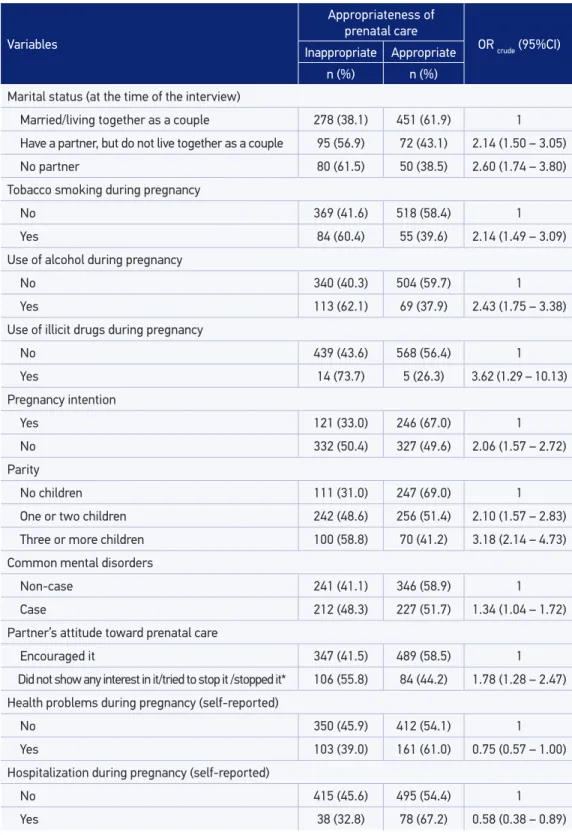
Women with less schooling, those having less than ive durable goods, and those not liv-ing with a partner showed higher prevalence of inappropriate use of prenatal care services. Moreover, the habit of smoking, consuming alcohol and/or using illicit drugs during preg-nancy, having an unintended pregpreg-nancy, having greater parity, having had CMD during the pregnancy, and the negative partner’s attitude toward prenatal care increased the chance of inappropriate use of prenatal care services. Health problems and hospitalization during pregnancy (self-reported) were established as protective factors of the outcome. Tobacco smoking, alcohol consumption, and the use of illicit drugs, especially if throughout the pregnancy, were associated with PVIP (Table 1).
Table 1. Association between the inappropriate use of prenatal care services, socioeconomic and demographic characteristics, risk behaviors in the current pregnancy, and the women’s reproductive history. Recife, Brazil, 2005–2006.
Variables
Appropriateness of
prenatal care
OR crude (95%CI)
Inappropriate Appropriate
n (%) n (%) Age (in full years)
≤ 24 248 (46.8) 282 (53.2) 1.35 (1.01 – 1.80)
25 – 29 113 (39.5) 173 (60.5) 1
≥ 30 92 (43.8) 118 (56.2) 1.19 (0.83 – 1.71)
Race/color
White 83 (41.1) 119 (58.9) 1
Nonwhite 370 (44.9) 454 (55.1) 1.17 (0.85 – 1.62)
Education (in years of schooling)
Nine or more 123 (31.9) 263 (68.1) 1
Less than nine 330 (51.6) 310 (48.4) 2.28 (1.73 – 2.99)
Number of durable goods
Five or more 175 (39.1) 273 (60.9) 1
Four or less 278 (48.1) 300 (51.9) 1.45 (1.12 – 1.87)
*Four women reported that their partners tried to stop it or actually stopped it. OR: odds ratio; 95%CI: 95% conidence interval. Variables
Appropriateness of
prenatal care
OR crude (95%CI)
Inappropriate Appropriate
n (%) n (%) Marital status (at the time of the interview)
Married/living together as a couple 278 (38.1) 451 (61.9) 1
Have a partner, but do not live together as a couple 95 (56.9) 72 (43.1) 2.14 (1.50 – 3.05)
No partner 80 (61.5) 50 (38.5) 2.60 (1.74 – 3.80)
Tobacco smoking during pregnancy
No 369 (41.6) 518 (58.4) 1
Yes 84 (60.4) 55 (39.6) 2.14 (1.49 – 3.09)
Use of alcohol during pregnancy
No 340 (40.3) 504 (59.7) 1
Yes 113 (62.1) 69 (37.9) 2.43 (1.75 – 3.38)
Use of illicit drugs during pregnancy
No 439 (43.6) 568 (56.4) 1
Yes 14 (73.7) 5 (26.3) 3.62 (1.29 – 10.13)
Pregnancy intention
Yes 121 (33.0) 246 (67.0) 1
No 332 (50.4) 327 (49.6) 2.06 (1.57 – 2.72)
Parity
No children 111 (31.0) 247 (69.0) 1
One or two children 242 (48.6) 256 (51.4) 2.10 (1.57 – 2.83)
Three or more children 100 (58.8) 70 (41.2) 3.18 (2.14 – 4.73)
Common mental disorders
Non-case 241 (41.1) 346 (58.9) 1
Case 212 (48.3) 227 (51.7) 1.34 (1.04 – 1.72)
Partner’s attitude toward prenatal care
Encouraged it 347 (41.5) 489 (58.5) 1
Did not show any interest in it/tried to stop it /stopped it* 106 (55.8) 84 (44.2) 1.78 (1.28 – 2.47) Health problems during pregnancy (self-reported)
No 350 (45.9) 412 (54.1) 1
Yes 103 (39.0) 161 (61.0) 0.75 (0.57 – 1.00)
Hospitalization during pregnancy (self-reported)
No 415 (45.6) 495 (54.4) 1
Yes 38 (32.8) 78 (67.2) 0.58 (0.38 – 0.89)
A PVIP report by women had no statistically signiicant association with not having pre-natal care. However, women who are victims of PVIP started prepre-natal care later, made less than six visits, were more likely to undergo inappropriate prenatal care (Table 2).
At the multivariate stage (Table 3), although the OR was slightly decreased, the asso-ciation remained statistically signiicant after the adjustment by variables conirmed as confounders: parity, use of alcohol during pregnancy, and educational level (OR = 1.37; 95%CI 1.01 – 1.85; p = 0.040).
Table 2. Association of physical violence by an intimate partner, the inappropriate use of prenatal care services, and risk behaviors during pregnancy. Recife, Brazil, 2005–2006.
Variables
PVIP
OR crude (95%CI)
Yes No
n (%) n (%)
Prenatal care
No 2 (0.76) 3 (0.39) 1.94 (0.23 – 14.3)
Yes 261 (99.2) 760 (99.6) 1
Onset of prenatal carea
Late 112 (42.9) 250 (32.9) 1.53 (1.14 – 2.06)
Early 149 (57.1) 510 (67.1) 1
Number of visitsa
< 6 78 (29.9) 149 (19.6) 1.75 (1.25 – 2.44)
≥ 6 183 (70.1) 611 (80.4) 1
Appropriateness of prenatal careb
Inappropriate 145 (55.1) 308 (40.4) 1.82 (1.36 – 2.43)
Appropriate 118 (44.8) 455 (59.6) 1
Partner’s attitude toward prenatal care
Did not show any interest in it/tried to stop it/stopped it 75 (28.5) 115 (15.1) 2.25 (1.59 – 3.18)
Encouraged it 188 (71.5) 648 (84.9) 1
Tobacco smoking during pregnancy
No 198 (75.3) 689 (90.3) 1
Yes 65 (24.7) 74 (9.69) 3.06 (2.08 – 4.49)
Duration of tobacco smoking
Did not smoke tobacco 198 (75.3) 689 (90.3) 1
Smoked tobacco at some point 13 (4.9) 22 (2.8) 2.06 (0.96 – 4.36)
Smoked tobacco throughout the pregnancy 52 (19.7) 52 (6.8) 3.48 (2.25 – 5.38)
Linear trend – – –
DISCUSSION
This study aimed at addressing the association between PVIP and the inappropriate use of prenatal care. Although some studies have addressed the impact of intimate partner
vio-lence on prenatal care,9-14 only one study was conducted in Brazil.9
Results reveal high PVIP rates before and/or during pregnancy among the women enrolled in the PSF in a state capital in northeastern Brazil. In addition, they showed that women who experienced or had experienced a situation of physical violence inlicted by an intimate partner started prenatal care late, made fewer visits than what is recommended by the MS, and were more likely to undergo inappropriate prenatal care.
This study has some limitations. One is the fact that information about the start time and the number of appointments for prenatal care having been reported by women and only
Table 2. Continuation.
aFive women did not have prenatal care, and three of them reported physical violence by their intimate partners; bthe
ive women who did not have prenatal care were categorized as those using prenatal care services inappropriately. PVIP: physical violence by an intimate partner; OR: odds ratio; 95%CI: 95% conidence interval.
Variables
PVIP
OR crude (95%CI)
Yes No
n (%) n (%) Use of alcohol during pregnancy
No 182 (69.2) 662 (86.8) 1
Yes 81 (30.8) 101 (13.2) 2.92 (2.06 – 4.14)
Duration of alcohol use
Did not drink 182 (69.2) 662 (86.7) 1
Drank at some point 46 (17.5) 67 (8.8) 2.50 (1.62 – 384)
Drank throughout the pregnancy 35 (13.3) 34 (4.45) 3.74 (2.21 – 6.35)
Linear trend – – –
Use of illicit drugs during pregnancy
No 252 (95.8) 755 (98.9) 1
Yes 11 (4.2) 8 (1.1) 4.12 (1.52 – 11.35)
Table 3. Final model for the association between physical violence by an intimate partner and the inappropriate use of prenatal care services, crude and adjusted odds ratios, and the 95% coni
-dence interval. Recife, Brazil, 2005–2006.
*Adjusted by women’s parity, use of alcohol during pregnancy, and education level. PVIP: physical violence by an intimate partner; OR: odds ratio; 95%CI: 95% conidence interval.
PVIP crude OR (95% CI) p value adjusted OR* (95% CI) p value
No 1 1
one-third of them had the Pregnancy Card at the time of the interview, thus, being sub-ject to information biases, even if the pregnancies were recent. Studies conducted in Brazil documented reduced agreement levels between self-reported data on prenatal care and the Pregnancy Card records. The information collected from the women’s accounts reported a higher number of appointments and earlier onset of prenatal care than what is registered on
their respective Pregnancy Cards23,24. Diferences may result both from women’s
overestima-tion and the sub-record on the Card24. Consequently, classiication errors may have occurred.
However, it can be assumed that the assessment error on the number of appointments and the onset time for prenatal care was random. Regarding the association measures, the
non-dif-ferential error tends to underestimate them25. Nevertheless, some women may have omitted
PVIP because of embarrassment or fear of retaliation by the perpetrator26. Therefore, it is
possible that the prevalence of PVIP as well as the association with the inappropriate use of prenatal care have been underestimated. It is possible that these factors have contributed to the threshold value found for the estimated conidence interval for the association between PVIP and the inappropriate use of prenatal care.
Another limitation is inherent to cross-sectional studies, which hinders the establishment of a clear temporal precedence for part of the studied factors, compromising the evidence of a causal relationship. However, physical violence in the relationship with a partner was investigated before and during pregnancy as the recurrent nature of intimate partner vio-lence was recognized; in truth, women who were abused during the pregnancy have, more
frequently, sufered abuse before27. Notwithstanding, even when violence ceases, its efects
can be cumulative and persist for a long period28.
The advantages of the study are that it was population-based and comprises a geo-graphically deined area with few losses, which minimizes the possibility of selection bias. Similarly, by including PSF users whose socioeconomic characteristics resemble those of the other ive sanitary districts, it is possible to generalize the results for the women assisted by the PSF in Recife.
The prevalence of PVIP was 25.4%; 49.8% of women reported PVIP exclusively before pregnancy, and the others, during pregnancy, with or without physical violence in a previ-ous period. Regardless of being considerably high, the prevalence of PVIP found was lower
than the one identiied by Gomes29, of 35.8%, analyzing a sample of 2,156 women enrolled
in the PSF in Recife. It is possible that such diference derives from the fact that in this study women were inquired about PVIP with reference to the time interval between the beginning of the relationship with their partners and the moment of the interview, whereas Gomes asked about the PVIP throughout life, including previous partners.
Risk behaviors during pregnancy — tobacco smoking, alcohol consumption, and use of illicit drugs — were reported more frequently by women who mentioned PVIP. In addi-tion, alcohol consumption during pregnancy was associated with the inappropriate use of prenatal care. Pregnant women who consume alcohol are more likely to have
inappropri-ate prenatal care7, and alcohol consumption during pregnancy may be associated with
the discrimination of the individual by society, especially when reported by women during pregnancy. Therefore, some women may have omitted such information or minimized the amount and frequency of use, underestimating the association found.
The high prenatal care coverage found was similar to the one estimated for the city of
Recife at the time of the study, which was 96.4% in 200530. Despite the reasonable
cover-age, 35% of women started prenatal care after the irst trimester and 22% made less than
six visits, a similar situation to the one described in Recife by Carvalho and Araújo31. These
indings suggest a deiciency in the early attraction of women and that the number of visits
still is lower than what is recommended by the PHPN6 for an expressive contingent.
The proportion between the women who made inappropriate use of prenatal care and those who reported PVIP was 55.1%; thus, an association between PVIP and the inappropriate use of prenatal care was established, with a 37% higher chance for women who mentioned PVIP in comparison to those without a history of violence, even after the adjustment by the covariables identiied as confounders. This association was evidenced by similar studies
conducted in Brazil9, India14, Bangladesh11, and the United States12. In the study conducted
in three maternity hospitals in Rio de Janeiro, in 2000, the probability of women under-going inappropriate prenatal care was twice as high for victims of PVIP during pregnancy
than among women who did not report violence9.
Women in situations of intimate partner violence tend to start prenatal care later and present lower adhesion to the program due to problems resulting from violence, such as depression during pregnancy, low self-esteem, and greater diiculty in caring for their
health32; that also happens because they have less partner support, including for prenatal
care33, as evidenced in this study, or because it is an unintended pregnancy8. Nevertheless,
it is possible that the embarrassment of exposing physical marks of violence can contribute
to lower adhesion to prenatal care appointments33.
The indings of this study conirm the importance of raising awareness among the professionals from the Primary Health Care System to identify women in situations of vio-lence, although health professionals have reported diiculties with regard to focusing on violence because they do not recognize it as a health problem, do not feel prepared to deal
with the identiied cases, or, yet, are victims or perpetrators of violence in marital relations34.
Because the PSF develops health prevention and promotion actions it is possible to
con-stitute a space to address issues related to violence, attention, and listening35.
CONCLUSION
1. Pallitto CC. Domestic violence and maternal, infant, and reproductive health: a critical review of the literature. Washington, DC: PAHO; 2004.
2. Garcia-Moreno C, Jansen H, Ellsberg M, Heise L, Watts CH. Prevalence of intimate partner violence: findings from the WHO multi-country study on women’s health and domestic violence. Lancet 2006; 368(9543): 1260-9.
3. Calderon IMP, Cecatti JG, Veja CEP. Intervenções benéicas no pré-natal para prevenção da mortalidade materna. Rev Bras Ginecol Obstet 2006; 28(5): 310-5.
4. Vidal AS, Samico IC, Frias PG, Hartz, ZMA. Estudo exploratório de custos e consequências do pré-natal no Programa Saúde da Família. Rev Saúde Pública 2011; 45(3): 467-74.
5. Brasil. Ministério da Saúde. Secretaria de Atenção à Saúde. Departamento de Ações Programáticas Estratégicas. Gestação de alto risco: manual técnico. 5ª ed. Brasília: Ministério da Saúde; 2012. Série A. Normas e Manuais Técnicoshttp://bvsms.saude.gov.br/bvs/ publicacoes/gestacao_alto_risco.pdf. (Acessado em 05 de setembro de 2013).
6. Brasil. Ministério da Saúde. Secretaria de Políticas de Saúde. Programa Humanização do Parto: Humanização no pré-natal e nascimento. Brasília: Ministério da Saúde; 2002. Disponível em: http://bvsms.saude. gov.br/bvs/publicacoes/parto.pdf. (Acessado em 12 de agosto de 2013).
7. Bassani DG, Surkan PJ, Olinto MTA. Inadequate use of prenatal services among brazilian women: The Role of Maternal Characteristics. Int Perspect Sex Reprod Health 2009; 35(1): 15-20.
8. Dibaba Y, Fantahun M, Hindin MJ. The efects of pregnancy intention on the use of prenatal care services: systematic review and meta-analysis. Reprod Health 2013; 10: 50.
9. Moraes CL, Arana FDN, Reichenheim ME. Violência física entre parceiros íntimos na gestação como fator de risco para a má qualidade do pré-natal. Rev Saúde Pública 2010; 44(4): 667-76.
10. Ononokpono DN, Azfredrick EC. Intimate Partner Violence and the Utilization of Maternal Health Care Services in Nigeria. Health Care Women Int 2014; 35(7-9): 973-89.
11. Rahman M, Nakamura K, Seino K, Kizuki M. Intimate partner violence and use of reproductive health services among married women: evidence from a national Bangladeshi sample. BMC Public Health 2012; 12(1): 913.
12. Dietz PM, Gazmararian JA, Goodwin MM, Bruce FC, Johnson CH, Rochat RW. Delayed entry into prenatal
care: efect of physical violence. Obstet Gynecol 1997; 90(2): 221-4.
13. Audi CAF, Segall-Corrêa AM, Santiago SM, Andrade MG, Pérez-Escamilla R.Violência doméstica na gravidez: prevalência e fatores associados. Rev Saúde Pública 2008; 42(5): 877-85.
14. Koski AD, Stephenson R, Koenig MR. Physical Violence by Partner during Pregnancy and Use of Prenatal Care in Rural India. J Health Popul Nutr 2011; 29(3): 245-54.
15. Thananowan N, Heidrich SM. Intimate partner violence among pregnant Thai women. Violence Against Women 2008; 14(5): 509-27.
16. Coker AL, Sanderson M, Dong B. Partner violence during pregnancy and risk of adverse pregnancy outcomes. Paediatr Perinatal Epidemiol 2004; 18: 260-9.
17. Jasinski JL. Pregnancy and domestic violence: A review of the literature. Trauma Violence Abuse 2004; 5(1): 47-64.
18. Brasil. Ministério da Saúde. Secretaria de Atenção à Saúde. Pré-natal e Puerpério: atenção qualiicada e humanizada. Brasília: Ministério da Saúde; 2005. Série A. Normas e Manuais Técnicos. Série Direitos Sexuais e Direitos Reprodutivos, nº 5. Disponível em: http://bvsms.saude.gov.br/bvs/publicacoes/parto. pdf. (Acesso em).
19. Ludermir AB, Lewis G, Valongueiro SA, Araújo TVB, Araya R. Violence against women by their intimate partner during pregnancy and postnatal depression: a prospective cohort study. Lancet 2010; 376(9744): 903-10.
20. Schraiber LB, Latorre MRD, França-Junior I, Segri NJ, D’Oliveira AFPL. Validade do instrumento WHO VAW STUDY para estimar violência de gênero contra a mulher. Rev Saúde Pública 2010; 44(4): 658-66.
21. Harding TW, Arango MV, Baltazar J, Climent CE, Ibrahim HHA, Ladrido-Ignacio L. et al. Mental Disorders in primary health care: a study of the frequency and diagnosis in four developing countries. Psychol Med 1980; 10(2): 231-41.
22. Mari JJ, Williams P. Misclassiication by psychiatric screening questionnaires. J Chronic Dis 1986; 39(5): 371-8.
23. Santos Neto ET, Leal MC, Oliveira AE, Zandonade E, Gama SGN. Concordância entre informações do Cartão da Gestante e da memória materna sobre assistência pré-natal. Cad Saúde Pública 2012; 28(2): 256-66.
24. Zanchi MAL, Gonçalves CV, Cesar JA, Dumith SC. Concordância entre informações do Cartão da Gestante e do recordatório materno entre puérperas de uma cidade brasileira de médio porte. Cad Saúde Pública 2013; 29(5): 1019-28.
25. Mertens TE. Estimating the efects of misclassiication. Lancet 1993; 342: 418-21.
26. Ellsberg MC, Heise L, Peña R, Winkvist A. Researching domestic violence against women: methodological and ethical considerations. Stud Fam Plann 2001; 32(1): 1-16.
27. Silva EP, Ludermir AB, Araujo TVB, Valongueiro SA. Freqüência e padrão da violência por parceiro íntimo antes, durante e depois da gravidez. Rev Saúde Pública 2011; 45 (6):1044-1053.
28. Dillon G, Hussain R, Loxton D, Rahman S. Mental and physical health and intimate partner violence against women: a review of the literature. Int J Family Med 2013; 2013: 1-15.
29. Gomes APPF. Situação de saúde e violência contra as mulheres no Recife, PE [dissertação de Mestrado]. Recife: Centro de Pesquisa Aggeu Magalhães, Fundação Oswaldo Cruz; 2008.
30. Brasil. Ministério da Saúde. DATASUS. Informações de saúde. Estatísticas vitais. Disponível em http://tabnet. datasus.gov.br/cgi/tabcgi.exe?sinasc/cnv/nvpe.def. (Acesso em 20 de janeiro de 2012).
31. Carvalho VCP, Araújo TVB. Adequação da assistência pré-natal em gestantes atendidas em dois hospitais de referência para gravidez de alto risco do Sistema Único de Saúde, na cidade de Recife, Estado de Pernambuco. Rev Bras Saúde Matern Infant 2007; 7(3): 309-17.
32. Pereira PK, Lovisi GM. Revisão da literatura: prevalência da depressão gestacional e fatores associados. Rev de Psiq Clin 2008; 35(4): 144-53.
33. Taggart L, Mattson S. Delay in prenatal care as a result of battering in pregnancy: cross-cultural implications. Health Care Women Int 1995; 17: 25-34.
34. Garcia-Moreno C. Dilemmas and opportunities for an appropriate health-service response to violence against women. Lancet 2002; 359(9316): 1509-14.
35. D’Oliveira AFPL, Schraiber LB, Hanada H, Durand J. Atenção integral à saúde de mulheres em situação de violência de gênero – uma alternativa para a atenção primária em saúde. Ciênc Saúde Coletiva 2009; 14(4): 1037-50.
Received on: 08/18/2014