Revista Brasil. Bot., V.33, n.4, p.615-630, out.-dec. 2010
Multivariate analysis of pollen frequency of the native species
Escallonia pulverulenta
(Saxifragaceae) in Chilean honeys
GloRia MonteneGRo
1,2, Raúl C. Peña and RodRiGo PizaRRo
1(received: July 04, 2007; accepted: october 14, 2010)
ABSTRACT – (Multivariate analysis of pollen frequency of the native species Escallonia pulverulenta (Saxifragaceae) in
Chilean honeys). The aim of this work was the identification of geographic zones suitable for the production of honeys in which
pollen grains of Escallonia pulverulenta (Ruiz & Pav.) Pers. (Saxifragaceae) can be detected. the analysis of botanical origin of 240 honey samples produced between la Serena and Puerto Mont (the iV and X administrative Regions of Chile), allowed the detection of pollen grains of E. pulverulenta in 46 Chilean honeys. the geographic distribution of the honeys studied is
presented together with their affinities, through factor analysis and frequency tables. The study was based on the presence of
E. pulverulenta pollen. Escallonia pulverulenta pollen percentages oscillated between 0.24% and 78.5%. Seventeen of the
studied samples were designated as unifloral – i.e. samples showing more than 45% pollen of a determined plant species. two of
these corresponded to E. pulverulenta (corontillo, madroño or barraco) honeys. The remaining unifloral honeys correspond to 8 samples of Lotus uliginosus Schkuhr (birdsfoot trefoil), 2 samples of Aristotelia chilensis (Molina) Stuntz (maqui) and 1 sample of Escallonia rubra (Ruiz & Pav.) Pers. (siete camisas), Eucryphia cordifolia Cav. (ulmo or muemo), Weinmannia trichosperma Cav. (tineo), Rubus ulmifolius Schott (blackberry) and Brassica rapa l. (turnip). Honeys with different percentages of E. pulverulenta pollen – statistically analyzed through correspondence analysis – could be associated and assigned to one
of three geographic types, defined on the basis of this analysis. The geographical type areas defined were the Northern
Mediterranean zone (samples from the iV Region), Central Mediterranean zone (samples from the V to the Viii regions
including two samples of unifloral Escallonia pulverulenta honey), and Southern Mediterranean zone (samples from the
iX Region).
Key words - Apis mellifera, Chile, Escallonia, Mediterranean type climates, unifloral honey
RESUMO – (análise multivariada da freqüência do pólen da espécie nativa Escallonia pulverulenta (Saxifragaceae) em
méis do Chile). O objetivo do presente trabalho foi o de identificar as zonas geográficas preferidas para a produção dos
méis que contêm grãos de pólen provenientes de Escallonia pulverulenta (Ruiz & Pav.) Pers. (Escalloniaceae), espécie
essencialmente nectarífera. A análise da origem botânica de 240 méis, produzidos entre La Serena e Puerto Montt (IV e X
regiões administrativas do Chile), detectou a presença de Escallonia pulverulenta em 46 destas amostras. A distribuição
geográfica dos méis examinados é apresentada juntamente com suas afinidades morfopalinológicas, usando diagramas de
freqüência e de análise de fatores (análise de correspondência). as porcentagens do pólen do E. pulverulenta variaram entre
0,24% e 78,5%. Dezessete das 46 amostras estudadas foram designadas como meis uniflorais, isto é, tem uma freqüência acima
de 45% do pólen de uma determinada espécie de planta, mas somente duas corresponderam ao mel unifloral de E. pulverulenta.
Dos méis uniflorais restantes, oito corresponderam a Lotus uliginosus Schkuhr (nome vulgar lotera, alfalfa chilota), dois a
Aristotelia chilensis (Molina) Stuntz (maqui) e um a cada uma das espécies de Escallonia rubra (‘siete camisas’), Eucryphia cordifolia Cav. (ulmo, muermo), Weinmannia trichosperma Cav. (tineo), Rubus ulmifolius Schott (mora) e de Brassica rapa l. (yuyo). os méis com freqüência variável de pólen de E.pulverulenta, analisados estatisticamente usando a análise de
correspondência, puderam ser associados e designados para cada uma das três zonas geográficas definidas com base nesta análise: a zona norte mediterrânea (amostras da IV região administrativa, a zona central mediterrânea (amostras entre a IV
e VIII regiões administrativas, incluindo uma das amostras uniflorais de Escallonia pulverulenta e a zona sul mediterrânea
(amostras da IX região administrativa).
Palavras-chave - Apis mellifera, Chile, climas Mediterrâneos, Escallonia, mel unifloral
1. Pontificia Universidad Católica de Chile, Facultad de Agronomía e Ingeniería Forestal, Departamento de Ciencias Vegetales Casilla
366, Santiago-22, Chile.
2. Corresponding author: [email protected]
Introduction
Honey is produced by the honeybee Apis mellifera
l. by the transformation of plant nectar and other sweet
616
G. Montenegro et al.: Pollen frequency of Escallonia pulverulenta in Chilean honeys(count and proportion calculation) analysis of the pollen grains content. Unifloral honeys – defined as those in which the dominant pollen grain is more than 45% of the total – have higher economical value than multifloral honeys since their sensorial properties (aroma, color and taste) and nutritive characters present greater consistency over time (andrade et al. 1999, Montenegro et al. 2005a).
applying the Chilean Regulation of Honey denomination via Melisopalynological analysis which was published recently in this country (Montenegro et al. 2005a), it is possible to classify a honey as unifloral,
bifloral or multifloral.
Chile produces a limited number of unifloral honeys with native plant origin. these are mainly derived from
Quillaja saponaria Molina (quillay) in the central zone,
and Eucryphia cordifolia Cav. (ulmo) in the southern zone (Ramírez & Montenegro 2004, Montenegro et al. 2005b). Given their excellent qualities, these honeys are greatly appreciated in the international market and generate better returns than non differentiated honeys. However, unifloral honeys are also produced from other native Chilean plant species, such as Gevuina avellana Molina (avellano) and species of the genus
Escallonia. For this reason the botanical origin of the
honey produced by local beekeepers should be certified, identifying the species composition of the differentiated honey’s pollen spectra. in Chile the genus Escallonia
comprises thirteen species in the continental territories and one in the Juan Fernandez archipelago (Sleumer 1968). Various species of the genus (E. pulverulenta
(Ruiz et Pav.) Pers., E. illinita K. Presl, E. revoluta
(Ruiz et Pav.) Pers., E. rosea Griseb. and E. rubra (Ruiz
et Pav.) Pers.) have been detected in the pollen spectrum of Chilean honeys. However the most important contribution is from E. pulverulenta (Montenegro et al. 2005a). the morphology of the pollen grain of
E. pulverulenta – monad, isopolar, radiosymmetric, tricolporate, colpi length, recessed, pores short, circular, located in the area where colpi are mildly depressed, circular-subprolate, amb circular, exine ca. 1 µm in thickness, tectate, columellate, collumellae distinct, finely reticulate – is distinctive for the genus (Heusser 1971). the grain is commonly smaller than other
Escallonia species, with 20-22 μm in equatorial axis
and 19-21 μm in polar axis.
in botanical terms, E. pulverulenta, as well as being a nectar source for honey production, is a main resource in the production of propolis. this plant is known, amongst other names, as barraco – which in Spanish means boar – due to its penetrating aroma. it is
a shrub with resinous leaves and large inflorescences in spiciform racemes which are very attractive to pollinators such as A. mellifera (Bonod et al. 2003). it has been demonstrated that E. pulverulenta accumulates iridoids such asasperuloside, dafiloside and geniposide as well as other compounds which include the flavanone ether of 7-methylacacetine, kaempherol, rutine and chlorogenic acid (Plouvier 1956, tomassini et al. 1993, taskova
etal. 2001). Given that E. pulverulenta is an endemic plant in Chile, the aim of this work was to analyze its pollen frequency in Chilean honeys, and undertake a multivariate analysis in order to determine the importance of this species in the geographical production of Chilean honeys.
Materials and methods
Hive locations – of a total sample of 240 honeys, harvested from hives located between 30° and 39° S, and 70° and 72° W, whose botanical origin had been determined previously (Montenegro et al. 2003, Ramírez & Montenegro 2004, Montenegro et al. 2005b), 46 honeys which contained E. pulverulenta in their botanical composition were selected for
analysis. The zone is characterized by a Mediterranean-type
climate, with a dryness gradient from arid to perhumid
trend (Di Castri & Hajek, 1976). This area has different anthropization degrees, with ample agrosilvicultural landscape, and the original flora reduced to patches or forest
fragments (Grez et al., 2006). the apiaries were selected in
basis to their location, in zones dominated by native flora.
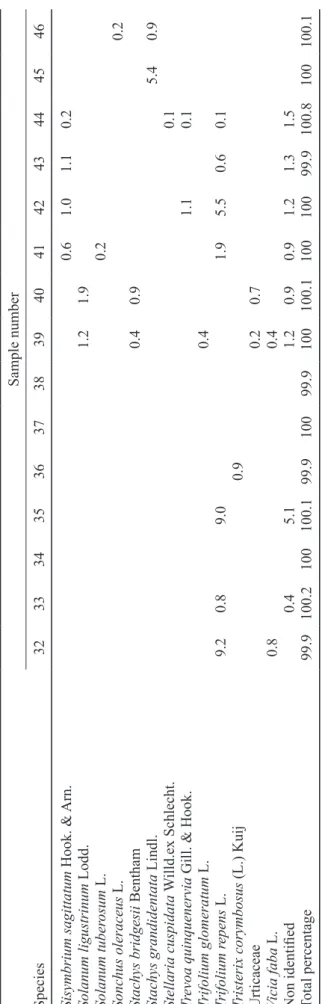
the distribution of the forty-six honeys samples by administrative region was as follows (see tables 1-3 for numbers): six from the iV Region (samples 41 to 46),
five from the V Region (samples 36 to 40), five from the
Metropolitan Region (samples 31 to 35), eight from the Vi
Region (samples 23 to 30), five from the VII Region (samples
18 to 22), one from the Viii Region (sample 17), and sixteen from the iX Region (samples 1 to 16). the locations of the
sampling apiaries are shown in figure 1.
Analysis of botanical origin of honeys – In order to analyze
botanical origin, for each sample 20 g of honey were diluted with 20 ml of distilled water and the pollen concentrated by
centrifuging at 2500 rpm for five min (Louveaux et al. 1978
modified). The pollen sediment was subsequently suspended with 0.1 mL of distilled water and of this suspension five aliquots of 20 µL were extracted in order to make five
preparations for the optical microscope, using the method described in the literature (louveaux et al. 1978), modified as in the Chilean norm of Botanical origin denomination through melissopalynological method (Montenegro et al. 2004, Montenegro et al. 2005a, Montenegro & Pizarro 2006).
Frequency assessment was carried out qualitatively
Revista Brasil. Bot., V.33, n.4, p.615-630, out.-dec. 2010
617
references (Heusser 1971, Hodges 1984, erdtman 1986) and quantitatively following louveaux et al. (1978), Moar (1985),
with our modifications (Montenegro et al. 1992, Montenegro
et al. 2005a). a minimum of 400 pollen grains were counted for each honey sample.
Statistical analysis – in order to see the relationships between each honey’s pollen frequency and its geographical origin, a correspondence analysis was applied, using Statistica version 6® (Stat Soft) software. For this analysis, all pollen types present in the honey’s pollen spectra were considered. With the objective of verifying associations between pollen types present in the honeys’ pollen spectra,
a classification analysis was carried out using the cladistics program ‘Hennig86’ to recognize similarities between pollen types associations in the various analyzed honeys.
the option ‘multiple most parsimonious trees option’ (mhennig*) was used. Pollen grain types percentages were coded as ‘0’ (percentages less than 45%), ‘1’ (ranging between 45 and 70%), and ‘2’ (more than 70%). this analysis did not consider pollen types with percentages
lower than 1%. table
1. Pollen types compositions of pollen spectrum of honey samples (one to sixteen). t otal percentages higher or lower than 100% are caused by approximation of
some pollen types percentages Species
Sample number 1 2 3 4 5 6 7 8 9 10 11 12 13 14 15 16 Acacia caven (Molina) Molina 0.2 Acacia dealbata (Link.) F
. J. Mull.
0.7 Acacia melanoxylon R. Br . 0.1 Aextoxicon punctatum
Ruiz & Pav
. 0.1 Alnus glutinosa (l.) Gaertn. 0.1 Amomyrtus luma (Molina) Legr
. & Kaus.
6.7 0.7 0.6 0.9 1.2 1.5 0.3 0.6 0.3 0.7 0.9 A n a g a ll is a lt er n if o li a ( A . m o n el li l .) 0.3 apiaceae 0.7 Aristotelia chilensis (Molina) Stuntz 5.9 11.9 1.1 0.8 1.4 1.4 0.9 0.8 7.3 13.4 7.3 3.0 3.4 13.7 0.4 1.4 Azara serrata
Ruiz & Pav
. 1.1 Azara sp. 0.4 * Baccharis linearis
(Ruiz & Pav
.) Pers. * 0.1 0.1 0.4 0.3 Blephar ocalyx cruckshanksii (Hook. & Arn.) Nied. 0.1 0.1 0.1 0.2 0.1 4.3 0.2 0.3 0.2 continue
Figure 1. Map depicting the sampling areas. Sampling places
618
G. Montenegro
et al.
: Pollen frequency of
Escallonia pulverulenta
in Chilean honeys
continue
Species Sample number
1 2 3 4 5 6 7 8 9 10 11 12 13 14 15 16
Brassicarapa l. 0.5 0.5 2.4
Buddlejaglobosa Hope 2.1 2.7 0.3
Caldcluviapaniculata (Cav.) d. don 0.3 4.1 4.5 2.4 0.6 1.2 2.7 2.8 2.6 1.8 0.7 0.4 1.0
Callitriche sp. 0.2
Castaneasativa l. 0.8 0.4 2.7 11.2 1.7 7.7 2.6 0.5 1.0 1.4 0.4 1.8 1.7 1.7 1.4
Chacayatrinervis (Gillies ex Hook. & Arn.) Escal. 0.1
Cissusstriata Ruiz & Pav. 0.5 0.4 0.3 0.1 0.5 0.1 1.8 0.4 1.1 6.6 8.1
Coriariaruscifolia l. 0.3
Crassulamoschata G. Forst. 1.1 0.2
Cryptocaryaalba (Molina) looser 0.1
Discariaserratifolia (Vent.) B. & H. ex Masters 1.1 0.3
Discariatrinervis (Gill. ex Hook. & Arn.) Reiche 0.5 3.4
Echiumvulgare l. 0.3 0.1
Escalloniapulverulenta (Ruiz & Pav.) Pers. 3.0 1.4 2.7 0.2 1.0 1.3 0.2 0.1 4.3 1.9 2.5 0.6 0.5 12.6 0.9 0.3
Escalloniarubra (Ruiz & Pav.) Pers. 1.2 1.5 1.1 0.1 0.1 * 2.3 0.8 0.1
Eschscholziacalifornica Cham. 0.7 0.6 0.9
Eucalyptusglobulus l’Her. 0.5 0.1 0.1 0.1 1.7
Eucryphia cordifolia Cav. 43.1 3.8 22.9 5.2 8.3 10.0 13.2 1.4 4.3 12.3 3.1 28.1 1.8 33.8 70.0
euphorbiaceae * 1.1
Fabiana imbricata Ruiz & Pav. 0.1 0.1
Fuchsia magellanica lam. 0.2 0.2
Gaultheria mucronata (L. f.) Hook. & Arn. 0.1 0.3
Gaultheria myrtillioides Cham. & Schltdl. 0.2 0.1 0.2
Gevuina avellana Molina 0.1 0.6 0.2 0.1 0.9 1.0
Gunnera tinctoria (Molina) Mirbel. 0.1
Hybanthus parviflorus (Mutis ex l. f.) Baillon 0.2
Hypericum perforatum l. 0.5
Hypochaeris radicata l. 0.1 * 0.3 0.3 0.3 0.8 1.7 6.0 0.2 0.3 0.6 0.3 0.1 0.4 2.7
Lapageria rosea Ruiz & Pav. 0.1
Lomatia ferruginea (Cav.) R. Br. 0.1
Lomatia hirsuta (lam.) diels 0.2 0.1 0.2 0.3
Lotus uliginosus Schkuhr 13.2 9.3 39.2 71.3 63.4 49.2 52.7 60.1 67.0 39.1 70.9 41.7 51.4 13.6 9.0 24.4
Luma apiculata (dC.) Burret 0.3 1.8 0.8 0.6 0.7 0.6 4.3 10.7 0.9 0.2 0.3 5.0 0.6 1.3 15.9
Luma chequen (Molina) a. Gray 3.1 4.1 5.6 1.1 3.4 4.1
Maytenus boaria Molina 0.3
Medicago sativa l. 1.1 0.2 0.5
Revista Brasil. Bot.,
V
.33, n.4, p.615-630, out.-dec. 2010
619
continuation
Species Sample number
1 2 3 4 5 6 7 8 9 10 11 12 13 14 15 16
Melilotus indicus (l.) all. 0.5
Monimiaceae 0.1
Myrceugenia exsucca (dC.) o. Berg 1.1 2.1 1.4 1.0 2.6 9.8
Myrceugenia planipes (Hook. & Arn.) O. Berg 0.8 0.5 1.8 1.8 0.4 6.7 13.1 0.8 0.4
Noccaea magellanica (Comm. ex Poir.) Holub 0.7
Nothofagus obliqua (Mirb.) oerst. 0.7 0.9 1.0
Otholobium glandulosum (l.) Grimes 0.1 0.3
Persea lingue (Ruiz & Pav.) Nees ex Kopp 0.1 0.8 0.2
Plantago sp. 0.3 0.1 0.1 0.1 0.2 0.5 1.1 1.0 0.3
Poaceae 0.2 0.4 0.3
Pratia repens Gaud. 0.1
Primula magellanica lehm. 0.2
Quinchamalium chilense Molina * 0.2 0.2
Raphanus sativus l. 0.1 0.4 1.9 0.9 0.4 1.0 * 0.3 0.8 0.7 0.1 2.6
Rhamnaceae 0.7 0.2 0.7
Rhamnus diffusus Clos 0.1
Rubus idaeus l. 0.1 0.1
Rubus ulmifolius Schott 0.1 0.1 1.5 0.7 1.9 2.9 0.6 4.4
Schinus polygamus (Cav.) Cabr. 0.2 0.2 0.3 0.9 1.0
Sonchus sp. 0.1
Sophora cassioides (F. Phil.) Sparre 0.2
Tepualia stipularis Griseb. 0.4
Thymus vulgaris l. 0.2
Trevoa quinquenervia Gill. & Hook. 1.4
Trifolium glomeratum l. 4.5 0.3 0.7
Trifolium pratense l. 0.3 0.1 0.3 0.3 2.8 3.1 0.1 0.5 0.3 0.9 8.7 0.9 11.5
Trifolium repens l. 1.4 *
Tristerix corymbosus (l.) Kuij 0.5
Tristerix verticillatus (Ruiz & Pav.) Barlow & Wiens 0.1 * 0.7
Tropaeolum azureum Miers ex Savi
Tropaeolum speciosum Poepp. & Endl. 0.2 0.1 0.2 0.1
Ugni molinae Turcz. 1.0
Weinmannia trichosperma Cav. 30.3 60.8 22.9 1.1 12.0 11.3 14.0 0.4 7.3 27.5 1.7 1.4 1.6 8.3 1.3 1.0
Non identified 1.5 1.0 2.0 0.5 0.3 1.0
620
G. Montenegro
et al.
: Pollen frequency of
Escallonia pulverulenta
in Chilean honeys
table 2. Pollen types compositions of pollen spectrum of honey samples (seventeen to thirty one). total percentages higher or lower than 100% are caused by approximation of some species percentages
Sample number
Species 17 18 19 20 21 22 23 24 25 26 27 28 29 30 31
Acacia dealbata (Link.) F. J. Mull. 0.1 0.2 0.7
Adenopeltis serrata (W. aiton) i. M. Johnst. 0.3
Adesmia confusa Ulib. 0.4 0.4
Amaranthus sp. 0.1 0.1 0.4
Anarthrophyllum cumingii (Hook. & Arn.) F. Phil. 1.8
apiaceae 0.1 1.1
Aristotelia chilensis (Molina) Stuntz 16.7 23.9 15.9 6.6 19.3 83.3 93.9
Asteranthera ovata (Cav.) Hanst. 1.3
Astragalus sp. 0.1 0.2
Azara serrata Ruiz & Pav. 7.4
Baccharis linearis (Ruiz & Pav.) Pers. * 0.2 0.4 0.1 * 2.4
Blepharocalyx cruckshanksii (Hook. & Arn.) Nied. 0.4
Boquila trifoliolata (dC.) dcne 0.3
Brassica rapa l. 1.6 1.9 21.2 10.5 1.0 0.1 3.6 3.5 18.2
Buddleja globosa Hope 0.1
Calceolaria thyrsiflora Graham 3.0 6.8 5.6
Carduus pycnocephalus l. 0.3 0.7
Cestrum parqui l’Her. 2.9
Chacaya trinervis (Gillies ex Hook. & Arn.) Escal. 0.1 0.2
Chenopodiaceae 0.1 0.1 0.5 *
Cirsium vulgare (Savi) ten. 0.3 0.7
Cissus striata Ruiz & Pav. 1.6
Colliguaja odorifera Molina * 1.1 2.9 *
Convolvulus sp. 0.1 0.3 0.5
Corynabutilon ceratocarpum (Hook. & Arn.) Kearney 0.9
Crinodendron patagua Molina 0.2 0.3
Cucurbita pepo l. 0.4
Cydonia oblonga Mill. 2.9
Datura stramonium l. *
Echinopsis chiloensis (Colla) Friedrich & G.D.Rowley 1.8 0.3
Echium vulgare l. 1.9 0.9 9.3 0.3 1.8
Escallonia pulverulenta (Ruiz & Pav.) Pers. 1.9 0.2 0.1 28.4 1.4 3.1 7.2 13.6 0.1 0.5 24.3 33.3 35.3 26.8 2.5
Escallonia rubra (Ruiz & Pav.) Pers. 1.3 7.7 4.5
Eschscholzia californica Cham. 0.3 0.2
Eucalyptus globulus l’Her. 1.1 0.9 0.8 0.2 0.1 0.1 3.6 2.1 1.7
Revista Brasil. Bot.,
V
.33, n.4, p.615-630, out.-dec. 2010
621
continuation
continue
Sample number
Species 17 18 19 20 21 22 23 24 25 26 27 28 29 30 31
Fabaceae 0.1 0.3
Fabiana imbricata Ruiz & Pav. 0.7
Foeniculum vulgare l. 0.1 *
Fuchsia magellanica lam. * 0.2 8.2 14.7
Galega officinalis l. 3.8 2.4
Gaultheria mucronata (L. f.) Hook. & Arn. 0.1 0.3
Gevuina avellana Molina 4.7
Helenium aromaticum (Hook.) Bailey 0.1
Hydrangea serratifolia (Hook. & Arn.) F. Phil. 0.1
Hypochaeris radicata l. 0.2 0.3 * 1.3 1.4 1.8 0.3
Kageneckia oblonga Ruiz & Pav. 2.2 3.6
lamiaceae 0.1
lauraceae 3.7
Lithrea caustica (Molina) Hook. & Arn. 0.2 0.6 11.3 0.3 0.1 0.1 2.9
Lotus uliginosus Schkuhr 9.3 30.5 7.7 16.7 40.2 44.3 0.1 0.1 31.4
Luma apiculata (dC.) Burret 3.7 10.0 12.6 8.0 6.1 9.7
Malva sp. 0.3 *
Marrubium vulgare l. 1.1 5.4
Maytenus boaria Molina *
Medicago polymorpha l. 13.3 14.5
Medicago sativa l. 2.2 1.9 1.6 9.8 11.3 0.7 * 13.9
Melilotus indicus (l.) all. 0.2 4.4 0.1 0.1 7.9
Mentha pulegium l. 2.2 0.1
Mitraria coccinea Cav. 0.7 0.4 0.8
Mutisia sp. 1.8 7.6
Myrceugenia exsucca (dC.) o. Berg 0.5 0.3
Myrtaceae 1.6 1.1
Nothofagus dombeyi (Mirb.) oerst. 1.1
Nothofagus obliqua (Mirb.) oerst. 0.1 0.4
Otholobium glandulosum (l.) Grimes 0.9 *
Pelletiera verna a.St.-Hil. 0.6
Peplis portula l. 0.3 0.8
Phacelia secunda J. F. Gmel. 0.2
Plantago lanceolata l. 0.1
Plantago sp. 0.1
Poaceae 0.2 0.1
622
G. Montenegro
et al.
: Pollen frequency of
Escallonia pulverulenta
in Chilean honeys
continuation
Sample number
Species 17 18 19 20 21 22 23 24 25 26 27 28 29 30 31
Prunus domestica l. 2.9 0.6 4.4
Prunus sp. 13.0 *
Puya sp. 0.1 0.1
Quillaja saponaria Molina 5.6 0.7 3.0 25.5 4.6 5.5 0.1 0.1 22.0 38.4 32.3 29.4 9.5
Ranunculus chilensis dC. *
Raphanus sativus l. 0.1 4.1
Relbunium hypocarpium (l.) Hemsl. * 0.1
Retanilla stricta Hook. & Arn. 1.9
Retanilla trinervia (Gill. & Hook.) Hook. & Arn. 7.8 4.7 11.4 10.9 1.7
Rhamnaceae 0.5 0.2
Ribes sp. 0.3 0.3
Ricinus communis l. 0.9
Robinia pseudoacacia l. *
Rubus idaeus l. 2.8 0.5
Rubus ulmifolius Schott 13.0 25.2 51.4 16.2 24.6 14.5 5.6 0.2 16.8 14.0 7.2 9.7 2.1
Ruta chalenpensis l. 0.1
Salix humboldtiana Willd. 1.9 0.6 0.5 0.4 0.4 1.2
Sarmienta repens Ruiz & Pav. 0.2 0.1
Schinus latifolius (Gill. ex lindl.) engler 0.7
Senecio sp. *
Silene plutonica naudin *
Stachys grandidentata lindl. *
Teucrium bicolor Sm. 0.1
Trevoa quinquenervia Gill. & Hook. 0.1 *
Trifolium pratense l. 5.3 0.9 *
Trifolium repens l. 0.3 0.1 0.4
Trifolium sp 0.4 1.4
Tristerix corymbosus (l.) Kuij 0.2 0.3
Tristerix verticillatus (Ruiz & Pav.) Barlow & Wiens 0.4 0.3
Tropaeolum azureum Miers ex Savi 0.1 0.3
Ugni molinae Turcz. 0.2 1.0 0.3
Urticaceae *
Vicia faba l. 1.9 2.6 3.8 1.7
Weinmannia trichosperma Cav. 5.6 0.9 1.2
Non identified 15.0 0.1 1.5 0.4 0.5 0.3 0.1
total percentage 100.6 99.3 100.4 99.6 99.9 100.1 100.1 100 100 99.9 100 100.2 100 100 100.2
Revista Brasil. Bot.,
V
.33, n.4, p.615-630, out.-dec. 2010
623
continue
table 3. Pollen types compositions of pollen spectrum of honey samples thirty two to forty six. total percentages higher or lower than 100% are caused by approximation of some pollen types percentages
Sample number
Species 32 33 34 35 36 37 38 39 40 41 42 43 44 45 46
Acacia caven (Molina) Molina 4.7 1.1 0.1 0.4
Acacia dealbata (Link.) F. J. Mull. 0.1 0.1 1.1
Adesmia confusa Ulib. 1.3
Adesmia sp. 0.4 2.1 1.6 6.9
Alnus glutinosa (l.) Gaertn. 0.4
Alona sp. *
Amaranthus sp. 0.1 2.2
Anthemis cotula l. 0.2
apiaceae 0.3 2.7 0.9 0.7
Aristotelia chilensis (Molina) Stuntz 10.2 2.1 1.0 5.8
Azara serrata Ruiz & Pav. 14.9 3.4 0.2 0.2
Azara sp. 0.4 0.4
Baccharis concava Pers. 0.6
Baccharis linearis (Ruiz & Pav.) Pers. 0.4 0.6 0.5 *
Baccharis marginalis dC. 0.5
Bahia ambrosioides lag. 1.7
Beilschmiedia miersii (Gay.) Kosterm. 1.3
Berberis empetrifolia lam. *
Brassica rapa l. 6.5 17.8 6.7 8.9 7.6 55.2 4.3 15.2 2.7
Cactaceae 0.2
Caesalpiniaceae 1.0 0.4
Calceolaria sp. 0.5 0.2
Chacaya trinervis (Gillies ex Hook. & Arn.) Escal. 0.5 2.3 1.1
Chenopodiaceae 0.4 0.2 0.1 0.1
Chenopodium ambrosioides l. 0.4
Chorizanthe vaginata Benth. 0.2 0.1
Cicendia quadrangularis Griseb. 0.3
Citronella mucronata (Ruiz & Pav.) D. Don 2.3 *
Colletia spinosa lam. 1.7
Colliguaja odorifera Molina 1.9 0.3 0 0.2
Convolvulus sp. 5.0 0.1 0.2
Cordia decandra Hook. & Arn. 5.3 7.6
Cryptantha sp. 1.1
Cryptocarya alba (Molina) looser 0.3 4.0
Cuscuta sp. 3.0 0.4
624
G. Montenegro
et al.
: Pollen frequency of
Escallonia pulverulenta
in Chilean honeys
continuation
continue
Sample number
Species 32 33 34 35 36 37 38 39 40 41 42 43 44 45 46
Dysopsis glechomoides Müll.-arg. 0.3 1.0
Eccremocarpus scaber Ruiz & Pav. 0.1
Elytropus chilensis (dC.) Muell. arg. 0.4
Erythraea chilensis Pers. 0.1
Escallonia pulverulenta (Ruiz & Pav.) Pers. 4.3 19.6 12.8 17.8 15.6 4.2 78.5 74.3 14.0 42.8 20.9 0.5 1.9 0.9 2.6
Escallonia rubra (Ruiz & Pav.) Pers. 46.9 3.8 17.7 1.1 1.2 * 5.7
Eschscholzia californica Cham. 0.4 0.1 0.3 0.8 1.5 0.7
Eucalyptus globulus l’Her. 1.2 4.4 2.2 1.7 27.8
Fabiana imbricata Ruiz & Pav. 0.5
Foeniculum vulgare l. 1.1 0.1 0.1
Fuchsia lycioides andr. 0.2 0.4 2.3 0.2 24.1 5.7
Galega officinalis l. 0.7 0.8 0.6 0.2
Gamocarpha poeppigii dC. 0.2
Gunnera tinctoria (Molina) Mirbel. *
Gymnophyton sp. 1.2
Heliotropium stenophyllum Hook. & Arn. 37.6
Hosackia subpinnata G.don 0.1
Hybanthus parviflorus (Mutis ex l. f.) Baillon 0.2 0.5 0.6
Hydrangea serratifolia (Hook. & Arn.) F. Phil. 1.1
Hypericum perforatum l. 0.4
Hypochaeris radicata l. 0.2 * 0.1 2.2
Jubaea chilensis (Molina) Baillon 21.9 1.9
Kageneckia oblonga Ruiz & Pav. 0.2 0.1
lamiaceae 0.3 3.0 3.1
Lamium amplexicaule l. 1.4 0.2
Larrea nitida Cav. 0.7
lauraceae 0.8
Lithrea caustica (Molina) Hook.& Arn. 3.0 0.9 0.4 0.4 0.6
Lobelia polyphylla Hook.& Arn. 0.7
Lonicera caprifolium l. 0.1
Lotus corniculatus Schkuhr 7.6 0.2
Lotus uliginosus Schkuhr 36.2 19.2 0.9
Luma apiculata (dC.) Burret 0.8 1.3
Lycopersicon esculentum Miller 0.4
Maytenus boaria Molina 0.9
Medicago sativa l. 4.9 4.0 7.3 0.1
Melilotus indicus (l.) all. 17.7 2.1 0.2 1.0
Revista Brasil. Bot.,
V
.33, n.4, p.615-630, out.-dec. 2010
625
continuation
Sample number
Species 32 33 34 35 36 37 38 39 40 41 42 43 44 45 46
Mentha pulegium l. 1.8 2.2
Microseris pigmaea d. don 0.2
Mitraria coccinea Cav. 0.4 0.1 0.2
Muhlenbeckia hastulata (J. e. Sm.) Johnst. 0.4
Myoschilos oblonga Ruiz & Pav. 0.2
Myrceugenia corraeifolia (Hook. & Arn.) O. Berg 5.5 17.5 3.7
Myrceugenia exsucca (dC.) o. Berg 2.6 11.2
Myrceugenia obtusa (dC.) o. Berg 1.4
Myrceugenia sp. 1.5
Myrcianthes coquimbensis (Barneoud) Landrum & Griffo 25.3
Myrica pavonis C.dC. 0.1
nolana paradoxa lindl. 0.2
onagraceae 0.1 0.1
Otholobium glandulosum (l.) Grimes 11.0
oxalidaceae 0.1
Persea americana Miller 1.0 15.0 19.3 0.2 0.3 0.1
Pinus radiata d. don 0.2 0.4
Plagiobotrys sp. 2.4 0.4
Plantago sp. 0.1 1.5 3.7
Pleurophora pungens d. don 0.7
Polycarpon tetraphyllum (l.) l. 0.3 0.7 0.1
Polygonum sp. 0.1 *
Prunus persica (l.) Batsch 2.0
Prunus sp. 4.5 7.5 0.1
Puya sp. 0.1 0.1
Quillaja saponaria Molina 28.7 17.2 5.4 42.0 7.7 6.7 17.4
Quinchamalium chilense Molina 0.4 0.1
Raphanus sativus l. 5.6 31.5 5.4 1.4 6.3
Retanilla stricta Hook. & Arn. 0.7 4.5
Retanilla trinervia (Gill. & Hook.) Hook. & Arn. 1.5 21.7 26.1 20.5
Rubus ulmifolius Schott 7.1 19.6 19.2 9.0 5.0 0.1 0.5 14.6 0.7
Rumex acetosella l. 0.4
Salix humboldtiana Willd. 1.9 2.0
Salix sp. 2.0 0.1 1.0
Sarmienta repens Ruiz & Pav. 0.3 *
Schinus latifolius (Gill. ex lindl.) engler 11.5 13.3 15.5 16.5 9.5
Schizopetalum gayanum Barn. 0.3
626
G. Montenegro et al.: Pollen frequency of Escallonia pulverulenta in Chilean honeys continuation Sample number Species 32 33 34 35 36 37 38 39 40 41 42 43 44 45 46 Sisymbrium sagittatum Hook. & Arn. 0.6 1.0 1.1 0.2 Solanum ligustrinum lodd. 1.2 1.9 Solanum tuber osum l. 0.2 Sonchus oleraceus l. 0.2 Stachys bridgesii Bentham 0.4 0.9 Stachys grandidentata lindl. 5.4 0.9 Stellaria cuspidata W illd.ex Schlecht. 0.1 T revoa quinquenerviaGill. & Hook.
1.1 0.1 T rifolium glomeratum l. 0.4 T rifolium r epens l. 9.2 0.8 9.0 1.9 5.5 0.6 0.1 T risterix corymbosus (l.) Kuij 0.9 Urticaceae 0.2 0.7 V icia faba l. 0.8 0.4 Non identified 0.4 5.1 1.2 0.9 0.9 1.2 1.3 1.5 t otal percentage 99.9 100.2 100 100.1 99.9 100 99.9 100 100.1 100 100 99.9 100.8 100 100.1
* = indicates pollen types appearing with percentages lower than 0.1%.
Figure 2. Correspondence analysis F1 x F2. The diagram
shows Geographical type 1 formed by 6 samples of honeys all of them harvested at the iV Region (samples 41-46). Geographic type 2 formed by 24 samples of honey between V Region and Viii Region (samples 17-40). Geographical type 3 formed by 16 samples from iX Region (samples 1-16)
Results
the botanical origins of each of the 46 honey samples are shown in tables 1 to 3. Unifloral honey is considered if contains at least 45% from a single pollen types (Montenegro etal. 2005a), 17 of the 46 samples analyzed were identified as unifloral. Of these, eight were of Lotus uliginosus Schkuhr (lotera or alfalfa chilota), two of Aristotelia chilensis (Molina) Stuntz (maqui), two of E. pulverulenta (barraco), one of E. rubra (siete camisas), one of E. cordifolia (ulmo or muemo), one of
Weinmannia trichosperma Cav. (tineo), one of Rubus ulmifolius Schott (mora) and one of Brassicarapa l. (yuyo).
Forty six botanical families were identified in 46 honey samples with pollen grains of E. pulverulenta
present in them. These include Fabaceae and Myrtaceae (represented in 14 samples); Rhamnaceae (in 8 samples); Rosaceae (in 4 samples); anacardiaceae, Boraginaceae, Brassicaceae, lamiaceae, lauraceae and Solanaceae (in 3 samples each); and asteraceae, Cunoniaceae, euphorbiaceae, Gesneriaceae, Proteaceae and Vitaceae (in 2 samples each).
Revista Brasil. Bot., V.33, n.4, p.615-630, out.-dec. 2010
627
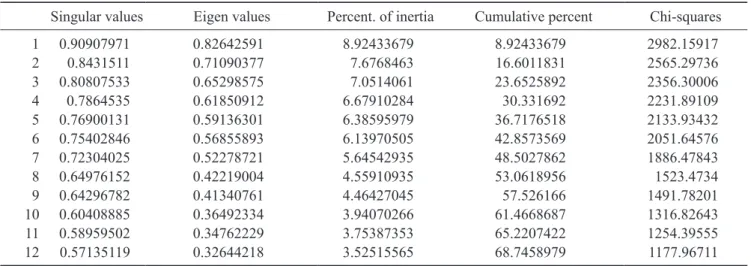
table 4. Singular values, eigen values, percentage of inertia, cumulative percentage and chi squares values for twelve components
Singular values eigen values Percent. of inertia Cumulative percent Chi-squares
1 0.90907971 0.82642591 8.92433679 8.92433679 2982.15917
2 0.8431511 0.71090377 7.6768463 16.6011831 2565.29736
3 0.80807533 0.65298575 7.0514061 23.6525892 2356.30006
4 0.7864535 0.61850912 6.67910284 30.331692 2231.89109
5 0.76900131 0.59136301 6.38595979 36.7176518 2133.93432
6 0.75402846 0.56855893 6.13970505 42.8573569 2051.64576
7 0.72304025 0.52278721 5.64542935 48.5027862 1886.47843
8 0.64976152 0.42219004 4.55910935 53.0618956 1523.4734
9 0.64296782 0.41340761 4.46427045 57.526166 1491.78201
10 0.60408885 0.36492334 3.94070266 61.4668687 1316.82643
11 0.58959502 0.34762229 3.75387353 65.2207422 1254.39555
12 0.57135119 0.32644218 3.52515565 68.7458979 1177.96711
Figure 3. Dominant genera for any of three geographical types as depicted in F1 × F2 diagram of Correspondence Analysis. For species names see text
Figure 4. Cladogram showing Escallonia pollen-
based clusters, identifying 4 major group of endemic honeys, i.e. Amomyrtus, Aristotelia, Eucryphia and Escallonia sorts.
of the V region, and corresponding to the typical sclerophyllous matorral of Central Chile. the pollen fractions of these honeys contain 78.5% (sample 38) and 74.3% (sample 39) of E. pulverulenta pollen. an exploratory classification using the cladistics software “Hennig86” (figure 4) indicated that the species found in the honey samples form three clearly delimited groups. these groups are 1. Aristotelia-Amomyrtus. 2.
Weinmannia‑Eucryphia‑Lotus, 3. Escallonia-Lithrea,
Brassica‑Raphanus‑Schinus‑Castanea‑Cordia, Persea, Prunus and Retanilla.
to the sixteen honey samples obtained in the extreme south of the study area (iX Region), in the Mediterranean climate zone with perhumid trends.
By applying a correspondence analysis (figure 3) the dominant genera in each geographic type could be determined. the singular values, eigen values, inertia percentage, cumulative percentages and chi squared are shown in table 4. the cumulative percentages of the two first axis comprised 16.6 of the variability. the main inertias were exhibited by Heliotropium stenophyllum Hook. & Arn. for the samples of
geographic type 1, Quillaja saponaria, Retanilla trinervia Hook. & Arn. and Raphanussativus l. for geographic type 2, and Weimannia trichosperma,
Aristotelia chilensis and Lotus uliginosus for samples of geographic type 3. The unifloral honeys of Escallonia pulverulenta appeared in the type which we define
628
G. Montenegro et al.: Pollen frequency of Escallonia pulverulenta in Chilean honeysDiscussion
the analysis of 46 honey samples with presence of E. pulverulenta pollen collected in Chilean Mediterranean climate zones with different trends of aridity suggests that they can be subdivided into three geographic types, determined by their association with three different classes of botanical composition in their pollen spectra: 1. Aristotelia‑Amomyrtus, 2. Escallonia‑ Lithrea, Brassica‑Raphanus‑Schinus, Castanea‑Cordia,
Persea, Prunus, Retanilla and 3. Weinmannia‑Eucryphia‑ Lotus. Escallonia pulverulenta appears to be most strongly associated with plants of the second group (geographic type 2) (figure 3). This correlates well with its greater abundance, within its area of distribution, in the area of the Mediterranean climate zone with semiarid to humid trends (figure 1). In general the geographical types corresponded well with the different climate zones within the region with Mediterranean climate. the honey samples associated with geographic type 1, derived from the Mediterranean climate zone with arid trends; the honeys which determine the geographic type 2, derive from zones with semi arid, subhumid and humid trends; while geographic type 3 corresponded to honeys produced in the perhumid Mediterranean zone (di Castri & Hajek 1976).
Escallonia belongs to a monogeneric family (escalloniaceae) or to Saxifragaceae. little information exists about the participation of species of the family Saxifragaceae in honey production in other regions with Mediterranean climate zones (Andrade et al. 1999), but most of the literature related to the botanical origin of honey from Mediterranean climate regions has not reported the presence of pollen types associated with Saxifragaceae in the honeys analysed (Serra-Bonvehi & Ventura-Coll 1995, Mateo & Bosch-Reig 1998, Mendes
etal. 1998, Tsigouri & Passaloglou-Katrali 2000, Herrero etal. 2001, Serrano etal. 2004, Soria etal. 2004). Chile is a country where it is possible to produce unifloral honey of E. pulverulenta, and the most promising location for its production is the Mediterranean climate zone with semiarid trends (the fifth and the metropolitan administrative regions, located between 32° and 33° of South latitude, approximately). the promotion of certification of unifloral Escallonia honey, and thereby of its origin, is highly recommendable, as currently only unifloral honeys of Q. saponaria (quillay) and E. cordifolia (ulmo) are recognised in the international market. The next step towards obtaining unifloral honey of E.pulverulenta or of other native and endemic plants is to ascertain the optimal season for harvest. this could
promote the conservation of determined plant species with apicultural utility, and under some degree of threat, by encouraging their economic exploitation in a sustainable way with minimal ecological impact through apicultural activity (Butz 1997). This is particularly valid for those species with narrow geographic distributions concentrated in areas with dense human population, the presence of which implies permanent habitat impacts and a degree of vulnerability; such is the case for the Mediterranean climate zone of Central Chile (Cincotta
etal. 2000).
through statistical analysis which included the whole spectrum of pollen types present in the samples, we obtained only one type of unifloral honey, compared with the three or four classes obtained by melissopalynological analysis, which only considers the percentage of the dominant pollen type. Generally, honey is characterized by the abundance of some pollen types and the infrequency of others. although the honey samples were derived from a large area (north, Center and South of the country), representing Chile’s Mediterranean climate zone, many pollen morphs from the total of 105 pollen types found in the pollen spectrum of all samples were shared among several of them. in turn, much of the inertia was also shared, requiring eight to twelve components in the correspondence analysis which made it difficult to define clusters. Different climatic trends are described within the study area: arid, semiarid, humid, and perhumid or very humid (di Castri & Hajek 1976), yet only the last of these was easily identified; in the factorial analysis by the grouping of components, and in the cladistic analysis by the allocation of associated species (Aristotelia and Amomyrtus, both typical of the southern zone) to the first two branches which separate from the main group of the cladogram (see figures 3 and 4). However, by associating them with the melissopalynological analyses these methods may be useful for identifying the biogeographical origin of a certain honey. Because the discriminative power of these methods is not based on dominant pollen type alone, which can be adjusted by the addition of pollen to the honey, but rather includes the total of all pollen types which appear in the pollen spectra, this could thereby help to prevent adulteration. today the prediction of zones with apicultural potential is fundamental to the commercialisation of products with added value. Chile could be converted in a country unique in the production of endemic honeys such as
Revista Brasil. Bot., V.33, n.4, p.615-630, out.-dec. 2010
629
Lotusuliginosus “bird trefoil” a dominant pasture species in the South geographic zone requires further comments: first the sampling take into account
Escallonia containing profiles, nevertheless in eight
cases appear consistently Lotus-frequencies. Many of them may be typified as multifloral no-native in the Chilean norm (nCh 2981. of 2005) terms, or still as a multifloral mixture (Ramirez & Montenegro 2004, Montenegro et al. 2008). in this study pollen of this species appears consistently associated with
Weinmannia and Eucryphia pollen grains as can see on cladistic analysis.
aknowledgements – the authors are grateful to Prof. o.
Monika Barth for the Portuguese translation. Funding by FONDECYT 1060535 and Corfo FDI-INNOVA
06Cn12iad-01 to G, Montenegro.
References
andRade, P.B., aMaRal, M.t., iSaBel, P.,
CARVALHO, J.C.M.F., SEABRA, R.M. & PROENCA
DA CUNHA, A. 1999. Physicochemical attributes and
pollen spectrum of Portuguese heather honeys. Food
Chemistry 66:503-510.
BOGDANOV, S. & MARTIN, P. 2002. Honey authenticity:
a review. www.culturaapicola.com.ar/apuntes/miel/ miel_autenticidad_review_alteraciones. pdf (accessed 2008 May 14).
BONOD, I., SANDOz, J.C., LOUBLIER, Y. &
PHAM-DELéGUE, M.H. 2003. learning and discrimination
of honey odours by the honey bee. apidologie 34:147-159.
BUTz, V.M. 1997. ecological impact of introduced honey
bees. the Quarterly Review of Biology 72:275-297.
CINCOTTA, R.P., WISNEWSKI, J. & ENGELMAN, R.
2000. Human population in the biodiversity hotspots. nature 404:990-992.
CODEX ALIMENTARIUS COMMISSION 1987. Joint
FAO/Who Food Standards Programme. Codex Standard
for Honey, CodeX Stan 12-1981, 1st Revision. Rome, italy.
DI CASTRI, F. 1968. equisse écologique du Chili.
Biologie de l’amerique australe: In Étude sur la faune du Sol. v. iV: Biologie de l’amerique australe
(C.L. Debouteville & E. Rapoport, eds.): Editions du Centre National de la Recherche Scientifique, Paris,
p.7-52.
DI CASTRI, F. & HAJEK, E. 1976. Bioclimatología de
Chile. Editorial de la Universidad Católica de Chile,
Santiago.
eRdtMan, G. 1986. Pollen morphology and plant taxonomy. angiosperms, e.J. Brill, leiden.
GREz, A.A, SIMONETTI, J.A. & BUSTAMANTE, R.O.
2006. Biodiversidad en ambientes fragmentados de Chile: patrones y procesos a diferentes escalas. editorial
Universitaria, Santiago.
HeRReRo, B., ValenCia-BaRReRa, R.M., San
MARTíN, R. & PANDO, V. 2001. Characterization of
honeys by melissopalynology and statistical analysis. Canadian Journal of Plant Science 82:75-82.
HEUSSER, C.J. 1971. Pollen and spores of Chile: modern types
of the Pteridophyta, Gymnospermae and angiospermae.
The University of Arizona Press, Tucson.
HodGeS, d. 1984. the Pollen loads of the honeybee. G. Beard and Son ltd., Brighton.
KRell, R. 1996. Value-added products from beekeeping.
FAO Agricultural Services Bulletin 124:1-409.
LOUVEAUX, J., MAURIzIO, J.A. & VORWOHL, G. 1978.
Methods of melissopalynology. Bee World 59:139-157.
MATEO, R. & BOSCH-REIG, F. 1998. Classification of Spanish unifloral honeys by discriminated analysis
of electrical conductivity, color, water content, sugars
and pH. Journal of Agricultural and Food Chemistry
46:393-400.
MENDES, E., PROENçA, E.B., FERREIRA, I.M.P.L.V.O.
& FERREIRA, M.A. 1998. Quality evaluation
of Portuguese honey. Carbohydrate Polymers 37: 219-223.
MoaR, n.t. 1985. Pollen analysis of new zealand honeys. new zealand Journal of agricultural Research 28:39-70.
MONTENEGRO, G., ÁVILA, G., & GÓMEz, M. 1992.
Importancia relativa de especies cuyo polen es utilizado
por Apis mellifera en el área de la Reserva nacional de los Ruiles Vii Región de Chile. acta Botánica Malacitana 17:167-174.
MonteneGRo, G., PizaRRo, R., ÁVila, G., CaStRo,
R., RíOS, C., MUÑOz, O., BAS, F., & GÓMEz, M.
2003. origen botánico y propiedades químicas de las mieles de la región mediterránea árida de Chile. Ciencia e investigación agraria 30:161-174.
MONTENEGRO, G., MUJICA, A.M., PEÑA, R.C., GÓMEz,
M., SEREY, I. & TIMMERMANN, B. 2004. Similitude
pattern and botanical origin of Chilean propolis. Phyton 2004:104-154.
MONTENEGRO, G., GÓMEz, M., PIzARRO, R.,
RIzzARDINI, G. &. ORTEGA, X. 2005a. Miel de
abejas-denominación de origen botánico mediante ensayo melisopalinológico. nCh 2981-2005. división
de Normas del Instituto Nacional de Normalización de Chile y Unidad de Botánica, Facultad de Agronomía e Ingeniería Forestal. Pontificia Universidad Católica de
Chile, Santiago.
MONTENEGRO, G., PIzARRO, R., ÁVILA, G., MUÑOz,
O., MUJICA, A.M. & BAS, F. 2005b. determination
of the botanical origin and some chemical properties
of honeys from central zone of Chile. Phyton: 2005:
630
G. Montenegro et al.: Pollen frequency of Escallonia pulverulenta in Chilean honeysMONTENEGRO, G. & PIzARRO, R. 2006. Manejo de
apiarios, producción apícola y certificación de miel. Facultad de Agronomía e Ingeniería Forestal, Pontificia Universidad Católica de Chile, Santiago.
PLOUVIER, V. 1956. the presence of asperuloside in
Escallonia and of dulcitol in Brexia madagascariensis. Compte rendu hebdomadaire séances de l’académie des sciences 242:1643-1645.
RAMíREz, R. & MONTENEGRO, G. 2004. Certificación del
origen botánico de miel y polen corbicular pertenecientes a la comuna de litueche, Vi región de Chile. Revista Ciencia e investigación agraria. 31:197-211.
SERRA-BONVEHí, J. & VENTURA-COLL, F. 1995.
Characterization of citrus honey (Citrus spp.) produced
in Spain. Journal of Agricultural and Food Chemistry
43:2053-2057.
SERRANO, S., VILLAREJO, M., ESPEJO, R. & JODRAL, M.
2004. Chemical and physical parameters of andalusian
honey: classification of Citrus and Eucalyptus honeys by
discriminant analysis. Food Chemistry 87:619-625.
SLEUMER, H. 1968. die Gattung Escallonia (Saxifragaceae).
Verhandelingen der Koninklijke nederlande akademie
van Wetenschappen. AFD Natuurkunde Tweede
Reeks-deel 58:1-146.
SoRia, a.C., GonzÁlez, M., de loRenzo, C.,
MARTíNEz-CASTRO, I. & SANz, J. 2004.
Characterization of artisanal honeys from Madrid
(Central Spain) on the basis of their melissopalynological,
physicochemical and volatile composition data. Food
Chemistry 85:121-130
TASKOVA, R., EVTATIEVA, N., HANDJIEVA, L. & POPOV, S.
2001. iridoid pattern of Plantago l. and their systematic
significance. zeitschrift für Naturforschung 57c:42-50. TOMASSINI, L., FODDAI, S., NICOLETTI, M., ERAzO
S., GARCíA, R. & BRAVO, G. 1993. iridoid glycosides
from Escallonia Species. Biochemical Systematics and ecology 21:621-623.
TSIGOURI, A. & PASSALOGLOU-KATRALI, M. 2000. a
scientific note on the characteristics of thyme honey from