Validity of Diagnostic Codes for Acute Stroke
in Administrative Databases: A Systematic
Review
Natalie McCormick
1,2, Vidula Bhole
2, Diane Lacaille
2,3,4, J. Antonio Avina-Zubieta
2,3,4*
1Faculty of Pharmaceutical Sciences, University of British Columbia, Vancouver, British Columbia, Canada, 2Arthritis Research Canada, Richmond, British Columbia, Canada,3Division of Rheumatology,
Department of Medicine. University of British Columbia, Vancouver, British Columbia, Canada, 4Cardiovascular Committee of the CANRAD Network, Richmond, British Columbia, Canada
Abstract
Objective
To conduct a systematic review of studies reporting on the validity of International
Classifi-cation of Diseases (ICD) codes for identifying stroke in administrative data.
Methods
MEDLINE and EMBASE were searched (inception to February 2015) for studies: (a) Using
administrative data to identify stroke; or (b) Evaluating the validity of stroke codes in
admin-istrative data; and (c) Reporting validation statistics (sensitivity, specificity, positive
predic-tive value (PPV), negapredic-tive predicpredic-tive value (NPV), or Kappa scores) for stroke, or data
sufficient for their calculation. Additional articles were located by hand search (up to
Febru-ary 2015) of original papers. Studies solely evaluating codes for transient ischaemic attack
were excluded. Data were extracted by two independent reviewers; article quality was
assessed using the Quality Assessment of Diagnostic Accuracy Studies tool.
Results
Seventy-seven studies published from 1976
–
2015 were included. The sensitivity of ICD-9
430-438/ICD-10 I60-I69 for any cerebrovascular disease was
82% in most [
50%]
stud-ies, and specificity and NPV were both
95%. The PPV of these codes for any
cerebrovas-cular disease was
81% in most studies, while the PPV specifically for acute stroke was
68%. In at least 50% of studies, PPVs were
93% for subarachnoid haemorrhage (ICD-9
430/ICD-10 I60), 89% for intracerebral haemorrhage (ICD-9 431/ICD-10 I61), and 82% for
ischaemic stroke (ICD-9 434/ICD-10 I63 or ICD-9 434&436). For in-hospital deaths,
sensi-tivity was 55%. For cerebrovascular disease or acute stroke as a cause-of-death on death
certificates, sensitivity was
71% in most studies while PPV was
87%.
OPEN ACCESS
Citation:McCormick N, Bhole V, Lacaille D, Avina-Zubieta JA (2015) Validity of Diagnostic Codes for Acute Stroke in Administrative Databases: A Systematic Review. PLoS ONE 10(8): e0135834. doi:10.1371/journal.pone.0135834
Editor:Terence J Quinn, University of Glasgow, UNITED KINGDOM
Received:January 16, 2015
Accepted:July 27, 2015
Published:August 20, 2015
Copyright:© 2015 McCormick et al. This is an open access article distributed under the terms of the Creative Commons Attribution License, which permits unrestricted use, distribution, and reproduction in any medium, provided the original author and source are credited.
Data Availability Statement:All relevant data are within the paper and its Supporting Information files.
Conclusions
While most cases of prevalent cerebrovascular disease can be detected using
430-438/I60-I69 collectively, acute stroke must be defined using more specific codes. Most in-hospital
deaths and death certificates with stroke as a cause-of-death correspond to true stroke
deaths. Linking vital statistics and hospitalization data may improve the ascertainment of
fatal stroke.
Introduction
Stroke imparts a substantial burden on patients, healthcare systems, and society, with stroke
accounting for more than 6.6 million deaths in 2012 (11.9% of all deaths globally) [
1
]. Those
who survive an acute stroke are often permanently disabled, with reduced work and social
activities [
2
], and quality of life [
3
]. The economic consequences are also substantial; the annual
costs of stroke were recently estimated at $33.6 billion in the United States [
4
] and £8.9 billion
in the United Kingdom [
5
], with direct medical costs accounting for half of these expenditures.
Although the incidence of stroke has been decreasing in high-income countries, this decrease is
being offset by increasing rates in low- and middle-income countries [
6
], such that the
world-wide burden of stroke is continuing to grow.
Administrative databases are increasingly being used for stroke research. These data
sources, which link longitudinal health resource utilization data for hospitalizations, outpatient
care, and, in some jurisdictions, dispensed medications, to individual-level demographic and
vital statistics data, allow for more efficient analyses, and more generalizable findings.
Unfortu-nately, as administrative databases are usually established for billing, and not research,
pur-poses, the diagnoses contained within tend to be coded by non-medical staff and may not
reflect the final diagnosis of the treating physician. But if these databases are to be used for
stroke research, the diagnostic codes used to identify stroke must be valid. This means they
must be able to distinguish those who have actually experienced a stroke (according to an
accepted
‘gold standard’
reference diagnosis) from those who have not. These diagnostic codes
must also allow researchers to distinguish the major subtypes of acute stroke, which differ from
one another with regards to their incidence rates, risk factors, and outcomes. For example,
hae-morrhagic stroke occurs far less frequently than ischaemic stroke [
4
], but is associated with
higher re-hospitalization rates [
7
,
8
] and earlier mortality [
7
,
9
–
11
], and greater short-term
[
8
,
10
,
12
–
21
] and long-term [
22
] treatment costs.
While several validation studies of stroke codes have been conducted [
23
–
26
], these have
varied widely with regards to their study populations, clinical and geographic settings, and the
reference standards used. For example, while some assessed the validity of codes for just one
subtype [
23
–
25
], others assessed broader groups of codes pertaining to cerebrovascular disease
as a whole (including acute stroke, transient ischaemic attack, and stroke sequelae). To
synthe-size the current evidence, we, as part of a Canadian Rheumatology Network for establishing
best practices in the use of administrative data for health research and surveillance (CANRAD)
[
27
–
31
], conducted a systematic review of studies reporting on the validity of diagnostic codes
for identifying cardiovascular diseases. Data from these studies were used to compare the
valid-ity of these codes, and evaluate whether administrative health data can accurately identify
car-diovascular diseases for the purpose of capturing these events as covariates, outcomes, or
complications in future research. We recently reported our findings on the validity of codes for
Arthritis Society of Canada. The funders had no role in study design, data collection and analysis, decision to publish, or preparation of the manuscript.
myocardial infarction [
32
] and heart failure [
33
]. In the current paper, we analyze studies
reporting on the validity of stroke codes in administrative databases.
Methods
Literature Search
An experienced librarian (M-DW) undertook searches of the MEDLINE and EMBASE
data-bases, from inception (1946 and 1974, respectively) for all available peer-reviewed literature.
Two search strategies were used: (1) All studies where administrative data was used to identify
cardiovascular diseases; (2) All studies reporting on the validity of administrative data for
iden-tifying cardiovascular diseases. Our MEDLINE and EMBASE search strategies are available as
(S1
,
S2
,
S3
, and
S4
Texts
). To identify additional studies, the authors hand-searched the
refer-ence lists of the key articles located. As well, the Cited-By tools in PubMed and Google Scholar
were used to find relevant articles that had cited the articles located through the database
search. The databases were originally searched from inception to November 2010, with the
handsearch conducted up to February 2011. These searches were updated in February 2015.
Two reviewers independently screened the titles and abstracts of the located records for
rele-vance to the study objectives. In the next step, full text publications were evaluated against the
inclusion criteria. Any discrepancies were discussed until consensus was reached. When the
conflict persisted a third reviewer (JAA-Z) was consulted. No protocol for this systematic
review has been published, though more information is available in the following publication
[
27
]. Our review was conducted in accordance with the Preferred Reporting Items for
System-atic Reviews and Meta-Analyses (PRISMA) [
34
] statements, and our completed PRISMA
checklist is provided as (S1 Checklist).
Inclusion Criteria
We considered full-length, English-language, peer-reviewed articles that used administrative
data and either reported validation statistics for the International Classification of Diseases
(ICD) codes of interest, or provided sufficient data for their calculation. We first included
stud-ies that evaluated at least one code pertaining to a subtype of acute stroke, being ICD-8/9 430
or ICD-10 I60 for subarachnoid haemorrhage (SAH), and ICD-8/9 431 or ICD-10 I61 for
intracerebral haemorrhage (ICH). For ischaemic stroke, the main codes are ICD-8 433/434
and ICD-9 434 (occlusion of the cerebral arteries), and ICD-10 I63 (cerebral infarction).
Stroke is a heterogeneous disease that is not defined consistently by clinicians or researchers
[
35
]. It has traditionally been distinguished from transient ischaemic attack (TIA) by way of
duration (more or less than 24 hours) and the presence/absence of permanent brain infarction.
Although advances in neuroimaging have resulted in many events that would previously have
been labelled as TIA now being considered as minor strokes, this is an area of ongoing
contro-versy [
35
]. As such, we took a conservative approach by not considering episodes of TIA as
acute stroke, and so excluded studies that solely evaluated codes for TIA (ICD-9 435 or ICD-10
G45).
while reviewing the literature, we observed that this broad range of codes for cerebrovascular
disease is frequently used to identify cases of acute stroke.
Data Extraction
Two independent reviewers (NM and VB) examined the full text of each selected record and
abstracted data using a standardized collection form (a copy is provided in
S5 Text).
Informa-tion was gathered on the study populaInforma-tion, administrative data source, stroke codes and
algo-rithm, validation process, and gold standard. Validation statistics comparing the codes to
definite, probable, or possible cases of acute stroke, or the specific diagnoses of SAH, ICH, or
ischaemic stroke in particular, were abstracted. These statistics included sensitivity, specificity,
positive predictive value (PPV), negative predictive value (NPV), and kappa. Wherever
possi-ble, we abstracted statistics for definite and probable cases of acute stroke. However, the
num-ber of categories available depended on the choice of gold standard. For example, under the
World Health Organisation criteria, potential cases are categorized as either definite stroke or
not stroke [
36
], while the National Survey of Stroke criteria [
37
] use the categories of definite,
highly probable, and probable stroke. Statistics for each sex, for fatal versus non-fatal cases,
and for each hospital discharge position (i.e. primary/principal and secondary diagnosis) were
abstracted where reported. Data were independently abstracted by each reviewer who
subse-quently compared their forms to correct errors and resolve discrepancies, if any.
Quality Scores
The design and methods employed in each study, including the rigour of the reference
stan-dard, and generalizability of the study population, could influence the resultant validity
statis-tics. Hence, all studies were evaluated for quality, with the validation statistics stratified by level
of study quality. An adaptation of the QUADAS tool (Quality Assessment of Diagnostic
Accu-racy Studies) [
38
] was used to evaluate study quality. Our group previously used the QUADAS
in assessing the validity of codes for diabetes mellitus [
30
], myocardial infarction [
32
], heart
failure [
33
] and osteoporosis and fractures [
31
].
Statistical Analysis
All validation statistics were abstracted as reported. Where sufficient data were available we
cal-culated 95% confidence intervals (95% CI) and validation statistics not directly reported in the
original publication. Kappa values (a measure of agreement beyond that expected by chance)
greater than 0.60 indicated substantial/perfect agreement, 0.21–0.60 were considered as fair/
moderate agreement and those 0.20 or lower as light/poor agreement [
39
].
Results
Literature Search
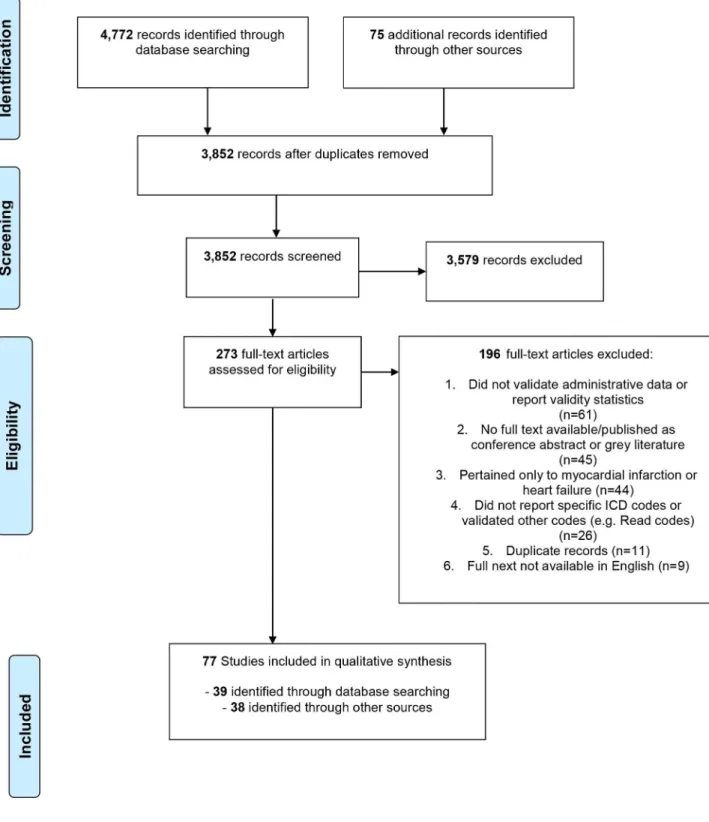
not published in English; their languages of publication were Danish, German, Italian,
Japa-nese, Portuguese, Spanish (two articles), French, and Chinese. Ultimately 77 articles were
included for the systematic review of acute stroke.
Study Characteristics
Of the 77 articles evaluating stroke diagnoses that were included in the final review, 31 (40%)
were from the United States (USA), 26 (34%) were from Europe, 13 (17%) were from Canada,
four were from Asia (5%), two (3%) were from Australia, and one (1%) was from Sri Lanka.
Characteristics of these studies are presented in
Table 1. Validation was the primary objective
in all but ten [
40
–
49
] of these studies. Two articles [
40
,
50
] reported on the validity of stroke
diagnoses exclusively in a paediatric population. Most studies evaluated the diagnostic codes in
hospitalization databases though 16 studies [
47
,
51
–
65
] evaluated stroke as a cause-of-death on
death certificates and one study [
66
] reported on outpatient data exclusively.
Gold standard
Chart reviews, sometimes in conjunction with unspecified diagnostic criteria, formed the basis
of the gold standard in 35 studies, patient self-report was used in one [
112
], and national and
regional stroke registries or clinical databases served as the gold standard in 12 [
52
,
58
–
60
,
65
,
67
,
73
,
74
,
76
,
81
,
91
,
92
]. One study [
23
] utilized two gold standards, with the reference
diagnosis for some cases established upon prospective clinical examination by a neurologist,
and for other cases, established after retrospective chart review by a different neurologist. The
28 remaining studies used a specific set of diagnostic criteria, most often the WHO criteria, to
evaluate the stroke diagnosis.
Study quality was evaluated based on the QUADAS tool [
38
], with 54 of 77 studies (70%)
categorized as high quality, and the remaining 23 studies as medium quality. A detailed
break-down of the quality assessment for each study is provided in
S1 Table. Seven of the
medium-quality studies [
47
,
57
,
59
,
64
,
71
,
73
,
104
] did not adequately describe the validation process or
other key methodological aspects, while nine employed a selected study population
[
25
,
40
,
50
,
77
,
89
,
92
,
105
,
107
,
111
] (e.g. atrial fibrillation cohort, kidney transplant recipients),
and seven used a less-reliable gold standard [
24
,
66
,
70
,
82
,
85
,
94
,
112
], typically chart review by
an individual other than a clinician or trained hospital coder.
Validity of Stroke Codes on Aggregate
The validation statistics reported by each of the included studies are provided in
S2
and
S3
Tables
. We located 36 papers examining the validity of the codes for cerebrovascular disease
as an aggregate (ICD-9 430–438 or ICD-10 I60-I69); these codes were compared to diagnoses
of any type of cerebrovascular disease (usually as a comorbidity) in 16 studies [
56
,
61
,
63
,
66
,
71
,
77
,
79
,
80
,
82
,
89
,
90
,
93
,
94
,
102
,
104
,
105
], and to a diagnosis of acute stroke in particular in 21
[
26
,
41
,
45
,
47
,
49
,
52
,
54
,
55
,
57
,
62
,
64
,
74
,
83
,
84
,
86
,
91
,
93
,
99
,
103
,
111
,
112
]. The sensitivity of these
codes for any type of cerebrovascular disease was
82% in seven of the 14 studies (range 32%
to 100%). The PPV was
81% in seven of the 14 studies reporting this statistic (range 43% to
97%). Specificity, reported by ten studies [
63
,
66
,
71
,
79
,
82
,
89
,
90
,
102
,
104
,
105
], was
95% in
nine of the ten (range 90% to 100%), while NPV was
95% in eight of the ten studies
[
63
,
71
,
79
,
82
,
89
,
90
,
94
,
102
,
104
,
105
] where this statistic was reported (range 84% to 100%).
Kappa values, as reported by seven studies, ranged from 0.52 [
82
] to 0.76 [
89
] to 0.91 [
79
].
Table 1. Characteristics of Included Studies.
First Author, Year of Publication Year(s) of Data Collection Primary Validation Study? Country Records Evaluated (N)
Source Population Type of
Administrative Data
Gold Standard
Aboa-Eboule[67], 2013
2004–2008 yes France 903 residents of one
community hospitalized for stroke at one teaching hospital ICD-10 inpatient records disease registry, using WHO criteria
Agrawal[40], 2009
1993–2003 no USA (California) 1,307 children aged 0–19 years enrolled in the Kaiser Permanente Medical Care Program and participating in the Kaiser Paediatric Stroke Study
ICD-9 inpatient and outpatient records
CRMD
Appelros[65], 2011
1999–2000 yes Sweden 377 residents of one
community
ICD-10 inpatient and vital statistics records
disease registry, using WHO criteria Arnason[68],
2006
1999–2000 yes Canada (Ontario) 616 all patient discharged from one tertiary hospital with a bleeding-related or thromboembolic diagnosis
ICD-9 inpatient records
CRDC
Benesch[69], 1997
1992 yes USA (Louisiana,
Massachusetts, California, Iowa, Pennsylvania)
649 patients hospitalized at one offive academic medical centres and eligible for a telephone survey of persons at increased risk for major stroke
ICD-9 inpatient records
CRDC—WHO criteria
Birman-Deych [70], 2005
1998–1999 yes USA (national) 23,657 Medicare beneficiaries (aged 20–105 years) on the National Registry of Atrial Fibrillation hospitalized for atrial fibrillation
ICD-9 inpatient records
chart review
Borzecki[66], 2004
1998–1999 yes USA (national) 1,176 individuals regularly receiving care from one of 10 Veterans Affairs sites across the USA, random selection of 100 users from each site with hypertension and 20 without
ICD-9 outpatient records
chart review
Broderick[41], 1998
1993–1995 no USA (Ohio,
Kentucky)
733 all residents of one of five counties
ICD-9 inpatient and vital statistics records CRDC– Rochester, Minnesota and National Institute of Neurological Disorders and Stroke
Brown[54], 2006 2000–2001 yes USA (Texas) 186 participants aged 44
years and older enrolled in the Brain Attack Surveillance in Corpus Christi (BASIC) Project
ICD-10 vital statistics records
CRMD
Chen[71], 2009 2003 yes Canada (Alberta) 4,008 general hospitalized population
ICD-10 inpatient records
chart review
Cheng[72], 2011 1999 yes Taiwan 372 hospitalized patients
aged 55 years and older
ICD-9 inpatient records
CRMD
Table 1. (Continued)
First Author, Year of Publication Year(s) of Data Collection Primary Validation Study? Country Records Evaluated (N)
Source Population Type of
Administrative Data
Gold Standard
Davenport[73], 1996
n/a yes Scotland 97,515 hospitalized patients at
one university teaching hospital ICD-9 inpatient records disease registry: Lothian Stroke Register de Faire[63],
1976
1961–73 yes Sweden 1,156 10,000 pairs of twins
enrolled in the Swedish Twin Registry and born during 1901–1925
ICD (1965 edition) vital statistics records
CRMD
Derby[42], 2000 1980–1991 no USA (Rhode
Island, Massachusetts)
3,811 residents of two communities aged 35– 74 years
ICD-9 inpatient records
CRMD
Ellekjaer[74], 1999
1994–1996 yes Norway 759 hospitalized patients
aged 15 years and older
ICD-9 inpatient records
disease registry, using WHO criteria
Gaist[43], 2000 1977–1995 no Denmark 191 patients hospitalized at
one university hospital or two other hospitals within one county
ICD-8 and ICD-10 inpatient records
CRMD
Ghia[75], 2010 2003–2007 yes Australia 570 hospitalized patients admitted through the emergency department and diagnosed upon admission with TIA
ICD-10 inpatient records
chart review
Goldstein[25], 1998
1995–1997 yes USA (North Carolina)
175 hospitalized patients at one Veterans Affairs Medical Center
ICD-9 inpatient records
CRDC—TOAST criteria
Golomb[50], 2006 1999–2004 yes USA (Indiana) 663 all inpatients and
outpatients seen at one Children's Hospital
ICD-9 inpatient and outpatient records
CRMD
Haesebaert[76], 2013
2006–2007 yes France 329 patients18 years of
age admitted to one of four university hospitals
ICD-10 inpatient records
disease registry: AVC69 cohort
Hasan[77], 1995 1993 yes Wales 166 patients admitted to the
Department of the Care of the Elderly at one of four hospitals within one health unit
ICD-9 inpatient records
CRMD
Heckbert[78], 2004
1994–2000 yes USA (national) 34,016 women participating in the Women's Health Initiative clinical and observational studies ICD-9 inpatient records CRDC— Women's Health Initiative criteria
Henderson[79], 2006
1998–99, 2000–01
yes Australia 14,635 all hospitalized patients
(excluding same-day chemotherapy and dialysis) ICD-10 inpatient records chart review: charts were re-coded by professional coders Hennessy[80],
2010
2002–2007 yes Canada 1,292 patients hospitalized at
one of four hospitals
ICD-10 inpatient records
chart review: charts were re-coded by nurses with coding experience
Table 1. (Continued)
First Author, Year of Publication Year(s) of Data Collection Primary Validation Study? Country Records Evaluated (N)
Source Population Type of
Administrative Data
Gold Standard
Holick[44], 2009 2003–2007 no USA 132 new users of
atomoxetine or stimulant ADHD medications, and general population controls, identified from a health insurance database for a study assessing the association between atomoxetine and stroke in adults
ICD-9 inpatient records
CRMD
Hsieh[81], 2013 2006–2008 yes Taiwan 1,736 patients hospitalized at
one tertiary referral centre ICD-9 inpatient records disease registry (Taiwan Stroke Registry) and CRMD Humphries[82],
2000
1994–1995 yes Canada (British Columbia)
817 patients hospitalized for percutaneous coronary intervention
ICD-9 inpatient records
chart review
Iso[57], 1990 1970 & 1980 yes USA (Minnesota) 214 residents of the study area aged 30–74 years who died in hospital, identified as part of the Minnesota Heart Survey
ICD-8 and ICD-9 vital statistics records
CRDC–National Survey of Stroke
Ives[62], 1995 1989–1992 yes USA (California, Maryland, North Carolina, Pennsylvania)
5,201 participants in the population-based Cardiovascular Health Study aged 65 years or older
ICD-9 inpatient and vital statistics records
CRMD
Johnsen[83], 2002
1993–1999 yes Denmark 565 participants in a
population-based cohort study on diet and cancer development aged 50– 64 years at enrollment
ICD-10 inpatient records
CRDC—WHO criteria
Jones[84], 2014 1987–2010 yes USA (Maryland,
Minnesota, Mississippi, North Carolina)
4,260 members of the population-based Atherosclerosis Risk in Community (ARIC) Study cohort, aged 45– 64 years at the time of study enrollment
ICD-9 inpatient records
CRDC–National Survey of Stroke, AHA/ASA
Kirkman[24], 2009
2002–2007 yes United Kingdom 2,147 all hospitalized patients residing in the study area ICD-10 inpatient records chart review: mentioned in records
Klatsky[45], 2005 1978–1996 no USA (California) 3,441 members of a prepaid
healthcare program who supplied data on voluntary health examinations
ICD-9 inpatient records
CRMD
Kokotalio[85], 2005
2000–2003 yes Canada (Alberta) 717 hospitalized patients at three centres
ICD-9 and ICD-10 inpatient records
chart review
Koster[60], 2013 2004 yes Sweden 3,534 residents aged 20 years
and older of two Swedish counties covered by the MONICA register ICD-10 inpatient, outpatient, and vital statistics records disease registry —MONICA
Table 1. (Continued)
First Author, Year of Publication Year(s) of Data Collection Primary Validation Study? Country Records Evaluated (N)
Source Population Type of
Administrative Data
Gold Standard
Krarup[86], 2007 1998–1999 yes Denmark 236 enrollees in the
population-based Copenhagen City Heart Study
ICD-10 inpatient records
CRDC—WHO criteria
Kumamaru[87], 2014
2003–2009 yes USA (national) 15,089 participants in the REasons for Geographic And RacialDifferences in Stroke (REGARDS) study, aged65 years with at least one month of Medicare eligibility
ICD-9 inpatient records
CRDC–WHO criteria
Lakshminarayan [46], 2009
1980, 1985, 1990, 1995, 2000
no USA (Minnesota) 6,032 general population aged 30–74 years
ICD-9 inpatient records
CRDC–WHO and Minnesota Stroke Survey criteria, and neuroimaging Lakshminarayan
[88], 2014
1993–2007 yes USA (national) 48,877 participants enrolled in the observational Women’s Health Initiative studies aged 50–79 years at
enrollment with Medicare fee-for-service coverage
ICD-9 inpatient records
CRDC–Women's Health Initiative criteria
Lambert[89], 2012
2002–2006 yes Canada (Quebec) 1,982 patients hospitalized with MI as a principal diagnosis, or who underwent PCI or CABG, at one of 13 primary, secondary, or tertiary hospitals ICD-9 inpatient records chart review; mentioned in records
Lee[90], 2005 1997–1999 yes Canada (Ontario) 1,592 hospitalized individuals
<105 years of age coded with a primary/most responsible diagnosis of heart failure ICD-9 inpatient records CRDC— Charlson comorbidity index
Leibson[91], 1999
1970, 1980, 1984, 1989
yes USA (Minnesota) 377 all hospitalized patients residing in the study area
ICD-A and ICD-9 inpatient hospitalizations
disease registry —Rochester Stroke Registry
Lentine[92], 2009 1991–2002 yes USA (Missouri) 571 kidney transplant
recipients aged18 years who had Medicare as their primary insurer at transplant and the time of each clinical event
ICD-9 inpatient records
clinical database
Leone[93], 2004 1998 yes Italy 1,126 hospitalized patients
from the Neurology, Neurosurgery, General Medicine, Cardiac Surgery, and Intensive Care departments at one centre
ICD-9 inpatient records
CRDC—WHO criteria
Table 1. (Continued)
First Author, Year of Publication Year(s) of Data Collection Primary Validation Study? Country Records Evaluated (N)
Source Population Type of
Administrative Data
Gold Standard
Leppala[51], 1999 1985–1989, 1992
yes Finland 593 male smokers enrolled in
a population-based, randomized controlled trial of alpha-tocopherol and beta-carotene supplementation, aged 50–69 years at registration
ICD-8 and ICD-9 inpatient and vital statistics records
CRDC—National Survey of Stroke and MONICA criteria
Levy[94], 1999 1994 yes Canada (Quebec) 224 individuals aged65
years discharged alive with a primary diagnosis of myocardial infarction
ICD-9 inpatient records
chart review: mentioned in records
Lindblad[53], 1993
1977–1987 yes Sweden 413 participants in a
hypertension registry (hypertensive cases, normotensive participants, randomly-selected controls), recruited from a geographical half of one Swedish county aged 40–70 years at registration
ICD-9 inpatient and vital statistics records
CRMD
Liu[26], 1999 1990–1991 yes Canada
(Saskatchewan)
1,494 patients hospitalized at one of three tertiary-care, or three community, hospitals
ICD-9 inpatient records
CRDC—National Survey of Stroke criteria
Mayo[95], 1993 n/a yes Canada (Quebec) 96 patients hospitalized at
five teaching, affiliated, and community hospitals
ICD-9 inpatient records
CRMD
Olson[96], 2014 2001–2009 yes USA (Colorado) 4,689 enrollees in a managed
care organization aged 18 years and older
ICD-9 inpatient and outpatient records CRDC– Rochester, Minnesota Stroke Study criteria
Newton[97], 1999 1992–1995 yes USA (Washington) 471 enrollees of a Health
Maintenance Organization with diabetes aged 18 years and older
ICD-9 inpatient and outpatient records
chart review
Palmieri[47], 2007
1997–1999 no Italy 8,000 general population aged
35–74 years residing in one of eight regions of Italy
ICD-9 inpatient and vital statistics records
CRDC— MONICA criteria
Phillips[55], 1993 1988–1989 yes Canada 301 patients hospitalized at
one teaching hospital
ICD-9 inpatient and vital statistics records
CRDC–WHO criteria
Piriyawat[98], 2002
2000 yes USA (Texas) 815 as part of the Brain
Attack Surveillance in Corpus Christi (BASIC) Project, patients45 years admitted to one of six area hospitals
ICD-9 inpatient records
CRDC–MONICA criteria
Ramalle-Gomara [99], 2013
2009 yes Spain 400 patients hospitalized at
one of two public hospitals
ICD-9 inpatient records
CRMD
Table 1. (Continued)
First Author, Year of Publication Year(s) of Data Collection Primary Validation Study? Country Records Evaluated (N)
Source Population Type of
Administrative Data
Gold Standard
Rampatage[61], 2013
2006–2008 yes Sri Lanka 648 deaths occurring at three
large hospitals in/near the capital city
ICD-10 vital statistics records
CRMD
Rao[56], 2007 2002 yes China 2,917 deaths occurring in
health facilities located in one of six large cities
ICD-10 vital statistics records
CRMD
Reker[100], 2001 1998–1999 yes USA (national) 671 patients hospitalized at
11 Veterans Affairs Medical Centres
ICD-9 inpatient records
CRDC—WHO criteria
Reggio[64], 1995 1985–1992 yes Italy 193 deaths occurring among
residents of one municipality
ICD-9 vital statistics records
CRDC–WHO criteria
Rinaldi[23], 2003 1999 yes Italy 233 hospitalized patients at
one centre ICD-9 inpatient records prospective clinical examination and retrospective CRDC—WHO criteria Rosamond[49],
1999
1987–1995 no USA (Maryland,
Minnesota, Mississippi, North Carolina)
1,185 members of the population-based Atherosclerosis Risk in Community (ARIC) Study cohort, aged 45– 64 years at the time of study enrollment
ICD-9 inpatient records
CRDC–National Survey of Stroke
Roumie[101], 2008
1999–2003 yes USA (Tennessee) 231 Medicaid enrollees aged
50–84 years, identified as part of a larger retrospective cohort study on the relationship between NSAID use and stroke
ICD-9 inpatient records
CRMD
Shahar[48], 1995 1980,1985, 1990
no USA (Minnesota) 2,939 general population aged 30–74 years
ICD-9 inpatient records
CRDC—WHO, Minnesota Stroke Survey
Singh[102], 2012 2007–2009 yes USA (Minnesota) 240 retrospective cohorts of
patients18 years of age admitted to the intensive care unit
ICD-9 inpatient and outpatient records
CRMD
Sinha[103], 2008 1993–2003 yes United Kingdom 250 residents in one
community aged 40–79 years and enrolled in a population-based study of the determinants of chronic disease
ICD-10 inpatient records
CRDC—WHO criteria
So[104], 2006 2003 yes Canada (Alberta) 193 patients hospitalized for myocardial infarction
ICD-9 and -10 inpatient records
chart review
Soo[105], 2014 2003 yes Scotland 3,219 participants in a
population-based cohort study of chronic kidney disease
ICD-10 inpatient records
CRMD
Spolaore[106], 2005
1999 yes Italy 4,015 general hospitalized
population
ICD-9 inpatient records
CRDC— MONICA criteria
Table 1. (Continued)
First Author, Year of Publication Year(s) of Data Collection Primary Validation Study? Country Records Evaluated (N)
Source Population Type of
Administrative Data
Gold Standard
Stegmayr[58], 1992
1985–1989 yes Sweden 6,000 residents of the two
provinces included in the Northern Sweden MONICA study aged 25– 74 years
ICD-9 inpatient and vital statistics records
disease registry —MONICA
Szczesniewska [59], 1990
1984–1986 yes Poland 213 residents of two city
districts covered by the POL-MONICA Warsaw Project aged 25–64 years
ICD-9 vital statistics records
disease registry —MONICA
Thigpen[107], 2015
2006–2010 yes USA (Alabama, Massachusetts, Pennsylvania)
1,812 patients with atrial fibrillation hospitalized at one of three medical centres
ICD-9 inpatient records
CRDC–WHO, AHA
Tirschwell[108], 2002
1990–1996 yes USA (Washington) 206 general hospitalized population20 years of age
ICD-9 inpatient records
CRMD
Tolonen[52], 2007
1993–1998 yes Finland 3,633 general population aged
25 years and older
ICD-9 and -10 inpatient and vital statistics records
disease registry —FINMONICA/ FINSTROKE register
Tu[109], 2013 2011 yes Canada 5,000 individuals aged20
years seen by a family practice physician using the EMRALD EMR system
ICD-10 inpatient and outpatient records
CRMD
Wahl[110], 2010 2002–2004 yes USA (national) 200 commercially-insured individuals in a large health claims database, identified as part of a larger retrospective observational cohort study on the risk of serious adverse events among users of selective coxibs and non-over-the-counter NSAIDs
ICD-9 inpatient records
CRMD
Wildenschild [111], 2014
2009–2010 yes Denmark 228 Part 1: individuals18
years admitted to hospital; Part 2: patients discharged from one of four neurologic wards
ICD-10 inpatient records
CRDC–WHO criteria
Wu[112], 2014 2004–2005 yes Taiwan 15,574 individuals aged12
years whose households were randomly selected for participation in the 2005 Taiwan National Health Interview Survey
ICD-9 inpatient and outpatient records
patient self-report
CRDC = Chart Review, Diagnostic Criteria–the charts of potential cases were reviewed, and a formal set of diagnostic criteria were applied when evaluating cases; CRMD = Chart Review, Medical Doctor–the charts of potential cases were reviewed by a physician, who evaluated cases using their clinical judgment or an otherwise unspecified set of criteria; AHA = American Heart Association; ASA = American Stroke Association; CABG = coronary artery bypass graft; EMRALD = Electronic Medical Record Administrative Data Linked Database; ICD = International Classification of Diseases; MONICA = MONItoring Trends and Determinants in CArdiovascular Disease; NSAID = non-steroid anti-inflammatory drug; PCI = percutaneous coronary intervention; TOAST = Trial of ORG 10172 in Acute Stroke Treatment; TIA = transient ischaemic attack; WHO = World Health Organization
43% to 100% among the medium-quality studies, and from 32% to 96% among the
high-qual-ity studies. There was, however, more of a difference in the PPVs, which ranged from 43% to
83% among the medium-quality studies, and from 52% to 97% among the high-quality studies
(with PPV
88% in five of the seven high-quality studies reporting on PPV).
The sensitivity of these codes for the narrower diagnosis of acute stroke (SAH, ICH, or
ischaemic stroke), which was reported by ten studies [
52
,
54
,
57
,
62
,
64
,
74
,
93
,
99
,
111
,
112
],
was
66% in seven of the ten (range 42% to 96%). The PPV for the reference diagnosis of
acute stroke was generally lower than that for the broader category of any cerebrovascular
dis-ease, being
68% in 12 of the 21 studies reporting this statistic (range 28% to 98%). Indeed, in
one study that evaluated the PPV against both acute stroke and
‘any cerebrovascular disease’,
the PPV for
‘any cerebrovascular disease’
(93%) was higher than that for acute stroke (66%)
[
93
].
Subarachnoid Haemorrhage
Twenty-seven papers reported on the validity of codes for SAH (ICD-9 430 or ICD-10 I60),
and the PPV was
86% in 16 of the 26 studies where this was reported (S2 Table). Fifteen
papers compared the SAH code to any type of acute stroke (meaning a case coded for SAH was
considered a true-positive if the diagnosis assigned upon validation was SAH, ICH, or
ischae-mic stroke), and the PPV was
86% in eight of these studies (range 33% to 100%). Thirteen
studies compared the SAH code to the diagnosis of SAH in particular, and the PPV was
93%
in seven of the 13 (range 46% to 100%). The sensitivity of these codes for SAH, reported by
only four studies [
52
,
56
,
84
,
93
], ranged from 35% [
93
] to 95% [
52
]. Kappa, reported by only
one study [
108
], was 0.88.
Intracerebral Haemorrhage
Thirty-four studies evaluated the validity of codes for ICH (ICD-9 431/432 or ICD-10 I61/62)
(S2 Table). Twenty-six evaluated the main ICH codes 431/I61, and the PPV was
87% in 16
of the 25 studies reporting on PPV. The PPV, when compared to any type of acute stroke,
was
87% in ten of 15 studies (range 78% to 100%), and when compared to the diagnosis of
ICH in particular, the PPV was
89% in six of the 12 studies (range 63% to 100%). The
sensi-tivity of these codes for ICH, as reported by three studies, ranged from 57% [
93
] to 69% [
56
] to
95% [
52
]. The kappa value for ICD-9 431, as reported by one study [
108
], was 0.82, while that
for ICD-9 430 and 431 combined, was 0.84 [
88
]. The lesser-used ICH codes (ICD-9 432 or
ICD-10 I62) were evaluated in 15 studies [
26
,
41
,
47
,
49
,
55
,
62
,
74
,
78
,
84
,
91
,
93
,
95
,
96
,
100
,
106
], in
which the PPV was
67% in all but two [
62
,
95
]. The PPV of ICD-9 431 and 432 combined,
available from 13 studies [
26
,
41
,
42
,
47
,
49
,
53
,
55
,
57
,
74
,
84
,
91
,
93
,
95
], ranged from 33% to 99%. In
sum, the PPV of the main codes for ICH (ICD-9 431/ICD-10 I61) was
87% in most studies.
Ischaemic Stroke
We located 39 papers that examined the validity of codes for ischaemic stroke (S2 Table).
From these, 28 evaluated the main code for ischaemic stroke (ICD-9 434 or ICD-10 I63) and
the PPV was
82% in 20 of the 27 studies reporting this statistics (range 62% to 100%). The
PPV was
83% in 13 of the 19 papers
80% [
52
]. ICD-9 433 was evaluated in 19 papers [
25
,
26
,
40
,
41
,
47
,
49
,
50
,
53
,
55
,
69
,
74
,
84
,
91
,
93
,
95
,
96
,
100
,
106
,
107
], with the PPV being
71% in 14 of the 19. Eight papers [
25
,
49
,
50
,
53
,
84
,
93
,
96
,
107
] reported on the PPV of ICD-9 433 for ischaemic stroke in particular, and it
was
79% in six of the eight. Just two studies reported on the sensitivity of ICD-9 433 for
ischaemic stroke, which was 2% [
93
] in one and 9% [
84
] in the other.
The combination of ICD-9 433 and 434 (occlusion of the precerebral or cerebral arteries)
was reported on by 20 studies [
26
,
40
,
41
,
47
,
49
,
51
–
53
,
55
,
57
,
69
,
72
,
74
,
81
,
84
,
93
,
95
,
99
,
107
,
110
], in
which the PPV for any stroke ranged from 23% to 100%, and that for ischaemic stroke ranged
from 40% to 100%. The sensitivity of these codes for ischaemic stroke, as reported by five
stud-ies [
52
,
81
,
84
,
93
,
99
], was
76% in four of these. The code for acute but ill-defined stroke
(ICD-9 436 or ICD-10 I64) was evaluated in 23 studies [
23
,
25
,
26
,
40
,
41
,
47
,
49
,
50
,
53
,
55
,
62
,
69
,
74
,
78
,
83
,
84
,
91
,
93
,
95
,
96
,
100
,
106
,
107
], with a PPV for any stroke of
75% in 12 of 19 studies (range
48% to 95%) and a PPV for ischaemic stroke of
75% in five of seven studies [
23
,
25
,
49
,
50
,
84
,
96
,
107
] where this statistic was reported (range 50% to 87%).
Nineteen studies [
25
,
26
,
40
,
41
,
47
,
49
,
52
,
55
,
69
,
74
,
84
,
85
,
87
,
88
,
93
,
95
,
101
,
107
,
108
] employed a
broader case definition (ICD-9 433/434/436 or ICD-10 I63/64); the PPV was
77% in 12 of
the 19 (range 46% to 94%). Two studies reported on kappa, which, for ICD-9 433, 434, and 436
together, was 0.82 [
108
] in one study and 0.85 [
88
] in the other. Sixteen studies [
23
,
26
,
40
,
41
,
47
,
49
,
53
,
55
,
62
,
69
,
74
,
78
,
84
,
93
,
95
,
107
] examined the validity of ICD-9 434 and 436 as a pair,
and the PPV was
82% in ten of the 16 (range 66% to 94%). Of interest, Leone
et al
[
93
]
com-pared the sensitivity and PPV of different codes for ischaemic stroke, and found that ICD-9
434 and 436 combined had a higher sensitivity (43% versus 35%) for ischaemic stroke, but
sim-ilar PPV (87% versus 90%), than did ICD-9 434 alone. In sum, the PPV of the main codes for
ischaemic stroke (ICD-9 434/ICD-10 I63) was
82% in most studies, and the PPV of codes
for acute but ill-defined stroke (ICD-9 436 or ICD-10 I64) was
75%.
Validity of Sets of Stroke-Specific Codes
Thirty-six papers examined the validity of a set of stroke-specific codes for identifying any type
of stroke (S3 Table) though in two [
70
,
92
], the reference diagnosis was stroke/TIA and not just
acute stroke. There was some variability in the codes included in each set, but they generally
excluded codes pertaining to occlusion of the precerebral arteries, intracranial haemorrhage
other than ICH, late effects of stroke/stroke sequalae, and cerebrovascular disorders stemming
from other conditions. The code for acute but ill-defined stroke was included in some of these
sets. One study, by Reker
et al
[
100
], used both a high-sensitivity algorithm for detecting stroke
(sensitivity = 91%, PPV = 52%) and high-specificity algorithm (sensitivity = 54%, PPV = 75%).
Lakshminarayan
et al
[
46
] compared two diagnostic criteria, those from the WHO and
Minne-sota Stroke Survey (MSS), and found the PPV against the WHO criteria was 98%, while that
against the stricter MSS criteria was 68% [
46
].
The sensitivity of these sets of codes for stroke was
82% in 13 of 22 studies [
40
,
41
,
59
,
62
,
65
,
67
,
70
,
73
–
75
,
78
,
87
,
88
,
92
,
93
,
97
–
101
,
109
,
111
] where this was reported (range 34% to 97%),
and the PPV was
86% in 18 of the 34 studies [
40
,
41
,
44
,
46
–
48
,
51
,
53
,
58
–
60
,
62
,
65
,
67
,
68
,
70
,
73
–
Validity by Subgroups
The 77 studies included in this review were published over a 40-year period (1976–2015),
though 81% of these (n = 62) were published from 1999-onwards. Few studies reported on any
longitudinal changes in sensitivity, and few longitudinal trends in PPV were observed after the
77 studies were stratified by period of publication. For instance, amongst the 27 studies
report-ing on the PPV of ICD-9 434/ICD-10 I63, the PPV ranged from 64% to 100% in the
eight-earli-est studies (published from 1993 to 1998), from 72% to 100% in the ten middle studies
(published from 1999 to 2004), and from 62% to 100% in the nine most-recent studies
(pub-lished from 2005 to 2015). And among the 26 studies reporting on ICD-9 431/ICD-10 I61, the
PPV ranged from 66% to 100% in the 12 earlier studies (published from 1993–2002) and from
65% to 100% in the 13 more-recent studies (published from 2004–2014). Still, several
investiga-tors collected data over ten or more years, and some improvements were observed in the PPV
for stroke over time. In one study [
91
], the PPV of ICD 430–438 increased from 48% to 58%
between 1970 and 1980, though by 1989 it had decreased slightly, to 54%. Moreover, Derby
et al
[
42
] found that the PPV of ICD-9 431, 432, 434, 435, 436, or 437 for stroke increased by
20% between 1980 and 1990, while Lakshminarayan
et al
[
46
] found that the PPV of ICD-9
431, 432, 434, 436, and 437 for stroke increased in this same period by 27% (from 55% in 1980
to 70% in 1990). These studies provide evidence for the accuracy of codes for acute stroke
hav-ing improved over time.
The accuracy of fatal and non-fatal stroke diagnoses were compared in nine studies [
47
,
51
–
53
,
58
,
60
,
62
,
65
,
91
], and amongst these, the accuracy of fatal diagnoses was similar, and often
slightly higher, than non-fatal diagnoses (S4 Table). Fifteen studies examined cerebrovascular
disease or acute stroke as a cause-of-death on death certificates, and the PPV was
87% in ten
of these (range 50% to 100%). However, the sensitivity of vital statistics data for deaths from
stroke was
71% in six of the 10 studies reporting on this (range 32% to 96%), and the
sensi-tivity of hospitalization data for fatal strokes—in the single study where this statistic was
reported—was 55% (compared to 68% for non-fatal hospitalizations for stroke) [
91
].
Most studies examined codes from the ICD 8
thand 9
threvisions, though 22 studies
exam-ined codes from the 10
threvision. Just one of these studies [
54
] was conducted in the United
States. Separate validation statistics for ICD-9 and ICD-10 codes were provided by three
arti-cles [
52
,
85
,
104
], and, overall, there were few differences in the accuracy of codes from the
two revisions. One study was conducted exclusively on males [
51
], and two were conducted
exclusively on females [
78
,
88
], and their findings were consistent with those of most studies
where both sexes were represented. Sex-stratified statistics were provided by six studies
[
47
,
52
,
84
,
87
,
93
,
105
], from which only minor differences in the accuracy of codes for males and
females were observed.
Discussion
when the reference standard was restricted to acute stroke (defined as SAH, ICH, or ischaemic
stroke). Given these findings, we conclude that most diagnoses of fatal stroke in administrative
data correspond to true stroke deaths, and that the presence of any code from 430–438 or
I60-I69 can be used to rule-in the diagnosis of prevalent cerebrovascular disease. We also
con-clude that administrative data can be used to identify cases of acute stroke, as long as
extrane-ous codes (i.e. ICD-9 432, 435, 437, and 438; ICD-10 I62, I67, I68, and I69) are excluded.
Only a few studies evaluated the sensitivity of individual codes for stroke but from these, it
appears the sensitivity of the main ICD-9 code for ischaemic stroke (434) is suboptimal.
How-ever, findings from some studies included in this review suggest that adding ICD-9 code 433
(occlusion of precerebral arteries), and/or 436 (acute but ill-defined stroke) to the search
algo-rithm can help capture more cases of ischaemic stroke at little cost to the PPV. Further support
is provided by the fact that the PPV of ICD-9 436 for ischaemic stroke in most applicable
stud-ies was
75%. Cases of ischaemic stroke appear to be coded as
“acute but ill-defined stroke”
much more often than haemorrhagic strokes are. For example, of all strokes that were coded
initially as ill-defined, Krarup
et al
[
86
] re-classified 57% of these as ischaemic, and just 6% as
haemorrhagic. We believe this is because it is harder to make a conclusive diagnosis of
ischae-mic stroke: neuroimaging can identify bleeds and haemorrhagic lesions more easily than brain
infarction, especially within the first twelve hours of onset [
35
]. Despite the WHO [
36
] and
other criteria calling for cases that fulfill the clinical criteria of stroke, but whose CT is negative
for recent brain lesions, to be classified as ischaemic stroke (ICD-9 433 or 434), conservative
clinicians and coders may still be inclined to classify these as acute, but ill-defined stroke
(ICD-9 436).
The findings of our review are consistent with those of a systematic review of algorithms for
identifying acute stroke or TIA in administrative data that was published in 2012 [
113
]. That
review, conducted as part of the US Food and Drug Administration’s Mini-Sentinel Program,
had a limited scope compared with ours, as it was restricted to evaluations of US and Canadian
databases published from 1990-onwards. Still, consistent with our findings, that review found
that when individual ICD-9 stroke codes were examined, the PPV’s were highest amongst 430,
431, and 434, and much lower when any other code from 430–438 was included in the search
algorithm. Further, the authors recommend that codes 433.x1, 434 (excluding 434.x0), and 436
be used when searching for cases of acute ischaemic stroke [
113
]. They also suggest that when
using administrative data to evaluate drug safety, the outcome of interest should be a definite
subtype of stroke rather than the broader endpoint of
‘any cerebrovascular disease’
as defined
by ICD-9 430–438 [
113
].
Regional and Temporal Trends
diagnosis [
53
]. For instance, when Lindblad
et al
[
53
] retrospectively reviewed the stroke codes
assigned to cases over 1977–1987, the subtype was reclassified, often on the basis of CT
find-ings, in 27% of the confirmed stroke cases [
53
]. More strokes were classified as
thromboem-bolic, and fewer as ill-defined, over time in the Derby
et al
study [
42
], and similar trends have
been reported in Denmark, where the incidence of unspecified stroke decreased from 1997 to
2009, while the incidence of ischaemic stroke increased [
116
].
Regional differences in access-to and use-of neuroimaging may explain other disparities
that were observed in the validity of strokes diagnoses, even amongst studies conducted more
recently (i.e. 1990 or later). Tolonen
et al
[
52
] observed that those aged 75 years and older were
coded more often with non-specific stroke codes. They attributed this to older individuals
being less likely to undergo CT and MRI, which could otherwise aide in making a more precise
diagnosis. They also found that the sensitivity and PPV were lower at district hospitals than
university hospitals [
52
], and attributed this to the limited neurological expertise and
neuroim-aging available at the district hospitals. Liu
et al
[
26
] also observed higher PPV’s amongst the
tertiary hospitals than community hospitals, and attributed this to the greater level of testing
performed in the tertiary hospitals. As neuroimaging services continue to become more
wide-spread, and more technologies like CT angiography and perfusion imaging [
117
] emerge, we
expect the validity of stroke codes to increase alongside.
It is possible that changes in billing and reimbursement practices, including the
introduc-tion of Diagnosis-Related Groups (DRGs) in the US Medicare program in the 1980’s, may also
have contributed to the assignment of more precise stroke codes over time. To investigate this,
Derby
et al
[
118
] compared how strokes were classified before and after DRGs were
intro-duced, but their findings (increased use of ICD-9 434 and decreased use of ICD-9 436) did not
directly correspond with any financial incentives. In addition, while the Medicare DRG system
was implemented only in the US, this temporal trend was observed in other countries
[
115
,
116
] as well.
Consequences of Using Broad Sets of Cerebrovascular Disease Codes
Many of the studies that reported on the validity of ICD-9 codes 430–438, or ICD-10 codes
I60-69, as a group were examining how well these codes performed for detecting preexisting
cerebrovascular disease as a comorbidity. Searching for any one of the codes in this group is
appropriate when seeking to identify and adjust for preexisting cerebrovascular disease in the
analyses of other clinical conditions. The high sensitivity we observed for these codes, and
high PPV they had when compared to the reference diagnosis of
‘any cerebrovascular disease’,
provides additional support for this use. However, when studying acute stroke as a primary
outcome, this broad group of codes, which includes the codes for non-acute and ill-defined
cerebrovascular disease, and the late effects of stroke, should not be used. It is far more difficult
to identify risk factors for stroke from this mixture of recent-onset and prevalent
cerebrovascu-lar disease because it is unclear which characteristics may have increased the risk of
developing
stroke, versus
surviving
the stroke. Instead, in pharmacoepidemiologic studies and other
analy-ses of risk factors where acute stroke is the primary outcome of interest, and diagnostic
speci-ficity is of upmost importance, only stroke-specific codes should be used.
Limitations
We acknowledge some limitations to our systematic review. There is the potential for a
lan-guage bias as we could not consider articles whose full-text was not available in English. We
were also conservative in our definition of acute stroke, and excluded studies that only reported
on the validity of diagnostic codes for TIA. Another potential limitation stems from the fact
that, even though our database searches were conducted by an experienced librarian,
adminis-trative databases are not well catalogued in MEDLINE and EMBASE (e.g. no MeSH term
per-taining to
“
administrative database
”
). Although the majority of the included studies were
located through database searches, our subsequent hand search turned up other relevant
arti-cles that had not been indexed under terms relating to Administrative Data or Validation. As a
result, despite our extensive hand search, we may have missed some relevant articles if they
were not indexed in MEDLINE or EMBASE under a term relating to administrative data or
validation. Our findings are also subject to publication bias, wherein reports of stroke codes
having poor validity may have been differentially withheld from publication. We feel this is
unlikely, however, given that we did locate reports of case definitions (i.e. ICD-9 432 or 433
individually) whose sensitivity and PPV for acute stroke were suboptimal.
Conclusions and Recommendations
Following our analysis of the evidence, we conclude that the diagnostic codes for acute stroke
in administrative databases are valid. In fact, advances in neuroimaging and the increased
availability of CT scanners may have helped improve diagnosis and coding of acute stroke
sub-types over time. However, it is apparent that researchers have been using a variety of codes to
identify acute stroke, some of which have suboptimal validity. Based on current evidence, we
provide researchers with several recommendations for the use of diagnostic codes to capture
cases of stroke in administrative data. We believe the findings of our review will help guide
researchers in their efforts to better understand and decrease the burden of stroke.
2. Codes that pertain to the diagnosis of acute stroke (ICD-9 430/ICD-10 I60, ICD-9
431/ICD-10 I61, ICD-9 434/I63, and ICD-9 436/ICD-431/ICD-10 I64) are highly predictive of true cases of
acute stroke of any type, and of the particular subtype.
˚
These are the codes that should be used when identifying acute stroke as an outcome,
especially in pharmacoepidemiologic and other analyses of risk factors where diagnostic
specificity is essential.
3. When searching for cases of ischaemic stroke, including both the code for ischaemic stroke
(ICD-9 434/ICD-10 I63) and the code for acute-but-ill-defined stroke (ICD-9 463/ICD-10
I64) in the case definition should help capture more cases of ischaemic stroke with little
impact on the PPV.
4. Whether identified from hospitalization or vital statistics data, diagnoses of fatal stroke
gen-erally correspond to true deaths from stroke.
5. Hospitalization and vital statistics databases should be linked and searched together in order
to maximize the capture of stroke deaths.
Supporting Information
S1 Checklist. PRISMA Checklist.
(DOC)
S1 Text. MEDLINE search strategy (inception to November 2010).
(DOCX)
S2 Text. EMBASE search strategy (inception to November 2010).
(DOCX)
S3 Text. MEDLINE search strategy (January 2010 to February 2015).
(DOCX)
S4 Text. EMBASE search strategy (January 2010 to February 2015).
(DOCX)
S5 Text. Data Collection Form.
(DOC)
S1 Table. Item-by-Item QUADAS Breakdown for Each Study.
(DOCX)
S2 Table. Results of Studies Validating Diagnoses of Stroke in Administrative Data.
(DOC)
S3 Table. Results of Studies Validating Sets of Diagnostic Codes for Stroke in
Administra-tive Data.
(DOC)
S4 Table. Results of Studies Validating Diagnoses of Fatal Stroke in Administrative
Data.
Acknowledgments
The authors wish to thank members of the CANRAD network, librarian Mary-Doug Wright
(B.Sc., M.L.S.) for conducting the literature search, Reza Torkjazi, and Kathryn Reimer for the
administrative support and help editing the manuscript.
Author Contributions
Conceived and designed the experiments: DL JAAZ. Performed the experiments: NM VB DL
JAAZ. Analyzed the data: NM VB DL JAAZ. Wrote the paper: NM VB DL JAAZ. Final
approval of the version of the manuscript to be published: NM VB DL JAAZ.
References
1. WHO | Global Health Estimates [Internet]. [cited 8 May 2014]. Available:http://www.who.int/ healthinfo/global_burden_disease/en/
2. Skolarus LE, Burke JF, Brown DL, Freedman VA. Understanding Stroke Survivorship: Expanding the Concept of Poststroke Disability. Stroke J Cereb Circ. 2013; doi:10.1161/STROKEAHA.113.002874
3. Sprigg N, Selby J, Fox L, Berge E, Whynes D, Bath PMW, et al. Very low quality of life after acute stroke: data from the efficacy of nitric oxide in stroke trial. Stroke J Cereb Circ. 2013; 44: 3458–3462. doi:10.1161/STROKEAHA.113.002201
4. Mozaffarian D, Benjamin EJ, Go AS, Arnett DK, Blaha MJ, Cushman M, et al. Heart Disease and Stroke Statistics-2015 Update: A Report From the American Heart Association. Circulation. 2014; doi:
10.1161/CIR.0000000000000152
5. Saka O, McGuire A, Wolfe C. Cost of stroke in the United Kingdom. Age Ageing. 2009; 38: 27–32. doi:
10.1093/ageing/afn281PMID:19141506
6. Feigin VL, Lawes CMM, Bennett DA, Barker-Collo SL, Parag V. Worldwide stroke incidence and early case fatality reported in 56 population-based studies: a systematic review. Lancet Neurol. 2009; 8: 355–369. doi:10.1016/S1474-4422(09)70025-0PMID:19233729
7. Sun Y, Lee SH, Heng BH, Chin VS. 5-year survival and rehospitalization due to stroke recurrence among patients with hemorrhagic or ischemic strokes in Singapore. BMC Neurol. 2013; 13: 133. doi:
10.1186/1471-2377-13-133PMID:24088308
8. Christensen MC, Munro V. Ischemic stroke and intracerebral hemorrhage: the latest evidence on mor-tality, readmissions and hospital costs from Scotland. Neuroepidemiology. 2008; 30: 239–246. doi:
10.1159/000128323PMID:18446043
9. Goulart AC, Bensenor IM, Fernandes TG, Alencar AP, Fedeli LM, Lotufo PA. Early and one-year stroke case fatality in Sao Paulo, Brazil: applying the World Health Organization’s stroke STEPS. J Stroke Cerebrovasc Dis Off J Natl Stroke Assoc. 2012; 21: 832–838. doi:10.1016/j.
jstrokecerebrovasdis.2011.04.017
10. Yoneda Y, Okuda S, Hamada R, Toyota A, Gotoh J, Watanabe M, et al. Hospital cost of ischemic stroke and intracerebral hemorrhage in Japanese stroke centers. Health Policy Amst Neth. 2005; 73: 202–211. doi:10.1016/j.healthpol.2004.11.016
11. Lee WC, Joshi AV, Wang Q, Pashos CL, Christensen MC. Morbidity and mortality among elderly Americans with different stroke subtypes. Adv Ther. 2007; 24: 258–268. PMID:17565915
12. Gioldasis G, Talelli P, Chroni E, Daouli J, Papapetropoulos T, Ellul J. In-hospital direct cost of acute ischemic and hemorrhagic stroke in Greece. Acta Neurol Scand. 2008; 118: 268–274. doi:10.1111/j. 1600-0404.2008.01014.xPMID:18384454
13. Christensen MC, Previgliano I, Capparelli FJ, Lerman D, Lee WC, Wainsztein NA. Acute treatment costs of intracerebral hemorrhage and ischemic stroke in Argentina. Acta Neurol Scand. 2009; 119: 246–253. doi:10.1111/j.1600-0404.2008.01094.xPMID:18771525
14. Christensen MC, Valiente R, Sampaio Silva G, Lee WC, Dutcher S, Guimarães Rocha MS, et al. Acute treatment costs of stroke in Brazil. Neuroepidemiology. 2009; 32: 142–149. doi:10.1159/ 000184747PMID:19088487
15. Dodel RC, Haacke C, Zamzow K, Paweilik S, Spottke A, Rethfeldt M, et al. Resource utilization and costs of stroke unit care in Germany. Value Health J Int Soc Pharmacoeconomics Outcomes Res. 2004; 7: 144–152.