www.epjournal.net – 2013. 11(1): 89-103
¯ ¯ ¯ ¯ ¯ ¯ ¯ ¯ ¯ ¯ ¯ ¯ ¯ ¯ ¯ ¯ ¯ ¯ ¯ ¯ ¯ ¯ ¯ ¯ ¯ ¯ ¯ ¯
Original Article
Facial Cues to Perceived Height Influence Leadership Choices in Simulated
War and Peace Contexts.
Daniel E. Re, University of St Andrews, St Andrews, United Kingdom. Email: [email protected]
(Corresponding author).
Lisa M. DeBruine, University of Glasgow, Glasgow, United Kingdom.
Benedict C. Jones, University of Glasgow, Glasgow, United Kingdom.
David I. Perrett, University of St Andrews, St Andrews, United Kingdom.
Abstract: Body size and other signs of physical prowess are associated with leadership hierarchies in many social species. Here we (1) assess whether facial cues associated with perceived height and masculinity have different effects on leadership judgments in simulated wartime and peacetime contexts and (2) test how facial cues associated with perceived height and masculinity influence dominance perceptions. Results indicate that cues associated with
perceived height and masculinity in potential leaders‟ faces are valued more in a wartime (vs. peacetime) context. Furthermore, increasing cues of apparent height and masculinity in faces increased perceived dominance. Together, these findings suggest that facial cues of physical stature contribute to establishing leadership hierarchies in humans.
Keywords: masculinity, dominance, intergroup conflict, body size, face morphology
¯ ¯ ¯ ¯ ¯ ¯ ¯ ¯ ¯ ¯ ¯ ¯ ¯ ¯ ¯ ¯ ¯ ¯ ¯ ¯ ¯ ¯ ¯ ¯ ¯ ¯ ¯ ¯ ¯ ¯ ¯ ¯ ¯ ¯ ¯ ¯ ¯ ¯ ¯ ¯ ¯ ¯ ¯ ¯ ¯ ¯ ¯ ¯ ¯ ¯ ¯ ¯ ¯ ¯ ¯ ¯ ¯ ¯ ¯ ¯ ¯ ¯ ¯ ¯ ¯ ¯ ¯ ¯ ¯ ¯ ¯ ¯ ¯ ¯ ¯ ¯ ¯ ¯ ¯ ¯ ¯ ¯ ¯ ¯ ¯ ¯ ¯ ¯ Introduction
Evolutionary Psychology – ISSN 1474-7049 – Volume 11(1). 2013. -90-
their leadership position (Rule and Ambady, 2011b). Together, these studies provide compelling evidence that leadership judgments made from faces influence democratic selection of leaders and are associated with actual leadership ability.
The ability to quickly evaluate potential leadership ability may draw upon snap judgments of physical dominance (Murray and Schmitz, 2011; Riggio and Riggio, 2010). Face ratings of dominance and maturity have been found to positively predict success in American political elections (Rule et al., 2010). In the corporate world, perceived dominance and maturity from face images of business CEOs predict company profits (Rule and Ambady, 2008), and similar ratings for faces of law firm Managing Partners positively predict profit margins (Rule and Ambady, 2011a). Faces that appear more mature are perceived as more powerful (Rule and Ambady, 2008, 2011a, 2011b) and have an advantage in winning leadership decisions (Zebrowitz and Montepare, 2005). In voices, deep pitch is perceived as masculine and physically dominant (Feinberg, Jones, Little, Burt, and Perrett, 2005; Puts, Hodges, Cardenas, and Gaulin, 2007), and people prefer political candidates with lower voice pitch (Klofstad, Anderson, and Peters, 2012; Tigue, Borak, O'Connor, Schandl, and Feinberg, 2012). Physical size and dominance predicts leadership hierarchies in several primate species (de Waal, 2005, 2007; Mason and Mendoza, 1993; Sapolsky, 2005) and the associations among physical stature, dominance and leadership ability in humans may reflect the use of size and strength in determining social status throughout history (Murray and Schmitz, 2011; Puts, 2010; Riggio and Riggio, 2010). Indeed, physical body strength can be assessed from faces (Sell et al., 2009) and is correlated with facial dominance and masculinity (Fink, Neave, and Seydel, 2007; Windhager, Schaefer, and Fink, 2011). In some studies facial masculinity is also correlated with levels of circulating and reactive testosterone (Penton-Voak and Chen, 2004; Pound, Penton-Voak, and Surridge, 2009), a hormone found to be associated with dominant behaviour (Mazur and Booth, 1998).
People with masculine, dominant-looking faces are more likely to be perceived as good leaders. However, this preference is influenced by the context for which a leader is required. Preferences for facial masculinity (and by association, perceived dominance) in leaders are strengthened when a group is subject to an external threat. Little et al. (2007) compared masculinized and feminized faces to assess leadership choices in the context of war and peace. In the war context, masculinized faces were more likely to be chosen, while the feminized faces were more likely to be chosen in the peace context (Little et al., 2007), preferences which were later found to extend across cultures (Spisak, Dekker, Kruger, and van Vugt, 2012). In a similar vein, Spisak, Homan, Grabo and van Vugt (2011) found masculinized faces were chosen as leaders in social contexts where the simulated in-group (the participants choosing their preferred leader) competed against an out-group, while feminized faces were preferred when within-group cooperation was given higher priority. Further studies report different facial attributions, such as attractiveness, are more preferred
in leaders‟ faces in war contexts, while other attributions, such as trustworthiness, are
preferred in peace contexts (Little, Roberts, Jones, and DeBruine, 2012), and that lower-pitched (and hence more dominant-sounding) voices are preferred in leaders in a war context (Tigue et al., 2012). In general, men are perceived as more dominant and competitive than women, and are preferred as leaders more during times of intergroup conflict (van Vugt and Spisak, 2008). Conversely, women are perceived as more peaceful and better able to resolve conflicts than men, and are preferred as leaders more during times of conflict within a group (van Vugt and Spisak, 2008). Together, these studies indicate the need to assess preferences for leaders in the context of intergroup conflict or peace.
Evolutionary Psychology – ISSN 1474-7049 – Volume 11(1). 2013. -91-
of two candidates won the majority of U.S. presidential elections in the 20th century (Sorokowski, 2010), and the difference in candidates‟ heights predicted the difference in obtained election votes from 1824-1992 (McCann, 2001). Height also predicts career success and income, and taller people are more likely to be selected to leadership positions within the business world (Judge and Cable, 2004). Physical stature positively correlates with perceived leadership ability, but also tendency to run for positions of leadership (Murray and Schmitz, 2011). The association between height and dominance is present even in preverbal infants, who show more surprise when taller lines back away from shorter lines in simulated confrontations than vice versa (Thomsen, Frankenhuis, Ingold-Smith, and Carey, 2011). Height may be associated with leadership due to the advantages of physical dominance in climbing dominance hierarchies in our evolutionary past (Murray and Schmitz, 2011).
Research in craniofacial anatomy reveals that faces develop along with regular body growth (Enlow and Hans, 1996). Faces become longer from infancy to adulthood, with overall face shape changing from round to oval and the jaw becoming more pronounced (Akgul and Toygar, 2002; Enlow and Hans, 1996; Ramanathan and Chellappa, 2006). Face cues associated with tall body height in men include more elongated faces and narrower jaws (Windhager et al., 2011). These findings suggest that there are cues to height in the face. Given the association between height and leadership status, it is possible that facial cues to height may influence judgments of leadership ability. Indeed, recent research indicates that face cues to perceived height influence leadership perception, in that faces thought to belong to taller people are also thought to belong to better leaders (Re et al., in press).
While studies have already demonstrated that preferences for facial masculinity in leaders varies by leadership context (e.g., wartime vs. peacetime), it is unclear whether preferences for apparent height in leaders also varies by context. Windhager et al. (2011) found that face cues to height were structurally distinct from cues to masculinity. Therefore, it is possible that preferences for apparent height in leaders may not follow those for facial masculinity. If, however, apparent height is associated with physical dominance, it may be that faces appearing to belong to taller people would be preferred for leaders in intergroup conflicts, while height preferences may be less pronounced in group situations lacking an external threat.
The current experiment examines whether face cues to apparent height affect leadership choices differently when intergroup conflict is simulated. We follow the methods of Little et al. (2007) to determine if preferences for leaders‟ apparent height differ between war and peace contexts (Experiment 1). Furthermore, we aim to replicate the findings of Little et al. (2007) by testing whether preferences for masculinized faces are stronger in a war context. Finally, we assess whether facial cues to apparent height and masculinity affect perceived dominance (Experiment 2).
Experiment 1: Manipulating apparent height and masculinity to maximize leadership
Methods
Face stimuli
We presented participants with Caucasian face images of 47 men (mean age = 25.3 years, SD = 4.64 years) and 83 women (mean age = 23.0 years, SD = 3.81 years) that were obtained from a commercially available database of face images (available at www.3d.sk).
Men‟s heights ranged from 168 cm to 192 cm (mean = 179.72 cm, SD = 6.43 cm), and
Evolutionary Psychology – ISSN 1474-7049 – Volume 11(1). 2013. -92-
photographed individuals had their hair pulled back and were photographed under constant lighting and camera set-up. Face images were standardized on pupil position. Twenty-two
participants (11 men, 11 women) were asked to „„please rate how tall you think this person is
in either feet and inches or cm‟‟ and were given eight evenly spaced height divisions from 152 cm to 203 cm (5‟0”– 6‟8”). Inter-rater reliability was high for height ratings of both
men‟s and women‟s faces (both Cronbach‟s α ≥ 0.94). The body heights of the photographed individuals were provided by the database, thus we calculated the correlation between body height and perceived height. Body height was significantly, positively correlated with
perceived height in both women‟s (n = 83, r = 0.22, p = 0.049) and men‟s (n = 47, r = 0.30, p
= 0.04) faces. The average apparent height for women‟s faces was 167.52 cm (SD = 3.08
cm), while the average apparent height for men‟s faces was 179.71 cm (SD = 3.03 cm). We used specialist computer graphic software (Tiddeman, Burt, and Perrett, 2001) to average the 10 faces (for each sex) perceived as belonging to the shortest individuals (to
create „short‟ prototypes) and the 10 faces perceived as belonging to the tallest individuals (to create „tall‟ prototypes). The faces from which the women‟s short prototype was
manufactured had an average apparent height of 162.91 cm (SD = 1.38 cm) and the faces
from which the women‟s tall prototype was manufactured had an average apparent height of
172.25 cm (SD = 0.79 cm). The faces from which the men‟s short prototype was manufactured had an average apparent height of 175.68 cm (SD = 1.44 cm) and the faces
from which the men‟s tall prototype was manufactured had an average apparent height of
183.76 cm (SD = 1.00 cm).
We created five male and five female face composites to use in experimental testing by averaging the faces of three individual men or women (Rowland and Perrett, 1995). Some of the individual photographs used in the prototypes were also used in the composites. The male composites had averaged heights of 170.67 cm (SD = 2.52 cm, average age = 25.33 years, SD age = 5.13 years), 176.00 cm (SD = 0.00 cm, average age = 27.33 years, SD age = 2.52 years), 182.00 cm (SD = 0.00 cm, average age = 23.00 years, SD age = 3.00 years), 188.67 cm (SD = 1.52 cm, average age = 25.00 years, SD age = 2.65 years) and 194.33 cm (SD = 4.93 cm, average age = 24.00 years, SD age = 6.93 years). The female composites had average heights of 156.00 cm (SD = 1.00 cm, average age = 22.00 years, SD age = 6.93 years), 167.00 cm (SD = 0.00 cm, average age = 24.67 years, SD age = 3.06 years), 169.00 cm (SD = 7.54 cm, average age = 23.00 years, SD age = 2.65 years), 170.67 cm (SD = 2.08 cm, average age = 22.67 years, SD age = 3.51 years), and 181.33 cm (SD = 3.06 cm, average age = 18.16 years, SD age = 0.58 years).
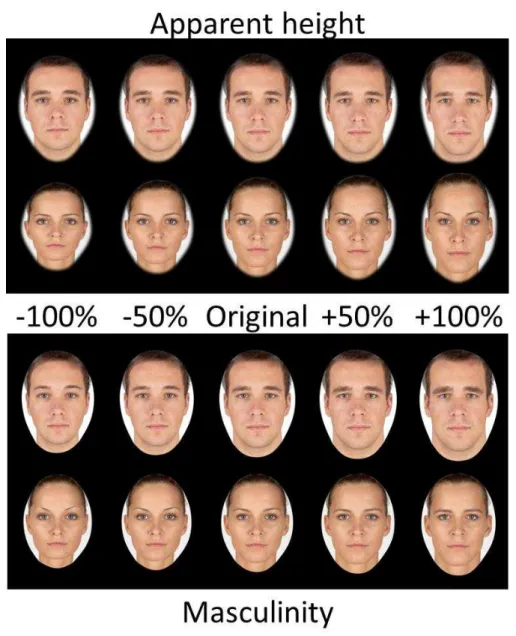
Next, we created apparent height continua to use for experimental testing. Male stimuli were manufactured by adding or subtracting percentages of the shape difference between the tall and short male prototypes to five male composite faces (Rowland and Perrett, 1995). Female stimuli were manufactured in the same way by adding or subtracting percentages of the shape difference between the tall and short female prototypes to five female composite faces (Rowland and Perrett, 1995). This process created ten face continua
(five male, five female) which spanned from 100% „short‟ face shape to 100% „tall‟ face
Evolutionary Psychology – ISSN 1474-7049 – Volume 11(1). 2013. -93- Figure 1. Examples of apparent height (top row) and masculinity (bottom row) transforms for male and female faces.
Note: Each continua contained 20 images of 10% increments. Original composites and ±50% and ±100% transforms are shown here as examples. In Experiment 1, participants were allowed to manually transform faces ± 100% or any point in-between to maximize perceived leadership. In Experiment 2, the ±50% transformed images of two male and two female faces were rated for dominance.
A manipulation check (i.e., pilot study) was conducted to establish whether our perceived height transforms altered perceptions of individuals‟ height. Twenty-two participants (16 women, 6 men) were presented with individual images of two male and two female composites transformed ±50% in apparent height. Participants were asked to rate how tall each person was on a scale of 1 (extremely short) to 7 (extremely tall). Paired-samples t -tests revealed that the composites increased in apparent height were rated as taller than those
Evolutionary Psychology – ISSN 1474-7049 – Volume 11(1). 2013. -94-
the main studies.
Masculinity transforms for each of the five male and five female composites were also created using established methods for manipulating sexually dimorphic shape cues in faces (DeBruine et al., 2006; Perrett et al., 1998). First, male and female prototypes were created by separately averaging all 47 individual male faces and all 83 individual female faces. Masculinity transforms were then created by adding or subtracting percentages of the shape difference between the male and female prototypes to each of our five male and five female composites (creating 10 continua of 20 images). Previous research has demonstrated the efficacy of masculinity transforms in altering perceived facial masculinity (DeBruine, Jones, Crawford, Welling, and Little, 2010; DeBruine et al., 2006; Welling et al., 2008).
Faces for both the perceived height and masculinity transforms were masked around the head so that clothing cues were not visible (Figure 1). Inter-pupillary distance was standardized to avoid changes in overal head size across transforms.
Participants and procedure
Thirty-five women and 22 men (mean age = 22.77 years, SD = 7.34 years) completed the experiment online. The study was approved by the institutional ethics committee. All participants gave informed consent. The twenty face continua (five male and five female perceived height continua, five male and five female masculinity continua) were presented to the participants in two blocks. In one block, participants were instructed to scroll over the
face to manually transform it and asked to “Please change the face to most resemble someone you would like to lead your country in a time of PEACE.” In the other block, participants were asked “Please change the face to most resemble someone you would like to lead your country in a time of WAR.” Order of the blocks was randomized.
Analysis
For each participant, we analysed all trials and calculated the average transform required to maximize leadership for judgment type (war vs. peace context), sex of face (male vs. female), and face manipulation (masculinity vs. perceived height). Since the apparent heights of the prototypes used in the perceived height transforms were known, we were able to calculate the average change in apparent height for each perceived height transform.
Results
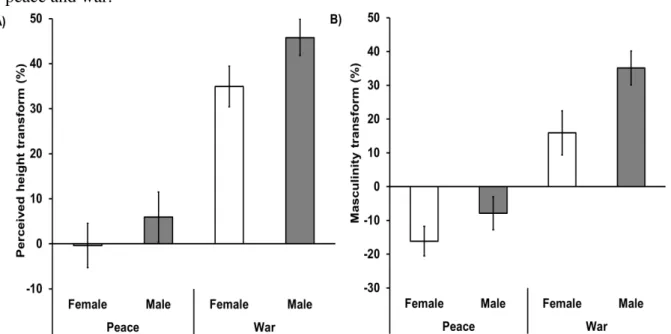
In the peace context, masculinity was decreased from the original composites by 16.6% in female faces and 7.85% in male faces. Apparent height was decreased by 0.38% (0.03 cm) in female faces, but increased by 5.93% (0.48 cm) in male faces. In the war context, masculinity was increased from the original composites by 15.9% in female faces and 35.1% in male faces. Apparent height was increased by 34.9% (3.26 cm) in female faces and 45.8% (3.70 cm) in male faces. One-way t-tests against chance (0% transformation) found that both masculinity and apparent height were significantly increased in the war context for both male and female faces (all t(56) ≥ 2.44, all p ≤ 0.02, all Cohen‟s d ≥ 0.65). Female faces were significantly decreased in masculinity in the peace context (t(56) = -3.70, p < 0.01, Cohen‟s d
= 0.99). There were no other significant transformations in masculinity or apparent height in the peace context (all t(56) ≤ 1.61, all p≥0.11, all Cohen‟s d≤ 0.43).
Evolutionary Psychology – ISSN 1474-7049 – Volume 11(1). 2013. -95-
ability for each face as the dependent variable. Participant sex (male vs. female) was entered as a between-subjects variable. The ANOVA found a main effect of transform type, with apparent height being increased more than masculinity to maximize perceived leadership ability (F(1,55) = 45.12, p < 0.01, partial eta-squared (ηp2) = 0.45; Figure 2). There was a main effect of context, with faces being increased in masculinity or height to a greater degree in the war condition than the peace condition (F(1,55) = 57.74, p < 0.01, ηp2 = 0.51). There was also a main effect of face sex, with male faces being increased in masculinity or height to a greater degree than female faces (F(1,55) = 10.37, p < 0.01, ηp2 = 0.16). There were no interactions among transform, context, and face sex, or any combination of these three factors. There was also no effect of participant sex on the degree of transform (F(1,55) = 0.20, p = 0.66, ηp2 < 0.01), and no interactions between participant sex and any transform type, context, or face sex (all F(1,55) ≤ 0.60, all p≥ 0.44, all ηp2 < 0.01).
Figure 2. Mean transformation and standard error for (A) apparent height transforms and (B) masculinity transforms for male faces (grey bars) and female faces (white bars) in contexts of peace and war.
Note: Apparent height and masculinity were increased more in the war context to maximize perceived leadership ability in both male and female faces.
Experiment 1 found that faces were increased in both apparent height and masculinity more in a war context than a peace context. These results replicate those of previous experiments that investigated the context-specific effects of facial masculinity on hypothetical voting decisions (Little et al., 2007; Spisak et al., 2011) and show that similar results are obtained when cues of apparent height are manipulated in face images.
Experiment 2: Effects of apparent height and masculinity on perceived dominance
Evolutionary Psychology – ISSN 1474-7049 – Volume 11(1). 2013. -96-
(Tigue et al., 2012; van Vugt and Spisak, 2008). Experiment 2 examines whether apparent height and masculinity both affect perceived dominance. Previous research has found facial masculinity affects perceived dominance (DeBruine et al., 2006; Puts, 2010). No research has been conducted on the possible effect of cues of apparent height on the perceived dominance of faces.
Methods
Participants and Procedure
Fourteen women and 9 men (mean age = 27.04, SD = 10.64) completed the experiment online. All participants were asked to indicate their sex and age and gave informed consent.
Two male and two female face composites transformed ±50% in apparent height and ±50% in masculinity (Figure 1) were rated for perceived dominance. Participants were presented with two blocks of faces, one for male faces and one for female faces. Each block presented eight faces, comprised of 2 composites transformed ±50% in masculinity and apparent height (2 composites x 2 transform types x 2 degrees of transform). Both the block order and face order within a block were randomized. Participants were asked to rate on a 1 (extremely submissive) – 7 (extremely dominant) scale how dominant they thought each face to be. Similar scales have been succesfully used in previous studies (Burriss and Little, 2006).
Analysis
For each participant, average dominance ratings were calculated for each of the eight types of faces: male faces with increased height, male faces with decreased height, female faces with increased height, female faces with decreased height, male faces with increased masculinity, male faces with decreased masculinity, female faces with increased masculinity, and female faces with decreased masculinity.
Results
A repeated-measures ANOVA was conducted analyzing the effects of transform type (apparent height vs. masculinity), degree of transform (-50% vs. +50%), and face sex (men vs. women) on dominance ratings. This analysis revealed a main effect of degree of transform (F(1,22) = 16.50, p < 0.01, ηp2 = 0.43), but not transform type (F(1,22) < 0.01, p = 0.93, ηp2 < 0.01) or face sex (F(1,22) = 0.03, p = 0.88, ηp2 < 0.01) on dominance ratings. However, these main effects were qualified by the significant 3-way interaction among transform type, face sex, and degree of transform (F(1,22) = 10.49, p < 0.01, ηp2 = 0.32). There was no between-subjects effect of participant sex on dominance ratings (F(1,22) = 0.33, p = 0.57, ηp2 = 0.02), and no interactions between participant sex and transform type, degree of transform, or face sex (all F(1, 22) ≤ 0.80, all p ≥ 0.38, all ηp2 ≤ 0.04). Next, transform type and degree of transform were analyzed separately for each face sex to interpret the 3-way interaction among transform type, face sex, and degree of transform.
Evolutionary Psychology – ISSN 1474-7049 – Volume 11(1). 2013. -97-
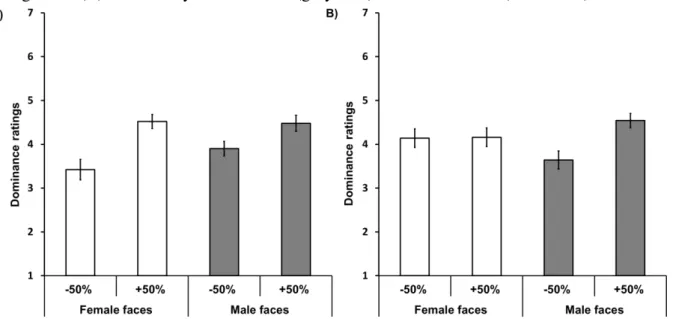
transforms had similar effects on perceived dominance for male faces (Figure 3).
A 2x2 repeated measures ANOVA was also run for female faces. Degree of transform had a significant effect (F(1,23) = 12.91, p < 0.01, ηp2 = 0.36) on dominance ratings. The main effect of transform type was not significant (F(1,23) = 0.88, p = 0.36, ηp2 = 0.04). The interaction between degree of transform and transform type was significant, however (F(1,23) = 18.71, p < 0.01, ηp2 = 0.45). The effects of manipulating apparent height and masculinity in female faces were therefore analyzed separately. Paired-samples t-tests revealed that amplifying apparent height increased dominance ratings in female faces (t(23) = 6.31, p < 0.01, Cohen‟s d = 2.63), while amplifying masculinity had no effect on dominance ratings in female faces (t(23) = 0.12, p = 0.78) (Figure 3).
Figure 3. Mean dominance ratings and standard error for ±50% transforms in (A) apparent height and (B) masculinity in male faces (grey bars) and female faces (white bars).
Note: Apparent height increased perceived dominance in both sexes, while masculinity increased perceived dominance in male faces, but not female faces.
Discussion
When altering the appearance of hypothetical leaders‟ faces, participants increased
cues of apparent height more in the war context than the peace context. Masculinity was also increased more in the war context than the peace context, replicating results found in previous studies (Little et al., 2007; Spisak et al., 2012). Experiment 2 demonstrated that increasing apparent height increased perceived dominance in both male and female faces, while increasing masculinity increased perceived dominance in male faces (but not female faces).
Evolutionary Psychology – ISSN 1474-7049 – Volume 11(1). 2013. -98-
(Thomsen et al., 2011), and taller athletes are more likely to be perceived as the aggressors in ambiguous physical contact in sports (van Quaquebeke and Giessner, 2010). Furthermore, taller men are more prone to acts of aggression (Archer and Thanzami, 2007), and taller people self-report more frequent dominant behavior (Melamed, 1992) than shorter people. The association between height and physical dominance, coupled with strengthened preferences for apparent height in leaders during time of intergroup conflict, provide further evidence that leadership perceptions from faces are based on cues to dominance.
Experiment 2 found that changes in apparent height and facial masculinity affect perceived dominance similarly in male faces, and apparent height has a greater impact on perceived dominance than masculinity in female faces. These results preclude the possibility that masculinity had a greater impact on perceived dominance than apparent height and thus required a smaller change to maximize perceived leadership ability. Instead, it appears that both apparent height and masculinity affect perceived dominance. Future research should therefore perhaps consider cues to apparent height when assessing dominance judgments from faces. It is important to note that social and physical dominance could be differentially affected by sexually selected traits (Puts, Gaulin, and Verdolini, 2006). Future research could examine if perceived social and physical dominance have different effects on leadership judgments.
It is interesting to note that masculinizing female faces did not make them more dominant-looking. Previous studies have found that the effect of masculinization on perceived dominance is weaker in women‟s faces than in men‟s (Watkins, Jones, and DeBruine, 2010). Furthermore, dominance ratings correlate with upper body strength (a body
indicator of physical dominance) in men‟s faces, however this relationship does not exist in
women‟s faces (Gallup, O'Brien, White, and Wilson, 2010), and one study found that
judgments of fighting ability from facial photographs images were less accurate for women‟s faces than for men‟s (Sell et al., 2009). Furthermore, judgments of women‟s dominance may
be influenced by perceived social acumen more than judgments of men‟s dominance (Puts et
al., 2006; Watkins et al., 2010), and feminizing (rather than masculinizing) women‟s faces
increase perception of social dominance (Watkins, Quist, Smith, Debruine, and Jones, 2012). These studies indicate that facial masculinity plays a smaller role in judgements of dominance in female faces, a result replicated here. While masculinity was increased and decreased by 50% in the stimuli for the current study, it is possible that larger transformations may have greater effect on perceived dominance in women‟s faces.
One limitation of the current study is that facial cues to apparent height and masculinity may interact (manipulating apparent height may alter perceived masculinity and vice versa). Previous research has found that actual body height has an inverse relationship to perceived facial masculinity (Windhager et al., 2011), and that geometrically defined scores of facial masculinity have no relationship with body height or apparent height from face images (Re et al., 2012). While facial cues to apparent height and masculinity may not be entirely orthogonal facial parameters – indeed, men are taller than women in every culture studied (Eveleth, 1975; Gaulin and Boster, 1985) – the current results indicate that these cues have varying impacts on social judgments.
In the peace condition in Experiment 1, facial cues were altered to increase apparent
height but decrease masculinity in men‟s faces. Women‟s faces were altered to decrease
masculinity, but were not altered in apparent height. Furthermore, the ±50% transformations
in apparent height had a significant effect on dominance ratings in women‟s faces, while a
Evolutionary Psychology – ISSN 1474-7049 – Volume 11(1). 2013. -99-
could examine the perceptual relationship between facial cues to apparent height and masculinity.
The results of the current experiments potentially have implications in the political and business worlds. In both sovereign states and businesses where leaders are selected
democratically, candidates‟ perceived attitudes toward external threats (rival countries or
businesses) greatly influence voting behavior. While the body height of politcial and business leadership candidates are rarely depicted and are hard to estimate, their faces are constantly on display in the media and in campaign adverts. The current results suggest that candidates who appear to be taller have a distinct advantage in leadership decisions, especially during times when potential threat from an external force is perceived to be high. These results could be troubling for politcal scientists. Leadership decisions are especially important during times of external conflict, however the results of the current experiments suggest that leadership choices at these times are especially affected by face cues irrelevant to political expertise. The current results suggest that human groups turn towards their most dominant members for leadership when faced with an external threat, much as they appear to have done throughout evolutionary history (Murray and Schmitz, 2011; Riggio and Riggio, 2010).
Received 16 November 2012; Revision submitted 18 January 2013; Accepted 18 January 2013
References
Akgul, A. A., and Toygar, T. U. (2002). Natural craniofacial changes in the third decade of life: A longitudinal study. American Journal of Orthodontics and Dentofacial Orthopedics, 122, 512-522.
Antonakis, J., and Dalgas, O. (2009). Predicting elections: Child's play! Science, 323, 1183-1183.
Archer, J., and Thanzami, V. (2007). The relation between physical aggression, size and strength, among a sample of young Indian men. Personality and Individual Differences, 43, 627-633.
Armstrong, J. S., Green, K. C., Jones, R. J., and Wright, M. J. (2010). Predicting elections from politicians' faces. International Journal of Public Opinion Research, 22, 511-522.
Ballew, C. C., and Todorov, A. (2007). Predicting political elections from rapid and unreflective face judgments. Proceedings of the National Academy of Sciences of the United States of America, 104, 17948-17953.
Banducci, S. A., Karp, J. A., Thrasher, M., and Rallings, C. (2008). Ballot photographs as cues in low-information elections. Political Psychology, 29, 903-917.
Buckley, F., Collins, N., and Reidy, T. (2007). Ballot paper photographs and low-information elections in Ireland. Politics, 27, 174-181.
Burriss, R. P., and Little, A. C. (2006). Effects of partner conception risk phase on male perception of dominance in faces. Evolution and Human Behavior, 27, 297-305. Castelli, L., Carraro, L., Ghitti, C., and Pastore, M. (2009). The effects of perceived
Evolutionary Psychology – ISSN 1474-7049 – Volume 11(1). 2013. -100- Psychology, 45, 1152-1155.
de Waal, F. (2005). Our inner ape. New York, NY: Riverhead Books.
de Waal, F. (2007). Chimpanzee politics: Power and Sex Among Apes. Baltimore, MD: Johns Hopkins University Press.
DeBruine, L. M., Jones, B. C., Crawford, J. R., Welling, L. L. M., and Little, A. C. (2010). The health of a nation predicts their mate preferences: cross-cultural variation in women's preferences for masculinized male faces. Proceedings of the Royal Society B-Biological Sciences, 277, 2405-2410.
DeBruine, L. M., Jones, B. C., Little, A. C., Boothroyd, L. G., Perrett, D. I., Penton-Voak, I. S., Cooper, P. A., Penke, L., Feinberg, D. R., and Tiddeman, B. P. (2006). Correlated preferences for facial masculinity and ideal or actual partner's masculinity.
Proceedings of the Royal Society B - Biological Sciences, 273, 1355-1360.
Enlow, D. H., and Hans, M. G. (1996). Essentials of facial growth. London: W.B. Saunders Company.
Eveleth, P. B. (1975). Differences between Ethnic Groups in Sex Dimorphism of Adult Height. Annals of Human Biology, 2, 35-39.
Feinberg, D. R., Jones, B. C., Little, A. C., Burt, D. M., and Perrett, D. I. (2005). Manipulations of fundamental and formant frequencies influence the attractiveness of human male voices. Animal Behaviour, 69, 561-568.
Fink, B., Neave, N., and Seydel, H. (2007). Male facial appearance signals physical strength to women. American Journal of Human Biology, 19, 82-87.
Gallup, A. C., O'Brien, D. T., White, D. D., and Wilson, D. S. (2010). Handgrip strength and socially dominant behavior in male adolescents. Evolutionary Psychology, 8, 229-243.
Gaulin, S., & Boster, J. (1985). Cross-Cultural Differences in Sexual Dimorphism - Is There Any Variance to Be Explained. Ethology and Sociobiology, 6, 219-225.
Judge, T. A., and Cable, D. M. (2004). The effect of physical height on workplace success and income: Preliminary test of a theoretical model. Journal of Applied Psychology, 89, 428-441.
Klofstad, C. A., Anderson, R. C., and Peters, S. (2012). Sounds like a winner: Voice pitch
influences perception of leadership capacity in both men and women. Proceedings of the Royal Society B - Biological Sciences, 279, 2698-2704.
Little, A. C., Burriss, R. P., Jones, B. C., and Roberts, S. C. (2007). Facial appearance affects voting decisions. Evolution and Human Behavior, 28, 18-27.
Little, A. C., Roberts, S. C., Jones, B. C., and DeBruine, L. M. (2012). The perception of attractiveness and trustworthiness in male faces affects hypothetical voting decisions differently in war- and peacetime scenarios. The Quarterly Journal of Experimental Psychology, 65, 2018-2032.
Martin, D. S. (1978). Person perception and real-life electoral behaviour. Australian Journal of Psychology, 30, 255-262.
Evolutionary Psychology – ISSN 1474-7049 – Volume 11(1). 2013. -101-
University of New York Press.
Mazur, A., and Booth, A. (1998). Testosterone and dominance in men. Behavioral and Brain Sciences, 21, 353-397.
McCann, S. J. H. (2001). Height, societal threat, and the victory margin in presidential elections (1824-1992). Psychological Reports, 88, 741-742.
Melamed, T. (1992). Personality correlates of physical height. Personality and Individual Differences, 13, 1349-1350.
Murray, G. R., and Schmitz, J. D. (2011). Caveman politics: Evolutionary leadership preferences and physical stature. Social Science Quarterly, 92, 1215-1235.
Olivola, C. Y., and Todorov, A. (2010). Elected in 100 milliseconds: Appearance-based trait inferences and voting. Journal of Nonverbal Behavior, 34, 83-110.
Penton-Voak, I. S., and Chen, J. Y. (2004). High salivary testosterone is linked to masculine male facial appearance in humans. Evolution and Human Behavior, 25, 229-241. Perrett, D. I., Lee, K. J., Penton-Voak, I., Rowland, D., Yoshikawa, S., Burt, D. M., Henzi, S.
P., Castles, D. L., and Akamatsu, S. (1998). Effects of sexual dimorphism on facial attractiveness. Nature, 394, 884-887.
Pound, N., Penton-Voak, I. S., and Surridge, A. K. (2009). Testosterone responses to competition in men are related to facial masculinity. Proceedings of the Royal Society B - Biological Sciences, 276, 153-159.
Puts, D. A. (2010). Beauty and the beast: Mechanisms of sexual selection in humans.
Evolution and Human Behavior, 31, 157-175.
Puts, D. A., Gaulin, S. J. C., and Verdolini, K. (2006). Dominance and the evolution of sexual dimorphism in human voice pitch. Evolution and Human Behavior, 27, 283-296. Puts, D. A., Hodges, C. R., Cardenas, R. A., and Gaulin, S. J. C. (2007). Men's voices as
dominance signals: Vocal fundamental and formant frequencies influence dominance attributions among men. Evolution and Human Behavior, 28, 340-344.
Ramanathan, N., and Chellappa, R. (2006). Face verification across age progression. IEEE Transactions on Image Processing, 15, 3349-3361.
Re, D. E., Dzhelyova, M., Holzleitner, I. J., Tigue, C. C., Feinberg, D. R., and Perrett, D. I. (in press). Apparent height and body mass index influence perceived leadership ability in three-dimensional faces. Perception.
Re, D. E., Hunter, D. W., Coetzee, V., Tiddeman, B. P., Xiao, D., DeBruine, L. M., Jones, B. C., Perrett, D. I. (2012). Looking like a leader - Facial shape predicts perceived height and leadership ability. Manuscript submitted for publication.
Re, D. E., and Perrett, D. I. (2012). Concordant preferences for actual height and facial cues to height. Personality and Individual Differences, 53, 901-906.
Riggio, H. R., and Riggio, R. E. (2010). Appearance-based trait inferences and voting: Evolutionary roots and implications for leadership. Journal of Nonverbal Behavior, 34, 119-125.
Evolutionary Psychology – ISSN 1474-7049 – Volume 11(1). 2013. -102-
Rule, N. O., and Ambady, N. (2008). The face of success: Inferences from chief executive officers' appearance predict company profits. Psychological Science, 19, 109-111. Rule, N. O., and Ambady, N. (2010). First impressions of the face: Predicting success and
behavior. Social and Personality Psychology Compass, 4, 506-516.
Rule, N. O., and Ambady, N. (2011a). Face and fortune: Inferences of personality from Managing Partners' faces predict their law firms' financial success. Leadership Quarterly, 22, 690-696.
Rule, N. O., and Ambady, N. (2011b). Judgments of power from college yearbook photos and later career success. Social Psychological and Personality Science, 2, 154-158. Rule, N. O., Ambady, N., Adams, R. B., Jr., Ozono, H., Nakashima, S., Yoshikawa, S., and
Watabe, M. (2010). Polling the face: Prediction and consensus across cultures.
Journal of Personality and Social Psychology, 98, 1-15.
Sapolsky, R. M. (2005). The influence of social hierarchy on primate health. Science, 308, 648-652.
Sell, A., Cosmides, L., Tooby, J., Sznycer, D., von Rueden, C., and Gurven, M. (2009). Human adaptations for the visual assessment of strength and fighting ability from the body and face. Proceedings of the Royal Society B - Biological Sciences, 276, 575-584.
Sorokowski, P. (2010). Politicians' estimated height as an indicator of their popularity.
European Journal of Social Psychology, 40, 1302-1309.
Spisak, B. R., Dekker, P. H., Kruger, M., and van Vugt, M. (2012). Warriors and peacekeepers: Testing a biosocial implicit leadership hypothesis of intergroup relations using masculine and feminine faces. Plos One, 7, e30399.
Spisak, B. R., Homan, A. C., Grabo, A., and van Vugt, M. (2011). Facing the situation: Testing a biosocial contingency model of leadership in intergroup relations using masculine and feminine faces. Leadership Quarterly, 23, 273-280.
Thomsen, L., Frankenhuis, W. E., Ingold-Smith, M., and Carey, S. (2011). Big and mighty: Preverbal infants mentally represent social dominance. Science, 331, 477-480.
Tiddeman, B., Burt, M., and Perrett, D. (2001). Prototyping and transforming facial textures for perception research. IEEE Computer Graphics and Applications, 21, 42-50. Tigue, C. C., Borak, D. J., O'Connor, J. J. M., Schandl, C., and Feinberg, D. R. (2012). Voice
pitch influences voting behavior. Evolution and Human Behavior, 33, 210-216. Todorov, A., Mandisodza, A. N., Goren, A., and Hall, C. C. (2005). Inferences of
competence from faces predict election outcomes. Science, 308, 1623-1626.
van Quaquebeke, N., and Giessner, S. R. (2010). How embodied cognitions affect judgments: Height-related attribution bias in football foul calls. Journal of Sport and Exercise Psychology, 32, 3-22.
van Vugt, M., and Spisak, B. R. (2008). Sex differences in the emergence of leadership during competitions within and between groups. Psychological Science, 19, 854-858. Watkins, C. D., Jones, B. C., and DeBruine, L. M. (2010). Individual differences in
Evolutionary Psychology – ISSN 1474-7049 – Volume 11(1). 2013. -103-
dominance. Personality and Individual Differences, 49, 967-971.
Watkins, C. D., Quist, M. C., Smith, F. G., Debruine, L. M., and Jones, B. C. (2012). Individual differences in women's perceptions of other women's dominance.
European Journal of Personality, 26, 79-86.
Welling, L. L. M., Jones, B. C., DeBruine, L. M., Smith, F. G., Feinberg, D. R., Little, A. C., and Al-Dujaili, E. A. S. (2008). Men report stronger attraction to femininity in women's faces when their testosterone levels are high. Hormones and Behavior, 54, 703-708.
Windhager, S., Schaefer, K., and Fink, B. (2011). Geometric morphometrics of male facial shape in relation to physical strength and perceived attractiveness, dominance, and masculinity. American Journal of Human Biology, 23, 805-814.