80
ANTIMICROBIAL ACTIVITY OF NONTRADITIONAL PLANT POLLEN AGAINST DIFFERENT SPECIES OF
MICROORGANISMS
Miroslava Kačániová
1*, Margarita Terentjeva
2, Jana Petrová
1, Lukáš Hleba
1, Tetiana Shevtsova
3, Maciej Kluz
4, Przemyslaw Rožek
4,
Nenad Vukovič
5Address(es):
1Department of Microbiology, Slovak University of Agriculture in Nitra, Tr. A. Hlinku 2, 949 76 Nitra, Slovak Republic.
2Institute of Food and Environmental Hygiene, Faculty of Veterinary Medicine, Latvia University of Agriculture, K. Helmaņa iela 8, LV-3004, Jelgava, Latvia.
2Department of Biotechnology, Institute of Ecological Safety, National Aviation University, Kosmonavta Komarova ave., 1, Kyiv, 03680, Ukraine. 4Department of Biotechnology and Microbiology,Faculty of Biology and Agriculture, University of Rzeszow, Zelwerowicza 4, 35-601, Rzeszow, Poland. 5Department of Chemistry, Faculty of Science, University of Kragujevac, Kragujevac, PO Box 12, Serbia.
*Corresponding author: [email protected]
ABSTRACT
Keywords: Nontraditional plant pollen, pathogenic bacteria, microscopic filamentous fungi, antimicrobial activity
INTRODUCTION
Pollen is a fine, powder-like material produced by flowering plants and gathered
by bees. Pollens are the male reproductive cells of flowers. Flower pollens, ‘‘bees
primary food’’ source, contain concentrations of phytochemicals, and nutrients
and are rich in carotenoids, flavonoids and phytosterols (Balch and Balch, 1990;
Broadhurts, 1999; Haas, 1992).
The chemical composition of pollen has gained worldwide research interest covering broad areas, ranging from plant physiology to biochemistry, nutrition and even material science (Schulte et al., 2008). Pollen has been used as a
“perfect health food” for many centuries due to its abundance of nutrimental
constituents and bioactive compounds. Modern research has also shown that pollen mainly possesses the therapeutic effects (Li et al., 2005; 2013). The
Pharmacopeia Committee of the People’s Republic of China and the German
Federal Board of Health (Linskens and Jorde, 1997) has officially recognized pollen as a medicine. Results of Habib et al., 1990 study demonstrated that a growth of cells derived from the human prostate carcinoma was inhibited by the pollen extract
Pollen and pollen products have been successfully used for the treatment of some cases of benign prostatitis and for oral desensitization of children who have an allergy (Campos et al., 1997; Mizrahi and Lensky, 1997). Bee pollen is considered a health food with a wide range of therapeutic properties, among which are antimicrobial, antifungal, antioxidant, anti-radiation, hepatoprotective, chemoprotective and/or chemopreventive and anti-inflammatory activities/ applications? (Abdella et al., 2009; Bariliak et al., 1996; Viuda-Martos et al., 2008; Fatrcova-Šramkova et al., 2013). In addition, it has been reported to trigger beneficial effects in the prevention of prostate problems, arteriosclerosis, gastroenteritis, respiratory diseases, allergy desensitization, improving the cardiovascular and digestive systems, body immunity and delaying aging (Estevinho et al., 2012). The promotion of tissues’ repair, which results from the acceleration on the mitotic rate, has also been lauded (Morais et al., 2011). These
therapeutic and protective effects have been related to the content of polyphenols
(Almeida-Muradian et al., 2005).
Pollen in modern medicine used mostly as the pollen preparations of flower pollen, because it is expected that only floral pollen can guarantee a relatively constant concentration of active ingredients. However, no report and study on of nontraditional plant pollen extract against pathogenic bacteria are available. Therefore the aim of the present study was to investigate the antimicrobial in vitro action of a nontraditional plant pollen extract against pathogenic bacteria... This is first study, which demonstrated the action of nontraditional plant pollen extracts against common pathogenic bacteria.
MATERIAL AND METHODS
Pollen samples
In our study plant pollen of dogwood common (Cornus mas), ray mountain (Secale strictum spp. strictum), pumpkin rape (Cucurbita pepo var. styriaca) and grape vine (Vitis vinifera) was tested. Four samples of plant pollen were gathered from trees. Four nontraditional plant pollens of different floral sources and geographical location of Slovakia were left in the dark at room temperature until further analysis. The pollen grains of plants were determined through the identification of a large number of valid elements, and diligent study of various palynomorphological indicators. The preparation of the extracts was performed by mixing the plant pollen with ethanol (1:10) (w/v). After maceration, the extract was evaporated in a vacuum evaporator. The dried plant pollen extract was kept in the dark at room temperature until further analysis.
Antimicrobial activity
The bacterial strains were purchased from the Czech Collection of Microorganisms (CCM). All isolates of microscopic fungi and yeasts were provided by the Slovak University of Agriculture in Nitra, Faculty of The aim of this study was to detect the antimicrobial activity of four plant pollen samples to pathogenic bacteria, microscopic fungi and yeasts. Pollens of dogwood common (Cornus mas), ray mountain (Secale strictum spp. strictum), pumpkin rape (Cucurbita pepo var. styriaca) and grape vine (Vitis vinifera) were collected in 2010 in Slovakia. The antimicrobial effects of the four nontraditional plant pollens were tested using the agar well diffusion method. For extraction, 70% ethanol (aqueous, v/v) was applied. Antimicrobial susceptibility of five different strains of bacteria - three gram positive (Listeria monocytogenes CCM 4699, Pseudomonas aeruginosa CCM 1960, Staphylococcus aureus CCM 3953) and gram negative (Salmonella enterica CCM 4420, Escherichia coli CCM 3988), as well as three different strains of microscopic fungi, Aspergillus fumigatus, Aspergillus flavus, Aspergillus niger, and three different strains of yeasts Candida albicans, Geotrichum candidum and Rhodotorula mucilaginosa, were examinated. L. monocytogenes was the most sensitive among bacteria to the three ethanol extracts of plant pollen after 24 hours of inoculation, A. flavus and C. albicans were the most sensitive microscopic fungi and yeast species, respectively.
ARTICLE INFO
Received 7. 5. 2014 Revised 2. 7. 2014 Accepted 17. 7. 2014 Published 1. 8. 2014
Regular article
J Microbiol Biotech Food Sci / Kačániová et al. 2014 : 4 (1) 80-82
81 biotechnology and food sciences, Department of microbiology. The antimicrobial effects of the extracts were tested using the agar well diffusion method in Mueller-Hinton agar (MHA, Biolife, Italy) for bacteria and Sabouraud agar (SA) for microscopic fungi and yeasts. After 30 min of initial drying, agar plates were
inoculated with 200 μL of microorganism suspension at a density of 107 CFU
mL-1 in saline solution and spread on the surface. Subsequently, four equidistant wells, 9 mm in diameter each, were punched into the inoculated medium with sterile glass. Bacteria were incubated at 37°C and fungi at 25°C. Inhibition zones in mm around the disks were measured after 24 h of cultivation. As positive controls, chloramphenicol and 99.9% methanol were used for bacteria and.fungi. Five different strains of bacteria; two Grampositive strains: Listeria monocytogenes CCM 4699 (LM); Staphylococcus aureus CCM 3953(SA) and three Gramnegative strains: (Pseudomonas aeruginosa CCM 1960 (PA); Salmonella enterica CCM 4420 (SE); Escherichia coli CCM 3988 (EC), three different strains of microscopic fungi: Aspergillus fumigates (AF); Aspergillus flavus; Aspergillus niger), and three different strains of yeasts (Candida albicans; Geotrichum candidum; Rhodotorula mucilaginosa) were tested in sets of plates, which were simultaneously processed for each strain. All the experiments were repeated twice, including a control. After incubation, the zones of growth inhibition of the bacteria, microscopic fungi and yeasts around the disks were measured.
RESULTS AND DISCUSSION
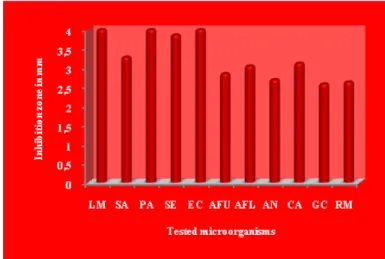
The antibacterial activities of the Cornus mas plant pollen extract in vitro test against different Gram-positive and negative pathogenic bacteria, microscopic fungi and yeasts are shown in Figure 1. According to analysis among the tested bacteria, Escherichia coli CCM 3988 was the most sensitive during 24 h incubation to dogwood common pollen, and the sensitivity of the bacteria decreased as follows: Listeria monocytogenes CCM 4699 > Salmonella enterica CCM 4420 > Staphylococcus aureus CCM 3953 > Pseudomonas aeruginosa CCM 1960. Aspergillus flavus was the most sensitive during 24 h incubation to dogwood common pollen and the sensitivity of the microscopic fungi decreased as follows: Aspergillus fumigatus > Aspergillus niger. Among the tested yeasts, Rhodotorula mucilaginosa was the most sensitive to dogwood common pollen. The antibacterial activities of the Secale strictum spp. strictum plant pollen extract in vitro test against different Gram-positive and negative pathogenic bacteria, microscopic fungi and yeasts are shown in Figure 2. According to analysis among the tested bacteria, Listeria monocytogenes CCM 4699 was the most sensitive during 24 h of incubation to ray mountain pollen, and the sensitivity of the bacteria decreased as follows: Escherichia coli CCM 3988 > Staphylococcus aureus CCM 3953 > Pseudomonas aeruginosa CCM 1960 > Salmonella enterica CCM 4420. Aspergillus flavus was the most sensitive during 24 h of incubation in ray mountain pollen and the sensitivity of the microscopic fungi decreased as follows: Aspergillus fumigatus > Aspergillus niger. According to analysis among the tested yeasts, Candida albicans was the most sensitive to ray mountain pollen.
Different patterns of sensitivity in pollen loads are due to different phenolic compounds in pollen, as shown in the studies of Almeida-Muradian et al. (2005) and Carpes et al. (2007). In these studies, the antioxidant activity, phenolic content and antibacterial activity of pollen extracts obtained with different concentrations of ethanol were compared among pollen samples. In the another study the antibacterial activities of Turkish pollen extracts were investigated against 13 different species of agricultural bacterial pathogens including Agrobacterium tumefaciens, A. vitis, Clavibacter michiganensis subsp. michiganensis, Erwinia amylovora, E. carotovora pv. carotovora, Pseudomonas corrugata, P. savastanoi pv. savastanoi, P. syringae pv. phaseolicola, P. syringae pv. syringae, P. syringae pv. tomato, Ralstonia solanacearum, Xanthomonas campestris pv. campestris and X. axonopodis pv. vesicatoria, and the inhibition zones were varied related to different concentrations of pollen extracts (Basim et al., 2006).
Figure 1 Antimicrobial activity of dogwood common pollen in mm
Figure 2 Antimicrobial activity of ray mountain pollen in mm
Also Fatrcova-Šramkova et al. (2013) has reported that S. aureus was the most sensitive microorganism to the poppy pollen ethanolic extract. The results of antimicrobial activity of nontraditional pollen hereby reported were slightly superior to the obtained by Morais et al. (2011), what may be related with the different microorganism origin, since in the present study the bacteria was isolated from biological fluids and in Morais et al. (2011) study from food products. Previously it has been observed that the Gram-negative bacteria were more resistant to the pollen action than the Gram-positive bacteria, what may be related with the additional outer layer membrane, impermeable to most molecules, that consists of phospholipids, proteins and lipopolysaccharides (Silici
and Kutluca, 2005). Additionally, it was observed that the reference strains were
more sensitive than the isolated from biological fluids in all the microorganisms were studied, what has already been reported in other beehive products (Silva et al., 2012).
The antibacterial activities of the Cucurbita pepo var. styriaca plant pollen extract in vitro test against different Gram-positive and Gram-negative pathogenic bacteria, microscopic fungi and yeasts are shown in Figure 3. Among the tested bacteria, Listeria monocytogenes CCM 4699 was the most sensitive during 24 h of incubation in pumpkin rape pollen, and the sensitivity of the bacteria decreased as follows: Escherichia coli CCM 3988 > Pseudomonas aeruginosa CCM 1960 > Salmonella enterica CCM 4420 > Staphylococcus aureus CCM 3953. Aspergillus flavus was the most sensitive during 24 h of incubation in or to pumpkin rape pollen and the sensitivity of the microscopic fungi decreased as follows: Aspergillus fumigatus > Aspergillus niger. Among the tested yeasts, Candida albicans was the most sensitive in pumpkin rape pollen.
The antibacterial activities of the Vitis vinifera plant pollen extract in vitro test against different Gram-positive and Gram-negative pathogenic bacteria, microscopic fungi and yeasts are shown in Figure 4. According to analysis among the tested bacteria, Listeria monocytogenes CCM 4699 was the most sensitive during 24 h of incubation in / to grape vine pollen, and the sensitivity of the bacteria decreased as follows: Salmonella enterica CCM 4420 > Escherichia coli CCM 3988 > Pseudomonas aeruginosa CCM 1960 > Staphylococcus aureus CCM 3953. Aspergillus fumigatus was the most sensitive during 24 h in grape vine pollen and the sensitivity of the microscopic fungi decreased as follows: Aspergillus niger > Aspergillus flavus. Among the tested yeasts, Candida albicans was the most sensitive in grape vine pollen.
J Microbiol Biotech Food Sci / Kačániová et al. 2014 : 4 (1) 80-82
82
Figure 4 Antimicrobial activity of grape vine pollen in mm
In general, our results of antimicrobial activity of bee collected pollen of (Helianthus annuus), poppy (Papaver somniferum) and rape (Brassica napus) are similar to Kačániová et al. (2012) results, who has found that this samples of pollen has good antimicrobial activity against bacteria, microscopic fungi and yeasts. However pollen had no antimicrobial effects on the bacteria and fungi tested in the concentrations used (0.02% to 2.5% (vol/vol) during testing of the antimicrobial activities of pollen extract of laurel (Laurus nobilis L.) on bacteria (Bacillus cereus, Bacillus subtilis, Escherichia coli, Salmonella typhimurium, Staphylococcus aureus, Yersinia enterocolitica, Enterococcus faecalis, and Listeria monocytogenes), yeasts (Saccharomyces cerevisiae and Candida rugosa), and molds (Aspergillus niger and Rhizopus oryzae) in Erkman and
Ozcan (2008) study.
Concentration of ethanol during the extraction may have an impact on antibacterial activity of pollen extract and antibacterial activity of 60% of pollen shows the same inhibition degree against Bacillus subtilis, Pseudomonas aeruginosa and Klebsiella pneumonia, while Bacillus cereus and Staphylococcus aureus bacteria were not inhibited for olive pollen in all extraction conditions applied (Basuny et al., 2013). Despite of it Bacillus cereus were inhibited by the pollen of olive in pollen ethanol extract at 50 and 60% of ethanol. Additionaly, the pollen ethanol extract of palm pollen at 90% showed the biggest clear zones around each disk (7.0 mm) against Klebsiella pneumoniae. Nevertheless, Klebsiella pneumoniae was also inhibited by the pollen from olive at 60 and 70 %. The olive pollen extract contained highest concentrations of phenolic content with antioxidant and antimicrobial activity. Pseudomonas aeruginosa bacteria were inhibited by 80% and 90% and Staphylococcus aureus bacteria were inhibited by extracts of pollen at 50%, 60%, 70% and 80% of ethanol solution
(Basuny et al., 2013). In general, in the present study the concentration of 70%
was adequate to inhibit the common Gram-negative and Gram-positive bacteria, microscopic fungi and yeasts.
CONCLUSION
The present research has shown that an ethanolic extracts of nontraditional plant pollen studied here possess antibacterial and antifungal effect on bacteria, fungi and yeasts. The inhibition effect of four plant pollen extracts were found in all tested pollen. The most sensitive was Gram positive bacteria Listeria monocytogenes in ray mountain (Secale strictum spp. strictum), pumpkin rape (Cucurbita pepo var. styriaca) and grape vine (Vitis vinifera) tested pollens. Among microscopic fungi Aspergillus flavus was the most sensitive to dogwood common (Cornus mas), ray mountain (Secale strictum spp. strictum), pumpkin rape (Cucurbita pepo var. styriaca) pollens and among yeasts Candida albicans, which was sensitive to ray mountain (Secale strictum spp. strictum), pumpkin rape (Cucurbita pepo var. styriaca) and grape vine (Vitis vinifera) pollen. This suggests that bee pollen could be used combined with antibiotics, since, as far as we know; there are not microorganisms capable of acquiring resistance to bee pollen.
Acknowledgments: This work was supported by the Operational Programme
Research and Development of the European Regional Development Fund in the
frame of the project „Support of technologies innovation for special bio-food
products for human healthy nutrition“ (ITMS 26220220115) and by European Community under project no 26220220180: Building Research Centre
„AgroBioTech".
REFERENCES
ABDELLA, E.M., TOHAMY, A., AHMAD, R.R. 2009. Antimutagenic activity of Egyptian propolis and bee pollen water extracts against cisplatin-induced
chromosomal abnormalities in bone marrow cells of mice. Iranian Journal of Cancer Prevention, 2, 175-181.
ALMEIDA-MURADIAN, L.B., PAMPLONA, L.C., COIMBRA, S., BARTH, O. 2005. Chemical composition and botanical evaluation of dried bee-pollen pellets. Journal of Food Composition and Analysis, 18, 105-111. http://dx.doi.org/10.1016/j.jfca.2003.10.008
BALCH, J. F., BALCH, P. A. 1990. Prescription for nutritional healing. NewYork: Avery Publishing Group Inc., p. 12-39.
BARILIAK, I.R., BERDYSHEV, G.D., DUGAN, A.M. 1996. The antimutagenic action of apiculture products. The Journal of Cytology and Genetics, 30, 48-55. BASIM, E., BASIM, H., OZCAN, M. 2006. Antibacterial activities of Turkish pollen and propolis extracts against plant bacterial pathogens, Journal of Food Engineering, 77, 992-996. http://dx.doi.org/10.1016/j.jfoodeng.2005.08.027
BASUNY, A.M., ARAFAT, .M., SOLIMAN, H.S. 2013. Chemical analysis of olive and palm pollen: Antioxidant and antimicrobial activation properties. Wudpecker Journal of Food Technology, 1(2), 014-021.
BROADHURTS, C. L. 1999. Bee products: medicine from the hive. Nutrition Science News, 4, 366-368.
CAMPOS, M. G., CUNHA, A., MARKHAM, K. R. 1997. Bee-pollen composition, properties and applications. In A. Mizrahi and Y. Lensky (Eds.), Bee-products properties, applications and apitherapy. London, UK : Plenum Publishers, p. 93-100.
ERKMEN, O., OZCAN, M.M. 2008. Antimicrobial effects of Turkish propolis, pollen, and laurel on spoilage and pathogenic food-related microorganisms. Journal of Medicinal Food, 11(3),587-592. http://dx.doi.org/10.1089/jmf.2007.0038
ESTEVINHO, L.M., RODRIGUES, S., PEREIRA, A.P., FEAS, X. 2012. Portuguese bee pollen: palynological study nutritional and microbiological evaluation. International Journal of Food Science and Technology, 47, 429-435. http://dx.doi.org/10.1111/j.1365-2621.2011.02859.x
FATRCOVA-ŠRAMKOVA, K., NOZKOVA, J., KACANIOVA, M., MARIASSYOVA, M., ROVNA, K., STRICIK, M. 2013. Antioxidant and antimicrobial properties of monofloral bee pollen. Journal of Environmental
Science and Health, 48, 133-138.
http://dx.doi.org/10.1080/03601234.2013.727664
HAAS, E. M. 1992. Staying healthy with nutrition. NewYork : Celestial Arts Publish, p. 297-298.
HABIB, F. K., ROSS, M., BUCK, A. C. 1990. In vitro evaluation of the pollen extract, Cernitin T-60, in the regulation of prostate cell growth. British Journal of Urology, 66, 393-397. http://dx.doi.org/10.1111/j.1464-410x.1990.tb14961.x
KAČÁNIOVÁ, M., VUKOVIČ, N., CHLEBO, R., HAŠČÍK, P., ROVNÁ, K.,
ČUBOŇ, J., DŻUGAN, M., PASTERNAKIEWICZ, A. 2012. The antimicrobial
activity of honey, bee pollen loads and beeswax from Slovakia. Archives of Biological Sciences, 64 (3), 927-934. http://dx.doi.org/10.2298/abs1203927k LI, Y. M., HU, F. L., ZHU,W., ZHENG, H. Q. 2005. The recent advances in pollen components in China. Apicultural Science and Technology, 4, 7-16. LI, Y. F., TANG, L. P., HE, R. R., XU, Z., HE, Q. Q., XIANG, F. J., SU,W. W., KURIHARA, H. 2013. Anthocyanins extract from bilberry enhances the therapeutic effect of pollen of Brassica napus L. on stress-provoked benign prostatic hyperplasia in restrained mice. Journal of Functional Foods, 5, 1357– 1365. http://dx.doi.org/10.1016/j.jff.2013.05.003
LINSKENS, H. F., JORDE,W. 1997. Pollen as food and medicines: A review. Economic Botany, 51, 77-78. http://dx.doi.org/10.1007/bf02910407
MIZRAHI, A., LENSKY, Y. 1997. Bee products: Properties, applications and apitherapy. London, UK : Kluwer Academic Publishers, p. 269.
MORAIS, M., MOREIRA, L., FEAS, X., ESTEVINHO, L.M. 2011. Honeybee-collected pollen from five portuguese natural parks: palynological origin phenolic content antioxidant properties and antimicrobial activity. Food and Chemical Toxicology, 49, 1096-1101. http://dx.doi.org/10.1016/j.fct.2011.01.020
SCHULTE, F., LINGOTT, J., PANNE, U., KNEIPP, J. 2008. Chemical characterization and classification of pollen. Analytical Chemistry, 80, 9551-9556. http://dx.doi.org/10.1021/ac801791a
SILICI, S., KUTLUCA, S. 2005. Chemical composition and antibacterial activity of propolis collected by three different races of honeybees in the same region. Journal of Ethnopharmacology, 99, 69-73. http://dx.doi.org/10.1016/j.jep.2005.01.046
SILVA, J.C., RODRIGUES, S., FEAS, X., ESTEVINHO, L.M. 2012. Antimicrobial activity, phenolic profile and role in the inflammation of propolis. Food and Chemical Toxicology, 50, 1790-1795. http://dx.doi.org/10.1016/j.fct.2012.02.097