WHY WOULD YOUNG STUDENTS CHOOSE ENTREPRENEURSHIP?
Muntean Andreea, Gavrila Paven Ionela,
Lecturer, Phd, Lecturer, Phd,
Faculty of Science,
Department of Economic Studies and Business Administration,
„1 Decembrie 1918” University, Alba Iulia,
[email protected], [email protected]
Abstract:
The entrepreneurship is widely considered as a solution for economic problems. The number of young people who start a new business is in increasing. The students’ motivation for choosing entrepreneurship is the research purpose of this paper. A survey developed in Alba Iulia, on a number of 100 students’ points out the relevant motivation why young people choose entrepreneurial alternative. The results showed that most of the actual students would choose to be entrepreneurs because they want to improve their life standards, to explore new business opportunities and to have a social status. In conclusion, the teachers, the governmental authorities and all the others interested in stimulating the entrepreneurial motivation should their words and actions affect potential entrepreneurs’ perceptions of entrepreneurial feasibility and net desirability.
Key words: entrepreneurship, students’ motivation, new business
JEL Classification : M40, M41
1. Introduction
In current economies, the entrepreneurship is a key factor for growth, innovation and job creation. A consequence of this is that policymakers are becoming increasingly interested in ways of enhancing entrepreneurship in different ways not least through entrepreneurship education. The last two decades have also seen an explosion in the number of universities offering entrepreneurship courses and programmes, in the USA as well as in Europe.
One reason for this increase is that the structure and teaching style of traditional business education has been accused of impairing entrepreneurship. More explicitly, traditional business education tends to focus on disseminating information and training of analytical abilities, whereas the vital skills for entrepreneurs are less about information processing and analysis and more about creativity and action. There is still a lack of knowledge regarding the effect of
different educational programmes on students’ behaviour and subsequent performance as entrepreneurs. Specifically, it
is indicated that the most or researches assume a causal relationship between the entrepreneurship education and entrepreneurial behaviour.
Teaching entrepreneurship to students is important in order to demonstrate how having an entrepreneurial spirit as early as possible in life is a positive thing. They will learn the value of money, time management, and maturity that will prepare them for life.
2. Entrepreneurship and students
Entrepreneurship refers to the ability of an individual of transforming its ideas in action with precise economic
and social finality. This includes creativity, innovation and risks’ assumption, as well as the ability of planning and managing projects for certain objectives. The entrepreneurial abilities are making aware the individuals to the context of their activity and make them able to identify and to concretize the opportunities that are representing the base for the commercial and social activities development.
By teaching them entrepreneurship, students will also be able to examine the worth of their abilities and what they can do to improve these abilities. Hand in hand with teaching them the benefits of entrepreneurship, students should also be given a realistic description on the daily life of an entrepreneur in order for them to have manageable expectations.
The National Council of Small and Medium enterprises asks to the Government to increase the amount for governmental programs that aims the setting up the new firms with 300.000.000 euros.
„There is a need for much money for the youth. If will be allocated 100.000 euro per year in 2012-2014
period, there could be created 300.000 new jobs and this will increase the GDP with with 4,26% in 2012-2016 period”,
declared mr. Ovidiu Nicolescu, the president of Council for Small and Medium Enterprises, in a press conference.
„The programs that sustain the setting up of new business have the biggest multiplying effect in economy thought the
all public programs”, mentioned him.
According with the Council data, last year, in the period February – December, were settled up more than
5000 firms, with a budget of 5.000.000 euro. In these firms were created 9.000 new jobs. More than that, almost 80% from youth under 25 years old who are unemployed.
In Romania, there are more than 600.000 Small and medium Enterprises, but this number is very small comparing with other countries. There are just 26 companies per 1.000 inhabitants in our country, while the average in European Union is third times bigger.
In the same time, the companies are asking for the adoption of Small and Medium Enterprises and this has to mention the importance of Small and Medium Enterprises, and the Romanian state has to assume the gradually increase budgetary expenses from 0,4% to 1% from GDP for financing the programs of developing new businesses.
„We would like that practical things to be included in this law, rather than being an abstract one”, mr. Nicolescu said. The Small and Medium Enterprises representatives also sustain that the Government has to revert to the
integral deduction of fuel expences for business trips. „Last year, the Romanian state lost 25% from the entire amount
earned per fuel liter after this facilities were canceled. Do you see what could happen if there were took measures
without impact studies?”, also said the Council representative.
He remembered that a Romanian company pays almost 113 taxes, while the Europeans pay an average number of 17
taxes. „There is no reason to maintain a number of taxes seventh times higher than in the rest of Europe. This means higher costs for us and for the state”, mentioned Nicolescu.
3. Socio-demographic characteristics of Romanian entrepreneurs
To analyze the reasons of youth entrepreneurship students, we believe it is useful to see which the general profile of the Romanian entrepreneur is. Using data collected in the research program led by the Global Entrepreneurship Monitor (GEM) Surveys on adult population in Romania during 2007-2010, we can indicate the main socio-demographic characteristics of Romanian entrepreneurs. Thus, the share of entrepreneurs aged between 25 and 54 is the largest, representing 70% of all entrepreneurs, from which 30.50% aged between 25 and 34 years. GEM reports for Europe states that in Eastern Europe the share of young entrepreneurs is higher than in other geographical areas. Perhaps the entrepreneurial spirit of young generations in these countries can be explained due to differences in socio-economic system in which they were raised.
Analyzing data collected results that Romanian typical entrepreneur is male, aged between 25 and 34, which is usually the main source of household income (contributing over 33%), with post-secondary studies in 2007 and school in 2008-2010.
Romanian entrepreneur motivations can be classified into two main groups, namely reasons of opportunity, those relating to individuals who see entrepreneurship as a way to ensure its independence and improve their income level, and reasons of necessity specific to individuals who have no other alternative or wanting to maintain their income they register at the same level. Orientation to entrepreneurship based on necessity, on another by lack of alternative incomes, tend to record higher levels in less developed countries, while developed economies are based on knowledge the highest levels recorded for those who entrepreneurial chose alternative to ensure its independence and ability to record higher revenues. If we analyze data for Romania, we see that in the year 2010 67.3% of respondents to GEM surveys said they based their choice on the opportunity, and only 31.1% have used this alternative for reasons of necessity.
profits, and suposing investments and risks that can not be directly controlled by managers, such as agriculture and forestry, and activity areas that require a special type of entrepreneurs, namely social entrepreneur, for areas such as welfare, health and education. A distinguished development had been recorded by financial intermediary, where from 2007 - 2009 the share was very low, up to 1%, and in 2010 to record level of 16.22%.
A special attention has to be given to the relation between technology and entrepreneurship. Romania is one of the country in which new technologies are not widely spread, being recorded many barriers, especially financial, in introducing new technologies and using the modern equipment on the market. Still, technology is a factor that offers possibilities for major transformations of the civilization towards a modern and efficient economy. Romania will be, in the next 20 years, a fertile field for the high-tech entrepreneurship and could become an innovation center in Europe and in the world.
Researches regarding the innovative characteristics of young people have been conducted by the Professor Elizabeth Chell. Professor Chell has developed the study of entrepreneurial behavior and the entrepreneurial personality. The study was developed during the last 20 years, during which period entrepreneurship has emerged as an important area of academic research and practice. In the research conducted, the objective was to present the characteristics of the young entrepreneurs and the motifs that base their decision in starting a new business. Professor
Chell does not consider herself an entrepreneur. She says: “There are opportunities to be entrepreneurial as an
academic and it makes sense to take advantage of these whenever possible. You need to stand out from the crowd when it comes to grant applications and securing funding, and there are more avenues to exploit your own intellectual property”. She focused her efforts for supporting two academic centers of excellence (Institute for Entrepreneurship at the University of Southampton and Science Enterprise Centre at the University of Manchester).
Professor Chell’s research wants to prove that learning context and the way in which the curriculum is
delivered will affect how innovative behavior is expressed. When it comes to innovative behavior in this age group,
Professor Chell says it’s a question of identifying and nurturing potential: “Some students may already be running
enterprises outside of school, but in general it’s about having the ability to think creatively and spot opportunities, rather than turning them into actual enterprises. The national curriculum can put a squeeze on creative expression and this places quite a demand on teachers to develop formats for drawing out creative potential from their students during lessons”.
A very important aspect of her work is referring to the preparation of the students for an entrepreneurial future: “Having a strong belief in yourself and feeling free to express your ideas are vital if you're going to go on to be adventurous, and consider setting up a business or social enterprise. Debating and exploring serious and pressing issues like climate change and obesity – inside or outside of school – can be a good way of fostering these characteristics in school”.
A representative study regarding the entrepreneurial alternative for young people as a way of becoming their own boss and to put their ideas in practice was conducted by Kauffman Foundation. The survey was realized in United States and included 2,438 young people ages 8 to 21. The results reveal that youth want to be their own boss to make their ideas a reality. According to this survey 4 in 10 young people have or would like to start their own business someday. In addition, the survey revealed that more than one-quarter (27%) of 8- to 21-year-olds would like to start a big company.
According to the same survey those who want to have their own business for using their skills and abilities (92%), building something for their future (89%), being their own boss (87%), seeing their ideas realized (81%) and earning lots of money (85%).
A special place is occupied by the young people that want to invent something if given the opportunity (37%). This is very important because innovation is the core of technical, economical and social development. Overall, 63% of the 8- to 21-year-olds agree that, if they work hard, they have the ability to successfully start their own business. 26% of all young people agree that starting a business is much more desirable than other career opportunities they might have.
A special attention was given to the models that young people observed. So, 59% of young people surveyed
know someone who has started his or her own business. More than 55% of today’s young people consider that
individuals support their community and contribute in making it a better place. Entrepreneurs and family are the top two sources young people would turn to for information on starting a business. 60% of all young people surveyed said they would go to someone who has started a business, and 52% said they would ask a family member for information about starting a business. Additional sources of entrepreneurial information that youth would use include Web sites, books, friends, business magazines and teachers.
Figures such as Steve Jobs or Bill Gates determine young people to aspire to be entrepreneurs. The results of a Gallup survey, conducted in United States among 1,721 students in grades 5 through 12, shows that many students have entrepreneurial aspirations and energy that could help drive future job creation in the country. According to this survey, nearly 8 in 10 students (77%) in grades 5 through 12 say they want to be their own boss, 45% say they plan to start their own business, and 42% say they will invent something that changes the world. The majorities of students
also demonstrates persistence and are willing to assume risk – both of which are qualities typically characteristic of
classes in starting or financing businesses. Gallup comments on the urgency of more education in entrepreneurship,
noting that “given the slow pace of the U.S. economic recovery and persistent unemployment and underemployment
rates, developing the entrepreneurial attitudes and experience of young people is critical to helping them grow up to be productive workers who ultimately help to create jobs.”
Similar studies do not exist for determining the entrepreneurial orientation of the young students in Romania. This is the raison for starting this research even if it is a small step and we analyzed the entrepreneurial orientation of
the students in economic specialization in the “1 Decembrie 1918” University of Alba Iulia.
4. Methodology research
A survey was conducted to identify the motivations of starting up and developing a business by young
students. The research was conducted in November, 2011 and it was used a sample of 100 students from “1 Decembrie 1918” University of Alba Iulia. The questioner was self - administrated. The question “what are you planning to do
after graduation?” was asked to students in order to discriminate between those who are entrepreneurially inclined and
those who are not. Respondents who have a response saying that “I'm planning to form my own business venture” are
accepted as potential entrepreneurs.
The survey objectives are: the identification of the importance of some personal, economic and social reasons in starting up and developing a business. The most important personal motivation considered were: "to be his/her own boss", "to improve his/her life standard", "family tradition" and "personal ambition". From an economic point of view, a young student could choose entrepreneurship because he/she wants "to become an employer" or because he/she wants "to explore new business opportunities". Social motivation could also be important: "to have a social status" or "because he/she respects entrepreneurs".
The importance of these motivations were evaluated using a five scale point, from 1- Unimportant to 5- Very important. All the questions were closed.
5. Results and conclusions
Regarding the personal motivation of starting up a business by young students, the results are as follows (Tabel 1):
Table 1. Personal motivation
Motivation 1 2 3 4 5
To be my own boss 5% 11% 5% 35% 44%
To improve my life
standard 5% - 5% 5% 85%
Familiy tradition 82% 5% 13% - -
Personal ambition 35% 5% 29% 11% 11%
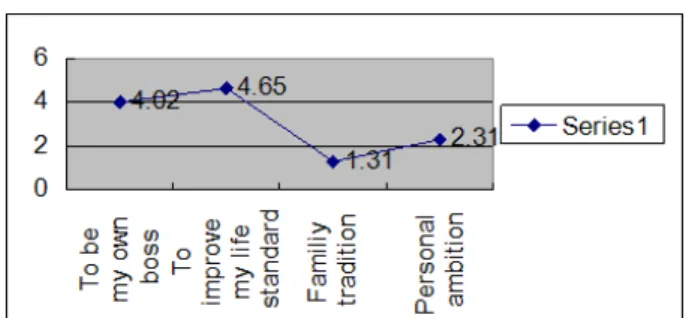
Most of the questioned students will choose the entrepreneurship to improve their life standards (85%) and to be their own boss (44%). Family tradition and personal ambition are not important reasons for starting up a business. The low importance of family traditions was quite surprising, because the entrepreneurial role models are widely considered as a significant factor affecting entrepreneurship. Of course, some personal traits could have a strong impact on the attitude toward self-employment or entrepreneurship. The entrepreneurial attitude is linked with the intention to start a new business. Another aspect of motivation required in individuals wanting to become entrepreneurs is self-confidence and a feeling of empowerment. Students need to believe that it is possible to become an entrepreneur.
The average importance of these 4 personal reasons is showed in the Figure 1.
To stimulate personal ambition of the students, the universities should include more practical training and should invite more guests speakers from the business. The teachers and lecturers need enterprise education in order to encourage students to entrepreneurship.
Regarding the economic motivation, for student majority (88%) the possibility to explore new opportunities is the most important motivation to become entrepreneur.
Table 2. Economic motivation
Motivation 1 2 3 4 5
To become an employer 47% 11% 11% 23% 5%
To explore new
business opportunities 5% - - 7% 88%
It seems that the attitudes are mainly positive but the interests very rarely finishes in entrepreneurship. Unfortunately, it has been considered that students lack proper knowledge about how to start and run an enterprise and that is why they do not consider entrepreneurship as a career option.
Figure 2. The average importance of the economic reasons
Of course, the attitudes towards risk-taking could constitute one of the the most significant factor in starting up a business.
From o social perspective, both social status and the respect for entrepreneurs have a high importance for young students (Tabel 3).
Table 3. Social motivation
Motivation 1 2 3 4 5
To have a social status 5% 5% 11% 23% 47%
Because I respect the
entrepreneurs 11% 17% 5% 23% 41%
The "social status" was pointed out with an average score of 3.75, while "the respect for the entrepreneurs" withan average score of 3.57.
Figure 2. The average importance of the social motivations
In the future, Romania has to develop a new generation of entrepreneurs with characteristic abilities such as responsibility, spontaneously, adaptability, initiative and managerial spirit that will allow them to implement adequate strategies for entering and maintaining on the market. These personal abilities have to be cultivated during the educational cycles, and more, long life learning.
The most important activity areas, considered as uncovered market pieces, that we consider that there are real possibilities for developing entrepreneurship for the Central region, based upon data synthesis in the study
accomplished by the Center for Entrepreneurship & Business Research are: (1) tourism and agro-tourism – due to the
geographical and ethnographic potential of the region, increasing demand in this area and multiple possibilities in
obtaining financing through European funds; (2) specific transportation for the mountain tourism – related to the
increase of the tourism there is a real need for increasing the innovative transportation means (trains on small lines, animal transportation means, cable transportation and others) as well as the financial possibilities through the European
funds grants and attraction of the foreign capital; (3) touristic services (for spending spare time) – it is more and more
acknowledged the need for diversity regarding the services offered for the tourists through specific modernizations (for example mountain cyclist, motorbike tours, ATV tours, paintball areas, alpinism tours for beginners and others) considering again the possibility for accessing the European funds; (4) business consultancy in human resources
development – many persons desire to start-up on their own but they are facing the lack of information and consultancy
in building their own business plan in a feasible way and regarding the financing opportunities; many companies that exist presently need trained staff for certain specific areas and cannot find appropriate financing opportunities, mainly information regarding the Sector Operational Program for Human Resources Development, this one being accessed mainly by the continuously professional training institutions; (5) roads building and technical installations for sports
(winter-summer) – roads building will be a sector that will not be affected by the crisis and the building for technical
installations for sports are strongly related to the tourism development and innovative services in this area; (6)
ecological agriculture for vegetables and fruits – there is an increasing demand on the market for internal ecological
products even with high possibilities for export for these products for which there is no need to invest increased amounts for investments and there are possibilities in attracting foreign investors; (7) children taking-care in kindergartens - education system for this sector does not offer solutions for the entire demand on the market, that is why many and many persons tried to offer the private solution for this problem offering better conditions, meals and
activities as well as the possibilities of accessing the European funds; (8) waste recycling – it is a relatively free area on
the market due to the big volume of the existing waste and its recycling in smaller quantities and only in certain areas; increased possibilities in accessing external funds and foreign capital for superior technologies; (9) alternative energy
(sun, wind, thermal) – a relatively new area in this region, special request of the European Union in using a bigger and
bigger percent of the nonconventional energies, possibilities in using European funds and partnership projects.
In conclusion, the teachers, the governmental authorities and all the others interested in stimulating the entrepreneurial
motivation should know that their words and actions affect potential entrepreneurs’ perceptions of entrepreneurial
feasibility and net desirability. We believe that the development of entrepreneurship activity requires consideration of the motivations of students making entrepreneurial decisions.
6. Bibliografie
1 Audretsch, D.B., Entrepreneurship: A Survey of the Literature: Report Prepared for the European Commission, Enterprise Directorate General, 2002;
2Birch, D.L., The Job Generation Process, Cambridge, Mass: MIT Program on Neighborhood and Regional Change, 1979;
3 Bosma, N., Jones, K., Autio, E. & Levie, J., Global Entrepreneurship Monitor 2007. Executive Report, Babson College, London Business School and Global Entrepreneurship Research Consortium (GERA), 2009.;
4Boutaiba, S,. ‘A moment in time’, in D. Hjort and C. Steyaert (Eds). Narrative and Discursive Approaches in Entrepreneurship, Cheltenham: Edward Elgar, 2004;
5Champley D., Teaching Entrepreneurship to Students, http://ezinearticles.com/?Teaching-Entrepreneurship-to-tudents&id=4097281;
6Cropley, A.J., ‘Defining and measuring creativity: are creativity tests worth using?’ Roeper Review, Vol. 23, 2000);
7Drucker, P.F. , Innovation and Entrepreneurship: Practice and Principles, New York: Harper & Row , 1985;
8 Fiet, J. , The Systematic Search for Entrepreneurial Discoveries, Greenwood, Westport, CT, 2002;
9Fletcher, W., ‘The management of creativity’, International Journal of Advertising, Vol. 9, No. 1, pp.37–43, 1990;
Spring, pp.11–28 , 1988;
11 Gartner, W.B., ‘Words lead to deeds: toward an organizational emergence vocabulary’, Journal of
Business Venturing, Vol. 8, No. 3, pp.231–240, 1993;
12Johannisson, B., Landström, H. and Rosenberg, J., ‘University training for entrepreneurship – an action
frame of reference’, European Journal of Engineering Education, Vol. 23, 1998;
13Kelley, D., Bosma, N. & Amoros, J. E., Global Entrepreneurship Monitor. 2010 Global Report, Babson College, Universidad del Desarrollo and Global Entrepreneurship Research Consortium (GERA), 2011;
14Krueger, N.F. and Brazeal, D.V., ‘Entrepreneurial potential and potential entrepreneurs’,Entrepreneurship Theory and Practice, Vol. 19, 1994;
15 Ştefan P., Agnes N., Lehel-Zoltan G., Benyovszki A., Petru T.P., Evoluţia factorilor de influenţă ai
activităţii antreprenoriale în stadiu incipient din România, Economie teoretică şi aplicată, Volumul XVII No.
7(548), pp. 3-12, 2010;
16 Rujoiu M., , Tinerii antreprenori pot scoate ţara din criză, www.antrepenoridesucces.ro, 2011;
17 Wennberg, K., Hamidi, D.Y., Panasenco, E. and Stanaityte, J., ‘To what extent does students’
engagement into entrepreneurship programs affect their wish to become entrepreneurs?’ Unpublished
Manuscript, Stockholm School of Economics, 2004;
18 *** Global Entrepreneurship Monitor (GEM), Adult Population Surveys in Romania 2007, 2008, 2009,
2010.