Skin tear prevalence and associated factors: a systematic review
1 Universidade de São Paulo, Escola de Enfermagem, Programa de Pós-Graduação em Enfermagem na Saúde do Adulto, São Paulo, SP, Brazil.
2 Universidade de São Paulo, Escola de Enfermagem, Departamento de Enfermagem Médico-Cirúrgica, São Paulo, SP, Brazil.
AbstrAct
Objective: To identify and analyse skin tear prevalence and factors associated with its occurrence. Method: Systematic review of literature of studies published until June 2014 including studies published in full in English, Spanish or Portuguese. he studies were analysed according to the Strengthening the Reporting of Observational Studies in Epidemiology and the Guidelines for Critically Appraising Studies of Prevalence or Incidence of a Health Problem. Results: he analysis of eight studies showed skin tear prevalence of 3.3% to 22% in the hospital setting and 5.5% to 19.5% in homecare. Advanced age, dependence on basic activities of daily life, frail elderly, level of mobility, agitated behavior, non-responsiveness, greater risk for concurrent development of pressure ulcers, cognitive impairment, spasticity and photoaging were cited as risk factors.
Conclusion: Skin tear prevalence ranged from 3.3% to 22% and is mainly associated with advanced age and dependence on basic activities of daily life.
descriPtors
Wounds and Injuries; Prevalence; Cross-Sectional Studies; Epidemiology; Review.
Skin tear prevalence and associated factors: a systematic review
Prevalência de lesão por fricção e fatores associados: revisão sistemática Prevalencia de lesión por fricción y factores asociados: revisión sistemática
Kelly Cristina Strazzieri-Pulido1, Giovana Ribau Picolo Peres1, Ticiane Carolina Gonçalves Faustino Campanili1, Vera Lúcia Conceição de Gouveia Santos2
Received: 10/02/2014 Approved: 03/26/2015
criticAl review DOI: 10.1590/S0080-623420150000400019
Correspondence Addressed to:
INTRODUCTION
Caring for people with fragile skin is a challenge when a minor trauma can result in Skin Tear (ST)(1-3).
Although some researchers suggest that Skin Tear is more prevalent than pressure ulcers and burns(4-5),ST go
unnoticed as they are shallow traumatic wounds, occurring mainly in elderly ends resulting from friction or a combi-nation of friction and shear, leading to separation of the epidermis from the dermis (partial thickness wound) or completely separating the epidermis and the dermis from the underlying structures (total thickness wound)(6). hey
are regarded as inherent to the age, inducing the feeling of an irrelevant condition, however, they cause pain and can easily be infected(2-4,7).
Because they are relegated as mere casual unavoidable incidents, there is little interest and therefore, they are un-derdiagnosed. he lack of diagnostic accuracy and under-standing of the causes involved, contributes to increasing pain and sufering, healing time and treatment costs, nega-tively afecting the quality of care(2-4,7-8).
For less than 25 years, researchers have slowly begun to monitor the epidemiology of ST in order to build and reine appropriate nomenclature and risk assessment instruments and classiication(8-9),fundamental instruments for the
eval-uation of the wound and planning care actions, which are essential for its prevention(10-11).
Simple measures such as the identiication of patients at risk and the implementation of prevention protocols are proving to be efective to prevent ST or minimize its severity(12). Researches(1,13) show that the occurrence of ST
decreases as soon as an individual is identiied at risk and preventive measures are implemented.
In order to bring tangible foundations on all scientiic knowledge that still needs to be built on the ST, the Inter-national Skin Tear Advisory Panel(3) recommends and
en-courages the development of studies to elucidate the epide-miology of ST in the health services and in the community. his review aimed at identifying and analyzing the in-formation available in the literature on the prevalence of ST, as well as factors associated with its occurrence in children, adults and elderly.
METHOD
Systematic review of the literature according to the rec-ommendations of the Cochrane Collaboration(14).
he guiding question of this review was: What is the information available in the literature on the prevalence and factors associated with ST in children, adults and elderly? To clarify it, the following electronic databases were consulted: CINAHL, Cochrane, EBM Reviews, Embase, LILACS, PubMed, SciELO, Scopus and Web of Science up to June 2014. For the selection of studies, we used the following criteria: to be published in English, Spanish or Portuguese until June 2014, to be available in full and to be an epide-miological research, that is, directed at the investigation of the prevalence of ST. Book chapters, conference abstracts, review articles, case reports, consensus, editorials, guidelines,
correspondences, clinical trials, cohort studies and case-control studies were excluded.
he search strategy was based not only on indexed de-scriptors by Medical Subject Headings Section and De-scriptors in Health Sciences - bold in Box 1 - but also on keywords used in narrative reviews and up to date stud-ies, since the terminology about ST is not uniform. he search for studies was performed using Boolean operators AND and OR, respecting the peculiarities of each database searched. Chart 1 shows the search strategy.
Chart 1 – Search strategy - Sao Paulo, 2014.
Number descritor MesH/ decs or key-word
# 1 older people
# 2 Adult
# 3 child
# 4 skin aging OR Elderly skin
# 5 Prevalence OR epidemiology
# 6
lacerations OR Mangled wounds OR Tear wounds
OR Rag wounds OR Skin lacerations OR Traumatic laceration OR Pretibial laceration OR Skin tears OR Skin trauma OR Skin stripping
# 7 (#1 or #2 or #3 or #4) ANd (#5) ANd (#6)
he search for studies was conducted by one of the au-thors in each of the electronic databases. he search results were exported to EndNote Web®program, which stored the following data from each study: title, authors, journal title, number, volume, page, section, abstract and keywords. he initial selection of studies was performed from the title and abstract analysis. he studies were randomized among the authors, and each of them had to be analyzed by two authors. Studies, which generated doubts about the relevance of their inclusion, were analyzed by a third author.
Studies that had their abstracts selected were redeemed in full and randomly distributed among the authors, and each one of them had to be analyzed by two authors. A third author judged the validation of analysis, evaluating and comparing 30% of the studies, chosen through a rale.
he studies were analyzed descriptively and the results were grouped and presented with respect to: year of pub-lication, country where the study was conducted, methods (population/sample; prevalence of ST; ST instruments used for classiication, and statistics strategies analysis) and the main results found by the authors (prevalence of ST and factors associated with ST, when identiied).
To assess the quality of the studies included in this re-view both the Strengthening the Reporting of Observational Studies in Epidemiology (STROBE)(15) and the Guidelines
for Critically Appraising Studies of Prevalence or Incidence of a Health Problem(16) were used.
STROBE, translated into Portuguese by Malta et al.(15),
Skin tear prevalence and associated factors: a systematic review to 1. he total score was converted into percentage to better assess the quality of the studies. he items that reached a percentage higher than 50% were considered of good quality.
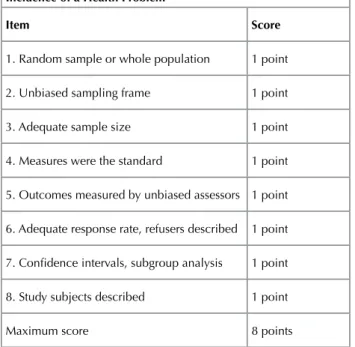
he Guidelines for Critically Appraising Studies of Preva-lence or Incidence of a Health Problem, developed by Loney et al.(16) consist of eight questions on the adequacy and
accu-racy of the study relating to the validity of the methods, in-terpretation and applicability of the results. Each item was rated with a point, generating maximum score of 8 points. Loney et al.(16) did not establish quality categories neither
for the score obtained nor for the cut-of score. Studies which reached more than 4 points were considered of good quality. he system is presented in Chart 2.
RESULTS
he search in the nine databases resulted in 8,095 stud-ies. After removing 2,426 duplicates, 5,669 studies were directed to title screening. After reading the titles, 5,433 studies were removed, leaving 236 studies for abstract analysis. Of these, book chapters, conference abstracts, re-view studies, case reports, consensus, editorials, guidelines, correspondences, clinical trials, cohort studies and case-control were excluded. Remaining only nine studies on the prevalence of ST, of which eight(17-24) met the inclusion
criteria and were read in full. he only excluded study(25)
did not meet the language criterion, since it was published in Chinese.
Embase (57.42%) and PubMed (34.48%) were the da-tabases that found the largest number of studies. he less representative databases were Cochrane (0.84%), CINAHL (0.21%), SciELO (0.10%), EBM Reviews (0.09%) and LI-LACS (0.01%), as shown Table 1.
Chart 3 presents a summary of the six selected articles.
Table 1 – Studies identified according to databases - Sao Paulo, 2014.
databases
Identiied studies
N %
CINAHL 17 0.21
Cochrane 68 0.84
EBM Reviews 07 0.09
Embase 4644 57.42
LILACS 01 0,01
PubMed
SciELO 278808 34,480,10
Scopus 283 3.50
Web of Science 279 3.45
Total 8087 100
Chart 3 – Study stratified by author, year of publication, country, methods, results and quality score - Sao Paulo, 2014.
Author/Year of publication country Methods results (prevalence of st) strobe loNeY
Carville K e Lewin G,
1998(17) Australia
Retrospective study
n=1,146 patients in homecare. Auditing charts. It does not cite instrument for ST clas-siication. It does not cite statistical methods
5,5%
(excluding ST of lower limbs)
(It does not have CI) Ad-vanced age
48% 4.0
Carville K e Smith JA,
2004(18) Australia
Cross-sectional study
n=492 war veterans in homecare Physical examination
It does not cite instrument for Skin tear classiication Cox regression analysis
19.5%
(It does not have CI) Advanced age Frail elderly
61% 6.0
McErlean B, Sandison S, Muir D, Hutchinson B e
Humphreys W, 2004(19) Australia
Cross-sectional study n=187 patients admitted to a tertiary hospital Physical examination Payne-Martin Classiication System for Skin Tears
It does not cite statistical methods
11%
(It does not have CI) Level of dependency and mobility
68% 6.5
Chart 2 – Guidelines for Critically Appraising Studies of Preva-lence or Incidence of a Health Problem - Sao Paulo, 2014.
Guidelines for critically Appraising studies of Prevalence or incidence of a Health Problem
item score
1. Random sample or whole population 1 point
2. Unbiased sampling frame 1 point
3. Adequate sample size 1 point
4. Measures were the standard 1 point
5. Outcomes measured by unbiased assessors 1 point
6. Adequate response rate, refusers described 1 point
7. Conidence intervals, subgroup analysis 1 point
8. Study subjects described 1 point
Maximum score 8 points
Source: Loney PL, Chambers LW, Bennett KJ, Roberts JG, Stratford PW. Critical appraisal of the health research literature: prevalence or incidence of a health
prob-lem. Chronic Dis Can. 1998;19(4):170-6.(16)
he studies are mostly from Australia (4)(17-19,21),
pre-dominantly from hospital settings (6)(19-24) or homecare (2) (17,18).Physical examination was the main strategy for data
collection, being held in seven studies(18-24).Payne-Martin
Classiication System for Skin Tears was used by one of the Australian(19) and the Canadian(23) studies.he
Brazil-ian study(22),as well as Japanese(24),used the Classiication
System STAR – Skin tears STAR Skin Tear Classiication System. However, most studies (4)(17-18,20-21) did not mention
which instrument was used for the classiication of ST. he prevalence of ST ranged from 3.3% to 22% in the hospital setting(19-24) and 5.5% to 19.5% in homecare(17-18).
With regard to risk factors associated with ST, advanced age (3)(17-18,21) and dependence for basic activities of daily
life (3)(19,22-23) were the most cited. Other factors mentioned
were frail elderly(18),level of mobility, agitated behavior,
non-responsiveness, greater risk for concurrent development of pressure ulcers(22),cognitive impairment, spasticity(23) and
photoaging(24). One study(20) did not mention risk factors
associated with ST.
Only one study(17) was not considered of good quality,
reaching 48% of STROBE and 4 points in the system de-veloped by Loney et al.(16). However, the performance of all
studies(17-24) was hampered, since none of them had
coni-dence intervals on the estimates of prevalence, and most (4)
(17,19-21) did not describe the study subjects.
DISCUSSION
In the hospital setting, the ST prevalence ranged from 3,3%(22) to 22%(23). he lowest rates (3.3%, 3.9% and 8%)
were identiied, respectively, in the studies developed in Brazil(22), in Japan(24) and in Australia(21). he Brazilian
study(22) identiied the prevalence of ST in adult patients
hospitalized with cancer, the Japanese study(24) in a
geriat-ric retired hospital and the Australian study(21) quantiied
the epidemiology of wounds, including ST, in all patients, regardless of age, admitted to hospitals/linked to the public health system hospitals of Western Australia.
Studies conducted in Australia(19), in the United States
of America(20) and in Canada(23) identiied the highest
preva-lence of ST (11%, 17% and 22%). he Australian study(19)
identiied ST prevalence in adult patients admitted to a ter-tiary hospital, the American study(20) documented the
preva-lence of pressure ulcers and other wounds, including ST, in hospitalized children, and the Canadian study(23) identiied
it on patients admitted to a long-term care facility.
Regarding homecare, all studies were conducted in Western Australia and the ST prevalence ranged from 5.5%(17) to 19.5%(18). he lowest prevalence (5.5%) was
identiied in the study in patients with wounds being cared at home(17). At that time, the authors chose to exclude ST
in lower limbs. In a later study(18), conducted with patients
Author/Year of publication country Methods results (prevalence of st) strobe loNeY
McLane KM, Bookout K, McCord S, McCain J e Jef-ferson LS, 2004(20)
United States of America
Cross-sectional study
n=1,064 patients in children’s hospitals (up to 17 years) Physical examination
It does not cite instrument for ST classiication
It does not cite statistical methods
17%
(It does not have CI) It does not refer to associ-ated factors
58% 4.5
Santamaria N, Carville K e
Prentice J, 2009(21) Australia
Cross-sectional study
n=5,800 admitted patients in public health institutions
Physical examination It does not cite instrument for ST
Conidence intervals for wounds in general, z-score and p value
8%
(It does not have CI) Ad-vanced age
58% 5.0
Amaral AFS, Strazzieri-Pulido KC e Santos VLG, 2012(22)
Brazil
Cross-sectional study
n=157 admitted patients with cancer Physical examination
STAR Skin Tear Classiication System Chi-square test and p value
3.3%
(It does not have CI) Less independence and autonomy
for self-care Agitated behavior or Non-responsiveness; Higher risk for concurrent development of pressure ulcers
87% 7.5
LeBlanc K, Christensen D, Cook J, Culhane B e Gutier-rez O, 2013(23)
Canada
Cross-sectional study
n=113 patients in long-stay institutions Physical examination
Payne-Martin Classiication System for Skin Tears
t-student, Chi-square, adherence and Bonfer-roni tests
22%
(It does not have CI) Dependence for basic activities of daily life Cognitive impairment Spasticity
90% 6.5
Koyano Y, Nakagami G, Iizaka S, Minematsu T, Noguchi H, Tamai N, et al., 2014(24)
Japan
Cross-sectional study
n=410 patients admitted to retirement geriat-ric hospital
Physical examination
STAR Skin Tear Classiication System Calculation of prevalence
3.9%
(It does not have CI) photoaging
87% 7.0
Skin tear prevalence and associated factors: a systematic review from the Department of Veterans’ Afairs in homecare for wound, the authors found a signiicantly higher prevalence (19.5%). When lower limb ST were included, there was a 10% increase in the prevalence of this type of wound(18).
As for the factors associated with ST, advanced age was identiied in three studies analyzed(17-18,21), and frail elderly
in one study(18). Physiological changes associated with aging
expose the elderly population to ST more than any other risk group. here is consensus among experts that it hap-pens for two reasons: the weakening of the skin and suscep-tibility to trauma(3-4,7-8,11,13,26-27).
In the irst case, with skin aging, or intrinsic aging, that is, premature increase in the keratinization of the epidermis and enlargement and lattening of skin grooves, along with the loss of the folding of the basal lamina. Consequently, the anchoring system between the layers of epidermis and dermis do not withstand well as to friction and shear(27).
On the other hand, in the dermis, ibroblasts begin to produce less collagen type I and more type III. Collagen ibers become tenuous, fragmented and separated by large areas occupied by fundamental amorphous substance. he mucopolysaccharides lose its structural function and is pres-ent as an amorphous pellet. he skin loses tensile strength, toughness, elasticity and extensibility(27).
he production of sweat and sebaceous glands is also re-duced with age, skin becomes dehydrated, dry and inelastic. he subcutaneous layer becomes thinner and the fat pad less eicient in absorbing impact. he skin thickness decreases progressively, reaching a 20% loss in thickness(27).
he indings obtained in another study(24), infer that the
risk factors for ST are not related only to the efects of skin aging but also to photoaging, or extrinsic aging. In the epidermis, exposure to ultraviolet radiation leads to thin-ning of the spinous layer and the lattethin-ning of the dermal-epidermal junction, while the dermis, is related to decreased collagen synthesis, as well as the increase of its degrada-tion(28). Photoaging, therefore, when enhancing skin aging,
contribute further to their fragility, increasing thereby the risk for ST(24).
Added to the fragile skin of the elderly, they also pres-ent susceptibility to trauma. hat happens because, over the years, the increase of musculoskeletal stifness and muscle spasticity reduce sensory sensitivity, visual acuity and cogni-tive ability, leading to loss of physical mobility and increas-ing dependence for basic activities of daily life. All of these changes contribute to the considerable increase in the risk for trauma and make advanced age a major risk factor for ST(3-4,7-8,11,13,26-27).
Dependence for basic activities of daily living(19,22-23),
non-responsiveness (which incurs total dependence), levels of mobility(22) and spasticity(23) were also identiied as risk
factors associated with ST.
In a study conducted with fully dependent elderly, who required assistance for basic activities of daily life, had large number of ST, particularly in the upper limbs(11). hey
oc-curred during routine care, such as dressing and bathing, and during placements and transfers. Almost half of the ST (48%) occurred in bedridden elderly and 11% in those who
required assistance to walk. In a descriptive study during six months of observation, it was found that the chances of presenting ST increased in the presence of gait diicul-ties(7). Wheelchairs were also associated with 25% of
oc-curred traumas(9).
Agitated behavior also igured as a risk factor associated with the occurrence of ST(22). Researchers(11) considered it
as a predisposing factor to trauma and therefore, ST, and included psychomotor agitation as one of the risk items being investigated for their risk ST assessment instrument, the Skin Integrity Risk Assessment Tool.
he decline in cognitive ability stems from the physi-ological processes of normal aging or a transitional stage for dementias, relecting in other cognitive domains be-yond memory and interfering with work capacity and social life(3). Some authors(7,23) found in their studies that
the chances of presenting ST increased in the presence of cognitive impairment.
Newborns and children are also susceptible to ST and constitute the second largest risk group. he authors of the study conirmed that ST prevalence (17%) is higher than the pressure ulcer (4%) in the pediatric population(20). he
age group up to 3 months old showed to be the most sus-ceptible, because, besides having poor stratum corneum and dermal-epidermal junction undeveloped at birth, the dermis is thin, with only 60% of the thickness when compared to adult dermis. Tapes and adhesive bandages are identiied as the main responsible for ST in this age group(20,29).
Clinical experience, however, provides strong evidence that ST is not restricted to the extremes of age(4,29-30).
Al-though elderly and newborns constitute the largest risk groups for ST, there are other groups which are prone to embrittlement of the skin and should not be ignored, such as critically ill individuals (in intensive care, or who have sufered major trauma or large surgery) at the end of life, or sufering from multiple extrinsic and intrinsic risk factors for ST regardless of age(29-30).
While studying patients hospitalized with cancer, the authors found many individuals under 50 years old with ST(22). he skin, like any other organ, can also fail. A severe
medical condition certainly compromise the body’s homeo-static mechanisms, which can cause skin to divert blood to vital organs, resulting in decreased skin and soft tissue perfusion and, consequently, compromising the metabolic processes of the skin. Small traumas would be able to cause major complications such as bleeding, gangrene, infection, pressure ulcers and ST. he tolerance to pressure and fric-tion decreases in such a way that these condifric-tions can make it impossible to prevent the breakage of the skin integrity(30).
Hospitalized patients with cancer and ST also had a higher risk for pressure ulcer development (60%) than those without ST (12.5%)(22). Similarly to this study(22) other
au-thors(8) also found that most elderly with ST (60%) had the
the activity and mobility and therefore, they were also at higher risk for developing pressure ulcers(8).
here is still a lot to be done in order to elucidate the ep-idemiology of ST. he methodological diversity of the stud-ies, as data collection and statistical processing of data and the diferent criteria used in the classiication of ST, besides the multitude of scenarios and the target population, make it diicult and sometimes impossible to generalize the results. It was also highlighted the importance of the presentation of the quantitative results of prevalence studies with their respective conidence intervals, which statistically estimate how reliable the values found are(16). Also, they recommend
that such prevalence should be analyzed in subgroups such as gender and age, among other variables that may be con-sidered relevant. Unfortunately, this recommendation was not performed in any of the eight studies analyzed.
Restriction of the publication language was one limi-tation of this study, resulting in the exclusion of a study, published in Chinese(25).
Nevertheless, it is considered that the present study, through the summary of the knowledge about the preva-lence of ST and factors associated with its occurrence, con-tributes to the development of protocols for prevention, and risk screening instruments for those wounds in the light of evidence-based practice.
CONCLUSION
he prevalence of ST ranged from 3.3% to 22% in hos-pital settings, and from 5.5% to 19.5%, in homecare. It was mainly associated with advanced age and dependence on basic activities of daily life.
resUMo
Objetivo: Identiicar e analisar a prevalência de lesão por fricção e os fatores associados à sua ocorrência. Método: Revisão sistemática da literatura publicada até junho de 2014 com a inclusão de estudos publicados na íntegra em inglês, espanhol ou português. Os estudos foram analisados segundo o Strengthening the Reporting of Observational Studies in Epidemiology e o Guidelines for Critically Appraising Studies of Prevalence or Incidence of a Health Problem. Resultados: As análises de oito estudos mostraram prevalência de lesão de 3,3% a 22% no cenário hospitalar e 5,5% a 19,5% no domiciliar.Idade avançada, dependência para as atividades básicas de vida diárias, idoso frágil, nível de mobilidade, comportamento agitado, arresponsividade, maior risco para o desenvolvimento concomitante de úlcera por pressão, comprometimento cognitivo, espasticidade e fotoenvelhecimento foram os fatores de risco citados. Conclusão: A prevalência de lesão variou de 3,3% a 22%, estando associada principalmente à idade avançada e dependência para as atividades básicas de vida diárias. descritores
Ferimentos e Lesões; Prevalência; Estudos Transversais; Epidemiologia; Revisão. resUMeN
Objetivo: Identiicar y analizar la prevalencia de lesión por fricción y los factores asociados con su ocurrencia. Método: Revisión sistemática de la literatura publicada hasta junio de 2014 con la inclusión de estudios publicados integralmente en inglés, español o portugués. Los estudios fueron analizados según el Strengthening the Reporting of Observational Studies in Epidemiology y el Guidelines for Critically Appraising Studies of Prevalence or Incidence of a Health Problem. Resultados: Los análisis de ocho estudios mostraron prevalencia de lesión del 3,3% al 22% en el escenario hospitalario y del 5,5% al 19,5% en el domiciliario.Edad avanzada, dependencia para las actividades básicas de vida diarias, anciano frágil, nivel de movilidad, comportamiento agitado, falta de responsividad, mayor riesgo para el desarrollo concomitante de úlcera por presión, afectación cognitiva, espasticidad y fotoenvejecimiento fueron los factores de riesgo citados. Conclusión: La prevalencia de lesión varió del 3,3% al 22%, estando asociada principalmente con la edad avanzada y la dependencia para las actividades básicas de vida diarias.
descriPtores
Heridas y Traumatismos; Prevalencia; Estudios Transversales; Epidemiología; Revisión.
REFERENCES
1. Groom M, Shannon RJ, Chakravarthy D, Fleck CA. An evaluation of costs and effects of a nutrient-based skin care program as a component of prevention of skin tears in an extended convalescent center. J Wound Ostomy Continence Nurs. 2010;37(1):46-51.
2. Stephen-Haynes J, Callaghan R, Bethell E, Greenwood M. The assessment and management of skin tear in care homes. Br J Nurs. 2011;20(11):S12-6.
3. LeBlanc K, Baranoski S. Skin tears: state of the science: consensus statements for the prevention, prediction, assessment, and treatment of skin tears. Adv Skin Wound Care. 2011;24(9):2-15.
4. Carville K, Lewin G, Newall N, Haslehurst P, Michael R, Santamaria N, et al. STAR: a consensus for skin tear classiication. Primary Inten-tion. 2007;15(1):8-25.
5. Edwards H, Gaskill D, Nash R. Treating skin tears in nursing home residents: a pilot study comparing four types of dressings. Int J Nurs Prac. 1998;4(1):25-32.
6. Strazzieri-Pulido KC, Santos VLCG, Carville K. Cultural adaptation content validity and inter-rater reliability of the “STAR Skin Tear Clas-siication System”. Rev Latino Am Enfermagem [Internet]. 2015 [cited 2015 Mar 22];23(1):155-61. Available from: http://www.scielo.br/ pdf/rlae/v23n1/0104-1169-rlae-23-01-00155.pdf
Skin tear prevalence and associated factors: a systematic review
8. Payne RL, Martin ML. Deining and classifying skin tears: need for a common language. Ostomy Wound Manage. 1993;39(5):16-20.
9. Malone ML, Rozario N, Gavinski M, Goodwin J. The epidemiology of skin tears in the institutionalized elderly. J Am Geriatri Soc. 1991:39(6):591-5.
10. Battersby L. Exploring best practice in the management of skin tears in older people. Nurs Times.2009;105(16):22-6.
11. White M, Karam S, Cowell B. Skin tears in frail elders: a practical approach to prevention. Geriatric Nurs. 1994;15(2):95-9.
12. Lopez V, Dunk AM, Cubit K, Parke J, Larkin D, Trudinger M, et al. Skin tear prevention and management among patients in the acute aged care and rehabilitation units in the Australian Capital Territory: a best practice implementation project. Int J Evid Based Healthc. 2011;9(4):429-34.
13. Bank D, Nix D. Preventing skin tears in a nursing and rehabilitation center: an interdisciplinary effort. Ostomy Wound Manage. 2006:52(9):38-46.
14. Higgins JPT, Green S, editors. Cochrane handbook for systematic reviews of interventions. Version 5.1.0 updated March 2011 [Internet]. London: Cochrane Collaboration; 2011 [cited 2014. Available from: www.cochrane-handbook.org
15. Malta M, Cardoso LO, Bastos FI, Magnanini MMF, Silva CMFP. STROBE initiative: guidelines on reporting observational studies. Rev Saúde Pública. 2010;44(3):559-65.
16. Loney PL, Chambers LW, Bennett KJ, Roberts JG, Stratford PW. Critical appraisal of the health research literature: prevalence or incidence of a health problem. Chronic Dis Can. 1998;19(4):170-6.
17. Carville K, Lewin G. Caring in the community: a wound prevalence survey. Primary Intention. 1998;6(2):54-62.
18. Carville K, Smith JA. A report on the effectiveness of comprehensive wound assessment and documentation in the community. Primary Intention. 2004;12(1):41-8.
19. McErlean B, Sandison S, Muir D, Hutchinson B, Humphreys W. Skin tear prevalence and management at one hospital. Primary Intention. 2004;12(2):83-6,8.
20. McLane KM, Bookout K, McCord S, McCain J, Jefferson LS. The 2003 national pediatric pressure ulcer and skin breakdown prevalence survey: a multisite study. J Wound Ostomy Continence Nurs. 2004;31(4):168-78.
21. Santamaria N, Carville K, Prentice J. Woundswest: identifying the prevalence of wounds within western Australia’s public health system. EWMA J. 2009;9(3):13-8.
22. Amaral AFS, Strazzieri-Pulido KC, Santos VLCG. Prevalence of skin tears among hospitalized pacients with cancer. Rev Esc Enferm USP [Internet[. 2012 [cited 2014 Aug 22];46(n.spe):44-50. Available from: http://www.scielo.br/pdf/reeusp/v46nspe/en_07.pdf
23. LeBlanc K, Christensen D, Cook J, Culhane B, Gutierrez O. Prevalence of skin tears in a long-term care facility. Wound Ostomy Continence Nurs. 2013;40(6):580-4.
24. Koyano Y, Nakagami G, Iizaka S, Minematsu T, Noguchi H, Tamai N, et al. Exploring the prevalence of skin tears and skin properties related to skin tears in elderly patients at a long-term medical facility in Japan. Int Wound J. 2014 Mar 28. [Epub ahead of print]
25. Hsu M, Chang S. A study on skin tear prevalence and related risk factors among inpatients. Tzu Chi Nurs J. 2010;9(4):84-95.
26. Bateman S. Treating skin tears with a new antimicrobial foam dressing. Wounds UK. 2012;8(1):95-9.
27. Naylor EC, Watson RE, Sherratt MJ. Molecular aspects of skin ageing. Maturitas. 2011;69(3):249-56.
28. Battie C, Jitsukawa S, Bernerd F, Del Bino S, Marionnet C, Verschoore M. New insights in photoaging, UVA induced damage and skin types. Exp Dermatol. 2014;23 Suppl 1:7-12.