Sofia Vaz
Faculdade de Economia, Universidade do Porto E-mail: [email protected]
Pedro Ramos
Faculdade de Economia, Universidade do Porto E-mail: [email protected]
Paula Santana
Departamento de Geografia, CEGOT, Universidade de Coimbra, PhD.
E-mail:[email protected]
Correspondence
Sofia Vaz
Universidade de Coimbra. Faculdade de Letras. Departamento de Geografia: Colégio de S. Jerónimo, CEP 3004-530, Coimbra, Portugal.
Distance effects on the accessibility
to emergency departments in Portugal
Efeito da distância na acessibilidade aos serviços
de urgência em Portugal
Abstract
Distance patients have to travel has shown to in-fluence demand for several health services. Our work looks at this effect on the utilization of Emergency Departments (ED) in Portugal. We build upon pre-vious works by taking into account both the seve-rity of emergency visits and the type of ED and by including a set of other variables that have shown to influence ED utilization. Overall, we find distance--elasticity for emergency care that ranges from -1 to -2 (a 10% increase in distance to ED results in a 10-20% decrease in ED utilization), with low-severity demand having the highest distance-elasticity and high-severity demand the lowest. We also show that Primary Health Care, and particularly some new typology of health centers in Portugal, negatively affects ED utilization. Our results provide eviden-ce that distaneviden-ce enters in the budget constraints patients face when seeking health care.
Resumo
Foi demonstrado que a distância (entre a residência e a unidade de saúde) que os pacientes têm de vencer influencia a procura/utilização de vários serviços de saúde. O nosso estudo analisa esse efeito na utilização dos Serviços de Urgência (SU) em Por-tugal. O trabalho foi desenvolvido tendo por base estudos anteriores, considerando a gravidade dos atendimentos de urgência, o tipo de SU, e um con-junto de outras variáveis que, segundo a literatura, têm demonstrado influenciar a utilização dos SU. Os resultados permitem concluir que os valores de elasticidade distância-procura de cuidados de saúde de urgência variam entre -1 e -2 (um aumento de 10% na distância ao SU resulta numa diminuição de 10-20% na utilização do SU), verificando-se que a pro-cura de baixa gravidade se associa aos valores mais elevados de elasticidade-distância, sendo o inverso verdadeiro. Também se evidencia que os Cuidados de Saúde Primários (CSP) e, particularmente, uma nova tipologia de centros de saúde em Portugal, afetam negativamente a utilização dos SU: pacientes com oferta de CSP próximo da sua residência revelam menor utilização dos SU. Este estudo coloca em evidência o contributo da distância nas restrições orçamentárias que os pacientes enfrentam quando procuram cuidados de saúde.
Palavras-chave: Elasticidade Distância; Procura de
Cuidados de Saúde; Cuidados de Urgência.
Introduction
Non-monetary factors such as the distance travelled to health facilities are nowadays widely acknow-ledged as important determinants of health care demand (Lovett et al., 2002; Puig-Junoy et al., 1998; Dor et al., 1987).
Ever since the seminal work of Acton (1975), who found that these non-monetary factors were as powerful as price itself – distance, elasticity of demand for ambulatory care was in the order of -0.96 to -1.4 – that other economic factors beyond price are considered in the budget constraints patients face when seeking for health care.
Following Acton (1975), several studies have confirmed the importance of distance to health care facilities in modulating demand for care, regardless of the nature of the care and of the development of the country or its Health System (Haynes et al., 1999; Jordan et al., 2004; Friedman et al., 2013; Alegana et al., 2012; Malqvist et al., 2010). This phenomenon is known as “the distance decay effect”, as demand for health care decreases as distance to health care institutions increases.
In the last few decades, the continuous overcro-wding of Emergency Departments (ED) has raised interest on the determinants of the demand for this service and their importance on shifting care towards primary care (Ludwick et al., 2009; Lowe et al., 2005, 2009).
In Sweden, Magnusson (1980) also identified that ED utilization was significantly associated with the distance patients had to travel to the ED, as did Rudge et al. (2013) in the UK, Sanz-Barbero et al. (2012) in Spain and Lee et al. (2007) and Henneman et al. (2011) in the USA.
In Portugal, to our knowledge, only Santana (1996) studied the effect of distance in the accessi-bility to health services, namely ED. Santana (1996) also found that distance had an important impact on the utilization of a large urban ED, with distance--elasticity ranging from -2 to -4. Furthermore, the author showed that distance was more important in determining ED demand for patients living at nearby municipalities (<50Km) than further away from the hospital.
ways: firstly, we use the Manchester Triage to dis-tinguish between different visits’ severities, under the assumption that low-severity visits are more distance-elastic than high-severity visits; secondly, we use data from 3 EDs, covering all levels of ED care in Portugal, again under the assumption that small rural Basic ED visits are more price elastic than large urban Polyvalent ED visits; finally, we include several other determinants of health care demand, both on the supply and on the demand side, which may be responsible for some of the variations in ED utilization.
The aim of this study is twofold: first, we revisit the “distance decay effect” on the demand for ED in Portugal, re-estimating ED’s distance-elasticity of demand considering different severities on admis-sion; second, we provide further insight over other determinants of ED utilization in Portugal.
The rest of the paper is structured as follows: in the next section we provide a brief review of the Portuguese Health System, namely the organization of ED care and its relationship with primary care; in section 3, we describe the methodology we used, in section 4 we present our main findings and in the final section we discuss the implications of those findings.
Context
Portuguese have the right to health protection throu-gh a National Health Service (NHS) created in 1979, which should be general, universal and tend to be free of charge, according to patients’ social and eco-nomic status. The non-gratuity of the System means that, when accessing NHS health services (e.g. GP care, hospital ambulatory care and ED care), some patients ought to pay a direct payment (known in Portugal as moderating fees - “taxas moderadoras”),
which is maximum for central Polyvalent EDs (20€
per visit – about 5% of the national minimum wage per month). Indirect costs, like transportation to he-alth facilities, are sometimes covered: ambulances transport patients to the health facility in emergent situations and back to their home in special circu-mstances (e.g. patients with chronic conditions, psychiatric patients, oncologic patients) although the criteria for being eligible for free transport has
recently become tighter (for instance, for ED care patients with a non-urgent triage classification are automatically ineligible for free transport).
There are two doors Portuguese may use for entering the NHS: the family doctor, which acts as a gatekeeper in the System; the ED, which have a 24/7 open door policy, i.e., patients may reach to the service without a referral, regardless of their clinical status. The focus of our work is on the latter.
The Portuguese Emergency Network comprises three levels of care – Polyvalent EDs, Medical-Surgi-cal EDs and Basic EDs -, which differ in terms of the complexity of the cases they receive, the resources they have (e.g. human resources, lab and imaging exams), the price the Government pays the hospi-tals for each ES visit and the level of co-payment required to each patient. Polyvalent EDs are those that receive the most complex patients. Basic EDs usually receive only patients with simple cases. Medical-surgical EDs are at an intermediate level, receiving cases with some complexity, but referring the most complex ones to polyvalent EDs.
Table 1 - Supply of Emergency Department care across the Portuguese territory, according to the EDs’ classi-fication.(Portugal, 2012)
No of EDs North Center South
Polyvalent EDs 3 2 3
Medical-Surgical EDs 11 7 16
Basic EDs 17 6 18
Total 31 15 37
Methodology
Data
In this paper, we used ED visits’ electronic data from three Portuguese NHS hospitals, one for each of the three types of ED found in Portuguese NHS hospitals (basic ED, medical-surgical ED and polyvalent ED) for a period of 12 months (January-June 2011 and January-June 2012, to avoid seasonality bias).
(“yellow” visits) and high-severity visits (“orange” and “red” visits).
ED visits were then linked to freguesias (the
smallest administrative area in Portugal) according to the patients’ registered residential address. Our unit of measure is therefore the number of ED visits, for each severity category (low, intermediate and high-severity), in each of the 3 EDs (basic, medical--surgical and polyvalent EDs).
Excluding criteria comprised ED visits from pa-tients with an address outside the Northern Region, because arguably these patients did not travel from their registered addresses to the ED, pediatric ED visits (patients younger than 18 y.o.) and ED visits for which no Manchester Triage classification was assigned.
Model
Was assumed that discrete random variable Y (number of visits to ED) is Poisson-distributed with rate parameter, and is the exposure parameter - the population of the correspondent freguesia. Y is de-fined by the following density distribution function
Where E[Y], the expected value of Y, equals the variance – V[Y].
The equi-dispersion property of Poisson model (equality of the mean with variance) is frequently violated in real-life data, which made us use the negative binomial regression for estimating our model’s parameters.
The final model that is estimated is:
Whereis the number of ED visits for freguesia
represents the number of freguesias of our sample size, is an offset variable that accounts for the resident population of freguesia andis the distance from patients’ municipality centre to the ED (in Kilo-metres). Vector X includes two key variables we used to stratify our ED visits: a categorical variable “ED Level” (coded as two dummy variables representing the 3 levels of care in Portuguese EDs) and a visit
severity variable (coded as two dummy variables representing the 3 levels of ED visits’ severity we defined) and a set of variables related to population’s health care needs such as, demographic information (sex and age at admission), health status, level of income and education and sanitary conditions; health care demand (e.g. psychiatric and ophthal-mologic visiting rates) and information on health provision determinants in each freguesia. The full list of health care needs and provision variables we used is presented in Table 2.
All coefficients have been put on an exponential scale, thus interpretation of the parameters obtai-ned from the Negative Binomial Regression models are in terms of incident ratio (exp[]). The expression tell us the change in the incidence of ED demand for each unit increase in the independent variable. Va-riables with IRR higher (lower) than 1 have a positive (negative) influence on ED utilization.
STATA Ver.12© was used to estimate the multi-variate model. ArcGIS (v.10.0, Environmental Sys-tems Research Institute, CA) was used for distance computation.
Results
Throughout the period of analysis, we identified a set of 229528 visits in the selected EDs
correspon-ding to people with residence in 1 490 freguesias
from the North of Portugal.
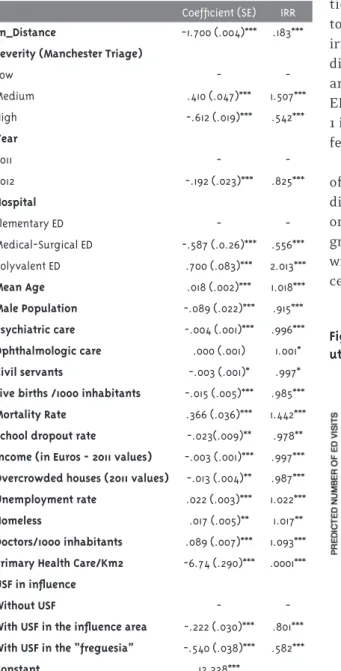
Our model’s coefficients are presented in table 2.We take the natural logarithm of distance and the coefficients from NB regressions may be directly read as elasticity. (Sheu et al., 2004)
Overall, we found a distance-demand elasticity of about -1,65; i.e., an increase of 10% in distance to ED leads to a 16,5% decrease in ED utilization.
More importantly, variables related with supply of care in each area had higher influence in deter-mining ED demand: availability of doctors was posi-tively associated with ED rates (IRR=1,093) whereas PHC had an inverse influence on ED utilization, with areas having an USF (modern primary health centers with performance-based financing) with the lowest ED visiting rates (IRR=0,801; IRR=0,582).
Table 2 - Estimation parameters for the ED utilization model
Coefficient (SE) IRR
Ln_Distance -1.700 (.004)*** .183***
Severity (Manchester Triage)
Low -
-Medium .410 (.047)*** 1.507***
High -.612 (.019)*** .542***
Year
2011 -
-2012 -.192 (.023)*** .825***
Hospital
Elementary ED -
-Medical-Surgical ED -.587 (.0.26)*** .556*** Polyvalent ED .700 (.083)*** 2.013***
Mean Age .018 (.002)*** 1.018***
Male Population -.089 (.022)*** .915***
Psychiatric care -.004 (.001)*** .996***
Ophthalmologic care .000 (.001) 1.001*
Civil servants -.003 (.001)* .997*
Live births /1000 inhabitants -.015 (.005)*** .985***
Mortality Rate .366 (.036)*** 1.442***
School dropout rate -.023(.009)** .978**
Income (in Euros - 2011 values) -.003 (.001)*** .997***
Overcrowded houses (2011 values) -.013 (.004)** .987***
Unemployment rate .022 (.003)*** 1.022***
Homeless .017 (.005)** 1.017**
Doctors/1000 inhabitants .089 (.007)*** 1.093***
Primary Health Care/Km^2 -6.74 (.290)*** .0001***
USF in influence
Without USF -
-With USF in the influence area -.222 (.030)*** .801***
With USF in the “freguesia” -.540 (.038)*** .582***
Constant 12.338***
Figure 1 - Representation of the distance effect on ED utilization for the Polyvalent ED
Our gross estimation for the distance-elasticity of demand may be affected by both the severity of the ED visits and the ED level. In table 3, we present dif-ferent distance-elasticity, considering each ED level and ED visits’ severity category. The results can be read as follows: in the polyvalent ED, for low severity visits, a 10% increase in distance reduces utilization for approximately 13%. In brief, table 3 shows that the sensitiveness of ED utilization to the distance patients have to travel varies quite considerably if we take into account the different visits’ severity: high severity visits have the lowest distance elas-ticity, whereas intermediate severity visits seem to be the most sensitive to distance. Furthermore irrespectively of the ED visits’ severity, estimates for distance-elasticity are lower in both the Polyvalent and the Elementary EDs ,i.e., the Medical-Surgical ED’ utilization is more sensitive to distance.Figure 1 illustrates for the Polyvalent ED this different ef-fect of distance, according to ED demand severity.
Table 3 - Distance-Demand elasticity according to ED level and Severity of ED visits
Distance-Demand Elasticity Polyvalent ED Medical-Surgical ED Elementary ED
Severity of Visits
High Severity -1.16*** -1.71*** -0.92***
Intermediate Severity -1.31*** -2.32*** -1.47***
Low Severity -1.27*** -2.24*** -1.29***
Table 4 - Distance-Demand Elasticity for the Polyvalent ED according to the severity of ED visits (50Km cut-off)
Distance-Demand Elasticity Polyvalent ED
<50Km >50Km
Severity of Visits
High Severity -1.36*** -0.98*** Intermediate Severity -1.44*** -0.70*** Low Severity -1.66*** -0.48***
Discussion
Our findings provide support over the hypothesis that distance has a negative influence on Emergency Department utilization in Portugal. A previous national study (Santana, 1996) that looked at the influence of distance on ED utilization has found an estimate for the distance-elasticity as high as -4. We found estimates that range from -1 to -2 (an increase in 10% in distance decreases ED utilization by 10 to 20%), which are closer to others reported in international literature. Taking into account other determinants that may influence ED utilization in each area was crucial for making distance-elasticity more accurate.
Specifically, one major influence we show is that in areas with higher availability of other health services, particularly Primary Health Care, ED uti-lization is lower, which has also been found in other studies (Mathison et al., 2013, Ludwick et al., 2009, Lowe et al., 2005). Interestingly, we also show that the existence of an USF (a new modern typology of Health Centres in Portugal with performance-based financing) in that area intensifies this inverse re-lationship between PHC and ED utilization, which
Conclusion
Distance patients have to travel to the Emergency Department has a sizeable effect in determining demand across all levels of Emergency care in Portu-gal, after taking into account other factors that also influence ED demand. Policies that wish to reduce geographic inequity in the accessibility to ED should be mindful of these findings and consider both direct and distance costs in the total costs patients incur when seeking care within the Portuguese NHS.
Acknowledgements
We are grateful to Manuel Gomes Mota for his help with the GIS analysis and to the Administrations of the CHSJ and CHMA for providing the data, particular-ly to José Pedro Almeida and to Antonio Parra for their time and their help on providing technical support.
Authors’ Contribution
Vaz and Ramos developed the statistical analysis. Vaz, Ramos and Santana discussed the main findin-gs and prepared the paper.
References
ACTON, J. P. Nonmonetary factors in the demand for medical services: some empirical evidence.
Journal of Political Economy, Chicago, v. 83, n. 3, p. 595-614, 1975.
ALEGANA, V. et al. Spatial modelling of health care utilization for treatment of fever in Namibia.
International Journal of Health Geographics, Inverness, v. 11, n. 1, p. 6, 2012.
DOR, A.; GERTLER, P.; VAN DER GAAG, J. Non-price rationing and the choice of medical care providers in rural Cote d’Ivoire. Journal of Health Economics, York, v. 6, n. 4, p. 291-304, 1987.
FRIEDMAN, J. M. et al. Distance to hospital and utilization of surgical services in Haiti: do children, delivering mothers, and patients with emergent surgical conditions experience greater geographical barriers to surgical care? The International Journal of Health Planning and Management, Staffordshire, v. 28, n. 3, p. 248-256, 2013.
HAYNES, R. et al. Effects of distances to hospital and GP surgery on hospital in patient episodes, controlling for needs and provision. Social and Science Medicine, Boston, v. 49, n. 3, p. 425-433, 1999.
HENNEMAN, P. L. et al. Geography and travel
distance impact emergency department visits.
Journal of Emergency Medicine, Milwaukee, v. 40, n. 3, p. 333-339, 2011.
JORDAN, H. et al. Distance, rurality and the need for care: access to health services in South West England. International Journal of Health Geographics, Inverness, v. 3, n. 1, p. 21, 2004.
LEE, J. E. et al. Utilization of the emergency room: impact of geographic distance. Geospatial Health, Naples, v. 1, n. 2, p. 243-253, 2007.
LOVETT, A. et al. Car travel time and accessibility by bus to general practitioner services: a study using patient registers and GIS. Social Science and Medicine, Boston, v. 55, n. 1, p. 97-111, 2002.
LOWE, R. A. et al. Association between primary care practice characteristics and emergency department use in a Medicaid managed care organization. Medical Care, Washington, DC, v. 43, n. 8, p. 792-800, 2005.
LOWE, R. A. et al. Community characteristics affecting emergency department use by Medicaid enrollees. Medical Care, Washington, DC, v. 47, n. 1, p. 15-22, 2009.
LUDWICK, A. et al. Distances to emergency department and to primary care provider’s office affect emergency department use in children.
Academic Emergency Medicine, Des Plaines, v. 16, n. 5, p. 411-417, 2009.
MAGNUSSON, G. The role of proximity in the use
of hospital emergency departments. Sociology of
Health & Illness, Cardiff, v. 2, n. 2, p. 202-214, 1980.
MATHISON, D. J. et al. Primary care spatial density and non urgent emergency department utilization: a new methodology for evaluating access to care. Academic Pediatrics, Rochester, v. 13, n. 3, p. 278-285, 2013.
PORTUGAL. Ministério da Saúde. Comissão da Reavaliação da Rede Nacional de Urgência e Emergência. Governo de Portugal. Lisboa, 2012.
PUIG-JUNOY, J.; SAEZ, M.; MARTINEZ-GARCIA, E. Why do patients prefer hospital emergency visits?: a nested multinomial logit analysis for
patient-initiated contacts. Health Care Management
Science, Richmond, v. 1, n. 1, p. 39-52, 1998.
RAKNES, G.; HANSEN, E.; HUNSKAAR, S. Distance and utilization of out-of-hours services in a Norwegian urban/rural district: an ecological study. BMC Health Services Research, London, v. 13, n. 1, p. 222, 2013.
RUDGE, G. M. et al. The combined influence of distance and neighborhood deprivation on emergency department attendance in a large English population: a retrospective database study. PloS one, San Francisco, v. 8, n. 7, 2013.
SANTANA, P. Utilização dos cuidados hospitalares: uma abordagem da geografia da saúde. In: VAZ, A.;
RAMOS, F.; PEREIRA, J. As reformas dos sistemas
de saúde. Lisboa: APES, 1996. p. 182-208.
SANZ-BARBERO, B.; OTERO GARCIA, L.; BLASCO HERNANDEZ, T. The effect of distance on the use of emergency hospital services in a Spanish region with high population dispersion: a multi-level analysis. Medical Care, Massachusetts, v. 50, n. 1, p. 27-34, 2012.
SHEU, M. L. et al. The effect of a major cigarette price change on smoking behavior in California: a zero-inflated negative binomial model. Health Economics, New York, v. 13, n. 8, p. 781-791, 2004.