Clinical and epidemiological aspects
of burned patients hospitalized in a
Teaching Hospital
ASPECTOS CLÍNICOS E EPIDEMIOLÓGICOS DE PACIENTES QUEIMADOS INTERNADOS EM UM HOSPITAL DE ENSINO
ASPECTOS CLÍNICOS Y EPIDEMIOLÓGICOS DE PACIENTES QUEMADOS INTERNADOS EN UN HOSPITAL DE ENSEÑANZA
RESUMO
Os objetivos foram: caracterizar os pacien-tes queimados segundo as variáveis epide-miológicas e clínicas e identificar os trata-mentos, procedimentos invasivos e as com-plicações. Trata-se de um estudo retrospec-tivo, descritivo e quantitativo. A amostra constituiu-se de 138 pacientes queimados internados em um hospital de ensino, no pe-ríodo de janeiro de 2003 a dezembro de 2007, de Uberaba-MG. Dos 138 pacientes in-ternados, 98 (71,0%) eram do gênero mas-culino e a média de idade foi de 26,1 anos. O tempo médio de internação foi de 16,2 dias; 93 (67,4%) eram de natureza acidental e a principal causa 68 (49,3%) foi a chama aberta. A superfície corporal queimada mé-dia foi de 20,8% e a maioria 122 (88,4%) apresentou queimadura de 2° grau. A tera-pia tópica mais utilizada 93 (67,4%) foi a sulfadiazina de prata. A sondagem vesical de demora foi instalada em 47 (34,0%) pacien-tes; 30 (21,7%) foram submetidos à enxertia e 28 (20,3%) ao desbridamento; 14 (10,1%) apresentaram infecção da lesão.
DESCRITORES
Queimaduras Epidemiologia Enfermagem Hospitais de ensino
1 RN. Nursing undergraduate program, Federal University of Triangulo Mineiro. Participated in scientific scholarship at the Federal University of Triangulo
Mineiro.Uberaba, MG, Brazil. [email protected] 2 PhD in Adult Health Nursing. Professor, Federal University of Triangulo Mineiro. Uberaba, MG,
Brazil. [email protected] 3 RN. Master's student, Graduate Program at the Federal University of Triangulo Mineiro. Uberaba, MG, Brazil.
O
RIGINAL
A
R
TICLE
Samanta Flor Montes1, Maria Helena Barbosa2, Adriana Lemos de Sousa Neto3
ABSTRACT
The objectives of this study were to charac-terize burned patients according to epide-miological and clinical variables and identify the treatments, invasive procedures and complications. This is a retrospective, de-scriptive and quantitative study. The sample consisted of 138 burned patients hospital-ized in a teaching hospital from January 2003 to December 2007, in Uberaba-MG. Of the 138 hospitalized patients, 98 (71.0%) were male, and the average age was 26.1 years. The average length of stay was 16.2 days; 93 (67.4%) of the burns were caused by acci-dents and the main cause (68; 49.3%) was an open flame. The average burned body surface was 20.8% and most (122; 88.4%) had second degree burns. The most com-mon topic treatment (93; 67.4%) was silver sulfadiazine. Forty-seven (34.0%) patients had indwelling catheters; 30 (21.7%) under-went tissue transplantation, and 28 (20.3%) underwent debridement; the lesions in 14 (10.1%) patients became infected.
DESCRIPTORS
Burns Epidemiology Nursing
Hospitals, teaching
RESUMEN
Los objetivos fueron caracterizar al pacien-te quemado según las variables epidemio-lógicas y clínicas e identificar los tratamien-tos, procedimientos invasivos y complica-ciones. Estudio retrospectivo, descriptivo, cuantitativo. Muestra de 138 pacientes quemados internados en hospital de ense-ñanza, en período de enero 2003 a diciem-bre 2007, en Uberaba-MG. De los 138 pa-cientes internados, 98 (71%) eran de sexo masculino, la media de edad fue de 26,1 años. El tiempo medio de internación fue de 16,2 días, 93 (67,4%) presentaban que-maduras accidentales y la principal causa, 68 (49,3%) fue la llama abierta. La superfi-cie quemada media fue de 20,8% y la ma-yoría, 122 (88,4%) presentó quemaduras de segundo grado. La terapia tópica más utili-zada, 93 (67,4%) fue la sulfadiacina de pla-ta. El sondaje vesical de demora se instaló en 47 (34,0%) pacientes; 30 (21,7%) fueron sometidos a injerto y 28 (20,3%) a desbrida-miento; 14 (10,1%) presentaron infección de la lesión.
DESCRIPTORES
366
Rev Esc Enferm USP2011; 45(2):365-9 www.ee.usp.br/reeusp/Clinical and epidemiological aspects of burned patients hospitalized in a Teaching Hospital in Minas Gerais
Montes SF, Barbosa MH, Sousa Neto AL INTRODUCTION
Burns are cutaneous lesions caused by the direct or in-direct action of heat and the main causes are in-direct flame, contact with boiling water or fluids, which is called scald-ing, contact with hot surfaces, electricity and chemical agents(1).
These lesions can compromise different organic struc-tures and are evaluated in degrees according to the depth of tissue trauma. A first-degree burn compromises the epi-dermis; the lesion presents redness (erythema), heat and pain, progresses rapidly with scaling, and its systemic im-pact is minimal. A second-degree burn involves not only the entire epidermis but it also affects the dermis; the le-sion site presents pain, erythema, edema, blisters, erole-sion and ulceration; the healing process is slower and sequelae may occur such as dyschromia or scarring. The epidermis and dermis are destroyed in a third-degree burn, which may reach the subcutaneous tissue, tendons, ligaments, muscle and bones. The lesion is white or black, dry, hard and in-elastic. There is no pain due to the
destruc-tion of nervous endings and no capillary re-turn, while blood vessels are compromised by coagulation; there is no spontaneous re-generation and grafting is indicated; when it is healing, there is edge retraction(1- 3).
Another important aspect to evaluate is the Total Body Surface Area involved (TBSA), which should be evaluated as precisely as possible because it is one of the factors that has the greatest influence on systemic reper-cussion and patient survival(1,3-4).
The site of lesions is also an important indicative to be considered when delivering
care to patients because burns on the face, neck and hands should receive more attention to reduce aesthetic and func-tional impairment(1).
Often burn victims have their airways burned by smoke inhalation, one of the main causes of mortality both due to the direct thermal action and inhalation of toxic substances and the presence of toxins on the site(1,5).
A burn harms the integrity of the skin, the functions of which are compromised. Local response is first to the emer-gency of coagulative necrosis, due to thrombosis of blood vessels that eventually leads to systemic repercussions of varied intensity(1,5).
One of the most expressive complications for burned patients is sepsis, which in many cases, leads to death(2-3,6-8).
Other complications, also common in these patients, are cardiovascular complications and renal disease directly as-sociated with hypovolemia. Among the cardiovascular com-plications there are hypotension, increased heart rate and shock(5,9).
Therefore, treatment for these patients involves both local and systemic treatments. The local treatment of the lesion includes coverage with bacterial and/or bacterio-static action and debridement of devitalized tissue. Among the topical agents the following are highlighted: silver sul-fadiazine at 1% and essential fatty acids (EFA). Natural products include papain and honey, while solutions in-clude silver nitrate, chlorhexidine gluconate and povidone-iodine, though these are currently seldom used. Another alternative is the use of temporary skin substitutes indi-cated to protect the lesion until completion of a graft or only to protect it until it is healed, when it is free of infection. Skin substitutes can be of animal origin such as a homologous graft, amniotic membrane, or collagen and also synthetic such as silicone or polyurethane, and finally associated with organic matter such as collagen and silicone(2-3).
The identification of epidemiological and clinical aspects of victims of burns can contribute to the development of care protocols to ensure the quality of care delivered to this population.
OBJECTIVE
To characterize inpatients, victims of burns, according to epidemiological and clinical variables, and identify the invasive treatments and procedures adopted and the main complications presented by these patients.
METHOD
This is a retrospective and descriptive study with quantitative approach. A total of 346 medi-cal files and forms of burn victims cared for in the emer-gency room of the Hospital das Clinicas at the Federal University of Triangulo Mineiro (HC/FUTM) between January 2003 and December 2007 were identified. Of these, 138 patients remained hospitalized and com-posed this study’s sample. Data were collected from the medical files by the researchers and trained collabora-tors in the Medical Files and Statistic Service at the stud-ied hospital.
Data collection was guided by an instrument address-ing epidemiological and clinical data includaddress-ing characteris-tics of the lesion, the adopted invasive treatments and pro-cedures, and complications presented by these patients. The collected data were input into an electronic spread-sheet using the Microsoft Excel program, Windows XP® and
submitted to descriptive statistic analysis.
This study was approved by the Research Ethics Com-mittee at the Federal University of Triangulo Mineiro (Pro-tocol n. 1164/2009).
The identification of epidemiological and clinical aspects of victims of burns can
contribute to the development of care protocols to ensure the
quality of care delivered to this
RESULTS
A total of 346 individuals, victims of burns, were cared for between January 2003 and December 2007 in the HC-FUTM; 208 (60.1%) of these were released after being cared for in the emergency room and 138 (39.9%) were admitted to the hospital.
Of the 138 (100.0%) hospitalized patients composing this study’s sample, 98 (71.0%) were men and 95 (68.8%) originated from Uberaba, MG, Brazil; the average age was 26.1 years old (minimum age was 10 months old and maxi-mum 76 years old), while 46 (33.3%) from 0 to 14 years old, 85 (61.6%) from 14 to 59 years old and seven (5.1%) were 60 years old or older. The average length of hospitalization was 16.2 days, varying from one to 110 days.
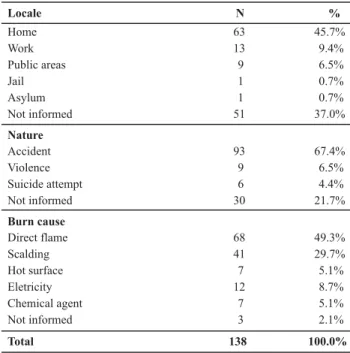
In relation to lesion characterization, 63 (45.7%) oc-curred at home, 93 (67.4%) were accidents, and the main cause for 68 (49.3%) patients was exposure to direct flame (Table 1). The main cause of burns, according to the age group, was scalding for patients zero to 14 years old and direct flame for the remaining age groups.
Table 1 – Distribution of patients according to locale, nature and causes of burns – Uberaba, MG, Brazil – 2003 to 2007
The average TBSA was 20.8%, varying from 1.0% to 95.0%. The most affected sites were the upper limbs, in 97 (70.3%) patients (Table 2). In regard to the severity of the lesions, 60 (43.5%) presented first-degree burns, 122 (88.4%) second-degree, and 38 (27.5%) third-degree burns, while 81 (58.7%) patients concomitantly displayed lesions of distinct degrees.
Table 2 – Distribution of patients according to the affected body area – Uberaba, MG, Brazil – 2003 to 2007
Silver sulfadiazine at 1% was the topical treatment used for 93 (67.4%) patients; sulfadiazine was used at first and then papain in 25 (18.1%) patients; other products were used in 11 (8.0%) patients such as rifamycin and fibrinol-ysin; and this data were not recorded in the files of nine (6.5%) patients. In regard to the invasive procedures, 53 (38.4%) underwent some type of procedure; an indwelling catheter was inserted in 47 (34%) patients (Table 3).
Table 3 – Distribution of patients according to invasive procedures
– Uberaba, MG, Brazil – 2003 to 2007
Locale N %
Home 63 45.7%
Work 13 9.4%
Public areas 9 6.5%
Jail 1 0.7%
Asylum 1 0.7%
Not informed 51 37.0%
Nature
Accident 93 67.4%
Violence 9 6.5%
Suicide attempt 6 4.4%
Not informed 30 21.7%
Burn cause
Direct flame 68 49.3%
Scalding 41 29.7%
Hot surface 7 5.1%
Eletricity 12 8.7%
Chemical agent 7 5.1%
Not informed 3 2.1%
Total 138 100.0%
Affected body site N %
Head/neck 70 50.7%
Trunk 82 59.4%
Upper limbs 97 70.3%
Lower limbs 70 50.7%
Genitalia 19 13.8%
Airways 12 8.7%
Total *350 *253.6%
Invasive procedures
Not subjected to invasive procedures 85 61.6%
Orotracheal intubation 24 17.4%
Indwelling catheter 47 34.1%
Nasogastric/nasoenteral tube 14 10.1%
Central venous catheterization 16 11.6%
Tracheotomy 2 1.4%
Total *188 *136.2%
N %
In relation to surgical interventions, 43 (31.2%) under-went some type of procedure: 30 (21.7%) grafts, and 28 (20.3%) surgical debridement. Of these, 15 (10.9%) con-comitantly submitted underwent these procedures.
Even though most of this study’s subjects (113/81.9%) did not have complications, 14 (10.1%) displayed infection in the lesion (Table 4). In regard to the clinical progress, 10 (2.9%) died and of these, five (50.0%) experienced burns in their airways; eight (80.0%) had 2nd and 3rd degrees burns
and the average TBSA was 49.8%, varying from 25% to 95%.
Table 4 – Distribution of patients according to complications – Uberaba, MG, Brazil – 2003 to 2007
Complications
Did not have any complication 113 81.9%
Infection on the lesion 14 10.1%
Respiratory failure 10 7.2%
Sepsis 5 3.6%
Pneumonia 4 2.9%
Acute renal failure 2 1.5%
Hypovolemic shock 1 0.7%
Total *149 *107.8%
N %
*average of affected body areas = 2.5 per patient
368
Rev Esc Enferm USP2011; 45(2):365-9 www.ee.usp.br/reeusp/Clinical and epidemiological aspects of burned patients hospitalized in a Teaching Hospital in Minas Gerais
Montes SF, Barbosa MH, Sousa Neto AL DISCUSSION
Male individuals were the majority among the hospi-talized patients, a fact also observed in other studies(10-14).
The main cause of burns among adults was exposure to direct flame and scalding predominated among children. Similarly, a descriptive study carried out in 2001 where burn victims younger than 15 years old were hospitalized in five hospitals in Londrina, PR, Brazil verified that 44% of the sample suffered burns by exposure to boiling fluids(15).
Various studies(10-13) indicate that greatest part of
hospi-talized victims of burns is made up of children, which does not agree with the findings of this study. The existence of a hospital specializing in caring for children in this city may explain the result found; it is possible that many juvenile victims of burns, are cared for in this facility. The results indicated that scalding is most common among children and exposure to direct flame is most common among adults, which is also evidenced in other studies(13). The primary
place where the event occurred was at home and accidents predominated, which also corroborates the findings of other studies(10-11,13).
The average TBSA was 20.8%, which is in agreement with other studies, whose findings vary from 14% to 21%(11-14,16).
The most affected body area was the upper limbs and the most frequent level of severity was 2nd degree, also verified
in another study with a similar methodology, though the frequency of third-degree burns was higher than that found in this study, evidencing more severe cases(10).
In regard to the adopted topical therapy, silver sulfadi-azine at 1% was the most frequently used. Silver sulfadiaz-ine is frequently used in the treatment of burns due to its bactericidal power since the loss of protection once con-ferred by the skin, especially in second and third-degree burns, predisposes patients to develop local and systemic infections. Papain is also recommended to promote chemi-cal debridement(2,6).
One aspect that drew attention was in relation to invasive procedures; indwelling catheters, orotracheal intubation, central venous catheterization, and naso-gastric or nasoenteral tube were identified in this study. It is important to keep in mind that even though these are essential to contribute to the recovery of these pa-tients, the use of three or more catheters or probes rep-resent a risk factor for the development of sepsis, as it breaks protection barriers and encourages colonization and infection; hence the prolonged use of these devices is not recommended(7).
It is important to highlight that invasive devices were identified among the patients of this study who displayed sepsis, while no sepsis was identified among those who presented infection in the lesion, which also corroborates the results of other studies that point to an association between invasive devices and sepsis in burned patients(7).
The occurrence of sepsis in this study was also below that found in a study carried out in a burn unit of a public facility. However, this complication is more frequent in more severe cases, which in general are cared for in more spe-cialized facilities(7,14).
The surgical procedures of graft and debridement found in this study were less frequent than in other studies. It may be related to the low occurrence of third-degree le-sions, since graft and debridement are most common for second and third degree lesions due to greater tissue de-struction. The excision of devitalized tissue and early graft-ing on the burn are currently recommended(14).
Even though most of this study’s patients did not have complications, infection in the lesion was the main complication identified, though less frequently found than in other studies(11,14). A study conducted in the burn unit
of a hospital in Brasília, Brazil, which in addition to the clini-cal evaluation of cases performed microbiologiclini-cal exams of the lesions, identified infection in 16.2% of the results. It shows that evaluation, including microbiological exams of lesion samples, is essential to the precise identification of infections(14).
Respiratory failure and pneumonia represent the most frequently observed pulmonary complications, corroborat-ing the findcorroborat-ings of other studies(11).One of the major risk
factors for these complications is the presence of airway injury by smoke inhalation(5).
The rate of mortality was lower than that of other stud-ies(11-12,15). Predictive studies addressing mortality in burn
patients showed factors such as burns over large areas, le-sion by smoke inhalation, and burned body surface area(12,15).
Although this study did not aim to address these factors, the results corroborate the findings of other studies(12,15).
CONCLUSION
This study’s results allowed showing that men were prevalent among the studied population (71.1%) and the average age was 26.1 years old. In relation to the categori-zation of lesions: 45.7% of burns occurred at home; 67.4% were accidents, and 49.3% were caused by exposure to di-rect flame. The average TBSA was 20.8% and the most (70.3%) affected regions were the upper limbs. In regard to the severity of lesions, most (88.4%) were second-degree. Silver sulfadiazine at 1% was the most (67.4%) used topical therapy. In relation to invasive procedures, 34.0% were re-ceived an indwelling catheter and the following surgical in-terventions were performed: 21.7% received grafts and 20.3% underwent debridement. A total of 10.1% displayed infection in the lesion and 2.9% died.
REFERENCES
1. Vale ECS. Primeiro atendimento em queimaduras: a aborda-gem do dermatologista. An Bras Dermatol. 2005;80(1):9-19. 2. Ferreira E, Lucas R, Rossi LA, Andrade D. Curativo do paciente
queimado: uma revisão de Literatura. Rev Esc Enferm USP. 2003;37(1):44-51.
3. Jorge AS, Dantas SRPE. Abordagem multiprofissional do trata-mento de feridas. São Paulo: Atheneu; 2003.
4. Smetzer SC, Bare B. Brunner & Suddarth: tratado de enferma-gem médico-cirúrgica. 10ª ed. Rio de Janeiro: Guanabara Koogan; 2006.
5. Souza R, Jardim C, Salge JM, Carvalho CRR. Lesão por inalação de fumaça. J Bras Pneumol. 2004;30(5):557-65.
6. Ragonha ACO, Ferreira E, Andrade D, Rossi LA. Avaliação microbiológica de coberturas com sulfadiazina de prata a 1%, uti-lizada em coberturas. Rev Lat Am Enferm. 2005;13(4): 514-21. 7. Macedo JLS, Rosa SC, Macedo KCS, Castro C. Fatores de risco
da sepse em pacientes queimados. Rev Col Bras Cir. 2005;32 (4):173-7.
8. Barbosa E, Morreira EAM, Faintuch J, Pereima MJL. Suplemen-tação de antioxidantes: enfoque em queimados. Rev Nutr. 2007;20(6):693-702.
9. Rossi LA, Dalri MCB, Ferraz AEP, Carvalho EC, Hayashida M. Déficit de volume de líquidos: perfil de características definidoras no paciente portador de queimadura. Rev Lat Am Enferm. 1998;6(3):85-64.
10. Pereira Júnior S, Ely JB, Sakae TM, Nolla A, Mendes FD. Estu-do de pacientes vítimas de queimaduras internaEstu-dos no hos-pital Nossa Senhora da Conceição em Tubarão-SC. ACM, Arq Catarina Med. 2007;36(2):22-7.
11. Macedo JLS, Rosa SC. Estudo epidemiológico dos pacientes in-ternados na unidade de queimados: Hospital Regional da Asa Norte, Brasília, 1992-1997. Brasília Med. 2000; 37(3/4):87-92. 12. Beraldo PSS, Nunes LGN, Silva IP, Ramos MFG. Predição de
mortalidade em unidade de queimados. Brasília Med. 1999;36(3/4):82-9.
13. Beraldo PSS, Nunes LGN, Silva IP, Ramos MFG. Sazonalidade de queimaduras por fogo, em paciente admitidos numa uni-dade especializada do Distrito Federal, no período 1993-1996. Brasília Med. 1999;36(3/4):72-81.
14. Macedo JLS. Complicações infecciosas e fatores preditivos de infecção em pacientes queimados [tese doutorado]. Brasília: Faculdade de Medicina, Universidade de Brasília; 2006. 15. Martins CBG, Andrade SM. Queimaduras em crianças e
ado-lescentes: análise da morbidade hospitalar e mortalidade. Acta Paul Enferm. 2007;20(4):464-69.