To whom it may concern: Somatic
Education in academic research
Priscila Rosseto Costa Márcia Strazzacappa Universidade Estadual de Campinas – UNICAMP, Campinas/SP, Brazil ABSTRACT – To whom it may concern: Somatic Education in academic research – Based on a survey conducted in different bases of academic data such as journal articles, undergraduate final papers, theses, and dissertations, this paper presents a critical analysis of different fields of knowledge in the scientific production on Somatic Education, aiming to support future work. The research was quantitative and documentary and it had as priority sources CAPES site and the Brazilian National Library of Dissertations and Theses (BDTD) site. It was concluded that Somatic Education is multidisciplinary and it has the largest academic representation in the field of Arts, followed by the Health sector, possibly reflecting its origins and applications.
Keywords: Somatic Education. Scientific Production. Multidisciplinary. Art. Applications. RÉSUMÉ – À qui cela peut Concerner: l’Éducation Somatique dans la recherche universitaire – Basé sur une enquête menée auprès de différentes bases de données académiques telles que des articles de revues périodiques, des mémoires et des thèses de doctorat, cet article présente une analyse critique des différents domaines dont les productions scientifiques sont appliquées à l’éducation somatique, visant à soutenir les travaux futurs. La recherche a été quantitative et documentaire et a eu comme sources prioritaires les données des sites internet des revues périodiques de la Coordination de Perfectionnement Académique (CAPES) et de la Bibliothèque Nationale Brésilienne de Thèses et Mémoires (BDTD). Il a été conclu que l’éducation somatique est multidisciplinaire, même si elle a une plus grande représentation académique dans le domaine des arts, suivi par le secteur de la santé, confirmant ses origines et ses applications.
Mots-clés: Éducation Somatique. Productions Scientifiques. Multidisciplinaire. Arts. Applications. RESUMO – A quem possa interessar: a Educação Somática nas pesquisas acadêmicas – Fundamentado em um levantamento realizado junto a diferentes bases de dados acadêmicas como artigos de periódicos, trabalhos de conclusão de curso de graduação, teses e dissertações, o presente artigo apresenta uma análise crítica sobre os diferentes campos do conhecimento em que estão sendo realizadas as produções científicas sobre Educação Somática, visando subsidiar trabalhos futuros. A pesquisa foi documental e quantitativa, tendo como fontes prioritárias o site de Periódicos da Coordenação de Aperfeiçoamento de Pessoal de Nível Superior (CAPES) e o site da Biblioteca Nacional Brasileira de Teses e Dissertações (BDTD). Concluiu-se que a Educação Somática é multidisciplinar, embora tenha maior representatividade acadêmica na área de Artes, seguida da área da Saúde, refletindo possivelmente suas origens e aplicações.
Dissemination of the term Somatic Education
Since the first publication in Brazil of a translated version of the article1 by Sylvie Fortin (1999) defining Somatic education as a set of alternative body practices that aims body awareness, this terminology has been incorporated into the daily activities of teachers, practitioners, and artists (whereas, since the 1970’s, there were translations available for Portuguese of the major reference works of such practices). Another article by the same author also contributed to the access to the term in the country, in 1998: the paper entitled ‘When dance science and somatics enter the dance technique class’ also had wide circulation in academic and artistic fields. Similarly, concurrent events, that brought at that time the name of Sylvie Fortin to the national scene, contributed to the term Somatic education to become object of study in the national territory; in this case, we remember the first International Meeting of Somatic education2 in Brazil in 2001. This meeting was a milestone and had the presence of Sylvie Fortin herself delivering the opening keynote, teaching a course, and promoting a final experience with all participants. The meeting lasted a week and brought together the major Brazilian representatives of the different lines of Somatic education present in the country, like Feldenkrais, Alexander, Eutony, Holistic Gymnastics, Body-Mind-Centering, Ideokinesis, amongst others. At the same year, Sylvie Fortin also participated of similar activities in Rio Grande do Sul, promoted by the Federal University of Rio Grande do Sul (UFRGS) and by the Cruz Alta University (UNICRUZ), further expanding the factors of for taking over the concept in the country.
This article is based on the results of a research in which a survey was carried out among different academic databases containing journal articles, undergraduate term papers, theses, and dissertations published in Portuguese in order to check in which field of knowledge, in Brazil, the scientific papers on Somatics are being based on: Art, Education or Health.
providing subsidies for a discussion around a dispute between dancers and the Brazilian Physical Education Federal Council referring to the regulations related to the teaching of bodily techniques.
This survey focused on answers for: is Somatic education more studied by the field of Arts, Education or Health? Is it possible that a somatic technique is most studied by one of these fields of knowledge than the others? What are the propositions that explain this data? Such answers help us to comprehend how Somatics, since its origin, has been taken over by different professional fields, allowing us to verify whether the assertion of its multidisciplinary is true or not.
Although apparently quantitative, when identifying which field of knowledge has produced and taken over the concepts related to it, one also identifies the background of those who research it and the scope of their work. Since the participants of the 2001 Meeting were mostly dancers, would Arts still be the field with the most intellectual output?
The databases used for this survey were CAPES’s journal website, University of Campinas’ (UNICAMP) integrated search engine3, as well as Google Scholar site. In order to search for dissertations, theses, and undergraduate term papers, the sites of the main university libraries were consulted, such as University of São Paulo (USP), Julio de Mesquita Filho State University (UNESP), UNICAMP, and other federal universities. We also searched the Brazilian National Library of Dissertations and Theses [Biblioteca Nacional Brasileira de Teses e Dissertações – BDTD], which maintain digitized theses and dissertations from the major universities in Brazil, including some private ones, like Anhembi Morumbi.
– Struyf [Muscle and Joint Chains or G.D.S. Method or Godelieve Denys–Struyf], Ginástica Holística ou Dra. L. Ehrenfried Holistic Gymnastics or Dr L. Ehrenfried]; Método Bertazzo ou Ivaldo Bertazzo [Bertazzo Method or Ivaldo Bertazzo]; Técnica Klauss Vianna [Klauss Vianna Technique]; and Método de Reorganização Postural Dinâmica ou José Antonio de Oliveira Lima [Method of Dynamic Postural Reorganization or José Antonio de Oliveira Lima].
The material identified by the search engines were selected, as the abstracts or, in some cases, the full papers were read, in order to make sure that they should be considered as part of the study. As an example, papers that covered concepts like Embriogênese somática [somatic embryogenesis], células somáticas [somatic cells], maturação somática [somatic maturation], crescimento somático [somatic growth], which are beyond the scope of this research5, were excluded. A spreadsheet was created6 with data from the selected papers, such as the paper’s title, author, year, journal’s name and academic field. The same was done with the theses, dissertations, and term papers. In the tables, the selected materials were classified by technique/ method, in separate spreadsheets, in order to gather the number of papers per Somatic education technique or method.
The identification of the academic field of the papers has been done using CAPES WebQualis site7. The fields defined by the CAPES site were Arts/Music; Education; Physical Education/ Physical Therapy; Nursing; Literature/Linguistics; Medicine (1, 2, and 3); Psychology; Collective Health and Interdisciplinary. Regarding publications not classified by the CAPES site, a survey was conducted directly in the journal or publication site. In regards of term papers, as well as theses and dissertations, we have identified the following academic fields: Arts; Education; Physical Education, Medicine; Communication/Semiotics; Psychology.
For term papers, theses, and dissertations, the obtained degree and the institution where they were presented were verified to categorize the academic field.
Surveys in Journal Articles
from Nursing; 5 from Interdisciplinary field; 1 from Literature/ Linguistics; 7 from Medicine; 1 from Psychology; and 2 from Collective Health. The following graph presents the proportion of production per academic field:
Graph 1 – Journal articles on the theme Somatic education per academic field.
From the graph above, we observe that most of the articles are from the field of Arts/Music and, secondly, from the field of Physical Education. However, if we classify all articles in only three categories – Arts, Education, and Health – we have:
Graph 2 – Article classification in three knowledge fields.
site). In this case, the articles published in interdisciplinary journals were not added up.
Considering this perspective, we have the Health field as the one with most publications about Somatic education, using CAPES journals classification. This can be explained, on one hand, by the historical circumstances that involved the origin and disseminations of these techniques. As seen, Somatic education originated from individual actions, mainly from artists, with the goal of achieving their own rehabilitation through bodily practices that were alternatives to conventional methods of medical treatment (Strazzacappa, 2012). Let’s remember Feldenkrais (1977), who had knee problems, to Mathias Alexander (1992), an actor who lost his voice, or even Mabel Todd (1932), who had paralysis during her adolescence, to name only a few. On the other hand, we should take into account some other aspects. First, the Health field has the highest number of undergraduate programs, which exist for longer and are more established than the field of Arts. Second, it is a field where, traditionally, the dissemination of knowledge is accomplished by means of publication in journals (in the field of Arts and Humanities, the publication of books and book chapters is far more common). Third, if we had conducted even a more thorough search, we would note that some authors who published in journals belonging to the Health field study or work in the field of Arts, as is the case of Débora Bolsanello (2007), who published an article in the magazine Movimento de Educação Física, amongst others. Fourth, there are fewer magazines from other fields that propose specific dossiers to address the issue of Somatic Education, such as this Journal.
Even in the cases where the research were conducted within other post-graduation programs, like these in the field of Health, when consulting the authors’s curriculum at the Lattes Platform, we identified that the majority of them have as a background, whether basic or supplementary, in the field of Performing Arts, such as Dance, Theater, and Music.
Another aspect accounted for in this research relates to the amount of publication in each technique/method of Somatic education. Is it possible that one technique or method has better affinity with one field than with another one?
the highest amount of articles are from magazines and journals of Arts/Music (CAPES Classification). The keyword Eutony, in relation to other methods and techniques, is the one with most articles related to Medicine. The Muscle and Joint Chains or GDS Method was the one with the most articles related to Physical Education. The Holistic Gymnastics has a mix of articles in the same proportion as the Health field, like Collective Health, Medicine, and Physical Education. For the Alexander Technique iy was found the highest number of articles published in Arts/Music journals. The keyword Bertazzo Method, when related to the other methods, had the major number of journal articles related to the Education field, mainly the journals from USP (Communication and Education). No journal articles were found using the keyword Dynamic Postural Reorganization or José Antônio de Oliveira Lima, probably due to its recent disclosure (2010).
Referring to the origins of Somatic Education in Brazil, we questioned which professionals supported its adoption in different Brazilian states. We see, for example, a large number of physical therapists in the dissemination of Holistic Gymnastics, G.D.S. Method, and Eutony, which will indicate, without doubt, a major presence of studies in the Health field. The Alexander Technique, in turn, was more disseminated by instrumental musicians. The dissemination of the Feldenkrais Technique is balanced between artists and physical therapists.
Thus, we observe the table below as a summary of the relationship of the Somatic education technique/method per academic field:
TECHNIQUE/METHOD ACADEMIC FIELD
Klauss Vianna Arts/Music
Joints and Muscular Chains Physical Education/Physical Therapy
Eutony Medicine
Feldenkrais Arts/Music
Holistic Gymnastics Collective Health/Medicine/Physi-cal Education
Method Bertazzo Education
Method of Dynamic Postural
Reorga-nization No paper found
Alexander Technique Interdisciplinary and Arts/Music
Surveys in Term Papers, Theses, and Dissertations
When consulting the site of the main university libraries, like USP, UNESP, UNICAMP, and other federal universities, as well as the site of the Brazilian National Library of Dissertations and Theses (BDTD), we have noticed that there are less term papers than theses and dissertations. In total, there were 6 term papers compared to 30 theses and 20 dissertations with the title/theme/subject on Somatic education.
We have found 3 physical education studies (UNESP and UNICAMP), 2 from Arts (UNESP and UNICAMP), and 1 from Medicine (UNICAMP). The Klauss Vianna theme was the one with the highest frequency in these studies; there were 5 of them for 1 approaching the Joints and Muscular Chains Method. Some of these have already been published as books, like Jussara Miller’s thesis (2005).
For term papers, the most common field is physical education. The field of Arts is the one presenting more theses and dissertations. From 30 theses, 25 are from the Arts course, corresponding to 83.33% of the total. From 20 dissertations, 13 are from the Arts field, corresponding to 65% of the total.
The classification of the institutions showed that term papers, theses and dissertations on Somatic Education are originated from the following universities: Pontifical Catholic University of São Paulo (PUC-SP), Federal University of Bahia (UFBA), Federal University of Minas Gerais (UFMG), UFRGS, UNESP, UNICAMP, and USP, all of them with tradition in post-graduation programs.
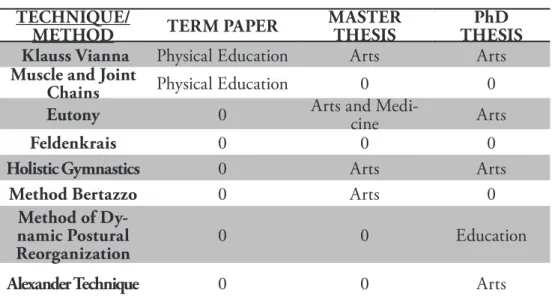
Holistic Gymnastics. Both in theses and dissertations, unlike the results for journal articles, Eutony is more related to Arts, followed by Medicine. It is possible to observe that, both for theses and dissertations, as mentioned before, the academic field of Arts (Dance, Theater, and Music) is the one that is more related with all of the techniques/methods. The following table compares Somatic education techniques and academic fields for term papers, theses, and dissertations:
TECHNIQUE/
METHOD TERM PAPER MASTER THESIS THESISPhD
Klauss Vianna Physical Education Arts Arts
Muscle and Joint
Chains Physical Education 0 0
Eutony 0 Arts and Medi-cine Arts
Feldenkrais 0 0 0
Holistic Gymnastics 0 Arts Arts
Method Bertazzo 0 Arts 0
Method of Dy-namic Postural
Reorganization 0 0 Education
Alexander Technique 0 0 Arts
Table 2 – Relationship between technique/method of Somatics with academic fields of term papers, theses, anddissertations.
Global Dimension of the Research
Graph 3 – Relationship of all researched materials with Somatic Educations.
The next graph shows the data categorized according to the three fields (Arts, Education, and Health) (Lima, 2010):
Graph 4 – Relationship of all researched materials to the three knowledge fields: Arts, Education, and Health.
We have noted, through a non-systematic search in Google Scholar, the existence of materials like conference proceedings, scans of online posters, articles in non-scientific magazines and informal texts available through the Internet on Somatic Education. The majority of these documents come from the field of Arts, having Dance as their content. An example is the collection O Avesso do Avesso do Corpo [The Reverse of the Reverse of the Body], a publication resulting from the Fourth Dance Seminar of Joinville (Wosniack, 2011), containing twenty-four texts from speeches of invited guests and submitted works. In this same direction, there is the collection of the Associação Brasileira de Pesquisa e Pós-graduação em Artes Cênicas [Brazilian Association of Research and Graduate in Performing Arts] (ABRACE), with several materials regarding Somatic education and its techniques. This information strengthens the previous assertion that Arts (Dance, Theater, and Music) is one of the fields that most takes over the field of Somatic Education as knowledge.
We emphasize that texts from the training institutes where the different techniques are taught were not included in our search,8 although they were also consulted. This decision is due to the fact that these texts are more informative about the techniques and their respective training programs rather than articles resulting from scientific investigation. In some cases, articles with more elaborate discussions are not available to the public, being sold through a registration, like the Somatics magazine site. Had we included these articles, the number of publications from the field of Arts would be even higher.
Final Considerations
post-graduation program, the background of the researchers, identified by the Lattes platform is mostly in the field of Arts.
Through analyzing the dates related to the materials, we identify a correlation between the increase of the number of studies and publications with the increase of the number of the undergraduate programs in Dance. Beyond this factor, we can equally highlight the increase, in the last decade, of the training and/or specialization courses on the different techniques of Somatic Educations, developed by local professionals throughout Brazil. This indicates that the new undergraduate programs, both private and public, in the field of Dance in Brazil has been a strong factor in the dissemination of research on the theme.
Notes
1 It is the article Educação Somática: novo ingrediente na formação prática em dança, originally
published in the Magazine Nouvelles de Danse (1996). This article has been translated to
Portuguese and published in the Cadernos do GIPE-CIT (1999).
2 I International Meeting in Somatics Education, organized by the Laboratory of Studies in
Arts, Body, and Education (Laborarte) from the Education Department of the UNICAMP,
with partnership with the Social Service of Commerce (SESC) from Campinas (SP) in November 2001.
3 The Integrated Search is a research tool which aims to facilitate access and retrieval of
information on available sources for research of UNICAMP: acervus base, digital library, e-books, databases, and electronic publications. In this research, we limited the search to electronic publications (such as newspaper articles, journal articles, scientific articles, and articles in specialized publications).
4 Performing a search for words in quotes allows the system to locate the expression just
like it is presented, namely, the concept itself. For example, in “Body Technique”, the system will search the concept itself and will not locate isolated words like “body” AND “technique”, that will open another field.
5 It is necessary to indicate that the concept of Somatics Education discussed in this research
resulted from the data collection from the authors: Sylvie Fortin, Michele Mangione, Débora Bolsanelo, Marcia Strazzacappa, Thomas Hanna, and José Antônio de Oliveira Lima, which are complementary and do not exclude each other.
6 The Table (in Excel) is available at the following site: <http://www.bibliotecadigital.
unicamp.br/>.
7 Available at: <http://qualis.capes.gov.br/webqualis>. Accessed on: 16 Oct. 2012.
8 Institutions like the Brazilian Association of Eutonye, the Brazilian Association of
Alexander Technique, the Association of Practitioners of GDS Method (responsible for the OLHAR Magazine), the Angel Vianna School of Dance, among others.
References
ACERVO KLAUSS VIANNA. Available at: <http://www.klaussvianna.art.br/>. Accessed on: 22 Aug. 2012.
ALEXANDER, Frederick Matthias. O Uso de si Mesmo: a direção consciente em relação com o diagnóstico, o funcionamento e o controle da reação. São Paulo: Martins Fontes, 1992.
ASSOCIAÇÃO BRASILEIRA DE EUTONIA. Available at: <http://www.eutonia.org. br/>. Accessed on: 07 Nov. 2012.
ASSOCIAÇÃO BRASILEIRA DE PESQUISA E PÓS-GRADUAÇÃO EM ARTES CÊNICAS – ABRACE. Available at: <http://portalabrace.org/portal/>. Accessed on: 22 Aug. 2012.
ASSOCIAÇÃO DOS PRATICANTES DO MÉTODO G.D.S. – APGDS. Available at: <http://www.apgds.com.br/homolog/>. Accessed on: 22 Aug. 2012.
ATHENA – Banco de Dados Bibliográficos da UNESP. Available at: <http://portal. biblioteca.unesp.br/portal/athena/>. Accessed on: 07 Nov. 2012.
BERTAZZO, Ivaldo; HAHN, Lúcia Campelo. Prefácio. In: STRUYF, Godelieve Denys. Cadeias Musculares e Articulares: o método G.D.S. Lucia Campello Hahn. 4. ed. São Paulo: Summus, 1995. P. 9-12.
BIBLIOTECA DIGITAL DE TESES E DISSERTAÇÕES DA USP. Available at: <http:// www.teses.usp.br/>. Accessed on: 07 Nov. 2012.
BIBLIOTECA NACIONAL BRASILEIRA DE TESES E DISSERTAÇÕES. Available at: <http://bdtd.ibict.br/pt/início.html>. Accessed on: 07 Nov. 2012.
BOLSANELLO, Débora Pereira.Educação Somática: corpo enquanto experiência. Motriz – Revista da Educação Física, Rio Claro, Universidade Estadual Paulista, n. 2, v. 11, p. 89-96, 07 Nov. 2007.
BUSCA INTEGRADA. Portal de Acesso à Informação Eletrônica (PAI-e), Sistema de Bibliotecas da UNICAMP, UNICAMP.Available at: <http://www.sbu.unicamp.br/fontes-eletronicas/index.php/busca-integrada>. Accessed on: 07 Nov. 2012.
COR POR A LMENTE . Body-Mind Centering. Available at: <http://w w w. bodymindcentering.com/organization/corporalmente>. Accessed on: 07 Nov. 2012. DEDALUS – Banco de Dados Bibliográficos da USP. Available at: <http://dedalus.usp. br/F?RN=267963947>. Accessed on: 07 Nov. 2012.
ESCOLA ANGEL VIANNA. Escola e Faculdade de Dança. Available at: <http://www. escolaangelvianna.com.br/novo/default.asp>. Accessed on: 22 Aug. 2012.
FELDENKRAIS, Moshe. Consciência pelo Movimento: exercícios fáceis de fazer, para melhorar a postura, visão, imaginação e percepção de si mesmo. São Paulo: Summus, 1977. FORTIN, Sylvie. Educação Somática: novo ingrediente da formação prática em dança. Cadernos do GIPE-CIT, Salvador, Universidade Federal da Bahia, n. 2, v. 2, p. 40-55, 22 Oct. 1999.
FORTIN, Sylvie. Nem do Lado Direito, nem do Lado Avesso: o artista de Dança e suas modalidades de experiência de si e do mundo. In: WOSNIAK, Cristiane; MARINHO, Nirvana (Ed.). O Avesso do Avesso do Corpo: educação somática como práxis. Joinville: Nova Letra, 2011. P. 25-42.
GOOGLE ACADÊMICO. Available at: <http://scholar.google.com.br/>. Accessed on: 07 Nov. 2012.
LIMA, José Antônio de Oliveira. Educação Somática: diálogos entre educação, saúde e arte no contexto da proposta da Reorganização Postural Dinâmica. 2010. 189 f. Tese (Doutorado em Educação) – Programa de Pós-graduação em Educação, Faculdade de Educação, Universidade Estadual de Campinas, Campinas, 2010.
MILLER, Jussara Côrrea. A Escuta do Corpo: abordagem da sistematização da técnica Klauss Vianna. 2005. 141 f. Dissertação (Mestrado em Artes) – Programa de Pós-graduação em Artes, Departamento de Artes, Universidade Estadual de Campinas, Campinas, 2005. PORTAL PERIÓDICOS CAPES. Available at: <http://www.periodicos.capes.gov.br.ez88. periodicos.capes.gov.br/index.php?option=com_phome>. Accessed on: 07 Nov. 2012. SOMATICS MAGAZINE/JOURNAL. Portal do Jornal Somatics – Thomas Hanna. Available at: <http://www.somaticsed.com/magJournal.html>. Accessed on: 22 Sept. 2012. STRAZZACAPPA, Márcia. Educação Somática e Artes Cênicas: princípios e aplicações. Campinas: Papirus, 2012.
TODD, Mabel. The Thinking Body. New York: Gestalt Journal Press, 2008.
WOSNIAK, Cristiane; MARINHO, Nirvana (Ed.). O Avesso do Avesso do Corpo: Educação Somática como práxis. Joinville: Nova Letra, 2011.
Priscila Costa is a graduate in Physical Education (Universidade Estadual de Campinas). She teaches in public schools in Itupeva/SP, conducting interventions in the field of Somatics and other areas of the body culture.
E-mail: [email protected]
Marcia Strazzacappa has a BA in Elementary Education, a BA in Dance, a Master Degree in Education (Universidade Estadual de Campinas), and a PhD in Arts (Université Paris). She teaches at the Education Department at Universidade Estadual de Campinas. She is a member of the Brazilian Association for Research and Graduate Studies in Performing Arts (ABRACE) and is a Fellow Researcher at the National Council for Scientific and Technological Development (CNPq).
E-mail: [email protected]
This unpublished text, translated from Portuguese by Mario de Seixas Queiroz, is also published in Portuguese in this issue.