online | memorias.ioc.fiocruz.br
Enterocytozoon bieneusi
detected by molecular methods in raw
sewage and treated effluent from a combined system in Brazil
Sandra Yamashiro1, Vagner Ricardo da Silva Fiuza2,
Ângela Therezinha Lauand Sampaio Teixeira3, Nilson Branco1, Carlos Emílio Levy3,
Isabel Cristina Vidal Siqueira de Castro1, Regina Maura Bueno Franco1/+
1Universidade Estadual de Campinas, Instituto de Biologia, Departamento de Biologia Animal, Laboratório de Protozoologia, Campinas, SP, Brasil
2Universidade Estadual de Campinas, Faculdade de Engenharia Civil, Arquitetura e Urbanismo, Departamento de Saneamento e Ambiente, Campinas, SP, Brasil
3Universidade Estadual de Campinas, Faculdade de Ciências Médicas, Departamento de Patologia Clínica, Hospital de Clínicas, Campinas, SP, Brasil
BACKGROUNDEnterocytozoon bieneusi are the most common microsporidia associated with different clinical manifestations such as diarrhoea, respiratory tract inflammation and acalculous cholecystitis, especially in immunocompromised patients. Infection usually occurs by ingestion of food and water contaminated with spores, but can also result from direct contact with spores through broken skin, eye lesions, and sexual transmission, depending on the microsporidian species.Although there are reports of E. bieneusi found in humans and animals in Brazil, there are no published studies of environmental samples examined by molecular methods.
OBJECTIVES The purpose of this study was to verify the presence of E. bieneusi in raw sewage and treated effluent from a combined system by molecular methods.
METHODS Raw sewage and treated effluent samples collected from a combined system were analysed for the presence of E. bieneusi using the internal transcriber spacer (ITS) region of E. bieneusi by nested polymerase chain reaction.
FINDINGS The analysis revealed E. bieneusi presence and a novel genotype (EbRB) in one raw sewage sample and one treated effluent.
MAIN CONCLUSIONS The presence of E. bieneusi in final effluent indicates that the combined system may not remove microsporidian spores. This study is the first report of E. bieneusi in environmental samples in Brazil.
Key words: sewage - Enterocytozoon bieneusi - PCR - treated effluent - combined system - Brazil
doi: 10.1590/0074-02760160435
+ Corresponding author: [email protected] Received 28 September 2016
Accepted 4 March 2017
Microsporidia represent a group of obligate intracel-lular parasites nested within the kingdom Fungi, with 1300 to 1500 species in 187 genera (Vávra & Lukes 2013). These ubiquitous organisms have been found in a wide range of vertebrate and invertebrate hosts with at least 17 species reported in humans, in which they can cause the opportunistic disease microsporidiosis (Fayer & Santín-Duran 2014). Faecal-oral transmission by in-gestion of food and water contaminated with spores is the most likely route of transmission to humans (Didier & Weiss 2011), whose infections are of commercial, ecological, and medical significance (Weiss & Becnel 2014). Spores are resistant to the environment and may exhibit long survival times (Li et al. 2003).
Microsporidiosis has been reported in all continents except Antarctica (Weiss 2014), primarily in severely im-munocompromised individuals (e.g., HIV/AIDS and trans-plant patients) (Galván et al. 2011). Diarrhoeal episodes in patients with AIDS can range from 30% to 70% (Field &
Milner Jr 2015). However, cases in HIV-negative people, tourists, and the elderly are increasing (Galván et al. 2011).
Enterocytozoon bieneusi are the most common micro-sporidia associated with different clinical manifestation such as diarrhoea, respiratory tracts inflammation and acalculous cholecystitis (Didier & Weiss 2006). Spores have been detected in various environmental samples, including surface water (Sparfel et al. 1997, Dowd et al. 1998), swimming pools (Fournier et al. 2002), wastewater samples (Ayed et al. 2012, Ma et al. 2016), and crop ir-rigation water (Cotte et al. 1999). Moreover, a foodborne outbreak of gastrointestinal illness was caused by food ingestion in over 100 people was associated with the con-sumption of E. bieneusi-contaminated vegetables in Swe-den (Decraene et al. 2012).
et al. 2012a, b, Fiuza et al. 2015, 2016a, b, Cunha et al. 2016). However, no information regarding E. bieneusi presence in environmental samples in Brazil is available.
During January 2013 to June 2014, Costa et al. (2013) verified several cases of microsporidiosis among trans-plant patients and HIV+ individuals attended by the University Clinical Hospital (University of Campinas, Campinas, Brazil) by microscopy techniques.
In this period, raw sewage and treated effluent samples from a combined system that receives and treats the hos-pital effluent were preserved to verify the presence of E. bieneusi, since diarrhoea was the most prominent clinical manifestation in these patients. Furthermore, E. bieneusi is the microsporidian species most commonly found in humans. Molecular analysis was performed and revealed the presence of E. bieneusi DNA. In addition, a novel E. bieneusi genotype (EbRB) was found in one raw sewage sample and one treated effluent sample. Our findings are of great importance to public health, as this is the first report of molecular methods used to determine the presence of E. bieneusi in environmental samples in Brazil.
MATERIALS AND METHODS
Wastewater samples - Wastewater sampling was performed from January, 2013, to June, 2014, every two weeks, regarding the hydraulic retention time (HRT) of each reactor. Samples from raw sewage (n = 18) and treated effluent (n = 18) were collected in plastic bottles. The detection of E. bieneusi was conducted at the Labo-ratory of Protozoology, Institute of Biology, University of Campinas.
The raw sewage samples were subjected to a centrifuge-concentration technique described by Cantusio et al. (2006) with minor modifications, including centrifugation at 1500 x g for 15 min, and using 1% Tween 80 for homogenisation of samples. Treated effluent samples were subjected to the membrane filtration technique of Franco et al. (2001), us-ing 1% Tween 80 to elute membrane surfaces and a double centrifugation step at 1500 x g for 15 min.
Region studied - The combined system was oper-ated at a pilot scale in the Biological Processes Labora-tory (LABPBIO), located at the University of Campinas, Campinas, Southeast Brazil.
This system was filled with raw sewage that received a discharge of effluent that drains a region of the Univer-sity of Campinas campus comprising a metropolitan ref-erence hospital, a nursery, financial banks, several cafete-rias, and three university restaurants. Over ten thousand people circulate through this area daily.
Combined system - The combined system consisted of one trickling filter composed of the following units: an anaerobic/anoxic filter (AAF) with a volume of 298.7 L, an aerated submerged biofilter (ASB) with a volume of 131.5 L, and a decanter (DEC) with a volume of 188.5 L (Fig. 1). Both reactors (AAF and ASB) were fulfilled with “pall ring” type rings (Fig. 2) produced in recycled polypropylene with a dimension of 38 mm x 38 mm (di-ameter x height), and a surface area of 128 m2.m-3, and a “free space index” of 89%.
A volume of 700 L of raw sewage is treated daily by the combined system with a flow rate of 25 L/h (Fig. 3).
DNA extraction - DNA extraction of microsporidian spores was performed using the ZR Fungal/Bacterial DNA® kit (Zymo Research, Irvine, CA, USA) according to the manufacturer’s instructions. After extraction, 100 µL DNA was stored at -20ºC.
Nested polymerase chain reaction (PCR) and puri-fication - A nested PCR protocol (Buckholt et al. 2002) was used to amplify two fragments (435 and 390 bp) of the internal transcriber spacer (ITS) region of the E. bi-eneusi rRNA gene, with the following primer sets: ITS3: (5’- GGT CAT AGG GAT GAA GAG -3’) and EB-ITS4: (5’- TTC GAG TTC TTT CGC GCT C -3’), for the first PCR; EB-ITS1: (5’- GCT CTG AAT ATC TAT GGC T -3’) and EB-ITS2.4: (5’- ATC GCC GAC GGA TCC AAG TG -3’) for the second PCR.
The PCR reaction mixture contained Ultrapure™ DNase-free Distilled Water (Invitrogen, Carlsbad, CA, USA), 1 x PCR buffer (Sigma-Aldrich, St Louis, MO, USA), 1.5 µM MgCl2 (Sigma-Aldrich), 0.2 µM of each
Fig. 1: pilot combined system of wastewater treatment: sewage res-ervoir (blue tank); from left to right: anaerobic/anoxic filter (AAF) followed by aerated submerged biofilter (ASB) and decanter (DEC) located at the Biological Process Laboratory in University of Campi-nas (CampiCampi-nas, São Paulo, Brazil).
dNTP (Sigma-Aldrich), 2.5 U Taq DNA Polymerase (Sigma-Aldrich), 2.5 µL of BSA (0.1 g/10 mL), 1 pmol of each forward and reverse primer, and 5 µL of extracted DNA in a total reaction volume of 50 µL. After dena-turation at 94ºC for 3 min, the first PCR consisted of 35 cycles (denaturation at 94ºC for 30 s, annealing at 57ºC for 30 s, and extension at 72ºC for 40 s), followed by a final extension at 72ºC for 10 min. Conditions for the second PCR were identical to the first PCR, except for the following modifications: 30 cycles with an annealing temperature of 55ºC. Also, 5 µL of amplified DNA pro-duced from the first PCR was used as template.
Negative and positive controls were included in all PCR reactions. Positive control samples were obtained from fae-cal samples from immunocompromised patients positive for E. bieneusi from the Clinical Hospital. PCR products were subjected to electrophoresis in agarose gel (2%) with the Low DNA Mass Ladder (Invitrogen), and visualised under UV light (UVDI-365®, Major Science) after staining the gel with GelRed® (Biotium, Fremont, CA, USA).
All positive PCR products were purified using the ExoSAP-IT (USB Corporation, Cleveland, OH, USA), following the manufacturer’s instructions. Both strands were sequenced using the inner primers utilising the Applied Biosystems® 3500 Genetic Analyzer (Helixxa, São Paulo, Brazil).
Sequences obtained were aligned with reference se-quences downloaded from GenBank using the program MEGA version 7 (Kumar et al. 2016) to determine E. bieneusi genotypes. Phylogenetic and molecular evolu-tionary analyses were made using MEGA version 7 (Ku-mar et al. 2016). Phylogenetic inference was determined by the neighbor-joining (NJ) method of Saitou and Nei (1987). Genetic distance was calculated with the Kimura 2-parameter model. The GenBank accession numbers of the reference sequences are: AF 101200, AY371286, AF348475, AY371283, AF242478, AY371281, AF076042, AY237223, AF101199, AF076040, AF076043, AY331007, EU153584, FJ439683, KY363360, JN997481, JN595887, JN997479, JN997480, DQ683749, JQ437575.
RESULTS
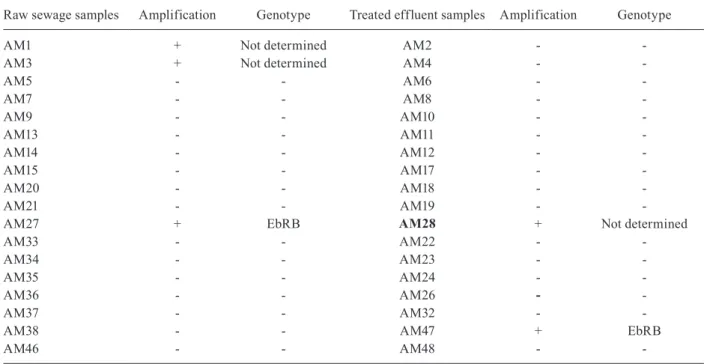
From the 18 raw sewage samples analysed by nested PCR (Table), three (16.6%) were positive for E. bieneusi (AM1, AM3, AM27), whereas out of 18 treated efflu-ent samples (Table), two (11.1%) were positive (AM28, AM47) (Fig. 4).
After sequencing all five positive samples, the E. bieneusi sequence was verified in four samples (AM3, AM27, AM28, and AM47). Sequencing of samples AM27 and AM47 revealed a novel E. bieneusi geno-type (EbRB). The closest match for EbRB is genogeno-type S7 (FJ439683) (syn. CHY1 KT267289) (Fig. 5), iso-lated from humans in the Netherlands (ten Hove et al. 2009), with five nucleotide differences. These sequences were deposited in GenBank under Accession Numbers KY363360 and KY593707. AM1, AM3, and AM28 were not successfully sequenced; hence, it was not possible to determine their genotypes.
Fig. 3: flow direction of the sewage in the combined system for wastewater treatment.
TABLE
Nested polymerase chain reaction (PCR) results of Enterocytozoon bieneusi and genotype in raw sewage and treated effluent samples from combined system for wastewater treatment
Raw sewage samples Amplification Genotype Treated effluent samples Amplification Genotype
AM1 + Not determined AM2 -
-AM3 + Not determined AM4 -
-AM5 - - AM6 -
-AM7 - - AM8 -
-AM9 - - AM10 -
-AM13 - - AM11 -
-AM14 - - AM12 -
-AM15 - - AM17 -
-AM20 - - AM18 -
-AM21 - - AM19 -
-AM27 + EbRB AM28 + Not determined
AM33 - - AM22 -
-AM34 - - AM23 -
-AM35 - - AM24 -
-AM36 - - AM26 -
-AM37 - - AM32 -
-AM38 - - AM47 + EbRB
AM46 - - AM48 -
DISCUSSION
In Brazil, prevalence surveys of HIV+ patients with diarrhoea showed that 5%, 27.5%, and 46.1% were in-fected by microsporidia (Wuhib et al. 1994, Brasil et al. 1996, 2000). Microsporidian spores were also identi-fied in 1.3% of immunosuppressed patients in the city of Goiânia (Goiás, Brazil) (de Souza Jr & García-Zapata
2006), and in 36% of rheumatic disease patients under-going anti-tumour necrosis factor therapy/anti-rheumatic drug treatment as compared to 4% of controls without diarrhoea (Aikawa et al. 2011). In 2013, Costa et al. (2013) described high positivity (40.3%) for microsporidia in pa-tients who underwent transplantation surgery in the Uni-versity Clinical Hospital, including bone marrow (75%), kidney (22%), and liver (3%) transplantation. These stud-ies have shown that microsporidiosis is associated with chronic diarrhoea in immunocompromised patients and other immunosuppressed individuals in Brazil.
E. bieneusi was confirmed by PCR and electron mi-croscopy as the only enteric pathogen found in five of 11 patients included in a cohort study of 40 HIV+ individuals with chronic diarrhoea in Rio de Janeiro state (Brasil et al. 2000). One HIV+ patient exhibited chronic diarrhoea and a CD4 level < 100 cells/mm3 (Brasil et al. 1998).
Although molecular studies of microsporidia in Bra-zil are still incipient, some investigations have demon-strated that E. bieneusi is a common species parasitis-ing animals in this country. There are reports in cattle (Fiuza et al. 2016a), pigs (Fiuza et al. 2015), sheep (Fiuza et al. 2016b), coatis (Lallo et al. 2012a), and birds (Lallo et al. 2012b, Cunha et al. 2016). These findings highlight the risk of human microsporidiosis by zoonotic trans-mission, since genotypes previously reported in both humans and animals were found in all animals surveyed in these studies, with the exception of coatis.
Many epidemiological studies have identified the consumption of untreated water as a potential risk fac-tor for microsporidiosis in humans (Didier et al. 2004, Wumba et al. 2012), and E. bieneusi spores have been found in surface water at relatively high frequencies (Graczyk et al. 2010, Galván et al. 2013, Guo et al. 2014). Guo et al. (2014) found that 58.2% of storm water sam-ples in the United States were positive for E. bieneusi us-ing filtration and PCR. In China, Hu et al. (2014) found E. bieneusi in 31.5% of drinking water samples, after episodes of water contamination with carcasses of do-mestic pigs. Galván et al. (2013) reported that 61% of domestic effluent samples in Madrid, Spain, contained microsporidia such as Encephalitozoon intestinalis, En-cephalitozoon cuniculi, Anncaliia algerae, and E. bi-eneusi (genotypes C and D).
Although preliminary, our findings are relevant since this is the first report of E. bieneusi occurrence in environmental samples in Brazil. DNA of microspo-ridian spores was amplified from two samples (AM27 and AM28), revealing the presence of E. bieneusi in both raw sewage and corresponding treated effluent samples. This finding demonstrates that the combined system did not achieve complete removal of E. bieneusi spores. This issue can be attributed to the low sedimentation rate of the spores in the decanted liquid of the combined sys-tem, thus they remained in the treated effluent.
Until date, over 201 genotypes of E. bieneusi have been reported based on nucleotide polymorphisms in the ITS region of the rRNA gene (Fayer & Santín-Du-ran 2014). While some genotypes are host-specific for humans, others show host specificity for animals, and some are zoonotic (Santín & Fayer 2011).
Fig. 5: phylogenetic relationships among the novel Enterocytozoon bieneusi genotype (EbRB, identified with a ●) found in raw sewage
and treated effluent, and E. bieneusi genotypes previously identified in water, humans and/or other hosts as inferred by a neighbor-joining analysis of the internal transcriber spacer (ITS) rRNA gene sequence, based on genetic distances calculated by the Kimura two-parameter model. Bootstrap values of less than 75% are not shown.
A novel E. bieneusi genotype (EbRB) was identified in a raw sewage (AM27) and a treated effluent (AM47) sample. The risks of human infection for this genotype are unknown. The closest match for this new strain is geno-type S7, which was previously reported in a diabetic pa-tient exhibiting severe diarrhoea and rectal bleeding (ten Hove et al. 2009), in horses (Santín et al. 2010), and in a yak (Bos grunniens) in a zoo in China (Li et al. 2015). Henriques-Gil et al. (2010) suggested that some geno-types of E. bieneusi circulate within a specific host spe-cies and are only occasionally transmitted to another host. Furthermore, contaminated water is a possible source of infection for transplant and HIV+ patients. Sewage dis-charges are a significant risk factor for the introduction of human enteropathogens into surface waters (Graczyk & Lucy 2007), and microsporidia spores are environmen-tally robust and ubiquitous in aquatic habitats (Graczyk et al. 2007). In addition, the present finding of E. bieneusi in treated effluent from the University Clinical Hospital is important from both public health and environmen-tal standpoints because this final effluent flows into the Ribeirão das Pedras stream, which runs through several neighbourhoods, and is discharged into the Anhumas stream, a tributary of the Atibaia River, the main water supply of the city of Campinas.
By using E. intestinalis in their assays, Gerba et al. (2003) evaluated spore removal through a conventional water treatment process on a pilot scale, and reported a high removal efficiency (2.47 log) using coagulation and sedimentation steps followed by a mixed media filtration. However, spore size can influence the removal efficiency attained by water and wastewater treatment plants, and E. bieneusi spores are smaller than those of E. intestinalis.
Negative removal efficiencies were obtained for E. bi-eneusi in two plants (-100%) by Cheng et al. (2011), who also reported high concentrations of microsporidian spores in inflowing wastewaters and in wastewater processing end-products (biosolids and final effluents) in Ireland. Therefore, spore identification, removal, and inactivation in drinking water and wastewater treatment processes re-main technological challenges (Graczyk & Lucy 2007).
Microsporidia were included in the United States Environmental Protection Agency’s Contaminant Can-didate List in 1998 and 2005 (Guillot & Loret 2009), and are currently considered as Category B priority patho-gens by the National Institute of Allergy and Infectious Diseases (NIAID, National Institutes of Health, Bethes-da, MD, USA - niaid.nih.gov/topics/biodefenserelated/ biodefense/pages/cata.aspx) due to their impact on pub-lic health. However, the Brazilian Drinking Water Leg-islation (MS 2011) (Federal Decree 2914/Health Min-istry) published in 2011 did not address microsporidia monitoring in the water supply.
The presence of E. bieneusi spores in the final ef-fluent reported in this study suggests that E. bieneusi contamination by human sources may be occurring at the Atibaia River basin. Thus, enteropathogen source-tracking research in wastewater treatment plants is criti-cal, considering that surface water supplies in Brazil receive large amounts of raw sewage (Sodré et al. 2010).
ACKNOWLEDGEMENTS
To Mônica Santín-Duran, of the United States Department of Agriculture (Washington, DC, USA), for support in confir-mation of the novel Enterocytozoon bieneusi genotype.
AUTHORS’ CONTRIBUTION
SY - Conceived the study, participated in its design, con-ducted the study, concon-ducted the analysis of laboratory tests, and participated in data acquisition and drafting of the manuscript; VRSF - conducted the phylogenetic analysis, and participated in data acquisition and drafting of the manuscript; ATLST, NB, CEL and ICVSC - participated in data acquisition; RMBF - conceived the study, participated in its design, conducted the study, and par-ticipated in data acquisition and drafting of the manuscript.
REFERENCES
Aikawa NE, Twardowsky AO, Carvallho JF, Silva CA, Silva IL, Ribeiro AC, et al. Intestinal microsporidiosis: a hidden risk in rheumatic disease patients undergoing anti-tumor necrosis fator therapy combined with disease-modifying anti-rheumatic drugs? Clinics. 2011; 66(7): 1171-5.
Ayed LB, Yang W, Widmer G, Cama V, Ortega Y, Xiao L. Survey and genetic characterization of wastewater in Tunisia for Cryptospori- dium spp., Giardia duodenalis, Enterocytozoon bieneusi, Cyclospora cayetanensis and Eimeria spp. J Water Health. 2012; 10(3): 431-44.
Brasil P, de Lima DB, de Paiva DD, Lobo MS, Sodré FC, Silva SP, et al. Clinical and diagnostic aspects of intestinal microsporidiosis in HIV-infected patients with chronic diarrhea in Rio de Janeiro, Brazil. Rev Inst Med Trop São Paulo. 2000; 42(6): 299-304.
Brasil P, de Paiva DD, de Lima DB, da Silva EJ, Peralta JM, da Silva AJ, et al. A 3-year follow-up of a Brazilian AIDS patient with protracted diarrhea caused by Enterocytozoon bieneusi. Rev Inst Med Trop São Paulo. 1998; 40(4): 215-8.
Brasil P, Sodré FC, Cuzzi-Maya T, Gutierrez Mc, Mattos H, Moura H. Intestinal microsporidiosis in HIV-positive patients with chronic unexplained diarrhea in RJ, Brasil: diagnosis, clinical presentation and follow-up. Rev Inst Med Trop São Paulo. 1996; 38(2): 97-102.
Buckholt MA, Lee JH, Tzipori S. Prevalence of Enterocytozoon bi-eneusi in swine: an 18-month survey at a slaughterhouse in Mas-sachusetts. Appl Environ Microbiol. 2002; 68(5): 2595-9.
Cantusio Neto R, Santos LU, Franco RMB. Evaluation of activated sludge treatment and the efficiency of the disinfection of Giardia
species cysts and Cryptosporidium oocysts by UV at a sludge treatment plant in Campinas, Southeast Brazil. Water Sci Tech-nol. 2006; 54(3): 89-94.
Cheng H-W A, Lucy FE, Graczyk TK, Broaders MA, Mastitsky SE. Municipal wastewater treatment plants as removal systems and environmental sources of human-virulent microsporidian spores. Parasitol Res. 2011; 109(3): 595-603.
Costa LNG, Marson FAL, Teixeira ATLS, Sales CRM, Levy CE. In-testinal microsporidiosis in a reference center. Letter to the edi-tor. Braz J Infect Dis. 2013; 17(6): 724-5.
Cotte L, Rabodonirina M, Chapuis F, Bailly F, Bissuel F, Raynal C, et al. Waterborne outbreak of intestinal microsporidiosis in persons with and without human immunodeficiency virus infection. J In-fect Dis. 1999; 180(6): 2003-8.
de Souza Jr ES, García-Zapata MT. Laboratory diagnosis of opportu-nistic intestinal parasites with emphasis on human microsporidi-osis, in Goiânia/GO. Rev Soc Bras Med Trop. 2006; 39(6): 560-4.
Decraene V, Lebbad M, Botero-Kleiven S, Gustavsson A-M, Löfdahl M. First reported foodborne outbreak associated with microsporid-ia, Sweden, October 2009. Epidemiol Infect. 2012; 140(3): 519-27.
Didier ES, Storvall ME, Green LC, Brindley PJ, Sestak K, Didier PJ. Epidemiology of microsporidiosis: sources and modes of trans-mission. Vet Parasitol. 2004; 126(1-2): 145-66.
Didier ES, Weiss LM. Microsporidiosis: current status. Curr Opin In-fect Dis. 2006; 19(5): 485-92.
Didier ES, Weiss LM. Microsporidiosis: not just in AIDS patients. Curr Opin Infect Dis. 2011; 24(5): 490-5.
Dowd SE, Gerba CP, Pepper IL. Confirmation of the human-patho-genic microsporidia Enterocytozoon bieneusi, Encephalitozoon intestinalis, and Vittaforma corneae in water. Appl Environ Mi-crobiol. 1998; 64(9): 3332-5.
Fayer R, Santín-Duran M. Epidemiology of microsporidia in hu-man infections. In: Weiss LM, Becnel JJ, editors. Microsporidia: pathogens of opportunity. Chichester: John Wiley & Sons, Inc.; 2014. p. 135-64.
Feng Y, Li N, Dearen T, Lobo ML, Matos O, Cama V, et al. Devel-opment of a multilocus sequence typing tool for high-resolution genotyping of Enterocytozoon bieneusi. Appl Environ Microbiol. 2011; 77(14): 4822-8.
Field AS, Milner Jr DA. Intestinal microsporidiosis. Clin Lab Med. 2015; 35(2): 445-59.
Fiuza VRS, Lopes CWG, Cosendey RIJ, Oliveira FCR, Fayer R, Santín M. Zoonotic Enterocytozoon bieneusi genotypes found in Brazilian sheep. Res Vet Sci. 2016b; 107: 196-201.
Fiuza VRS, Lopes CWG, Oliveira FCR, Fayer R, Santín M. New find-ings of Enterocytozoon bieneusi in beef and dairy cattle in Brazil. Vet Parasitol. 2016a; 216: 46-51.
Fiuza VRS, Oliveira FCR, Fayer R, Santín M. First report of Enterocy-tozoon bieneusi in pigs in Brazil. Parasitol Int. 2015; 64(4): 18-23.
Fournier S, Dubrou S, Liguory O, Gaussin F, Santillana-Hayat M, Sarfati C, et al. Detection of microsporidia, cryptosporidia and
Giardia in swimming pools: a one-year prospective study. FEMS Immunol Med Microbiol. 2002; 33(3): 209-13.
Franco RMB, Rocha-Eberhardt R, Cantusio Neto R. Occurrence of
Cryptosporidium oocysts and Giardia cysts in raw water from the Atibaia River, Campinas, Brazil. Rev Inst Med Trop São Pau-lo. 2001; 43(2): 109-19.
Galván AL, Magnet A, Izquierdo F, Fenoy S, Rueda C, Vadillo CF, et al. Molecular characterization of human-pathogenic microspo-ridia and Cyclospora cayetanensis isolated from various water sources in Spain: a year-long longitudinal study. Appl Environ Microbiol. 2013; 79(2): 449-59.
Galván AL, Sánchez AMM, Pérez-Valentin MA, Henriques-Gil N, Isquierdo F, Fenoy S, et al. First cases of microsporidiosis in transplant recipients in Spain and review of the literature. J Clin Microbiol. 2011; 49(4): 1301-6.
Gerba CP, Riley KR, Nwachuku N, Ryu H, Abbaszadegan M. Remov-al of Encephalitozoon intestinalis, calicivirus, and coliphages by conventional drinking water treatment. J Environ Sci Health A Tox Hazard Subst Environ Eng. 2003; 38(7): 1259-68.
Graczyk TK, Lucy FE, Tamang L, Miraflor A. Human enteropathogens load in activated sewage sludge and corresponding sewage sludge-end products. Appl Environ Microbiol. 2007; 73(6): 2013-15.
Graczyk TK, Lucy FE. Quality of reclaimed waters: a public health need for source tracking of wastewater-derived protozoan entero-pathogens in engineered wetlands. Trans R Soc Trop Med Hyg. 2007; 101(6): 532-3.
Graczyk TK, Sunderland D, Awantang GN, Mashinski Y, Lucy FE, Graczyk Z, et al. Relationships among bather density, levels of human waterborne pathogens, and fecal coliform counts in ma-rine recreational beach water. Parasitol Res. 2010; 106(5): 1103-8.
Guillot E, Loret J-F. Waterborne pathogens: review for the drinking-water industry. IWA Publishing. 2009; 194 pp.
Guo Y, Alderisio KA, Yang W, Cama V, Feng Y, Xiao L. Specificity and source of Enterocytozoon bieneusi genotypes in a drinking source watershed. Appl Environ Microbiol. 2014; 80(1): 218-25.
Henriques-Gil N, Haro M, Izquierdo F, Fenoy S, del Águila C. Phy-logenetic approach to the variability of the microsporidian, En-terocytozoon bieneusi and its implications for inter- and intrahost transmission. Appl Environ Microbiol. 2010; 76(10): 3333-42.
Hu Y, Feng Y, Huang C, Xiao L. Occurrence, source, and human infec-tion potential of Cryptosporidium and Enterocytozoon bieneusi in drinking source water in Shanghai, China, during a pig carcass disposal incident. Environ Sci Technol. 2014; 48(24): 14219-27.
Kumar S, Stecher G, Tamura K. Mega 7: molecular evolutionary genetics analysis version 7.0 for bigger datasets. Mol Biol Evol. 2016; 33(7): 1870-4.
Lallo MA, Calábria P, Bondan EF, Milanelo L. Identification of En-cephalitozoon and Enterocytozoon (microsporidia) spores in stool and urine samples obtained from free-living South American Coa-tis (Nasua nasua). Appl Environ Microbiol. 2012a; 78(12): 4490-2.
Lallo MA, Calábria P, Milanelo L. Encephalitozoon and Enterocytozoon
(microsporidia) spores in stool from pigeons and exotic birds. Mi-crosporidia spores in birds. Vet Parasitol. 2012b; 190(3-4): 418-22.
Li J, Qi M, Chang Y, Wang R, Li T, Dong H, et al. Molecular char-acterization of Cryptosporidium spp., Giardia duodenalis, and
Enterocytozoon bieneusi in captive wildlife at Zhengzhou Zoo, China. J Eukaryot Microbiol. 2015; 62(6): 833-9.
Li N, Xiao L, Wang L, Zhao S, Zhao X, Duan L, et al. Molecular surveillance of Cryptosporidium spp., Giardia duodenalis, and
Enterocytozoon bieneusi by genotyping and subtyping parasites in wastewater. PLoS Negl Trop Dis. 2012; 6(9): e1809.
Li X, Palmer R, Trout JM, Fayer R. Infectivity of microsporidia spores stored in water at environmental temperatures. J Parasitol. 2003; 89(1): 185-8.
Ma J, Feng Y, Hu Y, Villegas EN, Xiao L. Human infective potential of Cryptosporidium spp., Giardia duodenalis and Enterocyto-zoon bieneusi in urban wastewater treatment plant effluents. J Water Health. 2016; 14(3): 411-23.
MS - Ministério da Saúde. Portaria 2914/MS. 2011. Available f rom: ht t p:// bvsms.saude.gov.br/ bvs/saudelegis/g m /2011/ prt2914_12_12_2011.html.
Saitou N, Nei M. The neighbor-joining method: a new method for re-constructing phylogenetic trees. Mol Biol Evol. 1987; 4(4): 406-25.
Santín M, Fayer R. Microsporidiosis: Enterocytozoon bieneusi in do-mesticated and wild animals. Res Vet Sci. 2011; 90(3): 363-71.
Santín M, Vecino JAC, Fayer R. A zoonotic genotype of Enterocyto-zoon bieneusi in horses. J Parasitol. 2010; 96(1): 157-61.
Sodré FF, Locatelli MAF, Jardim WT. Occurrence of emerging con-taminants in Brazilian drinking waters: a sewage-to-tap issue. Water Air Soil Poll. 2010; 206(1): 57-67.
et al. Detection of microsporidia and identification of Enterocy-tozoon bieneusi in surface water by filtration followed by specific PCR. J Eukaryot Microbiol. 1997; 44(6): 78S.
ten Hove RJ, van Leshout L, Beadsworth MBJ, Perez MA, Spee K, Claas ECJ, et al. Characterization of genotypes of Enterocytozo-on bieneusi in immunosuppressed and immunocompetent patient groups. J Eukaryot Microbiol. 2009; 56(4): 388-93.
Vávra J, Lukes J. Microsporidia and “the art of living together”. Adv Parasitol. 2013; 82: 253-319.
Weiss LM, Becnel JJ. Microsporidia: pathogens of opportunity. 1st ed. United Kingdom: John Wiley & Sons, Inc; 2014. 709 pp.
Weiss LM. Clinical syndromes associated with microsporidiosis. In: Weiss LM, Becnel JJ, editors. Microsporidia: pathogens of op-portunity. 1st ed. United Kingdom: John Wiley & Sons, Inc; 2014. p. 371-401.
Wuhib T, Silva TM, Newman RD, Garcia LS, Pereira ML, Chaves CS, et al. Cryptosporidial and microsporidial infections in human immunodeficiency virus-infected patients in northeastern Brazil. J Infect Dis. 1994; 170(2): 494-7.