ONE-STEP PURIFICATION AND CHARACTERIZATION OF CELLULASE-FREE XYLANASE PRODUCED BY
ALKALOPHILICBACILLUS SUBTILIS ASH
Ashwani Sanghi1; Neelam Garg2; V.K.Gupta1∗∗∗∗; Ashwani Mittal1; R.C.Kuhad3
1
Department of Biochemistry, Kurukshetra University, Kurukshetra, India; 2Department of Microbiology, Kurukshetra University,
Kurukshetra, India; 3Department of Microbiology, University of Delhi South Campus, New Delhi, India
Submitted: September 30, 2008; Returned to authors for corrections: February 11, 2009; Approved: September 23, 2009.
ABSTRACT
The present study describes the one-step purification and characterization of an extracellular cellulase-free
xylanase from a newly isolated alkalophilic and moderately thermophilic strain of Bacillus subtilis ASH.
Xylanase was purified to homogeneity by 10.5-fold with ~43% recovery using ion-exchange
chromatography through CM-Sephadex C-50. The purified enzyme revealed a single band on SDS-PAGE
gel with a molecular mass of 23 kDa. It showed an optimum pH at 7.0 and was stable over the pH range
6.0-9.0. The optimum temperature for enzyme activity was 55 °C. The purified xylanase did not lose any
activity up to 45 ºC, however, it retained 80% and 51% of its activity after pre-incubation at 55 ºC and 60
ºC, respectively. The enzyme obeyed Michaelis-Menton kinetics towards birch wood xylan with apparent
Km 3.33 mg/ml and Vmax 100 IU/ml. The enzyme was strongly inhibited by Hg 2+
andCu2+ while enhanced
by Co2+ and Mn2+. The purified enzyme could be stored at 4 ºC for six weeks without any loss of catalytic
activity. The faster and economical purification of the cellulase-free xylanase from B. subtilis ASH by
one-step procedure together with its appreciable stability at high temperature and alkaline pH makes it
potentially effective for industrial applications.
Key words: Alkalophilic, Bacillus subtilis, Purification, Xylanase
INTRODUCTION
Xylanase (endo-1, 4- -D-xylanohydrolase; EC 3.2.1.8) is a
hydrolytic enzyme involved in depolymerization of xylan, the
major renewable hemicellulosic polysaccharide of plant cell
wall. It is produced by bacteria (11, 19, 37, 41), fungi (29, 34,
41), actinomycetes (33) and yeast (26). Recently, interest in
xylanase has markedly increased due its wide variety of
biotechnological applications such as pre-bleaching of pulp,
improving the digestibility of animal feed stocks, modification
of cereal-based stuffs, bioconversion of lignocellulosic material
and agro-wastes to fermentable products, clarification of fruit
juices and degumming of plant fibers (15, 21, 44) etc.
Cellulase-free xylanases active at high temperature and pH are
gaining importance in pulp and paper industry as they reduce
the need for toxic chlorinated compounds making the bleaching
process environment-friendly (40, 43).
The industrial application of xylanase may be limited by
its high cost of production. The use of cost-effective
agro-residues as substrates in solid state fermentation may reduce
*Corresponding Author. Mailing address: Department of Biochemistry, Kurukshetra University, Kurukshetra -136 119, India.; Tel.: +91-9416782476 (Mobile)
the cost of enzyme production substantially (37). Solid state
fermentation offers several advantages over submerged
fermentation including simplicity of media, greater product
yield, easier scale up of process, economy of space, no
complex machinery, equipment and control systems etc (2, 14).
In order to investigate the biotechnological applications of this
enzyme, it would be desirable to purify and characterize it.
Presently, purification and characterization costs are becoming
important issues in modern biotechnology as the industry
matures and competitive products reach the market. Although,
purification of microbial xylanase has been reported by several
investigators using a combination of two or more standard
enzyme purification techniques yet it would be advantageous to
develop a one-step purification procedure so as to reduce the
enzyme cost. In this study, we report a single step purification
and characterization of an extracellular cellulase-free xylanase
from an alkalophilic and moderately thermophilic strain of
Bacillus subtilis ASH 7414 isolated from soil.
MATERIALS AND METHODS
Microbial strain and its growth conditions
The xylanase-producing bacterial strain used in this study
was isolated from soil sample collected locally from
Kurukshetra, India, by using enrichment technique with wheat
bran as a source of carbon. The organism was identified as
Bacillus subtilis ASH 7414 on the basis of its morphological,
physiological and biochemical characteristics by the Institute
of Microbial Technology (IMTECH). It was assigned the
accession number MTCC 7414. The culture was maintained at
4 ºC on nutrient agar medium (in g/l: peptone, 5.0; beef extract,
3.0; NaCl, 5.0; pH 7.0; 2 % agar).
Xylanase production and extraction
Xylanase was produced by B. subtilis ASH 7414 in
solid-state fermentation. Erlenmeyer flasks each containing 10g
wheat bran and 25 ml mineral salt solution (in g/l:
MgSO4.7H2O, 0.2; K2HPO4, 0.4; pH 7.0) were autoclaved at
1.05 kg/cm2 for 45 min and cooled. After inoculation with 10%
(v/w) of 18 h old inoculum, the flasks were incubated at 37 ºC
for 72 h. The flasks were gently tapped intermittently to mix
the contents. The incubator was humidified by keeping a tray
containing sterile distilled water.
Xylanase was extracted from the above bacterial bran with
100 ml of sodium phosphate buffer (0.05 M, pH 7.0) by gently
squeezing through a wet muslin cloth followed by
centrifugation at 10,000 x g for 30 min at 4ºC. The clear
supernatant (crude extract) was used for xylanase purification.
Xylanase assay
Xylanase activity was assayed by measuring the amount of
reducing sugars liberated from birchwood xylan using 3,
5-dinitrosalicylic acid (28). The reaction mixture (1.0 ml)
containing 0.5 ml of 1 % birchwood xylan (prepared in 0.05M
sodium phosphate buffer, pH 7.0) as substrate, 0.02 ml of
appropriately diluted enzyme extract and 0.48 ml of sodium
phosphate buffer (0.05M, pH 7.0) was incubated at 55 ºC for 5
min and then the reaction was terminated by adding 3.0 ml of
3, 5-dinitrosalicylic acid reagent. A control was run
simultaneously which contained all the reagents but the
reaction was terminated prior to the addition of enzyme extract.
The test tubes were placed in a boiling water bath for 10 min.
After cooling to room temperature, the absorbance of the
resulting red color was measured against the control at 540 nm
using a double beam spectrophotometer (Systronics 2202,
India). One unit of xylanase activity was defined as the amount
of enzyme catalyzing the release of 1 mol/min of reducing
sugars equivalent to xylose under the specified assay
conditions. Cellulase activity was assayed as above, using low
viscosity carboxymethylcellulose (1%) in place of xylan as
substrate. All the experiments were carried out independently
in triplicate and the results presented are mean of the three
values.
Protein estimation
Protein was estimated by the Lowry’s method using
bovine serum albumin as standard (27).The protein content of
the chromatographic fractions was measured by monitoring the
Purification of xylanase
The crude enzyme extract was chromatographed on
CM-Sephadex C-50 column (20 cm × 2.0 cm), pre-equilibrated with
50 mM sodium phosphate buffer (pH 6.0). The column was run
at a flow rate of 40 ml/h. The bound proteins were eluted using
a continuous gradient of 0-1.0 M NaCl. Fractions of 5 ml each
were collected and analyzed for protein content and xylanase
activity. The fractions containing enzyme activity were pooled
and concentrated using Amicon ultrafiltration cell membrane
(10 kDa cut off).
Checking of enzyme homogeneity
The purity of the enzyme was checked by performing 12%
SDS-PAGE as described by Laemmli (22). Protein bands were
visualized by staining with coomassie brilliant blue R-250. A
reverse phase C-18 column (4.6 x 250 mm; E. Merck,
Germany) of High Performance Liquid Chromatography
(HPLC System 600 Waters, Waters Corporation,
Massachusetts, USA) was also employed to test the enzyme
purity. The sample components were separated using the
solvent system acetonitrile-water (70:30) at a flow rate of 0.5
ml/min. A highly sensitive photo-diode array (PDA) detector
(996 Waters) was set to read the absorbance at 280 nm.
Characterization of the purified enzyme
Molecular weight determination
Molecular weight (MW) of the purified xylanase was
estimated by SDS-PAGE and gel filtration. SDS–PAGE was
performed as described above using molecular weight markers
viz. lysozyme (14.3 kDa), trypsinogen (24 kDa), pepsin (34.7
kDa), ovalbumin (46 kDa) and BSA (66 kDa). Gel filtration
chromatography was performed on a Sephadex G-100 column
(90 cm x 0.8 cm), pre-equilibrated with 50 mM sodium
phosphate buffer, pH 6.0. The purified enzyme was loaded
onto top of this column, which was run at 15 ml/h and fractions
of 3 ml each were collected. A mixture of gel filtration protein
molecular weight markers viz. carbonic anhydrase (29 kDa),
BSA (66 kDa), alcohol dehydrogenase (150 kDa) and
-amylase (205 kDa) was also separated on the same column
under identical conditions and their elution volumes were
determined. A standard graph was then plotted between Ve/Vo
on x-axis and log MW on y-axis for calculation of molecular
weight of the purified xylanase.
Determination of Km and Vmax
Initial reaction rate of birchwood xylan hydrolysis was
determined by varying its concentration in the range of 1 to 15
mg/ml in standard xylanase assay and the double reciprocal
plot was drawn. The kinetic parameters Km and Vmax were
estimated from this plot (25).
Effect of temperature on activity and stability of xylanase
The optimum temperature for the purified xylanase
activity was determined by assaying the enzyme activity at
different temperatures ranging from 30-65 oC. To investigate
the thermal stability of the purified xylanase, an aliquot of the
enzyme was pre-incubated at different temperatures (30-60 oC)
for 10 min at pH 7.0, quickly chilled and assayed for its
residual activity at 55 oC.
Effect of pH on activity and stability of xylanase
The effect of pH on xylanase activity was studied by
carrying out the enzyme assay using buffers of different pH
ranging from 4.0 to 10.0. Three different buffers (each at
0.05M) viz. citrate buffer (pH 4.0-6.0), phosphate buffer (pH
6.0-8.0) and Tris-HCl (pH 8.0-10.0) were used for this study.
To test the pH stability of the enzyme, an aliquot of the
purified enzyme was pre-incubated with the above mentioned
buffers of different pH (4.0 – 9.0) for 10 min at room
temperature followed by measurement of xylanase activity
using sodium phosphate buffer (0.05M, pH 7.0). The residual
activity (%) at each pH was calculated.
Effect of metal ions
The purified enzyme was incubated with various metal
salts viz. ZnCl2, CaCl2, HgCl2, NaCl, KCl, FeCl3, MgCl2,
CoCl2, CdCl2, NiCl2, CuCl2 and MnCl2 at a final concentration
activity was assayed. The residual activity (%) was then
calculated.
Determination of shelf life
The shelf life of the purified enzyme was determined by
keeping it in a refrigerator (4°C) and at room temperature.
Enzyme samples were withdrawn at different intervals up to 10
weeks and the residual xylanase activity was determined.
RESULTS AND DISCUSSION
Microbial strain and its growth conditions
Bacillus subtilis ASH is an alkalophile being capable of
growing at pH values up to 11.0. It is a moderate thermophile
with minimum, optimum and maximum temperature for
growth at 15, 37 and 55ºC, respectively (37).
Enzyme activity
The bacterium produced high levels of xylanase (8,964
U/g dry wheat bran) in solid state fermentation under
optimized conditions. The enzyme was cellulase-free as the
crude extract was devoid of cellulase activity. Lignocellulosic
materials have been used earlier by various researchers for
production of xylanase but with lower activity (3, 9, 12).
Purification of xylanase
Xylanase produced by B. subtilis ASH in solid state
fermentation on wheat bran was purified to apparent
homogeneity by a single step chromatographic procedure.
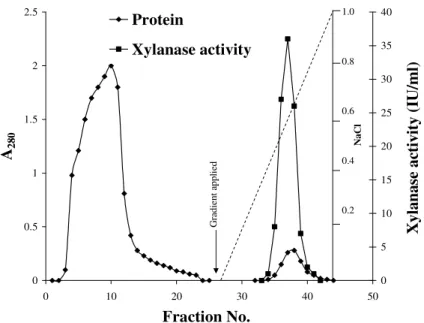
After loading the crude extract onto the column of
CM-Sephadex C-50, the enzyme eluted as a single peak in bound
fractions at 0.675 M NaCl as shown in Fig. 1. The fractions
containing enzyme activity were pooled and concentrated using
Amicon ultrafiltration cell membrane (10 kDa cut off). The
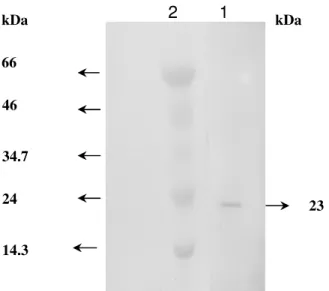
purity of the purified enzyme was checked by SDS-PAGE and
reverse phase HPLC on C-18 column. The purified enzyme
showed a single band in SDS-PAGE gel indicating that it was
homogeneous (Fig. 2). HPLC chromatogram of the purified
enzyme also revealed a single peak at a retention time of 2.513
min confirming that it was a pure preparation (Fig. 3). The
yield of the purified xylanase was 43.05% with a specific
activity of 1275.5 IU/mg and an overall purification fold of
10.5 (Table 1).
0 0.5 1 1.5 2 2.5
0 10 20 30 40 50
Fraction No.
A
28
0
0 5 10 15 20 25 30 35 40
X
y
la
n
a
se
a
ct
iv
it
y
(
IU
/m
l)
Protein
Xylanase activity
1.0
0.8
0.6
0.4
0.2
N
a
C
l
Fig 1
G
ra
d
ie
n
t
ap
p
li
ed
Figure 1. Purification of xylanase by ion-exchange chromatography through CM-Sephadex C-50 column (20 × 2.0 cm)
pre-equilibrated with 50 mM sodium phosphate buffer, pH 6.0. The bound proteins were eluted using a linear gradient of 0-1.0 M
Figure 2. SDS-PAGE analysis of the purified xylanase from
Bacillus subtilis ASH. Lane 1: purified xylanase; Lane 2:
molecular weight markers viz. lysozyme (14.3 kDa),
trypsinogen (24 kDa), pepsin (34.7 kDa), ovalbumin (46 kDa)
and BSA (66 kDa). Electrophoresis was performed using 12%
polyacrylamide gel. The gel was stained with coomassie
brilliant blue R-250.
Figure 3. HPLC profile of the purified xylanase from Bacillus
subtilis ASH using a reverse phase C-18 column (4.6 x 250
mm). The purified enzyme (10 µl) was injected into the loop of
column and eluted with acetonitrile-water (70:30) at a flow rate
of 0.5 ml/min. A photo-diode array (PDA) detector was set to
read the absorbance at 280 nm.
Table 1. Purification of xylanase from Bacillus subtilis ASH. The enzyme was produced in solid state fermentation using wheat
bran and the crude extract obtained after 72 h incubation was subjected to purification.
One-step chromatographic procedure for purification of
xylanase from B. subtilis ASH is rapid and economical which
is desirable for its industrial application. Other research groups
reported purification of xylanase by employing a combination
of two or more different methods including salt fractionation,
ion-exchange, gel filtration and hydrophobic interaction
chromatography (1, 5, 7, 16, 24, 29, 35, 36). The overall
purification in the present study using one step was higher than
that reported from Bacillusamyloliquefaciens (7) and Bacillus
circulans (36) using a multistep sequence of purification.
Further, recovery of the purified enzyme from B.subtilis ASH
following one step protocol was better than that obtained by
using multistep protocol (1, 5, 16, 24). However, grouping of
two or more techniques resulted in higher purification fold (1,
5, 16, 24, 35) or recovery (7).
Purification step Total
activity
(IU)
Total
Protein
(mg)
Specific activity
(IU/mg protein)
Recover
y (%)
Purification
fold
Crude extract 4000 33.0 121.2 100.0 1.0
CM-Sephadex C-50 1722 1.35 1275.5 43.05 10.5
kDa
66
46
34.7
24
14.3
2
1
kDaMolecular weight determination
The purified enzyme showed a single protein band on
SDS-PAGE corresponding to a molecular mass of 23 kDa (Fig.
2). The purified enzyme eluted as a single peak when applied
to Sephadex G-100 column (Fig. 4) with a molecular weight 23
kDa as calculated from the standard graph (Fig. 5). An
identical molecular mass obtained by gel filtration
chromatography and SDS-PAGE suggested that the enzyme
was a monomer consisting of a single polypeptide chain.
The molecular weight of B. subtilis ASH xylanase was
identical to the enzyme reported from B. circulans AB16 (10),
Bacillus sp. strain TAR-1 (42), Bacillus licheniformis A99 (1),
Arthrobacter sp. (16), Paecilomyces themophila (23) and
Streptomyces cyaneus SN32 (33). However, it was higher than
5.5 kDa as observed by Bastawde (4). In contrast, some
workers documented a higher molecular weight than that
observed in the present study (5, 19, 20, 38, 39). Low
molecular weight xylanases are preferred for commercial
application in paper and pulp industry as they penetrate
throughout the pulp fibres more effectively to hydrolyze xylan
making the fiber structure more permeable to extraction of
lignin by chemicals (21).
0 0.2 0.4 0.6 0.8 1 1.2 1.4 1.6 1.8 2
0 5 10 15 20 25 30 35 40
Fraction No. A2
8
0
0 5 10 15 20 25 30
X
y
la
n
a
se
a
ct
iv
it
y
(
IU
/m
l)
Protein
Xylanase activity
Figure 4. Elution profile of the purified xylanase through Sephadex G-100 column (90 x 0.8 cm) eluted with 50 mM sodium phosphate
buffer, pH 6.0 at 15 ml/h. Fractions of 3 ml each were collected and analyzed for enzyme activity and protein.
Figure 5. Determination of molecular weight of the purified xylanase from Bacillus subtilis ASH by gel filtration through Sephadex
G-100 column. The elution volume of the purified enzyme and molecular weight marker proteins viz. carbonic anhydrase (29 kDa), BSA
Determination of Km and Vmax
The activity of the purified xylanase from B. subtilis ASH,
measured at various concentrations of birch wood xylan (1-15
mg/ml) as substrate, exhibited a rectangular hyperbolic
response thus obeying Michaelis-Menton Kinetics. The
apparent Km and Vmax values obtained from the
Lineweaver-Burk plot (1/v versus 1/[S]) were 3.33 mg/ml and 100 IU/ml,
respectively. These values were comparable to those for
xylanases isolated from Bacillus sp. strain 41-1 (31), Bacillus
sp NCIM 59 (32), B. circulans Teri-42 (36), Aspergillus niger
(29) and Thermomyces lanuginosus (24). However, some
xylanases were found to have lower Km ranging from 0.025-1.7
mg/ml (8, 16, 23, 38).
Effect of temperature on xylanase activity and stability
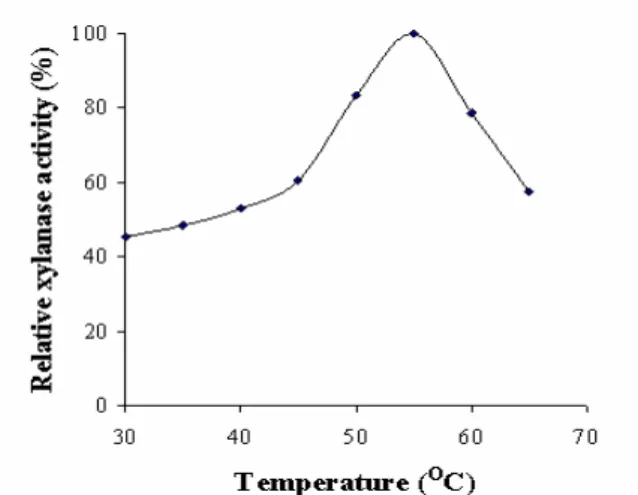
Measurement of xylanase activity at different temperatures
showed that the activity increased up to 55 ºC and then
declined progressively retaining 57% of the residual activity at
65 ºC. The optimum temperature of the purified xylanase from
B. subtilis ASH was 55 ºC as the enzyme was most active at
this temperature (Fig. 6). Thermostability study of the purified
enzyme revealed that it did not lose any activity up to 45 ºC.
However, it retained 80% and 51% of its activity after
pre-incubation at 55 ºC and 60 ºC respectively (Fig. 7). Significant
enzyme stability at higher temperatures would be important for
its industrial application. Purified xylanases exhibiting
optimum temperature in the range of 50-55 ºC have been
reported from several Bacillus and Streptomyces sp. (1, 6, 38,
44). However, some xylanases showed higher temperature
optima (5, 7, 16, 18, 24).
Effect of pH on xylanase activity and stability
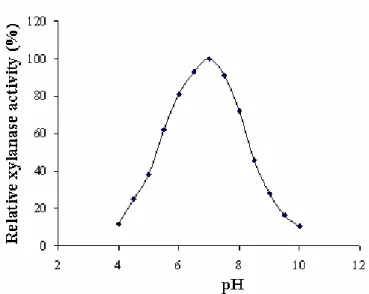
The purified enzyme showed more than 90% activity in
the pH range 6.5 to 7.5 with maximum at pH 7.0. It was active
at alkaline pH values although, to a lesser extent than at pH 7.0
(Fig. 8). The enzyme retained 80%, 28% and 10% activity
when assayed at pH 8.0, 9.0 and 10.0, respectively. Maximum
pH stability of the purified xylanase from B. subtilis ASHwas
between pH 6.0-7.5. On pre-incubation for 10 min at pH 8.0
and 9.0, the residual enzyme activity was 85% and 50%,
respectively (Fig. 9). A similar pH optimum was reported for
xylanase isolated from Bacillus spp. (7, 18, 30, 36),
Staphylococcus sp. (13), Paecilomyces themophila (23) and
Thermomyces lanuginosus (24). However, some xylanases
exhibited optimum pH at 6.0 (5, 33). Xylanase from
alkalophilic Bacillus sp. strain 41M-1 showed a broad pH
activity profile in the range of pH 4.0-11.0 (31). The pH
stability of the purified thermoalkalophilic xylanase of Bacillus
sp. ranged from 6.0–10.5 (36). A considerable stability of B.
subtilis ASH xylanase at alkaline pH values makes it
potentially effective for use in industry.
Figure 6. Temperature optima of the purified xylanase from
Bacillus subtilis ASH. The enzyme activity was assayed at
different temperatures ranging from 30-65 oC and relative
xylanase activity (%) was calculated.
Figure 7. Thermostability of the purified xylanase from Bacillus
subtilis ASH. The purified enzyme was pre-incubated at different
temperatures (30-60 oC) for 10 min at pH 7.0, quickly chilled and
Figure 8. pH optima of the purified xylanase from Bacillus.
subtilis ASH. The enzyme activity was determined at different
pH using citrate (pH 4.0-6.0), phosphate (pH 6.0-8.0) and
Tris-HCl (pH 8.0-10.0) buffers.
Figure 9. pH stability of the purified xylanase from Bacillus
subtilis ASH. The purified enzyme was pre-incubated with
citrate (pH 4.0-6.0), phosphate (pH 6.0-8.0) and Tris-HCl (pH
8.0-9.0) buffers for 10 min at room temperature followed by
measurement of xylanase activity using sodium phosphate
buffer (0.05M, pH 7.0). The residual activity (%) at each pH
was calculated.
Effect of metal ions on xylanase activity
Xylanase activity was strongly inhibited by Hg2+ which
might be due to its interaction with sulfhydryl groups present
on the enzyme. Cu2+ ions were also found to be inhibitory
causing 30% inhibition of enzyme activity (Table 2). Some
other metal ions like Na2+, K+, Ca2+, Ni2+ and Zn2+ decreased
the enzyme activity but to a very less extent. In contrast,
xylanase activity was enhanced in the presence of Co2+ and
Mn2+ with 20% and 85% increase as compared to the control.
HgCl2 has earlier been reported to completely inhibit the
activity of xylanase from different sources (5, 16, 17, 36). An
increase in xylanase activity in the presence of MnCl2 has also
been reported by several workers (5, 13, 19).
Table 2. Effect of metal ions on the activity of purified
xylanase from Bacillus subtilis ASH. The purified enzyme was
incubated with various metal salts at 1mm concentration for 5
min at room temperature and the xylanase activity was assayed.
Metal ion (1 mM)
Xylanase activity (IU/ml)
Xylanase activity (% of control)
Control 85.3 100.0
ZnCl2 73.6 86.3
CaCl2 71.6 84.0
HgCl2 4.9 5.7
NaCl 75.5 88.5
KCl 71.7 84.1
FeCl3 78.7 92.3
MgCl2 72.1 84.5
CoCl2 102.4 120.0
CdCl2 73.5 86.2
NiCl2 70.5 82.6
CuCl2 59.6 69.9
Determination of shelf life of xylanase
The purified enzyme did not lose any activity when stored
at 4°C for six weeks but thereafter, a decline was observed.
The enzyme retained 80 % its initial activity after 10 weeks
which would be important for its application. On the other
hand, at room temperature, the enzyme was completely stable
for three weeks but showed 60 % and 50 % residual activity
after storage for 7 and 10 weeks, respectively.
To sum up, an extracellular, cellulase-free xylanase has
been produced in high titer by B. subtilis ASH in solid state
fermentation using wheat bran, a cost-effective agro-residue.
This enzyme was purified to homogeneity in a single step by
cation exchange chromatography on CM-Sephadex C-50. The
characteristics of the purified enzyme have been studied. The
one-step procedure for xylanase purification reported in the
present study is rapid and economical. This protocol together
with the characteristics of the purified enzyme such as
significant stability at higher temperatures and alkaline pH
make it potentially effective for industrial applications.
ACKNOWLEDGEMENTS
The authors duly acknowledge the financial assistance
received from the Department of Biotechnology, Ministry of
Science and Technology, Govt. of India, New Delhi in the
form of a research project
(No.BT/PR3445/AGR/16/283/2002-IV). The first author thanks Kurukshetra University,
Kurukshetra for awarding University Research Fellowship.
REFERENCES
1. Archana, A.; Satyanarayana, T. (2003). Purification and characterization of cellulase-free xylanase of a moderate thermophile Bacillus licheniformis A99. World J. Microbiol. Biotechnol.,19: 53-57.
2. Babu, K.R.; Satyanarayana, T. (1995). -Amylase production by thermophilic Bacillus coagulans in solid-state fermentation. Process Biochem., 30: 305-309.
3. Bakri, Y.; Jawhar, M.; Arabi, M.I.E. (2008). Improvement of xylanase production by Cochliobolus sativus in solid state fermentation. Braz. J. Microbiol., 39: 602-604.
4. Bastawde, K.B. (1992). Xylan structure, microbial xylanases, and their mode of action. World J. Microbiol. Biotechnol., 8: 353-368.
5. Bataillon, M.; Cardinali, A.P.N.; Castillon, N.; Duchiron, F. (2000). Purification and characterization of a moderately thermostable xylanase from Bacillus sp. strain SPS-O. Enzyme Microb. Technol., 26: 187-192. 6. Blanco, A.; Vidal, T.; Colom, J.; Pastor, F.I.J. (1995). Purification and
properties of xylanase A from alkali-tolerant Bacillus sp. strain BP-23. Appl. Environ. Microbiol., 61: 4468-4470.
7. Breccia, J.D.; Sineniz, F.; Baigori, M.D.; Castro, G.R.; Hatti, K.R. (1998). Purification and characterization of a thermostable xylanase from Bacillus amyloliquefaciens. Enzyme Microb. Technol., 22: 42-49. 8. Chaudhary, P.; Debunker, D. (1997). Purification and characterization of
xylanase from Cellulomonas sp. NCIM 2353. Biotechnol. Appl. Biochem., 25: 127-133.
9. Da Silva, R.; Lago, E.S.; Merheb, C.W.; Macchione, M.M.; Park, Y.K.; Gomes, E. (2005). Production of xylanase and CMCase on solid state fermentation in different residues by Thermoascus aurantiacus miehe. Braz. J. Microbiol., 36: 235-241.
10. Dhillon, A.; Gupta, J.K.; Khanna, S. (2000). Enhanced production, purification and characterization of a novel cellulase poor thermostable, alkali tolerant xylanase from Bacillus circulans AB 16. Process Biochem., 35: 849-856.
11. Gilbert, H.J.; Hazlewood, G.P. (1993). Bacterial cellulases and xylanases. J. Gen. Microbiol., 139: 187-194.
12. Goyal, M.; Kalra, K.L.; Sareen, V.K.; Soni, G. (2008). Xylanase production with xylan rich lignocellulosic wastes by a local soil isolate of Trichoderma viride.Braz. J. Microbiol., 39: 535-541.
13. Gupta, S.; Bhushan, B.; Hoondal, G.S. (2000). Isolation, purification and characterization of xylanase from Staphylococcus sp. SG-13 and its application in biobleaching of kraft pulp. J. Appl. Microbiol., 88: 325-334.
14. Jecu, L. (2000). Solid-state fermentation of agricultural wastes for endoglucanase production. Ind. Crops Prod., 11: 1-5.
15. Kapoor, M.; Beg, Q.K.; Bhushan, B.; Singh, K.; Dadhich, K.S.; Hoondal, G.S. (2001). Application of an alkaline and thermostable polygalacturonase from Bacillus sp. MG-cp-2 in degumming of ramie (Boehmeria nivea) and sunn hemp (Crotalaria juncea) bast fibers. Process Biochem., 36: 803-807.
16. Khandeparker, R.D.S.; Bhosle, N.B. (2006). Isolation, purification and characterization of the xylanase produced by Arthrobacter sp. MTCC 5214 when grown in solid-state fermentation. Enzyme Microb. Technol., 39(4): 732-742.
17. Khanna, S.; Gauri, P. (1993). Regulation, purification and properties of xylanase from Cellulomonas fimi. Enzyme Microb. Technol., 15: 990-995.
18. Khasin, A.; Alchanati, I.; Shoham, Y. (1993). Purification and characterization of a thermostable xylanase from Bacillus stearothermophilus T-6. Appl. Environ. Microbiol., 59(6): 1725-1730. 19. Kiddinamoorthy, J.; Anceno, J.A.; Haki, D.G. Rakshit, S.K. (2008).
xylanase and its application in eucalyptus Kraft pulp biobleaching. World J. Microbiol. Biotechnol., 24: 605- 612.
20. Ko, C.H.; Chen, W.L.; Tsai, C.H.; Jane, W.N.; Liu, C.C.; Tu, J. (2007). Paenibacillus campinasensis BL11: A wood material-utilizing bacterial strain isolated from black liquor. Bioresour. Technol., 98: 2727–2733. 21. Kuhad, R.C.; Singh, A. (1993). Lignocellulose biotechnology: current
and future prospects. Crit. Rev. Biotech., 13: 151-172.
22. Laemmli, U.K. (1970). Cleavage of structural proteins during the assembly of the head of bacteriophage T4. Nature, 227: 680-685. 23. Li, L.; Tian, H.; Cheng, Y.; Jiang, Z.; Yang, S. (2006). Purification and
characterization of a thermostable cellulase-free xylanase from the newly isolated Paecilomyces themophila. Enzyme Microb. Technol., 38: 780-787.
24. Li, X.T.; Jiang, Z.Q.; Li, L.T.; Yang, Q.S.; Feng, W.Y.; Fan, J.Y.; Kusakabe, I. (2005). Characterization of a cellulase-free, neutral xylanase from Thermomyces lanuginosus CBS 288.54 and its biobleaching effect on wheat straw pulp. Bioresour. Technol., 96: 1370-1379.
25. Lineweaver, H.; Burk, D. (1934). The determination of enzyme dissociation constants. J. Am. Chem. Soc., 56: 658-666.
26. Liu, W.; Zhu, W.; Lu, Y.; Kong, J.; Ma, G. (1998). Production, partial purification and characterization of xylanase from Trichosporon cutaneum SL409. Process Biochem., 33: 331-336.
27. Lowry, O.H.; Rosebrough, N.J.; Farr, A.L.; Randall, R.J. (1951). Protein measurement with Folin phenol reagent. J. Biol. Chem., 193: 265-275. 28. Miller, G.H. (1959). Use of dinitrosalicylic acid reagent for
determination of reducing sugar. Anal. Chem., 31: 426–429.
29. Nair, S.G.; Sindhu, R.; Shashidhar, S. (2008). Purification and biochemical characterization of two xylanases from Aspergillus sydowii SBS 45. Appl. Biochem. Biotechnol., 149: 229-243.
30. Nakamura, S.; Nakai, R.; Wakabayashi, K.; Ishiguro, Y.; Aono, R. Horikoshi, K. (1994). Thermophilic alkaline xylanase from newly isolated alkalophilic and thermophilic Bacillus strain TAR-1. Biosci. Biotechnol. Biochem., 58: 78-81.
31. Nakamura, S.; Wakabayashi, K.; Nakai, R.; Aono, R.; Horikoshi, K. (1993). Purification and some properties of an alkaline xylanase from alkaliphilic Bacillus sp. strain 41M-1. Appl. Environ. Microbiol., 59: 2311-2316.
32. Nath, D.; Rao, M. (2001). pH dependent conformational and structural
changes of xylanase from an alkalophilic thermophilic Bacillus sp (NCIM 59). Enzyme Microb. Technol., 28: 397–403.
33. Ninawe, S.; Kapoor, M.; Kuhad. R.C. (2007). Purification and characterization of extracellular xylanase from Streptomyces cyaneus SN32. Bioresour. Technol., 99: 1252-1258.
34. Okafor, U.A.; Okochi, V.I.; Onyegeme-okerenta, B.M.; Nwodo-Chinedu, S. (2007). Xylanase production by Aspergillus niger ANL 301 using agro–wastes. African J. Biotechnol., 6(14): 1710-1714.
35. Panbangred, W.; Shinmyo, A.; Kinoshita, S.; Okada, H. (1983). Purification and properties of endoxylanase produced by Bacillus pumilus. Agric. Biol. Chem., 47: 957-963.
36. Qureshy, A.F.; Khan, L.A.; Khanna, S. (2002). Cloning, regulation and purification of cellulase-free xylanase from Bacillus circulans Teri-42. Indian J. Microbiol., 42: 35-41.
37. Sanghi, A.; Garg, N.; Sharma, J.; Kuhar, K.; Kuhad, R.C.; Gupta, V.K. (2007). Optimization of xylanase production using inexpensive agro-residues by alkalophilic Bacillus subtilis ASH in solid-state fermentation. World J. Microbiol. Biotechnol., 24: 633-640.
38. Sa-Pereira, P.; Duarte, J.; Costa-Ferreira, M. (2000). Electroelution as a simple and fast protein purification method: isolation of an extracellular xylanase from Bacillus sp. CCMI 966. Enzyme Microb. Technol., 27: 95-99.
39. Sapre, M.P.; Jha, H.; Patil, M.B. (2005). Purification and characterization of a thermoalkalophilic xylanase from Bacillus sp.World J. Microbiol. Biotechnol., 21: 649-654.
40. Srinivasan, M.D.; Rele, M.V. (1999). Microbial xylanases for paper industry. Curr. Sci. 77: 137-142.
41. Sunna, A.; Antranikian, G.(1997). Xylanolytic enzymes from fungi and bacteria. Crit. Rev. Biotechnol., 17: 39-67.
42. Takahashi, H.; Nakai, R.; Nakamura, S. (2000). Purification and partial characterization of a basic xylanase from thermoalkalophilic Bacillus sp. strain TAR-1. Biosci. Biotechnol. Biochem., 64(4): 887-890.
43. Viikari, L.; Kantelinen, A.; Sundquist, J.; Linko, M. (1994). Xylanases in bleaching: from an idea to the industry. FEMS Microbiol. Rev., 13: 335– 350.