ISSN 0104-6632 Printed in Brazil
www.abeq.org.br/bjche
Vol. 32, No. 01, pp. 35 - 42, January - March, 2015 dx.doi.org/10.1590/0104-6632.20150321s00003298
Brazilian Journal
of Chemical
Engineering
PRODUCTION AND CHARACTERIZATION OF
THERMOPHILIC CARBOXYMETHYL
CELLULASE SYNTHESIZED BY Bacillus sp.
GROWING ON SUGARCANE BAGASSE IN
SUBMERGED FERMENTATION
I. Q. M. Padilha
1, L. C. T. Carvalho
1, P. V. S. Dias
2, T. C. S. L. Grisi
1,
F. L. Honorato da Silva
2, S. F. M. Santos
2and D. A. M. Araújo
1*1
Departamento de Biotecnologia, Centro de Biotecnologia, Universidade Federal da Paraíba, Campus I, Cidade Universitária, CEP: 58051-900, João Pessoa - PB, Brasil.
Phone: + (55) (83) 32167173, Fax: + (55) (83) 32167502 E-mail: [email protected] 2
Departamento de Engenharia Química, Centro de Tecnologia, Universidade Federal da Paraíba, Campus I, Cidade Universitária, CEP: 58051-900, João Pessoa - PB, Brasil.
(Submitted: February 13, 2014 ; Revised: April 20, 2014 ; Accepted: April 29, 2014)
Abstract - The production and characterization of cellulase from thermophilic strain Bacillus sp. C1AC5507 was studied. For enzyme production, sugarcane bagasse was used as carbon source. The produced carboxymethyl cellulase (CMCase) had a molecular weight around 55 kDa and its activity varied between 0.14 and 0.37 IU mL-1 in conditions predicted by Response Surface Methodology. The optimum temperature
and pH for the CMCase production were 70 °C and 7.0, respectively. The enzyme activity was inhibited mostly by Cu+2and activated mostly by Co+2, Mn2+, Ca+2and Fe+3. Our findings provide a contribution to the use of natural wastes such as sugarcane bagasse as substrate for growth and production of thermophilic CMCase. Further optimization to increase the production of cellulase enables the use in industrial applications.
Keywords:Bacillus sp.; CMCase; Sugarcane; Enzyme production; Thermophilic cellulase.
INTRODUCTION
Lignocellulosic biomass is the most abundant or-ganic material in nature with high biotechnological po-tential (Rastogi et al., 2010). In Brazil, the largest pro-ducer of sugarcane in the world, 720 million tons were generated in 2012 (http://faostat.fao.org/default.aspx, Mar/2014). The large volume of lignocellulolytic waste could cause serious environmental pollution (Vivek et al., 2008).
The cellulose conversion to simple sugars by mi-croorganisms plays an important role in the carbon
cycle (Romano et al., 2013). A set of cellulases is re-quired for complete hydrolysis of cellulosic material: endoglucanase (1,4-ß-D-glucan-4-glucanohydrolase; EC 3.2.1.4), exocellobiohydrolase (1,4-ß-D-glucanglu-cohydrolase; EC 3.2.1.74) and ß- glucosidase (ß-D-glucosideglucohydrolase; EC3.2.1.21). The endoglu-canase randomly hydrolyzes the ß-1,4 bonds in the cellulose molecule, and the exocellobiohydrolases in most cases release a cellobiose unit, showing a recur-rent reaction from the chain extremity. Lastly, the cel-lobiose is converted to glucose by ß-glucosidase (Lynd
cellulosic materials could be accomplished through a complex reaction of these various enzymes (Lee et al., 2008). Cellulases can be utilized for applications in the textile and laundry, food and feed, pulp and paper, baking, alcohol from biomass, and waste treat-ment industries (Bhat, 2000).
Cellulases are produced by a wide range of organ-isms, including fungi, bacteria and invertebrates (Gau-tam et al., 2011). Most fungi are capable of degrading both amorphous and crystalline cellulose, while the majority of the bacterial strains effectively hydrolyze only amorphous cellulose (CMC, carboxymethyl-cellulose). Some bacterial genera such as Bacillus and
Paenibacillus are capable of degrading both CMC and Avicel (Afzal et al., 2010), as well as lignocellulosic waste from the agro-industry (Macedo et al., 2013).
Many researchers have used low-cost agricultural residues such as sugarcane bagasse, wheat bran, rice bran and others, which have been found to be good sources of cellulase production (Techapun et al., 2003). Moreover, various carbon sources in the growth medium influenced the bacterium’s ability to produce cellulase (Techapun et al., 2003). Cellulose degradation under aerobic and thermophilic condi-tions offers many advantages, such as preventing contamination and because the products from aerobic cellulose degradation are simple sugars that have the versatility and flexibility to be transformed into many value-added commodities including, but not limited to, ethanol, butanol, hydrogen, and amino acids (Liang et al., 2009).
The search for new cellulases with properties more suitable for industrial application remains a constant effort (Lima et al., 2005). In addition, new thermophilic cellulases are being exploited in order to make the relevant industrial processes more effi-cient and economical (Liang et al., 2009).
In this current study a cellulolytic bacteria of the
Bacillus genus was isolated and identified from a soil sample and described the characterization of the thermophilic cellulase produced using sugarcane ba-gasse as a carbon source.
MATERIALS AND METHODS
Isolation of the Microorganism Producing Cellulase
To isolate microorganisms, a sample of soil (25 g) in a sugarcane plantation field in Brazil (6.59 S 35.1 W) was used as a screening source. The soil was sus-pended with 225 mL of Ringer solution containing (g/L): NaCl 7.2; CaCl2 0.17 and KCl 0.37; at pH 7.0. The suspension was stirred at 200 rpm for 20
min-utes. Suitably diluted samples were spread onto a solid medium containing (g/L): CMC 1.0; NaNO3 0.5; K2HPO4 1.0; MgSO4.7H2O 0.5; FeSO4.7H2O 0.01; yeast extract 1.0; and agar 15.0; at pH 7.0 (Teather and Wood, 1982). Plates were incubated at 55 °C for 3 days. Isolates were transferred to this CMC-agar medium and incubated at 55 °C for 3 days. Microorganisms with cellulolytic activity were detected by the formation of clear zones around colonies through the Congo red overlay method (Teather and Wood, 1982). The isolate C1AC5507 was chosen for subsequent studies.
Analysis of 16S rDNA Gene Sequence
Genomic DNA from the isolate was extracted as described by Cheng and Jiang (2006), with slight modifications. The genomic DNA was diluted ap-propriately and used as a template in PCR reactions using universal eubacterial primers 27F and 1525R. The PCR reaction was run for 25 cycles with the following thermal profile for the PCR: 94 °C for 1 min, 57 °C for 1 min and 72 °C for 2 min. The final cycle included extension for 10 min at 72 °C to ensure full extension of the products. The DNA se-quencing reaction of PCR amplification was carried out using an ABI BigDye Terminator v3.1 cycle sequencing kit and an ABI 3730XL DNA analyzer (Applied Biosystems, USA).
The 16S rRNA gene sequences of related taxa were obtained from GenBank. Phylogenetic trees were constructed using the neighbor-joining method with the program MEGA 5.0 (Tamura et al., 2011). The partial 16S rDNA sequence was submitted to GenBank under accession no. JX437692.
Production of Cellulase
at 9,000 g for 15 min at 4 °C, and the clear cell-free supernatant (crude extract) was collected and stored at 4 °C before enzymatic assay. Using the same method, other carbon sources (lactose and CMC) were evaluated.
Enzymatic Assay
CMCase activity was determined according to the method of Ghose (1987), with some modifications. This method measures at proper temperature the release of the reducing sugars produced in 10 min from a mixture of enzyme solution (0.25 mL) and 0.25 mL of a 4.5% CMC (Sigma, USA) solution made in a specific buffer. After incubation the con-centration of reducing sugars was determined using the dinitrosalicylic acid (DNS) method described by Miller (1959). One unit of CMCase was defined as the amount of enzyme that catalyzes the release of 1µmol of reducing sugar glucose equivalent per minute under the specified assay conditions. All ac-tivity measurements were repeated three times.
Effect of pH, Temperature and Additives on Cellu-lasic Activity
Through the enzymatic assay performed with the crude extract, it was possible to evaluate the effect of temperature and pH on cellulosic activity by re-sponse surface methodology (RSM) using 22central composite designs with 5 coded levels, leading to 11 sets of experiments, 8 unique combinations, and 3 replicates at the central point (Table 1). Various buffer salts were used for determination of the opti-mal pH, 100 mM citrate (pH 4.2–5), sodium phos-phate (pH 7–8), glycine–NaOH (pH 9–9.8), and ap-propriate temperatures (ranging from 36 to 70 ºC). The data analysis was carried out using STATISTICA 7.0 software (StatSoft Inc., Tulsa, USA).
Table 1: Experimental range and levels of each variable studied using RMS.
Independent Variables Code Level of Variables -α -1 0 1 +α
Temperature (°C) 30 36 50 64 70
pH 4.2 5.0 7.0 9.0 9.8
The effects of additives on enzyme activity were assayed using various metal salts such as CaCl2, CuCl2, FeCl2, MgCl2, MnCl2, CdCl2, NiCl2, NaCl2 and EDTA. Each reagent was added to the enzyme solution at a final concentration of 5 mM, and Tween 20 (0.25%) at room temperature for 10 min. Relative CMCase activity was determined.
Thermostability was first investigated by incu-bating the enzyme at 20, 30, 40, 50, 60, 70, 80, and 90 °C for 30, 60, and 120 minutes. The residual en-zyme activity was determined with 4.5% CMC in a 100 mM sodium phosphate buffer with pH 7.0, at 70 °C (value optimized by RSM analysis).
The pH stability was analyzed by incubating the enzyme in 100 mM buffers with variable pH values at 25 °C for 30, 60, and 120 minutes, and then meas-uring the residual enzyme activity in 4.5% CMC at pH 7.0 within a 100 mM sodium phosphate buffer at 70 °C. Statistical analysis was performed using GraphPad Prism 4.0 (GraphPad software, San Diego, USA) by 1-way Analysis of Variance (ANOVA), followed by Tukey posttest.
Cellulase Molecular Weight Determination
Crude extract was analyzed by sodium dodecyl sulfate polyacrylamide gel electrophoresis (SDS-PAGE) on 10% acrylamide gels according to the method described by Laemmli (1970). After electro-phoresis, the gels were stained with a solution of 0.1% (w/v) Coomassie blue, 30% (v/v) methanol, and 10% (v/v) acetic acid. The molecular mass markers used were those for low molecular weight ranges (GE, USA) including phosphorylaseb (97kDa), serum albumin (66kDa), ovalbumin (45 kDa), car-bonic anhydrase (30kDa), trypsin inhibitor (20.1 kDa), and α-Lactalbumin (14.4 kDa). For detection of cel-lulase activity, 0.1% CMC was included in gels be-fore polymerization. The enzymes are separated in denaturing conditions (SDS). After electrophoresis, gels were incubated in Triton (to remove the SDS), then washed in 50 mM phosphate buffer, pH 7.0, for 30 min, and incubated at 37 ºC for 30 min in the same buffer. Gels were then stained with 0.1% Congo Red for 15 min and washed with 1 M NaCl until the cel-lulase band became visible. Gels were then im-mersed in 5% (v/v) acetic acid and photographed.
RESULTS AND DISCUSSION
chemical properties of soil could explain the pres-ence of potentially novel and efficient lignocellu-lolytic bacteria in tropical forests. However, studies of bacterial isolation from South American Atlantic Rainforest soil are scarce; nevertheless, this envi-ronment represents a vast source of novel bacteria (Bruce et al., 2010; Faoro et al., 2010).
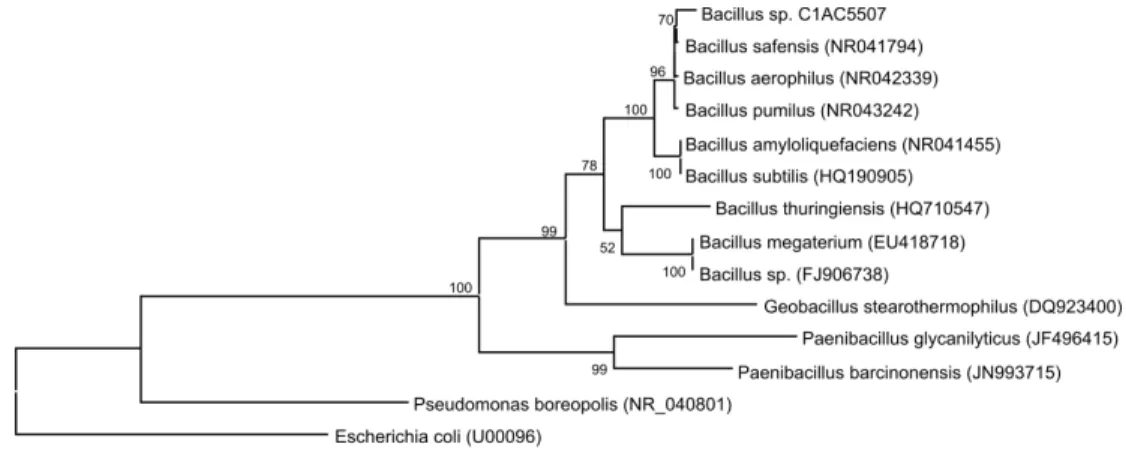
The partial sequence of 16S rDNA was obtained with a length of 829 bp. The 16S rRNA gene se-quence was compared with those of others in the GenBank databases using the NCBI BLAST tool (http://www.ncbi.n1m.nih.gov/blast/Blast.cgi). Based on the 16S rRNA gene sequence similarity (98%), C1AC5507 was closely related to Bacillus safensis, which was first isolated by Venkateswaran and col-leages (2001) after being collected from a spacecraft assembly facility. Further studies are needed to de-termine whether C1AC5507 can be classified as
Bacillus safensis or as a new species. A phylogenetic tree illustrating the relationship of strain C1AC5507 to other Bacillus species is depicted in Figure 1.
Several cellulases have been found in different members of the genus Bacillus (Rawat and Tewari, 2012). Bacillus sp. strain C1AC5507 showed clear zones on CMC agar plates followed by staining with 1% Congo red solution, indicating that it secretes CMCase. The CMCase production by Bacillus sp. strain C1AC5507 was high when the cell population entered into the stationary phase, suggesting that enzyme secretion is not growth-associated (Figure 2). CMCase activity was highest at 72 h of incubation and declined on further increase in the time of incu-bation. Experiments were conducted to determine the effect of different carbon sources on CMCase pro-duction. Overall, sugarcane had the highest CMCase activity; i.e., 0.38 IU mL-1at 72 h (Figure 3).
Figure 1: Phylogenic relationship of 16S rRNA sequences of Bacillus sp. strain C1AC5507 with other types of strains. The E. coli sequence was used as an outgroup model. Numbers at nodes are percentage bootstrap values based on 1000 re-sampled datasets. The bar shown in the figure represents 0.02% sequence dissimilarity per nucleotide position. Accession numbers of the 16S rRNA gene sequence are listed at the right.
Figure 2: The time course of fermentation for CMCase production by Bacillus sp. strain C1AC5507 at 37 °C, 150 rpm, in culture medium containing sugarcane bagasse. The enzyme activity was determined in a 100 mM sodium phosphate buffer at 50 °C, pH 7.0. Values are the mean ± SD of two experiments in replicates.
The crude extract obtained from sugarcane ba-gasse in submerged fermentation was analyzed by RSM in terms of CMCase activity. The results of the experimental data and predicted values are depicted in Table 2. The activity varied between 0.14 and 0.37 IU mL-1 in the tested conditions, as required by RSM design. A second-order polynomial equation was used to explain the production:
0.297 0.007 0.069 0.004 *
AE X
2
2
0.042 0.006 * * – 0.061 0.005 *
–0.021 0.005 * ,
X Y Y
X
where AE is CMCase activity, X represents tem-perature, and Y represents the pH. The proposed model equation illustrates the interaction between the two factors.
Table 2: Two-level factorial design for CMCase production by Bacillus sp. C1AC55-07 howing observed and predicted responses.
Independent Variables
CMCase activity (IU ml-1)
Run pH T (°C) Experimental Predicted
1 5.0 36 0.16 0.11
2 5.0 64 0.36 0.33
3 9.0 36 0.15 0.17
4 9.0 64 0.18 0.22
5 7.0 50 0.29 0.29
6 7.0 50 0.31 0.29
7 7.0 50 0.29 0.29
8 7.0 30 0.14 0.15
9 7.0 70 0.37 0.35
10 4.2 50 0.14 0.19
11 9.8 50 0.21 0.15
The analysis of variance of the regression for CMCase activity is summarized in Table 3. The op-timum values of temperature and pH were deter-mined. To investigate the interaction between the two factors researched on CMCase production, RSM was used and three-dimensional plots were made
between the two factors and CMCase production. The response surface plots between temperature and pH are shown in Figure 4. The conditions that led to the greatest activity were 65-70 °C and pH 5.0 to 7.0. Figure 3 shows 3D plots obtained after simultane-ously investigating the influences of pH and tem-perature on production of CMCase. CMCase pro-duction over a broad pH range is considered charac-teristic of cellulases secreted by Bacillus sp. (Mawadza
et al., 2000). Cellulase production observed at 70 °C is obviously different from other Bacillus strains (Mawadza et al., 2000; Li et al., 2006; Rastogi et al., 2010).
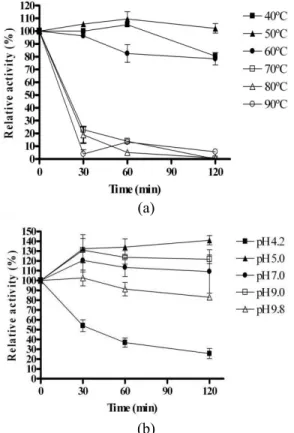
The thermal stability of CMCase was also deter-mined at various temperatures ranging from 40 to 90 °C at pH 7.0, as shown in Figure 5(a). More than 80% of the original CMCase activity was maintained at temperatures ranging from 40 to 60 °C after 120 minutes of incubation at pH 7.0, whereas less than 25% of the original CMCase activity was observed at 70 to 90 °C after 30 minutes of incubation.
The pH stability of the CMCase was also exam-ined at various pH levels ranging from pH 4.2 to pH 9.8, as shown in Figure 5(b). The original CMCase activity was maintained at a wide range of pHs ranging from 5.0 to 9.0 after 120 minutes of incuba-tion at 25 °C. The pH stability of the CMCase pro-duced by Bacillus sp. strain C1AC5507 over a broad pH range seems to be a common characteristic of many Bacillus CMCases (Ko et al., 2010).
The molecular mass of the CMCase from Bacillus
sp. strain C1AC5507 was estimated to be about 55 kDa (Figure 6). In this study, the molecular weight of the enzyme is close that of to Lee et al. (2008), who also reported a molecular mass of purified CMCase at around 53 kDa, produced by B. amyloliquefaciens. Cellulases from Bacillus species exhibit a variable molecular mass ranging from 24.4-185 kDa (Qiao et al., 2009; Rawat and Tewari, 2012). The effect of various metal ions and other compounds on the cel-lulase activity was examined by performing the as-say with the addition of additives. The activity meas-ured with no additional reagent was taken as 100%.
Table 3: Analysis of variance (ANOVA) of the second order polynomial model for ptimization of production of CMCase.
Source of Variation Sum of Squares
Degrees of Freedom
Mean Square F Ratio (Model SIgnificance)
p-value
pH (Quadratic) 0.021330 1 0.021330 159.9724 0.006193*
Temperature (Quadratic) 0.002600 1 0.002600 19.5018 0.047643*
Temperature (Linear) 0.038540 1 0.038540 289.0536 0.003442*
1L x 2L 0.007225 1 0.007225 54.1875 0.017959*
Lack of fit 0.012622 4 0.003156 23.6663 0.040952*
Pure error 0.000267 2 0.000133 - -
* Significant factors (p< 0.05); R2
(coefficient of determination) = 0.84; Adjusted R2
Figure 4: Response surface plot showing the effect of temperature and pH and their mutual interaction on production of CMCase from Bacillus sp. strain C1AC5507. The dots represent the averages of three replicates.
(a)
(b)
Figure 5: Effect of temperature and pH on the activ-ity and stabilactiv-ity of CMCase produced by Bacillus sp.
strain C1AC5507. a – thermal stability at 40 °C (■), 50 °C (▲), 60 °C (●), 70 °C (□), 80 °C (), and 90 °C (○). b – pH stability: Enzyme was analyzed first by incubating it in 100 mM buffers with the following pH: 4.2 (■), 5.0 (▲), 7.0 (●), 9.0 (□), and 9.8 () for 120 minutes. Values are the mean ±SD of three ex-periments in replicates.
Figure 6: Zymogram analysis of CMCase produced by Bacillus sp. strain C1AC5507. The right panel shows a polyacrylamide gel containing CMC after zy-mogram activity staining. Lanes: molecular weight markers (M); CMCase obtained from crude extract (1).
As shown in Figure 7, CMCase activity was strongly stimulated by Co+2, Mn+2, Ca+2, Fe+3 and Tween 20, and more mildly by Na+, Cd2+, Ni+2 and Mg2+. EDTA slightly inhibited the CMCase activity, while Cu2+ strongly inhibited the enzyme activity. The results of additive effects indicate the presence of binding sites to stabilize the conformation of the CMCase with an increased affinity for the substrate (Fu et al., 2010).
Figure 7: Effect of various additives on CMCase activity. Values are the mean ±SD of three experi-ments in replicates. Significant differences are indi-cated by * P<0.05 and *** P<0.0001.
subtilis A-53 is one of distinctive characteristics of marine microorganisms (Kim et al., 2009), CMCase of soil microorganisms has demonstrated consider-able salt tolerance. These properties confirm the essential requirements for use of the enzyme in in-dustrial applications.
CONCLUSION
In the present study we isolated a Bacillus sp. strain from a Brazilian tropical soil producing CMCase with sugarcane bagasse in submerged fer-mentation. Values of up to 0.37 IU mL-1 were ob-tained when Response Surface Methodology was used. The optimum temperature and pH for the CMCase production were 70 °C and 7.0, respectively. On the other hand, the enzyme maintained more than 80% stability at 60 °C during 2 hours. Thermostable cellulases are a key for industrial application of cel-lulose hydrolysis. Taken together, our findings on the production of cellulose-degrading enzymes under unoptimized medium and culture conditions repre-sent a strong contribution to the current knowledge on the use of natural wastes such as sugarcane ba-gasse as substrates for production of thermophilic CMCase. Further optimization of conditions to in-crease the production of cellulase could enable its use in industrial applications.
ACKNOWLEDGEMENTS
We thank Dr. Breno Grisi, Dr. Krystyna Gorlach-Lira, and Dante Guimarães (Japungu Agroindustrial) for their assistance. We are also grateful to the Bra-zilian Council for Research (CNPq) and the Coordi-nation for Higher Education Personnel Development (CAPES) for their financial support.
REFERENCES
Afzal, S., Saleem, M., Yasmin, R., Naz, M., Imran, M., Pre and post cloning characterization of a beta-1,4-endoglucanase from Bacillus sp. Mo-lecular Biology Reports, 37, 1717-1723 (2010). Bhat, M. K., Cellulases and related enzymes in
bio-technology. Biotechnology Advances, 18, 355-383 (2000).
Bruce, T., Martinez, I. B., Maia Neto, O., Vicente, A. C., Kruger, R. H., Thompson, F. L., Bacterial community diversity in the Brazilian Atlantic for-est soils. Microbial Ecology, 60, 840-849, (2010).
Cheng, H. R., Jiang, N., Extremely rapid extraction of DNA from bacteria and yeasts. Biotechnology Letters, 28, 55-59 (2006).
Faoro, H., Alves, A. C., Souza, E. M., Rigo, L. U., Cruz, L. M., Al-Janabi, S. M., Monteiro, R. A., Baura, V. A., Pedrosa, F. O., Influence of soil char-acteristics on the diversity of bacteria in the South-ern Brazilian Atlantic Forest. Applied and Envi-ronmental Microbiology, 76, 4744-4749 (2010). Fu, X., Liu, P., Lin, L., Hong, Y., Huang, X., Meng,
X., Liu, Z., A novel endoglucanase (Cel9P) from a marine bacterium Paenibacillus sp. BME-14. Applied Biochemistry and Biotechnology, 160, 1627-1636 (2010).
Gautam, S. P., Bundela, P. S., Pandey, A. K., Khan, J., Awasthi, M. K., Sarsaiya, S., Optimization for the production of cellulase enzyme from munici-pal solid waste residue by two novel cellulolytic fungi. Biotechnology Research International, 2011, article 810425, 8 pages (2011). DOI:10.4061/2011/ 810425.
Ghose, T. K., Measurement of cellulase activities. Pure and Applied Chemistry, 59(2), 257-268 (1987). Kim, B.-K., Lee, B.-H., Lee, Y.-J., Jin, I.-H., Chung,
C.-H., Lee, J.-W., Purification and characteriza-tion of carboxymethylcellulase isolated from a marine bacterium, Bacillus subtilis subsp subtilis
A-53. Enzyme and Microbial Technology, 44, 411-416 (2009).
Ko, C. H., Tsai, C. H., Lin, P. H., Chang, K. C., Tu, J., Wang, Y. N., Yang, C. Y., Characterization and pulp refining activity of a Paenibacillus campi-nasensis cellulase expressed in Escherichia coli. Bioresource Technology, 101(20), 7882-7890 (2010).
Laemmli, U. K., Cleavage of structural proteins during assembly of head of Bacteriophage-T4. Nature, 227 (1970).
Lee, Y. J., Kim, B. K., Lee, B. H., Jo, K. I., Lee, N. K., Chung, C. H., Lee, Y. C., Lee, J. W., Purifi-cation and characterization of cellulase produced by Bacillus amyoliquefaciens DL-3 utilizing rice hull. Bioresource Technology, 99(2), 378-386 (2008).
Li, Y. H., Ding, M., Wang, J., Xu, G. J., Zhao, F., A novel thermoacidophilic endoglucanase, Ba-EGA, from a new cellulose-degrading bacterium, Ba-cillus sp.AC-1. Applied Microbiology and Bio-technology, 70, 430-436 (2006).
Lima, A. O., Quecine, M. C., Fungaro, M. H., An-dreote, F. D., Maccheroni, W. Jr., Araujo, W. L., Silva-Filho, M. C., Pizzirani-Kleiner, A. A., Azevedo, J. L., Molecular characterization of a beta-1,4-endoglucanase from an endophytic Ba-cillus pumilus strain. Applied Microbiology and Biotechnology, 68, 57-65 (2005).
Lynd, L. R., Weimer, P. J., van Zyl, W. H., Preto-rius, I. S., Microbial cellulose utilization: Funda-mentals and biotechnology. Microbiology and Molecular Biology Reviews, 66, 506-577, (2002). Macedo, E. P., Cerqueira, C. L. O., Souza, D. A. J., Bispo, A. S. R., Coelho, R. R. R., Nascimento, R. P., Production of cellulose-degrading enzyme on sisal and other agro-industrial residues using a new Brazilian actinobacteria strain Streptomyces sp. SLBA-08. Brazilian Journal of Chemical En-gineering, 30, 729-735 (2013).
Maughan, H., Van der Auwera, G., Bacillus taxon-omy in the genomic era finds phenotypes to be essential though often misleading. Infection Ge-netics and Evolution, 11, 789-797, (2011). Mawadza, C., Hatti-Kaul, R., Zvauya, R., Mattiasson,
B., Purification and characterization of cellulases produced by two Bacillus strains. Journal of Bio-technology, 83, 177-187 (2000).
Miller, G. L., Use of dinitrosalicylic acid reagent for determination of reducing sugar. Analytical Chem-istry, 31, 426-428 (1959).
Qiao, J., Dong, B., Li, Y., Zhang, B., Cao, Y., Cloning of a beta-1,3-1,4-glucanase gene from Bacillus subtilis MA139 and its functional expression in
Escherichia coli. Applied Biochemistry and Bio-technology, 152, 334-342 (2009).
Rastogi, G., Bhalla, A., Adhikari, A., Bischoff, K. M., Hughes, S. R., Christopher, L. P., Sani, R. K., Characterization of thermostable cellulases pro-duced by Bacillus and Geobacillus strains. Biore-source Technology, 101, 8798-8806 (2010). Rawat, R., Tewari, L., Purification and
characteriza-tion of an acidothermophilic cellulase enzyme produced by Bacillus subtilis strain LFS3. Extre-mophiles, 16(4), 637-644, (2012).
Romano, N., Gioffre, A., Sede, S. M., Campos, E., Cataldi, A., Talia, P., Characterization of cellu-lolytic activities of environmental bacterial con-sortia from an Argentinian native forest. Current Microbiology, 67, 138-147 (2013).
Tamura, K., Peterson, D., Peterson, N., Stecher, G., Nei, M., Kumar, S., MEGA5: Molecular evolu-tionary genetics analysis using maximum likeli-hood, evolutionary distance, and maximum par-simony methods. Molecular Biology and Evolu-tion, 28, 2731-2739 (2011).
Teather, R. M., Wood, P. J., Use of Congo red-poly-saccharide interactions in enumeration and char-acterization of cellulolytic bacteria from the bo-vine rumen. Applied and Environmental Micro-biology, 43, 777-780 (1982).
Techapun, C., Poosaran, N., Watanabe, M., Sasaki, K., Optimization of aeration and agitation rates to improve cellulase-free xylanase production by thermotolerant Streptomyces sp Ab106 and re-peated fed-batch cultivation using agricultural waste. Journal of Bioscience and Bioengineering, 95, 298-301 (2003).
Venkateswaran, K., Satomi, M., Chung, S., Kern, R., Koukol, R., Basic, C., White, D., Molecular mi-crobial diversity of a spacecraft assembly facility. Systematic and Applied Microbiology, 24(2), 311-320 (2001).
Vivek, K., Sihag, R. C., Sharma, R. C., Gahlawat, S. K., Gupta, R. K., Biodegradation of water hyacinth, sugarcane bagasse and rice husk through vermi-composting. International Journal of Environment and Waste Management, 2, 601-609 (2008). Vos, P., Garrity, G., Jones, D., Krieg, N. R., Ludwig,