The genus Turnera is one of the most important gen-era of the Turneraceae comprising more than 100 species grouped in 9 series (Urban, 1883) which are distributed largely in tropical and subtropical areas of the Americas.
At least 34% of all species have been karyologically investigated. Chromosome numbers have been reported for 35 species (Raman and Kesavan, 1964; Hamel, 1965; Barrett, 1978; Barrett and Shore, 1980; Arbo and Fernández, 1983; Fernández, 1987; Solís Neffa and Fernández, 1993) but the karyotypes of only 21 have been described (Solís Neffa and Fernández, 1993; Solís Neffa, 1996).
The basic chromosome number x = 7 was found in the
Salicifolieae, Stenodictyae, Mycrophyllae and Leiocarpae
series and is clearly the most common, x = 5 was found in the Turnera (= Canaligerae) series and x = 13 in the
Papilliferae (Fernández, 1987).
Cytological investigation has shown the occurrence of diploid to decaploid populations, that may be autopoly-ploids as well as allopolyautopoly-ploids (Raman and Kesavan, 1964; Barrett, 1978; Arbo and Fernández, 1983; Shore and Barrett, 1985; Fernández, 1987). From these studies it is apparent that polyploidy has played an important and some-times dominant role in speciation within the genus. How-ever, chromosome rearrangements may be involved in the karyotype evolution of some species (Solís Neffa and Fer-nández, 1993; Solís Neffa, 1996).
Chromosome studies have been particularly detailed in the Turnera series, focusing on taxonomy and phyloge-netic relationships. Since 1982 a controlled crossing pro-gram within this series has been carried out and several interespecific hybrids obtained and, as a result of cytoge-netic studies, the genomic relationships of some species have been analyzed (Fernández and Arbo, 1989, 1990, 1993a,b, 1996; Fernández, 1997).
In this article we provide a review on the karyology of the whole genus for a better understanding of the chromo-somal evolution of Turnera.
POLYPLOIDY
Polyploidization has long been recognized as an im-portant process in plant evolution. In the genus Turnera,
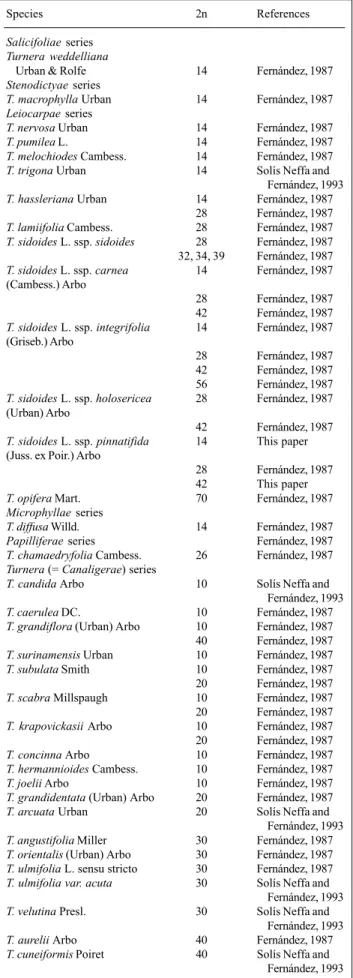
59% of the population analyzed have polyploid origin, rang-ing from tetraploids to decaploids (Table I), with tetraploids
and hexaploids more or less common and octoploids and decaploids rare (Table II).
Published counts together with our unpublished data reveal intraspecific polyploidy in several widespread spe-cies, some of which contain populations with 2x or 4x cytotypes, while T. grandiflora possesses 2x and 8x cytotypes. T. sidoides (x = 7) includes 5 subspecies that are known to be comprised of different ploidy levels, from 2x to 8x (Fernández, 1987), which makes it possible to con-clude that T. sidoides is a polyploid complex.
Autopolyploidy is apparently less frequent than al-lopolyploidy, but some workers suggest that the occurrence of autopolyploidy may have been underestimated (Soltis and Riesberg, 1986): of the polyploid species of Turnera about 35% are autopolyploids.
Autopolyploids are usually considered to be recog-nizable by multivalent chromosome configuration during meiosis metaphase, while the chromosomes of allopoly-ploids are assumed to pair into bivalents during meiosis. Most natural polyploids, however, fall somewhere in be-tween these two extremes in genome constitution, com-bining more or less well-differentiated genomes of closely related species. The terms auto-, allo- and segmental al-lopolyploids refer to the combination of fully homologous, non-homologous and partly homologous chromosome sets (Greilhuber and Ehrendorfer, 1988).
Data on meiotic behavior obtained from the T.sidoides
complex (x = 7) showed high levels of multivalent forma-tion with quadrivalents, hexavalents and octavalents, in 4x, 6x and 8x cytotypes, respectively, characterizing them as autopolyploids (Fernández, 1987). Among tetraploid spe-cies of Turnera series (x = 5), tetravalents were found in all cells of T.subulata, T. scabra (Figure 1) and T. krapo-vickasii, chromosome-pairing analysis showing an autotet-raploid origin. T. grandiflora possesses 2x and 8x cyto-types, with the diploid showing regular pairing while the other cytotype behaved like an auto-octoploid since it showed octavalent formation (Figure 1).
A detailed meiotic study of T. grandidentata, 2n = 4x = 20, T. ulmifolia, 2n = 6x = 30, and T. orientalis, 2n = 6x = 30 (Figure 1), showed only bivalents (Fernández, 1987). Meiosis pairing was generally regular in T. aurelii
(2n = 8x = 40), but 18 II and 1 IV were also found. Cyto-logical studies of hybrids between diploids and polyploids
Chromosome studies in
Turnera
(
Turneraceae
)
V.G. Solís Neffa1 and A. Fernández2
showed partly homologous chromosomes, suggesting that polyploid species are segmental allopolyploids (Fernández and Arbo, 1990, 1993a,b).
Pollen fertility of tetraploid species of Turnera
ranged between 59% in T. hassleriana (2n = 28) and94% in T. sidoides ssp. holosericea (2n = 28).Among the auto-hexaploids pollen fertility varied from 67% in T.sidoides
ssp. integrifolia (2n = 42) to 87% in T. sidoides ssp.
holosericea (2n = 6x = 42). Pollen stainability of auto-octoploids ranged from 71% in T. grandiflora (2n = 8x = 40) to75% in T.sidoides ssp. integrifolia (2n = 8x = 56). Low fertility, primarily caused by multivalent formation, is known to constrain autopolyploid evolution, and selection for increased fertility may lead to cytological diploidization in polyploids (De Wet, 1980), so that the high pollen fertil-ity in autopolyploids would correlate with the degree of diploidization observed in meiosis (Fernández, 1987).
In many autopolyploids, the cytotypes contrast in geo-graphical distribution, an example being T. sidoides, which is mostly native to the Chaco Phytogeographical Domain and is spread throughout the southern regions of Bolivia and Brazil, Paraguay and Uruguay until it reaches 39ºS in Argentina and is the Turnera species with the most south-erly distribution in the Americas (Arbo, 1986). In a pre-liminary analysis of the geographical distribution of the cytotypes of T. sidoides, greater variability was found in areas where the subspecies cohabit (Fernández, A. and Arbo, M.M., unpublished results).
Species of the Turnera series are mostly distributed in northern Brazil, where the 2x cytotype prevails, but in Central America and the Antilles the cytotypes are mainly 4x and 6x (Barrett, 1978; Shore and Barrett, 1985) while Paraguay has the highest levels of allopolyploids and auto-polyploids and constitutes an important certer of specia-tion (Arbo, 1986).
KARYOTYPE DATA AND SYSTEMATICS
Karyological information is available for 6 of 9 rec-ognized series in the genus and so far has concentrated on species of Turnera series. Detailed analysis of numerical data suggests that the karyotypes of the species of the ge-nus, although very similar, can be distinguished into
differ-Table I - Species studied.
Species 2n References
Salicifoliae series
Turnera weddelliana
Urban & Rolfe 14 Fernández, 1987
Stenodictyae series
T. macrophylla Urban 14 Fernández, 1987
Leiocarpae series
T. nervosa Urban 14 Fernández, 1987
T. pumilea L. 14 Fernández, 1987
T. melochiodes Cambess. 14 Fernández, 1987
T. trigona Urban 14 Solís Neffa and
Fernández, 1993
T. hassleriana Urban 14 Fernández, 1987
28 Fernández, 1987
T. lamiifolia Cambess. 28 Fernández, 1987
T. sidoides L. ssp. sidoides 28 Fernández, 1987 32, 34, 39 Fernández, 1987
T. sidoides L. ssp. carnea 14 Fernández, 1987 (Cambess.) Arbo
28 Fernández, 1987 42 Fernández, 1987
T. sidoides L. ssp. integrifolia 14 Fernández, 1987 (Griseb.) Arbo
28 Fernández, 1987 42 Fernández, 1987 56 Fernández, 1987
T. sidoides L. ssp. holosericea 28 Fernández, 1987 (Urban) Arbo
42 Fernández, 1987
T. sidoides L. ssp. pinnatifida 14 This paper (Juss. ex Poir.) Arbo
28 Fernández, 1987 42 This paper
T. opifera Mart. 70 Fernández, 1987
Microphyllae series
T. diffusa Willd. 14 Fernández, 1987
Papilliferae series Fernández, 1987
T. chamaedryfolia Cambess. 26 Fernández, 1987
Turnera (= Canaligerae) series
T. candida Arbo 10 Solís Neffa and
Fernández, 1993
T. caerulea DC. 10 Fernández, 1987
T. grandiflora (Urban) Arbo 10 Fernández, 1987 40 Fernández, 1987
T. surinamensis Urban 10 Fernández, 1987
T. subulata Smith 10 Fernández, 1987
20 Fernández, 1987
T. scabra Millspaugh 10 Fernández, 1987
20 Fernández, 1987
T. krapovickasii Arbo 10 Fernández, 1987
20 Fernández, 1987
T. concinna Arbo 10 Fernández, 1987
T. hermannioides Cambess. 10 Fernández, 1987
T. joelii Arbo 10 Fernández, 1987
T. grandidentata (Urban) Arbo 20 Fernández, 1987
T. arcuata Urban 20 Solís Neffa and
Fernández, 1993
T. angustifolia Miller 30 Fernández, 1987
T. orientalis (Urban) Arbo 30 Fernández, 1987
T. ulmifolia L. sensu stricto 30 Fernández, 1987
T. ulmifolia var. acuta 30 Solís Neffa and
Fernández, 1993
T. velutina Presl. 30 Solís Neffa and
Fernández, 1993
T. aurelii Arbo 40 Fernández, 1987
T. cuneiformis Poiret 40 Solís Neffa and
Fernández, 1993
Table II - Incidence of polyploidy in 111 populations of
Turnera (counts made at IBONE).
Series 2x 4x 6x 8x 10x
Salicifoliae 1 - - -
-Stenodictyae 1 - - -
-Leiocarpae 14 28 8 1 1
Microphylae 1 - - -
-Papilliferae 2 - - -
-Turnera 27 13 10 4
-Total 46 41 18 5 1
reported usually attached to the short arm of m or sm chro-mosomes. T. hassleriana is the only species with a macro-satellite located on the long arm.No satellites were ob-served in T.weddelliana and T. melochioides, probably due to the small size of their chromosomes (Solís Neffa and Fernández, 1993; Solís Neffa, 1996).
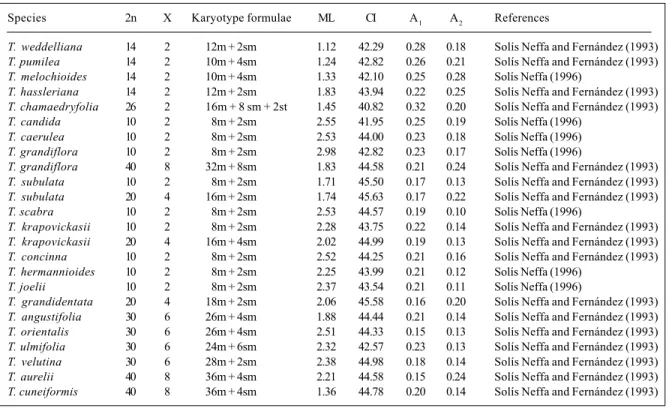
Most of the Turnera species studied have karyotypes with a low degree of asymmetry due to the predominance of m-type chromosomes (Table III), and neither highly sym-metrical karyotypes, those with all m chromosomes, nor bimodal karyotypes has been observed. The asymmetry
in-Figure 1 - Somatic and meiotic chromosomes of Turnera. A: T. grandiflora, 2n = 2x = 10. B: T. grandidentata, 2n = 4x = 20. C: T. ulmifolia, 2n = 6x = 30. D: T. aurelii, 2n = 8x = 40. E: T. sidoides ssp. pinnatifida, 2n = 2x = 14. F: T. sidoides ssp. integrifolia, 2n = 6x = 42. G: T. opifera, 2n = 10x = 70. H: T. ulmifolia, 15 II. I: T. scabra, 5 IV. J: T. grandiflora, 3 VIII + 2 IV + 4II. Scale = 5 µm.
A B C
D
E
F G
H I J
ent groups, mainly in terms of mean chromosome length, type and position of satellites and karyotype asymmetry (Solís Neffa and Fernández, 1993).
Chromosomes of Turnera are small (2.25 µm) with mean chromosome length varying between 1.12 µm in T. weddelliana and 2.55 µm in T. candida. Species based on x = 7 generally have shorter chromosomes than species with x = 5 and x = 13.
dices proposed by Romero Zarco (1986) are important in that they allow the discrimination of clear differences among species (Figure 2). Asymmetry analysis has shown that T. chamaedryfolia of the Papilliferae series (x = 13) has the highest tendency towards asymmetry while
Turnera series species (x = 5) have the smallest degree of asymmetry. Species with x = 7 showed an intermediate level of asymmetry.
Regarding series with x = 7, karyotype information is available for Salicifoliae and Leiocarpae. In the other se-ries, only chromosome numbers have been reported. For the Salicifoliae series the karyotype of T. weddelliana has been studied (Table III), while for the Leiocarpae series 20% of the species have been cytologically investigated. Although Leiocarpae series is the largest series of the ge-nus, chromosome numbers have been verified for only 8 species, with 2n = 2x = 14 being the most common num-ber, the karyotypes of 4 of which have been analyzed (Table III) and are characterized by the presence of small chromo-somes and a moderate degree of asymmetry.
Recently the karyotypes of the T. sidoides complex (x = 7) have been studied (Solís Neffa, V.G. and Fernández, A., unpublished results), and although this species belongs to the Leiocarpae series, it presents some unusual features (Arbo, 1985). Karyotype analysis of T. sidoides agrees with exomorphological data, and this species shares the basic number and the degree of karyotype asymmetry with the other species of the series but it differs in chromosome size, with the mean chromosome length more in accordance
with the values for species of Turnera series (Solís Neffa, V.G. and Fernández, A., unpublished results). Moreover, T. sidoides is the only species in the Leiocarpae series hav-ing one pair of st-type chromosomes in its karyotype.
Turnera chamaedryfolia (x = 13) belongs to the monotypic Papilliferae series. Karyotype characteristics confirm the distinctiveness of this taxon from other
Turnera species, not only in basic chromosome number but also in karyotype asymmetry. This may be due to the high number of sm chromosomes and the presence of one pair of st chromosome in its karyotype formula (Table III). The Turnera series presents the most complex flo-ral structure in the family and is made up of about 22 spe-cies that are divided into two groups by seminal charac-ters (Arbo, 1986). One of the groups constitutes the T. ulmifolia complex while the other comprises some tropi-cal species (Fernández and Arbo, 1989), with species of each group being genetically related to each other (Arbo and Fernández, 1987).
Turneraulmifolia is a polymorphic complex and Ur-ban (1883)recognized more than 10 varieties with yellow-and blue-flowered forms, which can be either heterostylous or homostylous. Shore and Barrett (1985) made a phenetic study based on morphological differentiation of 6 taxa; the results indicate that the complex is composed of several differentiated assemblages reproductively isolated from one another chromosomally via polyploidy, as well as geneti-cally, via crossing barriers. These observations support the separation of the complex into several species. Most of the
Table III - Karotype parameters. Chromosome numbers, ploidy level (X), karyotype formulae, mean chromosome length in µm (ML), centromeric index (CI), intrachromosomal asymmetry index (A1) and interchromosomal asymmetry index (A2).
Species 2n X Karyotype formulae ML CI A1 A2 References
T. weddelliana 14 2 12m + 2sm 1.12 42.29 0.28 0.18 Solís Neffa and Fernández (1993)
T. pumilea 14 2 10m + 4sm 1.24 42.82 0.26 0.21 Solís Neffa and Fernández (1993)
T. melochioides 14 2 10m + 4sm 1.33 42.10 0.25 0.28 Solís Neffa (1996)
T. hassleriana 14 2 12m + 2sm 1.83 43.94 0.22 0.25 Solís Neffa and Fernández (1993)
T. chamaedryfolia 26 2 16m + 8 sm + 2st 1.45 40.82 0.32 0.20 Solís Neffa and Fernández (1993)
T. candida 10 2 08m + 2sm 2.55 41.95 0.25 0.19 Solís Neffa (1996)
T. caerulea 10 2 08m + 2sm 2.53 44.00 0.23 0.18 Solís Neffa (1996)
T. grandiflora 10 2 08m + 2sm 2.98 42.82 0.23 0.17 Solís Neffa (1996)
T. grandiflora 40 8 32m + 8sm 1.83 44.58 0.21 0.24 Solís Neffa and Fernández (1993)
T. subulata 10 2 08m + 2sm 1.71 45.50 0.17 0.13 Solís Neffa and Fernández (1993)
T. subulata 20 4 16m + 2sm 1.74 45.63 0.17 0.22 Solís Neffa and Fernández (1993)
T. scabra 10 2 08m + 2sm 2.53 44.57 0.19 0.10 Solís Neffa (1996)
T. krapovickasii 10 2 08m + 2sm 2.28 43.75 0.22 0.14 Solís Neffa and Fernández (1993)
T. krapovickasii 20 4 16m + 4sm 2.02 44.99 0.19 0.13 Solís Neffa and Fernández (1993)
T. concinna 10 2 08m + 2sm 2.52 44.25 0.21 0.16 Solís Neffa and Fernández (1993)
T. hermannioides 10 2 08m + 2sm 2.25 43.99 0.21 0.12 Solís Neffa (1996)
T. joelii 10 2 08m + 2sm 2.37 43.54 0.21 0.11 Solís Neffa (1996)
T. grandidentata 20 4 18m + 2sm 2.06 45.58 0.16 0.20 Solís Neffa and Fernández (1993)
T. angustifolia 30 6 26m + 4sm 1.88 44.44 0.21 0.14 Solís Neffa and Fernández (1993)
T. orientalis 30 6 26m + 4sm 2.51 44.33 0.15 0.13 Solís Neffa and Fernández (1993)
T. ulmifolia 30 6 24m + 6sm 2.32 42.57 0.23 0.13 Solís Neffa and Fernández (1993)
T. velutina 30 6 28m + 2sm 2.38 44.98 0.18 0.14 Solís Neffa and Fernández (1993)
T. aurelii 40 8 36m + 4sm 2.21 44.58 0.15 0.24 Solís Neffa and Fernández (1993)
varieties of T.ulmifolia are now recognized as independent species (Backer, 1951; Arbo, 1985). Cytological data (Fernández, 1987; Fernández and Arbo 1989, 1990, 1993a) and karyotype analysis (Solís Neffa and Fernández, 1993; Solís Neffa, 1996) support this separation.
No hybrids were obtained between yellow-flowered and blue-flowered diploid species (Arbo and Fernández, 1987). They are reproductively isolated because of their different genomes; all yellow-flowered species share the same basic genome A (Fernández and Arbo, 1989), while all blue-flowered have the basic genome C (Fernández and Arbo, 1996). These species share the karyotype formula 8m + 2sm, which is considered the fundamental karyotype, nevertheless these taxa can differ by type and position of satellites, relative size of the chromosomes (A2) and mean
chromosome length.
KARYOTYPE EVOLUTION IN THE GENUS TURNERA
In Turnera there are different karyotypic evolution-ary trends. Considering the published chromosome num-bers and the data presented here, polyploidy is quite fre-quent in the genus. However, aneuploidy and dysploidy are also thought to be important in the chromosomic evolution of some species.
Data suggest that x = 7 is the ancestral basic chromo-some number of the genus, from which x = 5 and x = 13 could have been derived (Fernández, 1987), x = 13 being an unusual number within the genus since only one member of the genus has been identified as having this chromosome number. The origin of x = 13 probably was by reductional aneuploidy from 2n = 4x = 28.
Dysploid alteration of the basic chromosome num-ber is usually the outcome of successive translocation, so that centromeres can be lost without damage to the plant. This brings about a reduction in chromosome number and a progressive increase in chromosome size, a mechanism which is supposed to be involved in the origin of x = 5.
Dysploid changes may also explain the remarkable differences in chromosome size and karyotype asymme-try among species with x = 7 and with x = 5. Although in many Angiosperms symmetrical karyotypes are correlated with the primitive condition of the taxa (Stebbins, 1971), the major symmetry shown by species with x = 5 is in agreement with their derived basic number and would rep-resent a secondary tendency in chromosome evolution.
Diploid species of the Turnera series show the same basic haploid karyotype, although some karyotype varia-tion occurs among the species. They may be differenti-ated by type and position of satellites, the relative size of the chromosomes and mean chromosome length, differ-ences which might be the result of structural chromosome rearrangements which occurred during the evolution of this species.
Polyploidy has been correlated with a decrease in chromosome length (Stebbins, 1938) and species with au-topolyploid cytotypes show karyotypes with smaller chro-mosomes and more symmetry than in diploids(Solís Neffa and Fernández, 1993; Solís Neffa, 1996).
CONCLUSION
The data presented in this article suggest that there are different chromosomic evolutionary trends in Turnera. Cytological studies suggest that x = 7 is the ancestral ba-sic chromosome number for the genus, from which x = 5 and x = 13 may have been derived. Although polyploidy has played an important role in speciation within the ge-nus, aneuploidy and dysploidy have also occurred. The ori-gin of x = 13 probably was by reductional aneuploidy, while dysploid alteration is thought to be involved in the origin of x = 5. Dysploid changes may also explain the differ-ences in chromosome size and karyotype asymmetry among species.
Karyological data are meaningful in a systematic sense, since karyotype characteristics support taxonomic
Figure 2 - Scatter diagram of mean intrachromosomal asymmetry index (A1) against mean interchromosomal
asymmetry index (A2) for Turnera species. ▲: x = 5. ■: x = 7. ◆: x = 13. ●: T. sidoides complex. 0.25
0.15
0.2 0.3
A1
treatment of the species which can be distinguished by their mean chromosome length, type and position of satellites and karyotype asymmetry.
ACKNOWLEDGMENTS
This work was carried out with the economic support of CONICET and the Secretaría General de Ciencia y Técnica (UNNE).
REFERENCES
Arbo, M.M. (1985). Notas taxonómicas sobre Turneráceas sudamericanas.
Candollea40: 175-191.
Arbo, M.M. (1986). Paraguay, centro importante de especiación en las Turneráceas. En Spichiger & Bocquet, ed., Notula ad Floram para-quaiensem 6. Candollea41: 211-218.
Arbo, M.M. and Fernández, A. (1983). Posición taxonómica, citología y palinología de tres niveles de ploidía de Turnera subulata Smith.
Bonplandia5: 212-226.
Arbo, M.M. and Fernández, A. (1987). Cruzamientos intra e interespecíficos en Turnera, Serie Canaligerae. Bonplandia6: 23-38.
Backer, C.A. (1951). Turneraceae. Flora Malesiana Ser. I 4: 235-238. Barrett, S.C.H. (1978). Heterostyly in a tropical weed: the reproductive
biol-ogy of the Turnera ulmifolia complex (Turneraceae). Can. J. Bot.56: 1713-1725.
Barrett, S.C.H. and Shore, J. (1980). Variation in breeding systems in the
Turnera ulmifolia complex. Second International Congress of Sys-tematic and Evolutionary Biology, Vancouver, Canada (Abstracts, p. 10).
De Wet, J.M.J. (1980). Origins of polyploids. In: Polyploidy, Biological Relevance (Lewis, W.H., ed.). Plenum Press, New York, pp. 3-15. Fernández, A. (1987). Estudios cromosómicos en Turnera y Piriqueta
(Turneraceae). Bonplandia6: 1-21.
Fernández, A. (1997). Estudio citogenético en híbridos entre una especie octoploide, Turnera aurelii y dos diploides, T. caerulea y T. joelii.
Bonplandia9: 281-286.
Fernández, A. and Arbo, M.M. (1989). Relaciones genómicas entre cuatro especies diploides de Turnera con flores amarillas (Serie Canaligerae).
Bonplandia 6: 93-109.
Fernández, A. and Arbo, M.M. (1990). Gametas no reducidas y relaciones genómicas en tres especies de Turnera (Turneraceae). Darwiniana30: 21-26.
Fernández, A. and Arbo, M.M. (1993a). Relaciones genómicas entre seis especies de Turnera (Serie Canaligerae) del Paraguay. Candollea48: 305-318.
Fernández, A. and Arbo, M.M. (1993b). Citogenética de híbridos entre Turnera grandidentata (4x) y T. subulata y T. scabra (2x) (Turneraceae).
Bonplandia7: 119-127.
Fernández, A. and Arbo, M.M. (1996). Relaciones genómicas entre las especies diploides de flores blanco-azuladas de Turnera (Serie Canaligerae).
Bonplandia9: 95-102.
Greilhuber, J. and Ehrendorfer, F. (1988). Karyological approaches to plant taxonomy. ISI Atlas Sci.: Anim. Plant Sci.1: 289-297.
Hamel, J.L. (1965). Le noyau et les chromosomes somatiques de Turnera ulmifolia L. Mém. Mus. Natl. Hist. Nat. Sér. B 16: 3-8.
Raman, V.S. and Kesavan, P.C. (1964). Meiosis and nature of polyploidy in
Turneraulmifolia. J. Indian Bot. Soc. 43: 495-497.
Romero Zarco, C. (1986). A new method for estimating karyotype asymme-try. Taxon35: 526-530.
Shore, J. and Barrett, S.C.H. (1985). The genetics of distyly and homostyly in T.ulmifolia L. (Turneraceae). Heredity55: 167-174.
Solís Neffa, V.G. (1996). Cariotipos de especies de Turnera (Turneraceae).
Bonplandia9: 121-127.
Solís Neffa, V.G. and Fernández, A. (1993). Estudios cromosómicos en especies de Turnera (Turneraceae). Bonplandia7: 101-118.
Soltis, D.E. and Riesberg, L.H. (1986). Autopolyploidy in Tolmeia menziesii
(Saxifragaceae): genetic insights from enzyme electrophoresis. Am. J. Bot.73: 310-318.
Stebbins, G.L. (1938). Cytological characteristics associated with the differ-ent growth habits in the dicotyledons. Am. J. Bot.25: 189-198. Stebbins, G.L. (1971). Chromosomal Evolution in Higher Plants.
Adisson-Wesley Publishing Company, Massachusetts.