ISSN 0100-879X
BIOMEDICAL SCIENCES
AND
CLINICAL INVESTIGATION
www.bjournal.com.br
www.bjournal.com.br
Volume 43 (3) 182-267 March 2011
Braz J Med Biol Res, March 2011, Volume 44(3) 229-235
doi: 10.1590/S0100-879X2011007500012
The effects of stretching on the flexibility, muscle performance and
functionality of institutionalized older women
D. Gallon, A.L.F. Rodacki, S.G. Hernandez, B. Drabovski, T. Outi, L.R. Bittencourt and A.R.S. Gomes
Faculdade de Medicina de Ribeirão Preto Campus
Ribeirão Preto
Institutional Sponsors
The Brazilian Journal of Medical and Biological Research is partially financed by
analiticaweb.com.br S C I E N T I F I C
The effects of stretching on the flexibility,
muscle performance and functionality
of institutionalized older women
D. Gallon
1,2,5, A.L.F. Rodacki
2, S.G. Hernandez
3, B. Drabovski
2, T. Outi
4,
L.R. Bittencourt
3and A.R.S. Gomes
1,21Departamento de Fisioterapia, Universidade Federal do Paraná, Matinhos, PR, Brasil 2Departamento de Educação Física e Programa de Mestrado e Doutorado em Educação Fisica, Universidade Federal do Paraná, Curitiba, PR, Brasil 3Clínica do Atleta, Curitiba, PR, Brasil 4Asilo São Vicente de Paulo, Curitiba, PR, Brasil 5Departamento de Educação Física, Centro Universitário Franciscano, Curitiba, PR, Brasil
Abstract
Stretching has been widely used to increase the range of motion. We assessed the effects of a stretching program on muscle-tendon length, flexibility, torque, and activities of daily living of institutionalized older women. Inclusion/exclusion criteria were according to Mini-Mental State Examination (MMSE) (>13), Barthel Index (>13) and Lysholm Scoring Scale (>84). Seventeen 67 ± 9-year-old elderly women from a nursing home were divided into 2 groupsat random: the control group (CG, N = 9) par
-ticipated in enjoyable cultural activities; the stretching group (SG, N = 8) performed active stretching of hamstrings, 4 bouts of 1 min each. Both groups were supervised three times per week over a period of 8 weeks. Peak torque was assessed by an isokinetic method. Both groups were evaluated by a photogrammetric method to assess muscle-tendon length of uni- and biarticular hip flexors and hamstring flexibility. All measurements were analyzed before and after 8 weeks by two-way ANOVA with the level of significance set at 5%. Hamstring flexibility increased by 30% in the SG group compared to pre-training (76.5
± 13.0° vs 59.5 ± 9.0°, P = 0.0002) and by 9.2% compared to the CG group (76.5 ± 13.0° vs 64.0 ± 12.0°, P = 0.0018).
Muscle-tendon lengths of hip biarticular flexor muscles (124 ± 6.8° vs 118.3 ± 7.6°, 5.0 ± 7.0%, P = 0.031) and eccentric knee extensor
peak torque were decreased in the CG group compared to pre-test values (-49.4 ± 16.8 vs -60.5 ± 18.9 Nm, -15.7 ± 20%, P =
0.048). The stretching program was sufficient to increase hamstring flexibility and a lack of stretching can cause reduction of
muscle performance.
Key words: Homes for the aged; Muscle stretching exercises; Muscle strength; Flexibility; Activities of daily living
Introduction
Correspondence: D. Gallon, Av. Presidente Kennedy, 1823, Apto. 13, 80610-010 Curitiba, PR, Brasil. E-mail: [email protected]
This trial is registered and allocated the ACTRN: ACTRN12610001105033.
Received August 9, 2010. Accepted January 17, 2011. Available online January 28, 2011. Published March 7, 2011. The Brazilian Institute of Geography and Statistics (1)
has estimated that 8.6% of the Brazilian population (14.4 million) are composed of elderly citizens. According to the Institute, the growth experienced during the last 10 years was of 17% and projections indicate that this population may reach 55.0 million people (27% of the total population) by the year 2040. As the aging population increases so also will the number of people living in nursing homes (2). The institutionalized elderly have a different profile than non-institutionalized persons (3). For instance, physical disability, functional loss and autonomy, psychosocial context, stress,
family support, and loss of an identity role in the community cause difficulties in basic daily activities and cognitive skills and increase the risk of falling (2-4).
It has been shown that independence is closely related to the ability to sustain the functional status of the neu
-romuscular system (5). Furthermore, exercise programs have shown a reduction in the rate of falling and improved balance and mobility (4,6).
230 D. Gallon et al.
power in the active elderly (7). In fact, increasing muscle strengthening has been confirmed to be one of the most effective ways to reduce the debilitating effects of ageing on functional performance (4). However, a major part of the current literature has only reported the effect of multi-component exercise interventions and lacks studies as
-sessing the effects of stretching alone (4,8).
For example, some outcomes have shown that the el
-derly benefit from a stretching program in which the gains
in range of motion were translated into better performance
over a number of gait-related variables (9,10).
Therefore, muscle-tendon alterations associated with the ageing process especially affect the bi-articular muscles, such as knee flexors and extensors, limit the range of mo
-tion, and change torque distribution around joints (11-15). Thus, stretching exercises can be an important tool in
minimizing these losses.
To the best of our knowledge, no more than one study
has reported strength gains after a stretching program
using proprioceptive neuromuscular facilitation in the institutionalized aged (16). Other investigators have also found an increase in torque after a stretching program in a standing position, but performed by non-institutionalized older women (17,18).
Consequently, musculoskeletal adaptation induced by active stretching exercises in the institutionalized elderly, who experience difficulties in engaging in more strenuous training programs, needs to be further explored. In addition, the studies that analyzed the effects of stretching programs designed to improve flexibility did not fully assess muscle strength changes (14,19). Thus, there is limited information about the effects of stretching on the torque-producing abil
-ity of institutionalized older women. Assessment of muscle strength provides information about the extent of muscle weakness caused by ageing conditions. Hence, muscle
strength is a component of human performance and is an important measure for the characterization of the functional
capability of an individual (15).
For these reasons, the objective of the present study was to investigate the effects of an active static stretching program (3 sessions per week for 8 weeks) on the hamstring muscle in a group of institutionalized older women. Peak eccentric and concentric torques of agonist and antagonist knee muscle groups, muscle-tendon length of uni- and biarticular hip flexors, hamstring flexibility, and activities of daily living were used to investigate the influence of the
stretching program on female nursing home residents.
Material and Methods
Subjects
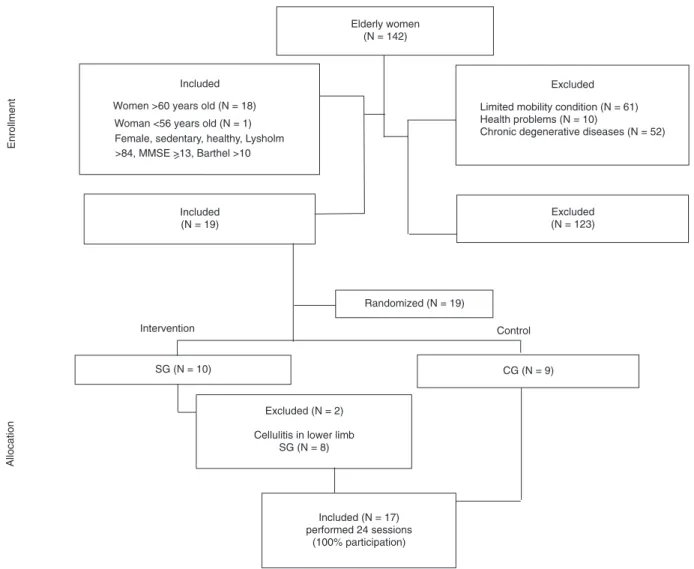
Initially, 142 women were contacted via the adminis
-tration of a long-term care facility. Sixty-one women were excluded from the study as they were limited in their mo
-bility (use of a wheel chair, cane or other walking device),
10 were found to experience health problems and 52 had physical restrictions in performing physical activities. Thus, 19 women (67.0 ± 9.0 years old; 72.4 ± 17.1 kg, and 1.54 ± 0.08 m) volunteered and were eligible to participate in the study. Age, weight and height were similar for all subjects (P > 0.05). All participants had been living in the facility care unit for at least 22.0 ± 16.0 years and were medically
stable. The recruitment and selection criteria are described
in Figure 1. All procedures used in the present study were approved by the Ethics Committee of the Federal University of Paraná (CAAE-0003.0.91.000-09) and written informed
consent was obtained from all participants after a detailed
explanation of the procedures and requirements of the experiments.
After recruitment, subjects were randomly assigned to either the control group (CG; N = 9), which received educational talks about healthy habits and cultural activi
-ties, or to the group enrolled in a stretching program (SG; N = 10) (20). Both groups (CG and SG) attended sessions three times per week for 8 weeks, for a total of 24 sessions. Unfortunately, 2 participants were excluded from the SG
due to cellulitis in the lower limbs.
A brief warm-up of 10 min of ludic activities and walk
-ing was carried out before the stretch-ing exercises (21). Then, the stretching exercises for hamstring muscles were performed in a sitting position with an extended knee with a thick non-elastic band (1 m in length) placed around the foot of the stretched limb to allow subjects to pull themselves forward with both hands. The lower segment was gradually extended with the trunk leaning forward to a position in
which participants felt discomfort for a period of 60 s. The
corresponding limb maintained knee and hip joint flexed and with the foot flat on the floor. Four consecutive repetitions of 60 s each were performed and an interval of 60 s was allowed before exercising the opposite limb (19,22,23).
Before starting the interventions, all participants un
-derwent two assessment sessions. The first assessment session was used to familiarize the elderly women with the peak torque measurements in the isokinetic dynamometer (Cybex NORM, division of Lumex, Inc., USA). In addition, participants underwent the following evaluations: Mini-Mental State Examination (MMSE), Barthel Index and Lysholm Scoring Scale. The MMSE questionnaire was applied to determine the cognitive ability of the subjects according to educational level, and the score had to be more than 13 (24). The Barthel Index was applied to establish the activities of daily life and the score also had to be more than 13 (25). The Lysholm Scoring Scale was applied to assess knee functional status and the presence or absence of signs of instability. Thus, to be included in this trial, the subject had to receive a minimum score of 84, i.e., knee
function fair to good (26).
session. Specific procedures are reported below in detail. The same tests (stretching training/ludic activities) were applied after the intervention period (i.e., 8 weeks later) and followed the same sequence.
Assessment of muscle-tendon length and flexibility
The muscle-tendon length and flexibility were deter
-mined by the Photogrammetric Method using a digital camera (Canon, model Power A95, Japan) positioned per
-pendicularly at ~2.7 m to the sagittal plane of the subjects. The focus of the camera aimed at the center of the relevant joints and the following landmarks were identified: greater trochanter (GT), lateral epicondyle (LE) of the femur, and malleolus of the fibula (MA). These points defined the thigh (GT-LE) and shank (LE-MA) segments. The angle between
these segments was determined using the angular
dimen-sion tool, which is available in commercial image processing software (Corel Drawl, version 13) and followed the rec
-ommendations proposed by Sarraf et al. (27). Initially, the modified “Thomas” test was applied (27). The test is used
to determine muscle-tendon length of the hip uni- and
biar-ticular flexor muscles. A comprehensive description of the test can be obtained elsewhere (27). Briefly, the participant was positioned in the supine posture with the knee joint of the tested segment flexed, with the thigh supported on the table and the shank hanging down from the edge of the table. The experimenter actively flexed the opposite seg
-ment until the hip reached 125° of flexion, while the tested segment hung free. Thus, the angle between the initial and final positions of the thigh with respect to the horizontal line
Figure 1. Study design. Flow of participants through the study. Nineteen institutionalized female elderly nursing home residentswere
232 D. Gallon et al.
(Table 1) and at the knee joint was measured.
After the Thomas test, the flexibility of the hamstrings was assessed by the passive straight-leg-raising test (28,29). The tested segment was slowly lifted by the experimenter
until some discomfort was felt in the popliteal region and
the other segment was stabilized in an extended position using adjustable straps. The initial and final positions were photographed and the angle between the elevated thigh and the horizontal line (Table 1) was quantified. Values above 65° were deemed as normal, and lower values were considered to indicate decreased flexibility.
Torque assessment
Peak torque was measured using an isokinetic dyna
-mometer (Cybex NORM, division of Lumex, Inc.). Assess -ments were performed according to the guidelines of the manufacturer and the procedures are described elsewhere
(30). Gravity correction was calculated using the procedures established in the software equipment (Cybex Software, version 2.06). Each participant sat secured by adjustable straps and was requested to fold her arms in front of the chest region. Participants received verbal encouragement and visual feedback was provided by the PC monitor in an attempt to obtain maximal performances.
The eccentric and concentric actions of the knee flexor and extensor muscles were tested at 60°/s. Initially, a set of three submaximal attempts was allowed prior to the proper test to permit the participants to familiarize themselves with the demands and requirements of the assessment. Then, tests were repeated three times with an interval of 2 min be
-tween trials. The order of the tests was randomly assigned. Blood pressure (Premium - G-Tech sphygmomanometer, China) was monitored throughout the test.
Statistical analysis
Standard descriptive statistics were calculated for all
variables. The normality of the data was deter mined using the Shapiro-Wilk test and homogeneity was assessed by the Levene test. When the results were homogeneous and normally distributed, two-way analysis of variance for inde
-pendent samples was applied. The Fisher test was applied to determine where differences occurred. Wilcoxon and Mann-Whitney tests were used where normality or homogeneity was not found. The level of significance was set at 5% for all comparisons and all analyses were performed using a specific soft ware (Statistica, version 7.0®, USA).
Results
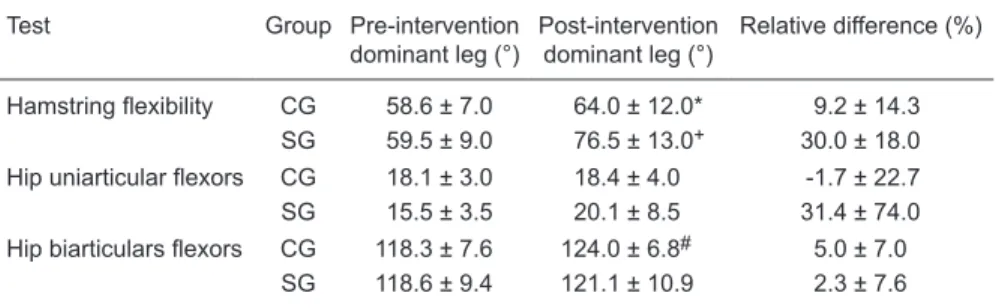
The 8-week stretching training program improved hamstring flexibility with respect to the initial condition (P < 0.05). The SG experienced a hamstring flexibility increase of 30% compared to the values found before intervention
(76.5 ± 13.0° vs 59.5 ± 9.0°, P = 0.0002). In addition, the
SG also showed greater increases in the flexibility of knee flexor muscles when compared to the CG (76.5 ± 13.0° vs 64.0 ± 12.0°, P = 0.0018).
The ability to stretch the hip biarticular flexors of the CG was reduced when compared to initial values (124.0 ±
6.8° vs 118.3 ± 7.6°; P = 0.031). Table 1 demonstrates the
data for flexibility and muscle-tendon length changes that
occurred in response to the stretching program.
No peak torque differences in knee extensor or flexor muscle groups were found in the SG (P > 0.05), irrespective of the contraction type (eccentric or concentric). However, the knee extensor eccentric peak torques of the CG de
-creased (15.7%) after the experimental period (post = -49.4
± 16.8 vs pre = -60.5 ± 18.9 Nm, P = 0.048; Fisher test). The Lysholm Knee Score, Barthel Index and MMSE showed no differences between groups (P > 0.05). In ad
-dition, results were stable across the intervention period (P > 0.05).
Table 1. Photogrammetry of hamstring flexibility and muscle-tendon lengths of the uni- and
biarticular hip flexors of institutionalized older women.
Test Group Pre-intervention dominant leg (°)
Post-intervention
dominant leg (°)
Relative difference (%)
Hamstring flexibility CG 58.6 ± 7.0 64.0 ± 12.0* 9.2 ± 14.3
SG 59.5 ± 9.0 76.5 ± 13.0+ 30.0 ± 18.0
Hip uniarticular flexors CG 18.1 ± 3.0 18.4 ± 4.0 -1.7 ± 22.7
SG 15.5 ± 3.5 20.1 ± 8.5 31.4 ± 74.0
Hip biarticulars flexors CG 118.3 ± 7.6 124.0 ± 6.8# 5.0 ± 7.0
SG 118.6 ± 9.4 121.1 ± 10.9 2.3 ± 7.6
Data are reported as means ± SD. CG = control group; SG = stretching group. Relative differ
Discussion
The active stretching protocol performed only three times per week induced an increase in hamstring flexibility
in nursing home women residents. Therefore, the main
findings of the present study were: i) decreased flexibility in all institutionalized older women studied before the ex
-perimental period; ii) increased flexibility of knee flexors after the stretching exercise program; iii) declined muscle-tendon length and eccentric torque of knee extensor of the
non-trained group.
All participants from both groups showed below normal flexibility values (<65°) before the study (29) that could be attributed to a decrease in the magnitude of maximal pas
-sive resistive force, which indicates a marked decrease in the maximal length associated with the aging process (12). These muscle-tendon changes can be caused by an increase in type I collagen and/or a decrease in type III collagen (12,31).
However, it was interesting to observe in the present study that active static stretching training, performed only three times per week, was sufficient to induce an increase in hamstring flexibility above normal values in institutionalized older females. This result was better than that obtained by other investigators who submitted aged people to a daily passive stretching program for 6 weeks (19). The increase observed in the present study can be attributed to the ac
-tive characteristics of the stretching technique, the longer duration of the training program, i.e., 8 weeks, and also the profile of the participants. It has been documented that active protocols are more effective in providing a greater gain than passive exercises (31).
Other factors may have contributed to the changes observed in the present study, such as Golgi tendon organs and muscle spindle adaptation (32), which may have al -lowed increased tolerance to stretching (33) and a possible addition of sarcomeres in series (34).
Moreover, the group that performed stretching exercises (SG) did not show as marked a reduction of flexibility of the knee extensor muscles during the course of the experiment as CG. This outcome could be explained by an increase in antagonist coactivation, which could have reduced the elastic rigidity of the passive viscoelastic elements of the muscle-tendon unit (12,31,35).
The elderly women who did not exercise showed a further flexibility decline during the period of the experi
-ment and once again demonstrated the negative effects of the lack of physical activity, which is generally found in the institutionalized elderly (4,36,37). Although the loss of flexibility and muscle strength deficit are common among institutionalized elderly subjects, the stretching training performed in the present study was sufficient to prevent reduction of flexibility even in the antagonist muscles (4).
Peak flexor or extensor torques remained unchanged after the stretching training despite the changes observed in
hamstring flexibility. These results agree with other studies in which peak torque did not respond to a program of stretching exercises (8,38). On the other hand, the group that did not exercise experienced a decline in the eccentric peak torque of the knee extensor muscles, which can be related to the reduction of muscle-tendon length in the hip bi-articular flexor muscles. In addition, the increasing loss of muscle strength
beginning from the 4th decade is more pronounced after the
6th decade and is further accelerated by the lack of physical activity induced by institutionalization (31,36,37).
Although the stretching program did not cause an increase in peak torque, nonetheless it was successful in preventing a further loss of muscle function, which can contribute to mobility. Consequently, this outcome is very relevant because strength of lower extremity muscles is an important determinant of mobility-based functional ac
-tivities as rising from a chair or stair negotiation (15). The unchanged peak torque found in the present study may be attributed to institutionalization and/or the stretching technique performed (17,18,37).
To the best of our knowledge, this is the first report that has investigated the effect of stretching on isokinetic peak torque in older women living in a nursing home. Therefore, when the peak torque of non-institutionalized elderly of other studies is compared to the results of the present study, a clear difference is noticed (17,18,39). It is interesting to observe that the peak torques of the institutionalized elderly women found in the present study were lower than those of active elderly subjects aged 70 to 80 years (39).
All elderly women analyzed were independent in their daily life tasks. The Barthel index remained unchanged after 8 weeks. The subjects showed good knee functionality (Lysholm Scoring Scale), and the training program did not interfere with the cognitive aspects (MMSE).
The present study has some limitations, specifically the reduced size of the sample per group (SG, N = 8 and CG, N = 9), which may have influenced the impact of the inves
-tigation. Using the equation of Luiz and Magnanini (40) to calculate the sampling size, we found that 16 subjects per group would be the number needed to test the hypothesis of the present study. However, on the basis of the eligibility criteria, it was not possible to include this number in each group, especially because of the profile of institutionalized elderly women to be enrolled in the stretching program. Hence, future studies should include more than one nursing
home to obtain a suitable sample size.
Additionally, other studies should include passive torque and analysis of the length-tension muscle-tendon properties, which may provide a better understanding of the effects of
stretching training on muscle adaptation in
institutional-ized older subjects. Nevertheless, we should emphasize the important contribution of active stretching exercises, performed three times per week, to increase flexibility and to prevent loss of muscle performance in female nursing
234 D. Gallon et al.
1. IBGE. Estimativas de projeção da população. IBGE; 2008.
2. Andresen M, Runge U, Hoff M, Puggaard L. Perceived au
-tonomy and activity choices among physically disabled older
people in nursing home settings: a randomized trial. J Aging Health 2009; 21: 1133-1158.
3. Coelho FM, Narciso FM, Oliveira DM, Pereira DS, Teixeira AL, Teixeira MM, et al. sTNFR-1 is an early inflammatory marker in community versus institutionalized elderly women.
Inflamm Res 2010; 59: 129-134.
4. Weening-Dijksterhuis E, de Greef MH, Scherder EJ, Slaets JP, van der Schans CP. Frail institutionalized older persons: a comprehensive review on physical exercise, physical fit
-ness, activities of daily living, and quality-of-life. Am J Phys Med Rehabil 2010.
5. Runge M, Rehfeld G, Resnicek E. Balance training and exer -cise in geriatric patients. J Musculoskelet Neuronal Interact
2000; 1: 61-65.
6. Lord SR, Castell S, Corcoran J, Dayhew J, Matters B, Shan A, et al. The effect of group exercise on physical functioning and falls in frail older people living in retirement villages: a randomized, controlled trial. J Am Geriatr Soc 2003; 51: 1685-1692.
7. Strasser B, Keinrad M, Haber P, Schobersberger W. Efficacy of systematic endurance and resistance training on muscle strength and endurance performance in elderly adults - a
randomized controlled trial. Wien Klin Wochenschr 2009; 121: 757-764.
8. Bird ML, Hill K, Ball M, Williams AD. Effects of resistance- and flexibility-exercise interventions on balance and related
measures in older adults. J Aging Phys Act 2009; 17: 444-454.
9. Kerrigan DC, Lee LW, Collins JJ, Riley PO, Lipsitz LA. Reduced hip extension during walking: healthy elderly and fallers versus young adults. Arch Phys Med Rehabil 2001; 82: 26-30.
10. Cristopoliski F, Sarraf TA, Dezan VH, Provensi CLG, Rodacki ALF. Transient effect of flexibility exercises in the hip joint
on the gait of older women. Efeito transiente de exercícios de flexibilidade na articulação do quadril sobre a marcha de idosas.Rev Bras de Med do Esporte. Rev Bras Med Esporte
2008; 14: 139-144.
11. Safran C, Slack WV, Bleich HL. Role of computing in patient
care in two hospitals. MD Comput 1989; 6: 141-148.
12. Gajdosik RL, Vander Linden DW, McNair PJ, Riggin TJ, Albertson JS, Mattick DJ, et al. Slow passive stretch and
release characteristics of the calf muscles of older women
with limited dorsiflexion range of motion. Clin Biomech 2004;
19: 398-406.
13. Gajdosik RL, Vander Linden DW, McNair PJ, Riggin TJ, Alb
-ertson JS, Mattick DJ, et al. Viscoelastic properties of short
calf muscle-tendon units of older women: effects of slow and
fast passive dorsiflexion stretches in vivo. Eur J Appl Physiol
2005; 95: 131-139.
14. Gajdosik RL, Vander Linden DW, McNair PJ, Williams AK, Riggin TJ. Effects of an eight-week stretching program on the passive-elastic properties and function of the calf
muscles of older women. Clin Biomech 2005; 20: 973-983.
15. Samuel D, Rowe PJ. Effect of ageing on isometric strength through joint range at knee and hip joints in three age groups
of older adults. Gerontology 2009; 55: 621-629.
16. Klein DA, Stone WJ, Phillips WT, Gangi J, Hartman S. PNF training and physical function in assisted-living older adults.
J Aging Phys Act 2002; 10: 476-488.
17. Batista LH, Camargo PR, Oishi J, Salvini TF. Effects of an active eccentric stretching program for the knee flexor muscles on range of motion and torque. Rev Bras Fisioter
2008; 12: 176-182.
18. Batista LH, Vilar AC, de Almeida Ferreira JJ, Rebelatto JR, Salvini TF. Active stretching improves flexibility, joint torque, and functional mobility in older women. Am J Phys Med Rehabil 2009; 88: 815-822.
19. Feland JB, Myrer JW, Schulthies SS, Fellingham GW, Mea
-som GW. The effect of duration of stretching of the hamstring
muscle group for increasing range of motion in people aged
65 years or older. Phys Ther 2001; 81: 1110-1117.
20. Thomas J, Nelson J, Silverman S. Research methods in physical activity. Champaign: Human Kinetics; 2005.
21. Agre JC, Pierce LE, Raab DM, McAdams M, Smith EL. Light resistance and stretching exercise in elderly women: effect
upon strength. Arch Phys Med Rehabil 1988; 69: 273-276.
22. Taylor DC, Dalton JD Jr, Seaber AV, Garrett WE Jr. Vis -coelastic properties of muscle-tendon units. The biome-chanical effects of stretching. Am J Sports Med 1990; 18: 300-309.
23. Chan SP, Hong Y, Robinson PD. Flexibility and passive resistance of the hamstrings of young adults using two dif -ferent static stretching protocols. Scand J Med Sci Sports
2001; 11: 81-86.
24. Bertolucci PH, Brucki SM, Campacci SR, Juliano Y. [The Mini-Mental State Examination in a general population:
impact of educational status]. Arq Neuropsiquiatr 1994; 52: 1-7.
25. Wade DT, Collin C. The Barthel ADL Index: a standard measure of physical disability? Int Disabil Stud 1988; 10:
References
We believe that an active stretching program should be added to the routine of institutionalized elderly subjects because it has been shown here to be effective not only in increasing knee flexor flexibility but also in preventing loss of knee extensor performance.
Acknowledgments
We gratefully acknowledge the help and support of the
staff and residents of the São Vicente de Paulo assisted-living in Curitiba, PR, and the Knee Clinic for providing their facilities to perform the isokinetic assessments. In addition, we wish to thank Jack Lagan, Italian Wilkins Public School, Park St. Marrickville, NSW Sydney, Australia, for revising the English text of the paper. Research supported by Universi
64-67.
26. Peccin MS, Ciconelli R, Cohen M. Questionário específico para sintomas do joelho “Lysholm Knee Scoring Scale” - tradução e validação para a língua portuguesa. Acta Ortop Bras 2006; 14: 268-272.
27. Sarraf T, Dezan VH, Rodacki ALF. Diferenças entre medidas qualitativas e quantitativas durante testes de comprimento músculo-tendíneos dos flexores do quadril uni e bi-articu -lares. Rev Bras Fisioter 2005; 9: 195-202.
28. Bohannon RW. Cinematographic analysis of the passive
straight-leg-raising test for hamstring muscle length. Phys Ther 1982; 62: 1269-1274.
29. Carregaro RL, Silva LCCB, Coury HJC. Comparison be
-tween two clinical tests for evaluating the flexibility of the
posterior muscles of the thigh. Rev Bras Fisioter 2007; 11: 139-145.
30. Wu G, Siegler S, Allard P, Kirtley C, Leardini A, Rosenbaum D, et al. ISB recommendation on definitions of joint coordi
-nate system of various joints for the reporting of human joint motion - part I: ankle, hip, and spine. International Society of
Biomechanics. J Biomech 2002; 35: 543-548.
31. Ferber R, Osternig L, Gravelle D. Effect of PNF stretch tech
-niques on knee flexor muscle EMG activity in older adults. J Electromyogr Kinesiol 2002; 12: 391-397.
32. Nelson RT, Bandy WD. Eccentric training and static stretch
-ing improve hamstr-ing flexibility of high school males. J Athl
Train 2004; 39: 254-258.
33. LaRoche DP, Connolly DA. Effects of stretching on passive muscle tension and response to eccentric exercise. Am J Sports Med 2006; 34: 1000-1007.
34. Gajdosik RL. Passive extensibility of skeletal muscle: review
of the literature with clinical implications. Clin Biomech 2001; 16: 87-101.
35. Folland JP, Williams AG. The adaptations to strength
training: morphological and neurological contributions to increased strength. Sports Med 2007; 37: 145-168.
36. McMurdo ME, Rennie LM. Improvements in quadriceps strength with regular seated exercise in the institutionalized elderly. Arch Phys Med Rehabil 1994; 75: 600-603.
37. Bastone AC, Jacob Filho W. Effect of an exercise program on functional performance of institutionalized elderly. J Re-habil Res Dev 2004; 41: 659-668.
38. LaRoche DP, Lussier MV, Roy SJ. Chronic stretching and voluntary muscle force. J Strength Cond Res 2008; 22: 589-596.
39. Frontera WR, Reid KF, Phillips EM, Krivickas LS, Hughes VA, Roubenoff R, et al. Muscle fiber size and function in elderly humans: a longitudinal study. J Appl Physiol 2008; 105: 637-642.
40. Luiz RR, Magnanini MMF. A lógica da determinação do ta