ISSN 0100-879X
BIOMEDICAL SCIENCES
AND
CLINICAL INVESTIGATION
www.bjournal.com.br
www.bjournal.com.br
Volume 42 (12) 1119-1247 December 2009
Campus
Institutional Sponsors
The Brazilian Journal of Medical and Biological Research is partially financed by
Braz J Med Biol Res, December 2009, Volume 42(12) 1119-1127
Differential gene expression profiles of hepatocellular
carcinomas associated or not with viral infection
Differential gene expression profiles of
hepatocellular carcinomas associated
or not with viral infection
M. Bellodi-Privato
1,
M.S. Kubrusly
1, J.T. Stefano
1, I.C. Soares
2,
A. Wakamatsu
2, A.C. Oliveira
1, V.A.F. Alves
2, T. Bacchella
1,
M.C.C. Machado
1and L.A.C. D’Albuquerque
11Departamento de Gastroenterologia (LIM 37/LIM 07), 2Departamento de Patologia (LIM 14), Faculdade de Medicina, Universidade de São Paulo, São Paulo, SP, Brasil
Abstract
Chronic hepatitis B (HBV) and C (HCV) virus infections are the most important factors associated with hepatocellular carci-noma (HCC), but tumor prognosis remains poor due to the lack of diagnostic biomarkers. In order to identify novel diagnostic
markers and therapeutic targets, the gene expression profile associated with viral and non-viral HCC was assessed in 9 tumor
samples by oligo-microarrays. The differentially expressed genes were examined using a z-score and KEGG pathway for the search of ontological biological processes. We selected a non-redundant set of 15 genes with the lowest P value for clustering samples into three groups using the non-supervised algorithm k-means. Fisher’s linear discriminant analysis was then applied
in an exhaustive search of trios of genes that could be used to build classifiers for class distinction. Different transcriptional levels of genes were identified in HCC of different etiologies and from different HCC samples. When comparing HBV-HCC vs
HCV-HCC, HBV-HCC/HCV-HCC vs non-viral (NV)-HCC, HBC-HCC vs NV-HCC, and HCV-HCC vs NV-HCC of the 58
non-redundant differentially expressed genes, only 6 genes (IKBKβ, CREBBP, WNT10B, PRDX6, ITGAV, and IFNAR1) were found to be associated with hepatic carcinogenesis. By combining trios, classifiers could be generated, which correctly classified 100% of the samples. This expression profiling may provide a useful tool for research into the pathophysiology of HCC. A detailed
understanding of how these distinct genes are involved in molecular pathways is of fundamental importance to the development of effective HCC chemoprevention and treatment.
Key words: Hepatocellular carcinoma; Molecular biomarkers; Viral infection; Oligo-microarrays
Introduction
Correspondence: M. Bellodi-Privato, Departamento de Gastroenterologia (LIM 37), FM-USP, Av. Dr. Arnaldo, 455, 01246-903 São Paulo, SP, Brasil. Fax: +55-11-3061-7270. E-mail: [email protected]
Received March 11, 2009. Accepted September 30, 2009. Available online November 6, 2009. Published December 4, 2009.
Hepatocellular carcinoma (HCC), the most important primary malignant tumor of the liver, is one of the human cancers clearly linked to viral infection (1). The major risk factors for HCC are chronic hepatitis B virus (HBV) infec-tion, chronic hepatitis C virus (HCV) infecinfec-tion, prolonged
dietary exposure to aflatoxin, alcoholic cirrhosis, and
cirrhosis due to other causes such as hereditary hemo-chromatosis (2). Some individuals who develop HCC are not infected with HCV or HBV, and do not have cirrhosis in the surrounding parenchyma. Although HCC mortality
has significantly decreased with the development of new surgical techniques, about 60-100% of these patients
ultimately suffer an HCC recurrence even after curative resection, and this has become the most important factor that limits the long-term survival of HCC patients. Shortage
of organs and limited indications make transplantation a therapeutic method not frequently used for HCC (3). With advances in the understanding of tumor biology, interest in the molecular biomarkers of carcinogenesis has grown,
both in terms of their prognostic significance and of their
1120 M. Bellodi-Privato et al.
by microarray offers a systematic approach to gaining
com-prehensive information regarding transcription profiles (9).
Although these genomic approaches have yielded global
gene expression profiles in HCC, new biomarkers useful
for cancer staging, prediction of prognosis, and treatment
selection must now be identified (8).
The present study was designed to identify new biomark-ers for HCC using microarray analyses in order to identify genes differentially expressed in HCV- or HBV-associated HCC, and in non-viral HCC.
Material and Methods
The study protocol (#633/06) was approved by the Ethics Committee of the School of Medicine, University of São Paulo.
Patients and tissues
We obtained liver tumor samples from 9 patients sub-jected to hepatic resection or liver transplantation for HCC.
Tumor tissue samples were either flash-frozen in liquid ni
-trogen or placed in ribonucleic acid (RNA) stabilization fluid
(RNAlater®, Invitrogen, USA) and stored at -80°C. Of the
9 patients, 3 were HBs antigen-positive (group HBV-HCC; samples B1, B2 and B3), 3 were HCV antibody-positive (group HCV-HCC; samples C1, C2 and C3), and 3 were double-negative for the HCV antibody and HBs antigen - non-viral HCC (group NV-HCC; samples N1, N2 and N3).
For NV-HCC patients, aflatoxin exposure, alcoholic
cirrhosis, cirrhosis due to other causes such as hereditary hemochromatosis and nonalcoholic steatohepatitis were excluded as causes of the carcinoma. No patients had other
causes of hepatocellular injury, as confirmed by clinical and laboratory findings.
Microarray experiments
At the time of RNA extraction, diagnosis of HCC was
confirmed by H&E staining. Total RNA was isolated and purified from frozen liver tissues using the RNeasy mini
kit (Qiagen, Germany), according to the manufacturer protocol. The quality of total RNA samples was analyzed by inspection of 18S and 28S rRNA bands following aga-rose gel electrophoresis. The concentrations of the RNA
samples were quantified by measuring absorbance using
a NanoDrop ND-1000 instrument (NanoDrop Technologies,
USA). We utilized the CodeLink™Human Whole Genome
Bioarray (GE Healthcare Biosciences, UK) with ~57,000
human transcripts represented in a single bioarray. Briefly, 5 µg total RNA was first reverse transcribed to the
single-stranded cDNA and subsequent cRNA was synthesized using the CodeLink™ Expression Assay Kit (GE Healthcare Biosciences). The cRNA targets were prepared by in vitro
transcription using a single labeled nucleotide, biotin-11-UTP, in the in vitro reaction at a concentration of 1.25 mM. The concentration of unlabeled UTP was 3.75 mM, while
the concentrations of GTP, ATP, and CTP were 5 mM in each case. The mixture was incubated at 37ºC overnight
for 14 h. The labeled cRNA was then purified using the
RNeasy™ mini kit (Qiagen) and subsequently fragmented in 1X fragmentation buffer (40 mM Tris-acetate, pH 7.9, 100 mM KOAc, and 31.5 mM MgOAc) at 94ºC for 20 min.
For hybridization, 10 µg fragmented cRNA in 260 µL hybridization solution was added to each bioarray and incubated for 18 h at 37ºC with shaking at 300 rpm in a shaking incubator. Immediately following hybridization, the bioarrays were washed and stained with Cy5™-streptavidin
(GE Healthcare Biosciences) and scanned with a GenePix
4000B Array Scanner (Axon Instruments, USA).
Data processing and statistical analysis
After image acquisition, the fluorescence intensity signal of each spot was corrected by subtracting fluorescence
intensity background (spots with signal level less than or
equal to background were identified and excluded from
the analysis). Next, background-subtracted spot intensities were normalized by the global mean normalization proce-dure (10). Replicate spots representing the same gene were
identified, and average signal intensity was determined.
Data analysis was performed using R (version 2.4.0), a free software environment for statistical computing and graphics (http://www.r-project.org), adapted to our needs. We searched our data for differentially expressed genes in the three groups (HCV-HCC, HBV-HCC and NV-HCC)
using the Wilcoxon test. The level of significance was set
at P < 0.01. Next, the differentially expressed genes were examined using a z-score and the Kyoto Encyclopedia of Genes and Genomes (KEGG) pathway (www.genome. jp/kegg) for searching biological process ontologies. The z-score was derived by dividing the difference between the observed number of genes meeting the criterion in a
specific Gene Ontology term and the expected number
of genes based on the total number of genes in the array meeting the criterion, and standardized by dividing by the standard deviation of the observed number of genes under the hypergeometric distribution. A positive z-score indicates
that more genes than expected fulfilled the criterion in a
given group or pathway; therefore, the respective group or pathway is likely to be affected (11). For clustering, based
on the expression profile we selected the non-redundant
set of 15 genes [6 genes from each HCC group (18 genes) with 3 redundant genes being excluded], with the lowest P value for clustering samples into three groups using the non-supervised algorithm k-means. Once clusters were obtained, samples were organized hierarchically based on
their correlation distances (12). To determine classifiers,
group of genes, this linear classification method searches
for linear combinations of their expressions with large ratios of between-group to within-group sum of squares (12). This maximal ratio of sum of squares, or its square root, which is denoted here by singular value decomposition, measures how well separated the three groups are. For the search of trios, the 9-sample dataset was split into three groups, and
we performed an exhaustive search for the best classifica -tion trios for each of the four comparisons of interest among HCV-HCC, HBV-HCC and NV-HCC samples. Trios were ranked according to their singular value decomposition and
only trios with perfect classification were considered.
Results
To identify differences in gene expression between HCC of different etiologies we compared mRNA samples prepared from the three groups, i.e., HBV-HCC, HCV-HCC
and NV-HCC. Using the Wilcoxon test, we identified differ -entially expressed genes for four comparisons: HBV-HCC vs
HCV-HCC (1141 genes), HBV-HCC/HCV-HCC vs NV-HCC
(2257 genes), HBV-HCC vs NV-HCC (1671 genes) and
HCV-HCC vs NV-HCC (1584 genes). This set of filtered
genes was stored and will be considered for further stud-ies. Considering the multiplicity of gene selection, we used
a second filtering criterion of at least a 2.0-fold change in
expression, the Student t-test (P < 0.05) and the z-score parameter in order to classify the differentially expressed genes into known signaling pathways derived from the
KEGG biological process. Genes were classified into several
families according to their function after separating each HCC group. Twelve, 60, 76, and 49 genes were differentially expressed while 9, 43, 45, and 31 were non-redundant
for the comparisons HBV-HCC vs HCV-HCC, HBV-HCC/
HCV-HCC vs NV-HCC, HBV-HCC vs NV-HCC, and
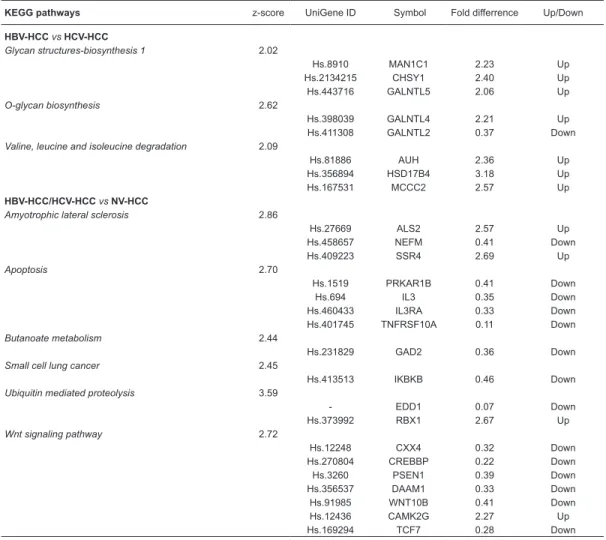
HCV-HCC vs NV-HCC, respectively, considering all selected pathways. Next, we selected only the non-redundant genes considering all comparisons. The functional categories and up-regulated or down-regulated genes in each comparison are summarized in Table 1.
Table 1. Biological process categories and differentially identified expressed genes for all comparisons. KEGG pathways z-score UniGene ID Symbol Fold differrence Up/Down
HBV-HCC vs HCV-HCC
Glycan structures-biosynthesis 1 2.02
Hs.8910 MAN1C1 2.23 Up
Hs.2134215 CHSY1 2.40 Up
Hs.443716 GALNTL5 2.06 Up
O-glycan biosynthesis 2.62
Hs.398039 GALNTL4 2.21 Up
Hs.411308 GALNTL2 0.37 Down
Valine, leucine and isoleucine degradation 2.09
Hs.81886 AUH 2.36 Up
Hs.356894 HSD17B4 3.18 Up
Hs.167531 MCCC2 2.57 Up
HBV-HCC/HCV-HCC vs NV-HCC
Amyotrophic lateral sclerosis 2.86
Hs.27669 ALS2 2.57 Up
Hs.458657 NEFM 0.41 Down
Hs.409223 SSR4 2.69 Up
Apoptosis 2.70
Hs.1519 PRKAR1B 0.41 Down
Hs.694 IL3 0.35 Down
Hs.460433 IL3RA 0.33 Down
Hs.401745 TNFRSF10A 0.11 Down
Butanoate metabolism 2.44
Hs.231829 GAD2 0.36 Down
Small cell lung cancer 2.45
Hs.413513 IKBKB 0.46 Down
Ubiquitin mediated proteolysis 3.59
- EDD1 0.07 Down
Hs.373992 RBX1 2.67 Up
Wnt signaling pathway 2.72
Hs.12248 CXX4 0.32 Down
Hs.270804 CREBBP 0.22 Down
Hs.3260 PSEN1 0.39 Down
Hs.356537 DAAM1 0.33 Down
Hs.91985 WNT10B 0.41 Down
Hs.12436 CAMK2G 2.27 Up
Hs.169294 TCF7 0.28 Down
1122 M. Bellodi-Privato et al.
A non-supervised clustering method was used to de-termine whether the 15 genes with the lowest P value for each HCC group would be capable of grouping samples
based on their expression profiles. Using the k-means algorithm (12), samples were grouped into three clusters
on the basis of the expression profile of 15 genes that
were non-redundant among the 6 genes with the lowest P value for all comparisons. The unsupervised hierarchi-cal clustering analysis of all HCC samples was based on the similarity of the expression patterns for all genes. As shown in Figure 1, all HCC samples were fully clustered into three distinct groups HBV-HCC, HCV-HCC and
NV-Table 1 continued
KEGG pathways z-score UniGene ID Symbol Fold differrence Up/Down
HBV-HCC vs NV-HCC
Aminosugars metabolism 2.12
Hs.274424 NANS 3.16 Up
Bile acid biosynthesis 2.57
Hs.177687 AKR1C4 3.08 Up
- SOAT1 4.48 Up
Butanoate metabolism 3.43
Hs.120 PRDX6 3.34 Up
Glycan structures degradation 2.48
Hs.302018 HPSE2 0.33 Down
Hs.121494 SPAM1 0.19 Down
Glycosaminoglycan degradation 3.89
Hs.69293 HEXB 3.15 Up
Heparan sulfate biosynthesis 3.24
Hs.20894 NDST1 2.35 Up
Hs.20028 NDST3 0.43 Down
Hs.183006 GLCE 2.74 Up
Lysine degradation 2.16
Hs.160208 SETD7 3.85 Up
Hs.289848 DOT1L 0.44 Down
Small cell lung cancer 3.9
Hs.436873 ITGAV 2.58 Up
Toll-like receptor signaling pathway 2.64
Hs.181315 IFNAR1 2.44 Up
Hs.432466 TBK1 0.34 Down
- TICAM2 6.86 Up
Ubiquitin mediated proteolysis 3.59
Hs.413133 FZR1 2.93 Up
HCV-HCC vs NV-HCC
Calcium signaling pathway 2.44
Hs.512612 PHKG1 0.3 Down
Hs.25804 PLCE1 0.43 Down
Hs.144465 SLC8A1 0.45 Down
Hs.32945 GRM1 0.42 Down
Hs.272458 PPP3CA 2.14 Up
Hs.3022 TRHR 0.29 Down
Fructose and mannose metabolism 2.72
Hs.75835 PMM1 4.81 Up
Hs.404119 TSTA3 2.62 Up
Glyoxylate and dicarboxylate metabolism 2.11
Hs.4415543 MTHFD1L 2.84 Up
Hs.430606 CS 2.06 Up
Nicotinate and nicotinamide metabolism 4.11
Hs.58251 NMNAT1 2.49 Up
Hs.375214 SIRT2 3.44 Up
Hs.151135 FN3K 0.43 Down
Pyrimidine metabolism 4.68
Hs.67201 NT5C 2.59 Up
RNA polymerase 7.71
Hs.57813 ZNRD1 3.66 Up
Up- and down-regulation of non-redundant genes are defined as expression in HCC tissues considering HBV-HCC
HCC, according to the serological and histological analysis described in Material and Methods, corroborating their
unique expression profile.
In order to validate the hierarchical clustering analysis, we next applied another approach, this time using an
ex-haustive search for trios of genes, to precisely separate all tumor samples, with perfect class distinction on the basis of the expression signature of each individual sample. Using the signal intensity of all genes selected previously by the Wilcoxon test, we then applied the Fisher’s linear
discrimi-Figure 1. Clustering of the 9 hepatocellular carcinoma (HCC) samples according to the expression profile of 15 genes. Using the k-means algorithm, 9 HCC tissue samples representing the HBV-HCC (B1, B2, B3 samples), HCV-HCC (C1, C2, C3 samples) and
NV-HCC (N1, N2, N3) groups were grouped into three clusters on the basis of the expression profile of the non-redundant set of 15
1124 M. Bellodi-Privato et al.
nant analysis (12) and identified all possible trios of genes that correctly separate, without misclassifications, tissue
samples in each of four possible comparisons: HBV-HCC vs
HCV-HCC, HBV-HCC/HCV-HCC vs NV-HCC, HBV-HCC vs
NV-HCC, and HCV-HCC vs NV-HCC. The number of trios
found for each comparison was 9, 108, 19, and 14 trios for
HBV-HCC vs HCV-HCC, HBV-HCC/HCV-HCC vs NV-HCC,
HBV-HCC vs NV-HCC and HCV-HCC vs NV-HCC,
respec-tively, with perfect distinction (100%) of all samples. Figure
2 and Table 2 show the examples of trios that can classify
HBV-HCC vs HCV-HCC, HBV-HCC/HCV-HCC vs NV-HCC,
HBV-HCC vs NV-HCC and HCV-HCC vs NV-HCC.
Discussion
Oligo-microarray technology has been extensively
applied to cancer research (13), and expression profil -ing is be-ing increas-ingly used for the distinction between physiological and disease states, as well as to distinguish between groups of disease samples for which the
expres-sion profile can discriminate between clinically or biologically
similar entities (14).
Although structural alterations in many cancer-related genes have been found in HCC (15), the high number of genes involved suggests that different etiological factors may affect different gene subsets within hepatocytes. Thus, distinct but related genetic pathways may be altered during hepatocarcinogenesis, possibly due to different initiators and promoters. Multiple studies linking hepatitis viruses and chemical carcinogens to hepatocarcinogenesis have provided clues for the understanding of this molecular
system (16). Several reports have differentially identified
Figure 2. Group classification by a trio of genes identified by Fisher’s linear discriminant analysis: A clear separation between (A)
HBV-HCC vs HCV-HCC, (B) HBV-HCC/HCV-HCC vs NV-HCC, (C) HCV-HCC vs NV-HCC, and (D) HBV-HCC vs NV-HCC is evident. Sam-ples: B1, B2, B3 (HBV-HCC: blue), C1, C2, C3 (HCV-HCC: green) and N1, N2, N3 (NV-HCC: red). XPA = Xeroderma pigmentosum,
expressed genes in HCC using oligo-microarrays (17,18). Although genomic approaches have yielded global gene
expression profiles in HCC and have identified a number
of candidate genes as biomarkers useful for cancer stag-ing, the prediction of prognosis and treatment selection (8) remain unclear across all subsets of HCC (19).
We first analyzed our microarray platform by search -ing for differentially expressed genes in the three groups
of HCC. We demonstrated that expression profiling can
identify genes that differentiate HBV-HCC, HCV-HCC and NV-HCC. Of the 58 non-redundant differentially expressed
genes (Table 1) considering HBV-HCC vs HCV-HCC,
HBV-HCC/HCV-HCC vs NV-HCC, HBC-HCC vs NV-HCC, and
HCV-HCC vs NV-HCC comparisons, only 6 genes (IKBKβ,
CREBBP, WNT10B, PRDX6, ITGAV, and IFNAR1) are involved in hepatic carcinogenesis. These genes have also been described in experimental studies of hepatocar-cinogenesis (20-28).
IkB kinase β (IKBKβ) is required for activation of NF-kB, a transcription factor that regulates liver inflammation and protection from injury. Koch et al. (20) found that IKBKβ
deletion conferred direct growth advantages to
hepato-cytes and enhanced cell proliferation. Both advantages
implicate a growth-suppressor role of IKBKβ under condi -tions of induced hepatotoxicity and hepatocarcinogenesis.
Therapies may target IKBKβ in Kupffer cells to prevent hepatic inflammation, hepatocyte proliferation, and hepatic
carcinogenesis (21).
Cyclic AMP responsive element-binding protein (CREBBP) is a transcriptional co-activator that plays an essential role in the liver by regulating gene expression and different processes such as gluconeogenesis, lipid metabolism, and cell proliferation (22). Abramovitch et al. (23) demonstrated both in vitro and in vivo that CREBBP involves resistance to apoptosis and plays an important role in HCC tumor progression.
The WNT10B gene is a member of the Wnt family, which plays crucial roles in normal development and neo-plastic transformation. WNT10B expression seems to be
a specific event in cancer because normal liver does not
show detectable expression of WNT10B. Yoshikawa et al. (24) demonstrated that WNT10B can be silenced by DNA methylation.
PRDX6 is a member of the PRDX family, associated
Table 2. Examples of trios of genes considering HBV-HCC vs HCV-HCC, HBV-HCC/HCV-HCC vs NV-HCC, HBC-HCC vs NV-HCC, and HCV-HCC vs NV-HCC comparisons.
Comparisons Trios
Gene 1 Gene 2 Gene 3
Hs Symbol Hs Symbol Hs Symbol
HBV-HCC vs HCV-HCC
374950 MT1X 324746 AHSG 422855 ADH1A
324746 AHSG 446588 RPS13 117367 SLC22A1
446588 RPS13 10862 AK3L1 497571 SERPINA3
10862 AK3L1 497571 SERPINA3 21162 RTBDN
389700 MGST1 497571 SERPINA3 107 FGL1
HBV-HCC/HCV-HCC vs NV-HCC
324746 AHSG 374596 TPT1 1955 SAA2
356502 RPLP1 374596 TPT1 2795 LDHA
374596 TPT1 177530 ATP5E 1955 SAA2
177530 ATP5E 1955 SAA2 512676 RPS25
1955 SAA2 512676 RPS25 2795 LDHA
HBV-HCC vs NV-HCC
324746 AHSG 427202 TTR 374950 MT1X
427202 TTR 374950 MT1X 356502 RPLP1
380135 FABP1 374950 MT1X 389700 MGST1
497571 SERPINA3 374950 MT1X 356502 RPLP1
HCV-HCC vs NV-HCC
324746 AHSG 356502 RPLP1 439552 EEF1A1
356502 RPLP1 439552 EEF1A1 381172 RPL41
439552 EEF1A1 381172 RPL41 177530 ATP5E
374596 TPT1 433529 RPS11 1955 SAA2
433529 RPS11 1955 SAA2 512676 RPS25
1126 M. Bellodi-Privato et al.
References
1. Murray CJ, Lopez AD. Mortality by cause for eight regions of the world: Global Burden of Disease Study. Lancet 1997; 349: 1269-1276.
2. Schafer DF, Sorrell MF. Hepatocellular carcinoma. Lancet
1999; 353: 1253-1257.
3. Anzola M. Hepatocellular carcinoma: role of hepatitis B and hepatitis C viruses proteins in hepatocarcinogenesis. J Viral Hepat 2004; 11: 383-393.
4. Mann CD, Neal CP, Garcea G, Manson MM, Dennison AR, Berry DP. Prognostic molecular markers in hepatocellular carcinoma: a systematic review. Eur J Cancer 2007; 43: 979-992.
5. Feitelson MA, Sun B, Satiroglu Tufan NL, Liu J, Pan J, Lian Z. Genetic mechanisms of hepatocarcinogenesis. Onco-gene 2002; 21: 2593-2604.
6. Thorgeirsson SS, Grisham JW. Molecular pathogenesis of human hepatocellular carcinoma. Nat Genet 2002; 31: 339-346.
7. Tsutsumi T, Suzuki T, Moriya K, Yotsuyanagi H, Shintani Y, Fujie H, et al. Alteration of intrahepatic cytokine expression and AP-1 activation in transgenic mice expressing hepatitis C virus core protein. Virology 2002; 304: 415-424.
8. Midorikawa Y, Makuuchi M, Tang W, Aburatani H. Microar-ray-based analysis for hepatocellular carcinoma: from gene
with cell proliferation, differentiation, and apoptosis. Many studies have suggested that the over-expression of PRDX6 in the liver is associated with protection of cells from cellular oxidative stresses. Yoo et al. (25) demonstrated increased expression of PRDX6 in Huh-7 cells following treatments with increasing concentrations of luteolin.
The expression of integrin αV (ITGAV) and extracellular
matrix proteins in the liver has been shown to be closely associated with chronic HBV infection and HBV-infected HCC, as follows: in the injured liver, integrins and collagens are expressed by activated hepatic stellate cells and the in-creased expression of these genes is a commonly observed histological abnormality in hepatitis B infection (26).
Interferon (IFN)-α exerts its antitumor effect by the in
-teraction of IFN with multisubunit receptors - IFN-α receptor
(IFNAR; including IFNAR1 and IFNAR2a). Damdinsuren et al. (27) have suggested that the expression of IFNAR1 plays
an important role in the anti-proliferative effect of IFN-α in
HCC cells. The expression levels of IFNAR1 were closely correlated with the response rates to IFN treatment in pa-tients with chronic hepatitis C. The 5-FU-induced modula-tion of IFNAR1 expression could play a pivotal role in the
therapeutic efficacy of IFN-α combined with 5-FU (28).
In the NV-HCC group, the PRDX6, ITGAV and IFNAR1 genes were up-regulated in relation to HBV-HCC. In con-trast, the CREBBP and WNT10B genes are down-regulated in NV-HCC when compared to HBV-HCC/HCV-HCC.
Con-cerning the IKBKβ gene, it is down-regulated in HCV-HCC
in relation to HBV-HCC (Table 1). Although many studies
have reported differential gene expression profile in HCC
(4,8,9,17,18), the 6 genes previously reported to be
as-sociated with HCC had not been identified in the literature
comparing viral and non-viral HCC. In a similar study, Kurokawa et al. (18) found a total of 51 genes that were
identified as differentially expressed between tumor and
non-tumor tissues regardless of the etiology of HCC. It is
thought that these genes may play significant roles in the
development of cancer independent of hepatitis viruses.
Having compared tumor samples and identified genes
whose pattern of expression correlates with HCC groups,
we next constructed a cluster where samples were orga-nized hierarchically (Figure 1). Based on their correlation distances, the samples were perfectly separated.
Subsequently, in order to confirm our differentially ex -pressed genes between groups, Fisher’s linear discriminant analysis was applied. We performed an exhaustive search
of trios of genes that could be used to build classifiers for
distinction between viral and non-viral HCC. There are few reports in the literature concerning this approach.
Meire-les et al. (29) determined the expression profile in tissue
samples representing normal gastric mucosa, as well as gastritis, intestinal metaplasia, and adenocarcinoma of the stomach. Using Fisher’s linear discriminant analysis, these
investigators identified a series of molecular classifiers that
could distinguish between cancer and non-cancer samples.
They also identified a series of intestinal metaplasias whose gene expression profile resembled that of adenocarcinoma.
Stolf et al. (30) searched for expression signatures of in-dividual samples of adenomas and follicular carcinomas
that could be used as molecular classifiers for the precise classification of malignant and non-malignant lesions. In
our study, we found a strong correlation between data from
classifiers and from cluster analysis. All samples that were classified by the trios were grouped into the hierarchical cluster. This is the first study that focuses on a search for
genes that could be used for the construction of molecular
classifiers. It is now imperative to apply these classifiers to
a large set of samples.
We identified differentially expressed genes in HCC of different etiologies, and this expression profiling may pro -vide useful clues for pathophysiological research into HCC.
Molecular stratification of individual HCC into genetically
homogeneous subclasses can be of help by offering an opportunity for developing optimal therapeutic agents for various HCC based on their distinctive genomic types.
Acknowledgments
expression profiling to new challenges. World J Gastroen-terol 2007; 13: 1487-1492.
9. Glinsky GV, Berezovska O, Glinskii AB. Microarray analysis
identifies a death-from-cancer signature predicting therapy
failure in patients with multiple types of cancer. J Clin Invest
2005; 115: 1503-1521.
10. Edwards D. Non-linear normalization and background cor-rection in one-channel cDNA microarray studies. Bioinfor-matics 2003; 19: 825-833.
11. Cheadle C, Vawter MP, Freed WJ, Becker KG. Analysis of microarray data using Z score transformation. J Mol Diagn
2003; 5: 73-81.
12. Hastie T, Tibshirani R, Friedman J. The elements of statisti-cal learning. New York: Springer-Verlag; 2001.
13. Yeatman TJ. The future of clinical cancer management: one tumor, one chip. Am Surg 2003; 69: 41-44.
14. van de Vijver MJ, He YD, van’t Veer LJ, Dai H, Hart AA, Voskuil DW, et al. A gene-expression signature as a predic-tor of survival in breast cancer. N Engl J Med 2002; 347: 1999-2009.
15. Murakami Y, Hayashi K, Hirohashi S, Sekiya T. Aberrations of the tumor suppressor p53 and retinoblastoma genes in human hepatocellular carcinomas. Cancer Res 1991; 51: 5520-5525.
16. Andrisani OM, Barnabas S. The transcriptional function of the hepatitis B virus X protein and its role in hepatocarcino-genesis (Review). Int J Oncol 1999; 15: 373-379.
17. Okabe H, Satoh S, Kato T, Kitahara O, Yanagawa R, Ya-maoka Y, et al. Genome-wide analysis of gene expression in human hepatocellular carcinomas using cDNA microarray:
identification of genes involved in viral carcinogenesis and
tumor progression. Cancer Res 2001; 61: 2129-2137. 18. Kurokawa Y, Honma K, Takemasa I, Nakamori S,
Kita-Mat-suo H, Motoori M, et al. Central genetic alterations common to all HCV-positive, HBV-positive and non-B, non-C hepato-cellular carcinomas: a new approach to identify novel tumor markers. Int J Oncol 2006; 28: 383-391.
19. Furuta K, Sato S, Yamauchi T, Kakumu S. Changes in
intra-hepatic gene expression profiles from chronic hepatitis to
hepatocellular carcinoma in patients with hepatitis C virus infection. Hepatol Res 2008; 38: 673-682.
20. Koch KS, Maeda S, He G, Karin M, Leffert HL. Targeted deletion of hepatocyte Ikkbeta confers growth advantages.
Biochem Biophys Res Commun 2009; 380: 349-354.
21. Schwabe RF, Brenner DA. Mechanisms of Liver Injury. I. TNF-alpha-induced liver injury: role of IKK, JNK, and ROS pathways. Am J Physiol Gastrointest Liver Physiol 2006; 290: G583-G589.
22. Servillo G, la Fazia MA, Sassone-Corsi P. Coupling cAMP signaling to transcription in the liver: pivotal role of CREB and CREM. Exp Cell Res 2002; 275: 143-154.
23. Abramovitch R, Tavor E, Jacob-Hirsch J, Zeira E, Amariglio N, Pappo O, et al. A pivotal role of cyclic AMP-responsive element binding protein in tumor progression. Cancer Res
2004; 64: 1338-1346.
24. Yoshikawa H, Matsubara K, Zhou X, Okamura S, Kubo T, Murase Y, et al. WNT10B functional dualism: beta-catenin/ Tcf-dependent growth promotion or independent suppres-sion with deregulated expressuppres-sion in cancer. Mol Biol Cell
2007; 18: 4292-4303.
25. Yoo DR, Jang YH, Jeon YK, Kim JY, Jeon W, Choi YJ, et al.
Proteomic identification of anti-cancer proteins in
luteolin-treated human hepatoma Huh-7 cells. Cancer Lett 2009; 282: 48-54.
26. Lee SK, Kim MH, Cheong JY, Cho SW, Yang SJ, Kwack K. Integrin alpha V polymorphisms and haplotypes in a Korean population are associated with susceptibility to chronic hepatitis and hepatocellular carcinoma. Liver Int 2009; 29: 187-195.
27. Damdinsuren B, Nagano H, Wada H, Noda T, Natsag J, Marubashi S, et al. Interferon alpha receptors are important for antiproliferative effect of interferon-alpha against human hepatocellular carcinoma cells. Hepatol Res 2007; 37: 77-83.
28. Oie S, Ono M, Yano H, Maruyama Y, Terada T, Yamada Y, et al. The up-regulation of type I interferon receptor gene plays a key role in hepatocellular carcinoma cells in the synergistic
antiproliferative effect by 5-fluorouracil and interferon-alpha.
Int J Oncol 2006; 29: 1469-1478.
29. Meireles SI, Cristo EB, Carvalho AF, Hirata R Jr, Pelosof A, Gomes LI, et al. Molecular classifiers for gastric cancer and nonmalignant diseases of the gastric mucosa. Cancer Res
2004; 64: 1255-1265.