ISSN 0100-879X
BIOMEDICAL SCIENCES
AND
CLINICAL INVESTIGATION
www.bjournal.com.br
www.bjournal.com.br
Volume 45 (3) 179-290 March 2012
Braz J Med Biol Res, March 2012, Volume 45(3) 264-272
doi: 10.1590/S0100-879X2012007500010
Increased immunohistochemical expression of YKL-40 in the
spleen of patients with portal hypertension
Dong Wang, Jian-Guo Lu, Qing Wang, Xi-Lin Du, Rui Dong, Peng Wang, Lei Zhao, Xue Jiang and
Li-Juan Yuan
Institutional Sponsors
The Brazilian Journal of Medical and Biological Research is partially financed by
Faculdade de Medicina de Ribeirão Preto Campus
Ribeirão Preto
Explore High - Performance MS Orbitrap Technology In Proteomics & Metabolomics
Increased immunohistochemical expression
of YKL-40 in the spleen of patients with
portal hypertension
Dong Wang
1*, Jian-Guo Lu
1*, Qing Wang
1, Xi-Lin Du
1, Rui Dong
1, Peng Wang
1,
Lei Zhao
1, Xue Jiang
2and Li-Juan Yuan
21Department of General Surgery, The Second Affiliated Hospital, Fourth Military Medical University, Xi’an, China 2Laboratory of General Surgery, The Second Affiliated Hospital, Fourth Military Medical University, Xi’an, China
Abstract
YKL-40 has been identified as a growth factor in connective tissue cells and also a migration factor in vascular smooth muscle cells. To a large extent, the increase of serum YKL-40 is attributed to liver fibrosis and asthma. However, the relationship of the expression and clinical/prognostic significance of YKL-40 to the splenomegaly of patients with portal hypertension is unclear.
In the present study, the expression of YKL-40 was studied by immunohistochemistry in 48 splenomegaly tissue samples from
patients with portal hypertension and in 14 normal spleen specimens. All specimens were quickly stored at -80°C after resec -tion. Primary antibodies YKL-40 (1:150 dilution, rabbit polyclonal IgG) and MMP-9 (1:200 dilution, rabbit monoclonal IgG) and
antirabbit immunoglobulins (HRP K4010) were used in this study. The relationship of clinicopathologic features with YKL-40 is presented. The expression of YKL-40 indicated by increased immunochemical reactivity was significantly up-regulated in sple
-nomegaly tissues compared to normal spleen tissues. Overexpression of YKL-40 was found in 68.8% of sple-nomegaly tissues and was significantly associated with Child-Pugh classification (P= 0.000), free portal pressure (correlation coefficient = 0.499, P < 0.01) and spleen fibrosis (correlation coefficient = 0.857, P < 0.01). Further study showed a significant correlation between YKL-40 and MMP-9 (correlation coefficient = -0.839, P < 0.01), indicating that YKL-40 might be an accelerator of spleen tissue remodeling by inhibiting the expression of MMP-9. In conclusion, YKL-40 is an important factor involved in the remodeling of
spleen tissue of portal hypertension patients and can be used as a therapeutic target for splenomegaly.
Key words: YKL-40; MMP-9; Splenomegaly; Fibrosis; Portal hypertension; Immunohistochemistry
Introduction
Correspondence: Jian-Guo Lu and Xi-Lin Du, Department of General Surgery, The Second Affiliated Hospital, Fourth Military Medical University, 1 Xin Si Road, Xi’an, China. E-mail: [email protected] and [email protected]
*These authors contributed equally to this study.
Received January 22, 2011. Accepted January 4, 2012. Available online January 27, 2012. Published March 19, 2012.
Splenomegaly is one of the complications of portal
hypertension and chronic liver diseases that can influence
patient morbidity and quality of life (1). The incidence of
splenomegaly in cirrhosis ranges from 36 to 92% in different series (2). Especially in China, decompensated cirrhosis
induced by viral hepatitis is an important cause of spleno
-megaly. In many cases, patients with portal hypertension
simultaneously have splenomegaly and hypersplenism. They have no special symptoms related to splenomegaly but have symptoms related to hypersplenism. Occasionally, patients do not have any symptoms until they touched the
enlarged spleen in the abdomen inadvertently. Splenom
-egaly may lead to the extrinsic compressionof abdominal organs and therefore result in corresponding symptoms.
Overlarge spleens may magnify the risk for spontaneous
rupture or rupture after minor trauma (1). To date, there is
no specific medical therapy for splenomegaly.
YKL-40, also called human cartilage glycoprotein-39 (HC-gp39) and chitinase-3-like-1 (CHI3L1), is a heparin- and
chitin-binding glycoprotein with a molecular mass of 40 kDa.
It is highly conserved phylogenetically and belongs to ‘mam
-malian chitinase-like proteins’, but has no chitinase activity (3-8). The details of the physiological function of YKL-40
are unknown. It has been reported that this glycoprotein may contribute to tissue remodeling and extracellular matrix
Expression of YKL-40 in spleen of patients with portal hypertension 265
it is involved in tissue remodeling and fibrosis (10,11).
YKL-40 also induces the proliferation of chondrocytes and
synovial cells (12). Furthermore, YKL-40 was found to in
-duce coordination of membrane-bound receptor syndecan-1
and integrin alpha (v) beta (3) to activate an intracellular
signaling cascade, including focal adhesion kinase and
mitogen-activated protein kinase extracellular signal-related kinase 1/2 in endothelial cells (13). Collectively, these data suggest that YKL-40 is involved in the pathologic process of human diseases involving tissue remodeling.
Matrix metalloproteinases (MMPs) are a family of prote-olytic enzymes that contain Zn2+, Ca2+, and other metal ions.
Accumulating evidence has indicated that MMPs play an es
-sential role in fibrogenesis. Traditional substrates of MMPs are components of the ECM, such as collagen, laminin, and fibronectin. More than 20 enzymes have been identified
as MMPs in mammals. MMP-9, an important member of the MMP family, functions in the degradation of almost all
types of ECM, such as collagen I, collagen IV, collagen V, collagen VII, collagen X, collagen XI, fibronectin, elastin, and proteoglycans. Recent studies have shown that YKL-40 might play a role in fibrogenesis through MMP-9. Thus, in
the present study, the relationship between expression of YKL-40 and of MMP-9 will also be explored.
Traditionally, splenomegaly in portal hypertension is
thought to be a mere consequence of the rise of portal ve
-nous pressure and the increased resistance to splenic blood
outflow (14), although there is a relatively weak correlation between portal venous pressure and spleen size. Recently,
the role of tissue hyperplasia in congested splenomegaly has also been reported (15). Thus, we hypothesized that YKL-40 may play a role in the process of splenomegaly
in portal hypertension. We also evaluated the expression
of MMP-9 in splenomegaly and the relationship between YKL-40 and MMP-9 expression measured by immunohis-tochemistry.
Material and Methods
Patients and samples
Forty-eight splenomegaly specimens were obtained
from consecutive patients submitted to full or partial sple
-nectomy [33 men and 15 women with a median age of 44
years (range: 19-69)] referred to the Department of General Surgery between January 2009 and December 2009 at the
Second Affiliated Hospital, Fourth Military Medical Univer
-sity, Xi’an, China. The diagnosis of portal hypertension was
based on accepted biochemical and clinical criteria (16).
In order to lower portal pressure and to alleviate clinical
signs of portal hypertension (e.g., ascites, esophageal and
gastric variceal bleeding, hypersplenism, splenomegaly,
etc.), splenectomy was carried out with periesophagogastric
devascularization or partial splenectomy was performed
with a distal splenorenal shunt plus periesophagogastric
devascularization after comprehensive evaluation. All
patients with portal hypertension had suffered from liver
cirrhosis, 41 patients had posthepatic cirrhosis [hepatitis B
(N = 35), hepatitis C (N = 6)], and 7 patients had alcoholic
cirrhosis. The main morphological diagnoses as well as pertinent clinical and biochemical parameters of the patients are summarized in Table 1. During the same period, 14 normal spleen specimens were taken from patients who had suffered traumatic splenic rupture without any signs
of liver disease or any other diseases. All samples used in this study were obtained with the approval of the Ethics Committee of Research in the Second Affiliated Hospital, Fourth Military Medical University, and all patients gave
written informed consent to participate.
Histological and immunohistochemical analyses All specimens were taken from the tissues near the hilum
of the spleen, which were those most directly influenced
by the high portal hypertension. After 10% formalin fixa
-tion, the tissues were embedded in paraffin, cut into 5-μm
sections and routinely stained with Masson trichrome and neighboring sections were used for immunolocalization.
Endogenous peroxidase activity was blocked with 0.3% hydrogen peroxide for 20 min. For antigen retrieval, slides were heated in a microwave oven for 10 min in 10 mM citrate buffer, pH 6.0. Nonspecific binding was inhibited by incubation with blocking buffer at room temperature for 30 min. The sections were then incubated at 4°C overnight
with primary antibodies against YKL-40 (1:150 dilution,
rabbit polyclonal IgG; Quidel, USA) or against MMP-9 (1:200 dilution, rabbit monoclonal IgG; Clone ID: EP1254, Epitomics, USA). After a brief wash with phosphate-buffered saline (PBS), the sections were incubated for 30 min with
a peroxidase-labeled polymer conjugated to antirabbit
im-munoglobulins (DAKO EnVision System/HRP K4010; Dako Cytomation, Denmark). The final detection was performed using 3,3′-diaminobenzidine (DAB) as the chromogen and 3% hematoxylin as the counterstain. Breast cancer tissue was used as positive control (immunoreactivity was noted in the tumor cells). A negative control without a primary
antibody was used.
For YKL-40 and MMP-9, mainly expressed in mac
-rophages but not in lymphocytes, expression of YKL-40/
MMP-9 was tested according to the percentage of stained cells. A positive result was defined when positive-stained cells were more than 10% of the total cells in one visual field at 400X magnification. The degree of fibrosis was evaluated based on the percentage of blue-stained fiber area. All images were analyzed using the Image pro plus 6.0 software (Media Cybernetics, USA).
Statistical analysis
Statistical analysis was performed with the SPSS
soft-ware (SPSS Standard version 17.0; SPSS Inc., USA). The
Student t-test and the χ2 test were used to evaluate the
parameter for the patients. The Spearman ρ test was per
-formed to evaluate correlation between YKL-40, MMP-9, free portal pressure (FPP), and degree of spleen fibrosis.
P values of less than 0.05 were considered to indicate
statistical significance.
Results
Evaluation of YKL-40 expression in enlarged spleen The expression of YKL-40 in 48 splenomegaly
speci-mens and 14 normal spleen tissues was investigated by
immunohistochemistry. YKL-40 was successfully detected
in 33 (68.8%) of 48 splenomegaly specimens and in 3 (21.4%) of 14 normal spleen tissues. Positive expression of
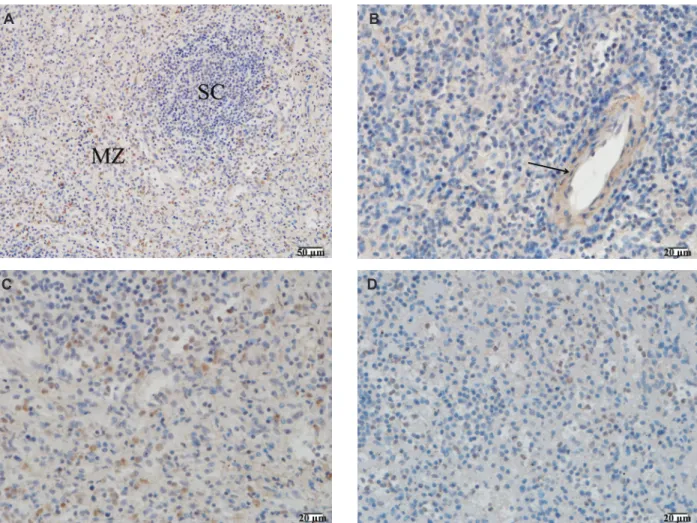
YKL-40 occurred in the cytoplasm. The tissues stained by YKL-40 antigen were in areas such as the splenic marginal zone and red pulp, but seldom was detected in splenic corpuscles. According to cell morphology, karyoplasmic
ratio and the location of positive-expressed cells, the positive-stained cells were macrophages. Positive-stained cells were also detected in some vascular smooth muscle cells (Figure 1).
The relationship between overexpression of YKL-40 and the clinical features of portal hypertension
The association of YKL-40 overexpression with the
clinical characteristics of the patient cohort was further
evaluated and is summarized in Tables 1 and 2. The im
-munohistochemical expression of YKL-40 was significantly
higher in the spleen of portal hypertension patients than in normal spleen. Among portal hypertension patients, there
was no significant difference in red blood cells, white blood cells, platelets, serum albumin, or serum glutamic pyruvic transaminase between the YKL-40 positive-stained group and the YKL-40 negative-stained group. But serum total
bilirubin (TBIL) [39.60 (21.40-74.50) vs 33.08 (15.20-51.20)],
Figure 1. Detection of the expression of YKL-40 by immunohistochemical staining. Positive expression (brown) of YKL-40 occurred in the cytoplasm. A, Expression of YKL-40 in the marginal zone (MZ) of the spleen of a patient with portal hypertension; lack of YKL-40
expression in splenic corpuscle (SC). B, Expression of YKL-40 in vascular smooth muscle cells (arrow). C, Expression of YKL-40 in
spleen tissue from a patient with portal hypertension. D, Expression of YKL-40 in normal spleen.
A
B
Expression of YKL-40 in spleen of patients with portal hypertension 267
serum glutamic oxalacetic transaminase (GOT) [40 (17-110) vs 30 (17-74)] were significantly higher in the YKL-40
positive-stained group than in the YKL-40 negative-stained
group (Table 1). The overexpression of YKL-40 did not cor
-relate with patient age (≤44 years old vs >44 years old),
gender, causes of cirrhosis (hepatitis B, hepatitis C, and alcoholic cirrhosis) and the severity of esophageal varices (none, slight, moderate to severe; Table 2).
However, overexpression of YKL-40 was sig
-nificantly related to Child-Pugh classification
(P = 0.000). When the expression of YKL-40
in different Child-Pugh classifications was
compared by the chi-square method, it was
found that overexpression of YKL-40 in Child B and Child C patients was higher (P = 0.000, P = 0.003, respectively) than that in Child A
patients. No difference in expression was found
between Child B and in Child C patients (P = 0.789; data not shown in Table 2). A significant
correlation between expression of YKL-40 and
FPP was also obtained by the Spearman ρ test (correlation coefficient = 0.499, P < 0.01; Figure 2).
Correlation of the overexpression of
YKL-40 and MMP-9 in fibrosis
It has been reported that YKL-40 is able
to activate the release of MMP-9 in alveolar
macrophages from patients with chronic
ob-structive pulmonary disease (17) and from the human monocytic cell line THP-1 (18)
when these cells were exposed to YKL-40. But a recent study (19) showed that YKL-40
in infiltrating macrophages inhibits MMP-1 activity and accelerates fibril formation in the vicinity of macrophages to trap macrophages
in adipose tissue. To determine whether
YKL-40 is able to mediate the activation of MMP-9
in spleen of patients with portal hypertension, expression of MMP-9 and its relationship with
YKL-40 were investigated in spleen tissue with
portal hypertension by immunohistochemistry.
Positive-stained cells were also located mainly
in the red pulp and marginal zone but scarcely in the splenic corpuscle. Interestingly, expres-sion of MMP-9 in normal spleen was indeed
higher than in enlarged spleen (37.39 ± 0.75
vs 25.11 ± 0.83%; P < 0.01), and a significant
correlation was found between YKL-40 and
MMP-9 (correlation coefficient = -0.839, P < 0.01; Figure 3).
Histomorphological analysis was carried out to detect the presence of fibrosis in the
spleen by Masson trichrome staining, and a
considerable amount of fibrosis extending to
the entire splenic parenchyma was found in portal
hyperten-sion patients compared to normal persons (17.07 ± 5.03 vs
5.11 ± 0.73%, P < 0.01). Additionally, the Spearman ρ test
showed that expression of YKL-40 was correlated with the
fibrosis area of the spleen (correlation coefficient = 0.857, P < 0.01; Figure 4).
Table 1. Clinical and biochemical characteristics of the patients with portal hy -pertension.
YKL-40 positive-stained
(N = 33) YKL-40 negative-stained (N = 15)
Age (years) 45 (22-69) 40 (19-58)
Red blood cells (1012/L) 3.59 (2.64-5.02) 3.41 (2.57-3.90)
White blood cells (109/L) 1.68 (0.10-7.04) 2.02 (0.77-3.11)
Platelets (109/L) 43 (20-119) 50 (11-94)
Serum albumin (g/L) 31.7 (25.8-41.8) 33.6 (27-38.7)
Serum TBIL (μM) 39.6 (21.4-74.5) 33.1 (15.2-51.2)* Serum GPT (U/L) 27 (9-75) 21 (11-61)
Serum GOT (U/L) 40 (17-110) 30 (17-74)*
Data are reported as median (range). TBIL = total bilirubin; GPT =
glutamic-pyruvic transaminase; GOT = glutamic-oxalacetic transaminase. *P < 0.05
compared to YKL-40 positive-stained group (Student t-test).
Table 2. Clinical significance of YKL-40 overexpression in portal hypertension.
Clinicopathologic features Total cases Overexpression of YKL-40
Normal spleen 14 3/14 (21.4%)*
No. of patients 48 33/48 (68.8%)
Age (years)
≤44 27 16/27 (59.3%)
>44 21 17/21 (81.0%)
Gender
Male 33 24/33 (72.7%)
Female 15 9/15 (60.0%)
Cause of cirrhosis
Hepatitis B 35 24/35 (68.6%) Hepatitis C 6 4/6 (66.7%)
Alcoholic cirrhosis 7 5/7 (71.4%)
Severity of esophageal varices
None 3 1/3 (33.3%)
Slight 9 6/9 (66.7%)
Moderate/Severe 36 26/36 (72.2%) Child-Pugh classification
Child A 14 3/14 (21.4%)*
Child B 26 22/26 (84.6%)*
Child C 8 8/8 (100%)*
Figure 2. Correlation between the expression of YKL-40 and free portal pressure. R = 0.499; P <0.01 were obtained with the
Spearman ρ test.
Figure 3. Expression of metalloproteinase-9 (MMP-9) in the spleen. Positive expression (brown) of MMP-9 occurred in the cytoplasm.
A, Normal spleen; B, spleen from a patient with portal hypertension; C, comparison of MMP-9 between a normal spleen and spleen
tis-sue from a patient with portal hypertension. Data are reported as means ± SD. D, Correlation between YKL-40 and MMP-9 expressed
in spleen tissue from a patient with portal hypertension (R = -0.839, P <0.01; Spearman ρ test).
A
B
Expression of YKL-40 in spleen of patients with portal hypertension 269
Discussion
YKL-40 was first detected by Johansen et al. (3) as an ECM glycoprotein in a human osteosarcoma MG63 cell
line. So far, expression of YKL-40 has been detected in
some kinds of cancer cells (20,21), macrophages (22,23),
fetal cells in the human embryo (24), tumor-associated macrophages (25), in the late differentiation of neutrophil
activation (26), in cartilage cells (4,27), in the differentiation of vascular smooth muscle cells (28,29), and fibroblast-like chondrocytes (26,30) but not in lymphocytes. As to tissue
remodeling, YKL-40 has been shown to be expressed by a
variety of cells during chronic inflammatory conditions (31)
and its serum concentration is associated with the risk and
severity of asthma (10,32), acute myocardial infarction (33),
rheumatoid arthritis (34), and atherosclerosis (35). Function
-ally, YKL-40 is secreted by activated macrophages during
early and late stages of differentiation in vitro (6,22). In vivo, YKL-40 mRNA is found in a subpopulation of macrophages
in tissues with inflammation and matrix remodeling (36). Johansen et al. (9) and Berres et al. (37) have reported
that serum YKL-40 is associated with severity of liver fi
-brosis and can be considered to be a noninvasive fi-brosis
marker. Our study initially showed that the expression of
YKL-40 was significantly higher in the spleen of patients
with portal hypertension than that in the spleen of normal
people. In the spleen, YKL-40 positive-stained cells were
detected mainly in the marginal zone and red pulp in which large macrophages were located, and scarcely found in the splenic corpuscle where most lymphocytes were located. Based on cell morphology, karyoplasmic ratio and the
loca-tion of the positive-expressed cells, they were identified as macrophages. This result is consistent with previous studies. Nishikawa and Millis (29) have reported that YKL-40 is a
Figure 4. Detection of fiber in the spleen by Masson trichrome staining. A, Normal spleen. B, Spleen from a patient with portal
hy-pertension. The arrow indicates blue staining of the fiber. C, Comparison of the amount of fiber between a normal spleen and spleen
tissue from a patient with portal hypertension. D, Correlation between expression of YKL-40 and fiber in spleen tissue from a patient
with portal hypertension (R = 0.857, P < 0.01; Spearman ρ test).
A
B
novel adhesion and migration factor for vascular cells. In our study, positive-stained vascular muscle cells were also detected in some individually proliferating vessels. However, positive-stained cells were not found in most proliferating vessels, although smooth muscle proliferation was their
common feature. This demonstrated that YKL-40 may be
engaged in vascular remodeling when there is a direct ir
-ritation of the hyperdynamic circulation or fibrosis-promoting
factors in the blood circulation, but YKL-40 may not be the main factor stimulating smooth muscle proliferation in the splenomegaly of portal hypertension. Because the spleen specimens were taken from patients suffering from cirrho-sis of different origins, the causes of cirrhocirrho-sis were also
evaluated. However, no difference was found (P = 0.982)
demonstrating that there was no relationship between
overexpression of YKL-40 and causes of cirrhosis. Normally, fibers support the structure of the spleen and
represent the blood spleen barrier. However, fiber prolifer
-ates largely in splenomegaly of portal hypertension. Thus, it will break the normal structure of the spleen and block
blood flow into the spleen. In addition, fiber proliferation limits
further expansion of the sinusoids to accept more blood and stimulates compensatory angiogenesis. More importantly,
fiber proliferation increases the mechanical damage to
blood cells and clearance of blood cells by macrophage, which will lead to hypersplenism. Thus, we explored whether splenomegaly associated with portal hypertension was
driven by fibrogenesis. Our results suggested that this
could be the case and statistical analysis also indicated
that overexpression of YKL-40 was significantly associ
-ated with the degree of fibrosis in the spleen associ-ated
with portal hypertension. This may well demonstrate that YKL-40 is an important factor contributing to the process
of spleen fibrosis. The Spearman ρ test also showed that overexpression of YKL-40 was correlated with FPP and Child-Pugh classification. It has been reported (38) that if
the spleen remained in the artificial system of portal hyper
-tension, fibrosis of the spleen would be increased and its
function would disappear gradually, but if it migrated to the
iliac vessels with normal blood pressure, the fibrosis could
be gradually reduced. This indicates that portal hyperten-sion might indirectly be the immediate cause of spleen
fibrosis. The correlation between YKL-40 and FPP showed
that the direct stimulation of portal pressure may be one of
the factors involved in the overexpression of YKL-40. As to the correlation with Child-Pugh classification, the more seriously liver function was impaired, the more YKL-40 was
expressed. Serum TBIL and GOT could reflect liver func
-tion and injury to the hepatocytes. The difference in serum
GOT/serum TBIL between the YKL-40 positive-expressed group and YKL-40 negative-expressed group may also indirectly demonstrate the influence of liver function on the overexpression of YLK-40 in splenomegaly. Although
this may not be the full reason for the result of our study,
it can be hypothesized that with the deterioration of liver function, some factors causing liver fibrosis may flow into
the spleen with the blood circulation and stimulate the expression of YKL-40.
MMPs are important factors in the ECM. Under normal
physiological conditions, they are thought to be of great
im-portance in the maintenance of connective tissue integrity. MMP-9, a member of the MMP family, was reported to have proteolytic activity against connective tissue proteins, and
has been suggested to be important in the connective tis
-sue remodeling processes associated with atherogenesis
and plaque rupture (39). Theoretically, we hypothesized that YKL-40 promoted fibrosis in the spleen by inhibiting
expression of MMP-9 in the process of portal hypertension. Interestingly, the results agreed with this hypothesis and led
us to believe that inhibition of MMP-9 by YKL-40 may be the key molecular mechanism involved in the development of fibrosis in splenomegaly derived from portal hypertension. However, further studies are needed.
In our study, we only investigated the function of YKL-40 in fibrogenesis, one aspect of splenomegaly caused by portal hypertension. Although we detected overexpression of YKL-40 in some individual vascular smooth muscle cells,
the effects of YKL-40 on angiogenesis are not yet fully known. As to hypersplenism, the lack of differences in red blood cells, white blood cells and platelets between the
YKL-40 positive-stained group and the YKL-40
negative-stained group may indicate that YKL-40 has no impact on this condition, but more studies are needed.
In conclusion, YKL-40 is an important factor in the spleen
fibrogenesis occurring in portal hypertension. Moreover,
combined with the routine treatment of portal hypertension
(modifying liver function, lowering free portal hypertension, etc.), development and application of YKL-40 inhibitors or
YKL-40 antibodymay be an effective target of therapy for
splenomegaly. Further investigations are in progress.
Acknowledgments
Research supported by the National Natural Science
Foundation of China (#81172287).
References
1. McCormick PA, Murphy KM. Splenomegaly, hypersplenism and coagulation abnormalities in liver disease. Baillieres Best Pract Res Clin Gastroenterol 2000; 14: 1009-1031.
2. Mutchnick MG, Lerner E, Conn HO. Effect of portacaval
anastomosis on hypersplenism. Dig Dis Sci 1980; 25:
Expression of YKL-40 in spleen of patients with portal hypertension 271
3. Johansen JS, Williamson MK, Rice JS, Price PA. Identifi -cation of proteins secreted by human osteoblastic cells in culture. J Bone Miner Res 1992; 7: 501-512.
4. Hakala BE, White C, Recklies AD. Human cartilage gp-39,
a major secretory product of articular chondrocytes and
synovial cells, is a mammalian member of a chitinase protein
family. J Biol Chem 1993; 268: 25803-25810.
5. Shackelton LM, Mann DM, Millis AJ. Identification of a 38-kDa heparin-binding glycoprotein (gp38k) in differentiating vascular smooth muscle cells as a member of a group of
proteins associated with tissue remodeling. J Biol Chem
1995; 270: 13076-13083.
6. Renkema GH, Boot RG, Au FL, Donker-Koopman WE, Stri
-jland A, Muijsers AO, et al. Chitotriosidase, a chitinase, and the 39-kDa human cartilage glycoprotein, a chitin-binding
lectin, are homologues of family 18 glycosyl hydrolases se-creted by human macrophages. Eur J Biochem 1998; 251: 504-509.
7. Bigg HF, Wait R, Rowan AD, Cawston TE. The mammalian chitinase-like lectin, YKL-40, binds specifically to type I colla
-gen and modulates the rate of type I colla-gen fibril formation.
J Biol Chem 2006; 281: 21082-21095.
8. Funkhouser JD, Aronson NN Jr. Chitinase family GH18: evolutionary insights from the genomic history of a diverse
protein family. BMC Evol Biol 2007; 7: 96.
9. Johansen JS, Christoffersen P, Moller S, Price PA, Henrik
-sen JH, Garbarsch C, et al. Serum YKL-40 is increased in patients with hepatic fibrosis. J Hepatol 2000; 32: 911-920.
10. Chupp GL, Lee CG, Jarjour N, Shim YM, Holm CT, He S,
et al. A chitinase-like protein in the lung and circulation of
patients with severe asthma. N Engl J Med 2007; 357:
2016-2027.
11. Furuhashi K, Suda T, Nakamura Y, Inui N, Hashimoto D,
Miwa S, et al. Increased expression of YKL-40, a chitinase-like protein, in serum and lung of patients with idiopathic
pulmonary fibrosis. Respir Med 2010; 104: 1204-1210.
12. De Ceuninck F, Gaufillier S, Bonnaud A, Sabatini M, Lesur C, Pastoureau P. YKL-40 (cartilage gp-39) induces prolifera
-tive events in cultured chondrocytes and synoviocytes and
increases glycosaminoglycan synthesis in chondrocytes.
Biochem Biophys Res Commun 2001; 285: 926-931.
13. Shao R, Hamel K, Petersen L, Cao QJ, Arenas RB, Bigelow C, et al. YKL-40, a secreted glycoprotein, promotes tumor
angiogenesis. Oncogene 2009; 28: 4456-4468.
14. Moschowitz E. The pathogenesis of splenomegaly in hyper
-tension of the portal circulation; congestive splenomegaly.
Medicine 1948; 27: 187-221.
15. Bolognesi M, Merkel C, Sacerdoti D, Nava V, Gatta A. Role
of spleen enlargement in cirrhosis with portal hypertension.
Dig Liver Dis 2002; 34: 144-150.
16. Bayraktar Y, Balkanci F, Uzunalimoglu B, Gokoz A, Koseoglu T, Batman F, et al. Is portal hypertension due to liver cirrhosis a major factor in the development of portal hypertensive
gastropathy? Am J Gastroenterol 1996; 91: 554-558.
17. Letuve S, Kozhich A, Arouche N, Grandsaigne M, Reed J, Dombret MC, et al. YKL-40 is elevated in patients with chronic obstructive pulmonary disease and activates alveo -lar macrophages. J Immunol 2008; 181: 5167-5173.
18. Michelsen AE, Rathcke CN, Skjelland M, Holm S, Ranheim
T, Krohg-Sorensen K, et al. Increased YKL-40 expression in patients with carotid atherosclerosis. Atherosclerosis 2010; 211: 589-595.
19. Iwata T, Kuwajima M, Sukeno A, Ishimaru N, Hayashi Y,
Wabitsch M, et al. YKL-40 secreted from adipose tissue inhibits degradation of type I collagen. Biochem Biophys Res Commun 2009; 388: 511-516.
20. Bi J, Lau SH, Lv ZL, Xie D, Li W, Lai YR, et al. Overexpres -sion of YKL-40 is an independent prognostic marker in gastric cancer. Hum Pathol 2009; 40: 1790-1797.
21. Yamac D, Ozturk B, Coskun U, Tekin E, Sancak B, Yildiz R, et al. Serum YKL-40 levels as a prognostic factor in patients with locally advanced breast cancer. Adv Ther 2008; 25: 801-809.
22. Rehli M, Niller HH, Ammon C, Langmann S, Schwarzfischer L, Andreesen R, et al. Transcriptional regulation of CHI3L1,
a marker gene for late stages of macrophage differentiation.
J Biol Chem 2003; 278: 44058-44067.
23. Rehli M, Krause SW, Andreesen R. Molecular character
-ization of the gene for human cartilage gp-39 (CHI3L1), a
member of the chitinase protein family and marker for late stages of macrophage differentiation. Genomics 1997; 43:
221-225.
24. Johansen JS, Hoyer PE, Larsen LA, Price PA, Mollgard K. YKL-40 protein expression in the early developing human
musculoskeletal system. J Histochem Cytochem 2007; 55:
1213-1228.
25. Junker N, Johansen JS, Andersen CB, Kristjansen PE. Ex -pression of YKL-40 by peritumoral macrophages in human small cell lung cancer. Lung Cancer 2005; 48: 223-231.
26. Volck B, Price PA, Johansen JS, Sorensen O, Benfield TL, Nielsen HJ, et al. YKL-40, a mammalian member of the chitinase family, is a matrix protein of specific granules in
human neutrophils. Proc Assoc Am Physicians 1998; 110:
351-360.
27. Volck B, Johansen JS, Stoltenberg M, Garbarsch C, Price
PA, Ostergaard M, et al. Studies on YKL-40 in knee joints of patients with rheumatoid arthritis and osteoarthritis.
In-volvement of YKL-40 in the joint pathology. Osteoarthritis Cartilage 2001; 9: 203-214.
28. Malinda KM, Ponce L, Kleinman HK, Shackelton LM, Millis AJ. Gp38k, a protein synthesized by vascular smooth mus -cle cells, stimulates directional migration of human umbilical
vein endothelial cells. Exp Cell Res 1999; 250: 168-173.
29. Nishikawa KC, Millis AJ. gp38k (CHI3L1) is a novel adhesion and migration factor for vascular cells. Exp Cell Res 2003;
287: 79-87.
30. Dasuri K, Antonovici M, Chen K, Wong K, Standing K, Ens W, et al. The synovial proteome: analysis of fibroblast-like synoviocytes. Arthritis Res Ther 2004; 6: R161-R168.
31. Ringsholt M, Hogdall EV, Johansen JS, Price PA, Christensen LH. YKL-40 protein expression in normal adult human tis -sues - an immunohistochemical study. J Mol Histol 2007; 38:
33-43.
32. Ober C, Tan Z, Sun Y, Possick JD, Pan L, Nicolae R, et al. Effect of variation in CHI3L1 on serum YKL-40 level, risk of
asthma, and lung function. N Engl J Med 2008; 358:
1682-1691.
33. Nojgaard C, Host NB, Christensen IJ, Poulsen SH, Egstrup K, Price PA, et al. Serum levels of YKL-40 increases in
patients with acute myocardial infarction. Coron Artery Dis
2008; 19: 257-263.
Relationship to disease activity and radiographic outcome.
J Rheumatol 2008; 35: 1277-1287.
35. Kucur M, Isman FK, Karadag B, Vural VA, Tavsanoglu S. Se
-rum YKL-40 levels in patients with coronary artery disease.
Coron Artery Dis 2007; 18: 391-396.
36. Baeten D, Boots AM, Steenbakkers PG, Elewaut D, Bos E, Verheijden GF, et al. Human cartilage gp-39+,CD16+ mono
-cytes in peripheral blood and synovium: correlation with joint
destruction in rheumatoid arthritis. Arthritis Rheum 2000; 43:
1233-1243.
37. Berres ML, Papen S, Pauels K, Schmitz P, Zaldivar MM, Hellerbrand C, et al. A functional variation in CHI3L1 is as
-sociated with severity of liver fibrosis and YKL-40 serum levels in chronic hepatitis C infection. J Hepatol 2009; 50:
370-376.
38. Wang Q, Cheng QJ, Guo QP. Comparison of partial spleno
-megaly preservation in situ with heterotopic transplantation in histology and function for portal hypertension. Beng Bu Yi Xue Yuan Xue Bao 1991; 16: 55-56 (in Chinese).