Rev Bras Cir Plást. 2012;27(1):93-6 93 What is the durability of gluteal prostheses?
What is the durability of gluteal prostheses?
Qual a durabilidade da prótese glútea?
ABSTRACT
Background: Over the last 3 years, there has been an increase in the number of patients requesting gluteoplasty. Despite this increase, there are no published data on the durability of gluteal prostheses. This study evaluated the mean useful life of silicone implants for gluteoplasty. Methods: This was a retrospective observational study. A total of 380 medical records were reviewed to obtain data on age, the date of prosthesis insertion, and the date of reoperation. The mean time between the irst surgery for insertion of the implant and the second surgery for exchanging it for a new one or to remove it was calculated. Results: Of the 380 cases evaluated, 70 patients were reoperated on by the senior author; only 2.8% of these cases showed an intact prosthesis during the reoperation, and all others presented with a ruptured prosthesis. The right and left buttock prostheses were ruptured in 100% and 80% of the cases, respectively. Conclusions: The useful life of gluteal implants is shorter than that of breast implants despite being manufactured from the same material. This is because gluteal prostheses are subjected to more tension and compression, which are associated with the lifestyle and job of the patient.
Keywords: Buttocks/surgery. Prosthesis implantation. Prostheses and implants.
RESUMO
Introdução: Nos últimos 3 anos, o aumento da procura pela gluteoplastia cresceu em 20% no Brasil. Apesar de ser pergunta frequente nos consultórios de cirurgia plástica, não exis-tem dados na literatura sobre a durabilidade da prótese. O objetivo deste trabalho é avaliar o tempo médio de duração do implante de silicone para gluteoplastia. Método: Estudo retrospectivo observacional, no qual foram revisados 380 prontuários para obtenção dos dados idade, data de inclusão da prótese e data da reoperação. Foi calculado o tempo médio entre a primeira cirurgia para inclusão do implante e a reoperação para troca ou retirada da prótese. Resultados: Dos 380 casos avaliados, 70 pacientes foram reoperados pelo autor sênior, apenas 2,8% dos casos apresentaram prótese íntegra durante a reoperação e os de-mais estavam com a prótese rota. A prótese do glúteo direito estava rompida em 100% dos casos e a do glúteo esquerdo, em 80%. Conclusões: O implante glúteo apresenta tempo de vida útil inferior ao do implante de mama, apesar de ser fabricado com o mesmo material. Esse fato decorre da maior exposição da prótese à tensão por compressão, o que explica sua menor durabilidade estar associada ao estilo de vida e à proissão da paciente.
Descritores: Nádegas/cirurgia. Implante de prótese. Próteses e implantes. Study conducted at
Clínica Dr. Milton Daniel, Curitiba, PR, Brazil.
Submitted to SGP (Sistema de Gestão de Publicações/Manager Publications System) of RBCP (Revista Brasileira de Cirurgia Plástica/Brazilian Journal of Plastic Surgery).
Article received: November 17, 2011 Article accepted: February 2, 2012
1. Plastic surgeon, named member of the Sociedade Brasileira de Cirurgia Plástica (Brazilian Society of Plastic Surgery), Curitiba, PR, Brazil. 2. General surgeon, resident physician in Plastic surgery, PR, Brazil.
Milton JaiMe Bortoluzzi
Daniel1
ivan Maluf Junior2
Franco T et al. Vendramin FS et al.
Rev Bras Cir Plást. 2012;27(1):93-6
94
Daniel MJB & Maluf Junior I
INTRODUCTION
Aesthetic gluteoplasty is now one of the fastest growing areas in plastic surgery1. Data from the Brazilian Society of
Plastic Surgery estimate that from 2008 to now, there has been a 20% increase in the number of procedures performed2.
The increasing attention given to this body part in the media is the driving factor behind the rise in demands to improve body shape and increase the volume of the buttocks. In addition, the growing popularity of bariatric surgery and massive weight loss programs has lead to an increase in the demand for body-shaping procedures and gluteoplasty3,4.
Singh4 states that a female body shape with full buttocks
and a small waist is considered universally attractive by ma les. This author theorized and presented multiple lines of evidence that a waist-to-hip ratio (WHR) of 0.7 is the ideal female body shape. The WHR is deined as the ratio between the waist circumference at its narrowest point and hip/thigh circumference at the height at which the buttocks are most prominent.
Lee et al.1 demonstrated that gluteoplasty is most suc
-cessful when the WHR of the woman is close to the ideal va lue of 0.7. Therefore, all surgical procedures should not only seek to achieve this universal aesthetic ideal value, but also consider various ethnic differences to achieve optimal results.
The irst studies on gluteal augmentation were carried out by plastic surgeons in Mexico, Brazil, Peru, and other South American countries. Since then, technical innovations have led to better implants and more reproducible surgical results1.
However, there are still signiicant differences in the way gluteoplasty is performed today. For instance, the subfascial technique is the most common in some countries and may produce excellent aesthetic results due to the availability of softer implants made of cohesive gel. However, these results cannot be replicated with the semisolid implants available in the United States5.
Contrary to popular belief, exercise cannot increase the size of the buttocks or signiicantly improve their shape. In fact, fat reduction associated with aggressive exercise may lead to a decrease in the size of the buttocks1.
The search for the ideal implant with regard to the type of prosthesis as well as the implantation technique is still ongoing6.
The main disadvantage of augmentation gluteoplasty with silicone implants is the substantially high rate of complica -tions. The most common complication is wound dehiscen ce, which occurs in up to 30% of intramuscular implants and 15–30% of subfascial implants. Other complications include seroma formation, infection, bad positioning, and implant loss; these lead to higher complication rates: 15–25% with intramuscular surgery and up to 35% with subfascial surgery5,6.
Despite being a frequently requested procedure in plastic surgery clinics, there are no data in the literature on the dura-bility of gluteal prostheses.
This study evaluated the average useful life of silicone implants in augmentation gluteoplasty.
METHODS
This was a retrospective, observational study. The medi -cal records of 380 augmentation gluteoplasty patients were reviewed to obtain age, the date of insertion of the prostheses, and the date of reoperation. The time between the irst surgery for the insertion of the implant and the reoperation to exchange or remove the prostheses was calculated for each patient.
RESULTS
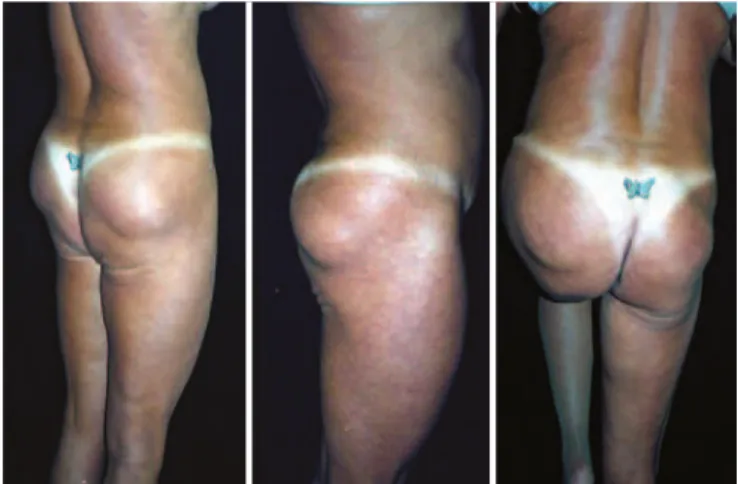
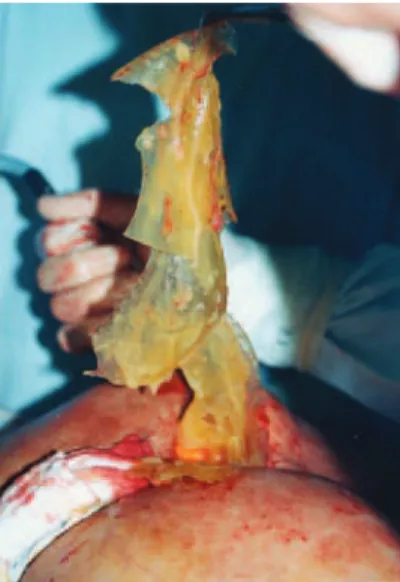
Of the 380 evaluated cases, 70 cases were reoperated on by the senior author; only 2.8% of these cases presented with intact prostheses during reoperation, and all others had a ruptured prosthesis (Figures 1 to 3).
The right and left buttock prostheses were ruptured in 100% and 80% of these cases, respectively.
The average reoperation time was 7 years, with a maxi-mum of 14 years.
Among the reoperations occurring 7 years after the initial procedure, only 1.4% of the implants had not ruptured.
Nuclear magnetic resonance imaging was the diagnostic imaging tool used to investigate symptomatic complaints in patients (Figure 4).
DISCUSSION
The durability of the gluteal implants is a very common concern of patients. However, no studies have addressed this question. The present study is based on the experience of the
Figure 1 – Case 1. Postoperative image 7 years after the insertion of silicone implants in the gluteal region performed
Rev Bras Cir Plást. 2012;27(1):93-6 95 What is the durability of gluteal prostheses?
In the only case in which the gluteal implant lasted for 14 years, the patient had a 220-cm3 prosthesis and a relatively
thick adipose cushion covering the prosthesis, suggesting an association between protection by abundant dermoadipose cushioning covering a smaller prosthesis and longer endu-rance of the prosthesis.
The presence of folds in silicone prostheses shortens their useful life. Richardson et al.8 carried out tests with S-folded
and crumbled implants that changed their coniguration. Folded implants exhibited a signiicantly reduced useful life compared to unfolded pairs. Creases also reduce the useful life of implants but not to the same extent as do folds.
Recent data from cohort studies over the last 10 years suggest that implants get damaged and their useful life gets shortened owing to tension applied to the prosthesis (e.g., by excessive force, trauma, compression, or during serious capsular contracture) and damage by surgical instruments but not by rupture associated purely with cyclic wear. Nonethe-less, the American Food and Drug Administration (FDA)9
states that cyclic wear tests provide useful information on the degradation characteristics of such devices. Both real-time mechanical and packaging-related testing must be carried out to establish the use-by date of a device9.
Around 20–40% of patients submitted to breast augmen-tation and 40–70% who received mammary reconstruction need reoperations in the irst 8–10 years after implantation of the prostheses. However, there are no corresponding data on gluteal implants in the literature9.
The useful life of most materials reduces when subjec ted to constant tension. Folds in the prosthesis might eventually weaken the implants, leading to degradation. Although the FDA recommends a testing method that simulates in vivo
conditions, they also recognize that this type of test cannot be properly validated until in vivo rupture by cyclic wear has been fully analyzed and characterized9.
In this study, data from the last 27 years were analyzed, which is a suficient interval for the in vivo evaluation of the durability of gluteal prostheses. The average endurance for a gluteal silicone gel-illed implant depends on 4 characteris -tics: the shape, quality, and cohesiveness of the implant and the lifestyle of the patient.
Since the diagnosis of rupture of gluteal prostheses was made in the intraoperative period in most cases, routine biennial follow-up using nuclear magnetic resonance in the same manner as that for mammary prostheses could more accurately determine the durability of gluteal implants.
CONCLUSIONS
The useful life of gluteal implants is shorter than that of breast implants, despite being manufactured from the same material; this is because gluteal implants are exposed to grea -ter tension and compression, which are associated with the lifestyle and job of the patient.
Figure 2 – Case 1. Appearance of the implants after removal.
Figure 3 – Case 2. Intraoperative appearance during surgery to replace gluteal implants 5 years after the irst surgery.
Figure 4 – In A, nuclear magnetic resonance imaging showing a ruptured implant on the right side. In B, nuclear magnetic resonance imaging showing the implant in the supericial plane on the left side.
A B
Rev Bras Cir Plást. 2012;27(1):93-6
96
Daniel MJB & Maluf Junior I
REFERENCES
1. Lee EI, Roberts TL, Bruner TW. Ethnic considerations in buttock aes -thetics. Semin Plast Surg. 2009;23(3):232-43.
2. Lima DA, Minakami DA, Pereira LC, Grando MC, Cruz RS, Braga AR, et al. Gluteoplastia de aumento: a importância do ensino na formação atual do residente frente à demanda crescente. Rev Bras Cir Plást. 2011; 26(1):127-33.
3. Senderoff DM. Buttock augmentation with solid silicone implants. Aesthet Surg J. 2011;31(3):320-7.
4. Singh D. Universal allure of the hourglass igure: an evolutionary theory
of female physical attractiveness. Clin Plast Surg. 2006;33(3):359-70. 5. Serra F, Aboudib JH, Cedrola JP, Castro CC. Gluteoplasty: anatomic
basis and technique. Aesthet Surg J. 2010;30(4):579-92.
6. Hwang K, Nam YS, Han SH, Hwang SW. The intramuscular course of the inferior gluteal nerve in the gluteus maximus muscle and augmenta-tion gluteoplasty. Ann Plast Surg. 2009;63(4):361-5.
7. Brandon HJ, Jerina KL, Wolf CJ, Young VL, Biodurability of retrieved silicone gel breast implants. Plast Reconstr Surg. 2003;111(7):2295-306. 8. Richardson DC, Long MC, Schroeder LW, Kisielewski RW. An in vitro study of the effect of in-folds on the durability of mammary implants. J Long Term Eff Med Implants. 2002;12(4):281-97.
9. Center for Devices and Radiological Health U.S. Food and Drug
Ad-mi nistration. FDA update on the safety of silicone gel-illed breast
implants. June 2011 Disponível em: http://www.fda.gov/DOWN- LOADS/MEDICALDEVICES/PRODUCTSANDMEDICALPRO-CEDURES/IMPLANTSANDPROSTHETICS/BREASTIMPLANTS/ UCM260090.PDF
Correspondence to: Ivan Maluf Junior