Effect of morning exercise in sunlight on the sleep-wake cycle
in adolescents
Ana Paula Leão Maia, Ivanise Cortez de Sousa and Carolina Virginia Macêdo de Azevedo
Universidade Federal do Rio Grande do Norte, Natal, RN, Brazil
Abstract
A delay in bedtime occurs in adolescence compared with childhood. However, the early waking that morning school hours impose leads to partial sleep deprivation. Although exposure to light is the most important regulator of circadian rhythm in mammals, physical exercise inluences circadian synchronization. To assess the effect of morning physical exercise in sunlight on the sleep-wake cycle (SWC) in adolescents, 160 irst- and second-year high-school students were exposed to classes in their usual classroom (Group C) or in a swimming pool exposed to sunlight (Group E) while physically exercising (EE; i.e., swimming) or resting (EL). At baseline, we applied Health and Sleep and Horne & Ostberg chronotype assessment questionnaires. One week later and during the intervention, we applied the Sleep Diary and Karolinska Sleepiness Scale. During the intervention we observed no changes in bedtime, time in bed and in indices of irregularity of bedtime and wake-up time. The changes observed in wake-up time (i.e., a delay in the EE group on Saturday), sleep quality (i.e., an improvement), and sleepiness (i.e., an increase) were also observed in the control group, discarding an intervention effect. We suggest that morning physical exercise in sunlight had no effect on SWC parameters, sleep quality, or daytime sleepiness, possibly because of the large irregularity in the SWC between weekdays and weekends in adolescent students as well as the low frequency and duration of exercise during the intervention. Therefore, studies that evaluate a higher frequency or duration of exercise are needed to assess its effect on the SWC in adolescents. Keywords: adolescents, physical exercise, sleep-wake cycle, partial sleep deprivation, school time.
Received 15 April 2011; received in revised form 5 July 2011; accepted 7 July 2011. Available online 29 December 2011
Ana Paula Leão Maia, Ivanise Cortez de Sousa, Carolina Virginia Macêdo de Azevedo. Laboratório de Cronobiologia, Departamento de Fisiologia, Universidade Federal do Rio Grande do Norte – Natal/ RN. Correspondence regarding this article should be directed to: Carolina Azevedo, Laboratório de Cronobiologia; Departamento de Fisiologia, Centro de Biociências, Universidade Federal do Rio Grande do Norte, Caixa Postal 1511, CEP 59078-970, Natal/RN, Brazil. Phone: +55 84 3215-3409. Fax: +55 84 3211-9205. E-mail: [email protected]
Introduction
Adolescence is characterized by innumerable transformations such as a delay in bedtimes and wake-up times compared with childhood and adulthood and a
greater need for sleep compared with adulthood. This delay has long been considered a psychosocial modiication that
results from the lifestyle during this phase, characterized by increased socialization (Carskadon, 2002; Carskadon & Acebo, 2002) and reinforced by other social factors such as decreased parental discipline with regard to bedtime
(Carskadon, 2002), extracurricular employment (Teixeira et
al.,2007), and increased school activities (Carskadon, 2002). Nevertheless, the delay in bedtimes during adolescence is linked not only to social factors but also to biological factors (Andrade, Benedito-Silva, Domenice, Arnhold, & Menna-Barreto, 1993; Wolfson et al., 2002; Carskadon,
Acebo, & Jenni, 2004). Among the biological factors, evidence indicates that changes occur in the circadian and homeostatic processes of sleep-wake cycle (SWC)
regulation during puberty (Carskadon et al., 2004; Taylor,
Jenni, Acebo, & Carskadon, 2005; Carskadon, 2011). With regard to the circadian component, a delay in the circadian pattern has been proposed, possibly caused by an
increase in the endogenous period relected by a delay in
the secretion of melatonin and other rhythms. Additionally, a change in sensitivity to light may occur that decreases in the morning and increases later in the day.
However, the morning school schedule is in contrast to the delay (i.e., adolescents go to bed and wake up earlier during the week). Consequently, they sleep less and exhibit partial sleep deprivation and irregular wake-up times between weekdays and weekends
(Taillard, Philip, & Bioulac, 1999; Saarenpää-Heikkila,
Rintahaka, Laupalla, & Koivikko, 2000; Louzada &
Menna-Barreto, 2003). This irregular SWC and daily
loss of sleep lead to an increase in daytime sleepiness and a decline in school performance compared with more regular sleep patterns (Wolfson & Carskadon, 1998; Acebo & Carskadon, 2002).
This pattern has been observed in several countries, conirming that adolescents who study in the morning
health problems caused by sleep deprivation (Wolfson & Carskadon, 1998; Epstein, Chilag, & Lavie,
1998; Andrade & Menna-Barreto, 2002). Therefore,
interventions are necessary within the school setting. Despite the positive effects of later school start times (Epstein et al., 1998; Wahlstrom, 2002), implementation
of such modiication is complex and involves not only
students and teachers but also several aspects of social life associated with school. As an alternative intervention, educational programs (Cortesi, Giannotti, Sebastiani, Bruni, & Ottaviano, 2004; Sousa, Araújo, & Azevedo, 2007; Cain, Gradisar, & Moseley, 2011) have been evaluated in school settings to inform students about sleep to prevent the negative effects of sleep deprivation
on school days. To minimize the delay in sleep in
adolescents, few studies have evaluated the effect of SWC synchronizers in a school environment (Sousa, 2009; Hansen, Janssen, Schiff, Zee, & Dubocovich, 2005). Evaluation of these factors can expand the intervention alternatives within a school context.
The main synchronizing factor of the SWC is the
environmental light-dark cycle (Czeisler et al., 1986, 1989; Czeisler & Khalsa, 2000; Youngstedt, Kripke,
& Elliott, 2002). The effect of this cycle on the SWC
has been assessed by numerous studies. Pulses of bright light generate phase delays and advances in the circadian rhythm of humans (Honma, Honma, & Wada, 1987; Czeisler & Khalsa, 2000; Samková, Vondrasova,
Hájek, & Illnerova, 1997). These effects vary according
to the time of their occurrence in the organism (Khalsa, Jewett, Cajochen, & Czeisler, 2003). Regardless of bedtime preference (i.e., chronotype), individuals who are exposed to early morning sunlight undergo advances in sleep onset of 30 min for each hour of light exposure (Roenneberg, Wirtz-Justice, & Merrow, 2003), although exposure to light between early evening and during the night promotes delays in sleep onset (Khalsa et al., 2003).
Although light exposure is considered the most important regulator of the circadian system in mammals (Meijer, Michel, & Vansteensel, 2007), studies of rodents and humans indicate that physical exercise
(PE) inluences circadian synchronization (Mistlberger
& Skene, 2005) because of the ability to modify the temporal relationship between the organism and the environment, acting as a synchronizer of biological
oscillators (Back, Fortes, Santos, Tambelli,
Menna-Barreto, & Louzada, 2007). Physical exercise triggers a phase delay between the middle and end of the resting phase in humans (Barger, Wright, Hughes, & Czeisler, 2004; Van Reeth et al., 1994), but controversy exists regarding the time at which the circadian system responds by triggering phase advances (Atkinson, Edwards, Reilly, & Waterhouse, 2007; Buxton, Lee,
L’Hermite-Baleriaux, Turek, & Van Cauter, 2003;
Miyazaki, Hashimoto, Masubuchi, Honma, & Honma, 2001; Piercy & Lack, 1988). Buxton et al. (2003)
observed phase advances in response to high-intensity PE performed in the early evening, whereas Piercy & Lack (1988) reported a phase advance in temperature
rhythm and a shorter delay to the irst episode of
rapid-eye-movement sleep in response to morning PE (6:00 AM-8:00 AM) in individuals exposed to sunlight compared with PE performed in the late afternoon and early evening (5:00 PM-7:00 PM).
In addition to these effects, PE is related to the promotion of health and well-being. Sherrill,
Kotchou, & Quan (1998) observed a signiicantly
lower prevalence of sleep problems and daily napping episodes in individuals who engaged in PE compared to subjects who were sedentary, which was associated
with the beneicial effects of PE on sleep quality and
self-esteem. Additionally, the regular practice of high levels of physical activity is positively related to sleep quality and psychological function in adolescents (Brand et al., 2010). It is also related to a lower frequency of drug use and a higher propensity to participate in health-promoting behaviors (Delisle, Werch, Wong, Bian, & Weiler, 2010).
The evaluation of the application of PE associated
with morning sunlight represents one possible intervention in the school setting, due to the response of the circadian system to light and PE. Intervention in the school environment assessed by the effect of sunlight exposure in the early hours of the morning 5 days per week on the SWC in adolescents shows a tendency to advance bedtime (Sousa, 2009). In contrast, exposure
to intense artiicial light in the morning did not affect
nocturnal sleep in adolescents or decrease daytime
sleepiness during weekdays (Hansenet al., 2005).
However, given that the impact of morning PE on the SWC has not been assessed in adolescents (Mistlberger & Skene, 2005), more investigations are
needed. Thus, we evaluated the effect of morning PE
in sunlight on the SWC in adolescents. We expected to observe an advance in bedtimes and wake-up times, an increase in time in bed, an improvement in sleep quality, and a reduction in daytime sleepiness.
Methods
Subjects
This study was approved by the institutional ethics committee (protocol no. 006/2007, UFRN). The sample
was composed of 160 high-school students aged 14-17 years (16 ± .7 years); 55% were girls and 45% were boys. Considering housing conditions, the majority (61%) of the students shared a house with three to four persons. Approximately 47% of the students slept alone in a room, and 33% slept with only one other person. Regarding the level of education of the person who
was inancially responsible for the family, 50% had
Exclusion criteria included students who did not submit an informed consent form signed by their parents or legal guardians or did not correctly complete the questionnaires, as well as the inability to swim and health problems (respiratory and psychosomatic).
Apparatus
Initially, a general characterization of the students was conducted with respect to sleep habits and chronotype using the Health and Sleep (Mathias, Sanchez, & Andrade, 2006) and Horne-Ostberg questionnaires, respectively. Moreover, the SWC was assessed at two stages (baseline and during the intervention) using the Sleep Diary with regard to the following variables: bedtime, wake-up time, time spent in bed, an index of bedtime and wake-up time irregularity assessed by the standard deviation of bedtime and wake-up time, and frequency, time, and duration of napping. Daytime sleepiness was assessed by the Karolinska Sleepiness Scale (KSS). Alertness was assessed by
the Psychomotor Vigilance Test (PVT). Students also
completed a self-assessment questionnaire that assessed the effect of the intervention of the study on their SWC.
This self-assessment ascertained which discipline kept
them most alert in the early morning hours.
Procedure
Three groups were assessed: control group (C, n = 68; the students attended class in their usual classroom under illumination of 142.3 ± 4.7 lux) and two experimental groups exposed to sunlight (34.190 ± 137 lux), one of which engaged in physical exercise (experimental exercise [EE] group, n = 49) and the other which remained at rest (experimental light [EL] group, n = 43).
The SWC of each group was evaluated for two consecutive weeks. The irst week was considered baseline (Stage 1). The intervention was done during
the second week on two days (Monday and Wednesday)
in the students’ irst class (between 7:45 AM and 8:30
AM), which substituted for their usual class.
Physical exercise consisted of a swimming class in an outdoor pool between 7:45 AM and 8:30 AM. Swimming involved different styles such as the crawl and breaststroke for 30 min followed by a 30-s rest interval. Before swimming, the students engaged in muscle-stretching exercises. During the procedure, we assessed light intensity at eye level using a digital light meter (ICEL, LD-500).
Statistical analysis
Bedtime (BT), wake-up time (WT), time in bed (TB),
indices of bedtime (BI) and wake-up time irregularities
(WI), sleep quality (SQ), and reaction time (RT) were
compared between stages using repeated-measures
analysis of variance (ANOVA). The three groups were
compared with the two stages as the repeated measures.
Also, the seven weekdays were considered repeated
measures for the analysis of BT, WT, TB and SQ, and
the 2 h of the day tested were the repeated measures
for RT analysis. Moreover, daytime sleepiness assessed
by the KSS was evaluated using repeated-measures analysis of variance. However, missing data as a result of incomplete questionnaires precluded the application of ANOVA using the two stages, the seven days and the
6 h/day as repeated measures. Thus, a similar design
was applied for each day of the week, considering the
two stages and 6 h/day as the repeated measures. Tukey
test was used for post hoc analysis.
The frequency of naps during the week and
weekend was compared between groups and stages using thec2 test. The beginning, end, and duration of
napping were analyzed by factorial ANOVA, with the two groups, two stages, and two types of days of week (week and weekend) as factors. All tests were conducted
using Statistica software (StatSoft); signiicance level
was established at 5%.
Results
Bedtime (F1,105 = .35, p > .05), WT (F1,97 = .86, p >
.05), indices of BT irregularity (F1,143 = .48, p > .05) and
WT irregularity (F1,145 = 2.63, p > .05), and TB (F1,98 = 1.66, p > .05) were not different between stages (Figure 1). However, repeated-measures ANOVA revealed an
interaction between stage, day, and group for WT (F12,582
= 1.94, p < .05), indicating distinct differences between Stage 1 and 2. During Stage 2, students in the EE and C groups woke up later on Saturday (p < .05, Tukey test). The C group woke up earlier on Monday (p < .05, Tukey test). This difference was not related to the intervention
because it was also observed in the C group.
Furthermore, the groups did not differ with regard
to BT (F2,105 = 1.65, p > .05) and TB (F2,98 = .07, p > .05) in both stages (F1,105 = .35, p > .05). With regard to
WT, the EE group woke up later than the other groups
(F2,97 = 7.87, p < .05) with no differences between stages (F2,97 = .80, p > .05), ruling out the possibility of an interventional effect.
Differences were found in BT (F6,630 = 26.73, p <
.05), WT (F6,582 = 122.91, p < .05), and TB (F6,588 = 16.31,
p < .05) between weekdays and weekend days (Figure
1). Throughout the week, students went to bed later on
Saturdays (p < .05, Tukey test). They had later BT on
Fridays compared with Mondays and Wednesdays and
later BT on Sundays compared with Tuesdays (p < .05,
Tukey test). They woke up later on Sundays, followed
by Saturdays and then Mondays compared with the other days of the week (p < .05, Tukey test). EE and
EL groups did not exhibit differences between Mondays
and the other days of the week (Tuesday–Friday, p >
.05, Tukey test). Students spent more TB on Saturday
week (p < .05, Tukey test). Repeated-measures ANOVA revealed an interaction between day and stage for BT
(F6,630 = 2.19, p < .05) and WT (F6,588 = 4.84, p < .05),
but this was not observed for the group factor (BT, F12,630
= 1.30, p > .05; WT, F12,588 = 1.71, p > .05). Thus, the
variations in the occurrence of these differences during the week and on weekend days were similar in all groups and were not linked to interventional effects.
The beginning (F1,593 = .26, p > .05) and end (F1,593
= .18, p > .05) of napping did not vary between stages
(Table 1). Duration of napping increased during Stage 2
(F1,593 = 4.12, p < .05) with no differences between groups (F2,593 = .33, p > .05). With regard to the percentage of students who napped, differences were found between groups during the week and weekend (p < .05,c2 test),
with no differences between stages (p > .05,c2 test).
Sleep quality improved during Stage 2 (F1,92 = 11.39,
p < .05) in all groups (F2,92 = 1.88, p > .05). Differences were found between days of the week (F6,552 = 4.53, p < .05; Figure 2), with better sleep quality on Friday nights
compared with Monday, Tuesday, and Wednesday
nights (p < .05, Tukey test). The interaction between Figure 1. Bedtime (A), wake-up time (B), time in bed (C), irregularity of bedtime (D), and irregularity of wake-up time (E) in the experimental exercise (EE), experimental light (EL), and control (C) groups (mean ± 95% conidence interval) during the week and weekend in Stage 1 and 2. Day 1, Monday; Day 2, Tuesday; Day 3, Wednesday; Day 4, Thursday; Day 5, Friday; Day 6, Saturday; Day 7, Sunday. *p < .05 (Tukey test).
*
*
*
A
D
E B
C
Group EE Group EL Group C
04:20
03:30
02:40
01:50
01:00
00:10
23:20
22:30
21:40
20:50
12:30
11:40
10:50
10:00
09:10
07:30
06:10
05:00
04:00
11:40
10:50
10:00
09:10
08:20
07:30
06:10
05:50
05:00
1 2 3 4 5 6 7 1 1 2 3 4 5 6 7 1 1 2 3 4 5 6 7 1
T
ime inbed (h:min)
W
ake up time (h:min
)
Bedtime (h:min
)
130 120 110 100 90 80 70 60 50 130 120 110 100 90 80 70 60 50
1 2
Stage
Stage 1
Stage 2
group and day (F12,552 = 1.96, p < .05) was associated with distinct differences in this pattern during the days between groups that were not related to interventional effects. No interaction was found between day, group, and stage (F12,552 = .87, p > .05).
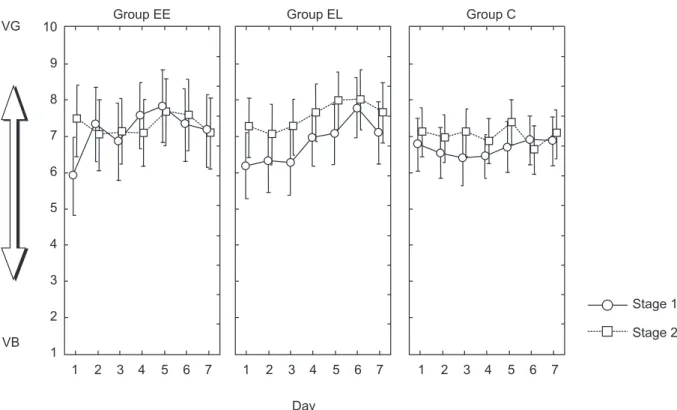
Daytime sleepiness was not different between stages (p > .05, ANOVA) with the exception of Monday when an increase was observed at 11:30 AM during Stage 2 (p <
.05, Tukey test) in all groups (F2,44 = .27, p > .05). A general decrease was observed on Saturday during Stage 2 (F1,28 = 5.84, p < .05). Sleepiness varied during the day (p < .05, ANOVA), showing a general daytime pattern characterized by increased alertness at 8:30 AM, 11:30 AM, and 2:30 PM
and more sleepiness at WT and BT during the week and on
the weekend (p < .05, Tukey test). These differences were
less pronounced on weekends (Figure 3).
Figure 2. Quality of sleep (mean ± 95% conidence interval) in the EE, EL, and C groups during the week and weekend during Stage 1 and 2. Day 1, Monday; Day 2, Tuesday; Day 3, Wednesday; Day 4, Thursday; Day 5, Friday; Day 6, Saturday; Day 7, Sunday.
EE Group EL Group C Group
Stage 1 Stage 2 Stage 1 Stage 2 Stage 1 Stage 2
Weekday
Nap (h:min ± min)
Start 14:22 ± 80 14:06 ± 96 13:43 ± 177 14:01 ± 151 14:02 ± 120 13:29 ± 75
End 16:03 ± 81 15:52 ± 105 15:21 ± 204 15:50 ± 166 15:44 ± 136 15:26 ± 182
Duration 1:42 ± 62 1:46 ± 65 1:37 ± 66 1:49 ± 56 1:41 ± 70 1:58 ± 80
Frequency (%) 16%a 12%b 11%a 11%b 19%a 14%b
Weekend
Nap (h:min ± min)
Start 14:01 ± 127 13:15 ± 195 13:42 ± 208 14:42 ± 130 13:28 ±170 12:59 ± 185
End 15:51 ± 150 15:16 ± 206 14:57 ± 229 16:22 ± 138 15:07 ± 171 15:01 ± 191
Duration 1:49 ± 91 2:00 ± 73 1:14 ± 40 1:40 ± 51 1:39 ± 51 2:02 ± 56
Frequency (%) 4%c 4%d 2%c 2%d 3%c 3%d
Table 1. Napping characteristics (mean ± SD) in the control (C), experimental exercise (EE), and experimental light (EL) groups
a,b,c,dSimilar letters represent p < .05 (c2 test). Stage 1 = Stage 2: Week (c2
(2) = 2.897, p > .05), Weekend (c 2
(2) = .179, p > .05).
SD, standard deviation.
Group EE Group EL Group C
Stage 1
Stage 2 10
9
8
7
6
5
4
3
2
1
1 2 3 4 5 6 7 1 2 3 4 5 6 7 1 2 3 4 5 6 7
Day VB
Figure 3. Sleepiness during daytime hours (mean ± 95% conidence interval) measured using the Karolinska Sleepiness Scale
(KSS) in the EE, EL, and C groups during Stages 1 and 2. VS, very sleepy; VA, very alert. a,b,c,d,eSimilar letters represent similar
Reaction time was not different between stages (F1,32 = 2.27, p > .05; Figure 4), although a trend was found toward differences between groups (F2,32 = 3.29,
p = .05). The C group had shorter reaction times than the
EE group (p < .05, Tukey test) during both stages (F2,32
= .97, p > .05).
With regard to the subjective effects of the physical education classes, 55.6% of the students reported that physical education was the discipline that would keep them most alert during the early morning hours (c2 =
1.25, p > .05).
Figure 4. Reaction time (mean ± 95% conidence interval) measured using the Psychomotor Vigilance Test (PVT) between Stages 1 and 2 in the EE, EL, and C groups.
Discussion
The SWC proiles that we found among students
at baseline were similar to those observed in Brazilians (Andrade et al., 1993; Louzada & Menna-Barreto, 2003; Sousa et al., 2007), Americans (Shinkoda, Matsumoto, Park, & Nagashima, 2000; Iglowstein, Jenni, Mollinari, & Largo, 2003), and Italians (Giannotti & Cortesi,
2002). The students showed later and longer nocturnal
sleep on weekends and earlier and shorter nocturnal
sleep on weekdays, conirming the SWC irregularity
characteristic of students who study in the morning (Andrade et al., 1993; Wolfson & Carskadon, 1998; Shinkoda et al., 2000; Giannotti & Cortesi, 2002;
Iglowstein et al., 2003). These characteristics contribute to the dificulties that adolescents have in going to
bed earlier in addition to the greater demands of high school compared with primary school, resulting in poorer nocturnal sleep quality and duration (Shinkoda
et al., 2000). Thus, on weekdays, students exhibit partial
sleep deprivation, which has serious consequences for physical, emotional, intellectual, psychological, and social development (Giannotti & Cortesi, 2002).
During the intervention we observed no changes in
BT, TB and in indices of BT and WT irregularity. The delay in WT observed in the EE group on Saturday also
550
500
450
400
350
300
250
200
Group EE Group EL Group C
8:30 h 11:30 h 8:30 h 11:30 h 8:30 h 11:30 h
Time of day
Stage 1 Stage 2
occurred in the C group. Thus, no interventional effect
can be assumed. Our results differ from those obtained by Piercy & Lack (1988) who assessed the effect of PE
performed in sunlight in adults at least ive times per
week during a 3-week interval (running 8-12 km for 35-55 min/day), in which phase advances were observed in response to morning PE. Lack of effects of PE observed in the present study may be associated with the lower frequency or duration of exercise during the intervention (30 min of swimming for 2 days of 1 week). Our results
are similar to the indings of Moog & Hildebrant (1986)
in which no changes were observed in the SWC in response to 15 min of early morning PE (cycling) for 2 days over a interval of 2 weeks. Youngstedt et al. (2002) found no effect of PE on the response to bright light pulses in a protocol that used high-intensity exercise (cycling on an ergometer for 3 h in one night). Despite the high intensity of exercise, the authors argued that
this may be insuficient to elicit effects because the subjects had extremely high itness levels.
Another factor that may contribute to the lack of effects may be the conditions under which the study was performed. As stated by Back et al. (2007), a synchronizer effect of PE is usually observed in protocols in which the subjects are in a laboratory setting under controlled
conditions where the inluence of photic and nonphotic
synchronizers is reduced (Barger et al., 2004, Buxton et al., 2003; Miyazaki et al., 2001; Van Reeth et al., 1994) With regard to sleep quality, an improvement was found during Stage 2 in all groups, indicating no interventional
effect. The absence of effects of PE on sleep quality is
similar to observations in college students (Lund, Reider, Whiting, & Prichard, 2010) but dissimilar to observations in high school students (Brand et al., 2010; Delisle et
al., 2010). The present results may also be related to the
frequency or duration of PE. Studies that have shown a positive association between PE and sleep quality in adolescents used high levels of vigorous exercise in students (Delisle et al., 2010) and athletes (Brand et al.,
2010). The higher levels of sleep quality on weekend
nights in all groups were also observed by Sousa et al. (2007) in adolescents and may be associated with the absence of the pressures of morning school schedules.
Our hypothesis that the present intervention and sunlight would promote decreases in daytime sleepiness and changes in the other variables (frequency, beginning, end, and duration of napping and reaction
time) was not conirmed. An increase in sleepiness
was observed during Stage 2, but this was observed in all of the groups, ruling out the possibility of an interventional effect. Daytime sleepiness exhibited a
daily proile characterized by greater alertness at 8:30
AM, 11:30 AM, and 2:30 PM and greater sleepiness at wake-up time and bedtime. On weekends, adolescents felt more alert, similar to the observations of Andrade et
The absence of the expected effects of the
intervention on the SWC may be associated with the frequency or duration of PE or the type of intervention. Students were evaluated in a school setting, and we did not monitor or control other factors that may have impacted the results such as evening habits that lead to light exposure near bedtime and caffeine intake that may delay bedtimes, thus increasing the irregularities in
BT and WT during the week and on weekends. Students exhibited irregularities of BT and WT of nearly 80
min and 100 min, respectively. An intervention with a longer frequency or duration may be necessary to elicit changes in the large irregularity of sleep schedules and lead to the expected effect on sleep duration and sleep quality and, consequently, daytime sleepiness. Another limitation of our study was incomplete questionnaire
data, which may have contributed to the dificulties in
the statistical analysis.
Absence of the expected interventional effects on the SWC and the lack of knowledge about the neural mechanisms involved in social, nonphotic synchronization do not necessarily diminish the importance of social factors in the regulation of the relationship between human rhythms and the photic synchronizer, the natural light-dark cycle (Back et
al., 2007). Therefore, because of the synchronizing
effect of PE on the SWC and the subjective effects of physical education classes reported by the students as the discipline that keeps them most alert early in the morning, more extensive studies on the effects of PE
in this age group are needed. This can be achieved by
applying more frequent interventions with a greater duration and photic and nonphotic controls to promote a better assessment of the effects of PE on the SWC.
In summary, PE in the morning in sunlight had no effect on SWC parameters, sleep quality, or daytime sleepiness in adolescent students, possibly because of the large irregularity in the SWC between weekdays and weekends associated with the low frequency/duration of exercise during the intervention.
Acknowledgements
Special thanks are given to the students who participated in this study and the school staff. We also thank Master’s students Aline Silva Belísio and Jane Carla de Souza and Dr. Fernando Louzada, Dr. Alexandre Menezes, and Dr. John Araújo for their
contribution to this research. This study was inancially
supported by CAPES and UFRN.
References
Acebo, C., & Carskadon, M. A. (2002). Inluence of irregular sleep patterns on waking behavior. In Carskadon, M.A. (Ed.), Adolescent
sleep patterns: Biological, social, and psychological inluences (pp. 220-235). Cambridge: Cambridge University Press.
Andrade, M., & Menna-Barreto, L. (2002). Sleep patterns of high school students living in São Paulo, Brazil. In Carskadon, M.A (Ed.), Adolescent sleep patterns: Biological, social, and
psychological inluences (pp. 118-131). Cambridge: Cambridge University Press.
Andrade, M., Benedito-Silva, A. A., Domenice, S., Arnhold, I. J., & Menna-Barreto, L. (1993). Sleep characteristics of adolescents: A longitudinal study. Journal of Adolescent Health, 14, 401-406. Atkinson, G., Edwards, B., Reilly, T., & Waterhouse, J. (2007)
Exercise as a synchroniser of human circadian rhythms: An update and discussion of the methodological problems. European Journal of Applied Physiology, 99, 331-341.
Back, F. L., Fortes F. S., Santos, E. H. R., Tambelli, R., Menna-Barreto, L. S., & Louzada, F. M. (2007). Sincronização não-fótica: O efeito do exercício físico aeróbio. Revista Brasileira Medicina do Esporte, 13(2), 1-5.
Barger, L. K., Wright, K. P., Jr., Hughes, R. J., & Czeisler, C. A. (2004). Daily exercise facilitates phase delays of circadian melatonin rhythm in very dim light. American Journal of Physiology: Regulatory, Integrative and Comparative Physiology,
286, R1077-R1084.
Brand, S. Gerber, M., Back, J., Hatzinger, M., Pühse, U., & Holsboer-Trachsler, E. (2010). High exercise levels are related to favorable sleep patterns and psychological functioning in adolescents: A comparison of athletes and controls. Journal of Adolescent Health, 46, 133-141.
Buxton, O., Lee, C. W., L’Hermite-Baleriaux, M., Turek, F. W., & Van Cauter, E. (2003). Exercise elicits phase shifts and acute alterations of melatonin that vary with circadian phase. American Journal of Physiology: Regulatory, Integrative and Comparative Physiology,
284, R714-R724.
Cain, N., Gradisar M., Moseley L. (2011). A motivational school-based intervention for adolescent sleep problems. Sleep Medicine, 12, 246-51. Carskadon, M. A. (2002). Factors inluencing sleep patterns of adolescents. In Carskadon, M. A. (Ed.), Adolescent sleep patterns:
Biological, social, and psychological inluences (pp. 4-26). Cambridge: Cambridge University Press.
Carskadon, M. A. (2011). Sleep in adolescents: The perfect storm.
Pediatric Clinics of North America, 58, 637-647.
Carskadon, M. A., Acebo, C., & Jenni, O. G. (2004). Regulation of adolescent sleep: Implications for behavior. In Dahl, R. E., & Spear, L. P. (Eds.), Adolescent brain development: Vulnerabilities and opportunities (series title: Annals of the New York Academy of Sciences, vol. 1021) (pp. 276-291). New York: New York Academy of Sciences.
Carskadon, M. A., & Acebo, C. (2002). Regulation of sleepiness in adolescents: Update, insights, and speculation. Sleep, 25(6), 606-614. Cortesi, F., Giannoti, F., Sebastiani, T., Bruni, O., & Ottaviano, S.
(2004). Knowledge of sleep in Italian high school students: Pilot-test of a school-based sleep educational program. Journal of Adolescent Health, 34, 344-351.
Czeisler, C. A., Allan, J. S., Strogatz, S. H., Ronda, J. M., Sánchez, R., Ríos, C. D. & Kronauer, R. E. (1986). Bright light resets the human circadian pacemaker independent of the timing of the sleep-wake cycle. Science, 233(4764), 667-671.
Czeisler, C. A., Kronauer, R. E., Allan, J. S., Duffy, J. F., Jewett, M. E., Brown, E. N., Ronda, J. M. (1989). Bright light induction of strong (type 0) resetting of the human circadian pacemaker. Science, 244(4910), 1328–1333.
Czeisler, C. A., & Khalsa, S. B. S. (2000). The human circadian timing system and sleep-wake regulation. In Kryger, M. H., Roth, T., & Dement, W. C. (Eds.), Principles and practice of sleep medicine, 3rd edition (pp. 353-375). Philadelphia: W.B. Saunders.
Delisle, T. T., Werch, C. E., Wong, A. H., Bian, H., & Weiler, R. (2010). Relationship between frequency and intensity of physical activity and health behaviors of adolescents. Journal of School Health, 80, 134-140.
Epstein, R., Chilag, N., & Lavie, P. (1998). Starting times of school: Effects on daytime functioning of ifth-grade children in Israel.
Sleep, 21,250-256.
Giannotti, F., & Cortesi, F. (2002). Sleep patterns and daytime function in adolescence: An epidemiological survey of an Italian high school student sample. In Carskadon, M. A. (Ed.), Adolescent
sleep patterns: Biological, social, and psychological inluences (pp. 132-147). Cambridge: Cambridge University Press.
(2005). The impact of school daily schedule on adolescent sleep.
Pediatrics, 115, 1555-1561.
Honma, K., Honma, S., & Wada, T. (1987). Phase-dependent shift of free-running human circadian rhythms in response to a single bright light pulse. Experientia, 43, 1205-1207.
Iglowstein, I., Jenni, O. G., Molinari, L., & Largo, R. H. (2003). Sleep duration from infancy to adolescence: Reference values and generational trends. Pediatrics, 111(2), 302-307.
Khalsa, S. B., Jewett, M. E., Cajochen, C., & Czeisler, C. A. (2003). A phase response curve to single bright light pulses in human subjects. Journal of Physiology, 549, 945-952.
Louzada, F. M., & Menna-Barreto, L. (2003). Sleep-wake cycle expression in adolescence: Inluences of social context. Biological Rhythm Research, 34(2), 129-136.
Lund, H. G., Reider, B. D., Whiting, A. B., & Prichard, J. R. (2010). Sleep patterns and predictors of disturbed sleep in a large population of college students. Journal of Adolescent Health, 46, 124-132. Mathias, A., Sanchez, R. P., & Andrade, M. M. M. (2006). Incentivar
hábitos de sono adequados: Um desaio para os educadores. In Pinho, S. Z., & Saglietti J. R. C. (Eds.), Núcleos de ensino da Unesp (pp. 718-731). São Paulo: UNESP.
Meijer, J. H., Michel, S., & Vansteensel, M. J. (2007). Processing of daily and seasonal light information in the mammalian circadian clock. General and Comparative Endocrinology, 152(2-3), 159-164. Mistlberger, R. E., & Skene, D. J. (2005). Nonphotic entrainment in
humans? Journal of Biological Rhythms, 20(4), 339-352. Miyazaki, T., Hashimoto, S., Masubuchi, S., Honma, S., & Honma,
K. I. (2001). Phase-advance shifts of human circadian pacemaker are accelerated by daytime physical exercise. American Journal of Physiology: Regulatory, Integrative and Comparative Physiology,
281, R197-R205.
Moog, R., & Hildebrant, G. (1986). Comparison of different causes of masking effects. In Haider, M., Koller, M., & Cerinka, R. (Eds.),
Night and shiftwork: Longterm effects and their prevention (pp. 131-140). New York: Peter Lang.
Piercy, J., & Lack, L. (1988). Daily exercise can shift the endogenous circadian phase. Journal of Sleep Research, 17, 393.
Roenneberg, T., Wirz-Justice, A., & Merrow, M. (2003). Life between clocks: Daily temporal patterns of human chronotypes. Journal of Biological Rhythms, 18(1), 80-90.
Saarenpää-Heikkila, O. A., Rintahaka, P. J., Laupalla, P. J., & Koivikko, M. (2000). Subjective daytime sleepiness and related predictors in Finnish schoolchildren. Sleep and Hypnosis, 2, 4.
Samková, L., Vondrasova, D., Hájek, I., & Illnerova, H. (1997). A ixed morning awakening coupled with a low intensity light maintains a phase advanced of the human circadian system. Neuroscience Letters, 224, 21-24.
Sherrill, D. L., Kotchou, K., & Quan, S. F. (1998). Association of physical activity and human sleep disorders. Archives of Internal Medicine, 158, 1894-1898.
Shinkoda, H., Matsumoto, K., Park, Y. M., & Nagashima, H. (2000). Sleep-wake habits of schoolchildren according to grade. Psychiatry and Clinical Neurosciences, 54, 287-289.
Sousa, I. C., Araújo, J. F., & Azevedo, C. V. M. (2007). The effect of a sleep hygiene education program on the sleep-wake cycle of Brazilian adolescent students. Sleep and Biological Rhythms, 5, 251-258. Sousa, I. C. (2009). Estratégias para ajuste do ciclo vigília-sono de
adolescentes aos horários escolares matutinos: A educação sobre o sono e a exposição à luz solar [unpublished doctoral thesis]. Universidade Federal do Rio Grande do Norte.
Taillard, J., Philip, P., & Bioulac, B. (1999). Morningness/eveningness and the need for sleep. Journal of Sleep Research, 8, 291-295. Taylor, D. J., Jenni, O. G., Acebo, C., Carskadon, M. A. (2005). Sleep
tendency during extended wakefulness: Insights into adolescent sleep regulation and behavior. Sleep, 14(3), 239-244.
Teixeira, L. R., Lowden, A., Turte, S. L., Nagai, R., Moreno, C. R. C., Latorre, M. R., & Fischer, F. M. (2007). Sleep and sleepiness among working and non-working high school evening students.
Chronobiology International, 24, 99-113.
Van Reeth, O., Sturis, J., Byrne, M. M., Blackman, J. D., L’Hermite-Balèriaux, M., Leproult, R., … Van Cauter, E. (1994). Nocturnal exercise phase delays circadian rhythms of melatonin and thyrotrophin secretion in normal men. American Journal of Physiology, 266, E964-E974.
Wahlstrom, K. (2002). Changing times: Findings from the irst longitudinal study of later high school start times. NASSP Bulletin,
86(633), 3-21.
Wolfson, A. R., & Carskadon, M. A. (1998). Sleep schedules and daytime functioning in adolescents. Child Development, 69, 875-887. Wolfson, A. R., Carskadon, M. A., Acebo, C., Seifer, R., Fallone, G.,
Labyak, S. E., & Martin, J. L. (2002). Evidence for the validity of a sleep habits survey for adolescents. Sleep, 26(2), 213-216. Youngstedt, S. D., Kripke, D. F., & Elliott, J. A. (2002). Circadian