Article
J. Braz. Chem. Soc., Vol. 23, No. 8, 1429-1436, 2012. Printed in Brazil - ©2012 Sociedade Brasileira de Química 0103 - 5053 $6.00+0.00
A
*e-mail: [email protected]
PAHs in Cultured Mussels
Perna perna
from a Southeastern Brazilian Bay
Renato V. Yoshiminea and Renato S. Carreira*,a,b
aFaculdade de Oceanografia, Universidade do Estado do Rio de Janeiro, 20550-013 Rio de Janeiro-RJ, Brazil
bDepartamento de Química, Pontifícia Universidade Católica do Rio de Janeiro, 22453-900 Rio de Janeiro-RJ, Brazil
A presença e a distribuição de hidrocarbonetos policíclicos aromáticos (HPAs) foram avaliadas pela primeira vez em mexilhões cultivados na Baía de Ilha Grande, o principal polo de maricultura do Estado do Rio de Janeiro, no sudeste do Brasil. As análises de HPASs no tecido dos mexilhões foram realizadas em triplicata por cromatografia em fase gasosa acoplada a espectrômetro de massas (GC-MS) em amostras compostas (cada uma com dez indivíduos), coletadas em 2011 em seis fazendas de cultivo. A concentração média para o total de HPAs (38 compostos), excluindo-se uma fazenda, foi de 14,00 ± 8,53 ng g-1, enquanto que para os 16 HPAs prioritários a média foi
de 9,51 ± 4,78 ng g-1. Esses valores caracterizam os mexilhões cultivados como tendo baixo
nível de contaminação por HPAs. A exceção foi a fazenda localizada em Mombaça, onde o total de HPAs de 584 ng g-1 (16 HPAs igual a 22,4 ng g-1) e o perfil dos HPAs individuais sugerem
contaminação moderada por fontes petrogênicas. Todas as concentrações medidas estão abaixo do limite estabelecido por agências internacionais de meio ambiente e de saúde que podem representar risco para a saúde humana devido ao consumo de mexilhões.
The presence and distribution of polycyclic aromatic hydrocarbons (PAHs) were evaluated for the first time in cultured mussels at Ilha Grade Bay, the largest mariculture center in the Rio de Janeiro State, Southeast Brazil. Analyses of PAHs on soft tissue were performed in triplicate by GC-MS on composite samples (10 individuals each) collected in 2011 at six mussel farms. The mean concentration of the total PAHs (38 compounds), excluding one farm, was 14.0 ± 8.53 ng g-1,
whereas the 16 priority PAHs was 9.51 ± 4.78 ng g-1. These values characterize the farmed mussels
analyzed as having low level of PAH contamination. The exception was the farm in Mombaça, where the total PAHs of 584 ng g-1 (16 PAHs of 22.4 ng g-1) and the profile of individual PAHs
suggest moderate contamination by petrogenic sources. All the concentrations measured were below threshold values established by environmental and health agencies as limiting to pose risk to humans by mussel consumption.
Keywords: mollusks, sentinel organism, PAHs, mariculture
Introduction
Polycyclic aromatic hydrocarbons (PAHs) are ubiquitous contaminants in aquatic environments, derived from pyrogenic (combustion of fossil fuel and biomass) and petrogenic (crude oil and derivatives) sources.1 In addition
to their widespread occurrence, PAHs are contaminants of environmental concern and may pose a threat to human health because of their persistency, tendency to bioaccumulate and possible mutagenic and carcinogenic effects.2
Biomonitoring (i.e., the measurement of body burden concentrations of a substance in biological samples)3
is an effective approach to evaluate environmental contamination. Bivalve mollusks are usually considered as biomonitors or sentinels because these filter-feeding organisms are exposed to contaminants in dissolved and/or particulate phases, have a wide geographical distribution, sessile lifestyle and show effective bioaccumulation with little metabolic transformation when compared to animals of higher trophic levels.4 Therefore, bivalve
contamination are also found in Brazilian coastal systems based on biomonitoring approaches.6,7,8
Another relevant aspect of the PAH body burden in mussels is related to consumption of these animals by humans. In order to supply the human demand for high-protein intake, an alternative to captured fishery is aquaculture, both in inland and marine waters. The global production of fish food from aquaculture has increased ten times in the last decades and reached 52.5 million ton in 2008.9 Marine aquaculture accounted with 32.3% of this
total production, represented by finfishes, crustaceans, oysters, mussels, clams, cockles and scallops.9 In Brazil,
the production of mussels has doubled in the last 10 years and contributed with ca. 11,700 ton of the total national production of 88,967 ton by marine aquaculture in 2004.10
Notwithstanding the ongoing discussion about the sustainability of aquaculture on a global change scenario,11
a key requirement of this activity is the production of safe food. For instance, it has been shown that PAH concentrations in farmed mussels are directly influenced by local environmental conditions12,13 and may, in some cases,
reach levels that restrict the harvesting of these animals for human consumption.14
In Brazil, data for PAHs in cultured mussels are virtually absent. Therefore, in the present work, the concentrations of up to 38 PAHs (including parental and alkylated compounds) were determined in the soft tissues of cultured brown mussels, Perna perna (Linneaus, 1758). The animals were collected in farms located in the Ilha Grande Bay, the main center of mariculture in the Rio de Janeiro State. The objectives were (i) to assess, with respect to PAH contamination, the quality of the products entering the market for human consumption and (ii) to evaluate the environmental health of the coastal region under investigation.
Experimental
Study area and sampling procedure
The Ilha Grande Bay is a large (ca. 1,000 km2)
coastal embayment located in the southern portion of the Rio de Janeiro State, which houses other smaller embayments, like Ribeira and Jacuecanga (Figure S1 in the Supplementary Information (SI) section). Human settlements around the bay are relatively few (compared to other coastal regions in the state), with a population of only ca. 170,000 inhabitants distributed in two municipalities (Angra dos Reis and Paraty). The region shows outstanding natural beauty, possesses great ecological wealth and
relevant biodiversity.15 As a consequence, tourism and
fisheries are among the major economic activities in the bay. With respect to mariculture activities, the Rio de Janeiro State represents 0.2% of the total national production,10
being Ilha Grande Bay the most important center of mussel culture in the State.
On a regional scale, the environmental alterations caused by human activities at Ilha Grande Bay are less significant16 than in other coastal bays in the state, like
Sepetiba17 and Guanabara18 bays. However, localized
environmental problems have already been identified.19
These were caused by recent increase in human activities (e.g., discharge of raw sewage, commercial and recreational boating traffic) and implementation of infra-structure, including three nuclear power plants, several marinas, a large shipyard to attend the oil industry demand for rigs and vessels, a commercial port and the second national largest oil terminal.
The brown mussels (Perna perna) are cultured in Ilha Grande Bay using the floating long line system. The animals were sampled in the summer of 2011, in farms located close to the Ilha Grande Island (Matariz, Sítio Forte, Araçatiba and Dois Rios) and near the continent (Macieis and Mombaça). The farms were selected as to represent a potential gradient in PAH contamination, ranging from clean areas in the island to more contaminated ones in the continent. However, in practice, the number of farms and their locations were determined by the availability of animals during the sampling period. In each station, 30 organisms of commercial size (5-8 cm) were randomly collected by hand with gloves in the floating lines at depths < 2 m. The animals were transported in ice to the laboratory, where they were cleaned and sized before storage at −20 °C.
Sample preparation, extraction and determination of total lipid contents
In the laboratory, the 30 animals collected in each farm were separated in three replicate samples, each containing 10 animals. The pooled soft tissues of each replicate were homogenized for 20 min in a homogeneizer (Ultra Turrax, IKA, Germany) and lyophilized before extraction.
Samples (ca. 3 g dry-weight; precision ± 0.001 g) were extracted in a Soxhlet system during 24 h using 200 mL of dichloromethane (pesticide grade, Mallinckrodt, USA) and, as surrogate, p-terphenyl-d14 (Cambridge Isotope
20 g of neutral alumina (Merck, 2 % water deactivated) and elution with 100 mL of dichloromethane and (ii) by gel permeation chromatography (GPC), using a Shimadzu LC10 system, a Shodex CLNpak EV2000 column and a mixture of acetone:cyclohexane (3:1, v:v).
PAH separation and quantification
PAHs were isolated from the purified extracts by adsorption chromatography, using a glass column (1.3 cm i.d. and 30 cm height) packed with 7 g of alumina (Merck, 2 % water deactivated), 10 g of silica-gel (Merck, 5% water deactivated), 1 g of anhydrous sodium sulfate (Merck) and, in the top, 1 g of activated copper for sulfur removal. PAHs were isolated in the second fraction, which was eluted with 100 mL of a mixture of hexane:dichloromethane (1:1, v:v) pesticide grade, Mallinckrodt, USA. Volume was reduced by rotary evaporation (mod. 801, Fisaton, Brazil) and then adjusted to 1 mL in a volumetric flask.
Quantification followed a protocol based on the US-EPA 8270D (United States Environmental Protection Agency) method and was performed by gas chromatography/ mass spectrometry (GC-MS) using a Finnigan Trace-ITQ 9000 system, fitted with a J&W-MS column (5% methyl-phenyl siloxane, 30 m × 0.25 mm × 0.25 µm film). Helium was used as carrier gas adjusted to 1.2 mL min-1 and the column
temperature was programmed as follows: initial hold of 5 min at 50 °C, 50 °C min-1 up to 80 °C, 6 °C min-1 from
80 to 280 °C and a hold of 25 min at 280 °C. The injector temperature was set at 270 °C, the interface at 300 °C and ion source at 250 °C. The system operated in the electron impact mode (70 eV) and in full scan mode (m/z 55-450).
For instrument calibration, eight solutions (all standards > 97% pure, Sigma or Aldrich, USA) (5, 10, 20, 50, 100, 200, 400 and 1.000 ng mL-1)
containing the 16 US-EPA PAHs (i.e., 16 priority PAHs), plus 2-methylnaphthalene, 1-methylnaphthalene, dibenzothiophene, 2,3-dimethylnaphthalene, perylene and the perdeuterated internal standards (naphthalene-d8, acenaphthylene-d10, chrysene-d12 and perylene-d12;
100 ng mL-1) were used. The following compounds
were determined (i) 16 PAHs (naphthalene (N), acenaphthene (ACE), acenaphthylene (ACF), fluorene (F), phenanthrene (Ph), anthracene (A), pyrene (Py), fluoranthene (Fl), benz[a]anthracene (BaA), chrysene (Ch), benzo[b]fluoranthene (BbFl), benzo[k]fluoranthene (BkFl), benzo[e]pyrene (BePy), benzo[a]pyrene (BaPy), indeno[1,2,3-cd]pyrene (I-Py), dibenz[a,h]anthracene (DBahA) and benzo[ghi]perylene (BghiPe)) and (ii) dibenzothiophene (DBT) and its alkylated homologs
(C1 to C3), 1- and 2- methylnaphthalenes; C2 to C4
naphthalenes, C1 to C3 fluorenes; C1 to C4 phenanthrenes; C1 and C2 pyrenes; C1 and C2 chrysenes. The determination
of each alkylated series was based on the response factor of the respective non-alkylated homolog and baselines were manually adjusted, except for the 1- and 2-methylnaphtalenes for which standards (Sigma, USA) were available. Quality assurance procedures included successful analysis of a reference material (NIST 2977, National Institute of Standards and Technology), analytical blank control, recovery control of the surrogate (mean of 100.3 ± 19.7%), daily check of calibration curves. The limit of detection was 0.20 ng g-1 and limit of quantification
was 0.66 ng g-1. All the concentrations are expressed in a
dry-weight basis.
Results and Discussion
Total contents of lipids and PAH body burden
The contents of total lipids ranged from 3.4 to 4.6% (Table 1). These values are in the range reported in the literature for mussels Perna perna from different coastal areas in the SE Brazilian region. For instance, in mussels collected at Guanabara Bay (Rio de Janeiro City, Rio de Janeiro State) the lipid contents ranged from 6 to 13%, with high values measured in the summer.7 On
the other hand, in Ubatuba City (São Paulo State) it was found values significantly lower, between 0.99 to 1.49%.20
Total lipids in mussels can seasonally vary, depending on exogenous (e.g., temperature and food availability) and endogenous (reproductive stage and energetic reserve storage) factors.12,13 Therefore, more samplings should be
performed at Ilha Grande Bay to check for any seasonal trends in the lipid contents of the mussels Perna perna.
It is noteworthy that, although PAHs are lipophilic contaminants, it was not observed a correlation between lipid and total PAH contents in our samples. The lack of correlation between these two variables in the mussel tissue is frequently reported in the literature and is attributed to the endogenous and exogenous factors mentioned before.13 Because of that, the lipid contents were not used
to normalize the concentration of PAHs obtained in the present study.
Considering five of the mussel farms sampled (Macieis, Dois Rios, Matariz, Sítio Forte and Araçatiba), where the results were similar, the mean concentration of total PAHs (38 compounds) was 14.0 ± 8.53 ng g-1, whereas for the 16
priority PAHs it was 9.51 ± 4.78 ng g-1 (Table 1). In these
Table 1. Lipid content (%) and PAHs (ng g-1; dry-weight) in cultured mussels Perna perna collected in the summer of 2011 at Ilha Grande Bay, Rio de Janeiro State
Local Macieis Mombaça Dois Rios Matariz Sítio Forte Araçatiba
Lipids / % 4.06 3.15 3.48 4.02 4.58 4.56
PAHsb
Na 3.65 2.60 2.45 0.94 4.81 < LOQ
C1N 1.20 3.31 0.85 < LOQ 1.85 1.25
C2N 1.61 7.08 nd nd 3.98 1.21
C3N 1.07 4.99 nd nd 2.56 1.01
C4N nd 12.6 nd nd 2.06 nd
ACFa nd nd nd nd nd nd
ACEa nd nd nd nd nd nd
Fa nd < LOQ nd nd < LOQ < LOQ
C1F nd nd nd nd nd nd
C2F nd nd nd nd nd nd
C3F nd nd nd nd nd nd
DBT < LOQ 1.30 nd nd < LOQ < LOQ
C1DBT nd 12.3 nd nd 1.26 nd
C2DBT nd 61.5 nd nd nd nd
C3DBT nd 72.6 nd nd nd nd
Pha 2.09 6.23 1.59 1.56 3.13 2.69
C1Ph nd 61.6 nd nd nd nd
C2Ph nd 139. nd nd nd nd
C3Ph nd 122. nd nd nd nd
C4Ph nd 62.3 nd nd nd nd
Aa nd 1.25 nd nd < LOQ < LOQ
Fla < LOQ 3.20 nd nd < LOQ 1.54
Pya nd nd nd nd nd 2.45
C1Py nd nd nd nd nd nd
C2Py nd nd nd nd nd nd
BaAa nd 1.27 nd nd < LOQ nd
Cha 0.97 3.04 nd 3.38 2.70 4.26
C1Ch nd nd nd nd nd nd
C2Ch nd nd nd nd nd nd
BbFla nd 4.01 nd nd 1.06 1.58
BkFla nd < LOQ nd nd nd < LOQ
BePy nd nd nd 0.84 < LOQ < LOQ
BaPya nd nd nd 1.20 nd nd
Pe nd nd nd nd nd nd
I-Pya < LOQ nd nd nd nd 0.69
DBahAa nd nd nd nd nd nd
BghiPera nd nd nd nd nd 0.85
∑ Total PAH 11.62 584. 4.88 8.26 25.6 19.9
∑ 16 PAH 7.52 22.4 4.03 7.08 13.3 15.6
a16 US-EPA priority PAHs marked; bN, naphthalene; C2N, C2 naphthalenes; C3N, C3 naphthalenes; C4N, C4 naphthalenes; ACF, acenaphthylene; ACE, acenaphthene; F, fluorene; C1F, C1 fluorenes; C2F, C2 fluorenes; C3F, C3 fluorenes; DBT, dibenzothiophene; C1DBT, C1 dibenzothiophenes; C2DBT, C2 dibenzothiophenes; C3DBT, C3 dibenzothiophenes;Ph, phenanthrene; C1Ph, C1 phenanthrenes; C2Ph, C2 phenanthrenes; C3Ph, C3 phenanthrenes; C4Ph, C4 phenanthrenes; A, anthracene; Fl, fluoranthene; Py, pyrene; C1Py, C1 pyrenes; C2Py, C2 pyrenes; BaA, benzo[a]anthracene; Ch, chrysene;
C1Ch, C1 chrysenes; C2Ch, C2 chrysenes; BbFl, benzo[b]fluoranthene; BkFl, benzo[k]fluoranthene;BePy, benzo[e]pyrene; BaPy, benzo[a]pyrene; Per,
perylene; I-Py, indeno[1,2,3-cd]pyrene;DBahA, dibenz[a,h]anthracene; BghiPer, benzo[ghi]perylene; nd: not detected; < LOQ: below limit of quantification
BaPy. The exception was the farm in Mombaça, with 584 ng g-1 of total PAHs but only 22.4 ng g-1 of 16 PAHs.
Alkylated PAHs, especially the C1-C3 DBT and C1-C4 Ph, were the major compounds in this sample, whereas the 5- and 6-ring PAHs were absent.
Evaluation of PAH contamination in cultured mussels
In the literature, there are several reports of PAH concentrations for native and cultured mussels from regions with distinct levels of contamination in Brazil and other coastal and estuarine regions in the world (Table 2). However, the comparison of PAH data from the literature must be made with caution since different methodologies are used and the number of individual PAHs quantified varies in each study. Bearing these limitations in mind, it is possible to observe that the concentrations of total PAHs (4.88 to 584 ng g-1; 38 compounds) obtained
in the present study varied in the low range of values measured in mussel farms from Italy (129 to 2638 ng g-1;
11 compounds)12 and from Spain (56.9 to 730 ng g-1;
13 compounds).13 Since these European farms are
located in places classified by their respective authors as having low to moderate contamination, and despite the constraints in data comparison mentioned before, our data suggest a low contamination level for 5 out of 6 mussel farms considered in the Ilha Grande Bay. The exception is the farm in Mombaça, with moderate level of PAH contamination.
The same observation, i.e., low level of PAH contamination in most of the mussel farms sampled, is valid when data for native mussels are considered (Table 2).
Excluding Mombaça, the PAH concentrations in the present study are comparable, for example, to unpolluted sites in the Mediterranean coast (25-80 ng g-1)21 and are
below the value of 100 ng g-1 for total PAHs suggested as
background concentration for mussels from Guanabara Bay.7 Similarly, our data are well below concentrations
of total PAHs measured in highly contaminated regions, like Guanabara Bay (60-6271 ng g-1)7 in Brazil, and
Victoria Harbor (600-22,858 ng g-1)22 in Hong Kong
(Table 2).
Source apportionment of PAHs
A variety of diagnostic ratios (or proxies) based on selected PAH compounds are traditionally used as bi-plot diagrams [e.g., Fl/(Fl+Py), BFl/(BFl+BePy) or I-Py/(I-Py+BghiPer] by several authors to infer the relative contributions of petrogenic and/or pyrolytic PAHs to environmental compartments, as well as to indicate the type of material combusted (oil, diesel, coal, biomass, etc.).30-32
However, PAH diagnostic ratios could not be calculated in the present study because many compounds were below the limit of quantification in most samples.
In the cases when diagnostic ratios cannot be calculated, PAH profiles are an alternative to source assignments of these compounds. It is well known that combustion processes produce mainly high molecular weight compounds (HMW; 4-6 rings), whereas in petroleum it is found a higher proportion of low molecular weight compounds (LMW; 2-3 rings).31,32 The relative contributions of
LMW and HMW PAHs, considering only the 16 priority compounds and excluding the alkylated homologues,
Table 2. PAH concentrations (ng g-1; dry-weight) in cultured and native mussels from coastal regions in Brazil and worldwide
Local Animal Type Number of PAHs Total PAHs range / (ng g-1) Reference
Brazil
Ilha Grande Bay-RJ Perna perna cultured 38 4.88-584 present study
Guanabara Bay-RJ Perna perna native 35 60-6271 7
São Sebastião Channel-SP Perna perna native 16 180-1630 23
Mundau-Manguaba Lagoons-PB Mytella charruana native 17 41.4-525 8
Wordwide
Ligurian Coast/Italy M.galloprovincialis cultured 11 129-2638 12
Ria de Vigo/Spain M.galloprovincialis cultured 13 59.6-739 13
Mediterranean Coast M.galloprovincialis native 18 25-80 21
Venice Lagoon/Italy M.galloprovincialis native 17 67-2434 24
Saronikus Gulf/Greece M.galloprovincialis native 17 184-2454 25
Boston Harbor - Massachusetts Bay/USA M.edulis native 24 44-3333 26
South and Southeast Asia Perna viridis native 19 11-1133 27
Victoria Harbor/Hong Kong Perna viridis native 15 600-22,858 22
Bahia Blanca Estuary/Argentina Brachyodontes sp and Tagelus sp native 17 349-1597 28
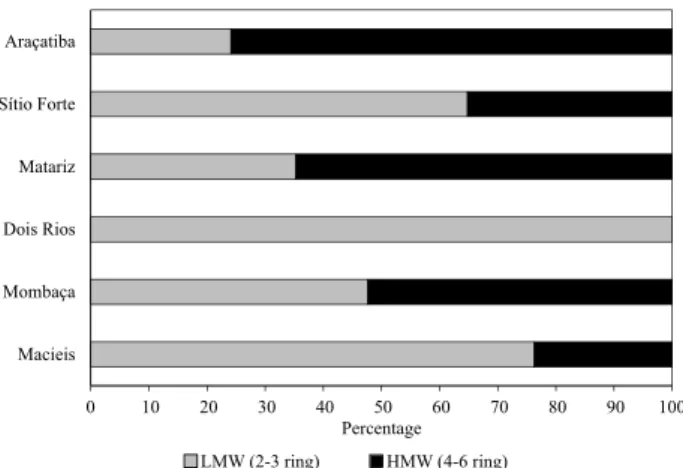
suggested accumulation of petrogenic PAHs in Macieis, Sítio Forte and Dois Rios (LMW > HMW). On the other hand, in Araçatiba and Matariz pyrogenic PAHs are more important (LMW < HMW) (Figure 1). In Mombaça, it was found similar proportions of LMW and HMW PAHs, indicating mixture of the two sources (petrogenic and pyrogenic).
The limitation of considering the ratios of LMW and HMW is that these groups consider only the 16 priority PAHs and other compounds present in petroleum, like DBT, as well as the alkylated PAHs are excluded. In this sense, the individual PAH profile obtained in the sample from Mombaça (Figure 2) shows elevated concentrations of alkylated PAHs, particularly for DBT and Ph, which comprised more than 95% of the total PAHs. Moreover, the profile of the alkylated PAHs exhibited the classical “bell shape” format, suggesting the presence of non-degraded petrogenic PAHs.32 Therefore, these results are clear
evidences of the presence of petrogenic PAHs in Mombaça, rather than a mixture of sources as indicated by the ratio LMW/HMW.
The presence of petrogenic PAHs in the mussels collected in Mombaça, where the contamination by PAHs may be considered moderate (as previous discussion),
could be explained by the traffic of recreational boats and/or commercial ships in the Jacuecanga Embayment. Probably the second source is more relevant, because a large shipyard is located nearby the farm in Mombaça (Figure S1 in the SI section). The farm at Macieis is located near to an oil terminal, which might explain the predominance of petrogenic PAHs in the mussels of this farm. However, the relatively low concentration of total PAHs at Macieis (11.62 ng g-1; Table 1) does not characterize, at least in the
sample analyzed, environmental contamination derived from the activities of the oil terminal.
The mussels from farms located at the western side of the Ilha Grande Island accumulated PAHs that can be assigned to petrogenic (Sítio Forte) or pyrolytic (Araçatiba and Matariz) sources, as discussed before. The traffic of small boats from fishermen or tourists might be the sources of PAHs to these sites, but in all cases the contamination level is low. Finally, the farm in Dois Rios is located at the eastern side of the island and far from human activities, and accordingly very low total PAH concentration (4.88 ng g-1) was measured.
Potential human health risk
There are no specific regulations in Brazil about concentrations of PAHs in shellfishes that are safe for human consumption. In other countries, however, several guidelines for PAHs are proposed for food safety. For instance, the commission for the protection of the marine environment of the North-East Atlantic named OSPAR (Oslo and Paris Convention) set up quite variable concentrations of individual PAHs in edible mussels (all values in a dry-weight basis): 5-50 ng g-1 for anthracene, 1000-10,000 for fluoranthene or
pyrene and 500-50,000 for phenantrene or benzo(a)pyrene.33
More recently, the European Commission Regulation 208/2005 proposed the limit of 10 ng g-1 (wet weight) for
benzo(a)pyrene in soft tissue of mussels.34 Considering
a median moisture content of 14%,35 this threshold is
equivalent to 71.4 ng g-1 dry-weight. Moreover, the US EPA
considers the concentration of 6000 ng g-1 (wet weight),
which is equivalent to 44,400 ng g-1 dry-weight, as the limit
of total PAHs that may present risks to human consumers of fish and shellfish.36
In all samples of mussel tissues analyzed in 2011 the PAH concentrations were below the threshold values in the guidelines cited above. Therefore, our data suggest that the consumption of mussels cultured at Ilha Grande Bay does not represent a vector of human exposure to PAHs. However, it was pointed out that to attest the overall good quality of the mussels, the contents of metals and sanitary parameters should also be considered.
Figure 1. Percentages of LMW (2-3 ring) and HMW (4-6 ring) PAHs,
considering only the 16 priority PAHs.
Conclusion
The concentrations of PAHs measured in the present study revealed a general low level of contamination of the cultured mussels from Ilha Grande Bay, Rio de Janeiro State. Despite our limited data set, based on a single sampling, the mean concentration of 14.0 ± 8.53 ng g-1
for total PAHs (including alkylated compounds) and of 9.51 ± 4.78 ng g-1 for the 16 priority PAHs may be
considered as background values for the region. Moreover, based on international criteria, the mussels do not represent risk for human consumption, at least with respect to PAH contamination. On the other hand, since the sample at Mombaça exhibited moderate level of PAH contamination by petrogenic sources, it is important to implement a monitoring program to assess the quality of the mussels for human consumption and the local environmental health.
Supplementary Information
Supplementary material (map with Ilha Grande Bay location showing the mussel farms) is available free of charge at http://jbcs.sbq.org.br as a PDF file.
Acknowledgments
We thank Coordenação de Aperfeiçoamento de Pessoal de Nível Superior (CAPES) for a MSc grant to R. V. Yoshimine and Conselho Nacional de Desenvolvimento Científico e Tecnológico (CNPq) for a research grant to R. S. Carreira (process No. 303399/2010-4). This research was funded by CNPq (process No. 574013/2008-3) and FAPERJ (process No. E/26-170.026/2009) under the project “National Institute of Oil and Gas – INOG”.
References
1. NRC; Oil in the Sea - Inputs, Fates and Effects, 2nd ed.; National
Academy Press: Washington, 2003.
2. Neff, J. M.; Bioaccumulation in Marine Organisms: Effects of Contaminants from Oil Well Produced Water; Elsevier: Amsterdam, 2002.
3. Manaham, S. E.; Environmental Chemistry, 9th ed.; CRC Press
LLC: Boca Raton, FL, 2010.
4. Goldberg, E. D.; Mar. Pollut. Bull.1975, 6, 111; Kimbrough, K. L.; Johnson, W. E.; Lauenstein, G. G.; Christensen, J. D.; Apeti, D. A.; An Assessment of Two Decades of Contaminant Monitoring in the Nation’s Coastal Zone; NOAA/National
Centers for Coastal Ocean Science: Silver Spring, MD, 2008. 5. Azdi, M.; Moukrim, A.; Burgeot, T.; Budzinski, H.; Chiffoleau,
J. F.; Kaaya, A.; Zekhnini, A.; Narbonne, J. F.; Guarrigues, P.;
Polycyclic Aromat. Compd.2006, 26, 265; Sundt, R. C.; Pampanin, D. M.; Grung, M.; Baršiene, J.; Ruus, A.; Mar. Pollut. Bull.
2011, 62, 1498; Viñas, L.; Franco, A.; Blanco, X.; Bargiela, J.; Soriano, J. A.; Perez-Fernandez, B.; Gonzalez, J. J.; Environ. Sci. Pollut. Res. Int.2011, 1; Baumard, P.; Budzinski, H.; Garrigues, P.; Narbonne, J. F.; Burgeot, T.; Michel, X.; Bellocq, J.;
Mar. Environ. Res.1999, 47, 415; Yeats, P.; Gagne, F.; Hellou, J.;
Environ. Int. 2008, 34, 254; Soriano, J. A.; Vinas, L.; Franco, M. A.;
Gonzalez, J. J.; Nguyen, M. H.; Bayona, J. M.; Albaiges, J.;
J. Environ. Monitor.2007, 9, 1018; Perugini, M.; Visciano, P.;
Giammarino, A.; Manera, M.; Di Nardo, W.; Amorena, M.;
Chemosphere2007, 66, 1904; Page, D. S.; Boehm, P. D.; Brown,
J. S.; Neff, J. M.; Burns, W. A.; Bence, A. E.; Mar. Environ. Res.2005, 60, 422; Oros, D. R.; Ross, J. R. M.; Mar. Environ. Res.2005, 60, 466.
6. Sericano, J. L.; Wade, T. L.; Jackson, T. J.; Brooks, J. M.; Tripp, B. W.; Farrington, J. W.; Mee, L. D.; Readmann, J. W.; Villeneuve, J. P.; Goldberg, E. D.; Mar. Pollut. Bull.1995, 31, 214; Azevedo,
L. A.; de Andrade Bruning, I. M. R.; Moreira, I.; Mar. Pollut. Bull.
2004, 49, 1120; Pereira, C. D. S.; Abessa, D. M. D. S.; Bainy,
A. C. D.; Zaroni, L. P.; Gasparro, M. R.; Bi?cego, M. C.; Taniguchi, S.; Furley, T. H.; De Sousa, E. C. P. M.; Environ. Toxicol. Chem.2007, 26, 462; Francioni, E.; Wagener, A. L. R.; Scofield, A. L.; Cavalier, B.; Environ. Forensics2006, 6, 361.
7. Francioni, E.; Wagener, A. L. R.; Scofield, A. L.; Depledge, M. H.; Cavalier, B.; Sette, C. B.; Carvalhosa, L.; Lozinsky, C.; Mariath, R.; Sci. Total Environ.2007, 372, 515.
8. Maioli, O. L. G.; Rodrigues, K. C.; Knoppers, B. A.; Azevedo, D. A.; Microchem. J.2010, 97, 1.
9. Food and Agriculture Organization (FAO); The State of World Fisheries and Aquaculture; FAO Fisheries and Aquaculture Department, Food and Agriculture Organization of the United Nations, Rome, 2010, http://www.fao.org/docrep/013/i1820e/ i1820e.pdf acessed in March 2012.
10. Ostrensky, A.; Borghetti, J. R.; Soto, D.; Aquacultura no Brasil: o Desafio é Crescer; CNPq/MCT: Brasília, 2008.
11. Merino, G.; Barange, M.; Mullon, C.; Rodwell, L.; Global Environ. Change2010, 20, 586.
12. Piccardo, M. T.; Coradeghini, R.; Valerio, F.; Mar. Pollut. Bull.
2001, 42, 951.
13. Ruiz, Y.; Suarez, P.; Alonso, A.; Longo, E.; Villaverde, A.; San Juan, F.; Environ. Pollut.2011, 159, 250.
14. McIntosh, A. D.; Moffat, C. F.; Packer, G.; Webster, L.;
J. Environ. Monit.2004, 6, 209.
15. Creed, J. C.; Oliveira, A. E. S.; Pires, D. O.; Figueiredo, M. A. O.; Ferreira, C. E. L.; Ventura, C. R. R.; Brasil, A. C. S.; Young, P. S.; Absalão, R. S.; Paiva, P. C.; Castro, C. B.; Serejo, C. S. In
Biodiversidade Marinha da Baía da Ilha Grande, vol. 1; Creed,
J. C.; Pires, D. O.; Figueiredo, M. A. O., eds.; MMA/SBF: Brasília, 2007.
Z. L.; Lopes, R. T; Sanchez-Cabeza, J. A.; de Lacerda, L. D; Wasserman, J. C; Mar. Pollut. Bull.2009, 59, 123; Freret-Meurer,
N. V.; Andreata, J. V.; Meurer, B. C.; Manzano, F. V.; Baptista, M. G. S.; Teixeira, D. E.; Longo, M. M.; Mar. Pollut. Bull.
2010, 60, 627; Figueiredo, L. H. M.; Wagener, A. d. L. R.; Dagaut, J.; Saliot, A.; J. Braz. Chem. Soc.2008, 19, 516.
17. Gomes, F. C.; Godoy, J. M.; Godoy, M. L. D. P.; de Carvalho, Z. L.; Lopes, R. T.; Sanchez-Cabeza, J.-A.; de Lacerda, L. D.; Wasserman, J. C.; Radioprotection2009, 44, 243; Silva, L. F. F.; Machado, W.; Lisboa Filho, S. D.; Lacerda, L. D.; Water, Air, Soil Pollut.2003, 145, 67; Cunha, C. d. L. d. N.; Rosman, P. C. C.; Ferreira, A. P.; Monteiro, C. N. T.; Cont. Shelf Res.2006, 26,
1940; Carreira, R. S.; Ribeiro, P. V.; Silva, C. E. M.; Farias, C. O.; Quim. Nova2009, 32, 1805.
18. Monteiro, F. F.; Cordeiro, R. C.; Santelli, R. E.; Machado, W.; Evangelista, H.; Villar, L. S.; Viana, L. C. A.; Bidone, E. D.;
Environ. Earth Sci.2011, 1; Souza, A. S. d.; Torres, J. P. M.; Meire, R. O.; Neves, R. C.; Couri, M. S.; Serejo, C. S.;
Chemosphere2008, 73, S186; Machado, W.; Santelli, R. E.; Loureiro, D. D.; Oliveira, E. P.; Borges, A. C.; Ma, V. K.; Lacerda, L. D.; J. Braz. Chem. Soc.2008, 19, 569; Meniconi, M. F. G.; Barbanti, S. M. In Oil Spill Environmental Forensics: Fingerprinting and Source Identification; Wang, Z.; Stout, S. A., eds.; Elsevier: Amsterdam, 2006; Baptista Neto, J. A.; Gingele, F. X.; Leipe, T.; Brehme, I.; Environ. Geol.2006, 49, 1051; Fernandez, M. A.; Wagener, A. L. R.; Limaverde, A. M.; Scofield, A. L.; Pinheiro, F. M.; Rodrigues, E.; Mar. Environ. Res.2005, 59, 435; Carreira, R. S.; Wagener, A. L. R.; Readman,
J. W.; Estuarine Coastal Shelf Sci.2004, 60, 587; Paranhos, R.; Pereira, A. P.; Mayr, M.; Environ. Monit. Assess.1998, 50, 131.
19. Azevedo, D. A.; Gonçalves, M. L.; Silva, D. B.; Environ. Forensics2007, 8, 245; Gomes, F. C; Godoy, J. M.; Godoy,
M. L. D. P.; de Carvalho, Z. L.; Lopes, R. T.; Sanchez-Cabeza, J.-A.; Osvath, I.; de Lacerda, L. D.; J. Environ. Radioact.2011,
102, 871.
20. Furlan, É. F.; Galvão, J. A.; Salán, E. O.; Yokoyama, V. A.; Oetterer, M.; Ciênc. Tecnol. de Aliment.2007, 27, 516. 21. Baumard, P.; Budzinski, H.; Michon, Q.; Garrigues, P.;
Burgeot, T.; Bellocq, J.; Estuarine Coastal Shelf Sci.1998,
47, 77.
22. Fang, J. K. H.; Au, D. W. T.; Wu, R. S. S.; Zheng, G. J.; Chan, A. K. Y.; Lam, P. K. S.; Shin, P. K. S.; Mar. Pollut. Bull.2009,
58, 615.
23. Pereira, C. D. S.; Abessa, D. M. D; Bainy, A. C. D.; Zaroni, L. P.; Gasparro, M. R.; Bicego, M. C.; Taniguchi, S.; Furley, T. H.; de Sousa, E. C. P. M.; Environ. Toxicol. Chem.2007,
26, 462.
24. Moschino, V.; Delaney, E.; Meneghetti, F.; Ros, L.; Environ. Monit. Assess.2011, 177, 649.
25. Valavanidis, A.; Vlachogianni, T.; Triantafillaki, S.; Dassenakis, M.; Androutsos, F.; Scoullos, M.; Estuarine Coastal Shelf Sci.
2008, 79, 733.
26. Hunt, C. D.; Slone, E.; Mar. Environ. Res.2010, 70, 343. 27. Isobe, T.; Takada, H.; Kanai, M.; Tsutsumi, S.; Isobe, K.;
Boonyatumanond, R.; Zakaria, M.; Environ. Monit. Assess.
2007, 135, 423.
28. Arias, A. H.; Spetter, C. V.; Freije, R. H.; Marcovecchio, J. E.;
Estuarine Coastal Shelf Sci.2009, 85, 67.
29. Oros, D. R.; Ross, J. R. M.; Spies, R. B.; Mumley, T.; Environ. Res.2007, 105, 101.
30. Tobiszewski, M.; Namieśnik, J.; Environ. Pollut.2012, 162, 110.
31. Yunker, M. B.; Macdonald, R. W.; Vingarzan, R.; Mitchell, R. H.; Goyette, D.; Sylvestre, S.; Org. Geochem.2002, 33, 489.
32. Wang, Z.; Fingas, M.; Page, D. S.; J. Chromatogr., A1999, 843, 369.
33. OSPAR Commission; Oslo and Paris Conventions for the Prevention of Marine Pollution Joint Meeting of the Oslo and Paris Commissions Brussels, Summary Record OSPAR 97/15/1, Annex 6, 1997.
34. http://ec.europa.eu/food/fs/sc/scf/out154_en.pdf accessed in March 2012
35. Law, R. J.; Kelly, C. A.; Baker, K. L.; Langford, K. H.; Bartlett, T.; Mar. Pollut. Bull.2002, 44, 903.
36. United States Environmental Protection Agency (US-EPA);
Guidance for Assessing Chemical Contaminant Data for Use in Fish Advisories: Risk Assessment and Fish Consumption Limits, Office of Water, EPA 823-B-00-008, USA, 2000.