Quality of life and discriminating power of two
questionnaires in fibromyalgia patients: Fibromyalgia
Impact Questionnaire and Medical Outcomes
Study 36-Item Short-Form Health Survey
A qualidade de vida e o poder de discriminação de dois questionários em
pacientes com fibromialgia: Fibromyalgia Impact Questionnaire e Medical
Outcomes Study 36-Item Short-Form Health Survey
Ana Assumpção1, Tatiana Pagano2, Luciana A. Matsutani3, Elizabeth A. G. Ferreira1, Carlos A. B. Pereira4, Amélia P. Marques1
Abstract
Background: Fibromyalgia is a painful syndrome characterized by widespread chronic pain and associated symptoms with a negative impact on quality of life. Objectives: Considering the subjectivity of quality of life measurements, the aim of this study was to verify the discriminating power of two quality of life questionnaires in patients with fibromyalgia: the generic Medical Outcomes Study 36-Item Short-Form Health Survey (SF-36) and the specific Fibromyalgia Impact Questionnaire (FIQ). Methods: A cross-sectional study was conducted on 150 participants divided into Fibromyalgia Group (FG) and Control Group (CG) (n=75 in each group). The participants were evaluated using the SF-36 and the FIQ. The data were analyzed by the Student t-test (α=0.05) and inferential analysis using the Receiver Operating Characteristics (ROC) Curve - sensitivity, specificity and area under the curve (AUC). The significance level was 0.05. Results: The sample was similar for age (CG: 47.8±8.1; FG: 47.0±7.7 years). A significant difference was observed in quality of life assessment in all aspects of both questionnaires (p<0.05). Higher sensibility, specificity and AUC were obtained by the FIQ (96%, 96%, 0.985, respectively), followed by the SF-36 (88%, 89% and 0.948 AUC). Conclusion: The FIQ presented the highest sensibility, specificity and AUC showing the most discriminating power. However the SF-36 is also a good instrument to assess quality of life in fibromyalgia patients, and we suggest that both should be used in parallel because they evaluate relevant and complementary aspects of quality of life.
Key words: fibromyalgia; quality of life; questionnaires; disability evaluation; health status indicators.
Resumo
Contextualização: A fibromialgia é uma síndrome dolorosa caracterizada por dor espalhada e crônica e sintomas associados com um impacto negativo na qualidade de vida. Objetivos: Considerando a subjetividade da mensuração de qualidade de vida, o objetivo deste estudo foi avaliar o poder de discriminação de dois questionários que avaliam a qualidade de vida de pacientes com fibromialgia: o genérico Medical Short Form Healthy Survey (SF-36) e o específico Questionário do Impacto da Fibromialgia (QIF). Métodos: Foi conduzido um estudo transversal com 150 indivíduos, divididos em dois grupos: grupo fibromialgia (FM) e grupo controle (GC) (n=75 em ambos). Os pacientes foram avaliados pelo SF-36 e pelo QIF. Na análise dos dados, utilizou-se o teste “t de Student” com α=0,05 e a Curva ROC (Receiver Operating Characteristics Curve). Resultados: As amostras foram estatisticamente semelhantes para a idade – 47,8 (8,1) no GC e 47,0 (7,7) no FM – e estatisticamente diferentes em todos os aspectos dos dois questionários (SF-36 e QIF). Alta sensibilidade, especificidade e área abaixo da curva (AUC) foram obtidas com o QIF (96%, 96%, 0,985 respectivamente), seguido pelo SF-36 (88%, 89% e 0,948 AUC). Conclusão: O QIF mostrou-se mais discriminativo do que o SF-36 para avaliar a qualidade de vida de fibromiálgicos. No entanto, o SF-36 é também um bom instrumento de avaliação e sugere-se que ambos sejam usados uma vez que avaliam aspectos relevantes e complementares da qualidade de vida.
Palavras-chave: fibromialgia; qualidade de vida; questionários; avaliação da deficiência; indicadores básicos de saúde.
Received: 17/12/2008 – Revised: 19/08/2009 – Accepted: 21/10/2009
1 Physical Therapy Department, Speech Therapy and Occupational Therapy, Faculdade de Medicina (FM), Universidade de São Paulo (USP), São Paulo (SP), Brazil 2 Physical Therapist
3 Physical Therapy Department, Fundação Instituto de Educação de Osasco (FIEO), Osasco (SP), Brazil 4 Statistics Department, Instituto de Matemática e Estatística (IME), USP
Correspondence to: Amélia Pasqual Marques, Rua Cipotânea, 51, Cidade Universitária, CEP 05360-000, São Paulo (SP), Brazil, e-mail: [email protected] 284
Introduction
“Health is […] not simply the absence of disease; it is something positive, a joyful attitude toward life, and a cheerful acceptance of the responsibilities that life puts upon the individual”1. According to WHO2, quality of life refers to the perception that people have about their position in life, within a context of culture and system of values in which they live and in relation to their aims, expecta-tions and social standards. Considering the chronic diseases, the role of healthcare in improving quality of life has been increasingly underlined, particularly as concerns the relief of pain and sufe-ring3. As in other chronic syndromes, improving the quality of life of patients is the main objective of ibromyalgia management.
Fibromyalgia syndrome has been described as a frequent rheumatological disorder in the world’s population4-7 and in the primary healthcare system, representing 7% of all health complaints and increasing health costs8. According to the cri-teria of the American College of Rheumatology (ACR), it is a painful syndrome characterized by widespread and chronic musculoskeletal pain and by the presence of at least 11 of the 18 tender points. hese symptoms are frequently associated with morning stifness, sleep disorders, fatigue, chronic heada-che, anxiety, depression, and irritable bowel syndrome9.
Considering the role of the symptoms, the negative impact on quality of life is frequently reported10,11. According to White et al.12, this negative impact on the quality of life of active in-dividuals leads to loss of function, afects work capacity and consequently lowers family income. Although the functional disability is not caused by movement restriction, the impact of the symptoms on all aspects of daily life (e.g. work, family life and leisure13) aggravates the psychological conditions, causing depression and anxiety14,15 and increasing the impact on the patient’s quality of life10,11.
As in other syndromes, accurate quality of life measure-ments play an important role in the scientiic and clinical con-text because they allow the identiication of patients’ needs, serve as outcome measures in experimental studies and provide parameters for the cost-beneit and cost-efectiveness analysis of treatment16-18. In this sense, quality of life assessment has great relevance, and the use of speciic and generic instruments could improve the diagnosis, treatment eicacy and research results18,19. While the generic questionnaires are usually more representative of overall quality of life, the speciic instruments have a higher discriminating power20. Consequently, it is impor-tant that quality of life instruments have a reliable discrimina-ting power16,18. he aim of the present study was to verify the discriminating power of two instruments used to assess quality of life in patients with ibromyalgia: the generic Medical Outco-mes Study 36-Item Short-Form Health Survey (SF-36) and the speciic Fibromyalgia Impact Questionnaire (FIQ).
Methods
Type of study
his is a cross-sectional study.
Sample
his study included 150 participants. Seventy-ive partici-pants had a diagnosis of ibromyalgia according to the ACR9 criteria and were selected at the rheumatology outpatient service of Hospital das Clínicas, Faculdade de Medicina da Universidade de São Paulo (HC-FMUSP), Brazil. For the healthy control group (CG), another 75 participants without ibromyal-gia were selected among workers doing diferent jobs at Uni-versidade de São Paulo.
he inclusion criteria were age between 35 and 60 years. All eligible participants were evaluated until the desired sample was completed and any sample losses were recorded. he par-ticipants from the ibromyalgia group (FG) were already under medical treatment. he study was approved by the Ethics Com-mittee of HC-FMUSP – Comissão para Análise de Projetos de Pesquisa (Cappesq) – protocol number 210/01. All participants gave written informed consent.
Instrument and proceedings
All participants from both groups were evaluated at a single face-to-face interview regarding demographic data (age, height, weight, gender, educational level, occupational activity and medical diagnosis). Two physical therapists were previously trained to read the questions in a standard format and clarify any questions. Because of the participants’ limited reading skills, especially in the FG, the researchers decided to read the questionnaires along with them, avoiding problems in the comprehension and completion of the questionnaires.
Quality of life was assessed by two questionnaires: the
FIQ16,17 and the SF-3618,19. he FIQ21 was used to assess the FG,
and it was translated to Portuguese and validated for the Bra-zilian population by Marques et al.22. he FIQ captures infor-mation on the following items: physical function, well-being, missed work, job diiculty, pain, fatigue, morning stifness, morning tiredness, anxiety and depression. his questionnaire has been widely used in research and has shown good sensi-tivity, validity and reliability. Scores range from 0 to 100, and higher scores are associated with increased impact. As per Bennett, the mean value is 50, and severely afected patients have scores above 7023.
The SF-36 is a generic multidimensional instrument that assesses eight scales: Physical Functioning, Role-Physical,
Bodily Pain, General Health, Vitality, Social Functioning, Role-Emotional and Mental Health24. The score for each scale varies from 0 to 100, and the higher the score the bet-ter the quality of life. Two final measures are used: Physical Health and Mental Health17,25. A score based on the mean of the eight scales is reported in order to compare it with other questionnaires15. This partial score is used in the present study. The SF-36 has been widely used in research with excellent metric properties (sensitivity, validity and reliability)17,19, and it has been translated and validated for the Portuguese language26.
Statistical analysis
All variables were tested for normality using Shapiro-Wilk’s test. Only demographic data (age and BMI) had adhe-rence to normality and were analyzed using a two-tailed t-test for independent samples. he questionnaire variables were analyzed with the non-parametric Mann-Whitney test. he signiicance level adopted was 0.05. he discriminating power of the questionnaires was assessed using the Receiver Operating Characteristics (ROC) curve with its sensitivity, speciicity and area under the curve (AUC). For these analy-ses, we used the total FIQ score23 and the partial SF-36 score, as used in a previous study15.
Results
Table 1 shows the patients’ demographic data. he groups are similar for age, gender and body mass index (BMI). For edu-cational level, the CG had more years of education than the FG, which may be related to the socioeconomic status of patients in a public hospital.
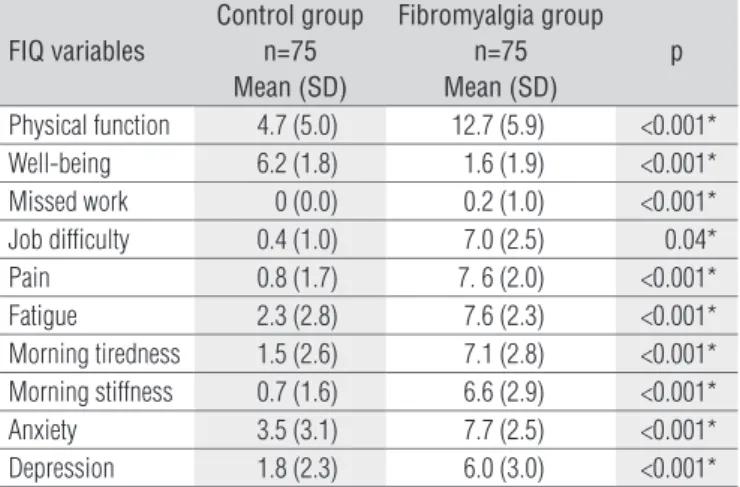
he results obtained with the FIQ showed signiicant di-ferences (p<0.05) between the CG and FG for all variables (Table 2). Table 3 shows the results obtained with the SF-36. here were signiicant diferences (p<0.05) between the CG and FG for all variables.
Discriminating power of the questionnaires
The FIQ was applied to the FG and CG. In the ROC analysis, the AUC was 0.985 (95% CI: 0.969 - 1.000). he cut-of score of 36.76 for the FIQ gave a sensitivity of 96% and specii-city of 96% (Figure 1).
The SF-36 was applied to both groups. In the ROC analy-sis, the AUC was 0.948 (95% CI: 0.917 - 0.980). he cut-of score of 60.06 for the SF-36 gave a sensitivity of 88% and speciicity of 89% (Figure 2).
Demographic data
Control group n=75 Mean (SD)
Fibromyalgia group n=75 Mean (SD)
Age (years) 47.8 (8.1) 47.0 (7.7)
Weight (Kg) 64.6 (11.7) 69.1 (14.5)
Height (m) 1.6 (0.8) 1.6 (0.7)
Body Mass Index (Kg/cm2) 25.2 (4.5) 26.8 (4.7)
Gender
Female (%) 73 (97%) 73 (97%)
Male (%) 2 (3%) 2 (3%)
Educational level
More than 12 years 57% 17%
9 to 11 years 26% 37%
0 to 8 years 17% 46%
Occupation
Housekeeper 31% 37%
Retired 0% 14%
Other 69% 49%
Table 1. Socio-demographic data of participants in the control group and fibromyalgia group.
FIQ variables
Control group n=75 Mean (SD)
Fibromyalgia group n=75 Mean (SD)
p
Physical function 4.7 (5.0) 12.7 (5.9) <0.001*
Well-being 6.2 (1.8) 1.6 (1.9) <0.001*
Missed work 0 (0.0) 0.2 (1.0) <0.001*
Job difficulty 0.4 (1.0) 7.0 (2.5) 0.04*
Pain 0.8 (1.7) 7. 6 (2.0) <0.001*
Fatigue 2.3 (2.8) 7.6 (2.3) <0.001*
Morning tiredness 1.5 (2.6) 7.1 (2.8) <0.001*
Morning stiffness 0.7 (1.6) 6.6 (2.9) <0.001*
Anxiety 3.5 (3.1) 7.7 (2.5) <0.001*
Depression 1.8 (2.3) 6.0 (3.0) <0.001*
* Significantly different according to the Mann-Whitney Test.
Table 2. Data from the Fibromyalgia Impact Questionnaire (FIQ) in the control group and fibromyalgia group.
SF-36 variables
Control group n=75 Mean (SD)
Fibromyalgia group n=75 Mean (SD)
p
Physical functioning 86. 3 (15.8) 39.1 (23.2) <0.001*
Role-physical 89.3 (24.0) 16.05 (30.1) <0.001*
Bodily pain 79.3 (21.1) 30.1 (16.1) <0.001*
General health 83.1 (18.3) 49.5 (25.9) <0.001*
Vitality 70.2 (20.4) 36.3 (27.1) <0.001*
Social functioning 84.2 (20.8) 46.6 (30.9) <0.001*
Role-emotional 81.9 (35.1) 38.4 (40.4) <0.001*
Mental health 77.3 (16.0) 48.75 (24.0) <0.001*
Table 3. Data from the Medical Outcomes Study 36-item Short Form Health Survey (SF-36) in the control group and fibromyalgia group.
* Significantly different according to the Mann-Whitney Test.
Discussion
he main objective of the present study was to analyze the discriminating power of two quality of life questionnaires. he results showed that the FIQ and the SF-36 are eicient to me-asure quality of life and to discriminate between participants with ibromyalgia and healthy participants, with excellent metric properties. Currently, the improvement in the quality of life of patients is one of the main objectives of treatments for several health conditions16. However, it is diicult to measure quality of life because it is related to a perception of living in terms of health, socioeconomic, psychological and cultural aspects1. In this sense, questionnaires are the most important instruments to indirectly quantify quality of life17,19,23.
Several studies have reported a negative impact of i-bromyalgia on quality of life10,11. he combination of physical and mental symptoms interferes in diferent aspects of living such as work, family and leisure13,27,28. As in other syndromes, questionnaires are the most important form of assessing qua-lity of life in order to compare patients with ibromyalgia and other chronic diseases18,29 to healthy subjects30 and to quantify the efectiveness of treatments20,25,31. herefore, knowledge of the metric properties of the questionnaires is essential to eva-luate their eicacy.
In the present study, both questionnaires showed a signiicant diference in quality of life between the FG and the CG (p<0.05) in all aspects of the FIQ and SF-36. Studies in the literature report similar results supporting the negative impact of ibromyalgia, assessed with speciic14,15,23 and generic3,10,11 instruments. For the FIQ, the ROC curve analyses show an AUC of 0.985, a cut-of score of 36.76, a sensitivity of 96%, and speciicity of 96%. hese data demonstrate the excellent metric properties and the high discriminating power of this questionnaire.he eicacy of the FIQ has been demonstrated for comparisons with healthy sub-jects32, with other diseases33, when comparing subjects before and after a treatment program23,31 and in prospective studies34.
he FIQ is certainly the most widely used quality of life ins-trument in studies on ibromyalgia, which can be attributed to the fact that it is a speciic questionnaire measuring all aspects of the syndrome. According to Bennett23, the FIQ has credible construct validity, reliable test-retest characteristics and good sensitivity in demonstrating therapeutic change. In the same study, the author noted that the average score for ibromyalgia patients is around 50 and that severely afected patients usu-ally score 70 or above. In our study, the cut-of score between the CG and the FG was 36.76.In addition, the FIQ is short and easy to apply, thus allowing brief and eicient records.
For the SF-36, the ROC analysis showed an AUC of 0.948, a sensitivity of 89% and speciicity of 89%. he SF-36 is the most generic instrument used to assess quality of life17,24. For
ibromyalgia patients, this instrument have been widely used for comparisons with other diseases10,11,35, other kinds of pain and healthy subjects12,13,36. However, its discriminating proper-ties in ibromyalgia were not described in the same way as they were in psychiatric disorders37,38. Our results have shown that the SF-36 was an excellent instrument for screening the FG and CG, with a cut-of score of 60.06.
When compared, both instruments provided objective and direct measures of quality of life and good discriminating power
Figure 2. ROC curve for the Medical Outcomes Study 36-item Short-Form Health Survey (SF-36).
1-Specificity
0.0 0.2 0.4 0.6 0.8 1.0
0.0
0.2
0.4
0.6
0.8
1.0
Cut-off that minimizes the distance between the curve and upper left corner.
Sensitivity
cut off: -60.06
Sensitivity: 0.8800 Specificity: 0.8933 AUC: 0.9482
Figure 1. ROC curve for the Fibromyalgia Impact Questionnaire (FIQ).
1-Specificity
Sensitivity
0.0 0.2 0.4 0.6 0.8 1.0
0.0
0.2
0.4
0.6
0.8
1.0
Cut-off that minimizes the distance between the curve and upper left corner.
cut off:36.76
Sensitivity: 0.9600 Specificity: 0.9600 AUC: 0.9856
to distinguish ibromyalgia patients from healthy individuals. According to Contopoulos-Ioannidis et al.25, the data from qua-lity of life and health surveys should be used more systematically in randomized trials. In this sense, the qualities of both disease-speciic and generic instruments can be useful25. In ibromyalgia patients, quality of life instruments can even detect subgroups of the syndrome39,40. Oswald et al.39 showed that the SF-36 was able to distinguish a psychological dysfunction subgroup among ibromyalgia patients and that this subgroup did not difer in terms of the physical well-being scores. he FIQ cluster analysis also found two subgroups among ibromyalgia patients. Pain and stifness are universal symptoms for these patients but psycho-logical distress was a feature only in some of them40.
In our study, the FIQ was the most sensitive and speciic instrument for assessing quality of life in individuals with i-bromyalgia. Similar results have been reported by Garratt et al.41 and Gliklich and Hilinski42, who compared the SF-36 with speciic instruments and observed a higher eicacy of the speciic questionnaire. However, the authors emphasized the discriminating power of the SF-36. For chronic pain, Angst et al.18 suggest that, although speciic questionnaires are more responsive than the SF-36, the generic one is recommended for comprehension of the biological, psychological and social efects of pain.
In the present study, the SF-36 had less discriminating power, however it was eicient in identifying poor quality of life in in-dividuals with ibromyalgia and in screening for ibromyalgia in
control subjects. Considering the WHO deinition of quality of life, social and psychological aspects are important when assessing quality of life, therefore generic and speciic questionnaires provide complementary evaluations and should be applied in parallel43.
Conclusions
he participants with ibromyalgia presented a poorer quality of life than the healthy participants, demonstrating that ibromyal-gia interferes with quality of life. he FIQ presented the highest sensitivity, speciicity and AUC, with greater discriminating power, however the SF-36 was also a good instrument for assessing qua-lity of life in the participants with ibromyalgia and for discrimi-nating participants with ibromyalgia from healthy participants. We suggest that both instruments be used in parallel because the SF-36 evaluates relevant aspects not evaluated in the FIQ.
Acknowledgements
his study was supported for two years (200-2002) by Programa Institucional de Bolsas de Iniciação Cientíica, Conselho Nacional de Desenvolvimento Cientíico e Tecnoló-gico (PIBIC/CNPq) - No. 109187/2000-8, and by Fundação de Amparo à Pesquisa do Estado de São Paulo (FAPESP) - Grant No. 01/00484-0, Brazil.
1. Sigerist HE. Medicine and human welfare. New Haven: Yale University Press; 1941.
2. The World Health Organization. Quality of life assessment: position paper from the World Health Organization. Soc Sci Med. 1995;41(10):1403-9.
3. Ferraz MB. Sobrevida e qualidade de vida. Rev Bras Reumatol. 1999;39(9):311.
4. Carmona L, Ballina J, Gabriel R, Laffon A; EPISER study Group. The burden of musculoskeletal diseases in the general population of Spain: results from a national survey. Ann Rheum Dis. 2001;60(11):1040-5.
5. Wolfe F, Cathey MA. Prevalence of primary and secondary fibrositis. J Rheumatol. 1983;10(6):965-8.
6. Senna ER, De Barros AL, Silva EO, Costa IF, Pereira LV, Ciconelli RM, et al. Prevalence of rheumatic diseases in Brazil: a study using the COPCORD approach. J Rheumatol. 2004;31(3):594-7.
7. Assumpção A, Cavalcante AB, Capela CE, Sauer JF, Chalot SD, Pereira CA, et al. Prevalence of fibromyalgia in a low socioeconomic status population. BMC Musculoskelet Disord. 2009;10:64.
8. Goldenberg DL, Simms RW, Geiger A, Komaroff AL. High frequency of fibromyalgia in patients with chronic fatigue seen in a primary care practice. Arthritis Rheum. 1990;33(3):381-7.
9. Wolfe F, Smythe HA, Yunus MB, Bennett RM, Bombardier C, Goldenberg DL, et al. The American College of Rheumatology 1990 Criteria for the Classification of Fibromyalgia. Report of the Multicenter Criteria Committee. Arthritis Rheum. 1990;33(2):160-72.
10. Hoffman DL, Dukes EM. The health status burden of people with fibromyalgia: a review of studies that assessed health status with the SF-36 or the SF-12. Int J Clin Pract. 2008;62(1):115-26.
11. Tander B, Cengiz K, Alayli G, Ilhanli I, Canbaz S, Canturk F. A comparative evaluation of health related quality of life and depression in patients with fibromyalgia syndrome and rheumatoid arthritis. Rheumatol Int. 2008;28(9):859-65.
12. White KP, Speechley M, Harth M, Ostbye T. Comparing self-reported function and work disability in 100 community cases of fibromyalgia syndrome versus controls in London, Ontario: the London Fibromyalgia Epidemiology Study. Arthritis Rheum. 1999;42(1):76-83.
13. Henriksson CM. Longterm effects of fibromyalgia on everyday life. A study of 56 patients. Scand J Rheumatol. 1994;23(1):36-41.
14. Santos AMB, Assumpção A, Matsutani LA, Pereira CAB, Lage LV, Marques AP. Depressão e qualidade de vida em pacientes com fibromialgia. Rev Bras Fisioter. 2006;10(3):317-24.
15. Pagano T, Matsutani LA, Ferreira EA, Marques AP, Pereira CA. Assessment of anxiety and quality of life in fibromyalgic patients. São Paulo Med J. 2004;122(6):252-8.
16. Carville SF, Choy EH. Systematic review of discriminating power of outcome measures used in clinical trials of fibromyalgia. J Rheumatol. 2008;35(11):2094-105.
17. Ware JE Jr. SF-36 health survey update. Spine (Phila Pa 1976). 2000;25(24):3130-9.
18. Angst F, Verra ML, Lehmann S, Aeschlimann A. Responsiveness of five condition-specific and generic outcome assessment instruments for chronic pain. BMC Med Res Methodol. 2008;8:26.
19. Campolina AG, Ciconelli RM. SF-36 e o desenvolvimento de novas ferramentas de avaliação de qualidade de vida. [SF-36 and the development of new assessment tools for quality of life]. Acta Reumatol Port. 2008;33(2):127-33.
288
20. Oga T, Nishimura K, Tsukino M, Sato S, Hajiro T, Mishima M. A comparison of the responsiveness of different generic health status measures in patients with asthma. Qual Life Res. 2003;12(5):555-63.
21. Burckhardt CS, Clark SR, Bennett RM. The fibromyalgia impact questionnaire: development and validation. J Rheumatol. 1991;18(5):728-33.
22. Marques AP, Santos AMB, Assumpção A, Matsutani LA, Lage LV, Pereira CAB. Validação da versão brasileira do Fibromyalgia Impact Questionnaire (FIQ). Rev Bras Reumatol. 2006;46(1):24-31.
23. Bennett R. The Fibromyalgia Impact Questionnaire (FIQ): a review of its development, current version, operating characteristics and uses. Clin Exp Rheumatol. 2005;23(5 Suppl 39): S154-62.
24. Ware JE Jr, Sherbourne CD. The MOS 36-item short-form health survey (SF-36). I. Conceptual framework and item selection. Med Care. 1992;30(6):473-83.
25. Contopoulos-Ioannidis DG, Karvouni A, Kouri I, Ioannidis JP. Reporting and interpretation of SF-36 outcomes in randomised trials: systematic review. BMJ. 2009;338:a3006.
26. Ciconelli RM, Ferraz MB, Santos W, Meinão I, Quaresma MR. Tradução para a língua portuguesa e validação do questionário genérico de avaliação de qualidade de vida SF-36 (Brasil SF-36) [Brazilian-Portuguese version of the SF-36. A reliable and valid quality of life outcome measure]. Rev Bras Reumatol. 1999;39:143-50.
27. Reilly PA. Fibromyalgia in the workplace: a ‘management’ problem. Ann Rheum Dis. 1993;52(4):249-51.
28. Hawley DJ, Wolfe F. Pain, disability, and pain/disability relationships in seven rheumatic disorders: a study of 1,522 patients. J Rheumatol. 1991;18(10):1552-7.
29. Laas K, Roine R, Räsänen P, Sintonen H, Leirisalo-Repo M; HUS QoL Study Group. Health-related quality of life in patients with common rheumatic diseases referred to a university clinic. Rheumatol Int. 2009;29(3):267-73.
30. Mas AJ, Carmona L, Valverde M, Ribas B; EPISER Study Group. Prevalence and impact of fibromyalgia on function and quality of life in individuals from the general population: results from a nationwide study in Spain. Clin Exp Rheumatol. 2008;26(4):519-26.
31. Matsutani LA, Marques AP, Ferreira EA, Assumpção A, Lage LV, Casarotto RA, et al. Effectiveness of muscle stretching exercises with and without laser therapy at tender points for patients with fibromyalgia. Clin Exp Rheumatol. 2007;25(3):410-5.
32. Marques AP, Ferreira EA, Matsutani LA, Pereira CA, Assumpção A. Quantifying pain threshold and quality of life of fibromyalgia patients. Clin Rheumatol. 2005;24(3):266-71.
33. White KP, Nielson WR, Harth M, Ostbye T, Speechley M. Chronic widespread musculoskeletal pain with or without fibromyalgia: psychological distress in a representative community adult sample. J Rheumatol. 2002;29(3):588-94.
34. Goldenberg DL, Mossey CJ, Schmid CH. A model to assess severity and impact of fibromyalgia. J Rheumatol. 1995;22(12):2313-8.
35. Birtane M, Uzunca K, Tastekin N, Tuna H. The evaluation of quality of life in fibromyalgia syndrome: a comparison with rheumatoid arthritis by using SF-36 Health Survey. Clin Rheumatol. 2007;26(5):679-84.
36. Neumann L, Berzak A, Buskila D. Measuring health status in Israeli patients with fibromyalgia syndrome and widespread pain and healthy individuals: utility of the short form 36-item health survey (SF-36). Semin Arthritis Rheum. 2000;29(6):400-8.
37. Berwick DM, Murphy JM, Goldman PA, Ware JE Jr, Barsky AJ, Weinstein MC. Performance of a five-item mental health screening test. Med Care. 1991;29(2):169-76.
38. Ware JE, Kosinski M, Kelle SK. SF-36 Physical and Mental Health Summary Scales: a user’s manual. Boston (MA): The Health Institute, New England Medical Center; 1994.
39. Oswald J, Salemi S, Michel BA, Sprott H. Use of the Short-Form-36 Health Survey to detect a subgroup of fibromyalgia patients with psychological dysfunction. Clin Rheumatol. 2008;27(7):919-21.
40. de Souza JB, Goffaux P, Julien N, Potvin S, Charest J, Marchand S. Fibromyalgia subgroups: profiling distinct subgroups using the Fibromyalgia Impact Questionnaire. A preliminary study. Rheumatol Int. 2009;29(5):509-15.
41. Garratt AM, Ruta DA, Abdalla MI, Russell IT. Responsiveness of the SF-36 and a condition-specific measure of health for patients with varicose veins. Qual Life Res. 1996;5(2):223-34.
42. Gliklich RE, Hilinski JM. Longitudinal sensitivity of generic and specific health measures in chronic sinusitis. Qual Life Res. 1995;4(1):27-32.
43. McColl E, Han SW, Barton JR, Welfare MR. A comparison of the discriminatory power of the Inflammatory Bowel Disease Questionnaire and the SF-36 in people with ulcerative colitis. Qual Life Res. 2004;13(4):805-11.