Article
J. Braz. Chem. Soc., Vol. 22, No. 9, 1634-1643, 2011. Printed in Brazil - ©2011 Sociedade Brasileira de Química 0103 - 5053 $6.00+0.00
A
*e-mail: [email protected]
Microwave-Promoted Morita-Baylis-Hillman Reactions: Eficient Synthesis of
New Monoacylglycerols (MAGs) as Potential Anti-Parasitic Compounds
Suervy C. O. Sousa, Claudio G. L. Junior, Fábio P. L. Silva, Natália G. Andrade, Ticiano P. Barbosa and Mário L. A. A. Vasconcellos*
Departamento de Química, Universidade Federal da Paraíba, Campus I, 58059-900 João Pessoa-PB, Brazil
Descrevemos neste artigo, a irradiação por microondas promovendo a síntese de monoacilglicerol hidrofílico, MAG, a partir da hidrólise de um acrilato (15 min, 100%). Depois, o MAG foi transformado em adutos de Morita-Baylis-Hillman (AMBH) hidrofílicos, (54-82%, caminho 1). No caminho 2, outros AMBHs foram preparados em altos rendimentos (90-100%) e transformados em AMBH hidrofílicos em 70-90%. Durante e síntese em alta temperatura do AMBH, foi detectado por CG-EM a formação de uma indolizina inédita. Todos estes resultados estão de acordo com o novo mecanismo uniicado para a reação de Morita-Baylis-Hillman. Estes novos monoacilgliceróis, bem como seus precursores sintéticos, são novos compostos antiparasitários em potencial.
In this article we describe microwave irradiation promoting the synthesis of a hydrophilic monoacylglycerol, MAG, by hydrolysis of acrylate (15 min, 100%). After, MAG was transformed in hydrophilic Morita-Baylis-Hillman adducts (MBHA), (54-82%, pathway 1). In pathway 2, the different lipophilic MBHAs were prepared in high yields (90-100%) and transformed on hydrophilic MBHA, in 70-90%. Through the high temperature synthesis of one MBHA, a unprecedented indolizine formation was detected by GC-MS,. All results are in agreement with the new uniied mechanism to the Morita-Baylis-Hillman reaction. These new monoacylglycerols, as well the its synthetic precursors, are new potential antiparasitic compounds.
Keywords: Morita-Baylis-Hillman reaction, microwaves, monoacylglycerols, acrylates, potential antiparasitic
Introduction
The Morita-Baylis-Hillman reaction (MBHR) is an important way for C–C bond formation.1,2 It involves
the alkenes coupling containing electron-withdrawing groups (EWG) with aldehyde, ketones or imines, among others. Tertiary amines are used as nucleophilic catalysts on which 1,4-diazabicyclo [2.2.2]octane (DABCO) is the
most widely used (Scheme 1). The Morita-Baylis-Hillman adducts (MBHA) have been extensively used as starting materials in organic synthesis for a variety of applications, many of which have biological activity.2 An inconvenience
associated with this reaction is, in several examples, the long reaction times. There are reports of reactions that, last up to 65 days.2 However, due to the synthetic utility of these
MBHA adducts, several protocols have been described to
R
O EWG
+
NR3 (catalyst)
R OH
EWG
R = alkyl, aryl, H
EWG = CO2R, CN, COR, others MBHA
conditions NN
DABCO
Sousa et al. 1635 Vol. 22, No. 9, 2011
improve the reaction time and yields, such as the use of ultrasound, high pressures, use of ionic liquids, change of catalyst, change of solvents, microwaves irradiation, and several other experimental protocols.2
Despite the fact that this reaction has already more than 40 years of existence,1 the debate on the exact mechanism
of reaction is still highlighted in the scientiic community. The irst catalytic cycle suggested by Hill and Isaacs3 is
still accepted, but being the rate-determining step (RDS) it remains at the center of the scientiic debate. For example, the nonprotic4 and protic5 currently accepted mechanisms
suggested by McQuade and Aggarwal respectively and corroborated by Coelho6 have been very recently revisited
by Cantillo and Kappe.7
In our continuing search for bioactive substances8
and in connection with our efforts towards reactivity of MBH reaction study,9 our research group described
in 2006 the molluscicidal activities of simple aromatic MBHA against Biomphalaria glabrata (Say) snails, intermediate schistosomiasis host.10 In sequence, some
aromatic MBHA were presented as very active compounds against the Leishmania amazonensis (cutaneous and mucocutaneous infections).11 Following that work,
we published the biological evaluation of aromatic MBHA against Leishmania chagasi (visceral infections) parasites,12 and in 2010, we have shown that the MBHA
3-hydroxy-2-methylene-3-(4-nitrophenyl)propanenitrile, a high anti-leishmania compound, is also a highly active compound against epimastigote and trypomastigote form of Trypanosoma cruzi, the parasite that causes Chagas disease.13 In the same year, we presented an improved
synthesis for sixteen MBHA and their biological evaluation against L. amazonensis and L. chagasi
and we proposed, at the irst time, a structure-activity relationship (SAR) analysis for this class of anti-parasitic compounds.14
In this context we present in this article the design and two efficient synthesis of new hydrophilic 8-13
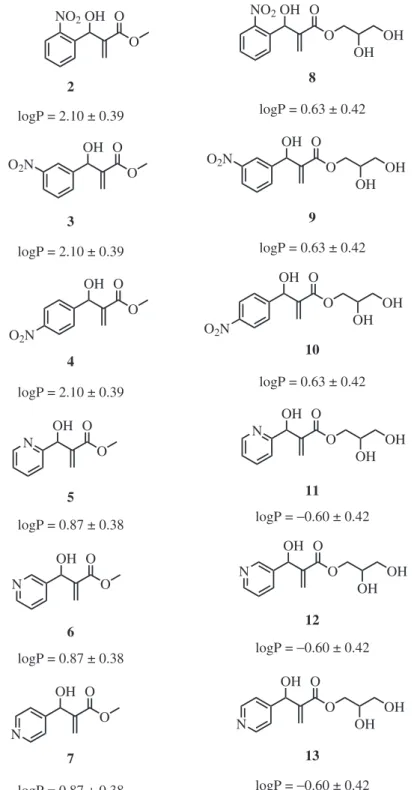
monoacylglycerols (MAGs)15 (Scheme 2 and Figure 1)
idealized as potential anti-parasitic compounds.
It has been reported in the literature that there is an important relationship between the hydrophilicity-lipophilicity and anti-parasitic activity of drugs, e.g., it were described that increasing the solubility in water or using cationic amphiphilic drugs (CADs) tends to increase anti-leishmaniasis and anti-malarial activities.16 The strategy
presented here was based on the introduction of hydrophilic portion derived from the glycerol (1), as an important factor in water solubility increase of MBHA, previously described by us as anti-leishmania proprieties14 (Figure 1). The key step in
these syntheses is the MBH reaction between the commercial aldehydes 14-19 (Figure 2) and the corresponding acrylates
20 or 21 presented in Scheme 3. All MAGs steps preparations were promoted by microwave irradiations, a very eficient and green methodology17 used to obtain improvement in
yields and rates of organic reactions.18
Results and Discussion
We began our experimental work on the acrylate
20 synthesis (Scheme 3). This compound was prepared by reaction between acryloyl chloride and solketal on CH2Cl2 at room temperature for 2 h (94%).
19 The solketal
is commercial, but it could easily be prepared here in 90% yield, by heating to 60 °C of glycerol under azeotropic distillation condition, on a mixture of acetone-pentane (1:1) under p-toluenesulfonic acid catalysis.19 After that,
two synthetic pathways were investigated to MAGs 8-13
prepare (step iii and iv to pathway 1 and step v and vi to pathway 2, Scheme 3).
There are up to now, more than 280 applications to MAG 21 mainly for the polymers synthesis and other
Y Z X OH O O OH OH Y Z X OH O O HO OH OH 1 W W anti-leishmania activities Hydrosolubility New MBHA Increased water solubility
2-7 8-13
MAGs
Scheme 2. 1: Glycerol; 2, 8: X = Y = Z = H, W = o-nitro; 3, 9: X = Y= Z = H, W = m-nitro; 4, 10: X = Y = Z = H, W = p-nitro; 5, 11: X = N, Y = Z = W = H; 6, 12: Y = N, X = Z = W = H; 7, 13: Z = N, Y = X = W = H.
Y Z X OH O O OH OH Y Z X OH O O HO OH OH 1 W W anti-leishmania activities Hydrosolubility New MBHA Increased water solubility
2-7 8-13
NO2OH O
O
OH OH
NO2OH O
O OH O O OH OH OH O O OH O O OH OH OH O O
O2N O2N
O2N
O2N
N OH O O OH OH N OH O O N OH O O OH OH N OH O O N OH O O OH OH N OH O O 2 3 4 5 6 7 8 9 10 11 12 13 logP = 0.87 ± 0.38
logP = 0.87 ±0.38
logP = 0.87 ± 0.38 logP = 2.10 ± 0.39
logP = 2.10 ± 0.39
logP = 2.10 ± 0.39
logP = 0.63 ± 0.42
logP = 0.63 ± 0.42
logP = 0.63 ± 0.42
logP = −0.60 ± 0.42
logP = −0.60 ±0.42
logP = −0.60 ± 0.42
Figure 1. logP values were calculated in silico using the Pharma-algorithms®; help available from http://pharma-algorithms.com.
O O
NO2
NO2
O
O2N
N O N O N O
14 15 16 17 18 19
Sousa et al. 1637 Vol. 22, No. 9, 2011
macromolecules as nanoparticles.20 However, even that
acrylates 20 and 21 are described, surprisingly, in the best of our knowledge, only in 2008, Shi and co-workers21
described a irst procedure to MAG 21 synthesis directly from the acrylate 20. Moreover, due to high water solubility of 21 it is important the development of an experimental protocol to 20→21 transformation using no large amount of water or other very high boiling point polar solvent, aiming to simplify this reaction isolation. Then, the development of a more eficient technology to minimize this problem is also an important point in this present article. First, to screen the suitable reaction conditions using only water quantity for the hydrolysis reaction of 20 in MAG acrylate 21 can occur (step iii, Scheme 3), we investigated many protocols as the use of PPTS/ CHCl3/ r.t. (24 h, no reaction),
22 TsOH/
toluene/ 80 oC (24 h, no reaction),23 TsOH/ CH
3OH/ r.t.
(3 h, 34%),23 CHCl
3/ FeCl3.SiO2/ r.t (6h, 33%), 24 HCl
(catalytic)/ toluene/ r.t. (24 h, 16%),25 montmorillonite
KSF/ CHCl3/ 60
oC (3 days, no reaction),26 montimorillonite
K10/ acetone/ 60 oC (24 h, 51%)26 and amberlite IRA-120/
ethanol/78 oC (24 h, 12%).26 In Fact, these previous results
to detach this transformation dificulty appears a simple chemical processing.
After, we evaluated the use of acetic acid 10%, under 60 oC (entry 1, Table 1, 10%).21 However, when this reaction
was carried out with addition of catalytic amount of BHT as anti polymerizing compound we observed a very large increase in the reaction yield (entry 2, Table 1, 92%). However, the use of amberlyst 15 in methanol at room temperature produced 21 in high yields (entry 3, Table 1,
97%).27 Very gratifying, we discover that the 21 yield
increased when the reaction was conducted in methanol under microwave irradiation for 15 min without the addition of any anti polymerization reagent. After that irradiation, a simple iltration to remove the resin and evaporation of methanol was necessary to obtained pure 21 in 100% yields (entry 4, Table 1).
Continuing on the pathway 1, several conditions have been evaluated on MBH reaction between the MAG acrylate
21 and aldehyde 14-19, modifying solvents (protic and nonprotic), temperature, using the microwave irradiation, trying to convert 21 to MBHA 8-13 (step iv, Scheme 3). Again, the experimental protocol development to 21→8-13 transformation without the use of large amount of water or other very high boiling point polar solvent, aiming to simplify the isolation of these reactions, especially for the more hydrophilic adducts 11, 12 and 13 (see the calculated values of logP in Figure 1). In Table 2 we present our best results for these steps iv.
HO OH OH 1 O O O O i, ii 20 Y Z X OH O O O O
W 22-27
Y Z X OH O O OH OH W
8-13
iii iv v O O OH OH 21 vi pathway 2 pathway 1
Scheme 3. i) Glycerol/acetone-pentane (1:1), 60 °C, azeotropic distillation, 24 h, 95%; ii) solketal, 1.2 equiv. acryloyl chloride, CH2Cl2, TEA, 94%; iii) acrylate 20, amberlyst 15, CH3OH, MW, 60 °C, 15 min, 100%; iv) aldehydes 14-19, acrylate 21, 1 equiv. DABCO, conditions in Table 2, 54-82%; v) aldehydes 14-19, acrylate 20, 1 equiv. DABCO, conditions in Table 3, 90-100%; vi) MBHA 22-27, condition in Table 4, 70-90%. 22, 8: X = Y = Z = H, W = o-nitro; 23, 9: X = Y= Z = H, W = m-nitro; 24, 10: X = Y = Z = H, W = p-nitro; 25, 11: X = N, Y = Z = W = H; 26, 12: Y = N, X = Z = W = H; 27, 13: Z = N, Y = X = W = H.
Table 1. Conditions and results to MAG 21 preparation (Scheme 3, pathway 1, step iii)
entry Condition time Yields / (%)*
In the pathway 2, the results of MBH reaction between the less hydrophilic acrylate 20 and the aldehyde 14-19 (step v, Scheme 3) were more eficient when they obtained from step iv from pathway 1, considering both reactions under microwave irradiations, producing the lipophilic MBHA
22-27 in high yields (step v, 90%-100% yields, Table 3). Again a complete study of different conditions was evaluated and we present in Table 3 the best results obtained for each evaluated adduct in this step. In this case, use of water or high boiling point polar solvent media does not minimize the reaction yield, since they are more lipophilic compounds.
We can point out that depending on the aldehydes used in the MBH reaction can be obtained good yields in both protic4,6 or aprotic5,6 media, conirming that slight
changes in reaction conditions can change the RDS of these
reactions and then, there are not, up to now, a clear general relationship between substrates-solvents-yields-rate, which corroborates the uniied mechanism proposed by Cantilo and Kappe for this exquisite reaction.7
Completing the pathway 2 (step vi, Scheme 3), the synthesis of adducts 8-13 from intermediates 22-27 was irst performed using the same methodology used on MAG
21 preparation (step iii, Scheme 3). However, surprisingly these transformations were ineficient, showing low yield (Table 4, entry 1). Since we observed no byproducts from this condition we have increased temperature (entry 2, Table 4). However, we obtained low yield and, in this case, byproduct. We believed that the origin of the principal byproduct could be the result from Michael reaction between the Methanol (a nucleophilic solvent) on 4-position of acrylate moiety from
Table 2. Results of the MBHA synthesis 8-13 from step iv in Scheme 3
Y Z X OH O O OH OH W
8-13
O O
OH OH
21
Aldehyde (14-19)
1 mmol DABCO
54-81% MW, 100 °C
entry Aldehyde MBHA Solvent time / min Yields / (%)
1 14 8 CH3CN 10 68
2 15 9 CH3CN 10 65
3 16 10 CH3CN 10 54
4 17 11 CH3CN 10 82
5 18 12 CH3CN 10 81
6 19 13 CH3CN 10 80
*8: X = Y = Z = H, W = o-nitro; 9: X = Y= Z = H, W = m-nitro; 10: X = Y = Z = H, W = p-nitro; 11: X = N, Y = Z = W = H; 12: Y = N, X = Z = W = H; 13: Z = N, Y = X = W = H.
Table 3. Results of the intermediates 22-27 preparations from the step v, presented in Scheme 3
Y Z X OH O O O O W
22-27 O
O O
O
20
Aldehyde (14-19)
1 equiv. DABCO
90-100% MW, 100 °C
entry MBHA Aldehyde Solvent time / min Yields / (%)
1 22 14 DMF 10 100
2 23 15 CH3CN 10 90
3 24 16 DMF/H2O* 10 90
4 25 17 CH3CN 10 98
5 26 18 DMF/H2O* 10 95
6 27 19 DMF/H2O* 10 90
Sousa et al. 1639 Vol. 22, No. 9, 2011
adduct 27 before or along with adduct 13 production. Another hypothesis suggested by us was the possibility of MBH reaction reversibility using high temperature, according to the uniied mechanism proposed by Cantillo and Kappe.7
Based on these hypothesis we irst investigated the solvent change using t-butanol, which is less nucleophilic than methanol, not changing microwave irradiation temperature. In fact, this solvent change was eficient, producing the new hydrophilic adduct 13 in good yield and no byproducts was obtained (entry 3, Table 4). Continuing, this methodology was high eficient to MAGs 8, 9 and 10 preparations from MBHA 22, 23 and 24 (entries 4, 5 and 6, Table 4; step vi in Scheme 3). In fact, Cantillo and Kappe described that the MBH reaction between acrylates and nitroarylaldehyde are less susceptible to reversibility even when high temperatures are used (until 107 °C the reaction is exergonic).7
Reaction at 100 C of t-butanol on MBH adducts 25
(entry 7, Table 4), which presented a 2-piridinyl moiety, lead to formation of two products, observed by TLC. A more polar product was isolated on 58% yield and characterized as the pure MAG 11 (entry 7, Table 4). The CGMS analysis of the less polar product indicated that this supposed product by TLC were in fact a more complex mixture of products that were not possible to be isolated. However, in the largest proportion byproduct (43% in this mixture) was proposed to be the unpublished indolizine 28 (Figure 3). Since this molecule could not be puriied by lash chromatography, no NMR data could were obtained and 28 preparation was based on the CGMS data. This compound showed all the characteristic fragmentations (m/z) of the indolizine28 and
also all the expected fragmentations showed in Figure 3, that no doubt characterizes the molecule 28. In fact, is already well established in the literature that indolizines are synthesized at high temperatures.29 We presented in Scheme 4
a short proposal of mechanism reaction for the 28 formation. As expected, the MAG 11 could be prepared in good yield without byproducts formations by decreasing the temperature at 60 oC (entry 8, Table 4). Then, it is clear
that in lower temperature the addition of less nucleophilic
t-butanol solvent on 25 do not occurs and also the formation of indolizines was not observed.
It is important to detach that both reactions with adducts presenting 3-pyridinyl (26) and 4-pyridinyl (27) moieties give best yields than the reaction with the 25 adduct (in the
same experimental condition, compare the entries 3, 7 and 10, Table 4). This experimental observation also conirms what has been discussed here about 2-N participation.
Finally, we believe that the best conversions to 8, 9 and
10 MAGs preparations compared with the conversions in MAGs 11, 12 and 13 syntheses can be also explained by the possibility of reversibility to the MBH reaction in both protic and nonprotic media as proposed by Cantilo and Kappe. 7
Conclusions
In summary we report in this article two eficient, facile and quick synthesis of six new hydrophilic MBHA N
O
O
OH OH
m/z = 235 [M+]
28
m/z = 144 (100%)
m/z = 116 (75%) m/z = 162 (85%)
Figure 3. Indolizines 28, proposed as principal byproduct and characterized thought the expected fragmentations obtained by GC-MS.
Table 4. Results of the MBHA 8-13 synthesis from step vi, presented in Scheme 3
entry MBHA Solvent T / °C time /min Yields / (%)
1 13 CH3OH 60 60 < 10
2 13 CH3OH 100 15 < 10*
3 13 t-butanol 100 15 70
4 8 t-butanol 100 15 90
5 9 t-butanol 100 15 90
6 10 t-butanol 100 15 90
7 11 t-butanol 100 15 58**
8 11 t-butanol 60 90 70
9 12 t-butanol 60 60 40
10 12 t-butanol 100 15 70
*Byproducts were observed from chromatography, no identified. **Puriied MAG 11 by chromatography.
28 N OH O O R N OH O O R N O O R N O O R –OH H H
8-13 on high yield (pathway 2, 67-90% two steps-yields and pathway 1, 54-82% two steps-yields, Scheme 3) from solketal acrylate 20. We also report a new very eficient and quick synthesis of MAG 20 from 21 (100% yield), using resin and microwave irradiation for 15 min. All steps starting from acrylate 20 were performed under microwave irradiation methodology. An advantage of pathway 2 is that we can also produce a new more lipophilic MBHA 22-27
in high yields (90-100% one step from acrylate 20, step v, Scheme 3). The bioactivities evaluations of these new 8-13
hydrophilic MAGs and also the new hydrophobic MBHA
22-27 will continue with this present article.
Experimental
General
All commercially available reagents and solvent were obtained from commercial providers and used without further puriication. Reactions were monitored by TLC using silica gel 60 UV254 Macherey-Nagel pre-coated silica gel plates; detection was by means of a UV lamp. Flash column chromatography was performed on 300-400 mesh silica gel. Organic layers were dried over anhydrous MgSO4 or Na2SO4 prior to evaporation
on a rotary evaporator. Reactions requiring microwave irradiation were performed in a microwave reactor CEM®
model system Discover benchmate with temperature monitored by built-in infrared sensor. 1H NMR and 13C
NMR spectra were recorded using Varian Mercury Spectra AC 20 spectrometer (200 MHz for 1H, 50 MHz for 13C)
for adducts 22-27 together with the acrylates 20 and 21
acrylates and Bruker DPX300 spectrometer (300 MHz for
1H, 75 MHz for 13C) for the adducts 8-13. Chemical shifts
were reported relative to internal tetramethylsilane (d0.00 ppm) for 1H, and CDCl
3 (d 77.0 ppm) for
13C. FTIR spectra
were recorded on a Shimadzu spectrophotometer model IRPrestige-21 in KBr pellets. MS data were measured with a Shimadzu GCMS-QP2010 mass spectrometer. High resolution mass spectra were determined using a MicroTOF Ic Bruker Daltonics spectrometer®. Solketal were prepared
in this work as described in Results and Discussion section and characterized in accordance with the commercial compounds physical data.
(2,2-Dimethyl-1,3-dioxolan-4-yl)methyl acrylate (20) 21
The reaction was performed using solketal 6 g (0.045 mols) which was left under stirring at 0 °C with 80 mL of dichloromethane (CH2Cl2) and 7 mL of TEA
in a closed system. After 5 min, a solution containing 20 mL of CH2Cl2 and 4.8 mL of acryloyl chloride was
slowly added. The reaction mixture kept under magnetic stirring for 1 h at room temperature. Then the isolation was done by adding the reaction mixture a solution of sodium bicarbonate NaHCO3 10% and the product was extracted by
the organic phase (CH2Cl2), which, in turn, was dried with
sodium sulfate anhydrous Na2SO4 and concentrated under
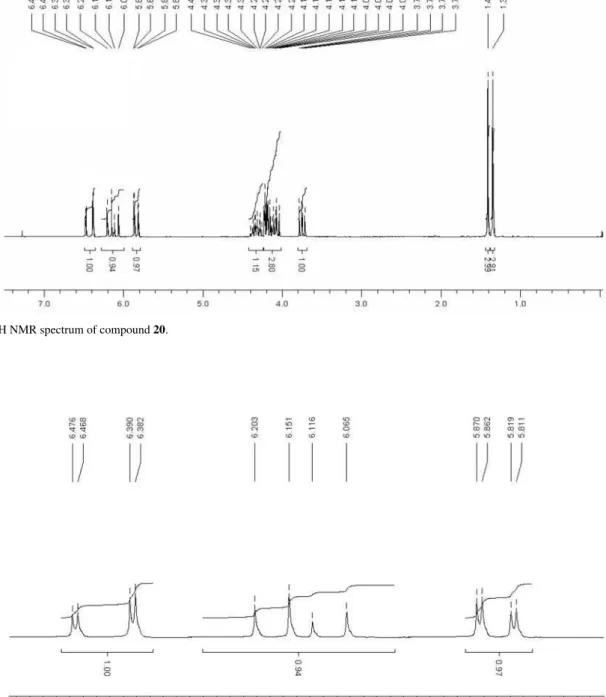
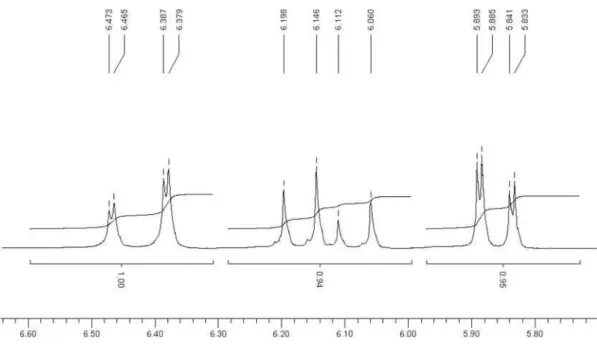
reduced pressure where it was obtained a 94% isolated yield. 1H NMR (CDCl
3, 200 MHz): d 1.38 (s, 3H), 1.41
(s, 3H), 3.71-4.41 (m, 5H), 5.84 (dd, 1H, J 10.2/1.6 Hz), 6.13 (dd, 1H, J 17.2/10.2 Hz), 6.43 (dd, 1H, J 17.2/1.6 Hz);
13C NMR (CDCl
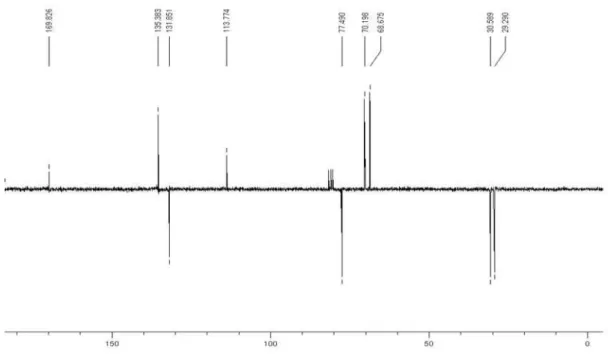
3, 50 MHz): d 29.3, 30.6, 68.7, 70.2, 77.5,
113.8, 131.9, 135.4, 169.8.
Synthesis of 2,3-dihydroxypropyl acrylate (21)21
It was produced using 186 mg (1 mmol) of the corresponding acrylate 20, 5 mL of methanol and 100 mg of resin Amberlyst 15 that were placed in a 10 mL glass microwave tube with magnetic stirrer. The reaction tube was placed inside the cavity of a CEM Discover benchmate and irradiated at 60 °C for 15 min. After the reaction completes, the reaction mixture brought to room temperature and was directly iltered using methanol and concentrated in a rotary evaporator. 1H NMR
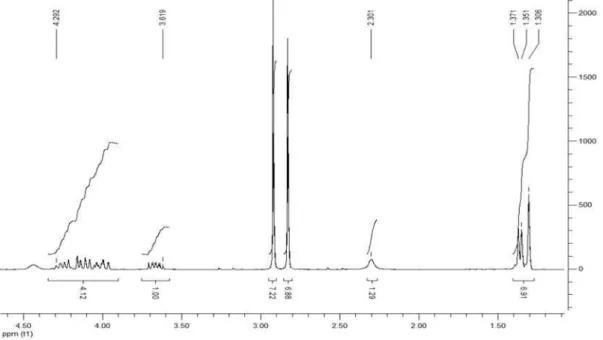
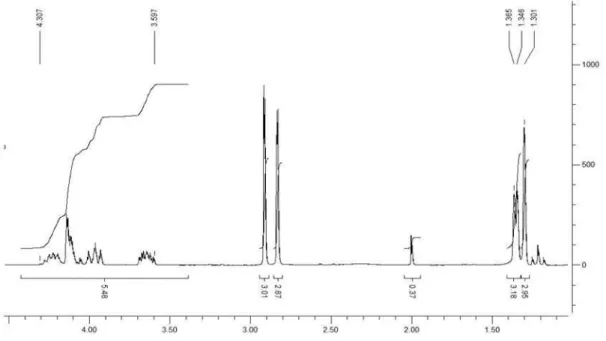
(CDCl3, 200 MHz): d 3.39-4.71(m, 7H), 5.86(dd, 1H,
J 10.4/1.6 Hz), 6.13 (dd, 1H, J 17.2/10.4 Hz), 6.43 (dd, 1H, J 17.2/1.6 Hz); 13C NMR (CDCl
3, 50 MHz): d 67.2,
69.2, 74.0, 131.8, 135.8, 170.6.
A typical procedure for synthesis of 22-27 (Scheme 3)
The corresponding aldehydes (1,5 mmol), 186 mg (1 mmol) of acrylate 20, DABCO (1 equiv.) and 5 mL of appropriate solvent were placed in a 10 mL glass microwave tube with magnetic stirrer. The reaction tube was placed inside the cavity of a CEM Discover® benchmate and
irradiated at 100 °C for 10 min. After the reaction completes, the reaction mixture brought to room temperature where the solvent used were extracted from the reaction medium and the product was isolated from the crude reaction by column chromatography through silica gel, using AcOEt:hexane as solvent at a ratio of 3:7 to the adducts 22, 23 and 24 and 7:3 to the adducts 25, 26 and 27. The reaction products were concentrated under reduced pressure and characterized by NMR, IR and mass spectroscopy.
(2,2-Dimethyl-1,3-dioxolan-4-yl)methyl[2-(hydroxy(2-nitrophenyl)methyl)] acrylate (22)
1H NMR (CDCl
3, 200 MHz): d 1.31 (s, 3H), 1.38 (s,
3H), 3.60-4.34 (m, 6H), 5.70 (d, 1H, J 5.8 Hz), 6.20 (s, 1H), 6.38 (s, 1H), 7.45 (m, 1H), 7.63 (t, 1H, J 7.8 Hz), 7.75 (d, 1H, J 8.0 Hz), 7.94 (d, 1H, J 8.0 Hz); 13C NMR (CDCl
Sousa et al. 1641 Vol. 22, No. 9, 2011
50 MHz): d 29.1, 30.5, 69.5, 70.0, 71.1, 77.2, 113.8, 128.5, 130.9, 132.6, 132.8, 137.5, 140.3, 144.8, 152.1, 169.4; IR (KBr) ν
max/cm-1:3433, 2989, 2939, 2889, 1724, 1527,
1350, 1157, 1053; ESI-HRMS (m/z) calc. for C16H19NO7
[(M+H)+] 338.1195, found 338.1233.
(2,2-Dimethyl-1,3-dioxolan-4-yl)methyl[2-(hydroxyl(3-nitrophenyl)]methyl) acrylate (23)
1H NMR (CDCl
3, 200 MHz): d 1.34 (s, 3H), 1.40 (d,
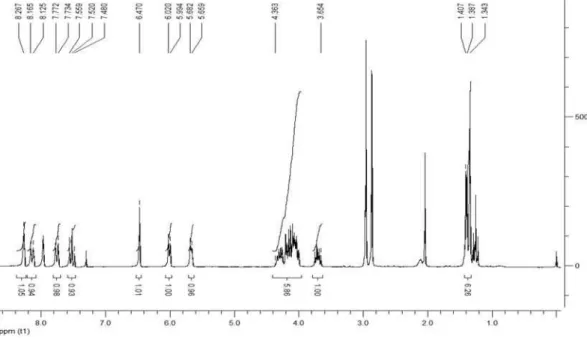
3H, J 4.0 Hz), 3.65-4.37 (m, 6H), 5.67 (d, 1H, J 4.6 Hz), 6.01 (d, 1H, J 5.2 Hz), 6.47 (s, 1H), 7.52 (t, 1H, J 7.8 Hz), 7.75 (d, 1H, J 7.6 Hz), 8.15 (d, 1H, J 8.0 Hz), 8.27 (s, 1H);
13C NMR (CDCl
3 50 MHz): d 29.1, 30.6, 69.1, 69.9, 75.9,
77.2, 113.8, 125.7, 126.6, 131.4, 133.2, 136.8, 145.1, 147.9, 152.2, 169.4; IR (KBr) ν
max/cm-1:3437, 2989, 2935, 2889,
1716, 1531, 1350, 1157, 1053; ESI-HRMS (m/z) calc. for C16H19NO7 [(M+H)+] 338.1195, found 338.1239.
(2,2-Dimethyl-1,3-dioxolan-4-yl)methyl[2-(hydroxyl(4-nitrophenyl)methyl)] acrylate (24)
1H NMR (CDCl
3, 200 MHz): d 1.31 (s, 3H), 1.36 (d,
3H, J 4.0 Hz), 3.62-4.33 (m, 5H), 4.44 (sl, 1H), 5.64 (d, 1H, J 4.2 Hz), 5.97 (d, 1H, J 4.8 Hz), 6.41 (s, 1H), 7.55 (d, 2H, J 8.4 Hz), 8.15 (d, 2H, J 8.6 Hz); 13C NMR (CDCl
3
50 MHz): d 29.1, 30.6, 70.0, 69.9, 75.5, 77.2, 113.8, 127.4, 131.2, 131.5, 145.3, 151.2, 153.2, 169.4; IR (KBr)
ν
max/cm-1:3410, 3213, 2985, 2935, 2897, 1716, 1519,
1350, 1157, 1056; ESI-HRMS (m/z) calc. for C16H19NO7
[(M+H)+] 338.1195, found 338.1229.
(2,2-Dimethyl-1,3-dioxolan-4-yl)methyl[2-(hydroxy (pyridin-2-yl)methyl)] acrylate (25)
1H NMR (CDCl
3, 200 MHz): d 1.30 (s, 3H), 1.36 (d,
3H, J 3.8 Hz), 3.59-4.28 (m, 5H), 4.98 (sl, 1H), 5.59 (s, 1H), 5.97 (s, 1H), 6.38 (s, 1H), 7.18 (m, 1H), 7.40 (d, 1H, J 8.0 Hz), 7.65 (td, 1H, J 7.6/1.6 Hz), 8.49 (dd, 1H,
J 4.8/1.0 Hz); 13C NMR (CDCl
3 50 MHz): d 29.2, 30.6,
68.7, 70.2, 76.0, 77.2, 113.7, 125.2, 126.6, 131.5, 140.8, 145.4, 152.1, 163.4, 169.8; IR (KBr) ν
max/cm-1:3421, 2985,
2939, 2889, 1720, 1157, 1053; ESI-HRMS (m/z) calc. for C15H19NO5 [(M+H)+] 294.1296, found 294.1335.
(2,2-Dimethyl-1,3-dioxolan-4-yl)methyl[2(hydroxyl (pyridin-3-yl)methyl)] acrylate (26)
1H NMR (CDCl
3, 200 MHz): d 1.32 (s, 1H), 1.38 (d,
1H, J 3.2 Hz), 3.58-4.33 (m, 6H), 5.59 (s, 1H), 6.02 (d, 1H, J 3.4 Hz), 6.43 (s, 1H), 7.25 (dd, 1H, J 8.0/5.0 Hz), 7.72 (d, 1H, J 8.0 Hz), 8.38 (d, 1H, J 4.6 Hz), 8.47 (d, 1H, J 2.0 Hz); 13C NMR (CDCl
3 50 MHz): d 29.1, 30.6,
69.9, 70.0, 74.3, 77.2, 113.8, 127.4, 130.7, 141.5, 145.4, 152.3, 152.5, 169.4; IR (KBr) ν
max/cm-1: 3124, 2989, 2877,
1716, 1145, 1060; ESI-HRMS (m/z) calc. for C15H19NO5
[(M+H)+] 294.1296, found 294.1337.
(2,2-Dimethyl-1,3-dioxolan-4-yl)methyl[2-(hydroxyl (pyridin-4-yl)methyl)] acrylate (27)
1H NMR (CDCl
3, 200 MHz): d 1.34 (s, 3H), 1.39 (d,
3H, J 4.2 Hz), 3.63-4.35 (m, 6H), 5.55 (s, 1H), 5.96 (d, 1H, J 4.6 Hz), 6.44 (s, 1H), 7.33 (d, 2H, J 6 Hz), 8.46 (d, 2H, J 4.8); 13C NMR (CDCl
3 50 MHz): d 29.1, 30.6, 69.0,
69.9, 75.5, 77.2, 113.8, 125.5, 131.6, 145.0, 153.4, 155.1, 169.4; IR (KBr) ν
max/cm-1:3140, 2989, 2877, 1716, 1141,
1056; ESI-HRMS (m/z) calc. for C15H19NO5 [(M+H) +]
294.1296, found 294,1337.
A typical procedure for synthesis of MAGs 8-13 from step iv(Scheme 3)
The corresponding aldehydes (1.5 mmol), 146 mg (1 mmol) of acrylate 21, DABCO (1 equiv.) and 5 mL of acetonitrile (CH3CN) were placed in a 10 mL glass microwave
tube with magnetic stirrer. The reaction tube was placed inside the cavity of a CEM Discover benchmate and irradiated at 100 °C for 10 min. After the reaction completes, the reaction mixture brought to room temperature where the CH3CN was
extracted from the reaction medium and the product was isolated from the crude reaction by column chromatography through silica gel, using AcOEt:hexane as solvent at a ratio of 8:2 to the adducts 8, 9 and 10 and using MeOH:AcOEt as solvent at a ratio of 1:9 to the adducts 11, 12 and 13. The reaction products were concentrated under reduced pressure and characterized by NMR, IR and mass spectroscopy.
A typical procedure for synthesis of MAGs 8-13 from step vi(Scheme 3)
The corresponding MBHA 22-27 (1.0 mmol), 5.0 mL of t-butanol and 100 mg of resin Amberlyst 15 were placed in a 10 mL glass microwave tube with magnetic stirrer. The reaction tube was placed inside the cavity of a CEM Discover® benchmate and irradiated at 100 °C for 15 min
The MAGs 8-13 spectroscopic data
2,3-Dihydroxypropyl[2-(hydroxyl(2-nitrophenyl)methyl)] acrylate (8)
1H NMR (MeOD, 300 MHz): d 3.35 (s, 3H), 3.46-3.55
(m, 2H), 3.79-3.86 (m, 1H), 4.13-4.23 (m, 2H), 5.72-5.74 (m, 1H), 6.26 (s, 1H), 6.37 (s, 1H), 7.48-7.54 (m, 1H), 7.66-7.72 (m, 1H), 7.77 (d, 1H, J 7.8 Hz), 7.94 (d, 1H,
J 8.1 Hz); 13C NMR (MeOH, 75 MHz): d 64.2, 67.0, 67.6,
71.1, 124.5, 126.4, 129.3, 129.8, 134.3, 138.4, 144.2, 167.1; IR (KBr) ν
max/cm-1:3383, 1712, 1527, 1350, 1265,
1157, 1120, 1045; ESI-HRMS (m/z) calc. for C13H15NO7
[(M+Na)+] 320.0746, found 320.0748.
2,3-Dihydroxypropyl[2-(hydroxyl(3-nitrophenyl)methyl)] acrylate (9)
1H NMR (MeOD, 300 MHz): d 3.35 (s, 2H), 3.49
(d, 2H, J 5.4 Hz), 3.75-3.83 (m, 1H), 4.07 (ddd, 1H,
J 11.4/6.0/4.2 Hz), 4.17 (ddd, 1H, J 11.4/4.5/3.0 Hz), 5.70 (s, 1H), 6.13 (dd, 1H, J 2.1/1.5 Hz), 6.46 (dd, 1H,
J 2.4/1.2 Hz), 7.56 (t, 1H, J 8.1 Hz), 7.77-7.81 (m, 1H), 8.13 (ddd, 1H, J 8.1/2.1/0.9 Hz), 8.26 (t, 1H, J 1.8 Hz);
13C NMR (MeOH, 75 MHz): d 64.1, 67.0, 71.1, 72.2, 123.0,
123.5, 126.5, 130.6, 134.6, 144.3, 146.4, 149.7, 167.0; IR (KBr) ν
max/cm-1:3375, 1708, 1527, 1350, 1273, 1157, 1095,
1049; ESI-HRMS (m/z) calc. for C13H15NO7 [(M+Na) +]
320.0746, found 320.0749.
2,3-Dihydroxypropyl[2-(hydroxyl(4-nitrophenyl)methyl)] acrylate (10)
1H NMR (MeOD, 300 MHz): d 3.35 (s, 2H), 3.47-3.51
(m, 3H), 3.75-3.82 (m, 1H), 4.04-4.21 (m, 2H), 5.69 (s, 1H), 6.10 (dd, 1H, J 2.1/1.5 Hz), 6.44 (dd, 1H, J 2.1/0.9 Hz), 7.63 (d, 2H, J 9.0 Hz), 8.19 (d, 2H, J 9.0 Hz); 13C NMR
(MeOH, 75 MHz): d 64.1, 67.0, 71.1, 72.3, 124.5, 126.6, 129.3, 138.4, 144.2, 148.9, 167.0; IR (KBr) ν
max/cm -1:3375,
1708, 1519, 1350, 1269, 1157, 1111, 1049; ESI-HRMS (m/z) calc. for C13H15NO7 [(M+Na)
+] 320.0746, found
320.0749.
2,3-Dihydroxypropyl[2-(hydroxy(pyridin-2-yl)methyl)] acrylate (11)
1H NMR (MeOD, 300 MHz): d 3.349 (s, 2H),
3.470-3.670 (m, 3H), 3.750-3.825 (m, 1H), 4.08 (ddd, 1H,
J 11.4/9.0/6.0 Hz), 4,17 (ddd, 1H, J 11.4/7.5/4.5 Hz), 5.66 (s, 1H), 5.98 (d, 1H, J 0.6 Hz), 6.43 (d, 1H, J 0.9 Hz), 7.31 (ddd, 1H, J 7.5/5.1/1.2 Hz), 7.56 (d, 1H, J 8.1 Hz), 7.82 (td, 1H, J 7.8/1.8 Hz), 8.46 (ddd, 1H, J 5.1/1.8/0.9 Hz);
13C NMR (MeOH, 75 MHz): d 64.1, 67.0, 71.1, 73.9,
123.2, 124.2, 127.1, 138.8, 143.8, 149.47, 162.5, 167.3; IR (KBr) ν
max/cm-1:3383, 1712, 1269, 1161, 1111, 1049;
ESI-HRMS (m/z) calc. for C12H15NO5 [(M+H)+] 254.0983,
found 254.1021.
2,3-Dihydroxypropyl[2-(hydroxyl(pyridin-3-yl)methyl)] acrylate (12)
1H NMR (MeOD, 300 MHz): d 3.35 (s, 2H),
3.47-3.67 (m, 3H), 3.75-3.83 (m, 1H), 4.07 (ddd, 1H,
J 11.4/6.0/4.2 Hz), 4.17 (ddd, 1H, J 11.4/4.5/2.4 Hz), 5.64 (s, 1H), 6.15 (s, 1H), 6.46 (d, 1H, J 1.2 Hz), 7.40 (ddd, 1H,
J 7.8/4.8/0.6 Hz), 7.84 (dt, 1H, J 8.1/1.8 Hz), 8.43 (dd, 1H,
J 4.8/1.5 Hz), 8.56 (d, 1H, J 1.8 Hz); 13C NMR (MeOH,
75 MHz): d 64.1, 67.0, 70.9, 71.1, 125.1, 126.2, 137.0, 140.3, 144.1, 149.2, 149.4, 167.0; IR (KBr) ν
max/cm-1:3348,
1716, 1265, 1157, 1118, 1029; ESI-HRMS (m/z) calc. for C12H15NO5 [(M+H)+] 254.0983, found 254.1023.
2,3-Dihydroxypropyl[2-(hydroxyl(pyridin-4-yl)methyl)] acrylate (13)
1H NMR (MeOD, 300 MHz): d 3.35 (s, 3H), 3.49-3.60
(m, 2H), 3.77-3.83 (m, 1H), 4.06-4.21 (m, 2H), 5.61 (s, 1H), 6.08 (dd, 1H. J 2.5/1.0 Hz), 6.45 (dd, 1H, J 2.0/1.0 Hz), 7.47 (d, 2H, J 6.5 Hz), 8.47 (dd, 2H, J 4.5/1.5 Hz); 13C NMR
(MeOH, 75 MHz): d 64.1, 64.6, 71.1, 71.8, 123.7, 127.0, 143.9, 150.0, 167.0; IR (KBr) ν
max/cm
-1:3363, 1716, 1269,
1161, 1115, 1053; ESI-HRMS (m/z) calc. for C12H15NO5
[(M+H)+] 254.0983, found 254.1027.
Supplementary Information
Supplementary data are available free of charge at http://jbcs.sbq.org.br as a PDF ile.
Acknowledgments
This work has been supported by CNPq, CAPES and FAPESQ-PB.
References
1. Morita, K.; Suzuki, Z.; Hirose, H.; Bull. Chem. Soc. Jpn. 1968, 41, 2815; Baylis, A. B.; Hillman, M. E. D.; German Pat. 2155113, 1972 (CA 77: 34174q).
Sousa et al. 1643 Vol. 22, No. 9, 2011
3. Hill, J. S.; Isaacs, N. S.; J. Phys. Org. Chem. 1990, 3, 285; Hill, J. S.; Isaacs, N. S.; J. Chem. Res. 1988, 330; Hill, J. S.; Isaacs, N. S.; Tetrahedron Lett. 1996, 27, 5007.
4. Price, K. E.; Broadwater, S. J.; Jung, H. M.; McQuade, D. T.; Org. Lett. 2005, 7, 147; Price, K. E.; Broadwater, S. J.; Walker, B. J.; McQuade, D. T.; J. Org. Chem. 2005, 70, 3980. 5. Aggarwal, V. K.; Fulford, S. Y.; Lloyd-Jones, G. C.; Angew.
Chem., Int. Ed. 2005, 44, 1706.
6. Amarante, G. W.; Milagre, H. M. S.; Vaz, B. G.; Ferreira, B. R. V.; Eberlin, M. N.; Coelho, F.; J. Org. Chem. 2009, 74, 3031. 7. Cantillo, D.; Kappe, C. O.; J. Org. Chem. 2010, 75, 8615. 8. Miranda, L. S. M.; Marinho, B. G. S.; Leitão, Matheus, G. E.;
Fernandes, M. P. D.; Vasconcellos, M. L. A. A.; Bioorg. Med. Chem. Lett. 2004, 14, 1573; Miranda, L. S. M.; Meireles, B.A.; Costa, J. S.; Pereira, V. L. P.; Vasconcellos, M. L. A. A.; Synlett 2005, 869; Alencar, K. G.; Dumas, F.; Costa, P. R. R.; Vasconcellos, M. L. A. A.; Tetrahedron: Asymmetry 1997, 8, 579; Filho, H. C. A.; Filho, U. F. L.; Pinheiro, S. Vasconcellos, M. L. A. A.; Costa, P. R. R.; Tetrahedron: Asymmetry 1994, 5, 1219; Coelho, A. L.; Vasconcellos, M. L. A. A.; Simas, A. B. C.; Rabi, J. A.; Costa, P. R. R.; Synthesis 1992, 914. 9. de Souza, R. O. M. A.; Pereira, V. L. P.; Esteves, P. M.
Vasconcellos, M. L. A. A.; Tetrahedron Lett. 2008, 49, 5902; de Souza, R. O. M. A.; Souza, A. L. F.; Fernandez, T. L.; Silva, A. C.; Pereira, V. L. P.; Esteves, P. M.; Vasconcellos, M. L. A. A.; Antunes, O. A. C.; Lett. Org. Chem. 2008, 5, 379; de Souza, R. O. M. A.; Vasconcellos, M. L. A. A.; Catal. Commun. 2004, 5, 21; de Souza, R. O. M. A.; Meireles, B. A.; Aguiar, C. S.; Vasconcellos, M. L. A. A.; Synthesis 2004, 1595; de Souza, R. O. M. A.; Vasconcellos, M. L. A. A.; Synth. Commun. 2003, 33, 1393.
10. Vasconcellos, M. L. A. A.; Silva, T. M. S.; Camara, C. A.; Martins, R. M.; Lacerda, K. M.; Lopes, H. M.; Pereira, V. L. P.; de Souza, R. O. M. A.; Crespo, L. T. C.; Pest Manage. Sci. 2006, 62, 288.
11. de Souza, R. O. M. A.; Pereira, V. L. P.; Muzitano, M. F.; Rossi-Bergmann, B.; Filho, E. B. A.; Vasconcellos, M. L. A. A.; Eur. J. Med. Chem. 2007, 42, 99.
12. Barbosa, T. C.; Junior, C. G. L.; Silva, F. P. L. Lopes, H. M. Figueiredo, L. R. F.; Souza, S. C. O.; Batista, G. N.; Silva,T. G.; Silva, T. M.; Oliveira, M. R.; Vasconcellos, M. L. A. A.; Eur. J. Med. Chem. 2009, 44, 1726.
13. Sandes, J. M.; Borges, A. R.; Junior, C. G. L.; Silva, F. P. L. Carvalho, G. A. U.; Rocha, G. B.; Vasconcellos, M. L. A. A.; Figueiredo, R. C. B. Q.; Bioorg. Chem. 2010, 38, 190. 14. Junior, C. G. L.; de Assis, P. A. C.; Silva, F. P. L.; Sousa, S. C.
O.; Andrade, N. G.; Barbosa, T. P.; Nerís, P. L. N.; Segundo, L. V. G.; Anjos, I. C.; Carvalho, G. A. U.; Rocha, G. B.; Oliveira, M. R.; Vasconcellos, M. L. A. A.; Bioorg. Chem. 2010, 38,279.
15. Choe1, J.; Guerra, D.; Michels, P. A. M.; Hol, W. G. J.; J. Mol. Biol. 2003, 329, 335; Yu, C. C.; Lee, Y-S.; Cheon, B-S.; Lee, S. H.; Bull. Korean Chem. Soc. 2003, 24, 1229.
16. Almela, M. J.; Torres, P. A.; Lozano, S.; Herreros, E.; Toxicol. in vitro 2009, 23, 1528; Charris, J. E.; Lobo, G. M.; Camacho, J.; Ferrer, R.; Barazarte, A.; Domínguez, J. N.; Gamboa, N.; Rodrigues, J. R.; Angel, J. E.; Lett. Drug Des. Discovery 2007, 4, 49; Sanders, J. M.; Gomez, A. O.; Mao, J.; Meints, G. A.; Van Brussel, E. M.; Burzynska, A.; Kafarski, P.; Gonzalez-Pacanowska, D.; Oldield, E.; J. Med. Chem. 2003, 46, 5171; Liu, M.; Wilairat, P.; Croft, S. L.; Lay-Choo A.; Go Mei-Lin.; Bioorg. Med. Chem. 2003, 11, 2729; Loyevsky, M.; Cabantchik, Z. I.; Mol. Pharmacol. 1994, 45, 446.
17. Kappe, C. O.; Dallinger, D.; Mol. Divers. 2009, 13, 71;Larhed, M.; Olofsson, K.; Topics in Current Chemistry: Microwave Methods in Organic Synthesis; Springer: Berlin, 2006. 18. de Souza, R. O. M. A.; Miranda, L. S. M.; Mini-Rev. Org.
Chem. 2010, 7, 212; Bose, A. K.; Manhas, M. S.; Ganguly, S. N.; Sharma, A. H.; Banik, B. K.; Synthesis 2002, 1578; Nuchter, M.; Ondruschka, B.; Bonrath, W.; Gum, A.; Green Chem. 2004, 6, 128.
19. Yu, C. C.; Lee, Y-S.; Cheon, B. S.; Lee, S. H.; Bull. Korean Chem. Soc. 2003, 24, 1229.
20. Obtained data from Scienceinder®, accessed in January 2011. 21. Zhifeng, F.; Tao, W.; Shi, Y.; J. Polym. Sci., Part A: Polym. Chem.
2008, 46, 362.
22. He, Y.; Johansson, M.; Sterner, O.; Synth. Commun. 2004, 34, 4153.
23. Ichihara, I.; Ubakaba, M.; Sakamura, S.; Tetrahedron Lett. 1977, 18, 3473.
24. Kim, K. S.; Song, Y. H.; Lee, B. H.; Hahn, C. S.; J. Org. Chem. 1986, 51, 404.
25. Fleet, G. W. J.; Smith, P. W.; Tetrahedron Lett. 1985, 26, 1469. 26. Li, T-S.; Li, S-H.; Synth. Commun. 1997, 27, 2299.
27. Batovska, D. I.; Kishmoto, T.; Bankova, V. S.; Kamenarska, Z. G.; Ukubata, M.; Molecules 2005, 10, 552.
28. For indolizine mass spectra, see: http://webbook .nist.gov/cgi/ cbook.cgi? Spec=C274408&Idex=0 &Type=Mass&Large=on, accessed in January 2011, or visit: http://webbook.nist.gov/ chemistry/[search=indolizine+mass spectra].
29. Basavaiah, D.; Devendar, B.; Lenin, D. V.; Satyanarayana, T.; Synlett 2009, 411; Jiang, M.; He, Q.; Yang, C.; Xie, Y.; Heterocycles 2008, 75, 2659; Basavaiah, D.; Rao, A.; J. Chem. Commun.2003, 604; Basavaiah, D.; Rao, A. J.; Tetrahedron Lett. 2003, 44, 4365; Bode, M. L.; Kaye, P. T. J.; Chem. Soc., Perkin Trans. 1 1993, 180.
Supplementary Information
S
I
J. Braz. Chem. Soc., Vol. 22, No. 9, S1-S41, 2011. Printed in Brazil - ©2011 Sociedade Brasileira de Química 0103 - 5053 $6.00+0.00
*e-mail: [email protected]
Microwave-Promoted Morita-Baylis-Hillman Reactions: Eficient Synthesis of
New Monoacylglycerols (MAGs) as Potential Anti-Parasitic Compounds
Suervy C. O. Sousa, Claudio G. L. Junior, Fábio P. L. Silva, Natália G. Andrade, Ticiano P. Barbosa and Mário L. A. A. Vasconcellos*
Departamento de Química, Universidade Federal da Paraíba, Campus I, 58059-900 João Pessoa-PB, Brazil
(2,2-Dimethyl-1,3-dioxolan-4-yl)methyl acrylate (20)
1H NMR (CDCl
3, 200 MHz): d 1.38 (s, 3H), 1.41 (s, 3H), 3.71-4.41 (m, 5H), 5.84 (dd, 1H, J 10.2/1.6 Hz), 6.13 (dd, 1H, J 17.2/10.2 Hz), 6.43 (dd, 1H, J 17.2/1.6 Hz); 13C NMR (CDCl
3 50 MHz): d 29.3, 30.6, 68.7, 70.2, 77.5, 113.8, 131.9, 135.4, 169.8.
Microwave-Promoted Morita-Baylis-Hillman Reactions J. Braz. Chem. Soc.
S2
Figure S2.1H NMR spectrum of compound 20.
Figure S4.13C NMR spectrum of compound 21.
Figure S5.1H NMR spectrum of compound 21.
2,3-Dihydroxypropyl acrylate (21)
1H NMR (CDCl
3, 200 MHz): d 3.39-4.71(m, 7H), 5.86(dd, 1H, J 10.4/1.6 Hz), 6.13 (dd, 1H, J 17.2/10.4 Hz), 6.43 (dd, 1H, J 17.2/1.6 Hz); 13C NMR (CDCl
Microwave-Promoted Morita-Baylis-Hillman Reactions J. Braz. Chem. Soc.
S4
Figure S6.1H NMR spectrum of compound 21.
Figure S7.13C NMR spectrum of compound 22.
(2,2-Dimethyl-1,3-dioxolan-4-yl)methyl[2-(hydroxy(2-nitrophenyl)methyl)] acrylate (22)
1H NMR (CDCl
3, 200 MHz): d 1.31 (s, 3H), 1.38 (s, 3H), 3.60-4.34 (m, 6H), 5.70 (d, 1H, J 5.8 Hz), 6.20 (s, 1H), 6.38 (s, 1H), 7.45 (m, 1H), 7.63 (t, 1H, J 7.8 Hz), 7.75 (d, 1H, J 8.0 Hz), 7.94 (d, 1H, J 8.0 Hz); 13C NMR (CDCl
3 50 MHz): d 29.1, 30.5, 69.5, 70.0, 71.1, 77.2, 113.8, 128.5, 130.9, 132.6, 132.8, 137.5, 140.3, 144.8, 152.1, 169.4; IR (KBr) ν
max/cm
-1: 3433,
Figure S8.1H NMR spectrum of compound 22.
Microwave-Promoted Morita-Baylis-Hillman Reactions J. Braz. Chem. Soc.
S6
Figure S10.1H NMR spectrum of compound 22.
Figure S12. ESI-HRMS spectrum of compound 22.
Figure S13.13C NMR spectrum of compound 23.
(2,2-Dimethyl-1,3-dioxolan-4-yl)methyl[2-(hydroxyl(3-nitrophenyl)]methyl) acrylate (23)
1H NMR (CDCl
3, 200 MHz): d 1.34 (s, 3H), 1.40 (d, 3H, J 4.0 Hz), 3.65-4.37 (m, 6H), 5.67 (d, 1H, J 4.6 Hz), 6.01 (d, 1H, J 5.2 Hz), 6.47 (s, 1H), 7.52 (t, 1H, J 7.8 Hz), 7.75 (d, 1H, J 7.6 Hz), 8.15 (d, 1H, J 8.0 Hz), 8.27 (s, 1H); 13C NMR (CDCl3 50 MHz): d 29.1, 30.6, 69.1, 69.9, 75.9, 77.2, 113.8, 125.7, 126.6, 131.4, 133.2, 136.8, 145.1, 147.9, 152.2, 169.4; IR (KBr) ν
Microwave-Promoted Morita-Baylis-Hillman Reactions J. Braz. Chem. Soc.
S8
Figure S14.1H NMR spectrum of compound 23.
Microwave-Promoted Morita-Baylis-Hillman Reactions J. Braz. Chem. Soc.
S10
Figure S18. ESI-HRMS spectrum of compound 23.
Figure S19.13C NMR spectrum of compound 24.
(2,2-Dimethyl-1,3-dioxolan-4-yl)methyl[2-(hydroxyl(4-nitrophenyl)methyl)] acrylate (24)
1H NMR (CDCl
3, 200 MHz): d1.31 (s, 3H), 1.36 (d, 3H, J 4.0 Hz), 3.62-4.33 (m, 5H), 4.44 (sl, 1H), 5.64 (d, 1H, J 4.2 Hz), 5.97 (d, 1H, J 4.8 Hz), 6.41 (s, 1H), 7.55 (d, 2H, J 8.4 Hz), 8.15 (d, 2H, J 8.6 Hz); 13C NMR (CDCl
3 50 MHz):
d 29.1, 30.6, 70.0, 69.9, 75.5, 77.2, 113.8, 127.4, 131.2, 131.5, 145.3, 151.2, 153.2, 169.4; IR (KBr) ν
max/cm-1: 3410, 3213, 2985, 2935, 2897, 1716, 1519, 1350, 1157, 1056; ESI-HRMS (m/z) calc. for C16H19NO7 [(M+H)
Microwave-Promoted Morita-Baylis-Hillman Reactions J. Braz. Chem. Soc.
S12
Figure S22.1H NMR spectrum of compound 24.
Figure S23. ESI-HRMS spectrum of compound 24.
(2,2-Dimethyl-1,3-dioxolan-4-yl)methyl[2-(hydroxy(pyridin-2-yl)methyl)] acrylate (25)
1H NMR (CDCl
3, 200 MHz): d 1.30 (s, 3H), 1.36 (d, 3H, J 3.8 Hz), 3.59-4.28 (m, 5H), 4.98 (sl, 1H), 5.59 (s, 1H), 5.97 (s, 1H), 6.38 (s, 1H), 7.18 (m, 1H), 7.40 (d, 1H, J 8.0 Hz), 7.65 (td, 1H, J 7.6/1.6 Hz), 8.49 (dd, 1H, J 4.8/1.0 Hz); 13C NMR (CDCl3 50 MHz): d 29.2, 30.6, 68.7, 70.2, 76.0, 77.2, 113.7, 125.2, 126.6, 131.5, 140.8, 145.4, 152.1, 163.4, 169.8; IR (KBr) ν
max/cm
-1:3421, 2985, 2939, 2889, 1720, 1157, 1053; ESI-HRMS (m/z) calc. for C
15H19NO5 [(M+H)
+] 294.1296,
Figure S24.1H NMR spectrum of compound 25.
Microwave-Promoted Morita-Baylis-Hillman Reactions J. Braz. Chem. Soc.
S14
Figure S26.1H NMR spectrum of compound 25.
Figure S28. ESI-HRMS spectrum of compound 25.
Figure S29.13C NMR spectrum of compound 26.
(2,2-Dimethyl-1,3-dioxolan-4-yl)methyl[2(hydroxyl(pyridin-3-yl)methyl)] acrylate (26)
1H NMR (CDCl
3, 200 MHz): d 1.32 (s, 1H), 1.38 (d, 1H, J 3.2 Hz), 3.58-4.33 (m, 6H), 5.59 (s, 1H), 6.02 (d, 1H, J 3.4 Hz), 6.43 (s, 1H), 7.25 (dd, 1H, J 8.0/5.0 Hz), 7.72 (d, 1H, J 8.0 Hz), 8.38 (d, 1H, J 4.6 Hz), 8.47 (d, 1H, J 2.0 Hz); 13C NMR (CDCl3 50 MHz): d 29.1, 30.6, 69.9, 70.0, 74.3, 77.2, 113.8, 127.4, 130.7, 141.5, 145.4, 152.3, 152.5, 169.4; IR (KBr)
ν
Microwave-Promoted Morita-Baylis-Hillman Reactions J. Braz. Chem. Soc.
S16
Figure S30.1H NMR spectrum of compound 26.
Microwave-Promoted Morita-Baylis-Hillman Reactions J. Braz. Chem. Soc.
S18
(2,2-Dimethyl-1,3-dioxolan-4-yl)methyl[2-(hydroxyl(pyridin-4-yl)methyl)] acrylate (27)
1H NMR (CDCl
3, 200 MHz): d 1.34 (s, 3H), 1.39 (d, 3H, J 4.2 Hz), 3.63-4.35 (m, 6H), 5.55 (s, 1H), 5.96 (d, 1H, J 4.6 Hz), 6.44 (s, 1H), 7.33 (d, 2H, J 6 Hz), 8.46 (d, 2H, J 4.8); 13C NMR (CDCl
3 50 MHz): d 29.1, 30.6, 69.0, 69.9, 75.5, 77.2, 113.8, 125.5, 131.6, 145.0, 153.4, 155.1, 169.4; IR (KBr) ν
max/cm
-1:3140, 2989, 2877, 1716, 1141, 1056; ESI-HRMS (m/z) calc.
for C15H19NO5 [(M+H)+] 294.1296, found 294,1337.
Figure S34.13C NMR spectrum of compound 27.
Figure S36.1H NMR spectrum of compound 27.
Microwave-Promoted Morita-Baylis-Hillman Reactions J. Braz. Chem. Soc.
S20
Figure S38. ESI-HRMS spectrum of compound 27.
Figure S39.13C NMR spectrum of compound 8.
2,3-Dihydroxypropyl[2-(hydroxyl(2-nitrophenyl)methyl)] acrylate (8)
1H NMR (MeOD, 300 MHz): d 3.35 (s, 3H), 3.46-3.55 (m, 2H), 3.79-3.86 (m, 1H), 4.13-4.23 (m, 2H), 5.72-5.74 (m,
1H), 6.26 (s, 1H), 6.37 (s, 1H), 7.48-7.54 (m, 1H), 7.66-7.72 (m, 1H), 7.77 (d, 1H, J 7.8 Hz), 7.94 (d, 1H, J 8.1 Hz); 13C NMR (MeOH, 75 MHz): d 64.2, 67.0, 67.6, 71.1, 124.5, 126.4, 129.3, 129.8, 134.3, 138.4, 144.2, 167.1; IR (KBr) ν
max/cm
-1:3383,
Figure S40.1H NMR spectrum of compound 8.
Microwave-Promoted Morita-Baylis-Hillman Reactions J. Braz. Chem. Soc.
S22
Figure S42. IR spectrum of compound 8.
Figure S44.13C NMR spectrum of compound 9.
Figure S45.1H NMR spectrum of compound 9.
2,3-Dihydroxypropyl[2-(hydroxyl(3-nitrophenyl)methyl)] acrylate (9)
1H NMR (MeOD, 300 MHz): d 3.35 (s, 2H), 3.49 (d, 2H, J 5.4 Hz), 3.75-3.83 (m, 1H), 4.07 (ddd, 1H, J 11.4/6.0/4.2 Hz),
4.17 (ddd, 1H, J 11.4/4.5/3.0 Hz), 5.70 (s, 1H), 6.13 (dd, 1H, J 2.1/1.5 Hz), 6.46 (dd, 1H, J 2.4/1.2 Hz), 7.56 (t, 1H, J 8.1 Hz), 7.77-7.81 (m, 1H), 8.13 (ddd, 1H, J 8.1/2.1/0.9 Hz), 8.26 (t, 1H, J 1.8 Hz); 13C NMR (MeOH, 75 MHz): d 64.1, 67.0, 71.1, 72.2, 123.0, 123.5, 126.5, 130.6, 134.6, 144.3, 146.4, 149.7, 167.0; IR (KBr) ν
max/cm-1:3375, 1708, 1527, 1350, 1273, 1157, 1095, 1049; ESI-HRMS (m/z) calc. for C13H15NO7 [(M+Na)
Microwave-Promoted Morita-Baylis-Hillman Reactions J. Braz. Chem. Soc.
S24
Figure S46.1H NMR spectrum of compound 9.
Figure S48.1H NMR spectrum of compound 9.
Microwave-Promoted Morita-Baylis-Hillman Reactions J. Braz. Chem. Soc.
S26
Figure S50. ESI-HRMS spectrum of compound 9.
Figure S51.13C NMR spectrum of compound 10.
2,3-Dihydroxypropyl[2-(hydroxyl(4-nitrophenyl)methyl)] acrylate (10)
1H NMR (MeOD, 300 MHz): d 3.35 (s, 2H), 3.47-3.51 (m, 3H), 3.75-3.82 (m, 1H), 4.04-4.21 (m, 2H), 5.69 (s, 1H),
6.10 (dd, 1H, J 2.1/1.5 Hz), 6.44 (dd, 1H, J 2.1/0.9 Hz), 7.63 (d, 2H, J 9.0 Hz), 8.19 (d, 2H, J 9.0 Hz); 13C NMR (MeOH, 75 MHz): d 64.1, 67.0, 71.1, 72.3, 124.5, 126.6, 129.3, 138.4, 144.2, 148.9, 167.0; IR (KBr) ν
max/cm
-1:3375, 1708, 1519,
Figure S52.1H NMR spectrum of compound 10.
Microwave-Promoted Morita-Baylis-Hillman Reactions J. Braz. Chem. Soc.
S28
Figure S54.1H NMR spectrum of compound 10.
Figure S56. IR spectrum of compound 10.
Microwave-Promoted Morita-Baylis-Hillman Reactions J. Braz. Chem. Soc.
S30
2,3-Dihydroxypropyl[2-(hydroxy(pyridin-2-yl)methyl)] acrylate (11)
1H NMR (MeOD, 300 MHz): d 3.349 (s, 2H), 3.470-3.670 (m, 3H), 3.750-3.825 (m, 1H), 4.08 (ddd, 1H, J 11.4/9.0/6.0 Hz),
4.17 (ddd, 1H, J 11.4/7.5/4.5 Hz), 5.66 (s, 1H), 5.98 (d, 1H, J 0.6 Hz), 6.43 (d, 1H, J 0.9 Hz), 7.31 (ddd, 1H, J 7.5/5.1/1.2 Hz), 7.56 (d, 1H, J 8.1 Hz), 7.82 (td, 1H, J 7.8/1.8 Hz), 8.46 (ddd, 1H, J 5.1/1.8/0.9 Hz); 13C NMR (MeOH, 75 MHz): d 64.1, 67.0, 71.1, 73.9, 123.2, 124.2, 127.1, 138.8, 143.8, 149.47, 162.5, 167.3; IR (KBr) ν
max/cm-1: 3383, 1712, 1269, 1161, 1111, 1049; ESI-HRMS (m/z) calc. for C12H15NO5 [(M+H)
+] 254.0983, found 254.1021.
Figure S59.1H NMR spectrum of compound 11.
Microwave-Promoted Morita-Baylis-Hillman Reactions J. Braz. Chem. Soc.
S32
Figure S61.1H NMR spectrum of compound 11.
Figure S63. IR spectrum of compound 11.
Microwave-Promoted Morita-Baylis-Hillman Reactions J. Braz. Chem. Soc.
S34
2,3-Dihydroxypropyl[2-(hydroxyl(pyridin-3-yl)methyl)] acrylate (12)
1H NMR (MeOD, 300 MHz): d 3.35 (s, 2H), 3.47-3.67 (m, 3H), 3.75-3.83 (m, 1H), 4.07 (ddd, 1H, J 11.4/6.0/4.2 Hz),
4.17 (ddd, 1H, J 11.4/4.5/2.4 Hz), 5.64 (s, 1H), 6.15 (s, 1H), 6.46 (d, 1H, J 1.2 Hz), 7.40 (ddd, 1H, J 7.8/4.8/0.6 Hz), 7.84 (dt, 1H, J 8.1/1.8 Hz), 8.43 (dd, 1H, J 4.8/1.5 Hz), 8.56 (d, 1H, J 1.8 Hz); 13C NMR (MeOH, 75 MHz): d 64.1, 67.0, 70.9, 71.1, 125.1, 126.2, 137.0, 140.3, 144.1, 149.2, 149.4, 167.0; IR (KBr) ν
max/cm-1: 3348, 1716, 1265, 1157, 1118, 1029; ESI-HRMS (m/z) calc. for C12H15NO5 [(M+H)
+] 254.0983, found 254.1023.
Figure S66.1H NMR spectrum of compound 12.
Microwave-Promoted Morita-Baylis-Hillman Reactions J. Braz. Chem. Soc.
S36
Figure S68.1H NMR spectrum of compound 12.
Figure S70. IR spectrum of compound 12.
Microwave-Promoted Morita-Baylis-Hillman Reactions J. Braz. Chem. Soc.
S38
2,3-Dihydroxypropyl[2-(hydroxyl(pyridin-4-yl)methyl)] acrylate (13)
1H NMR (MeOD, 300 MHz): d 3.35 (s, 3H), 3.49-3.60 (m, 2H), 3.77-3.83 (m, 1H), 4.06-4.21 (m, 2H), 5.61 (s, 1H), 6.08
(dd, 1H. J 2.5/1.0 Hz), 6.45 (dd, 1H, J 2.0/1.0 Hz), 7.47 (d, 2H, J 6.5 Hz), 8.47 (dd, 2H, J 4.5/1.5 Hz); 13C NMR (MeOH, 75 MHz): d 64.1, 64.6, 71.1, 71.8, 123.7, 127.0, 143.9, 150.0, 167.0; IR (KBr) ν
max/cm
-1: 3363, 1716, 1269, 1161, 1115,
1053; ESI-HRMS (m/z) calc. for C12H15NO5 [(M+H)+] 254.0983, found 254.1027.
Figure S73.1H NMR spectrum of compound 13.
Microwave-Promoted Morita-Baylis-Hillman Reactions J. Braz. Chem. Soc.
S40
Figure S75.1H NMR spectrum of compound 13.