This is the pre-review version of the paper published in
Journal of Organic Chemistry, 2012, 77, pp 4653–4659
The final version may be obtained from the publisher, at the following link:
Unravelling the reaction mechanism of the reductive
ring contraction of 1,2-pyridazines.
Pedro J. Silva*
REQUIMTE / Fac. de Ciências da Saúde, Universidade Fernando Pessoa, Rua Carlos da Maia, 296, 4200-150 Porto-Portugal
Introduction
Many different strategies for the synthesis of substituted pyrroles are available nowadays, ranging from the classical Knorr,1 Hantszch2 and Paal-Knorr3,4 syntheses to multiple-component palladium-catalyzed reactions5 and several different methodologies involving the contraction of larger heterocyclic rings.6 The most widely used of these ring contraction strategies is the reductive contraction of substituted 1,2-pyridazines (I) to yield 3,4-substituted pyrroles (III) first used by Kornfeld et al.7 and widely studied8 and popularized by Boger (Scheme 1). This zinc/acetic acid-catalyzed reaction is very tolerant of additional functionality around the ring (such as aryl methyl ethers, aryl benzyl ethers, ketones, esters and carbamates), and has been used in a large number of total syntheses of biologically active natural compounds such as roseophilin,9 ningalin D10 and lycogarubin C.11,12 Electrochemical investigation13,14 of this 4-electron reaction has shown that the mechanism may involve the formation of a 1,4-dihydropyridazine intermediate (II), which is sometimes stable enough to be isolated.9 The reaction has been reported to proceed more smoothly when using trifluoroacetic acid instead of acetic acid,9 but neither the precise order of reduction/protonation steps nor the characteristics of the rate-determining steps or the influence of ring substituents have been elucidated. In this work, we have studied the reaction mechanism using computational methods and analyzed the influence of substituents on the 3- and 6- position of the pyridazine ring on the reaction profile. The results allow us to explain the reaction mechanism, understand the influence of pyridazine substituents on reaction rates and the lack of reactivity of unsubstituted 1,2-pyridazine.
The geometries of every organic molecule described were optimized at the B3LYP15-17 level with the 6-31+G(d) basis set, using autogenerated delocalized coordinates.18 Accurate DFT energies of the optimized geometries were then calculated using the 6-311+G(3d,2p) basis set. Zero-point and thermal effects on the energies at 298 K were computed at the optimized geometries using a scaling factor of 0.9804. For the zinc clusters, the Stevens-Basch-Krauss-Jasien pseudopotential19 (and associated basis set) was used. All computations were performed with the Firefly20 quantum chemistry package, which is partially based on the GAMESS (US)21 source code. Deprotonation energies in this work are Gbase -Gacid and therefore do not include H+ solvation. All energy values described below include solvation effects in dichloromethane computed using the Polarizable Continuum Model22-24 implemented in Firefly. Natural resonance theory analysis25,26,27 was performed with NBO 5.G.28 Unless otherwise noted, all energies below are reported relative to the initial state.
Results and Discussion
Zn clusters in the experiment is not known, we used the lower value above (190.2 kcal•mol-1) as an estimate for this energy. The lack of a precise value obviously prevents the obtention of rigorous values for the energies of the electron-transfers from zinc to the substrate, but the order of the reduction/protonation events can nonetheless be ascertained with confidence. Due to the complexity of the mechanism, the reduction and protonation steps for 1,2-pyridazine will first be described and compared to several 3,6-disubstituted pyridazines. The steps involved in the actual ring closure will be described in a later section.
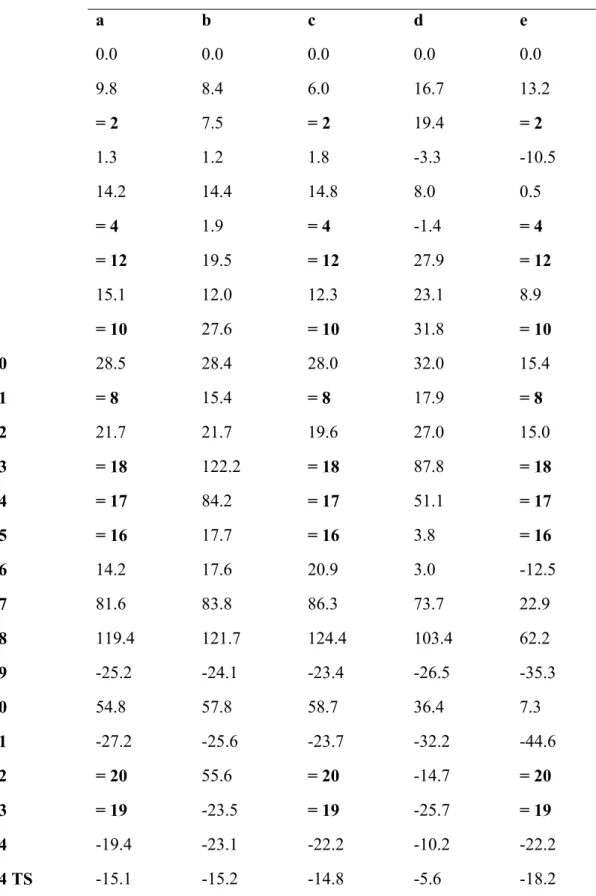
Table 1: Energies (in kcal•mol-1, vs. isolated reactants) of the most relevant molecules described in this work. Complete data are available as Supporting Information.
Substitutents
a b c d e
1 0.0 0.0 0.0 0.0 0.0
2 9.8 8.4 6.0 16.7 13.2
3 = 2 7.5 = 2 19.4 = 2
4 1.3 1.2 1.8 -3.3 -10.5
5 14.2 14.4 14.8 8.0 0.5
6 = 4 1.9 = 4 -1.4 = 4
7 = 12 19.5 = 12 27.9 = 12
8 15.1 12.0 12.3 23.1 8.9
9 = 10 27.6 = 10 31.8 = 10
10 28.5 28.4 28.0 32.0 15.4
11 = 8 15.4 = 8 17.9 = 8
12 21.7 21.7 19.6 27.0 15.0
13 = 18 122.2 = 18 87.8 = 18
14 = 17 84.2 = 17 51.1 = 17
15 = 16 17.7 = 16 3.8 = 16
16 14.2 17.6 20.9 3.0 -12.5
17 81.6 83.8 86.3 73.7 22.9
18 119.4 121.7 124.4 103.4 62.2
19 -25.2 -24.1 -23.4 -26.5 -35.3
20 54.8 57.8 58.7 36.4 7.3
21 -27.2 -25.6 -23.7 -32.2 -44.6
22 = 20 55.6 = 20 -14.7 = 20
23 = 19 -23.5 = 19 -25.7 = 19
24 -19.4 -23.1 -22.2 -10.2 -22.2
25 -17.6 -16.5 -15.7 -15.7 -30.4
25 TS 35.0 37.1 38.8 40.6 18.1
26 = 25 -17.0 = 25 -17.6 = 25
26 TS = 25 TS 37.1 = 25 TS 30.4 = 25 TS
27 = 24 -18.3 = 24 -19.8 = 24
27 TS = 24 TS -16.6 = 24 TS -18.6 = 24 TS
40 -19.1 -15.9 -16.0 -13.9 -20.0
41 -21.2 -18.1 -18.5 -14.9 -25.7
41 TS -18.4 -17.5 -17.9 -12.1 -19.9
42 -22.4 -27.5 -28.0 -12.2 -26.3
42 TS -23.2 -26.2 -26.2 -11.9 -31.7
43 -39.3 -37.5 -35.2 -39.6 -62.4
45 = 40 -19.6 = 40 -17.8 = 40
46 = 41 -21.6 = 41 -22.6 = 41
46 TS = 41 TS -19.0 = 41 TS -17.3 = 41 TS
47 = 42 -22.7 = 42 -17.6 = 42
47 TS = 42 TS -24.1 = 42 TS -20.5 = 42 TS
Reduction and protonation of unsubstituted 1,2-pyridazine
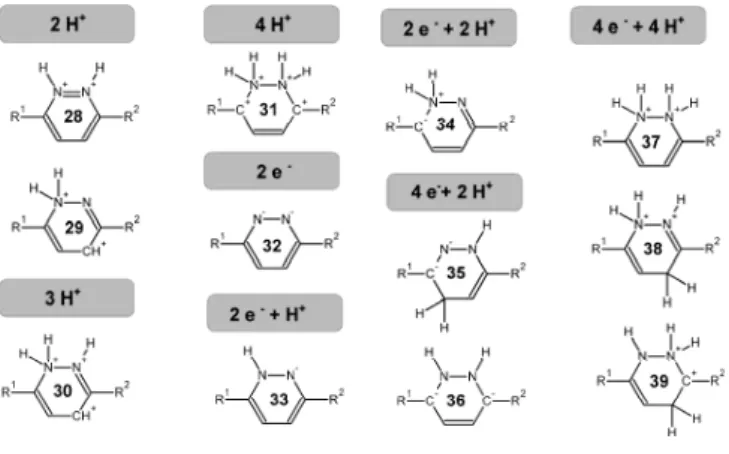
(Figure 2), from 1a and TFA has a sizeable ΔG of 62.3 kcal•mol-1. Additional protonations are still farther out of reach (ΔG=207.7 kcal•mol-1
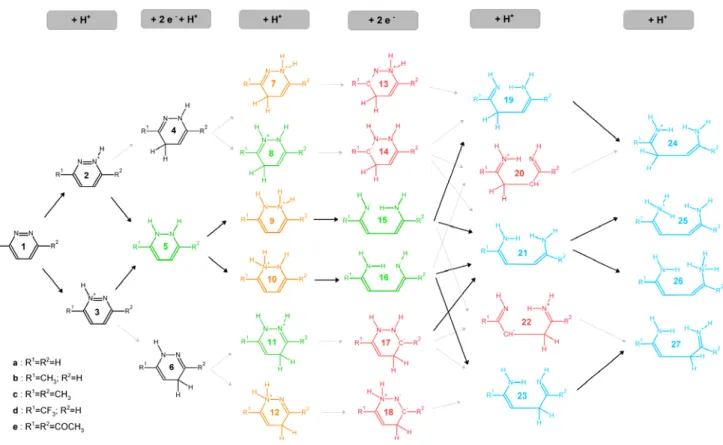
for the triply-protonated state, 30a, and 390.6 kcal•mol-1 for the quadruply-protonated state, 31a). Reduction of the singly-protonated structure (2a) would yield intermediate 33a but this outcome is prevented due to the high energy of the resulting products (52.3 kcal•mol-1 above reactants). Since neither individual protonation events nor reduction events are possible, these results suggest that progression of the reaction can only occur if the two-electron reduction occurs at the same time as the inclusion of an additional proton. This second proton may add to the same nitrogen atom as the initial proton (34a), to the other nitrogen (5a) or to the (in this case equivalent) 4- or 5- positions in the ring (4a or 6a, respectively), yielding a dihydropyridazine. The least stable of these intermediates is 34a (14.4 kcal•mol-1 above 5a, which itself lies 13.0 kcal•mol-1 above 4a/6a). Generation of 4a/6a from 2a, zinc and TFA, is favorable by 8.5 kcal•mol-1.
Figure 2: Unstable intermediates arising from different sequences of protonation/reduction events.
Further reduction of 5a or 4a/6a by zinc is prohibitively expensive, as the reactions leading to the corresponding products have very large ΔG (155.4 kcal•mol-1
Protonation of 4a/6a may occur either at the “free” nitrogen atom or at the nitrogen atom that already bears a hydrogen: the latter option yields an intermediate (7a/12a) which lies 6.6 kcal•mol-1 above the intermediate (8a/11a) arising from the former option. Proton addition to one of the nitrogens of 5a yields an intermediate (9a/10a) that lies 6.8 kcal•mol-1 above the 7a/12a and 13.4 kcal•mol-1 above the preferred 8a/11a intermediate. Further protonation of any of these intermediates generates very unstable intermediates: 37a, 38a and 39a are (respectively) 54.7 kcal•mol-1, 53.3 kcal•mol-1, and 62.8 kcal•mol-1, more acidic than trifluoroacetic acid, and cannot therefore be generated using trifluoroacetic acid as the proton donor. Interestingly, two-electron reduction of both most-favored intermediates (8a/11a or 7a/12a) is not feasible (reaction ΔG of 66.4 and 97.7 kcal•mol-1, respectively) as the respective products (18a and 13a) bear significant charges on electropositive or on contiguous atoms. On the other hand, two-electron reduction of the (least-favored) intermediate 9a/10a by zinc is favored by 14.3 kcal•mol-1, in a reaction that entails the breaking of N-N bond. This intermediate (16a) must then acquire two more protons before the ring contraction itself may occur. The first of these protons is about equally likely to add to the negatively charge nitrogen (reaction ΔG = -41.5 kcal•mol-1) or to the carbon atom two bonds away from this nitrogen (reaction ΔG = -39.5 kcal•mol-1
). Attemps to close the neutral four-electron-reduced ring 21a yielded very high energy intermediates (>50 kcal•mol-1 above 21a). These results highlighted the need for an additional protonation before ring closure might occur. This final protonation may yield either an intermediate (25a) with a triply-protonated nitrogen (17.6 kcal•mol-1 below the initial reactant state) or an intermediate with doubly-protonated nitrogens (24a) which lies 1.8 kcal•mol-1 below 25a.
Reduction and protonation of substituted 1,2-pyridazines
Figure 3: Comparison of the reaction profiles of pyridazine derivatives. Panel A: pyridazine (1a, continuous line), 3-methyl-1,2-pyridazine (1b, dotted/broken line) and 3,6-dimethylpyridazine (1c, broken line). Panel B: pyridazine (1a, continuous line), 3-trifluoromethyl-1,2-pyridazine (1d, dotted/broken line) and 1,1’-pyridazine-3,6-diyldiethanone (1e, broken line). Numerical values in the graphs identify the intermediates.
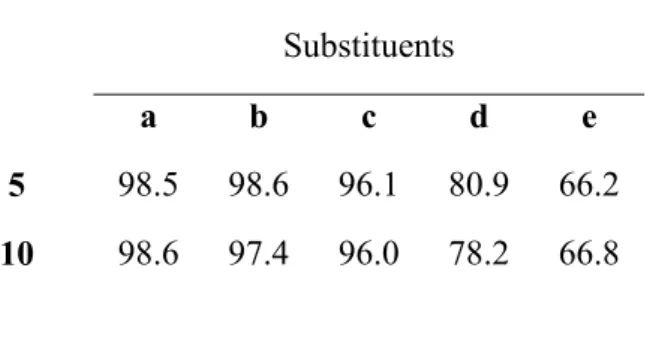
As expected from electrostatic considerations, the introduction of a single, electron-withdrawing, trifluoromethyl group in the pyridazine scaffold (1d) acts in a way opposite (Figure 3B) to that observed with the introduction of one methyl group, i.e. it destabilizes positively charge intermediates (2d and 10d) and stabilizes the negatively charged species. The magnitude of the effect is larger with CF3, as the difference in electronegativities in the C-F bond is larger than that in the C-H bond, and therefore the charge distribution in the ring is more affected by CF3 than CH3. The neutral intermediate 5d is, however, stabilized by 6 kcal•mol-1 relative to 5a, pointing to an additional, non-electrostatic, contribution: indeed, a natural resonance theory analysis shows that this stabilizing effect arises from the relatively large weights (3–5% each) of several resonance structures involving the electron pairs on the fluorine atoms and that further delocalize the electron density.
Table 2: Combined resonance weight (%) of all resonance structures of 5 and 10 differing among themselves only on the bonding pattern of the heavy atoms of the pyridazine ring. Hyperconjugation and resonance away from the ring are therefore not included.
Substituents a b c d e 5 98.5 98.6 96.1 80.9 66.2 10 98.6 97.4 96.0 78.2 66.8
The most interesting results arose in the investigation of the reductive contraction of the derivative bearing two COCH3 groups (1e). The initial stage proceeds as expected from the moderate electron-withdrawing character of these substituents: the energy gap between 1e and intermediate 2e lies between the energy gaps computed for unsubstituted pyridazine and 3-fluoromethyl pyridazine. Thenceforth, the reaction acquires a very distinctive energetic profile as the COCH3 substituents strongly stabilize intermediates 5e and 10e by 13–14 kcal•mol-1 (relative to 5a and 10a), due to sizable electron delocalization away from the ring and into the C=O moiety (Table 2). In consequence, the highest lying intermediate in the pathway (10e) becomes very accessible, only 15.4 kcal•mol-1 above the isolated reactants. The transition state for the 5e→10e proton transfer is, accordingly, readily accessible (19.0 kcal•mol-1 above initial reactants).
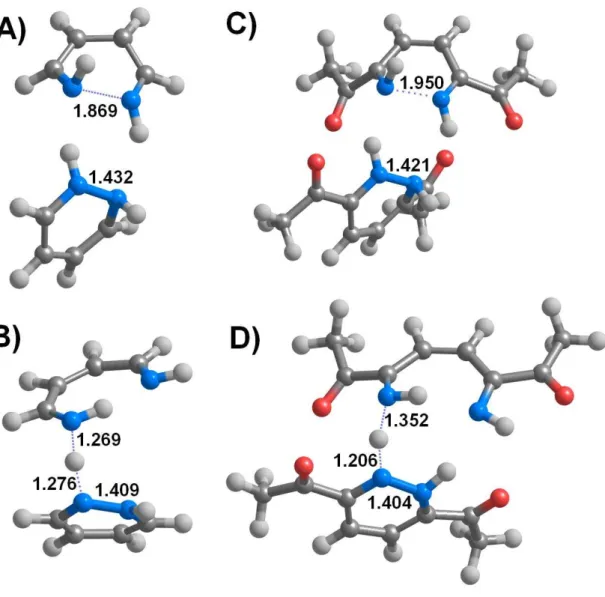
Generation of the four-electron-reduced species (15/16) through disproportionation of the
two-electron reduced species (5)
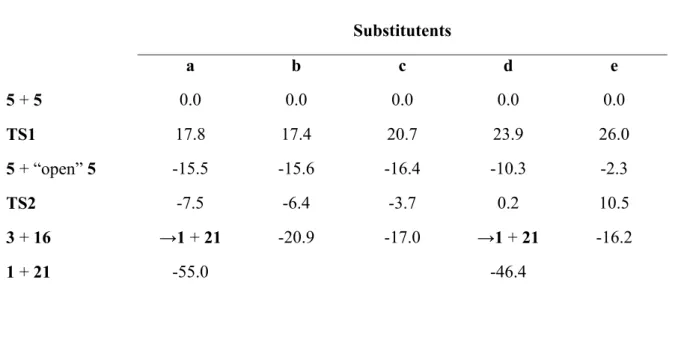
Table 3: Energies (in kcal•mol-1, vs. two interacting molecules of 5) of the intermediates in the disproportionation pathway. For the unsubstituted (a) and trifluoromethyl (d) pyridazines, products 3 + 16 spontaneously decay into 1 + 21.
Substitutents
a b c d e
5 + 5 0.0 0.0 0.0 0.0 0.0
TS1 17.8 17.4 20.7 23.9 26.0
5 + “open” 5 -15.5 -15.6 -16.4 -10.3 -2.3
TS2 -7.5 -6.4 -3.7 0.2 10.5
3 + 16 →1 + 21 -20.9 -17.0 →1 + 21 -16.2
1 + 21 -55.0 -46.4
Pyrrole formation
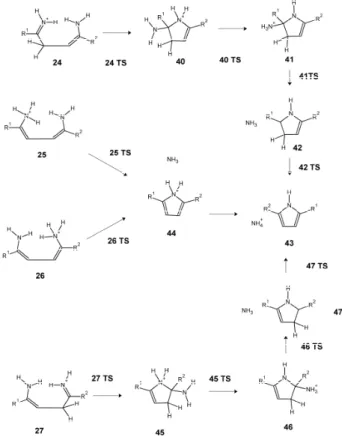
Figure 5: Pathways leading to pyrrole from four-electron-reduced/five-protons-bearing pyridazines.
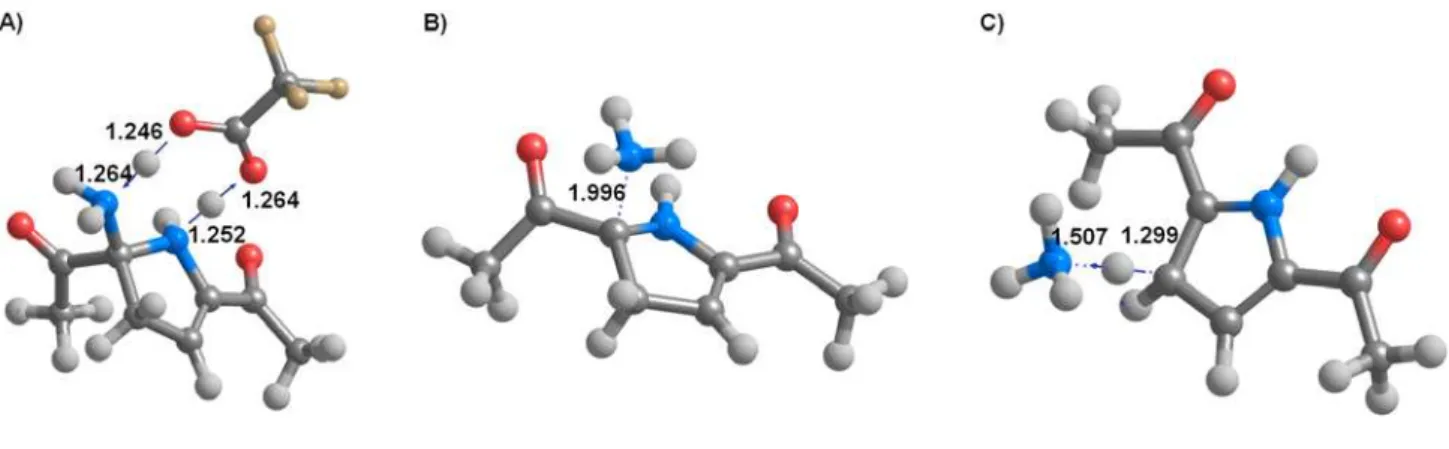
Figure 6: Transition states of the final steps of reductive ring contraction of pyridazines: A) CF3COOH-assisted proton transfer from the ring nitrogen to the leaving amino group (40TS/e); B) NH3 elimination (41TS/e); C) Aromatization (42TS/e). Distances (in Å) between intervening atoms are depicted in bold. Arrows show the vibrations associated with the imaginary frequencies of transition states.
Conclusions
Reductive ring contraction of 1,2-pyridazines using Zn/TFA follows a sequential mechanism whose rate seems to be limited by the addition of the third proton to the two-electron-reduced species. The high energy of this 2e-/3H+-bearing intermediate slows the reaction rates, unless positions 3- and 6- of the pyridazine ring bear substituents able to resonate negative charge away from the ring. The same substituent effects are also observed in an alternative pathway (which proved equally ineffective) involving disproportionation of earlier 2e-/2H+-bearing intermediates to bypass this unfavorable 2e -/3H+-bearing intermediate. The character of the ring substituents does not, however, greatly affect the outcome of the ring contraction steps, which have very small barriers in all cases studied. By establishing the need for electron-withdrawing resonant groups in the 3- and 6- positions, this work suggests that the reductive ring contraction of 1,2-pyridazines may be applied to pyridazines bearing COCH3 groups, amides or aryls in these positions, further expanding the scope of this interesting synthetic route, nowadays applied mostly to 3,6-dicarbomehoxy-1,2 pyridazines8-12 and 3,6-bipyrydyl-1,2-pyridazines.14 Finally, the 1,4-dihydropyridazine intermediate (4/6 in our scheme) found in electrochemical investigations13,14 and isolated in the course of the total synthesis of ent-(–) roseophilin9 seems to be part of an unproductive pathway involving (at the four-electron-reduced stage) intermediates (17 or 18) with energies far above those on the preferred pathway.
Acknowledgments: Research at REQUIMTE is supported by Fundação para a Ciência e a Tecnologia through grant no. PEst-C/EQB/LA0006/2011
REFERENCES
1 L. Knorr (1884) Chem. Ber., 17, 1635.
2 A. Hantzsch (1890) Chem. Ber., 23, 1474.
3 C. Paal (1884), Chem. Ber.17: 2756
4 L. Knorr (1884), Chem. Ber.17: 2863
5 R. Dhawan, B.A. Arndtsen (2004) J. Am. Chem. Soc. , 126, 468.
6 U. Joshi, M. Pipelier, S.Naud, D. Dubreuil (2005) Curr. Org. Chem, 9, 261-288
7 Bach, N. J.; Kornfeld, E. C.; Jones, N. D.; Chaney, M. O. ; Dorman,D. E.; Paschall, J. W.; Clemens, J. A.; Smalstig, E. B. (1980) J. Med. Chem. 23, 481.
8 Boger, D. L.; Coleman, R. S.; Panek, J. S.; Yohannes, D. (1984) J. Org. Chem. 49, 4405.
9 Boger D.L.; Hong J.(2001) J. Am. Chem. Soc. 123, 8515-8519
10 A. Hamasaki, J.M. Zimpleman, I. Hwang, D.L. Boger (2005) J. Am. Chem. Soc., 127, 10767
11 F. Liangfeng, W.G. Gordon (2010) Tetrahedron Lett., 51,537
12 J.S. Oakdale, D.L. Boger (2010) Org. Lett., 12, 1132
13 G. T. Manh, R. Hazard, J.P. Pradère, A. Tallec, E. Raoult, D. Dubreuil (2000) Tetrahedron Lett. 41, 647
14 G. T. Manh, R. Hazard, J.P. Pradère, A. Tallec, E. Raoult, D. Dubreuil, M. Thiam, L. Toupet (2002) Electrochim. Acta 47, 2833
15 A. D. Becke (1993) J. Chem. Phys. I, 98, 5648
17 R. W. Hertwig, W. Koch (1995) J. Comp. Chem. , 16, 576.
18 J. Baker, A. Kessi, B. Delley (1996) J. Chem. Phys. 105, 192
19 W. J. Stevens, M. Krauss, H. Basch, P. G. Jasien (1992) Can. J. Chem, 70, 612-630
20 A. A. Granovsky, Firefly version 7.1.G, http://classic.chem.msu.su/gran/gamess/index.html
21 M.W. Schmidt, K.K. Baldridge, J. A. Boatz, S.T. Elbert, M.S. Gordon, J.J. Jensen, S. Koseki, N. Matsunaga, K.A. Nguyen, S. Su, T.L. Windus, M. Dupuis, J.A. Montgomery (1993) J. Comput. Chem. 14, 1347
22 J. Tomasi, M. Persico (1994) Chem. Rev., 94, 2027-2094
23 B. Mennucci, J. Tomasi (1997) J. Chem. Phys., 106, 5151-5158
24 M. Cossi, B. Mennucci, J. Pitarch, J. Tomasi (1998) J. Comput. Chem., 19, 833-846
25 Glendening, E.D; Weinhold, F. (1998) J. Comput. Chem., 19, 593-609 26 Glendening, E.D; Weinhold, F. (1998) J. Comput. Chem. , 19, 610-627
27 Glendening, E.D; Badenhoop. J.K.; Weinhold, F. (1998) J. Comput. Chem., 19, 628-646
28 Glendening, E.D.; Badenhoop J. K.; Reed, A. E. ; Carpenter, J. E.; Bohmann, J. A.; Morales, C. M.; Weinhold, F., 2004, NBO 5.G. (Theoretical Chemistry Institute, University of Wisconsin, Madison, WI, 2004); http://www.chem.wisc.edu/~nbo5
29 D.L. Boger, J.S. Panek, M. Patel (1992) Org. Synth., 70, 79