
Article
0103 - 5053 $6.00+0.00*e-mail: [email protected]
Chemical and Photochemical Properties of a Ruthenium Nitrosyl Complex
with the N-Monosubstituted Cyclam
1-(3-Propylammonium)-1,4,8,11-tetraazacyclotetradecane
Kleber Q. Ferreiraa,b and Elia Tfouni*,a
aDepartamento de Química, Faculdade de Filosoia, Ciências e Letras de Ribeirão Preto,
Universidade de São Paulo - USP, Av. Bandeirantes, 3900, 14040-901 Ribeirão Preto-SP, Brazil
bDepartamento de Química Geral e Inorgânica, Instituto de Química, Universidade Federal da
Bahia, Rua Barão de Jeremoabo, s/n, Campus Universitário de Ondina, 40170-115 Salvador-BA, Brazil
O complexo aminofuncionalizado trans-[Ru(NO)Cl(1-pramcyH)](PF6)3 (1-pramcyH = 1-(3-propilamônio)-1,4,8,11-tetraazaciclotetradecano) foi sintetizado através da reação do trans -[RuCl(tfms)(1-pramcyH)](tfms)2 (tfms = triluorometanossulfonato) com óxido nítrico (NO) em
solução aquosa ácida. O complexo foi caracterizado por análise elementar, espectroscópica (UV-vis, IV, RMN de 1H e 13C) e eletroquímica. Dois valores de pK
a (7,0 e 8,2) foram determinados
para trans-[Ru(NO)Cl(1-pramcyH)](PF6)3 e foram atribuídos a um dos prótons do grupo amina do cyclam e ao propilamônio. A redução do trans-[Ru(NO)Cl(1-pramcyH)]3+ leva à saída rápida
de cloreto seguida de saída lenta de NO, enquanto a irradiação do complexo em solução aquosa desaerada resulta na labilização fotoquímica do NO. O rendimento quântico para a fotoaquação do NO diminui com o aumento do comprimento de onda de irradiação e com a diminuição do pH, e é observável apenas a λirr < 370 nm. O comportamento do trans-[Ru(NO)Cl(1-pramcyH)]
3+
é semelhante ao do complexo análogo trans-[Ru(NO)Cl(cyclam)]2+, porém difere daquele do
complexo com carboxipropil como substituinte.
The amine-functionalized trans-[Ru(NO)Cl(1-pramcyH)](PF6)3 complex (1-pramcyH = 1-(3-propylammonium)-1,4,8,11-tetraazacyclotetradecane) was synthesized from trans-[RuCl(tfms) (1-pramcyH)](tfms)2 (tfms = triluoromethanesulfonate) in acidic aqueous solution in the presence
of nitric oxide (NO). The complex was characterized by elemental, spectroscopic (UV-Vis, IR,
1H and 13C NMR) and electrochemical analyses. Two pK
a values (7.0 and 8.2) were estimated for
trans-[Ru(NO)Cl(1-pramcyH)](PF6)3 and were assigned to one of the cyclam nitrogen protons
and to the protonated aminopropyl group. Reduction of trans-[Ru(NO)Cl(1-pramcyH)]3+ results
in rapid loss of chloride followed by slower loss of NO, while irradiation of the complex in aqueous deaerated conditions suggests photochemical labilization of NO. The quantum yields for NO photoaquation decrease as the irradiation wavelength increases, being noticeable only at
λirr < 370 nm, and increase as pH increases. The behavior of trans-[Ru(NO)Cl(1-pramcyH)]3+,
which contains an aminopropyl substituted cyclam, parallels that reported for the analogous complex with the unsubstituted ligand, but differs from that described for the complex in which carboxypropyl is the substituent.
Keywords: nitrosyl, ruthenium, nitric oxide donor, substituted cylam, mono-N-functionalized cyclam
Introduction
The discovery of the participation of nitric oxide (NO)
in a wide range of physiological processes and pathologies1
has launched investigations on NO donors, including metal
nitrosyl complexes in solution or immobilized in matrices, aiming at the understanding of both fundamental aspects
and biological activity for potential applications.2-43
potentials and/or by light irradiation, in either solution or
matrices.14-18,34,40-49 These properties can be tuned by the
adequate choice of ligands.14, 18
It should be pointed out that interesting biological activities for several of these complexes have already been
reported.14,17,21,33,34,37-39Because NO can be either beneicial
or harmful depending on its bioavailability, compounds capable of releasing NO in a speciic biological target have potential biological applications and could be useful tools to study the physiological action of NO. Efforts from this laboratory have been directed toward this goal, using several strategies. One of such approaches involves the functionalization of ruthenium nitrosyl complexes, so they can be linked to important entities such as antibodies and to surfaces, in order to obtain selective NO donor drugs or devices.
We have been working with complexes such as
trans-[Ru(NO)(NH3)4(py-X)]n+ (py-X are pyridine, substituted
pyridines, pyrazine), trans-[Ru(NO)X(py-X)4]n+ (X = Cl−,
OH−, H
2O, NO2
−, etc.), and [Ru(NO)X(mac)]n+ (X = Cl−,
OH−, H
2O, etc.; mac = tetraazamacrocycle).
14,18,41,45 The
tetraazamacrocyclic RuII and RuIII complexes exhibit
some unusual features compared to alicyclic analogues.18
One of their fundamental properties is the size of the macrocyclic ring. A change in ring size has been shown to markedly affect the electronic spectra, redox potentials, and
reactivities of the complexes.18 Substitution in the ligand
may also affect some properties, such as reactivity. We have reported the syntheses and reactivity of trans-[RuCl(L)(1-pramcyH)]n+ (1-pramcyH =
1-(3-propylammonium)cyclam), L = Cl−, H
2O, OH
− and
tfms (triluoromethanesulfonate), where cyclam has a
pendant ammonium group.48 The loss of chloride from
trans-[RuCl2(1-pramcyH)]2+ and trans-[RuCl
2(tmc)]
+ (tmc
= tetramethylcyclam) is faster than that in the corresponding
dichloro cyclam complex.18 However, in very few cases,
the substitution in the cyclam ligand imparts a drastic shift
from the expected properties of the metal complex.19,50,51
These complexes present interesting conigurations
by exhibiting a κ3 denticity for the mono-N-substituted
1-(carboxypropyl)cyclam ligand in fac-[Ru(NO)Cl2
(κ3N4,N8,N11(1-carboxypropyl)cyclam)]Cl·H
2O,
19 κ5 for
the mono-N-substituted N-(2-methylpyridyl)cyclam
ligand in cis-[Ru(Lpy)NO]3+ (Lpy = N
-(2-methylpyridyl)-1,4,8,11-tetraazacyclotetradecane),50 and κ6 for the
tetra-N-substituted 1,4,8,11-tetrakis(2-pyridylmethyl)
cyclam in [Ru(HL)][ClO4]3·H2O (L =
1,4,8,11-tetrakis(2-pyridylmethyl)cyclam).51 However, when the substituent
is ammoniumpropyl (1-(3-propylammonium)cyclam), the
ruthenium complex adopts the expected trans coniguration
in trans-[RuCl(L)(1-pramcyH)]n+ (L = Cl−, H
2O, OH
−)
(trans-[Ru(NO)Cl(1-pramcyH)]3+),48 instead of the fac
coniguration adopted in fac-[Ru(NO)Cl2(κ3N4,N8,N11
(1-carboxypropyl)cyclam)]Cl•H
2O when the substituent is
carboxypropyl.
In order to verify the effect of the ammoniumpropyl substituent on the coniguration of the nitrosyl complex, so as to obtain a wider variety of NO donors, in this paper we report the synthesis, characterization, electrochemical
and photochemical properties of the trans
-[Ru(NO)Cl(1-pramcyH)](PF6)3 complex.
Experimental
Chemicals and reagents
Ruthenium trichloride (RuCl3•nH
2O) (Strem; 40-45%
Ru) was the starting material for the syntheses of the ruthenium complexes. Cyclam was purchased from Aldrich. Acetone, chloroform and ethanol were puriied according
to literature procedures.52 Doubly distilled water was used
throughout this work. All other materials were reagent grade and were used without further puriication.
Syntheses
The trans-[Ru(NO)Cl(cyclam)](PF6)2 complex25
was synthesized for comparison purposes. 1H NMR
(acetonitrile-d3) δ 1.59 (m, 4 H, CH2), 1.94 (d, J 6.8 Hz, 2
H, CH2), 2.16 (d, 2 H, J 5.6 Hz, CH2), 2.61 (m, 4 H, CH2),
2.86 (q, J 5.4 Hz, 2 H, CH2), 3.09 (d, J 7.2 Hz, 2 H, CH2),
3.32 (m, 4 H, CH2), 5.12 (s, 2 H, NH), 5.66 (s, 2 H, NH). 13C
NMR (acetonitrile-d3) δ 26.66 (CH2), 28.83 (CH2), 49.76
(CH2), 52.42 (CH2), 52.93 (CH2), 55.07 (CH2)). Trans
-[RuCl2(1-pramcyH)]Cl2,48trans-[RuCl(tfms)(1-pramcyH)]
(tfms)2,48trans-[RuCl(H
2O)(1-pramcyH)](PF6)3
48 and trans
-[RuCl(H2O)(cyclam)](PF6)248 complexes were prepared as
described elsewhere.
Trans-[Ru(NO)Cl(1-pramcyH)](PF6)3 was prepared by a slight modiication of a procedure previously described
for the synthesis of trans-[Ru(NO)Cl(cyclam)](PF6)2.25
An amount of 77 mg (0.10 mmol) of trans-[RuCl(tfms)
(1-pramcyH)](tfms)2 was dissolved in 10 mL of 0.1 mol L-1
HPF6 solution in a three-necked flask under argon
atmosphere and continuous stirring. Nitric oxide, which was generated by dropping 30% nitric acid onto Cu and
passing it through a 6 mol L-1 solution of NaOH, was
bubbled through the solution. After 4 h of bubbling, 1 mL of
a saturated aqueous solution of NH4(PF6) was added, and the
solution was concentrated to ca. 2 mL by rotary evaporation
washed with acetone, ether, and dried under vacuum. Yield: 45% (0.17 g; 0.046 mmol). Elemental analyses: Found: C,
17.98; H, 3.67; N, 9.65. Calc. for C13H32ClF18N6OP3Ru:
C, 18.16; H, 3.75; N, 9.77%. UV-Vis λmax/nm (water)
272 (ε/(dm3 mol-1 cm-1) 3.1×10³), 360 (4×10²) and 455
(90). 1H NMR (acetonitrile-d
3) δ 1.86 (m, 3 H, CH2),
2.15 (m, 3 H, CH2), 2.66 (m, 5 H, CH2), 2.78 (m, 4 H,
CH2), 3.07 (t, J 4.5Hz, 2 H, CH2), 3.29 (d, J 4.8 Hz, 3 H,
CH2), 3.45 (d, J 5.2 Hz, 2 H, CH2), 3.55 (dd, J 5.3 Hz, 4 H,
CH2), 5.36 (s, 3 H, NH), 6.06 (s, 1 H, NH), 6.26 (s, 2 H,
NH). 13C NMR (acetonitrile-d
3) δ 29.89 (CH2), 30.05 (CH2),
30.23 (CH2), 50.48 (CH2), 51.20 (CH2), 53.27 (CH2), 53.50
(CH2), 53.82 (CH2), 54.39 (CH2), 55.20 (CH2),55.80 (CH2),
56.10 (CH2), 56.54 (CH2).
Elemental analyses
Analyses were performed at the Departamento de Química, Faculdade de Filosoia, Ciências e Letras de Ribeirão Preto, University of São Paulo, using an Elemental Analyzer CE Instruments, model EA 1110.
Spectra
Electronic absorption spectra were recorded on a Hewlett-Packard model 8452A spectrophotometer using quartz cells. Infrared absorption spectra were obtained in Nujol mulls, in water or in acetonitrile, on
a Bomen MB-102 spectrophotometer. 1H and 13C NMR
spectra were obtained in 5 mm NMR tubes on a Bruker
WH400 spectrometer in acetonitrile-d3 or D2O. The EPR
experiments were conducted in frozen acetonitrile (77 K) in an ESP-300E Bruker instrument operated with an X-band microwave bridge.
Electrochemical measurements
Cyclic voltammetry and controlled potential electrolysis were performed with a PARC 273 potentiostat/galvanostat. All tests were carried out using a conventional three-electrode cell. Glassy carbon and platinum gauze were used as working electrodes for cyclic voltammetry and coulometry, respectively. Ag/AgCl and platinum wire were used as the reference and auxiliary electrodes respectively. Electrochemical data were obtained in
different media, as follows: pH 1 (CF3SO3H/CF3SO3Na,
µ = 0.1 mol L-1); pH 4.32 (CF
3COOH/CF3COONa,
µ = 0.1 mol L-1); pH 1 (HCl/KCl, µ = 0.1 mol L-1); pH 7.9
(NaH2PO4•H
2O/Na2HPO4, µ = 0.1 mol L
-1); pH 6 (LiCl,
µ = 0.2 mol L-1); and acetonitrile, µ = 0.1 mol L-1, containing
tetrabutylammonium hexaluorophosphate [tba(PF6)]. All
solutions were deaerated by bubbling high purity argon, and thermostated using a Haake FK ultracryostat. The
reported E1/2’ values are the arithmetic means of the Epa
and Epc values.
The spectroelectrochemical measurements in the UV-Vis region were carried out in a quartz cell with 0.030 cm optical path, using gold mini-grid, Ag/AgCl and platinum wire as working, reference and auxiliary electrodes respectively. Analogous measurements in the infrared region were carried out using gold mini-grid, Ag wire and gold wire as working, reference and auxiliary
electrodes respectively, mounted in a CaF2 window with
0.020 cm optical path. Successive UV-Vis or IR spectra for trans-[Ru(NO)Cl(cyclam)](PF6)2 and trans-[Ru(NO)
Cl(1-pramcyH)](PF6)3 were recorded during the reduction
process of the complexes at 25 oC, with applied potentials
of –500 mV vs. Ag/AgCl in acetonitrile solutions. The pH
measurements were performed using a 430 Analion or a Corning pH meters.
Photolyses
Monochromatic irradiations at 313, 334 and 370 nm were carried out using a 150 W Xenon lamp in an Oriel Universal Arc Lamp Source (model 6253). For photolysis at the appropriate wavelengths, the irradiation wavelength was selected with Oriel interference ilters, with an average band path of 10 nm.
The progress of the photoreactions was monitored spectrophotometrically on a MB Bomem 102 FTIR spectrophotometer, using a ZnSe ATR crystal, or on
an HP8452A diode array spectrophotometer for in-situ
vibrational and electronic spectroscopy respectively. For most runs, the initial concentration of the complex was
ca. 10-2 (infrared experiments) to 10-3 mol L-1 (UV-Vis
experiments)in the following buffers: CF3SO3H/CF3SO3Na
(µ = 0.1 mol L-1; pH 1), CH
3COOH/CH3COONa
(µ = 0.1 mol L-1; pH 4.75); CH
3COOH/CH3COONa
(µ = 0.1 mol L-1; pH 4.90), or Na
2HPO4/NaH2PO4
(µ = 0.1 mol L-1; pH 7.4). The collimated beam intensities
ranged from 1×10⁻⁹ to 4×10⁻⁸ einstein-1 cm-2 as determined
by ferrioxalate actinometry. The chemical actinometer potassium tris(oxalato)ferrate(III) was prepared according
to Calvert and Pitts.53 After the equilibration of the cell
holder temperature, photolysis begun by irradiating the sample for a period of time ranging from 0 to 7200 s, with increments of 1200 s.
Considering that the coordinated water of trans
-[RuCl(1-pramcyH)(OH2)]3+ has a pK
a of 3.1,
48 the calculated
NO quantum yield was based on the concentrations of the
photoproduct trans-[RuCl(1-pramcyH)(L)]n+ (L = H
OH–), obtained by spectroscopic determination with
absorbance readings at λ = 356 nm for the photolysis
at pH = 1. At this pH, trans-[RuCl(1-pramcyH)(OH2)]3+
(λmax/nm = 356, ε/(dm3 mol-1 cm-1) = 2900) is formed. At
pHs 4.75 and 4.90, a mixture of trans-[RuCl(1-pramcyH)
(OH2)]3+ and trans-[RuCl(1-pramcyH)(OH)]2+ (λ
max = 315,
ε = 830) is obtained. At pH 7.4, only trans
-[RuCl(1-pramcyH)(OH)]2+ (λ
max = 310, ε = 1.0 x 10
3) is produced.
The calculated φNO values were plotted versus % of the
reaction (φ x % R). The extrapolated spectroscopic quantum
yield at R = 0% was taken as φNO for the photoaquation of
NO from trans-[Ru(NO)Cl(1-pramcyH)]3+. Evaluation of
φNO at R = 0 % eliminates possible complications resulting
from secondary photolysis of primary reaction products and inner ilter effects.
Results and Discussion
Syntheses
The synthesis of the 1-pramcyH complex uses trans
-[Ru(tfms)Cl(1-pramcyH)](tfms)2 as precursor, which,
in acidic aqueous solution, aquates with a speciic rate
constant, k1, of 6.5×10⁻² s-1 at pH 1, forming trans
-[RuCl(OH2)(1-pramcyH)]3+.48 As for the cyclam complex,
trans-[Ru(NO)Cl(cyclam)](PF6)2, trans-[RuCl(H2O)
(1-pramcyH)]3+ generates trans-[Ru(NO)Cl(1-pramcyH)]3+
in the presence of NO. The nitrosyl complex was obtained as
its hexaluorophosphate salt, trans-[Ru(NO)Cl(1-pramcyH)]
(PF6)3, which is soluble in water, acetonitrile, methanol and
dimethylsulfoxide, and in a lesser extent in acetone. Because the complex was isolated in acidic medium
(0.1 mol L-1 HPF
6), the aminopropyl group is protonated.
Potentiometric titration allowed estimation of two pKa values
(7.0 and 8.2) for trans-[Ru(NO)Cl(1-pramcyH)](PF6)3,
which should be ascribed to one of the cyclam nitrogen protons and to the protonated propylammonium. Considering
that the cyclam nitrogen of the related complexes trans
-[RuCl(cyclam)(NHC(O)4-py)]+ (py = pyridine), trans
-[RuCl2(1-pramcyH)]2+, and trans-[RuCl(OH)(1-pramcyH)]2+
have pKa values of 7.9, 8.0, and 7.8, respectively,48,54 and
free propylammonium has a pKa of 9.8,55,56 it is dificult
to undoubtedly assign the pKa values. However, it is more
likely that the pKa of 7.0 refers to the cyclam nitrogen and
that of 8.2 to propylammonium, value that is lower than 9.8 due to the charge effect of the Ru metal center, as expected.
IR, EPR, NMR and electronic spectra
In nitrosyl complexes, an IR absorption band assigned
to NO stretching in the 1950-1800 cm-1 region is associated
with a linear structure for Ru−N−O and a nitrosonium
character (NO+).57 Ruthenium complexes of this type
are often represented by the resonance form RuII(NO+).
As pointed out earlier, this formulation is one of several
resonance forms (others being RuIII(NO) and RuIV(NO–)),
and, following Enemark and Feltham’s58 notation, the
{Ru-NO}6 complexes are highly delocalized. The IR
spectrum of nujol mulls of trans-[Ru(NO)Cl(1-pramcyH)]
(PF6)3 displays three peaks at 1880 cm-1, 1865 cm-1 and
1842 cm-1 (Figure 1). In the IR spectra of ruthenium nitrosyl
complexes recorded from Nujol mulls or KBr pellets, the NO stretching band sometimes appears as two or more peaks or as one peak with one or two shoulders. This
feature has been assigned to solid state effects.18 However,
only one peak at 1875 cm-1 appears in the spectrum of
the aqueous solution of trans-[Ru(NO)Cl(1-pramcyH)]
(PF6)3; it is shifted to 1864 cm−1 in acetonitrile (Figure 2),
indicating a solvent dependence for the ν(NO). These peaks
support the nitrosonium character of NO in this complex.
An attempt to obtain an EPR spectrum for trans-[Ru(NO)
Cl(1-pramcyH)](PF6)3 showed no signal, giving further
support to the IR assignment.
The 1H and 13C NMR spectra of trans-[Ru(NO)Cl
(1-pramcyH)](PF6)3 are consistent with the presence of the
3-propylammonium group (-(CH2)3NH3+) bound to a cyclam
nitrogen. The 1H NMR chemical shifts in the 5-7.5 ppm
range can be assigned to the hydrogen atoms linked to the nitrogens of cyclam and those of the 3-propylammonium group (Figure S1 in Supplementary Information).
In the already described 1H NMR spectrum of
trans-[Ru(NO)Cl(cyclam)](PF6)2 obtained in D2O,25 the NH’s hydrogen signals are absent because of fast H-D
exchange.18,60 Hence, the 1H NMR spectrum of trans
-[Ru(NO)Cl(cyclam)](PF6)2 was obtained in acetonitrile-d3
for comparison, and it has a relatively simple resonance pattern regarding the NH-cyclam hydrogens, as a result of the higher symmetry of the cyclam moiety in this
geometry.25 There are two signals in the 5-7.5 ppm range
(δ = 5.12 and 5.66 ppm) (see Experimental section), with
2:2 intensities, assigned to four NH hydrogens of cyclam.
In its turn, the 1H NMR spectrum of trans
-[Ru(NO)Cl(1-pramcyH)](PF6)3 in acetonitrile-d3 shows three signals
of NH hydrogens with 3:1:2 intensities (Figure S1). The
signal with δ 5.36 ppm was assigned to the hydrogen atoms
linked to the nitrogen of 3-propylammonium group, while
the signals with δ 6.06 and δ 6.26 ppm were assigned to
hydrogen atoms linked to the cyclam nitrogens. These
signals were absent in the 1H NMR in D
2O because of fast
H-D exchange. The integral of the signals assigned to the carbon chain hydrogens of the 1-(3-propylammonium) cyclam ligand is consistent with 26 hydrogens in this molecule (see Experimental section).
The 13C NMR spectrum of trans-[Ru(NO)Cl(cyclam)]
(PF6)2 in acetonitrile-d3 displays six signals in the
26-56 ppm range assigned to the CH2 aliphatic carbons
present in the macrocyclic ligand, and is consistent
with that of trans-[RuCl(cyclam)(4-acpy)](BF4)2.59
In its turn, the 13C NMR spectrum of trans-[Ru(NO)
Cl(1-pramcyH)](PF6)3 in acetonitrile-d3 shows thirteen
peaks (Figure S2), assigned to the CH2 aliphatic carbons
present in the 1-(3-propylammonium)cyclam ligand. The structure of this complex in solution is shown in Figure 3,
and is similar to those of trans-[Ru(NO)Cl(cyclam)]
(PF6)2,25 trans-[RuCl(cyclam)(4-acpy)](BF 4)2,
59 and
trans-[RuCl2(cyclam)]Br.61 This trans coniguration is
the thermodinamically expected one, unlike that of fac
-[Ru(NO)Cl2(κ3N4,N8,N11(1-carboxypropyl)cyclam)]+, a
very closely related cyclam monosubstituted complex, where the cyclam ring N (with the carboxypropyl pendant arm instead of an aminopropyl) is not coordinated to the
ruthenium, resulting in κ3 denticity.19
The electronic spectrum of trans
-[Ru(NO)Cl(1-pramcyH)]3+ (Figures S3 and S4) is similar to those of
other ruthenium nitrosyl complexes,17,18,25 especially
that of the related cyclam complex, trans-[Ru(NO)
Cl(cyclam)]3+, as expected. This is due to the similarity
of the ligands and, therefore, the bands were assigned by
analogy. The spectrum of a pH 1 aqueous solution of trans
-[Ru(NO)Cl(1-pramcyH)]3+ displays one band at 272 nm
(ε/(dm3 mol-1 cm-1) = 3.1×10³), ascribed to a ligand to metal
charge transfer (LMCT) [pπ(Cl) → eg(Ru)], and another band
at 360 nm (ε = 4×10²) assigned to at least a spin-allowed
d-d transition plus an additional contribution from a metal
to ligand charge transfer (MLCT) due to a dπ(Ru)→π*(NO)
transition. The band at 455 nm (ε = 90) was assigned to
a ligand ield transition with a possible contribution from
another dπ(Ru)→π*(NO) MLCT transition.
Redox potentials
The cyclic voltammetry study of trans-[Ru(NO)
Cl(1-pramcyH)](PF6)3 in acetonitrile [25º C; 100 mV s-1;
µ = 0.1 mol L-1 tba(PF
6)] reveals three electrochemical
processes in the −1.6 V to + 1 V range (vs. Ag/AgCl):
Ep2c = −1350 mV, Ep1c = −320 mV and Ep1a = −220 mV
(Figure S5). The ratio of the Ep1c and Ep1a current peak
heights approaches unity as the scan rate increases, consistent with a coupled chemical reaction, assigned to the
slow loss of NO following reduction to trans
-[Ru(NO)Cl(1-pramcyH)]2+, similarly to trans-[Ru(NO)Cl(cyclam)]+.25 If
the [RuII-NO+] formalism is considered, the Ep
1c and Ep1a
processes can be attributed to the NO+/NO0 (or {RuNO}6/7)
Figure 2. Infrared spectrum of a 10-2 mol L-1 acetonitrile solution of trans-[Ru(NO)Cl(1-pramcyH)](PF6)3.
couple by analogy with trans-[Ru(NO)Cl(cyclam)]2+, for
which Ep1c = −210 mV and Ep1a = −150 mV (vs. Ag/AgCl)
were obtained (equation 1). The previously reported values
of Ep1c = −262 mV and Ep1a = −82 mV (vs. Ag/AgCl)25
were probably due to an ohmic drop. The Ep2c process at
−1.35 V can be assigned to the {RuNO}7/8 process, similarly
to trans-[Ru(NO)Cl(cyclam)]n+ (equation 2).25
The cyclic voltammetric behavior of trans-[Ru(NO)
Cl(1-pramcyH)](PF6)3 in 0.1 mol L-1 CF
3SO3H/CF3SO3Na
at pH 1 and 25 ºC is very similar to that of trans-[Ru(NO)
Cl(cyclam)]3+.25 At a 100 mV s-1 scan rate, there are three
electrochemical processes, namely Ep1c = –390 mV,
Ep2c = –530 mV, and Ep2a = –400 mV vs. Ag/AgCl
(Figure 4). At these conditions, peak 1a (see ahead) is enveloped by peak 2a; peaks 2c and 2a are pH dependent in the 1-9 pH range, while the others are pH independent.
When the cyclic voltammogram is run in 0.2 mol L-1 LiCl
at pH 6 or in 0.1 mol L-1 HCl/KCl at pH 1, only two peaks
are detected, Ep1c at −370 mV and Ep1a at −290 mV vs.
Ag/AgCl; peaks 2a and 2c are no longer observed (Figure S6). These results are consistent with suppression of the chloride dissociation, and the observed redox
process is assigned to the {RuNO}6/7 couple for trans
-[Ru(NO)Cl(1-pramcyH)]3+ (equation 1).
Reduction of trans-[Ru(NO)Cl(1-pramcyH)]3+ at
−400 mV should be followed by a fast chloride release, as
veriied by a test with silver nitrate, to form trans-[Ru(NO)
(OH2)(1-pramcyH)]3+ (equation 3), which then loses NO
at a smaller rate, to form trans-[Ru(OH2)2(1-pramcyH)]3+
(equation 4). The pH dependent 2c/2a pair of peaks was
attributed to the {RuNO}6/7 couple in trans-[Ru(NO)(OH
2)
(1-pramcyH)]4+ (equation 5), after loss of chloride.
Only when the scan range is extended further to
–1.5 V (vs. Ag/AgCl) in 0.1 mol L-1 CF
3SO3H/CF3SO3Na
at pH 1, and the coordinated NO0 undergoes a further
reduction process {RuNO}7/8 (equation 6), or at smaller
scan rates, is it possible to observe the presence of the
trans-[Ru(H2O)2(1-pramcyH)]3+ species (equation 7) in the
repetitive scan mode. The trans-[Ru(H2O)2(1-pramcyH)]3+
species exhibits a reversible, pH dependent, one electron
electrochemical process at E1/2 = −50 mV close to the
Figure 4. Cyclic voltammogram of a 7×10⁻³ mol L-1 solution of trans
-[Ru(NO)Cl(1-pramcyH)](PF6)3. Conditions: 0.1 mol L-1 CF 3SO3H/
CF3SO3Na at pH 1; 100 mV s-1; glassy carbon, Ag/AgCl and platinum wire
as the working, reference and auxiliary electrodes, respectively; T = 25 ºC.
(1)
(2)
(3)
(4)
(5)
(6)
reported value, at pH 1, of −100 mV48 and of −155 mV for
trans-[Ru(H2O)2(cyclam)]2+.61 The possibility that the Ep 3c process may involve ive electrons and result in reduction
of NO to amine, as reported for some cases,62-64 is under
investigation in our laboratories.
From plots of Ep2cversus pH it was possible to estimate
the equilibrium constants for the reactions represented in equations 8 and 9.
The estimated pKa value of 2 for the trans-[Ru(NO)
(OH2)(1-pramcyH)]4+ species is close to those of
trans-[Ru(NO)(OH2)(cyclam)]3+ and trans-[Ru(NO)(OH
2) (NH3)4]3+ species, pK
a = 3.1.
25,42 As in the case of the
latter two complexes and others, such as trans-[Ru(salen)
(NO)(OH2)]+ with a pK
a of 4,
40 it indicates a strong RuIII
character.
Spectroelectrochemistry
The infrared and UV-Vis spectral changes observed for
trans-[Ru(NO)Cl(1-pramcyH)](PF6)3 when it is submitted
to a controlled potential electrolysis at –500 mV vs.
Ag/AgCl in acetonitrile (µ = 0.1 mol L-1 tba(PF
6)) are shown
in Figures 5 and 6. We were unable to avoid some solvent evaporation during the experiments, which may explain the absence of clean isosbestic points. The intensity of
the ν(NO) band at 1864 cm−1 decreases, while a new peak
appears at 1810 cm-1, the intensity of which increases. These
changes are consistent with the reduction of the nitrosyl
ligand, forming trans-[Ru(NO)Cl(1-pramcyH)]2+, and are
similar to results previously described in the literature.18,25
However, it has been reported that the spectra of reduced
froms of nitrosyl complexes show the ν(NO) peak at much
lower wavenumbers.65,66
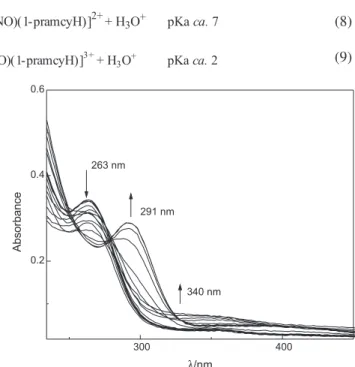
The electronic absorption spectral changes observed for trans-[Ru(NO)Cl(1-pramcyH)](PF6)3 consist of an absorbance decrease at 263 nm with a concomitant increase at 291 nm. The inal electronic absorption spectrum is
assigned to the trans-[Ru(NO)Cl(1-pramcyH)]2+ complex.
Likewise, the UV-Vis monitoring of the non-exhaustively
controlled potential electrolysis of trans-[RuCl(cyclam)
(NO)](PF6)2, carried out in the same conditions to promote
reduction of NO+ to NO, shows absorbance decrease at
254 nm with concomitant increase at 298 nm, which in acetonitrile and under a reductive potential should denote
coordinated NO0.
Photochemical studies
Irradiation of trans-[Ru(NO)Cl(1-pramcyH)](PF6)3
in a deaerated 0.1 mol L-1 HPF
6 solution with light of
λ = 334 nm results in the decrease in intensity of the ν(NO)
band at 1875 cm−1 (Figure 7). This decrease undoubtedly
suggests the photochemical labilization of NO (equation 10). Similar changes in the infrared spectrum had already been
observed with 10-2 mol L-1trans-[RuCl(NO)(cyclam)]2+ and
trans-[RuCl([15]aneN4)NO]2+ solutions at pH 7,17 and with
trans-[RuCl(NO)(cyclam)]2+ in a xerogel matrix. 16 Addition of silver nitrate solution to the photolyzed solution did not (8)
(9)
Figure 5. Infrared spectral changes during controlled potential electrolysis at −500 mV (vs. Ag/AgCl) of trans-[Ru(NO)Cl(1-pramcyH)](PF6)3 in a 2.1×10⁻² mol L-1 acetonitrile solution containing 0.1 mol L-1 tba(PF
6) at
25 °C. Time intervals between spectra: 10 min.
Figure 6. UV-Vis spectral changes during controlled potential electrolysis at –500 mV (vs. Ag/AgCl) of a 2.1×10⁻² mol L-1 acetonitrile solution of trans-[Ru(NO)Cl(1-pramcyH)](PF6)3 containing 0.1 mol L-1 tba(PF
6) at
evidence formation of AgCl, indicating that chloride is not labilized as far as this assay is considered.
The UV-Vis spectral changes during photolysis of
trans-[Ru(NO)Cl(1-pramcyH)](PF6)3 with 334 nm light at pH 1 are shown in Figure 8. There is a broad absorption increase in the 300-390 nm region, which is consistent
with the formation of the RuIII aquo complex photoproduct,
trans-[Ru(OH2)Cl(1-pramcyH)]3+ (equation 10), as
observed for trans-[RuCl(NO)(cyclam)](PF6)227 and other
ruthenium ammine nitrosyl complexes.16,17 At this pH,
trans-[Ru(OH2)Cl(1-pramcyH)]3+ has an absorption band
at λmax/nm = 356 (ε/(dm3 mol-1 cm-1) = 2900). At pH 4.75
or 4.90, the photoproduct is mainly trans
-[Ru(OH)Cl(1-pramcyH)]2+, which absorbs at λ
max = 356 (ε = 830).
At pH 7.4, trans-[RuIII(OH)Cl(1-pramcy)]+ absorbs at
λmax = 356 (ε = 2900).
The photoproducts quantum yields for the photolysis of
trans-[Ru(NO)Cl(1-pramcyH)](PF6)3are shown in Table 1.
The quantum yields pattern for the photolysis of
trans-[Ru(NO)Cl(1-pramcyH)](PF6)3 is similar to those of
other nitrosyl ruthenium(am(m)ine) complexes.14,17,18,46,67
The quantum yields decrease as pH decreases and as the irradiation wavelength increases, being noticeable only at
λirr < 370 nm. The larger quantum yields achieved at larger
pH values can be explained, as in the case of the analogous
trans-[Ru(NO)(NH3)4(py-X)]3+ complexes,46 as follows. The trans-[Ru(NO)Cl(1-pramcyH)](PF6)3 complex has 3
pKa values, and as the pH increases, in addition to other
species a larger fraction of the product is in the hydroxo form. Different species are not necessarily expected to have the same quantum yields. Also, the hydroxo complex is likely to be much less reactive toward the back reaction with NO than the corresponding aquo product, and, thus, has larger quantum yields. As a matter of fact, the increase in quantum yield with larger pH is also consistent with
the synthesis of trans-[Ru(NO)Cl(1-pramcyH)]3+ (see
Experimental). Figure 7. Infrared spectral changes during photolysis (λ = 334 nm) of
a 1×10⁻² mol L-1 solution of trans-[Ru(NO)Cl(1-pramcyH)](PF 6)3 in
0.1 mol L-1 HPF
6 at 25 °C. Total photolysis time: 3 h.
Figure 8. UV-Vis spectral changes during photolysis (λ = 334 nm) of a 2.6×10⁻² mol L-1 solution of trans-[Ru(NO)Cl(1-pramcyH)](PF
6)3 in
CF3SO3H/CF3SO3Na (µ = 0.1 mol L-1, pH 1) at 25 °C. Total photolysis
time: 3h.
Table 1. Quantum yield values for NO photoaquation from trans-[Ru(NO) Cl(1-pramcyH)](PF6)3 at different pH values and irradiation wavelengths
pH λirr/nm φNOa
1.00 313 0.009 (± 0.001)
1.00 334 0.008 (± 0.001)
1.00 370 < 0.0010
4.75 313 0.010 (± 0.002)
4.75 334 0.009 (± 0.001)
4.75 370 < 0.001
4.90 313 0.030 (± 0.002)
4.90 334 0.011 (± 0.001)
4.90 370 < 0.002
7.40 313 0.10 (± 0.002)
7.40 334 0.09 (± 0.01)
7.40 370 < 0.003
aAverage values of three determinations. pH 1 in a CF
3SO3H/CF3SO3Na
(µ = 0.1 mol L-1; pH 1); pH 4.75 and 4.90 (0.01 mol L-1 acetate buffer);
pH 7.4 in 0.1 mol L-1 phosphate buffer.
Conclusions
The procedures described here result in the successful synthesis of a ruthenium nitrosyl complex with the
substituted 1-(3-propylammonium)cyclam, trans-[Ru(NO)
Cl(1-pramcyH)](PF6)3. Unlike 1-carboxypropyl, which
results in a fac coniguration for the nitrosyl complex, the
aminopropyl results in the thermodynamically expected
trans arrangement. This amine functionalized complex can be linked to a peptide, or an antibody, for selective biological activity. It can also be bound to a support in a device, such as a stent, to form a drug eluting stent.
The behavior of trans-[Ru(NO)Cl(1-pramcyH)]3+,
which contains a substituted cyclam, parallels that of the cyclam analog, suggesting that these complexes could maintain their properties when linked to a biomolecule. Electrochemical and photochemical experiments suggest the labilization of NO. Like other ruthenium am(m)mine
nitrosyl complexes, such as trans-[Ru(NO)(NH3)4(py-X)]n+
and trans-[RuCl(NO)(cyclam)](PF6)2, trans-[Ru(NO)
Cl(1-pramcyH)](PF6)3 is attractive for potential biological
applications because it is stable, water-soluble, and can deliver NO upon activation by reduction at a biologically accessible potential and/or by irradiation with light. Current research in this lab is directed toward these goals for potential applications of the complexes as NO donors.
Supplementary Information
1H NMR, 13C NMR and electronic absorption spectra, as
well as cyclic voltammograms recorded for trans-[Ru(NO)
Cl(1-pramcyH)](PF6)3, are available free of charge at
http://jbcs.sbq.org.br, as a pdf ile.
Acknowledgments
The authors thank the Brazilian agencies FAPESP, CNPq and CAPES for inancial support.
References
1. Ignarro; L. J.; Nitric Oxide: Biology and Pathobiology, 1st ed., Academic Press: San Diego, 2000.
2. Ford, P. C.; Fernandez, B. O.; Lim, M. D.; Chem. Rev.2005,
105, 2439.
3. Paolocci, N.; Jackson, M. I.; Lopez, B. E.; Miranda, K.; Tocchetti, C. G.; Wink, D. A.; Hobbs, A. J.; Fukuto, J. M.;
Pharmacol. Ther.2007, 113, 442.
4. Rose, M. J.; Mascharak, P. K.; Coord. Chem. Rev.2008, 252, 2093.
5. Miranda, K. M.; Coord. Chem. Rev.2005, 249, 433.
6. Wink, D. A.; Grisham, M. B.; Miles, A. M.; Nims, R. W.; Krishna, M. C.; Pacelli, R.; Teague, D.; Poore, C. M. B.; Cook. J. A.; Ford, P. C.; Methods Enzymol.1996, 268, 120. 7. Eroy-Reveles, A. A.; Leung, Y. ;Mascharak, P. K.; J. Am. Chem.
Soc.2006, 128, 7166.
8. Hrabie, J. A.; Keefer, L. K.; Chem. Rev.2002, 102, 1135. 9. Hayton, T. W.; Legzdins, P.; Sharp, W. B.; Chem. Rev.2002,
102, 935.
10. Richter-Addo, G. B.; Legzdins, P.; Burstyn, J.; Chem. Rev.2002,
102, 857.
11. Ford, P. C.; Lorkovic, I. M.; Chem. Rev.2002, 102, 993. 12. Wang, P. G.; Xian, M.; Tang, X. P.; Wu, X. J.; Wen, Z.; Cai, T.
W.; Janczuk, A. J.; Chem. Rev.2002, 102, 1091.
13. Ostrowski, A. D.; Deakin, S.; J.; Azhar, B.; M.; Miller T. W.; Franco, N.; Cherney, M. M.; Lee, A. J.; Burstyn, J. N.; Fukuto, J. M.; Megson, I. L.; Ford, P. C.; J. Med. Chem.2010, 53, 715. 14. Tfouni, E.; Krieger, M.; McGarvey, B. R.; Franco, D. W.; Coord.
Chem. Rev.2003, 236, 57.
15. Zanichelli, P. G.; Estrela, H. F. G.; Spadari-Bratisch, R. C.; Grassi-Kassisse, D. M.; Franco, D. W.; Nitric Oxide-Biol. Chem. 2007, 16, 189.
16. Ferreira, K. Q.; Schneider, J. F.; Nascente, P. A. P.; Rodrigues, U. P. ; Tfouni, E.; J. Colloid Interface Sci.2006, 300, 543. 17. Oliveira, F. D.; Ferreira, K. Q.; Bonaventura, D.; Bendhack, L.
M.; Tedesco, A. C.; Machado, S. D.; Tfouni, E.; da Silva, R. S.;
J. Inorg. Biochem.2007, 101, 313.
18. Tfouni, E.; Ferreira, K. Q.; Doro, F. G.; da Silva, R. S.; da Rocha, Z. N.; Coord. Chem. Rev.2005, 249, 405.
19. Doro, F. G.; Castellano, E. E.; Moraes, L. A. B.; Eberlin, M. N.; Tfouni, E.; Inorg. Chem.2008, 47, 4118.
20. Doro, F. G.; Rodrigues, U. P.; Tfouni, E.; J. Colloid Interface Sci.2007, 307, 405.
21. da Rocha, Z. N.; Marchesi, M. S. P.; Molin, J. C.; Lunardi, C. N.; Miranda, K. M.; Bendhack, L. M.; Ford, P. C.; da Silva, R. S.; Dalton Trans.2008, 4282.
22. Ford, P. C.; Wecksler, S.; Coord. Chem. Rev.2005, 249, 1382. 23. Holanda, A. K. M.; Pontes, D. L.; Diogenes, I. C. N.; Moreira,
I. S.; Lopes, L. G. F.; Transition Met. Chem.2004, 29, 430. 24. Holanda, A. K. M.; da Silva, F. O. N.; Carvalho, I. M. M.;
Batista, A. A.; Ellena, J.; Castellano, E. E.; Moreira, I. S.; Lopes, L. G. F.; Polyhedron2007, 26, 4653.
25. Lang, D. R.; Davis, J. A.; Lopes, L. G. F.; Ferro, A. A.; Vasconcellos, L. C. G.; Franco, D. W.; Tfouni, E.; Wieraszko, A.; Clarke, M. J.; Inorg. Chem.2000, 39, 2294.
26. Lopes, L. G. F.; Sousa, E. H. S.; Miranda, J. C. V.; Oliveira, C. P.; Carvalho, I. M. M.; Batista, A. A.; Ellena, J.; Castellano, E. E.; Nascimento, O. R.; Moreira, I. S.; J. Chem. Soc., Dalton Trans.2002, 1903.
27. Lopes, L. M. F.; Garcia, A. R.; Fidalgo, A.; Ilharco, L. M.;
28. Silva, F. O. N.; Araujo, S. X. B.; Holanda, A. K. M.; Meyer, E.; Sales, F. A. M.; Diogenes, H. C. N.; Carvalho, I. M. M.; Moreira, I. S.; Lopes, L. G. F.; Eur. J. Inorg. Chem.2006, 2020. 29. Butler, A. R.; Megson, I. L.; Chem. Rev.2002, 102, 1155. 30. Gomes, A. J.; Barbougli, P. A.; Espreaico, E. M.; Tfouni, E.;
J. Inorg. Biochem.2008, 102, 757.
31. Cicillini, S. A.; Prazias, A. C.; Tedesco, A. C.; Serra, O. A.; da Silva, R. S.; Nitric Oxide-Biol. Chem.2008, 19, S67. 32. Madhani, M.; Patra, A. K.; Miller, T. W.; Eroy-Reveles, A. A.;
Hobbs, A. J.; Fukuto, J. M.; Mascharak, P. K.; J. Med. Chem. 2006, 49, 7325.
33. de Barros, B. F.; Toledo, J. C.; Franco, D. W.; Tfouni, E.; Krieger, M. H.; Nitric Oxide-Biol. Chem.2002, 7, 50. 34. Marcondes, F. G.; Ferro, A. A.; Souza-Torsoni, A.; Sumitani,
M.; Clarke, M. J.; Franco, D. W.; Tfouni, E.; Krieger, M. H.;
Life Sci.2002, 70, 2735.
35. Silva, J. J. J.; Osakabe, A. L.; Pavanelli, W. R.; Silva, J. S.; Franco, D. W.; Br. J. Pharmacol. 2007, 152, 112.
36. Silva, J. J. N.; Pavanelli, W. R.; Gutierrez, F. R. S.; Lima, F. C. A.; da Silva, A. B. F.; Silva, J. S.; Franco, D. W.; J. Med. Chem. 2008, 51, 4104.
37. Pestana, C. R.; Phelippin, D. P. S.; Polizello, A. C. M.; Dorta, D. J.; Uyemura, S. A.; Santos, A. C.; Doro, F. G.; Rodrigues, F. P.; Tfouni, E.; Curti, C.; Nitric Oxide-Biol. Chem.2009, 20, 24.
38. Bonaventura, D.; Lunardi, C. N.; Rodrigues, G. J.; Neto, M. A.; de Lima, R. G.; da Silva, R. S.; Bendhack, L. M.; Basic Clin. Pharmacol. Toxicol.2008, 102, 38.
39. Keefer, L. K.; Nat. Mater.2003, 2, 357.
40. Bordini, J.; Novaes, D. O.; Borissevitch, I. E.; Owens, B. T.; Ford, P. C.; Tfouni, E.; Inorg. Chim. Acta2008, 361, 2252. 41. Tfouni, E.; Doro, F. G.; Gomes, A. J.; Silva, R. S.; Metzker, G.;
Benini, P. G. Z.; Franco D. W.; Coord. Chem. Rev.2010, 254, 355.
42. Bezerra, C. W. B.; da Silva, S. C.; Gambardella, M. T. P.; Santos, R. H. A.; Plicas, L. M. A.; Tfouni, E.; Franco, D. W.; Inorg. Chem.1999, 38, 5660.
43. Gomes, M. G.; Davanzo, C. U.; Silva, S. C.; Lopes, L. G. F.; Santos, P. S.; Franco, D. W.; J. Chem. Soc., Dalton Trans.1998, 601.
44. Bordini, J.; Ford, P. C.; Tfouni, E.; Chem. Commun.2005, 4169. 45. Calandreli, I.; Oliveira, F. D.; Liang, G. G.; da Rocha, Z. N.;
Tfouni, E.; Inorg. Chem. Commun.2009, 591.
46. Carlos, R. M.; Ferro, A. A.; Silva, H. A. S.; Gomes, M. G.; Borges, S. S. S.; Ford, P. C.; Tfouni, E.; Franco, D. W.; Inorg. Chim. Acta2004, 357, 1381.
47. Ferreira, K. Q.; Santos, F. G.; da Rocha, Z. N.; Guaratini, T.; da Silva, R. S.; Tfouni, E.; Inorg. Chem. Commun.2004, 7, 204. 48. Ferreira, K. Q.; Doro, F. G.; Tfouni, E.; Inorg. Chim. Acta2003,
355, 205.
49. Sauaia, M. G.; Oliveira, F. D. S.; de Lima, R. G.; Cacciari, A. D. L.; Tfouni, E.; da Silva, R. S.; Inorg. Chem. Commun.2005,
8, 347.
50. De Candia, A. G.; Marcolongo, J. P.; Slep, L. D., Polyhedron 2007, 26, 4719.
51. Che, C. M.; Tang, W. T.; Mak, T. C. W.; J. Chem. Soc., Dalton Trans.1988, 2879.
52. Vogel, A. I. Química Orgânica Qualitativa, 5a. ed., Ao Livro Técnico: Rio de Janeiro, Brasil, 1980.
53. Calvert, J. G.; Pitts, J. N.; Photochemistry, 1st ed., Willey: New York, 1966.
54. da Rocha, Z. N.; Ferreira, K. Q.; Silva, M.; de Oliveira, E. C.; Chiericato, G.; Tfouni, E.; Inorg. Chem.2001, 40, 5385. 55. Schiegg, A.; Kaden, T. A.; Helv. Chim. Acta.1990, 73, 716. 56. Pallavicini, P. S.; Perotti, A.; Poggi, A.; Seghi, B.; Fabbrizzi,
L.; J. Am. Chem. Soc.1987, 109, 5139.
57. Richter-Addo, G. B.; Legzdins, P.; Metal Nitrosyls, 1st ed., Oxford University Press: New York, 1992.
58. Enemark, J. H.; Feltham, R. D.; Coord. Chem. Rev.1974, 13, 339.
59. da Silva, R. S.; Gambardella, M. T. P.; Santos, R. H. A.; Mann, B. E.; Tfouni, E.; Inorg. Chim. Acta1996, 245, 215.
60. McGarvey, B. R.; Batista, N. C.; Bezerra, C. W. B.; Schultz, M. S.; Franco, D. W.; Inorg. Chem.1998, 37, 2865.
61. Walker, D. D.; Taube, H.; Inorg. Chem.1981, 20, 2828. 62. Sauaia, M. G.; da Silva, R. S.; Trans. Met. Chem.2003, 28, 254. 63. Thompson, M. S.; Meyer, T. J.; J. Am. Chem. Soc.1981, 103,
5577.
64. Murphy, W. R.; Takeuchi, K.; Barley, M. H.; Meyer, T. J.; Inorg. Chem.1986, 25, 1041.
65. Baumann, F.; Kaim, W.; Baraldo, L. M.; Slep, L. D.; Olabe, J. A.; Fiedler, J.; Inorg. Chim. Acta1999, 285, 129.
66. Kurtikyan, T.S.; Hovhannysian, A.A..; Hakobyan, M.E.; Patterson, J.C.; Irtskii, A.; Ford, P.C.; J. Am. Chem. Soc. 2007,
129, 3576.
67. Tfouni, E.; Coord. Chem. Rev.2000, 196, 281.
Received: October 27, 2009 Web Release Date: April 29, 2010
Supplementary Information
0103 - 5053 $6.00+0.00*e-mail: [email protected]
Chemical and Photochemical Properties of a Ruthenium Nitrosyl Complex
with the N-Monosubstituted Cyclam
1-(3-Propylammonium)-1,4,8,11-tetraazacyclotetradecane
Kleber Q. Ferreiraa,b and Elia Tfouni*,a
aDepartamento de Química, Faculdade de Filosoia, Ciências e Letras de Ribeirão Preto,
Universidade de São Paulo - USP, Av. Bandeirantes, 3900, 14040-901 Ribeirão Preto-SP, Brazil
bDepartamento de Química Geral e Inorgânica, Instituto de Química, Universidade Federal da
Bahia, Rua Barão de Jeremoabo, s/n, Campus Universitário de Ondina, 40170-115 Salvador-BA, Brazil
Figure S1.1H NMR spectrum (400.13 MHz) of trans-[Ru(NO)Cl(1-pramcyH)](PF
Figure S3. Electronic absorption spectrum of a 3.0 × 10⁻⁴ mol L-1 aqueous solution (pH 1) of trans-[Ru(NO)Cl(1-pramcyH)]3+.
Figure S2. 13C{1H} NMR spectrum (100.61 MHz) of trans-[Ru(NO)Cl(1-pramcyH)](PF
6)3 in acetonitrile-d3.
Figure S5. Cyclic voltammogram of a 7×10⁻³ mol L-1 solution of trans -[Ru(NO)Cl(1-pramcyH)](PF6)3 in acetonitrile [25 ºC; 100 mV s-1;
µ = 0.1 mol L-1 tba(PF
6)], at 100 mV s
-1, with glassy carbon, Ag/AgCl and platinum wire as working, reference and auxiliary electrodes, respectively. T = 25 ºC.
 3 in nujol mull.](https://thumb-eu.123doks.com/thumbv2/123dok_br/18994314.461711/4.892.455.794.555.806/figure-infrared-spectrum-trans-ru-pramcyh-nujol-mull.webp)
 3 .](https://thumb-eu.123doks.com/thumbv2/123dok_br/18994314.461711/5.892.94.438.109.403/figure-infrared-spectrum-mol-acetonitrile-solution-trans-pramcyh.webp)
 3](https://thumb-eu.123doks.com/thumbv2/123dok_br/18994314.461711/6.892.446.802.131.493/figure-cyclic-voltammogram-mol-solution-trans-trans-pramcyh.webp)
 3 in 0.1 mol L -1 HPF 6 at 25 °C](https://thumb-eu.123doks.com/thumbv2/123dok_br/18994314.461711/8.892.66.415.104.381/figure-infrared-spectral-changes-photolysis-solution-trans-pramcyh.webp)
 3 in acetonitrile-d 3 .](https://thumb-eu.123doks.com/thumbv2/123dok_br/18994314.461711/11.892.101.821.413.1038/figure-nmr-spectrum-mhz-trans-ru-pramcyh-acetonitrile.webp)
![Figure S4. Electronic absorption spectrum of a 1.8×10 -3 mol L -1 aqueous solution (pH 1) of trans-[Ru(NO)Cl(1-pramcyH)] 3+ .](https://thumb-eu.123doks.com/thumbv2/123dok_br/18994314.461711/12.892.68.412.787.1054/figure-electronic-absorption-spectrum-aqueous-solution-trans-pramcyh.webp)
 3 in 0.2 mol L -1 LiCl (pH 6) at 100 mV s -1 , with glassy carbon, Ag/AgCl and platinum wire as working, reference and auxiliary electrodes, re](https://thumb-eu.123doks.com/thumbv2/123dok_br/18994314.461711/13.892.94.438.109.371/figure-cyclic-voltammogram-solution-platinum-reference-auxiliary-electrodes.webp)
