A
rt
ic
le
0103 - 5053 $6.00+0.00
*e-mail: [email protected]
Organotin(IV) Esters of 4-Maleimido-benzoic Acid:
Synthesis, Characterization and
in vitro
Anti-leishmanial Effects
M. I. Khan,*,a Musa Kaleem Baloch,b Muhammad Ashfaqc and Saima Gula
aDepartment of Chemistry, Kohat University of Science & Technology, Kohat-26000 (N-W.F.P.), Pakistan
bDepartment of Chemistry, Gomal University, Dera Ismail Khan, Pakistan
cDepartment of Chemistry, Islamia University, Bahawalpur, Pakistan
Seis novos ésteres diorganoestanho(IV) com composição geral R2SnL2 (onde R: Me(1), Et(2), Pr(3), Bu(4), Ph(5), Bz(6) e L(7): ácido p-N-maleimidobenzóico) foram sintetizados neste trabalho. Espectros de absorção no infravermelho e de Mössbauer de 119mSn no estado sólido revelaram o comportamento bidentado de L em relação ao centro diorganoestanho(IV) nos complexos octaédricos distorcidos. Espectros de RMN de 1H, 13C e 119Sn, em CDCl
3, indicaram hexacoordenação em 1-4, pentacoordenação de 5 em geometria trapezoidal distorcida, e ausência de hipercoordenação no arranjo tetraédrico em 6. Dados de análise elementar comprovaram a estequiometria dos compostos organoestanho(IV). Foram realizados testes in vitro contra cinco espécies de Leishmania: L. major, L. tropica, L. infantum, L. mex. mex. e L. donovani. Resultados promissores foram observados e, com base nos dados obtidos nesses ensaios, tentou-se estabelecer relações estrutura-atividade. O aumento no tamanho dos grupos R em {R2Sn
IV}2+ aumentou a lipofilicidade dos complexos organoestanho(IV), acentuando assim a atividade antileishmania.
Six new diorganotin(IV) esters with the general composition R2SnL2 (where R: Me(1), Et(2), Pr(3), Bu(4), Ph(5), Bz(6) and L(7): p-N-maleimido-benzoic acid) have been synthesized. Solid state FTIR and 119mSn Mössbauer spectra revealed bidentate behavior of L towards the diorganotin(IV) centre in the distorted octahedral products. 1H, 13C and 119Sn NMR spectra in CDCl
3 indicated hexacoordination in 1-4, penta-coordination of 5 in skew-trapezoidal geometry, and absence of hypercoordination in tetrahedral 6. Elemental analyses data have been found to corroborate the stoichiometry of the title organotin(IV) compounds. In vitro anti-leishmanial screenings have been conducted on five leishmanial strains of L. major, L. tropica, L. infantum, L. mex. mex. and
L. donovani. Promising results have been observed and, on the basis of the data obtained during these assays, a structure-activity relationship has been suggested. The increasing size of the R groups in the {R2SnIV}2+ moieties increased the lipophilicity of organotin(IV) complexes, which thereby enhanced the anti-leishmanial activity.
Keywords: organotin(IV), anti-leishmanial, SAR
Abbreviations
Me(methyl), Et(ethyl), Pr(n-propyl), Bu(n-butyl), Ph(phenyl), Bz(benzyl).
Introduction
Amino acids and their organic as well as organometallic derivatives present a wide range of noteworthy pharmacological applications.1 Transition metal complexes
of N-protected amino acids are active against different types of microbes, but literature reveals that the coordinating ability of N-protected amino acids as ligands decrease the biological activity of their transition metal complexes up to a certain extent.2 Organotin(IV) compounds are
well-known for their manifold implications, such as tumouricidal, bactericidal and fungicidal activities, and for their interesting structural features.3 Leishmaniasis is
been screened in vitro for anti-leishmanial activity on five different leishmanial strains.
Experimental
General
Analytical Reagent (AR) grade chemicals used during this work were procured from Sigma or Fluka and used without purification. Dibenzyltin(IV)dichloride was prepared according to a reported procedure, and solvents were dried as reported.5
Instrumentation
Elemental analyses (C, H, N) were performed on a Yanaco high-speed CHN analyzer with antipyrene as a reference, while tin content was estimated according to a reported procedure.5 Uncorrected melting points were
taken on a Reichert Thermovar of F. G. Bode Co., Austria. The FTIR spectra of the p-N-maleimido-benzoic acid (L) and the complexes were measured on a Brüker FTIR TENSOR27spectrophotometer using OPUS software in the range of 5000-500 cm-1 (ZnSe). For Mössbauer
measurements, the solid samples were maintained at liquid nitrogen temperature (77.3 K), and the equipment employed was a V.G. Micromass 7070 F Cryolid liquid nitrogen cryostat. The multichannel calibration was performed with an enriched iron foil using a 57Co-Pd source, while the zero
point of the Doppler velocity scale was determined through the absorption spectra of CaSnO3 (119Sn = 0.5 mg cm-2).
The resulting 5 × 10⁵-count spectra were refined to obtain
the isomer shift (IS), the nuclear quadrupole splitting (QS),
ρ (QS/IS) and the width at half-height of the resonant peaks, G (mm s-1). 1H and 13C NMR spectra in deuterated
chloroform (CDCl3) were recorded on a multinuclear Brüker BiospinAMX 300 MHz FT NMR spectrometer operating at room temperature (300 MHz for 1H and
75 MHz for 13C); the hydrogen and carbon chemical shifts
were measured with respect to SiMe4. 119Sn NMR spectra
in CDCl3 were recorded at 186.5 MHz on a Brüker AMX 500 spectrophotometer using 5 mm o.d. tubes and are reported relative to external neat SnMe4 (d119Sn = 0 ppm).
acid (9.1 g, 0.1 mol L-1) in acetic acid (150 mL) was added
to it. This mixture was stirred at room temperature for 3 h resulting in a white precipitate, which was washed several times with cold water and recrystallized from water to give maleamic acid of analytical purity. Maleamic acid (5 g, 0.02 mol L-1) was then suspended in dry toluene (350 mL),
and triethylamine (7.5 mL, 0.05 mol L-1) was added to
this suspension. The mixture was refluxed with vigorous stirring for 1.5 h with the concomitant removal of water using a Dean-Stark separator. The solvent was removed on a rotary evaporator (Büchi) leaving a hygroscopic solid; HCl was added up to pH 2 and the mixture was extracted with ethyl acetate and dried over anhydrous MgSO4. The ethyl acetate fraction was vacuum dried; the solid mass left was recrystallized from hexane. Figure 1 depicts a general chemical reaction scheme.
Synthesis of organotin(IV) complexes
A solution of the triethylammonium salt of 4-maleimido-benzoic acid (0.5 g, 0.0015 mol L-1) in dry toluene (100 mL)
was prepared and an appropriate amount of diorganotin(IV) dichloride (0.0008 mol L-1) was added. This mixture was
heated to reflux for 3 hours, resulting in the formation of triethylammonium hydrochloride, which was filtered off. The filtrate was evaporated on a rotary evaporator and the solid mass was triturated in n-hexane, dissolved in C6H6 and finally recrystallized from CH2Cl2.
Spectral data for compounds (1-7)
Bis(4-maleimido-benzoato)dimethyltin(IV)(1)
White solid, mp 158 °C. Yield: 81%. IR νmax/cm-1:
1631 ν(COO)a, 1447 ν(COO)s, ∆ν: 184, 411 ν(Sn–O), 522 ν(Sn–C)a, 517 ν(Sn–C)s. 119mSn Mössbauer (mm s-1):
QS: 3.31, IS: 1.32, G1: 0.98,G2: 0.87, ρ: 2.50. 1H NMR
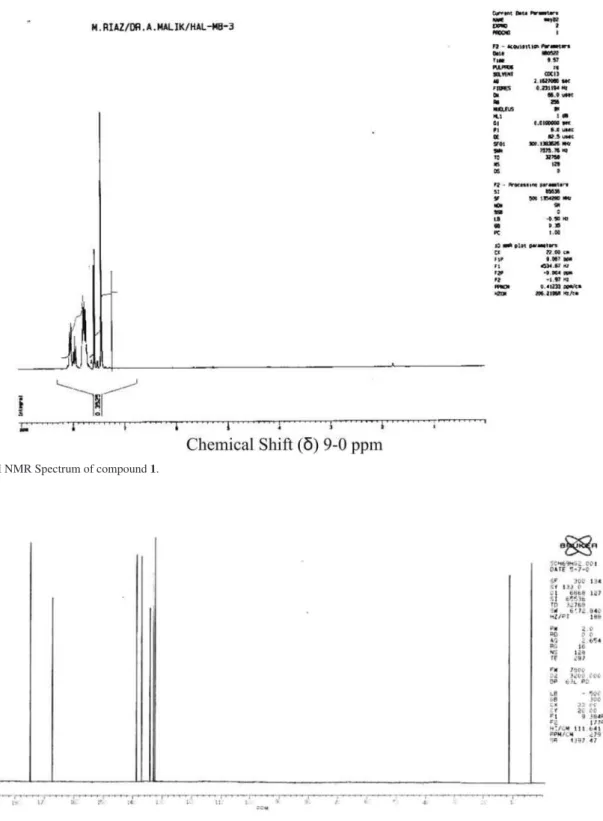
(CDCl3) d 7.8 (d, J 2.0 Hz, 1H, CH), 7.7 (d, J 7.1 Hz, 1H, CH), 7.1 (d, J 7.3 Hz, 1H, CH), 0.6 (s, 3H, CH3); 13C NMR
(75 MHz, CDCl3) d: 175.4(1C), 133.6(2C), 136.8(3C); 129.0(4C), 136.4(5C), 170.0(6C), 135.4(7C), –0.7 (8C,
1J(119Sn–13C)903 Hz). Anal. Calc. for C
24H18N2O8Sn: C,
Bis(4-maleimido-benzoato)diethyltin(IV)(2)
White solid, mp 74 °C. Yield: 83%. IR νmax/cm-1: 1655
ν(COO)a, 1474 ν(COO)s, ∆ν: 181, 409 ν(Sn–O), 537
ν(Sn–C)a, 523 ν(Sn–C)s. 119mSn Mössbauer (mm s-1): QS:
3.44, IS: 1.41, G1: 0.96, G2: 0.84, ρ: 2.43. 1H NMR (CDCl 3)
d 7.8 (d, J 2.0 Hz, 1H, CH), 7.8 (d, J 7.1 Hz, 1H, CH), 7.1 (d, J 7.3 Hz, 1H, CH), 0.9 (q, 2J (119Sn-1H) 100 Hz,
2H, CH2), 0.8 (t, J 4.2 Hz, 3H, CH3); 13C NMR (75 MHz,
CDCl3) d: 168.5(1C), 130.1(2C), 137.0(3C); 131.3(4C), 138.2(5C), 172.3(6C), 139.2(7C), 10.7(8C, 1J(119Sn–13C)
918 Hz), 6.1(9C, 2J(119Sn–13C) 187 Hz). Anal. Calc. for
C26H22N2O8Sn: C, 51.46; H, 3.64; N, 4.60; Sn, 19.19. Found: C, 51.12; H, 4.37; N, 4.51; Sn, 19.03.
Bis(4-maleimido-benzoato)dipropyltin(IV)(3)
White solid, mp 94 °C. Yield: 87%. IR νmax/cm-1: 1651
ν(COO)a, 1483 ν(COO)s, ∆ν: 168, 468 ν(Sn–O), 529
ν(Sn–C)a, 517 ν(Sn–C)s. 119mSn Mössbauer (mm s-1): QS:
3.42, IS: 1.28, G1: 1.00, G2: 0.88, ρ: 2.67. 1H NMR (CDCl 3)
d7.8 (d, J 2.0 Hz, 1H, CH), 7.9 (d, J 7.1 Hz, 1H, CH), 7.0 (d, J 7.3 Hz, 1H, CH), 1.1 (t, 2J (119Sn-1H) 102 Hz, 2H,
CH2), 1.6 (m, 2H, CH2) 0.8 (t, J 4.2 Hz, 3H, CH3); 13C NMR
(75 MHz, CDCl3) d: 169.6(1C), 132.2(2C), 138.0(3C); 131.0(4C), 136.9(5C), 171.1(6C), 135.1(7C), 34.2 (8C,
1J(119Sn–13C)893 Hz), 20.3(9C, 2J(119Sn–13C) 196 Hz). Anal.
Calc. for C28H26N2O8Sn: C, 52.78; H, 4.11; N, 4.40; Sn, 18.63. Found: C, 52.70; H, 4.02; N, 4.01; Sn, 18.45.
Bis(4-maleimido-benzoato)dibutyltin(IV)(4)
White solid, mp 138 °C. Yield: 86%. IR νmax/cm-1: 1596
ν(COO)a, 1431 ν(COO)s, ∆ν: 165, 415 ν(Sn–O), 547 ν(Sn–C)a, 531 ν(Sn–C)s. 119mSn Mössbauer (mm s-1): QS: 3.16, IS: 1.33,
G1: 1.01, G2: 0.94, ρ: 2.37.
1H NMR (CDCl
3) d7.8 (d, J 2.0
Hz, 1H, CH), 7.7 (d, J 7.1 Hz, 1H, CH), 7.0 (d, J 7.3 Hz, 1H, CH), 1.4 (t, 2J (119Sn-1H) 99 Hz, 2H, CH
2), 1.8 (m, 2H, CH2),
1.3 (m, 11H, CH2), 0.9 (t, J 4.2 Hz, 3H, CH3); 13C NMR (75
MHz, CDCl3) d: 169.6(1C), 132.2(2C), 138.0(3C); 131.0(4C), 136.9(5C), 171.9(6C), 134.1(7C), 27.1(14C, 1J(119Sn–13C)
911 Hz), 27.3(15C, 2J(119Sn–13C) 235 Hz). Anal. Calc. for
C30H30N2O8Sn: C, 54.16; H, 4.55; N, 4.21; Sn, 17.84. Found: C, 54.01; H, 4.45; N, 4.13; Sn, 17.62.
Bis(4-maleimido-benzoato)diphenyltin(IV)(5)
White solid, mp 83 °C. Yield: 71%. IR νmax/cm-1: 1577
ν(COO)a, 1425 ν(COO)s, ∆ν: 152, 400 ν(Sn–O), 530
ν(Sn–C)a, 511 ν(Sn–C)s. 119mSn Mössbauer (mm s-1): QS:
3.38, IS: 1.04, G1: 0.97, G2: 0.96,ρ: 3.25. 1H NMR (CDCl 3)
d7.8 (d, J 2.0 Hz, 1H, CH), 7.6 (d, J 7.1 Hz, 1H, CH), 7.1 (d, J 7.3 Hz, 1H, CH), 7.8 (d, J 7.7 Hz, 1H, CH), 7.6 (t, J 7.7 Hz, 1H, CH), 1.3 (t, J 7.7 Hz, 1H, CH); 13C NMR (75 MHz,
CDCl3) d: 170.0(1C), 129.9(2C), 136.8(3C); 132.3(4C), 138.7(5C), 170.0(6C), 139.0(7C), 129.1(8C, 1J(119Sn–13C)
326 Hz), 122.1(9C, 2J(119Sn–13C) 154 Hz), 135.4(10C, 3J(119Sn–13C) 198 Hz), 130.1(11C, 4J(119Sn–13C) 123 Hz).
Anal. Calc. for C34H22N2O8Sn: C, 57.90; H, 3.14; N, 3.97; Sn, 16.83. Found: C, 57.79; H, 3.09; N, 3.74; Sn, 16.59.
Bis(4-maleimido-benzoato)dibenzyltin(IV)(6)
White solid, mp 142 °C. Yield: 89%. IR νmax/cm-1:
1593 ν(COO)a, 1424 ν(COO)s, ∆ν: 169, 416 ν(Sn–O), 564
ν(Sn–C)a, 534 ν(Sn–C)s. 119mSn Mössbauer (mm s-1): QS:
3.29, IS: 1.54, G1: 0.98, G2: 0.92,ρ: 2.13. 1H NMR (CDCl 3)
d 7.7 (d, J 2.0 Hz, 1H, CH), 7.7 (d, J 7.1 Hz, 1H, CH), 7.1 (d, J 7.3 Hz, 1H, CH), 3.0 (s, 2H, CH2), 7.7 (m, 1H, CH), 7.3 (d, J 5.2 Hz, 1H, CH), 7.4 (m, 1H, CH); 13C NMR
(75 MHz, CDCl3) d: 168.3(1C), 130.5(2C), 137.4(3C); 134.3(4C), 137.2(5C), 169.8(6C), 136.7(7C), 20.6(8C,
1J(119Sn–13C) 401 Hz), 142.1(9C, 2J(119Sn–13C) 174 Hz),
127.5(10C, 3J(119Sn–13C) 223 Hz), 129.4(11C), 125.3(12C, 4J(119Sn–13C) 231 Hz). Anal. Calc. for C
36H26N2O8Sn: C,
58.96; H, 3.57; N, 3.82; Sn, 16.19. Found: C, 58.74; H, 3.57; N, 3.76; Sn, 15.97.
H, 3.15; N, 6.26.
In vitro anti-leishmanial activity
All promastigote cultures of both the reference and local Pakistani leishmanial strains were maintained in blood agar based bi-phasic Evans modified Tobies medium supplemented with RPMI-1640 with 25 mmol L-1 TES at
25 °C. Leishmanialstrains in promastigote stage that were used include L. major (JISH118), L. major (MHOM/PK/88/ DESTO), L. tropica (K27), L. infantum (LEM3437), L. mex. mex. (LV4) and L. donovani (H43).
Viability test
Parasites in the promastigote stage were transferred from Evans modified to RPMI-1640 supplemented with 5% fetal bovine serum (FBS) and 1% sterile human urine, buffered with 25 mmol L-1 TES, pH 7.2 (complete medium). They were
grown in bulk at 25 °C and then centrifuged at 2500 rev. per
min for 10 min; early log phase promastigotes were collected. The parasites were washed twice with RPMI (without FBS or urine) and resuspended in the complete medium to achieve a final concentration of 106 parasites per mL. In order to get
the 50% mortality concentration (IC50), serial dilutions of the test compounds were performed in 96-well microtiter plate. Subsequently, 105 promastigotes in 100 µL of culture medium
were added to each well and the plate was incubated at 25 ºC for 72 h. Negative controls (culture without test compounds) were on the same plate. At the end of the incubation time, the plate was shaken mechanically over a plane shaker and parasites were counted with the help of a hemocytometer. Dose-dependent viability curves were obtained.
Results and Discussion
The ligand 4-maleimido-benzoic acid and its diorganotin(IV) complexes were synthesized by a general procedure as shown in Figure 1. Analytical data for the complexes confirmed the 1:2 metal-ligand stoichiometry. All compounds were quite stable with good yield (70-92%) and were soluble in organic solvents. Elemental analysis data were found to be in good agreement with calculated contents.
COOH group (7) in the spectral range of 3000-2600 cm-1.6
The imide ν(N–C=O) band in the range of 1700-1710 cm-1
remained unchanged, which ruled out the interaction of SnIV with imide CO.6
It is reported in the literature that the difference (∆ν) between νa(COO) and νs(COO) is important in predicting the coordinating ability of the ligand; in complexes 1-5, ∆ν was less than 200 cm-1, which indicated the bidentate nature
of 4-maleimido-benzoic acid (Figure 2a).7 In the spectrum
of 5, a characteristic sharp peak at 450 cm-1 confirmed
the Sn–Ph bond.7 In addition, bands of medium intensity
observed in the spectral ranges of 570-545 cm-1 and
490-430 cm-1 confirmed the presence of Sn–C {ν
a(Sn–C),
νs(Sn–C)} and Sn–O bonds respectively.
4
119mSn Mössbauer spectroscopy provides useful information
on the geometry around the tin atom in the solid state.8 In
particular, quadropole splitting (QS) values often allow the discrimination between tetra- and hypercoordination of SnIV
centres; each of these being identified by characteristic value ranges (tetrahedral: 2.01-2.5 mm s-1, trigonalbipyramidal:
3.0-4.0 mm s-1, cis-octahedral: 1.7-2.2 mm s-1, trans-octahedral:
3.0-4.5 mm s-1).7 For diorganotin(IV) dicarboxylates, the ρ
values (QS/IS) play an important role in the prediction of the geometry around the tin centre; it is reported in the literature that if the ρ value is greater than 2.1, the dirganotin(IV) dicarboxylates possess a trans-octahedral geometry around the tin atom. Hence, in this work, ρvalues strongly suggest a
trans-octahedral geometry for 1-4 (Figure 2a).9
The CDCl3 NMR spectra of 1-6 exhibited the expected resonances arising from the organotin(IV)moieties and hydrogens of 4-maleimido-benzoic acid.10 The coupling
constants 1J[119Sn–13C] and 2J[119Sn–1H] yield important
structural information; the magnitude of these coupling constants was consistent with a six-coordinate tin centre in an octahedral arrangement, indicating a 1:2 metal-to-ligand stoichiometry.11 Howard’s equations (1 and 2)
were successfully applied for the estimation of C–Sn–C angle; equation (1) yielded 182º, 186º and 175º, indicating octahedron for compounds 2-4.12
θ(C–Sn–C) = 2.28 2J[119Sn–1H] – 46.4 (1)
Equation (2), in its turn, employing 1J[119Sn–13C]
values, provided C–Sn–C angles of 176º, 179º, 174º and 177º respectively for 1-4,confirming the trans-octahedral arrangement.
119Sn NMR spectroscopy plays a significant role in the
determination of geometry around tin atoms.13119Sn NMR
chemical shifts of 1-4 (-220.3, -208.5, -213.6 and -221.8 ppm) were comparable with earlier reports describing octahedral geometry.14 On the other hand, 5 showed a broad singlet at
−114.3 ppm, indicating the existence of an equilibrium between penta and hexa-coordination states describing a skew trapezoidal geometry (Figure 2b), while 6 displayed a resonance peak at
−44.6 ppm characteristic of a tetrahedral SnIV centre; in this case,
coordination may be lost due to the size of the benzyl group.15
The coupling constant [1J(119Sn–13C)] furnished a typical trend, i.e., 1J >> 2J < 3J, which confirmed the tetrahedral geometry
of 6 (Figure 2c).15 These results were comparable to the solid
state geometrical behavior of the complexes, confirming the 1:2 metal-to-ligand stoichiometry in the solid as well as in CDCl3 for all complexes.
Bioactivity
Table 1 contains the in vitro anti-leishmanial activity data of 1-7 and two reference drugs used clinically (Amphotericin B and Pentamidine). These displayed an anti-leishmanial activity trend as 7 < 1 < 2 < 3 < 4 < 5 <
6 > >> A and B (A: Amphotericin B, B: Pentamidine). The results obtained have been depicted in Figure 3, which
suggests that the nature and size of the R group attached to SnIV affect the in vitro anti-leishmnial activity. For
highlighting this statement, the mean values of the average IC50 for compounds 1-7 against each leishmanial strain have been plotted versus the percent CH of R groups attached to SnIV in Figure 4. The percent CH for compounds 1-7
were calculated as:
[Cn×(12.011)+Hn×(1.0079)]
Percent CH(R)= ––––––––––––––––––––––––––––×100 Molecular Mass of the Complex
where n is the number of carbon or hydrogen atoms in R groups.
Figure 4 shows that the lethality increases almost linearly (and therefore IC50 decreases) with the increase in percent CH of the R groups. Some deviations in the case of smaller alkyl groups have been observed, which may be attributed to variation in the conformational behavior and distribution of complexes between phases. Literature reveals that organotin(IV) compounds formed with ligands containing carboxylic groups (–COO–Sn bonds) have proved to be more biologically active; the use of 4-maleimido-benzoic acid as ligand increases the hydrolysability of the organotin(IV) precursors due to formation of the Sn–O bonds.16 This
property of the ligand permits attack of the hydrolysed {R2SnIV}2+ moieties on the target cells, thereby enhancing
the anti-leishmanial activity.16
On the other hand, the function of the R group is to determine the extent of activity; in this work, the trend was observed that the increase in the size of R groups made
Figure 2. Geometrical trends in compounds 1-6 (a) trans-octahedral; (b) skew-trapezoidal; (c) tetrahedral; and numbering scheme for 1H and 13C NMR.
Table 1.In vitro anti-leishmanial effect of 1-7 and standard drugs (A: Amphotericin B and B: Pentamidine, IC50 in µg mL-1)
Leishm. strain Compound A B
(1) (2) (3) (4) (5) (6) (7)
L. major 144 151 127 101 89 66 202 128 203
L major (Pak.) 225 177 142 123 100 95 184 101 147
L. tropica 88 76 44 23 11 03 107 175 203
L. mex. mex. 112 110 87 69 65 49 142 126 167
Figure 3. Effect of R groups on anti-leishmanial activity (IC50) of 1-6.
Figure 4. Effect of bulkier R groups (percent CH) on anti-leishmanial activity (IC50).
the {R2SnIV}2+ moieties more lipophilic, resulting in the
decrease of IC50 when compared with reference drugs (A
and B) and starting organotin(IV) reagents. Conclusively, we can say that the bulkiness of the attached R group/ percent CH values and polar character of carboxylic group of 4-maleimido-benzoic acid are interlinked with each other, and enhances the polarity C–Sn and O–Sn bonds in
1-6. A study is being carried out for the in vivo interactions/ mechanism of action of these complexes.
Acknowledgment
This work was carried out with the financial support of Gomal University, D. I. Khan, Pakistan, (Research Project No. 717-29/DF/GU).
Supplementary Information
Supplementary data are available free of charge at http:// jbcs.sbq.org.br, as PDF file.
Nath, M.; Pokharia, S.; Yadav, R.; Coord. Chem. Rev. 2001,
215, 99; Gielen, M.; Appl. Organomet. Chem. 2002, 16, 481; Chandrasekhar, V.; Najendran, S.; Baskar, V.; Coord. Chem.
Rev. 2002, 235, 1.
2. West, D. X.; Billeh, I. S.; Jasinski, J. P.; Butcher, R. J.; Transition
Met. Chem. 1998, 23, 209; Costa, R. E. F.; Perez-Rebolledo,
A.; Matensio, T.; Calado, H. D. R.; Adisson, J. D.; Cortés, M.
E.; J. Coord. Chem. 2005, 1307, 58, 1307.
3. Gielen, M.; J. Braz. Chem. Soc. 2003, 14, 870.
4. Raychaudhury, B.; Banerjee, S.; Gupta, S.; Singh R. V.; Datta, S. C.; Acta Trop. 2005, 95, 1; Khan, M. I.; Baloch, M. K.; Ashfaq, M.; J. Enz. Inhib. Med. Chem. 2007, 22, 343; Khan, M. I.; Baloch, M. K.; Ashfaq, M.; Rehmat M.; Main Group Met.
Chem. 2006, 29, 201; Khan, M. I.; Baloch, M. K.; Ashfaq, M.;
Malik, A.; Mehsud Saifullah; Main Group Met. Chem. 2006,
29, 343; Ashfaq, M.; Khan, M. I.; Baloch, M. K.; Malik, A.; J.
Organomet. Chem. 2004, 689, 238.
5. Sisido, K.; Takeda, Y.; Kinugawa, Z.; J. Am. Chem. Soc. 1961,
83, 538; Perrin, D. D.; Armarego, W. L. F.; Purification of
Laboratory Chemicals, Butterworth Heinemann: Oxford, 1988;
Mendham, J.; Denney, R. C.; Barnes, J. D.; Thomas, M.; Vogel’s
Text Book of Quantitative Chemical Analysis, 6th ed., Pearson
Education Pte. Ltd, Singapore, 2003.
6. Rehman, W.; Baloch, M. K.; Badshah, A.; J. Braz. Chem. Soc.
2005, 16, 827; Ewing, G. W.; Instrumental Methods of Chemical
Analysis, McGraw-Hill: New York, 1985; Szymanski, H. A.;
Erickson R .E.; Infrared Band Handbook, IFI/Plenum: New York, 1970.
7. Xueqing, D.; Qinglan, F.; Xiaoniu, F.; Heteroat. Chem. 2002,
13, 592; Xie, Q. L.; Yang, Z. Q.; Zhang, Z. X.; Zhang, D. K.;
Appl. Organomet. Chem. 1992, 6, 193; Whiffen, D. H.; J. Chem.
Soc. 1956, 1350.
8. Parish, R. V.; Long, G. J.; Mössbauer Spectroscopy Applied to
Inorganic Chemistry, Plenum Press: New York, 1984; Zhao,
A.; Carraher, C.E.; Barone, G.; Pellerito, C.; Scopelliti, M.; Pellerito, L.; Polym. Mater. Sci. Eng. 2005, 93, 414; Barbieri, R.; Huber, F.; Pellerito, L.; Ruisi, G.; Silvestri, A.; Smith, P. J.;
Chemistry of Tin: 119Sn Mössbauer Studies on Tin Compounds,
Blackie: London, 1988.
9. Gielen. M.; Khloufi, A. El; Biesemans, M.; Kayser, F.; Willem,
F.; Appl. Organomet. Chem. 1993, 7, 201; Sandhu, G. K.; Kaur,
G.; Main Group Met. Chem. 1990, 13, 149; Tiekink, E. R. T.;
10. Pavia, D. L.; Lampman, G. M.; Kriz, G. S.; Introduction to
Spectroscopy, Saunders College: Philadelphia, 1979.
11. Mitchel, T. N.; J. Organomet. Chem. 1973, 59, 189; Pellerito, L; Nagy, L.; Coord. Chem. Rev. 2002, 224, 111; Holeček, J.; Nádvorník, M.; Handlíř, K.; Lyčka, A.; J. Organomet. Chem.
1983, 241, 177.
12. Howard, W. F.; Crecely, R.W.; Nelson, W. H.; Inorg. Chem.
1985, 24, 2204.
13. Davis, A.G.; Smith, P. J.; Stone, F. G. A.; Abel, E. W.;
Comprehensive Organometallic Chemistry, Pergamon: New
York, 1982; Jambor, R.; Dostal, L.; Ruzicka, A.; Cisarova, I.; Brus, J.; Holcapek, M.; Holecek, J.; Organometallics 2002, 21, 3996.
14. Pejchal, V.; Holecek, J.; Nadvornik, M.; Lycka, A.; Collect.
Czech. Chem. Commun. 1995, 60, 1492; Wrackmeyer, B.;
Application of 119Sn NMR Parameters Annu. Rep. NMR
Spectrosc., 1999, 38.
15. Lockhart, T. P.; Manders, W. F.; Zukerman, J. J.; J. Am. Chem.
Soc. 1985, 107, 4546; Lockhart, T. P.; Manders, W. F.; Holt, E.
M.; J. Am. Chem. Soc. 1986, 108, 6611; Dalil, H.; Biesemanns,
M.; Teerenstra, M.; Willem, R; Angiolini, L.; Salatelli, E.; Caretti, D.; Macromol. Chem. Phys. 2000, 201, 1266. 16. Apodaca, P.; Lee, F.; Cervantes, F.; Pannell, H. K.; Main
Group Met. Chem.2001, 24, 597; Gielen, M.; Khloufi, A.E.;
Biesemans, M.; Kayser, F.; Willem, R.; Appl. Organomet. Chem.
1993, 7, 201; Brown, N. M.; PhD Thesis, Clemsom University, Clemson, SC, USA, 1972.
n
ta
ry
In
fo
rm
a
ti
o
n
*e-mail: [email protected]
aDepartment of Chemistry, Kohat University of Science & Technology, Kohat-26000 (N-W.F.P.), Pakistan
bDepartment of Chemistry, Gomal University, Dera Ismail Khan, Pakistan
cDepartment of Chemistry, Islamia University, Bahawalpur, Pakistan
Figure S1. FT IR Spectrum of compound 1.
Figure S3.1H NMR Spectrum ofcompound 1.