0103 - 5053 $6.00+0.00
Article
* e-mail: [email protected]
Synthesis of Benzomacrolactam by 11-
endo
Selective Aryl Radical Cyclization of
2-Iodobenzamide Derived from D-Galactose
Ildefonso Binattia, Maria Auxiliadôra F. Prado*,a, Ricardo J. Alvesa and José D. Souza Filhob
a
Departamento de Produtos Farmacêuticos, Faculdade de Farmácia, Universidade Federal de Minas Gerais, Av. Olegário Maciel 2360, 30180-112 Belo Horizonte - MG, Brazil
b
Departamento de Química, Instituto de Ciências Exatas, Universidade Federal de Minas Gerais, Av. Antônio Carlos 6627, 31270-200 Belo Horizonte - MG, Brazil
No âmbito de um programa de estudo de reações de macrociclização intramolecular de radicais arila de o-iodobenzamidas mediadas por hidreto de tri-n-butilestanho foi obtida a benzomacrolactama
2, proveniente de ciclização regiosseletiva 11-endo a partir de 4-O-alil-2,3-di-O -benzil-6-desoxi-6-(2-iodobenzoilamino)-α-D-galactopiranosídeo de metila (1). A benzamida 1 foi sintetizada a partir do α-D-galactopiranosídeo de metila em oito etapas. Da reação de 1 com hidreto de tri-n-butilestanho,
além da macrolactama 2, foi isolado o produto de hidrogenólise 3. As estruturas das substâncias 1,
2 e 3 foram identificadas pelos seus espectros de RMN 1H, RMN 13C e DEPT e por experimentos
de RMN bidimensional (COSY e HMQC).
Encouraged by our previous studies of tri-n-butyltin-mediated radical cyclization reaction of o -iodobenzamides, we applied this methodology to the synthesis of benzomacrolactam 2 from methyl 4-O-allyl-2,3-di-O-benzyl-6-deoxy-6-(2-iodobenzoylamino)-α-D-galactopyranoside 1. Apart from the macrolactam 2, resulting from regioselective 11-endo aryl radical cyclization, the hydrogenolysis produt 3 was obtained. The o-iodobenzamide 1 was prepared in eight conventional synthetic steps from methyl α-D-galactopyranoside. The unequivocal structures of 1, 2 and 3 were supported by
1H, 13C and DEPT NMR spectroscopy and by COSY and HMQC experiments.
Keywords: benzomacrolactam, aryl radical cyclization
Introduction
Aryl radical cyclization reactions have become an important tool in the development of modern heterocyclic chemistry and the synthesis of natural products.1 Bu
3 SnH-mediated aryl radical cyclizations are now widely used in organic synthesis for the construction of fused aromatic compounds.2 There are several examples of fused aromatic compounds obtained by Bu3SnH-mediated aryl radical cyclization from ortho-halogen compounds bearing a carbon-carbon double bound in the side chain1-21 and most of them have a five- or six-membered ring fused to a phenyl group.1-14 To the best of our knowledge, there are few reports of Bu3SnH-mediated aryl radical cyclization to give fused aromatic compounds in which the rings have more than six members.15-21 Until 1999, there were no benzolactams with lactam rings larger than six members obtained by the same method described in the literature. One possible
explanation for this involves an assumption that, in the
ortho-halogenobenzamides bearing a hydrogen in the saturated carbon at the 5-position relative to the aryl radical center, the generation of the aryl radical is followed by intramolecular hydrogen-atom transfer to the aryl group with formation of an amidoyl radical which undergoes a variety of new radical additions and cyclization reactions.22 Despite the knowledge about 1,5-hydrogen atom transfer, we decided to explore the possibility of using the Bu3SnH-mediated radical cyclization reaction to create benzomacrolactams from methyl 4-O-allyl-2,3-di-O -b e n z y l - 6 - d e o x y - 6 - ( 2 - i o d o -b e n z o y l a m i n o ) -α D
In view of this result we applied this methodology to the synthesis of benzomacrolactams by 11-endo and/or 10-exo cyclization from N -(3-allyloxypropyl)-2-iodobenzamide (7) to examine whether or not the conformational restraint of 4 “imposed by the carbohydrate unit” aids the cyclization. We also intended to know whether or not the sugar unit affects the cyclization mode (endo or exo). In this case we have also obtained the benzomacrolactam 8, resulting from 11-endo aryl radical cyclization, and the hydrogenolysis product 9 in 14% and 85% yield, respectively.21
Comparison of the ratio lactam 5 : hydrogenolysis product 6 isolated from the Bu3SnH-mediated reaction of benzamide 4 (1:1) with the ratio lactam 8 : hydrogenolysis product 9 isolated from the reaction of benzamide 7 (1:6) suggests that our previous hypothesis might be correct: conformational restraint “imposed by the sugar unit” in the carbohydrate aryl radical precursor favored the cyclization.21 We have also concluded that the 11-endo cyclization mode is preferred over a 10-exo ring closure.21 In order to confirm the observation that conformational restraint “imposed by the carbohydrate unit” favors the cyclization and to examine the influence of the C-4 configuration of the sugar unit on the cyclization mode, the substrate methyl 4-O-allyl-2,3-di-O -benzyl-6-deoxy-6-(2-iodobenzoylamino)-α-D-galactopyranoside (1), C-4
epimer of 4,was synthesized and submitted to Bu3 SnH-mediated radical reaction.
Results and discussion
The o-iodobenzamide 1 was obtained from methyl α
-D-galactopyranoside in eight conventional synthetic steps (Scheme 1). Initially, the C-4 and C-6 hydroxy groups of
the starting material were protected as benzylidene acetal23 and the C-2 and C-3 hydroxy groups were O-benzylated.24 Acid catalyzed removal of the benzylidene group25 and regioselective replacement of hydroxy group at C-6 of methyl 2,3-di-O-benzyl-α-D-galactopyranoside (12) by iodine atom26 afforded the methyl 2,3-di-O -benzyl-6-deoxy-6-iodo-α-D-galactopyranoside (13). Treatment of
13 with sodium azide27 gave the 6-azido derivative 14, which was treated with allyl bromide28 to give methyl
4-O-allyl-6-azido-2,3-di-O-benzyl-6-deoxy-α
-D-galacto-pyranoside (15). Treatment of 15 with lithium aluminium hydride29 led to the reduction of the azido group to give methyl 4-O-allyl-6-amino-2,3-di-O-benzyl-6-deoxy-α
-D-galactopyranoside (16). The desired iodobenzamide 1 was obtained by reaction of 16 with 2-iodobenzoyl chloride.30 The radical reaction was carried out with very low concentrations of both 4-O-allyl-2,3-di-O -benzyl-6-deoxy-6-(2-iodobenzoylamino)-α-D-galactopyranoside (1) and
Bu3SnH and, moreover, with slow addition of Bu3SnH/ AIBN in benzene solution. These reaction conditions are recommended to improve the formation of cyclized products and to decrease the intermolecular reactions and the rate of hydrogen atom transfer to uncyclized radicals.6,31,32
Thus, a mixture of Bu3SnH (1.5 equivalent) and AIBN (catalytic amount) in nitrogen-saturated anhydrous benzene was added over one hour to a solution of the o -allyloxyiodobenzamide 1 in nitrogen-saturated anhydrous benzene maintained at 80 oC to give a reaction mixture 0.012 mol L-1 in Bu
3SnH. The reaction mixture was heated under reflux for a further one hour. Subsequent solvent removal and column chromatography on silica gel gave two main products identified as the benzomacrolactam 2, resulting from 11-endo aryl radical cyclization, in 32%
yield and the hydrogenolysis product 3 in 22% yield (Scheme 2).
The structures of precursor 1, lactam 2 and hydro-genolysis product 3 were established on the basis of their 1H and 13C NMR spectra. The unequivocal structures were
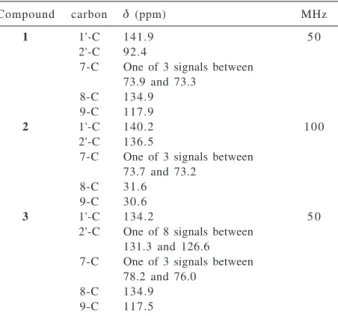
also confirmed by DEPT, COSY and HMQC experiments. The selected 13C NMR data for these compounds are listed in the Table 1.
The elemental analysis of iodobenzamide 1 is correct but attempts to obtain correct elemental analysis of compounds 2 and 3 were not successful due to the presence of tin impurities which could not be separated from the
main products. The presence of tin compounds can be justified, since it is well known that a major drawback in employing the tri-n-butyltin reagent can be the poor separation of the products from the tin residues.33
The differences observed in the radical reactions of 1
and 4 (yields: 2 32%, 5 40%; ratios: 2:3 1.4:1, 5:6 1:1) are relatively small and could be attributed to the difficulties in the separation of the products from the tin residues. Comparison of these similar yields of macrolactams and ratios lactam:hydrogenolysis product with the yield of lactam 8 and the ratio lactam 8:hydrogenolysis product 9
isolated from benzamide 7 (15% and 1:6, respectively)
4' 2' 2' 1' 7 6 4 1 1''' 1'' 4' 2' 1' 4 1 9 7 1''' 1'' 1''' 1'' 2' 1' 9 8 7 4 1 4 2' 1' 9 7 1 9 9 7 7 O OCH3 OH HO OH OH O OCH3 OBn BnO O O H O OCH3 OBn BnO I OH O OCH3 OBn OBn OH OH O OCH3 OBn BnO N3 O O OCH3 OBn BnO NH2 O O OCH3 O O NH O I O O OCH3 O O NH O O 3 1 2 O OCH3 OH HO O O H
i ii iii
10 11 12
iv v vi O OCH3 OBn BnO N3 OH vii ix viii 13 14 15 16 O OCH3 O O NH O O 4' 5' 4' 5' 2' 3' 3'
Scheme 2. Reagents, conditions and yields: i, 13.4 equiv. benzaldehyde, 2 equiv. ZnCl2, rt, 71%; ii, 9 equiv. KOH, 25 equiv. BnCl, 100 oC, 77%; iii, acetone, aqueous HCl (cat.), reflux, 82%; iv, 2.5 equiv. triphenylphosphine, 2 equiv. imidazole, 1 equiv. iodine, toluene, reflux, 46%; v, 4.5 equiv. NaN3, DMF, 50 oC, 72%; vi, 0.7 equiv. Bu
4NBr, 50% aq. NaOH, CH2Cl2, 2.6 equiv. allyl bromide, rt, 87%; vii, 2.1 equiv. LiAlH4, THF, rt,
confirms that conformational restraint “imposed by the carbohydrate unit” favors the cyclization. The similarity of the results obtained with the epimeric iodobenzamides
2 and 4 suggests that the cyclization mode, the yields and the ratio of the products are not affected by C-4 configuration of the carbohydrate unit of iodobenzamide. In conclusion, this investigation has confirmed that 11-endo cyclization mode is preferred over a 10-exo ring closure, which is in agreement with the guideline for radical macrocyclization that “endo cyclization modes are favored”34 and with other literature data of macro-cyclization.15-21 Our results have also confirmed that the presence of the sugar unit in the benzamide favors the aryl radical cyclization.21 This work allows to deduce that the C-4 configuration of the carbohydrate unit of o -iodobenzamide does not interfere or has little effect on the formation of the products in Bu3SnH-mediated aryl radical reactions.
Experimental
General procedures
All melting points were determined on a Kofler Sybron apparatus and are uncorrected. Optical rotations were determined at 25 oC with a Bellingham & Stanley P20 Polarimeter. The NMR spectra were measured in deuterio-chloroform with TMS as the internal standard with a Bruker Avance DRX-400 or a Bruker Avance-200 instruments. Chemical shifts are given in δ scale and J values are given
in Hz. Column chromatography was performed with silica
gel 60, 70-230 mesh (Merck). The term “standard work-up” means that the organic layer was washed with water, dried over anhydrous sodium sulfate, filtered and the solvent was removed under reduced pressure. The known compounds 10, 11 and 12 and the new carbohydrate derivatives 13, 14, 15, 16 and 1 were prepared according to published procedures.23-30 The radical reaction was carried out using standard procedure.32
Methyl 2,3-di-O-benzyl-6-deoxy-6-iodo-α -D-galacto-pyranoside (13)
To a solution of 12 (0.50 g, 1.3 mmol) in toluene (15 mL) were added imidazole (0.18 g, 2.7 mmol), triphenylphosphine (0.90 g, 3.4 mmol) and iodine (0.37 g, 1.4 mmol). The solution was stirred under reflux for 7 h. Saturated aqueous NaHCO3, iodine, and 1 mol L-1 aqueous sodium thiosulfate were added. The organic layer was separated and the aqueous layer was extracted with toluene. Standard work-up gave a residue, which was purified by column chromatography. The compound 13 (0.30 g, 0.62 mmol, 46%), eluted with hexane-ethyl acetate 8:2 (v/v), was obtained as a white crystal; mp 103.9-105.5 oC; [α]
D +44.7 (c 2.40 in CHCl3); δ
H (200 MHz, CDCl3) 7.37-7.29 (10 H, m, Ph); 4.82 (1 H, d, J
gem 11.4, one of PhCH2); 4.81 (1 H, d, Jgem 12.2, one of PhCH2); 4.69 (1 H, d, Jgem11.4, one of PhCH2); 4.64 (1 H, d, J
gem 12.2, one of PhCH2); 4.63 (1 H, d, J1,2 3.2, 1-H); 4.14-4.09 (1 H, m, one of sugar H); 3.90-3.76 (3 H, m, sugar H); 3.43 (3 H, s, MeO); 3.34 (2 H, d, J6,5 8.9, 6-H); 2.47 (1 H, s, OH); δ
C (50 MHz, CDCl3) 138.2, 137.9 (2 ipso C); 128.5, 128.4, 128.1, 127.9, 127.8 (Ar); 98.5 (1-C); 77.3, 75.2 (sugar C); 73.5, 73.0 (2 x PhCH2); 70.1, 68.4 (sugar C); 55.2 (MeO); 3.0 (6-C).
Methyl 6-azido-2,3-di-O-benzyl-6-deoxy-α -D-galacto-pyranoside (14)
The solution of 13 (0.19 g, 0.39 mmol) and NaN3 (0.080 g, 1.8 mmol) in DMF (12 mL) was stirred for 7 h at 50 oC. After DMF removal under reduced pressure, water was added. Extraction with CH2Cl2 and standard work-up gave a residue, which was submitted to column chromatography. The compound 14 (0.11 g, 0.28 mmol, 72%), eluted with hexane-ethyl acetate 8.5:1.5 (v/v), was obtained as a colorless oil; [α]
D +96.9 (c 2.72 in CHCl3); δH (200 MHz, CDCl3) 7.38-7.27 (10 H, m, Ph); 4.81 (1 H, d, Jgem 11.6, one of PhCH2); 4.74 (1 H, d, J
gem 12.3, one of PhCH2); 4.68 (1 H, d, Jgem11.6, one of PhCH2); 4.67 (1 H, d, J1,2 3.4, 1-H); 4.65 (1 H, d, J
gem 12.3, one of PhCH2); 3.87-3.76 (4 H, m, sugar H); 3.60 (1 H, dd, Jgem12.7 J6,5 8.2, one of 6-H); 3.41 (3 H, s, MeO); 3.25 (1 H, dd, J
gem12.7 J6,5 4.3, one of 6-H); δC (50 Table 1. Selected 13C NMR (CDCl
3) data for compounds 1, 2 and 3
Compound carbon δ (ppm) MHz
1 1'-C 141.9 5 0
2'-C 92.4
7-C One of 3 signals between 73.9 and 73.3
8-C 134.9 9-C 117.9
2 1'-C 140.2 100
2'-C 136.5
7-C One of 3 signals between 73.7 and 73.2
8-C 31.6 9-C 30.6
3 1'-C 134.2 5 0
2'-C One of 8 signals between 131.3 and 126.6 7-C One of 3 signals between
MHz, CDCl3) 138.7, 137.5 (2 ipso C); 129.1, 129.0, 128.6, 128.4 (Ar); 99.1 (1-C); 77.8, 76.1 (sugar C); 74.0, 73.6 (2 x PhCH2); 69.3, 68.7 (sugar C); 56.0 (MeO); 51.8 (6-C).
Methyl 4-O-allyl-6-azido-2,3-di-O-benzyl-6-deoxy-α -D-galactopyranoside (15)
To a solution of 14 (1.0 g, 2.5 mmol) in CH2Cl2 (10 mL) were added, under magnetic stirring, 50% (m/v) aqueous NaOH (7 mL) and Bu4NBr (0.55 g, 1.7 mmol), as phase transfer catalyst. The mixture was stirred for 15 minutes. Allyl bromide (0.60, 0.80 g, 6.6 mmol) was added and the mixture was stirred for 6 h at rt. The organic layer was separated and the aqueous layer was extracted with CH2Cl2. Standard work-up gave a residue, which was submitted to column chromatography. The compound 15 (0.96 g, 2.2 mmol, 87%), eluted with hexane-ethyl acetate 8:2 (v/v), was obtained as a syrup; [α]
D +18.1 (c 2.80 in CHCl3); δ
H (200 MHz, CDCl3)7.37-7.25 (10 H, m, Ph); 5.89 (1 H, dddd, J8,9 17.1 J8,9 10.3, J8,7 6.7 J8,7 5.2, 8-H); 5.22 (1 H, dd, J9,8 17.1 Jgem1.5, one of 9-H); 5.17-5.14 (1 H, m, one of 9-H); 4.84 (1 H, d, J
gem 11.9, one of PhCH2); 4.83 (1 H, d, Jgem 11.9, one of PhCH2); 4.70 (1 H, d, Jgem11.5, one of PhCH2); 4.68 (1 H, d, J1,2 3.4, 1-H); 4.65 (1 H, d, J
gem 11.5, one
of PhCH2); 4.45 (1 H, dd, Jgem12.8 J7,8 5.2, one of 7-H); 4.07 (1 H, dd, J
gem12.8 J7,8 6.7, one of 7-H); 3.96 (1 H, dd, J2,3 10.0
J2,1 3.4, 2-H);3.87 (1 H, dd, J3,2 10.0 J3,4 2.6, 3-H); 3.82-3.78 (1 H, m, one of sugar H); 3.70-3.79 (1 H, m, one of sugar H); 3.56 (1 H, dd, Jgem12.4 J6,5 8.0, one of 6-H); 3.39 (3 H, s, MeO); 3.17 (1 H, dd, J
gem12.4 J6,5 4.8, one of 6-H); δC (50 MHz, CDCl3) 138.5, 137.3 (2 ipso C); 128.3, 128.2, 127.9, 127.6, 127.5, 127.4 (Ar); 98.7 (1-C); 78.6, 76.2, 75.3 (sugar C); 73.8, 73.5, 73.3 (2 x PhCH2 and 7-C); 69.5 (sugar C); 55.4 (MeO); 51.3 (6-C).
Methyl 4-O-allyl-6-amino-2,3-di-O-benzyl- 6-deoxy-α -D-galactopyranoside (16)
To a suspension of lithium aluminium hydride (0.15 g, 4.2 mmol) in THF (15 mL) was added a solution of methyl 4-O-allyl-6-azido-2,3-di-O-benzyl-6-deoxy-α
-D-galacto-pyranoside 15 (1.0 g, 2.3 mmol) in THF (10 mL). The solution was stirred for 12 h at rt. Water (6 mL) and 5% (m/v) aqueous NaOH (1 mL) were added. The organic layer was separated and the aqueous layer was extracted with THF. Standard work-up gave a residue which was not purified.
Methyl 4-O-allyl-2,3-di-O-benzyl-6-deoxy-6-(2-iodo-benzoylamino)-α-D-galactopyranoside (1)
To a solution of 2-iodobenzoyl chloride (0.70 g, 2.6 mmol) in CH2Cl2 (5 mL) were added 10% (m/v) aqueous
NaOH (2 mL) and a solution of methyl 4-O -allyl-6-amino-2,3-di-O-benzyl-6-deoxy-α-D-galactopyranoside 16,
obtained as described above, in CH2Cl2. The mixture was stirred for 6 h at rt. The organic layer was separated and the aqueous phase was extracted with CH2Cl2. Standard work-up gave a residue, which was submitted to column chromatography. The iodobenzamide 1 (0.75 g, 1.2 mmol, 52% from 15), eluted with hexane-ethyl acetate 6:4 (v/v), was obtained as a white solid; mp 123.8-126.2 oC; [α]
D +36.7 (c 2.40 in CHCl3); δ
H (200 MHz, CDCl3)7.83 (1 H, d,
J3',4' 8.3, 3-H); 7.40-7.28 (12 H, m, Ph); 7.06 (1 H, ddd, J4',3'
8.3 J4',5' 5.5 J4',6' 3.4, 4-H); 6.28-6.24 (1 H, m, N-H); 6.01-5.82 (1 H, m, 8-H); 5.26-5.12 (2 H, m, 9-H); 4.83 (1 H, d,
Jgem 11.8, one of PhCH2); 4.80-4.74 (2 H, m, 2 of PhCH2); 4.65 (1 H, d, J
gem 11.6, one of PhCH2); 4.64 (1 H, d, J1,2 3.0, 1-H); 4.60 (1 H, dd, Jgem12.5 J7,8 5.3, one of 7-H); 4.13 (1 H, dd, J
gem12.5 J7,8 6.8, one of 7-H); 4.01-3.83 (5 H, m, sugar H); 3.45-3.38 (1 H, m, one of 6-H); 3.35 (3 H, s, MeO); δ
C (50 MHz, CDCl3) 164.9 (C=O); 141.9 (1'-C); 139.9 (3'-C); 138.5, 138.4 (1''-C and 1'''-C); 134.9 (8-C); 131.1, 128.4, 128.3, 128.1, 127.9, 127.7, 127.6, 127.5 (Ar); 117.9 (9-C); 98.9 (1-C); 92.4 (2'-C); 78.6, 76.3, 75.9 (sugar C); 73.9, 73.6, 73.3 (2 x PhCH2 and 7-C); 68.7 (sugar C); 55.5 (MeO); 40.9 (6-C) (Found: C, 57.5; H, 5.3; N, 2.1. Calc. for C31H34INO6: C, 57.9; H, 5.4; N, 2.6%).
Radical cyclization of compound 1
To a stirring and boiling solution of compound 1 (0.20 g, 0.31 mmol) in nitrogen-saturated benzene (30 mL) was added a solution of Bu3SnH (0.12 mL, 0.14 g, 4.8 mmol)) and AIBN (10 mg) in nitrogen-saturated benzene (10 mL)
via an addition funnel during 1 h. The reaction mixture was heated under reflux and nitrogen atmosphere for a further 1 h. Subsequent solvent removal and column chromatography gave, successively, the uncyclised product 3 (0.035 g, 0.067 mmol, 22%), eluted with hexane-ethyl acetate 6:4 (v/v), and the lactam 2 (0.051 g, 0.098 mmol, 32%), eluted with hexane-ethyl acetate 4:6 (v/v). The lactam 2 was obtained as an oil; [α]
D +49.9 (c 1.90 in CHCl3); δ
H (400 MHz, CDCl3)7.45 (1 H, dd, J6',5' 7.6 , J6',4' 1.2, 6'-H); 7.35-7.14 (13 H, m, Ph); 6.93 (1 H, br s, N-H); 4.81 (1 H, d, J
gem 12.0, one of PhCH2); 4.79 (1 H, d, Jgem
12.0, one of PhCH2); 4.70 (1 H, d, Jgem 12.0, one of PhCH2); 4.66 (1 H, d, J1,2 3.6, 1-H); 4.63 (1 H, d, J
gem 12.0, one of
PhCH2); 4.32-4.30 (1 H, m, one of 7-H); 4.14-4.10 (1 H, m, one of 6-H); 3.94 (1 H, dd, J2,3 10.0 J2,1 3.6, 2-H); 3.87 (2 H, br s, 4-H and 5-H); 3.85 (1 H, dd, J3,2 10.0 J3,4 2.0, 3-H); 3.54-3.40 (2 H, m, one of 6-H and one of 7-H); 3.36 (3 H, s, MeO); 3.09 (1 H, ddd, Jgem 7.2 J9,8 5.2 J9,8 2.2, one of 9-H); 2.75 (1 H, dt, J
H, m, one of 8-H); 1.76-1.70 (1 H, m, one of 8-H); δ
C (100 MHz, CDCl3) 170.7 (C=O); 140.2 (1'-C); 138.5, 138.4 (1''-C and 1'''-(1''-C); 136.5 (2'-(1''-C); 130.4, 129.9, 128.4, 128.3, 127.9, 127.7, 127.6, 127.5, 126.1 (Ar); 99.1 (1-C); 80.1, 79.6, 76.6 (sugar C); 73.7, 73.6, 73.2 (2 x PhCH2 and 7-C); 66.4 (sugar C); 55.5 (MeO); 43.1 (6-C); 31.6 (8-C); 30.6 (9-C). The uncyclized product 3 was also obtained as an oil; [α]
D +53.8 (c 1.30 in CHCl3); δH (200 MHz, CDCl3) 7.69 (2 H, dd, J2',3' 7.9 J2',4' 1.5, 2'-H); 7.39-7.22 (12 H, m, Ph); 6.77-6.73 (1 H, m, N-H); 6.00-5.80 (1 H, m, 8-H); 5.24-5.10 (2 H, m, 9-H); 4.79 (1 H, d, J
gem 12.0, one of PhCH2); 4.78 (1 H, d, Jgem 11.6, one of PhCH2); 4.66 (1 H, d, Jgem
11.6, one of PhCH2); 4.62 (1 H, d, J1,2 3.2, 1-H); 4.61 (1 H, d, Jgem 12.0, one of PhCH2); 4.42 (1 H, dd, Jgem12.5 J7,8 5.3, one of 7-H); 4.08 (1 H, dd, J
gem12.5 J7,8 6.9, one of 7-H); 4.01-3.83 (6 H, m, sugar H); 3.45-3.27 (1 H, m, one of 6-H); 3.24 (3 H, s, MeO); δ
C (50 MHz, CDCl3) 169.4 (C=O); 138.4, 138.3 (1''-C and 1'''-C); 134.9 (8-C); 134.2 (1'-C); 131.3, 128.4, 128.2, 128.1, 127.8, 127.5, 127.4, 126.6 (Ar); 117.5 (9-C); 98.9 (1-C); 92.4 (2-C); 78.2, 76.2; 76.0 (sugar C); 73.8, 73.4, 73.2 (2 x PhCH2 and 7-C); 68.4 (sugar C); 55.0 (MeO); 40.8 (6-C).
Acknowledgement
I. Binatti and M. A. F. Prado, respectively, thank the Fundação Coordenação de Aperfeiçoamento de Pessoal de Nível Superior (CAPES) and the Conselho Nacional de Desenvolvimento Científico e Tecnológico (CNPq) for fellowship. The authors thank the Fundação de Amparo à Pesquisa do Estado de Minas Gerais (FAPEMIG) for financial support.
References
1. Escolano C.; Jones, K.; Tetrahedron Lett.2000, 41, 8951. 2. Ishibashi, H.; Kawanami, H.; Ikeda; M.; J. Chem. Soc., Perkin
Trans. 11997, 817.
3. Jones, K.; Wilkinson, J.; J. Chem. Soc., Chem. Commun.1992, 1767.
4. Schultz, A. G.; Holoboski, M. A.; Smith, M. S.; J. Am. Chem. Soc. 1993, 115, 7904.
5. Jones, K.; Wilkinson, J.; Ewin, R.; Tetrahedron Lett.1994, 35, 7673.
6. Bowman, W. R.; Heaney, H.; Jordan, B. M.; Tetrahedron Lett. 1988, 29, 6657.
7. Jones, K.; Thompson, M.; Wright, C.; J. Chem. Soc., Chem. Commun.1986, 115.
8. Beckwith, . A. L. J.; Gara, W.; J. Chem. Soc., Perkin Trans. 2
1975, 593.
9. Brunton, S. A.; Jones, K.; J. Chem. Soc., Perkin Trans. 1 2000, 763.
10. Ishibashi, H.; Kato, I. ; Takeda, Y.; Kogure, M.; Tamura, O.;
Chem. Commun.2000, 1527.
11. Borger, D. L.; Boyce, C. W.; J. Org. Chem. 2000, 65, 4088. 12. Jia, G.; Lown, J. W.; Bioorg. Med. Chem. 2000, 8, 1607. 13. Ishibashi, H.; Kobayashi, T.; Machida, N.; Tamura, O.;
Tetra-hedron. 2000, 56, 1469.
14. Ishibashi, H.; Kato, I. ; Takeda, Y.; Tamura, O.; Tetrahedron Lett.2001, 42, 931.
15. Gibson, S. E.; Guilo, N.; Tozer, M. J.; Chem. Commun.1997, 637.
16. Chattopadhayay, P.; Mukherjee, M.; Ghosh, S.; Chem. Commun.
1997, 2139.
17. Ghosh, A. K.; Ghosh, K.; Pal, S.; Gatak, U. R.; J. Chem. Soc., Chem. Commun. 1993, 809.
18. Ghosh, K.; Ghosh, A. K ; Gatak, U. R.; J. Chem. Soc. Chem., Commun. 1994, 629.
19. Ghosh, K.; Gatak, U. R.; Tetrahedron Lett.1995, 36, 4897. 20. Nandi, A.; Mukhopadhyay, R.; Chattopadhyay.P.; J. Chem.
Soc., Perkin Trans. 1 2001, 3346.
21. Prado, M. A. F.; Alves, R. J.; Souza Filho, J. D.; Alves, R. B.; Pedrosa, M. T. C.; Prado, R. F.; Faraco, A. A. G.; J. Chem. Soc., Perkin Trans. 1 2000, 1853.
22. Snieckus, V.; Cuevas, J. C.; Sloan, C. P.; J. Am. Chem. Soc. 1990, 112, 896.
23. Hall, D. M.; Carbohydr. Res., 1980, 86, 158.
24. Fréchet, M. J.; Baer, H. H.; Canad. J. Chem. 1975, 53, 670. 25. Bell, D. J.; Lorder, J.; J. Chem. Soc. 1940, 453.
26. Köhn, A.; Schimidt, R. R.; Liebigs Ann. Chem. 1987, 1045. 27. Umezawa, S.; Nishimura, Y.; Hata, Y.; Tsuchiya, T.; J.
Antibi-otics1974, 27, 722.
28. Pietraszkiewicz, M.; Jurckzak, J.; Tetrahedron1984, 40, 2967. 29. Dufour, M.; Gramain, J. C.; Husson, H. P.; Sinibaldi, M. E.;
Troin, Y.; Synth. Commun. 1992, 22, 189.
30. Beak, P.; Musick, T. J.; Chen, C.; J. Am. Chem. Soc. 1988,
110, 3538.
31. Beckwith, A. L. J.; Drok, K.; Maillard, B.; Degueil-Castaing, M; Philippon, A.; Chem. Commun. 1997, 499.
32. Marinovic, N. N.; Ramanathan, H.; Tetrahedron Lett. 1983,
24, 1871.
33. Berge, J. M.; Roberts, S. M. Synthesis1979, 471.
34. Porter, N. A.; CHANG, V. H. T.; J. Am. Chem. Soc. 1987, 109, 4976.
Received: October 23, 2001